Reveal Consistency and Hidden Fasteners Define the Contemporary Look
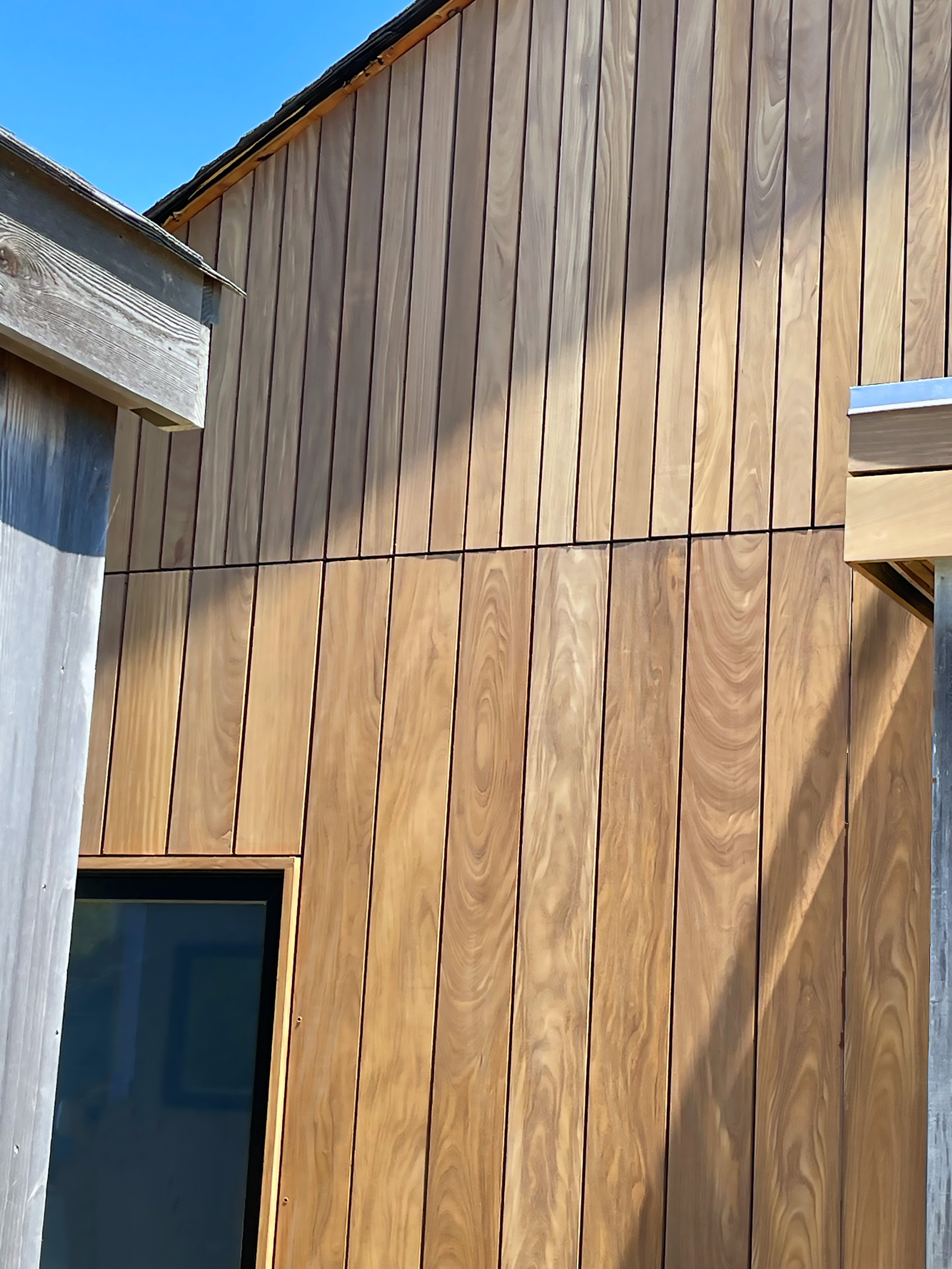
A contemporary facade reads clean because the reveal between boards is uniform and the fasteners are invisible, so the eye runs an uninterrupted rhythm of lines. Let the gap wander, or leave a row of screw heads showing, and the whole effect breaks. Instantly.
That takes face-fastened shiplap off the table for the primary field on most modern designs. Hidden fastening means one of two things: a tongue-and-groove profile blind-nailed or clipped through the tongue, or a proprietary clip running in a milled kerf. Clip systems need a profile cut for that exact clip, not a stock T&G. For the mechanics, see our profile selection guide and our overview of vertical wood siding for contemporary design.
Profiles That Produce Clean Modern Facades
The contemporary palette runs on nickel-gap, open-joint rainscreen, and vertical fin or batten profiles, each throwing a different but controlled shadow line.
| Profile | Fastening | Reveal / Shadow | Notes |
|---|---|---|---|
| Nickel-gap T&G | Hidden through tongue | Narrow uniform reveal | The default clean modern reveal |
| Open-joint rainscreen | Clip or concealed | Deep, crisp shadow gap | Requires UV-stable WRB behind the open joints |
| Channel reveal | Face or concealed | Defined shadow line | More texture than nickel-gap |
| Vertical fins / battens | Mechanically fixed | Strong vertical rhythm | Screens, brise-soleil, feature walls |
Open-joint cladding comes with a warning. The joints are open on purpose, which leaves the water-resistive barrier behind the boards partly exposed to UV and water, so it has to be a barrier rated for open-joint use. In that assembly the cavity and the drainage detailing carry most of the water-management load, not the boards. Our guide on rainscreen systems covers it.
Why Dimensional Stability Keeps Reveals Crisp
A uniform reveal stays uniform only if the boards barely move, which is why stable species run the contemporary market. If boards swell and shrink with the seasons, those carefully set gaps open and close, and the clean look goes with them.
- Modified woods: Accoya, Thermory, and Abodo Vulcan are the most stable options, and they show up everywhere on modern work because they hold a tight reveal and take the dark, even tones the style favors. Accoya documents big stability gains from acetylation, and Thermory and Abodo publish stability and color data. They are also the only category that carries a real manufacturer warranty.
- Dense tropical hardwoods: Ipe and Cumaru are stable when dried right and give a rich natural facade. J. Gibson McIlvain carries Ipe in a full range of dimensions for fins, screens, and cladding.
- Cedar: clear vertical grain (CVG) cedar is the stable, contemporary-friendly grade, and it holds a clean reveal far better than flat-grain stock.
Stability also comes down to the moisture content at install. The USDA Forest Products Laboratory documents how installing wood near its in-service equilibrium keeps post-install movement down. Boards delivered and acclimated to the right MC hold their reveal. Boards installed wet do not. See our moisture content guide.
Transitions, Corners, and Trim on Modern Facades
On a minimalist wall the corners, the reveals around openings, and the transitions between profiles are where it all succeeds or falls apart, because there is no ornament to cover a rough junction. Mitered or splined corners, even reveals around windows, clean handoffs between a fin field and a flat field, all of it gets decided before anything is milled.
Where one profile meets another on the same building, the transition should be drawn as a deliberate reveal or trim element, not left to the crew to solve. Our guide on transitions between siding profiles covers the usual approaches. All of it still sits over a vented furring cavity, grooves down to drain. Holding one reveal across a whole facade takes a repeatable milling tolerance, which is why J. Gibson McIlvain mills its contemporary profiles in-house and ships them nationwide to a consistent spec.
"Contemporary facades are unforgiving. The whole look is the consistency of the reveal, so the two things that matter most are a stable species and a tight milling tolerance, then a rainscreen behind it all. We steer a lot of modern projects toward modified woods or clear vertical grain stock for exactly that reason. The profile gives you the shadow line; the stability and the install keep it looking the way it did on day one."
Camden Zacker, Sales Director, J. Gibson McIlvain Company
How J. Gibson McIlvain Would Specify a Contemporary Facade
A contemporary package at J. Gibson McIlvain starts from the reveal the architect wants, then the profile and fastener system that delivers it hidden, then a species stable enough to hold that reveal for years. Because the company mills profiles in-house, the reveal, tongue, and kerf geometry stay to one tolerance across the whole order, which is what keeps every gap identical on the finished wall.
Species leans toward modified woods for the most demanding tight-reveal, dark-tone facades, with Ipe and Cumaru for natural hardwood looks and CVG cedar where a stable softwood fits. On open-joint designs, the team coordinates the profile with a barrier rated for open-joint exposure, since the barrier and the cavity, not the boards, manage the water.
Performance and Procurement Checklist
| Item | Why it matters |
|---|---|
| Target reveal | Defines the profile and fastener system; nickel-gap and open-joint read differently. |
| Hidden fastening | Requires T&G or a clip-specific profile; shiplap shows fasteners. |
| Species stability | Modified woods and CVG hold a tight reveal; flat-grain stock moves and degrades it. |
| Moisture content | Install near in-service EMC to minimize post-install movement. |
| Open-joint WRB | Open joints expose the barrier; specify one rated for open-joint use. |
| Milling tolerance | Consistent reveal depends on a tight, repeatable profile tolerance. |
Where Specifications Usually Fail
- Face-fastened profile on a clean facade: shiplap shows fasteners; use T&G or a clip system for hidden fastening.
- Unstable species for a tight reveal: flat-grain softwood moves and the reveal goes uneven; choose modified wood or CVG.
- Wrong WRB behind open joints: a standard housewrap exposed at open joints degrades under UV; use an open-joint-rated barrier.
- Installing wet boards: wood installed above its in-service EMC shrinks and opens the reveals after install.
- Undetailed transitions: corners and profile transitions get designed before milling, not solved on site.
Ordering Information to Resolve Before Pricing
- Reveal and profile: nickel-gap, open-joint, channel, or vertical fin, with exact reveal dimension.
- Fastening: T&G hidden, clip system (and which clip), or mechanically fixed fins.
- Species and grade: modified wood, tropical hardwood, or CVG cedar, with moisture-content target.
- Assembly: rainscreen cavity, WRB type for open joints, corner and transition details.
- Logistics: total square footage, lengths, milling tolerance, delivery sequence.
Related J. Gibson McIlvain Guidance and Next Steps
- Vertical Wood Siding for Contemporary Design
- Tongue-and-Groove vs. Shiplap vs. Channel: Profile Selection
- Rainscreen Systems for Commercial Cladding
- Transitions Between Siding Profiles on the Same Building
- Thermally Modified Wood Overview
- J. Gibson McIlvain Custom Milling Services
- Request a Contemporary Cladding Quote
Frequently Asked Questions
What wood siding profile is best for a contemporary modern facade?
Contemporary facades favor a uniform reveal and concealed fasteners, which means nickel-gap tongue-and-groove or clip-mounted open-joint profiles rather than face-fastened shiplap. Nickel-gap gives a narrow, crisp reveal with hidden fasteners. Open-joint rainscreen gives a deeper shadow gap but needs a UV-stable barrier behind it. The clean look rides on the reveal staying uniform, so a stable species and a tight milling tolerance matter as much as the profile itself.
Why do contemporary facades use modified wood so often?
Modified woods like Accoya, Thermory, and Abodo Vulcan are highly dimensionally stable, so they hold a tight, uniform reveal through seasonal humidity swings. They also take the dark, even tones modern designs favor, and they are the only wood category that carries a real manufacturer warranty. Unstable, flat-grain boards move enough to widen and narrow the reveal, which wrecks the clean look the whole design leans on.
Can shiplap be used on a modern facade?
It can, but on an exterior wall shiplap has to be face fastened with visible stainless, which fights the fastener-free look most contemporary facades want. For hidden fasteners, a nickel-gap tongue-and-groove profile or a clip system is the better call. Shiplap does earn its place in protected spots like porch ceilings, where a flat, tight reveal reads well and the face fastening barely shows.
What does open-joint cladding require behind the boards?
Open-joint cladding leaves intentional gaps between boards, which partly exposes the water-resistive barrier to UV and water. So it needs a barrier rated for open-joint use, plus a properly detailed rainscreen cavity that handles drainage and drying. In an open-joint assembly the barrier and the cavity carry most of the water-management load rather than the boards, which makes the assembly detailing more critical than the species choice.
Can custom reveal profiles be milled for a contemporary facade?
Yes. Contemporary facades often need a specific reveal, tongue, or clip-kerf geometry, which a supplier that mills in-house can produce to a consistent tolerance. J. Gibson McIlvain mills custom nickel-gap, open-joint, and channel profiles in modified woods, tropical hardwoods, and clear vertical grain cedar, and ships nationwide so every elevation holds the same reveal.
Sources and Standards Referenced
- USDA Forest Products Laboratory - Moisture content and dimensional movement
- Accoya - Acetylation and dimensional stability data
- Thermory - Thermally modified wood documentation
- Abodo - Vulcan thermally modified radiata pine specifications
- Building Science Corporation - Rainscreen and open-joint cladding guidance
- Forest Stewardship Council - Chain of custody certification