This guide walks through each of those requirements so design and construction teams can specify wood cladding that will pass plan review and survive inspection.
The Three Code Tests That Govern Commercial Wood Cladding
1. ASTM E84 Surface-Burning (the Flame-Spread Rating)
The foundational test is ASTM E84, also called the Steiner Tunnel Test. It measures two values: the flame-spread index (FSI) and the smoke-developed index (SDI). These indices place a material into one of three fire classes that the International Building Code (IBC) references throughout its exterior-wall and interior-finish provisions.
| Fire Class | Flame-Spread Index (FSI) | Smoke-Developed Index (SDI) | Typical Commercial Use |
|---|---|---|---|
| Class A (I) | 0-25 | 0-450 | High-occupancy, taller, and noncombustible-type buildings |
| Class B (II) | 26-75 | 0-450 | Many standard commercial exterior finishes |
| Class C (III) | 76-200 | 0-450 | Limited-use, low-rise, sprinklered applications |
According to the American Wood Council, most untreated softwoods test in the Class C range (FSI roughly 90-160), while some dense tropical hardwoods reach Class B or Class A without treatment. The USDA Forest Products Laboratory Wood Handbook documents that flame spread in wood correlates strongly with density and char-forming behavior, which is why heavy hardwoods perform better in the tunnel test than light softwoods.
2. NFPA 285 Assembly Fire-Propagation Testing
A Class A flame-spread rating on the cladding alone is not sufficient for many commercial buildings. Where a building is of noncombustible construction (IBC Type I or II) or exceeds certain height thresholds and incorporates combustible components in the exterior wall, the IBC requires the complete exterior wall assembly to pass NFPA 285. This is a large-scale, multi-story test that evaluates whether fire will propagate vertically and horizontally across and within the assembly, not just along the surface of one board.
"Designers frequently assume a Class A material guarantees compliance. It does not. NFPA 285 evaluates the wall as a system, including the cladding, the air gap, the water-resistive barrier, and the insulation. A compliant assembly must be tested and documented as a complete configuration." — International Code Council technical staff, IBC commentary on exterior wall fire propagation
The practical consequence is that the cladding, rainscreen furring, water-resistive barrier, and continuous insulation must be specified as a tested package. Substituting one component can invalidate the listing. For the detailing fundamentals behind a ventilated, code-conforming wood facade, see our guide to commercial cladding rainscreen design.
3. IBC Construction Type and Height
The IBC classifies buildings into Types I through V based on the combustibility and fire-resistance of their structural elements. Type I and II are noncombustible construction (steel and concrete), Type III is noncombustible exterior walls with combustible interior, Type IV is mass timber, and Type V is combustible. The construction type, combined with occupancy and height, determines whether combustible exterior finishes are permitted at all and which fire tests apply. Wood cladding is most readily used on Type III, IV, and V buildings, and can be used on Type I and II facades when it meets the additional NFPA 285 and fire-retardant requirements the code imposes.
Species and Treatment Options That Meet Commercial Fire Code
Naturally Fire-Resistant Dense Hardwoods
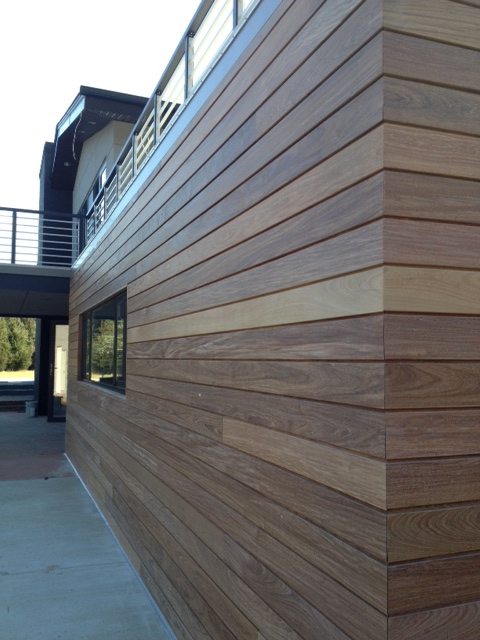
The densest tropical hardwoods are the only woods that routinely meet Class A or Class B flame spread without chemical treatment. Ipe is the benchmark: its high density (roughly 1,050 kg/m3) and slow char rate yield a Class A flame-spread index in standard ASTM E84 testing, which is why it is specified on commercial boardwalks, plazas, and facades nationwide. J. Gibson McIlvain stocks Ipe and related dense tropical hardwoods such as Cumaru and Santa Maria in cladding and decking dimensions, kiln-dried and graded for exterior commercial use.
Fire-Retardant-Treated Wood (FRTW)
Lighter species can reach Class A through pressure-impregnated fire-retardant treatment. For exterior applications the treatment must be rated for exterior exposure (it must not leach or lose efficacy when wet) and the treated product must carry documentation of its post-treatment ASTM E84 results. FRTW expands the palette of usable species but introduces handling, fastening, and durability considerations that must be coordinated with the treater.
Modified Woods
Acetylated and thermally modified woods are primarily specified for dimensional stability and decay resistance rather than fire rating, but they can be combined with fire-retardant treatment or used in tested assemblies. Teams weighing these options should review our performance data on acetylated Accoya siding and on thermally modified wood when balancing fire compliance against long-term facade durability.
Wildland-Urban Interface (WUI) Requirements
In jurisdictions that have adopted WUI codes, an additional layer of requirements applies in designated fire-hazard zones. California's Building Code Chapter 7A and the International Wildland-Urban Interface Code, both referenced through the ICC, require exterior wall coverings in WUI zones to be noncombustible, ignition-resistant, or to pass specific exterior fire tests such as the modified ASTM E84 extended 30-minute exposure. These provisions are in addition to the base flame-spread and NFPA 285 requirements, not a substitute for them. A commercial project in a WUI zone must satisfy both sets of criteria, so the cladding selection must be coordinated with the local authority having jurisdiction early in design.
A Practical Specification Sequence
To specify fire-compliant exterior wood cladding for a commercial building, work through the requirements in this order:
- Confirm the IBC construction type, occupancy, and height to establish whether combustible exterior finishes are permitted and which tests apply.
- Determine the required flame-spread class (A, B, or C) for the exterior finish under the applicable IBC sections.
- Determine whether NFPA 285 applies to the assembly, and if so, select a tested, listed wall configuration.
- Check for WUI provisions with the local authority having jurisdiction and add ignition-resistance criteria if the site is in a designated zone.
- Select species or treatment that meets the class requirement, e.g., naturally Class A Ipe or documented exterior FRTW.
- Document chain of custody for responsible sourcing; verify certification through the Forest Stewardship Council.
Because compliance depends on the complete assembly and the local code, commercial teams benefit from sourcing through a supplier that can provide graded material with documented properties and milling to a tested profile. J. Gibson McIlvain's custom milling and architectural services can supply dense hardwood cladding and matched components for fire-regulated facades, and the team can help align material selection with assembly listings. To begin a project review, contact the team with your specifications and code data. For the broader durability picture behind species selection, our guide to exterior wood siding species is a useful companion.
Frequently Asked Questions
What fire rating does exterior wood cladding need on a commercial building?
It depends on the building's construction type and occupancy under the International Building Code. Most commercial exterior wall finishes require at minimum a Class B flame-spread rating (flame-spread index 26-75) per ASTM E84, and many require Class A (index 0-25). Taller buildings and noncombustible construction types (IBC Type I and II) typically also require the exterior wall assembly to pass NFPA 285 multi-story fire-propagation testing. Always confirm the specific requirement with the local authority having jurisdiction.
What is the difference between Class A and Class B fire ratings for cladding?
Class A, B, and C ratings come from the ASTM E84 (Steiner Tunnel) test, which measures flame-spread index and smoke-developed index. Class A is a flame-spread index of 0-25, Class B is 26-75, and Class C is 76-200. All three classes require a smoke-developed index of 450 or less. Class A is the most stringent and is required in many commercial and high-occupancy applications.
Can wood cladding meet commercial fire codes, or must it be treated?
Some naturally dense hardwoods such as Ipe achieve a Class A or Class B flame-spread rating without treatment, which is why they are specified on commercial facades. Many lighter species require fire-retardant treatment (FRTW) to reach a Class A rating, and the treatment must be documented as durable for exterior exposure. For assemblies in noncombustible construction types or above height thresholds, NFPA 285 testing of the complete wall assembly is required regardless of the cladding's individual rating.
Do wildland-urban interface (WUI) requirements apply to commercial wood cladding?
Yes, in jurisdictions that have adopted WUI codes such as California's Chapter 7A or the International Wildland-Urban Interface Code, exterior wall coverings in designated fire-hazard zones must meet specific ignition-resistance and noncombustibility criteria, including approved exterior fire tests. These requirements are separate from and in addition to the base flame-spread and NFPA 285 requirements, so cladding for a commercial project in a WUI zone must satisfy both.
Sources and Standards Referenced
- ASTM E84 - Standard Test Method for Surface Burning Characteristics of Building Materials
- NFPA 285 - Standard Fire Test Method for Evaluation of Fire Propagation Characteristics of Exterior Wall Assemblies
- International Code Council - International Building Code
- American Wood Council - Design for Code Acceptance: Flame Spread Performance of Wood Products
- USDA Forest Products Laboratory - Wood Handbook: Wood as an Engineering Material (FPL-GTR-282)
- Forest Stewardship Council - Responsible Forest Management Standards