Why Boardwalks Use Tropical Hardwood Decking
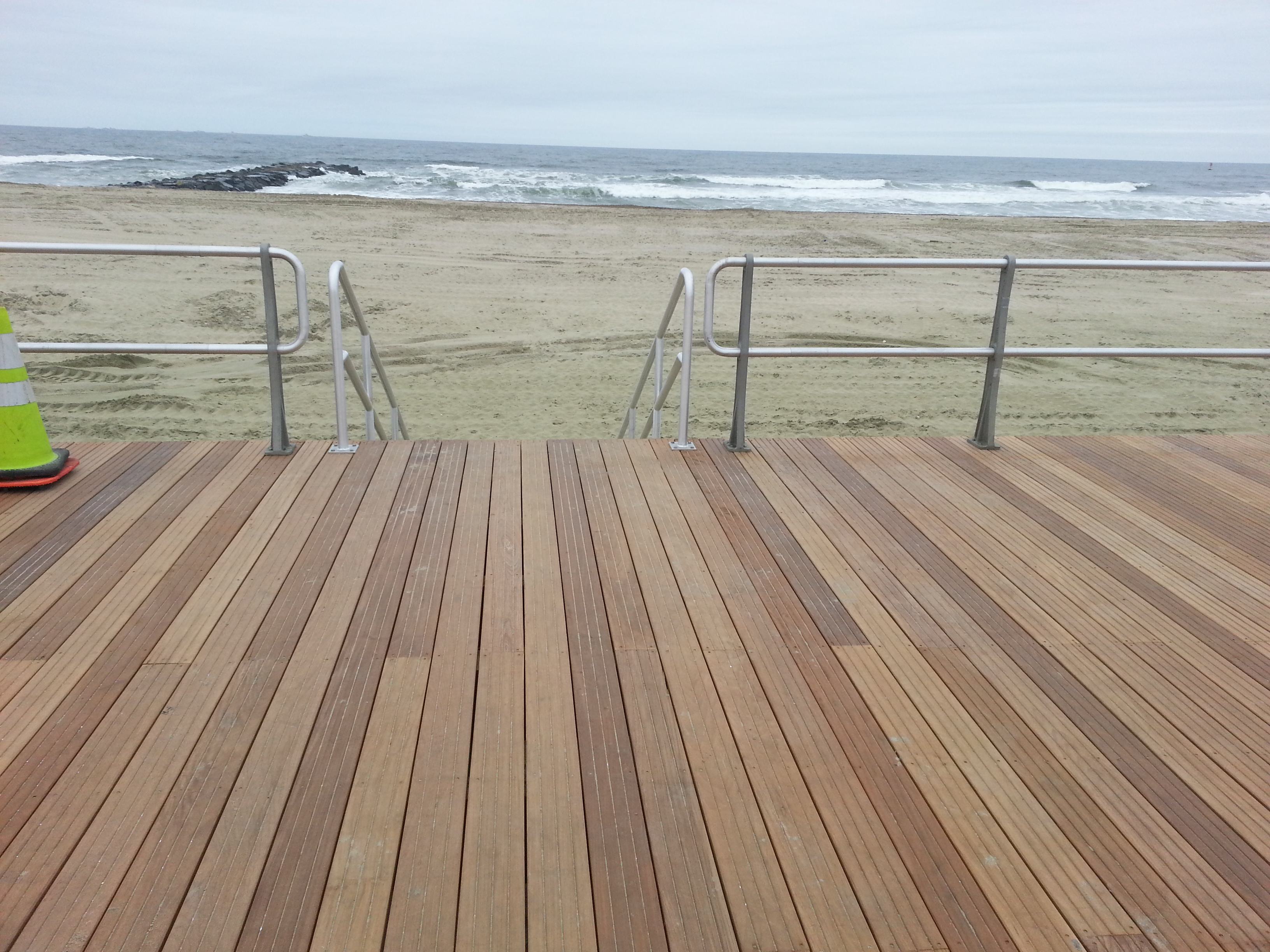
For boardwalks and public decks, tropical hardwoods win on lifecycle: decades of service under constant foot traffic, natural rot and insect resistance without treatment, and a Class A fire rating. A public boardwalk cannot be closed every few years for replacement, so the 40-to-75-year service life of Ipe, rated Class 1 durability under EN 350 by the USDA Forest Products Laboratory, makes the lifecycle cost competitive despite a higher material cost than softwood or composite. See how tropical hardwood compares in our wood decking versus composite guide. A boardwalk closed for redecking is a cost, not an amenity. The species case is settled. What public work adds is compliance detailing, starting with accessibility.
ADA Board Gaps and Slip Resistance
Public decking must meet accessibility requirements, which limit the gap between boards so wheels and canes do not catch, and it must provide slip resistance for public safety. Under ADA guidance, openings in a walking surface generally must not allow passage of a half-inch sphere, so board gaps are held tighter than a private deck might use. Slip resistance can be improved with grooved decking profiles or a specified surface texture. Both are detailing decisions made before the order, and grooved profiles require in-house milling. On public bids, J. Gibson McIlvain mills those grooved slip-resistant profiles in its own shop and supplies the FSC and CITES paperwork the procurement package calls for, so the surface spec and the sourcing documents arrive together. Get the gap and the groove right, and the next challenge is holding one standard across thousands of feet.
| Factor | Private deck | Commercial / public |
|---|---|---|
| Board gap | Drainage-driven | ADA-limited (under 1/2 in opening) |
| Slip resistance | Optional | Often required; grooved profile or texture |
| Grading | Small volume | Consistent across large volume |
| Sourcing docs | Simple | FSC/CITES for public procurement |
| Delivery | One drop | Staged to construction schedule |
Consistent Grading Across Large Volumes
A boardwalk runs thousands of linear feet, so holding grade and color consistent across the whole order is essential and depends on a deep single-source supplier. Lot-to-lot variation that is invisible on a small deck reads clearly on a long public walkway. Long lengths reduce butt joints across the run. A deep supplier grades the full volume to one standard and provides the documentation a public project requires. Grade drift that hides on a backyard deck shouts on a long public run. That depth of inventory, more than the species, is what the sourcing decision turns on.
Sourcing for Public and Commercial Decking
Public procurement rewards a supplier that can deliver volume, consistency, documentation, and staged delivery, which is a project-management capability more than a species question. J. Gibson McIlvain supplies tropical hardwood decking for boardwalks, piers, and public decks, graded consistently across large volumes, with FSC and CITES documentation and nationwide staged delivery. For over-water detailing, see our discussion in marine-grade lumber. With the supply chain proven, the case an agency actually weighs is the one that follows: decades of service measured against first cost.
Lifecycle Value and Maintenance for Public Decks
Tropical hardwood wins public projects on lifecycle, not first cost: a boardwalk that serves 40 to 75 years without replacement beats a softwood or composite surface that must be renewed several times over the same period. A public agency weighs the whole service life, including closures, labor, and disruption for replacement, and a material that lasts decades with minimal upkeep reduces all of them. Ipe carries no chemical treatment to reapply and needs no film finish to fail.
Maintenance on a public tropical hardwood deck is minimal: periodic cleaning, and inspection of fasteners and framing, with the surface left to weather to gray since color is rarely a public priority. This low-maintenance profile is part of why municipalities specify Ipe despite a higher material cost. For the material comparison behind these decisions, see our wood decking versus composite guide. J. Gibson McIlvain supplies documented tropical decking for public projects and advises on the low-maintenance detailing, shipping nationwide. The lifecycle math holds only if the surface stays safe underfoot when wet, which is where slip detailing carries the load.
Slip Resistance and Surface Detailing for Public Walkways
Public walkways carry a duty of slip resistance, and on tropical hardwood that is delivered through a grooved decking profile or a specified surface texture rather than a coating. A lightly grooved surface breaks the water film and gives traction underfoot when wet, which is the practical way to add slip resistance to a dense hardwood that will not hold a textured coating long-term. The groove pattern is milled into the boards, so it is specified with the order.
Grooved profiles also channel water off the surface, which suits a boardwalk exposed to rain and spray. Combined with ADA-appropriate board gaps, a grooved tropical hardwood surface meets both the accessibility and the safety expectations public projects carry. The U.S. Access Board publishes the accessibility guidance these surfaces follow. J. Gibson McIlvain mills grooved decking profiles for slip resistance in-house and supplies documented tropical decking for public walkways, shipping nationwide. A wet public walkway without traction is a claim waiting to be filed. The boards are half the service story. The fasteners holding them down carry the rest.
Fastening Systems for Public Decks
Public boardwalks use corrosion-resistant fastening rated for heavy traffic and long service, typically stainless steel, with the choice between hidden clips and face fastening driven by maintenance and safety needs. Face-fastened boards with stainless screws are simple to inspect and replace, which suits a public deck maintained over decades, while hidden clips give a cleaner surface with no exposed heads to work loose underfoot. Many public projects favor accessible face fastening for maintainability.
Whatever the system, the hardware is stainless to survive the exposure, and 316 stainless where salt is present. Fastener selection is coordinated with the grooved slip-resistant surface and the ADA board gaps as one detailing package. J. Gibson McIlvain supplies documented tropical decking for public projects and can pre-groove for hidden clips or supply square-edge boards for face fastening, shipping nationwide.
ADA and Slip-Resistance Specifications
Public walkways follow measurable accessibility limits: under U.S. Access Board and ADA guidance, openings in a walking surface must not permit passage of a 1/2-inch sphere, the running slope of an accessible route generally stays at or below 1:20 before ramp rules apply (ramps at a maximum 1:12), and cross slope stays at or below 1:48. These figures set the board gap and the deck pitch on a boardwalk, so the decking is spaced tighter than a private deck and laid to a controlled slope.
For the surface itself, dense tropical hardwoods reach ASTM E84 Class A flame spread, and slip resistance is added with a grooved profile rather than a coating. Ipe's Janka hardness near 3,680 lbf and Class 1 durability under EN 350 give a surface that holds up to heavy public traffic for 40 to 75 years. The International Code Council building codes govern the structural and guard requirements alongside. J. Gibson McIlvain mills ADA-appropriate gapping and grooved slip-resistant profiles and supplies documented decking for public projects nationwide.
ADA and Public-Walkway Reference Figures
The accessibility figures a public walkway is detailed to, per the U.S. Access Board standards and the International Code Council codes.
| Item | Value |
|---|---|
| Surface openings (board gap) | Must reject a 1/2 in sphere |
| Running slope (accessible route) | 1:20 max before ramp rules |
| Ramp slope | 1:12 max |
| Cross slope | 1:48 max |
| Slip resistance | Grooved or textured milled surface |
"A public boardwalk is a fifty-year decision, which is exactly why they spec Ipe. You cannot shut down a pier every few years to re-deck it. The things we manage on those jobs are the ADA gap, the slip resistance, and grading the whole run to one standard so it does not look like a quilt. Plus the FSC and CITES paperwork, because on a public job the documentation is part of the bid."
Brett Miller, President, J. Gibson McIlvain Company
How J. Gibson McIlvain Would Supply a Boardwalk
For J. Gibson McIlvain, a commercial boardwalk order is managed as a volume project: the team grades the full run to one standard from deep inventory, mills grooved profiles for slip resistance where required, coordinates ADA-appropriate board gaps, provides FSC and CITES documentation for public procurement, and stages nationwide delivery to the construction schedule. Long lengths reduce jointing across the walkway.
The team frames public decking as a project-management and documentation task on top of a settled species choice. The value it adds is the consistency across volume, the compliant detailing, and the paperwork that a public bid requires, delivered on schedule.
Commercial Decking Checklist
| Item | Why it matters |
|---|---|
| ADA board gap | Openings limited so wheels and canes do not catch. |
| Slip resistance | Grooved profile or texture for public safety. |
| Volume grading | Consistent grade and color across the run. |
| Documentation | FSC and CITES for public procurement. |
| Staged delivery | Sequenced to the construction schedule. |
Where Public Decking Goes Wrong
- Ignoring ADA gaps: Board spacing must limit openings on public walkways.
- No slip resistance: Public safety often requires grooved or textured surfaces.
- Split sourcing: Grade and color drift shows on long runs.
- Missing documentation: Public bids require FSC and CITES paperwork.
Related J. Gibson McIlvain Guidance and Next Steps
Frequently Asked Questions
What decking is used for commercial boardwalks?
Public boardwalks, piers, and park decks are typically built with dense tropical hardwoods, most often Ipe, because they deliver 40 to 75 years of service under heavy public foot traffic with natural rot and insect resistance and no chemical treatment. The long service life makes the lifecycle cost competitive despite a higher material cost. J. Gibson McIlvain supplies tropical decking for public projects in volume with consistent grading and legal-sourcing documentation.
What board gap is required for an ADA-compliant boardwalk?
Under ADA guidance, openings in a walking surface generally must not allow passage of a half-inch sphere, so board gaps on public boardwalks are held tighter than on a typical private deck to prevent wheels and canes from catching. Slip resistance is also commonly required and can be provided with grooved decking profiles or a specified surface texture. Both are detailing decisions confirmed before ordering, and grooved profiles require in-house milling.
How do you keep a long boardwalk consistent in appearance?
A boardwalk runs thousands of linear feet, so consistency depends on grading the whole order to one standard from a single deep supplier, plus long lengths to reduce butt joints across the run. Lot-to-lot variation that is invisible on a small deck reads clearly on a long walkway. J. Gibson McIlvain grades large-volume decking orders to a consistent standard from deep inventory and provides the documentation public procurement requires.
Do public decking projects need legal-sourcing documentation?
Yes. Public and institutional procurement typically requires documented legal sourcing, meaning FSC chain-of-custody and, for CITES-listed species, the appropriate permits, as part of the bid. The documentation proves the wood was legally harvested and traded. J. Gibson McIlvain is an FSC-certified supplier that provides chain-of-custody and CITES documentation for its tropical decking, supplied in volume with staged nationwide delivery for public projects.
Why do public projects use Ipe despite the higher cost?
Public agencies weigh lifecycle cost, not just first cost, and a tropical hardwood boardwalk that serves 40 to 75 years without replacement beats a softwood or composite surface renewed several times over the same period, avoiding repeated closures, labor, and disruption. Ipe needs no chemical treatment reapplied and no film finish that fails, so upkeep is minimal. This low lifecycle cost is why municipalities specify it. J. Gibson McIlvain supplies documented tropical decking for public projects nationwide.
How much maintenance does a commercial boardwalk need?
A tropical hardwood boardwalk needs minimal maintenance: periodic cleaning and inspection of fasteners and framing, with the surface usually left to weather to a silver-gray since color is rarely a priority on public decks. There is no chemical treatment to reapply and no film finish to fail, because dense tropical hardwoods resist decay naturally and take only penetrating oil if color is wanted. J. Gibson McIlvain advises on low-maintenance detailing and supplies documented decking for public projects.
How do you make a boardwalk slip resistant?
On tropical hardwood, slip resistance for a public boardwalk is delivered through a grooved decking profile or specified surface texture rather than a coating, because dense hardwoods will not hold a textured coating long-term. A lightly grooved surface breaks the water film and gives traction when wet, and it channels water off the surface. The groove pattern is milled into the boards, so it is specified with the order. J. Gibson McIlvain mills grooved slip-resistant profiles in-house.
Do commercial boardwalks need grooved decking?
Public walkways carry a duty of slip resistance, and grooved decking is the practical way to provide it on dense tropical hardwood, giving wet traction and channeling water off the surface. Combined with ADA-appropriate board gaps, a grooved surface meets both the accessibility and safety expectations of public projects. Because the groove is milled in, it is specified with the order. J. Gibson McIlvain mills grooved profiles in-house and supplies documented tropical decking for public boardwalks.
How is decking fastened on a public boardwalk?
Public boardwalks use corrosion-resistant fastening, typically stainless steel and 316 stainless where salt is present, with the choice between hidden clips and face fastening driven by maintenance and safety. Face-fastened stainless screws are easy to inspect and replace over a deck's decades of service, which many public projects favor, while hidden clips give a cleaner surface. J. Gibson McIlvain can pre-groove for hidden clips or supply square-edge boards for face fastening on public decking.
Sources and Standards Referenced
- USDA Forest Products Laboratory - Wood Handbook and Durability
- U.S. Access Board - ADA Accessibility Standards
- Forest Stewardship Council - Chain of Custody Certification
- CITES - Convention on International Trade in Endangered Species
- International Code Council - Building Codes
- EN 350 - Durability of Wood and Wood-Based Products
- National Hardwood Lumber Association - Grading Rules
- USDA Forest Products Laboratory - Wood Handbook (FPL-GTR-282)
- North American Deck and Railing Association
- PEFC - Programme for the Endorsement of Forest Certification