What Is Accoya? The Acetylation Process Explained
Accoya is radiata pine (Pinus radiata) modified through acetylation — a non-toxic chemical process that permanently alters the wood at the molecular level. Developed by Accsys Technologies in the Netherlands, the process saturates wood cells with acetic anhydride (derived from vinegar), which reacts with the hydroxyl groups in wood cell walls to form stable acetyl groups.
This reaction is critical: hydroxyl groups are what attract and bond with water molecules, causing wood to swell, shrink, and ultimately decay. By replacing approximately 80% of accessible hydroxyl groups with acetyl groups, Accoya fundamentally changes how wood interacts with moisture — without adding any toxic preservatives.
The key distinction from other modified wood products:
- Thermal modification (Thermory, Lunawood) uses heat only — degrades hemicellulose, reduces strength 10-20%
- Pressure treatment (ACQ, CA-B) infuses copper-based chemicals — leaches over time, requires special fasteners
- Acetylation (Accoya) chemically bonds to wood polymers — no leaching possible, retains full structural strength
Independent Performance Data
Unlike many wood product claims based on manufacturer testing alone, Accoya's performance has been validated by multiple independent research institutions over 15+ years of testing:
| Performance Metric | Accoya Result | Test Standard | Testing Body |
|---|---|---|---|
| Durability Class | Class 1 — Very Durable | EN 350 / EN 113 | BRE (UK), SHR (Netherlands) |
| Anti-Swelling Efficiency | 75% (±3%) | Internal method / EN 318 | SHR Timber Research |
| Moisture Uptake (24hr soak) | 65-70% reduction vs. unmodified | EN 927-5 | BRE |
| Bending Strength (MOR) | Unchanged from untreated pine | EN 408 | SHR Timber Research |
| Hardness (Janka equivalent) | ~510 lbf (slight increase) | EN 1534 | BRE |
| UV Resistance | Grays uniformly without fiber erosion | EN 927-6 (accelerated) | BRE, Tecnalia (Spain) |
| Fungal Decay Resistance | <3% mass loss (vs. 40-60% unmodified) | EN 113 | BRE, Imperial College London |
| Termite Resistance | Resistant (visual rating 0-1) | EN 117 | CIRAD (France) |
Dimensional Stability: The Core Advantage for Siding
For exterior siding applications, dimensional stability is arguably more important than rot resistance. A board that swells and shrinks through seasonal humidity cycles will cup, warp, crack paint films, and stress fastener connections — regardless of whether it's technically "rot-proof."
Accoya's 75% anti-swelling efficiency means it experiences only one-quarter of the dimensional movement of unmodified wood. In practical terms for a 6-inch siding board:
- Unmodified radiata pine: 0.12" width change from winter to summer humidity (Northeast US)
- Western red cedar: 0.08" width change
- Thermally modified ash: 0.04-0.06" width change
- Accoya: 0.03" width change — within the tolerance of a typical paint film
This near-elimination of seasonal movement is why Accoya holds paint and coating systems dramatically longer than any other wood substrate. The BRE documented coating lifespans of 8-12 years on Accoya versus 3-5 years on unmodified softwoods — a 2-3× improvement driven entirely by the stable substrate underneath.
"We've been selling Accoya for siding since 2018, and the callback rate is essentially zero. Compare that to cedar — where we get calls every spring about cupping, paint peeling, and boards pulling away from fasteners after a hard Northeast winter. The dimensional stability data isn't theoretical. We see it in the field every year."
— Brett Miller, President, J. Gibson McIlvain Co.
50-Year Warranty: What It Covers
Accsys Technologies backs Accoya with a 50-year warranty for above-ground exterior applications and a 25-year warranty for ground-contact/freshwater applications. This is the longest warranty in the wood siding industry — exceeding fiber cement (30 years typical), composite cladding (25 years), and thermally modified wood (25 years).
The warranty specifically covers:
- Decay and rot from fungal attack
- Dimensional instability exceeding specified tolerances
- Structural failure under normal loads
It does not cover surface weathering (graying), mechanical damage, or improper installation. Full warranty terms require installation per Accoya guidelines, including proper ventilation and drainage behind the cladding.
Performance in Specific Harsh Conditions
Freeze-Thaw Climates (Northeast US, Canada)
With equilibrium moisture content of 3-5% (vs. 12-15% for untreated softwoods), Accoya contains minimal free water available to freeze and damage cell walls. Field installations in Scandinavia — with 100+ freeze-thaw cycles annually — show no measurable degradation after 15+ years of monitoring by the SINTEF Building and Infrastructure Institute (Norway).
Coastal/Salt Air Environments
Salt accelerates decay by drawing moisture into wood. Accoya's reduced hygroscopicity resists salt-driven moisture accumulation. The Dutch national water authority (Rijkswaterstaat) has approved Accoya for canal lock gates, bridge components, and coastal infrastructure — applications subject to constant salt-water immersion far beyond what residential siding encounters.
High-UV Environments (Southwest US, tropical)
Accoya grays uniformly under UV exposure without the fiber erosion and checking common in untreated softwoods. Unlike thermally modified wood, which can develop surface cracks from UV-driven lignin breakdown, Accoya's stabilized cell structure resists surface degradation. A penetrating UV oil extends the original color indefinitely if desired.
Cost Analysis: Accoya Siding vs. Alternatives
| Cost Component | Accoya | Western Red Cedar | Fiber Cement (James Hardie) |
|---|---|---|---|
| Material cost | $18,000-$24,000 | $9,000-$14,000 | $10,000-$16,000 |
| Installation | $12,000-$16,000 | $10,000-$14,000 | $14,000-$18,000 |
| Painting/staining over 30 years | $8,000-$12,000 (every 10-12 yrs) | $30,000-$45,000 (every 3-5 yrs) | $16,000-$24,000 (every 8-10 yrs) |
| Board replacement | $0 | $4,000-$8,000 | $2,000-$4,000 |
| Total 30-year cost | $38,000-$52,000 | $53,000-$81,000 | $42,000-$62,000 |
Accoya's lifecycle cost advantage emerges from year 8 onward, when cedar's first major restaining cycle hits. By year 15, the cumulative maintenance savings exceed the initial material premium. For projects with a 30+ year horizon, Accoya is the lowest total-cost natural wood siding option.
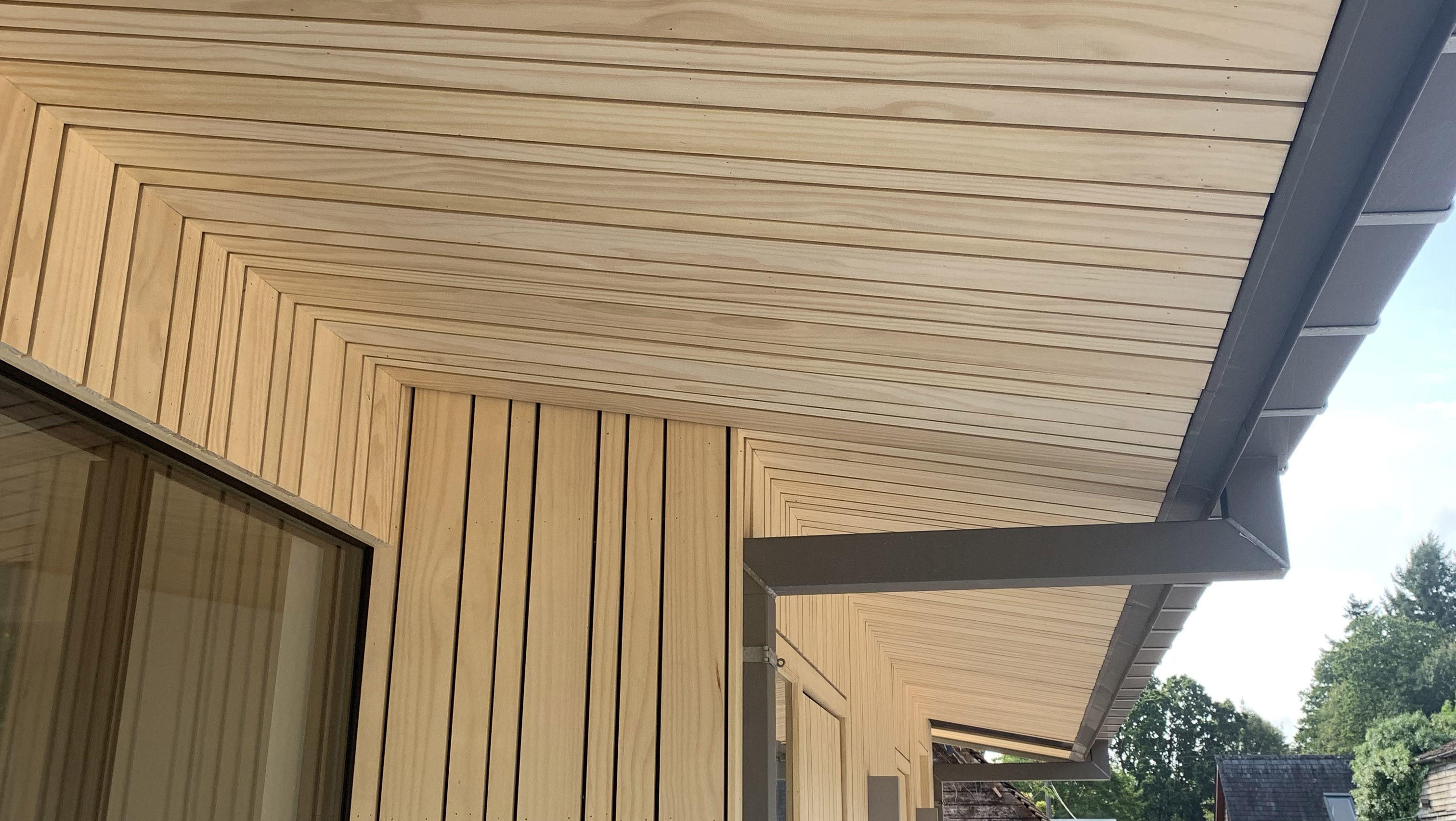
J. Gibson McIlvain supplies Accoya siding in shiplap, channel, and bevel profiles, with delivery to East Coast job sites. Custom profiles available with 4-6 week lead times.
Installation Requirements for Maximum Lifespan
Accoya's 50-year warranty requires adherence to these installation standards:
- Rainscreen cavity: Minimum 19mm (3/4") ventilated air gap per Accoya installation guide. This exceeds the typical 3/8" minimum for other species.
- Stainless steel fasteners: A4 marine-grade stainless or hot-dipped galvanized. Standard fasteners will outlast the wood but may cause staining.
- End-grain sealing: All field cuts sealed with Accoya-approved end sealer. End grain remains a potential moisture entry point even in acetylated wood.
- Back-priming: Recommended but not required for warranty. Accoya's own hygroscopic stability makes back-priming less critical than for cedar or pine.
- Coating system: Optional — Accoya performs bare, oiled, stained, or painted. When painted, use flexible coating systems designed for exterior wood.
"The single question architects ask most about Accoya is whether the 50-year claim is real. I point them to the Rijkswaterstaat canal locks in the Netherlands — those have been in salt water since 2009 with zero deterioration. If it can handle immersion in Dutch canals, it can handle rain on your building."
— Brett Miller, President, J. Gibson McIlvain Co.
Frequently Asked Questions
How long does Accoya siding last?
Accoya siding carries a 50-year manufacturer warranty for above-ground exterior applications — the longest in the wood siding industry. Independent testing by the Building Research Establishment (BRE) and SINTEF confirms durability exceeding untreated teak. Field installations in Scandinavia (100+ freeze-thaw cycles annually) show no measurable degradation after 15+ years. The wood achieves Class 1 durability under EN 350 with less than 3% mass loss in standardized fungal decay tests.
Is Accoya better than cedar for siding?
Accoya outperforms cedar in dimensional stability (75% vs. 30% anti-swelling efficiency), durability (Class 1 vs. Class 2), coating lifespan (8-12 years vs. 3-5 years), and warranty (50 years vs. none). Cedar is less expensive upfront ($4.50-$7.00/sq. ft. vs. $9.00-$12.00/sq. ft.) and lighter weight. Over 30 years, Accoya's total cost is typically lower due to dramatically reduced maintenance — cedar requires restaining every 3-5 years at $3,000-$5,000 per cycle on a typical home.
Does Accoya need to be painted or stained?
No — Accoya does not require any finish for durability or structural performance. Its rot resistance and dimensional stability are built into the wood's cell structure permanently. Left unfinished, Accoya weathers to a uniform silver-gray. If color retention is desired, a single coat of penetrating UV oil or a flexible paint system will last 8-12 years (vs. 3-5 years on cedar) due to Accoya's stable substrate that doesn't crack or stress coating films.
Is Accoya wood toxic or safe for residential use?
Accoya is completely non-toxic and safe for all residential applications including near food gardens, children's play areas, and water features. The acetylation process bonds acetic acid (vinegar-derived) permanently to wood cell walls — nothing can leach out. Unlike pressure-treated lumber (copper compounds leach into soil) or CCA (arsenic), Accoya produces no environmental contamination. It is approved for aquatic applications by European environmental agencies.
Where can I buy Accoya siding?
Accoya siding is available through authorized distributors including J. Gibson McIlvain, which stocks shiplap, channel, and bevel profiles for East Coast delivery. Accoya is manufactured exclusively by Accsys Technologies in the Netherlands and distributed through a certified dealer network. Lead times are typically 2-4 weeks for stocked profiles and 4-6 weeks for custom milling. Contact McIlvain at 410-687-0857 for current pricing and availability.
Sources and Standards Referenced
- Accsys Technologies — Accoya product specifications, warranty terms, and acetylation process documentation
- Building Research Establishment (BRE) — Independent durability testing, coating performance data
- SINTEF Building and Infrastructure — Scandinavian field performance monitoring (15+ year data)
- EN 350: Natural Durability of Solid Wood — European durability classification standard
- EN 113: Determining Protective Effectiveness Against Wood-Destroying Basidiomycetes
- EN 927-5/6: Paints and Varnishes — Coating Materials and Systems for Exterior Wood