Pool Deck Surface Temperature by Wood Color
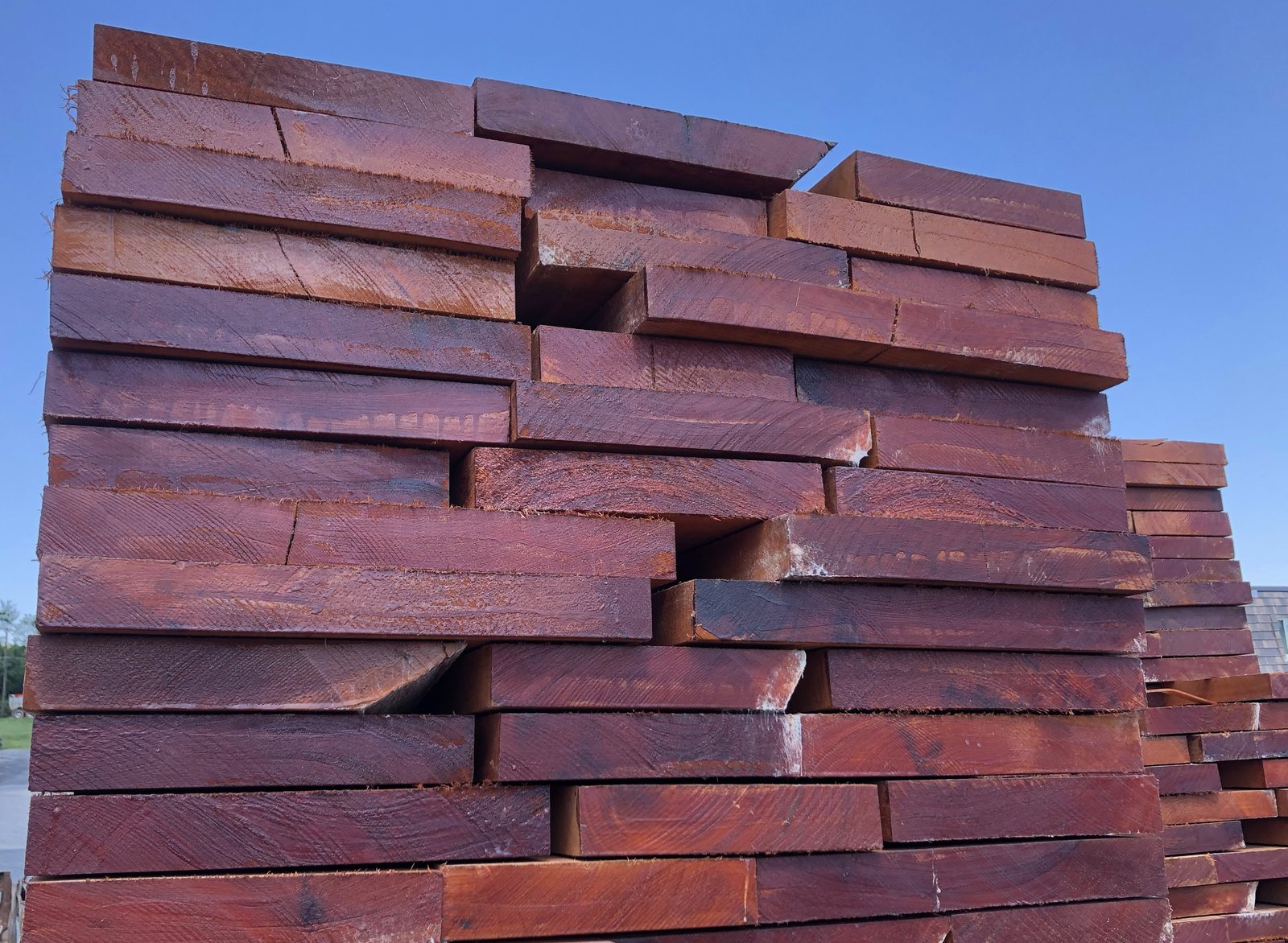
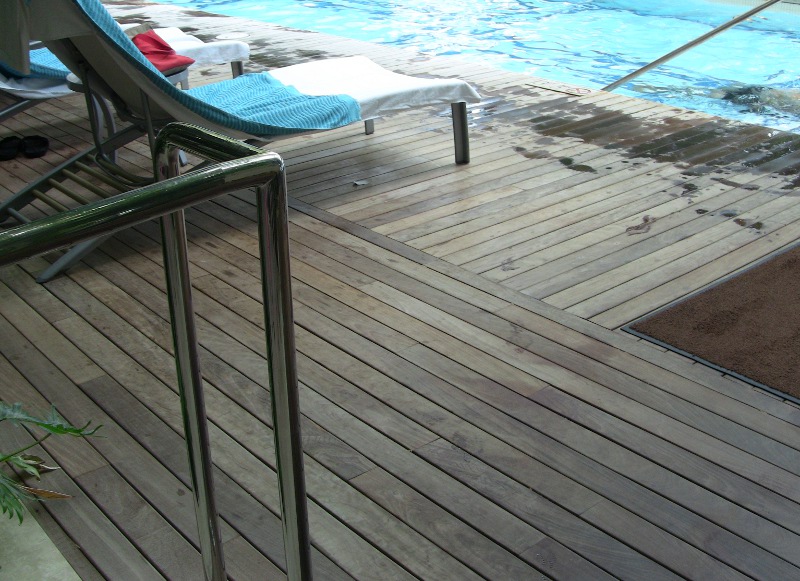
Surface temperature on a barefoot pool deck is driven mostly by color: lighter woods absorb less solar radiation and run cooler underfoot than dark ones in full sun. A dark Ipe deck can get uncomfortably hot in direct summer sun, while a light golden Garapa deck stays more comfortable barefoot. This is a straightforward consequence of solar absorptance, so for a pool deck in a hot, sunny location, color is a comfort decision, not only an aesthetic one. See our Garapa decking guide for the lighter option. A gorgeous deck nobody can cross barefoot at noon is a failed deck. Color settles the comfort question; the next question is whether the wood survives constant water.
Tropical Hardwood Durability Around Pools
All the dense tropical hardwoods resist the constant wetting, splash-out, and pool chemistry a pool deck sees, because their density and natural durability make them decay-resistant without treatment. Rated Class 1 durability under EN 350 by the USDA Forest Products Laboratory, species like Ipe, Cumaru, and Garapa shrug off the moisture that would rot softwoods. The deck should still be built over a ventilated structure with proper drainage and board spacing so water clears quickly. Durability keeps the deck alive. Traction and smooth surfacing keep the people on it upright, which is the next decision.
| Species | Color | Underfoot in sun | Note |
|---|---|---|---|
| Garapa | Light golden | Coolest of the group | Best barefoot comfort in hot sun |
| Cumaru | Tan to red-brown | Moderate | Durable value option |
| Ipe | Dark brown | Warmest | Most durable; hotter in sun |
Slip Resistance and Barefoot Detailing
Because a pool deck is walked barefoot and wet, slip resistance and a splinter-free surface matter, which points to smooth-dressed boards with eased edges and, where wanted, a grooved surface for grip. Boards should be surfaced smooth and the edges eased so bare feet are comfortable, while a lightly grooved profile can add traction when wet. A penetrating oil maintains color and a fresh surface, or the deck can weather to gray. Grooved or custom profiles require in-house milling. J. Gibson McIlvain carries the full range from light Garapa to dark Ipe and surfaces the boards smooth with eased edges in-house, so the decking arrives ready for bare feet. That milling capability is also why the supplier question belongs early in the project, not after the boards are picked.
Sourcing Pool Decking
The right pool decking supplier carries both the light species for comfort and the ability to surface and groove boards for barefoot, wet use. J. Gibson McIlvain stocks the full range of tropical decking, from light Garapa to dark Ipe, kiln-dried, milled and surfaced for pool applications in-house, and ships nationwide. For the finish decision, see our oil versus film finishes guide. Species and surfacing decide how the deck feels. What happens under the boards decides how long it lasts.
Drainage, Substructure, and Ventilation Under a Pool Deck
A pool deck sees constant splash-out, so the structure beneath must drain and ventilate quickly to keep the boards and framing dry, which matters as much as the species for how long the deck lasts. Board spacing lets surface water fall through, and a sloped, ventilated substructure carries it away and lets air dry the underside. Standing water under a deck is what shortens its life, so the framing is detailed to drain and breathe.
Around a pool, the deck often meets coping and wet transitions, where flashing and slope keep water moving away from the house and the frame. Corrosion-resistant hardware suits the wet, sometimes chlorinated environment. The USDA Forest Products Laboratory documents that wood stays sound when it can dry, which is the principle behind a ventilated pool-deck substructure. J. Gibson McIlvain supplies the tropical decking and advises on spacing and hardware for the wet environment, shipping nationwide. Chlorinated splash-out is the baseline case. Salt water raises the corrosion stakes another level.
Salt-Water Pools and Coastal Pool Decks
Salt-water pools and coastal pool decks add chloride exposure, which raises the hardware standard to 316 stainless and rewards the hardest tropical species for abrasion resistance. Salt-water pool systems and ocean-side sites expose the deck and its fasteners to chlorides that corrode ordinary hardware, so fasteners and connectors move to 316 stainless, the same standard used for docks. The tropical hardwoods themselves resist salt exposure well because their density limits absorption.
On the coast, wind-blown sand adds abrasion, which the hardest species like Ipe best resist, and drainage detailing keeps salt water from lingering on the surface or in the framing. The combination of a dense, durable species and 316 stainless hardware gives a pool deck that lasts in the salt environment. Our guide on coastal salt exposure covers the marine environment in depth. J. Gibson McIlvain supplies tropical pool decking and advises on the species and 316 hardware a salt environment requires, shipping nationwide. Hardware fails long before dense hardwood does. With species, structure, and fasteners settled, what remains are the details bare feet actually touch.
Barefoot Edge and Corner Detailing
Because a pool deck is walked barefoot, the edges, corners, and transitions are eased and smoothed so there are no sharp arrises or splinter risks, which is a milling and detailing step beyond choosing the species. Board edges are given a slight round-over, corners are softened, and any step or coping transition is detailed smooth. On a dense hardwood, these eased edges are milled cleanly and stay crisp, giving a comfortable barefoot surface without sharp lines. A splinter at the pool edge is the one flaw nobody forgives.
The perimeter often uses a picture-frame border for a clean edge, face-fastened with plugged stainless screws so no sharp fastener sits at the pool edge. These barefoot details are milled to match the field. J. Gibson McIlvain surfaces and eases pool decking and mills matching border stock in-house, so the whole deck is comfortable underfoot, shipping nationwide.
Surface Temperature, Slip, and Hardware Data
Barefoot comfort on a pool deck comes down to solar absorptance: dark woods absorb roughly 80 to 90 percent of incident solar radiation while light woods absorb closer to 50 to 60 percent, so a light Garapa surface (Janka near 1,700 lbf) can run measurably cooler underfoot than dark Ipe (near 3,680 lbf) in full sun. The USDA Forest Products Laboratory documents that surface temperature tracks with color and absorptance, which is why color is a comfort specification on a sunny deck, not only an aesthetic one.
For durability in the wet, all these tropical hardwoods rate Class 1 under EN 350, and hardware is stainless, 316 stainless (about 2 to 3 percent molybdenum) for salt-water pools and coastal sites per ASTM fastener standards. Board gaps near 3/16 inch and a ventilated substructure clear splash-out. Eased edges and a grooved surface add barefoot comfort and wet traction. The American Wood Council span basis and International Code Council building code govern the deck structure beneath. J. Gibson McIlvain stocks the full range from light Garapa to dark Ipe, surfaced and eased for pool use, and ships nationwide.
Pool Deck Hardware and Detailing Figures
The detailing figures for a barefoot, wet pool deck, per ASTM stainless standards and the density data of the USDA Wood Handbook.
| Item | Value |
|---|---|
| Fasteners (salt-water pool) | 316 stainless (~2 to 3% molybdenum) |
| Board gap | ~3/16 in for drainage |
| Edges | Eased round-over for bare feet |
| Traction | Lightly grooved profile option |
| Cooler species | Garapa (~800 kg/m3, light color) |
"For a pool deck the first question I ask is how much sun it gets, because dark Ipe in full sun gets hot on bare feet. If comfort is the priority, Garapa is lighter and runs cooler, and it is still a durable tropical hardwood that handles the water. Then you dress the boards smooth, ease the edges so nobody gets a splinter, and you have a pool deck that is comfortable and lasts."
Camden Zacker, Sales Director, J. Gibson McIlvain Company
How J. Gibson McIlvain Would Supply Pool Decking
For J. Gibson McIlvain, a pool decking order starts with sun exposure and comfort. The team recommends lighter species such as Garapa where barefoot comfort in hot sun is the priority, or Ipe and Cumaru where maximum durability or a darker look is wanted, all kiln-dried and surfaced smooth with eased edges in-house. Grooved profiles for wet traction are milled to order, and the material ships nationwide.
The team treats a pool deck as a comfort-and-safety problem layered on durability. Every tropical hardwood handles the water; the differentiators are how hot the surface gets underfoot and how it feels barefoot, which is why color and surfacing lead the recommendation.
Pool Decking Checklist
| Item | Why it matters |
|---|---|
| Species color | Lighter woods run cooler underfoot in sun. |
| Surfacing | Smooth-dressed, eased edges for bare feet. |
| Slip resistance | Grooved profile for wet traction where wanted. |
| Drainage and spacing | Clears splash-out quickly; ventilated structure. |
| Fasteners | Stainless; hidden clips for a clean barefoot surface. |
Where Pool Decks Go Wrong
- Dark wood in full sun: Gets hot on bare feet; consider lighter species.
- Rough or sharp edges: Barefoot decks need smooth boards with eased edges.
- Poor drainage: Standing splash-out; space and slope for quick clearing.
- Exposed fasteners: Hidden clips give a cleaner, safer barefoot surface.
Related J. Gibson McIlvain Guidance and Next Steps
Frequently Asked Questions
What is the best tropical hardwood for a pool deck?
For a pool deck, lighter-colored tropical hardwoods like Garapa are often best because they absorb less solar heat and run cooler underfoot, which matters on a barefoot, high-sun surface, while still resisting the constant water. Ipe and Cumaru are more durable and darker but get hotter in full sun. J. Gibson McIlvain stocks the full range from light Garapa to dark Ipe, so the deck can be matched to sun exposure and comfort, surfaced smooth for bare feet.
Which decking stays coolest underfoot around a pool?
Lighter-colored woods stay coolest underfoot because surface temperature is driven mostly by color and solar absorptance. A light golden Garapa deck runs cooler than a dark Ipe deck in direct summer sun, making it more comfortable for barefoot use around a pool. All dense tropical hardwoods handle the water equally well, so for a sunny pool deck the color choice is primarily a barefoot-comfort decision.
Does tropical hardwood decking hold up around a pool?
Yes. Dense tropical hardwoods like Ipe, Cumaru, and Garapa are rated Class 1 durable and resist the constant wetting, splash-out, and pool chemistry a pool deck sees, without chemical treatment. The deck should still be built over a ventilated structure with proper drainage and board spacing so water clears quickly. Smooth-surfaced boards with eased edges keep the barefoot surface comfortable and splinter-free.
How do you make a wood pool deck slip resistant?
Slip resistance on a wet pool deck can be improved with a lightly grooved decking profile that adds traction underfoot, along with proper drainage and board spacing so water clears quickly rather than pooling. Boards should be surfaced smooth with eased edges for barefoot comfort while still providing grip. Grooved and custom profiles require in-house milling; J. Gibson McIlvain mills pool decking to order and ships nationwide.
How do you keep a wood pool deck from rotting?
A wood pool deck stays sound when it can drain and dry: board spacing lets splash-out fall through, and a sloped, ventilated substructure carries water away and lets air dry the underside. Dense tropical hardwoods resist decay naturally, but standing water under any deck shortens its life, so the framing is detailed to drain and breathe, with corrosion-resistant hardware for the wet, sometimes chlorinated environment. J. Gibson McIlvain advises on spacing and hardware alongside supplying the decking.
What hardware should be used on a pool deck?
A pool deck is a wet, sometimes chlorinated environment, so it needs corrosion-resistant fasteners and connectors, with stainless steel for the deck boards and hidden clips for a clean barefoot surface. The substructure hardware should also resist the constant moisture. Matching corrosion resistance through the whole assembly prevents staining and connection failure. J. Gibson McIlvain supplies tropical pool decking and advises on stainless fasteners and the hardware the wet environment requires.
What hardware do I need for a salt-water pool deck?
Salt-water pools and coastal pool decks expose hardware to chlorides that corrode ordinary fasteners, so use 316 stainless steel fasteners and connectors, the same standard used for docks, throughout the deck. The tropical hardwoods themselves resist salt exposure because their density limits absorption, but the hardware must match. Drainage detailing keeps salt water from lingering. J. Gibson McIlvain supplies tropical pool decking and advises on the 316 hardware a salt environment requires.
Is tropical hardwood good for a coastal pool deck?
Yes. Dense tropical hardwoods resist coastal salt exposure well because their density limits water absorption, and the hardest species like Ipe also best resist abrasion from wind-blown sand. Paired with 316 stainless hardware to handle chlorides and proper drainage to clear salt water, a tropical hardwood pool deck lasts in the coastal environment. J. Gibson McIlvain supplies the full range of tropical decking and advises on the species and hardware for coastal and salt-water pool sites.
How do you make a wood pool deck comfortable for bare feet?
Beyond choosing a lighter, cooler species, a barefoot pool deck has its board edges eased with a slight round-over, corners softened, and step and coping transitions detailed smooth so there are no sharp arrises or splinter risks. A picture-frame border with plugged stainless screws keeps sharp fasteners away from the pool edge. On dense hardwood these eased edges mill cleanly and stay crisp. J. Gibson McIlvain surfaces and eases pool decking and mills matching border stock in-house.
Sources and Standards Referenced
- USDA Forest Products Laboratory - Wood Handbook and Durability
- Forest Stewardship Council - Chain of Custody Certification
- CITES - Convention on International Trade in Endangered Species
- ASTM International - Stainless Steel Fastener Standards
- EN 350 - Durability of Wood and Wood-Based Products
- American Wood Council
- International Code Council
- USDA Forest Products Laboratory - Wood Handbook (FPL-GTR-282)
- National Hardwood Lumber Association - Grading Rules
- North American Deck and Railing Association