
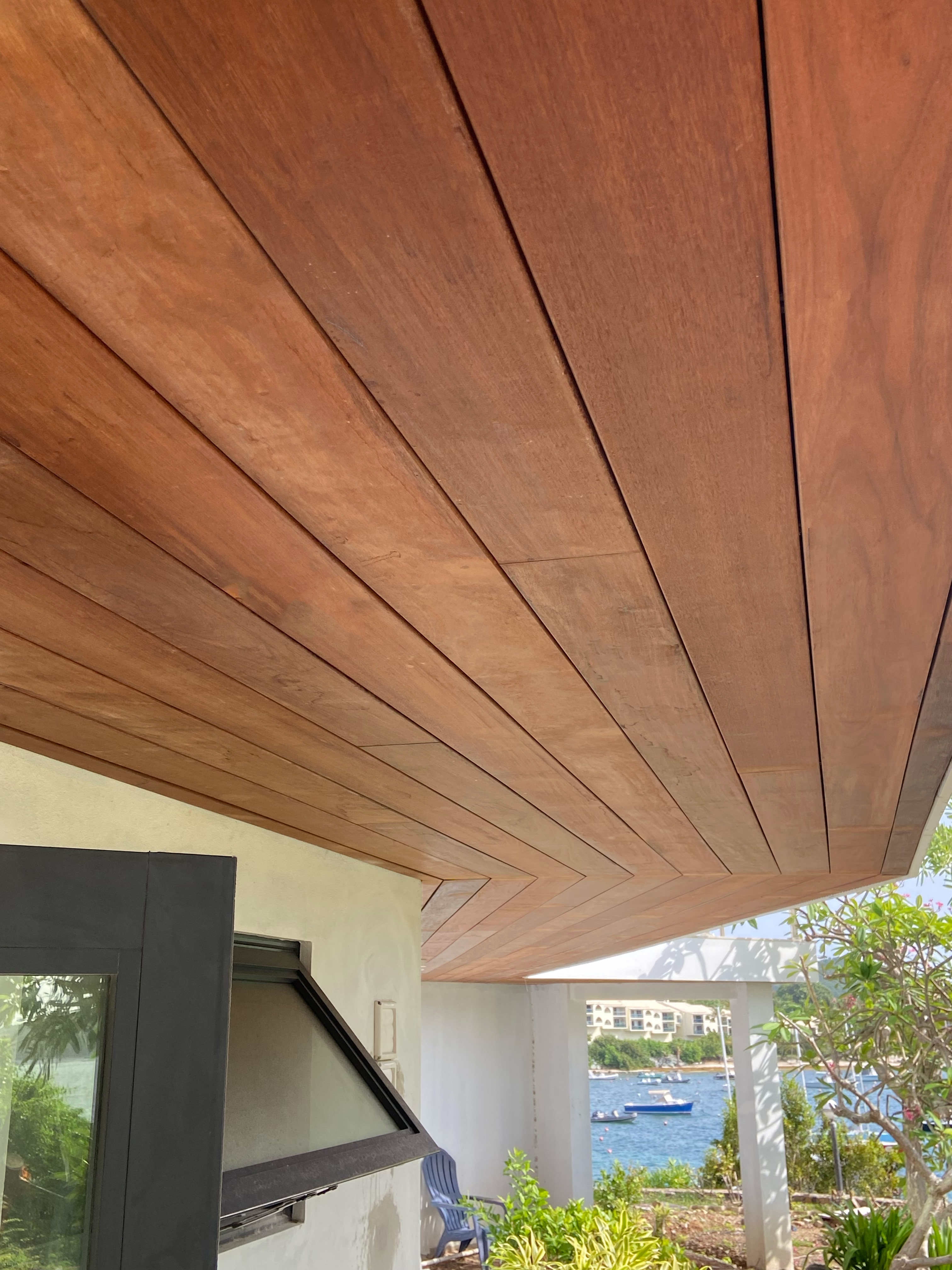
Why Soffit Applications Demand Different Thinking Than Wall Cladding
When architects specify exterior wood, most of the conversation centers on wall cladding and decking. Soffits receive less attention during design development—yet they fail at disproportionately higher rates. The reason is physics: a horizontal or near-horizontal wood surface facing downward cannot shed water by gravity, receives less direct solar drying, and sits in a zone where warm interior air meets cool exterior air, creating persistent condensation risk.
According to the USDA Forest Products Laboratory, wood in overhead exterior applications typically equilibrates at 2–4 percentage points higher moisture content than the same species installed vertically on the same building. That difference is enough to move certain species from the safe zone into the decay-risk zone, particularly in climate zones 4A through 7 as defined by the International Code Council (ICC).
This guide addresses species selection, ventilation strategy, moisture management, and installation detailing for wood soffits—whether you are specifying a 3,000-square-foot residential project or a 40,000-square-foot commercial overhang. The principles are identical; only the tolerances and documentation requirements change.
Understanding the Soffit Microclimate
Vapor Drive and Condensation Mechanics
In heating-dominated climates, warm interior air migrates outward through the roof assembly. When that vapor reaches the soffit cavity—typically the coolest point in the assembly during winter nights—it condenses on the backside of the soffit boards. Unlike wall assemblies where condensation runs down and exits at the base flashing, soffit condensation pools on horizontal surfaces and wicks into end grain.
The American Wood Council (AWC) technical notes recommend maintaining soffit cavity temperatures within 10°F of ambient exterior temperature to minimize condensation potential. This is achieved through adequate ventilation—a point we will quantify in detail below.
Reduced Solar Drying
Vertical cladding on south and west exposures receives direct solar radiation that drives moisture content down rapidly after rain events. Soffits, particularly those under deep overhangs, receive almost no direct solar gain. Drying relies entirely on air movement across the wood surface. Species with high permeability (the ability to release bound water through cell walls) perform measurably better in these conditions than dense, tight-grained species that hold moisture longer.
Biological Exposure
The combination of elevated moisture content and reduced UV exposure creates favorable conditions for mold and mildew colonization. While mold does not cause structural decay, it creates aesthetic problems that generate callbacks and client dissatisfaction. Species with natural fungicidal extractives—such as the thujaplicins in western red cedar or the lapachol in ipe—resist biological colonization without relying on topical treatments that require maintenance access overhead.
Species Performance Matrix for Soffit Applications
The following table compares species commonly specified for wood soffits across the performance criteria that matter most in overhead exterior applications. Data is compiled from FPL research, manufacturer technical specifications, and field performance observations across McIlvain's project history dating to the early 1990s.
| Species | Decay Resistance | Dimensional Stability | Vapor Permeability | Fire Performance | Soffit Suitability Rating |
|---|---|---|---|---|---|
| Western Red Cedar | Moderate–High | Excellent (low shrinkage) | High | Class C (untreated) | ★★★★☆ |
| Genuine Mahogany (Swietenia) | High | Excellent | Moderate | Class B (dense heartwood) | ★★★★★ |
| Thermory Ash | High (Class 1 modified) | Excellent (40% improved) | Moderate–High | Class B equivalent | ★★★★★ |
| Abodo Vulcan (radiata pine) | High (Class 1 modified) | Excellent (60% improved) | Moderate–High | Class B equivalent | ★★★★★ |
| Accoya (acetylated radiata) | Very High (Class 1) | Outstanding (75% improved) | Low–Moderate | Class B | ★★★★★ |
| Ipe | Very High | Good | Low | Class A | ★★★★☆ |
| Sapele | Moderate–High | Good | Moderate | Class B | ★★★★☆ |
| White Oak | High | Moderate (higher shrinkage) | Very Low (tyloses) | Class C | ★★★☆☆ |
| Douglas Fir | Moderate | Moderate | Moderate | Class C | ★★★☆☆ |
| Cypress | High | Good | High | Class C | ★★★★☆ |
Note: Fire performance ratings reference ASTM E84 flame spread classifications. "Improved" dimensional stability percentages reference manufacturer data comparing modified wood to the same species in its unmodified state.
Thermally Modified Species: Purpose-Built for Overhead Exposure
Thermal modification fundamentally alters wood's relationship with water. By heating wood to 190–215°C in an oxygen-free environment, the process permanently degrades hemicellulose—the cell wall component most responsible for moisture uptake. The result is wood that equilibrates at lower moisture content, moves less seasonally, and resists biological decay without chemical treatment.
For soffit applications, this translates to three measurable advantages:
- Reduced equilibrium moisture content (EMC): Thermally modified wood equilibrates 40–60% lower than its unmodified counterpart in the same environment, keeping it well below the 20% threshold where decay fungi activate.
- Reduced movement: Less moisture absorption means less seasonal expansion and contraction, reducing stress on fasteners and joint sealants in overhead applications where gravity works against connection integrity.
- Eliminated food source: With hemicellulose degraded, the wood becomes indigestible to most decay organisms, providing durability without relying on toxic preservatives.
Thermory offers thermally modified ash, pine, and spruce in cladding profiles suitable for soffit installation, with documented Class 1 durability ratings per EN 350. Similarly, Abodo Vulcan—a thermally modified radiata pine—provides comparable durability with a slightly different color palette and proprietary profile geometries optimized for concealed-fastener systems that work particularly well in overhead applications.
McIlvain stocks both Thermory and Abodo Vulcan product lines and can provide project-specific technical data sheets, span tables for soffit applications, and sample boards for finish testing.
Acetylated Wood: The Engineering Solution
Accoya—acetylated radiata pine—represents the most dimensionally stable wood product currently available for exterior applications. The acetylation process permanently bonds acetic anhydride to wood cell walls, reducing their ability to absorb water by approximately 75%. For soffit applications where board widths of 6–8 inches are common, this translates to seasonal movement measured in thousandths of an inch rather than sixteenths.
The practical significance for soffit detailing: Accoya allows tighter joint tolerances, eliminates the need for expansion gaps in most climates, and maintains flatness in wide boards that would cup or bow in conventional species. McIlvain supplies Accoya in standard and custom profiles suitable for T&G soffit, shiplap, and open-joint configurations.
Tropical Hardwoods: When Density and Longevity Justify the Investment
For projects where budget supports premium materials and design intent calls for rich color and fine grain, tropical hardwoods deliver exceptional soffit performance. Genuine Mahogany (Swietenia macrophylla) combines Class 2+ natural durability with outstanding dimensional stability—it was the species of choice for exterior millwork and boat building for centuries precisely because it handles moisture cycling without distortion.
Ipe, Jatoba, and Sapele each offer soffit-appropriate characteristics, though with caveats. Ipe's extreme density (over 1,050 kg/m³) makes it practically impervious to decay and insects, but that same density creates challenges: pre-drilling is mandatory for every fastener, the wood's low permeability means trapped moisture takes longer to escape, and its weight (approximately 5.5 lbs/BF) increases structural requirements for soffit framing. For projects already specifying ipe for decking or cladding, extending it to soffits creates visual continuity, but specify increased ventilation clearance (minimum 1-inch cavity) to compensate for reduced permeability.
Domestic Species: Cedar, Cypress, and Douglas Fir
Western Red Cedar remains the most commonly specified domestic species for wood soffits in residential construction. Its combination of natural durability, low density (facilitating overhead installation), excellent dimensional stability, and high vapor permeability makes it well-suited to the soffit microclimate. Select Tight Knot (STK) grades provide a cost-effective option for painted soffits, while Clear grades serve stain-grade applications.
Cypress offers similar performance characteristics with slightly higher density and a distinct grain pattern. In the southeastern United States where cypress is locally available, it often represents the best value proposition for wood soffits—combining native durability with regional supply chain efficiency.
Douglas Fir, while commonly used for structural soffit framing, requires preservative treatment or protective finish for exposed applications. Its moderate natural durability limits its use to covered soffits (under deep overhangs with minimal weather exposure) or projects where regular maintenance access is assured.
Ventilation Requirements: Quantifying Airflow for Wood Soffit Longevity
Ventilation is not optional for wood soffits—it is the single most influential factor in long-term performance. The International Residential Code (IRC) Section R806.2 establishes minimum ventilation ratios for attic spaces, but these minimums are insufficient for protecting wood soffit materials themselves. The code addresses condensation on roof sheathing; it does not address moisture equilibrium in decorative soffit boards.
Minimum Ventilation Cavity Depth
For wood soffits, specify a minimum ventilation cavity of ¾ inch between the back of the soffit board and the substrate or insulation above. This dimension allows convective air movement across the back surface of the board, promoting drying from both faces. For low-permeability species (ipe, white oak) or in climate zones 5–7, increase to 1 inch minimum.
Net Free Area (NFA) Calculations
When soffit boards are installed as a continuous surface with ventilation provided through discrete openings (strip vents, individual vent holes, or perforated sections), calculate Net Free Area based on the total soffit square footage:
- Climate Zones 1–3: Minimum 1/150 NFA ratio (1 square inch of net free ventilation area per 150 square inches of soffit surface)
- Climate Zones 4–5: Minimum 1/100 NFA ratio
- Climate Zones 6–7: Minimum 1/75 NFA ratio
These ratios exceed IRC minimums because they address wood hygrothermal performance specifically, not just attic condensation control.
Open-Joint Configurations
An increasingly popular detail for contemporary architecture, open-joint soffit installations use gaps between boards (typically 3/16" to 3/8") as the ventilation mechanism. This approach provides excellent air circulation, eliminates discrete vent components, and creates a shadow-line aesthetic. However, it introduces visibility concerns—occupants and visitors can see into the cavity—requiring a secondary screen or mesh above the boards to block insect entry and maintain visual cleanliness.
For open-joint soffit details, a furring strip rainscreen approach adapted for overhead use provides the optimal combination of ventilation, drainage, and insect exclusion. Mount furring strips perpendicular to the soffit boards at 16" on center, with continuous insect screen above.
Moisture Management: Beyond Ventilation
Moisture Content at Installation
Wood soffit boards must be installed at moisture content appropriate to their service environment. The National Hardwood Lumber Association (NHLA) grading rules specify kiln-dried moisture content ranges, but these represent lumber as delivered—not necessarily as installed after site storage. For soffit applications, target installation moisture content of:
- 8–12% for most climates and species
- 6–10% for thermally modified and acetylated species (which equilibrate lower)
- 10–14% for cypress and cedar in humid coastal climates (these species will equilibrate higher)
Verify moisture content with a pin-type meter at multiple points across a representative sample before installation. Document readings—this baseline becomes essential for warranty administration if issues arise. For detailed protocols, see our moisture content guide for exterior wood.
End-Grain Sealing
End grain absorbs moisture 10–15× faster than face grain. In soffit applications where board ends often terminate at fascia or beam intersections—creating trapped moisture pockets—end-grain sealing is mandatory for all species. Apply a quality end-grain sealer (wax-based or penetrating) to all cuts before installation. This single step prevents the most common soffit failure mode: end-grain decay that propagates inward over 3–5 years.
Back-Priming and All-Surface Coating
Any penetrating oil, stain, or film-forming finish applied to the face of soffit boards must also be applied to the back surface. Sealing only exposed faces creates a vapor gradient that drives moisture through the uncoated back surface and traps it behind the finish film, accelerating decay. The back coat need not be the same aesthetic product—a clear penetrating sealer or primer is sufficient—but complete surface coverage is non-negotiable for long-term performance.
Fire Performance Considerations
Soffits in Wildland-Urban Interface (WUI) zones and many commercial applications must meet specific fire performance requirements. The National Fire Protection Association (NFPA) and local jurisdictions establish flame spread, ember resistance, and fire-rated assembly requirements that directly influence species selection.
ASTM E84 Classification by Species
Dense tropical hardwoods generally achieve lower flame spread indices than lighter domestic species. Ipe consistently tests at Class A (flame spread index ≤ 25), making it the default choice for projects requiring Class A soffit materials without fire-retardant treatment. Thermally modified ash and mahogany typically achieve Class B (FSI 26–75), while untreated cedar and Douglas fir fall into Class C (FSI 76–200).
Fire-Retardant Treatment Compatibility
Not all species accept fire-retardant treatment equally. Permeable species (cedar, Douglas fir, pine) absorb water-based fire retardants effectively. Dense tropical species and thermally modified wood—already resistant to liquid absorption—may not achieve adequate retention. Verify treatment compatibility with both the treatment manufacturer and the wood supplier before specifying. Factory-applied intumescent coatings offer an alternative for species that resist pressure treatment.
Installation Detailing for Long-Term Performance
Fastener Selection
Overhead applications amplify fastener requirements. Gravity works constantly to pull boards away from the substrate, and seasonal wood movement generates withdrawal forces not present in wall applications. Specify:
- Stainless steel ring-shank nails (Type 316 in coastal environments, Type 304 elsewhere) with minimum 1-1/4" penetration into solid framing
- Stainless steel screws for dense tropical species and boards wider than 6"—the higher withdrawal resistance compensates for reduced face-nailing options in pre-drilled applications
- Concealed clip systems for T&G and shiplap profiles—these allow boards to expand and contract without visible fastener movement, and distribute load across the full board width rather than point-loading at nail locations
Framing and Substrate Requirements
Soffit framing must accommodate both the dead load of wood boards and the live load of maintenance access (workers standing on ladders pushing upward against boards during inspection or refinishing). Minimum framing:
- 2×4 joists at 16" OC for boards up to ¾" thick and 6" wide in species under 45 lbs/CF
- 2×4 joists at 12" OC for boards over ¾" thick, wider than 6", or in species over 45 lbs/CF (ipe, jatoba)
- 2×6 joists for continuous spans over 4 feet without intermediate support
Expansion and Contraction Allowances
While thermally modified and acetylated species allow tighter tolerances, conventional species require expansion provisions:
- T&G profiles: Leave 1/32" gap at tongue shoulder during installation (boards will tighten seasonally)
- Shiplap: Overlap should allow 1/16" movement without exposing substrate
- Butt joints: Leave 1/16" gap between board ends, backed by a continuous furring strip to prevent visible gaps from interior
Sustainability and Certification
Wood soffits contribute to a building's sustainability profile when sourced responsibly. The Forest Stewardship Council (FSC) and Programme for the Endorsement of Forest Certification (PEFC) provide chain-of-custody certification that verifies wood originates from responsibly managed forests. For LEED v4.1 projects, certified wood contributes to MR Credit: Responsibly Sourced Materials.
J. Gibson McIlvain maintains FSC chain-of-custody certification (active since 2008), enabling projects to specify FSC-certified hardwood soffit materials with full documentation for green building submissions. Species availability under FSC certification varies—mahogany, sapele, and white oak are typically available FSC-certified; ipe certification is limited and requires advance ordering.
Specifying for Commercial Projects
Commercial soffit specifications require additional documentation beyond residential applications. The WoodWorks program provides free technical support for architects specifying wood in commercial construction, including fire-rating assemblies, structural calculations, and code compliance pathways.
For commercial projects with wood soffits, the specification should address:
- Preservative treatment requirements: Reference AWPA Use Category UC3B for above-ground exterior wood not in contact with the ground but subject to sustained moisture exposure
- Structural performance: Provide span tables specific to the soffit profile thickness and species, calculated per NDS (National Design Specification)
- Quality assurance: Specify third-party grading certification, moisture content testing protocols, and material submittals including chain-of-custody documentation
- Maintenance narrative: Include a maintenance plan as part of the project manual, specifying inspection frequency, refinishing intervals, and replacement protocols
For architects developing exterior hardwood specifications targeting 30-year service life, soffit details deserve their own specification section rather than being subsumed under general cladding—the exposure conditions are sufficiently different to warrant species-specific and detail-specific requirements.
Common Soffit Failures and Their Prevention
Cupping and Warping
Boards that cup or warp after installation almost always indicate a moisture differential between the face and back surfaces. Prevention: coat all surfaces before installation, ensure adequate back-ventilation, and verify the substrate above is not a moisture source (missing vapor retarder, leaking HVAC condensate, inadequate roof drainage).
Fastener Pop-Out
Ring-shank nails or screws that gradually withdraw indicate excessive seasonal movement—typically because the wrong species was selected for the exposure condition, or because boards were installed at incorrect moisture content. Prevention: select dimensionally stable species, verify MC at installation, and use mechanical fastener systems (clips) rather than face-fastening for species with higher shrinkage coefficients.
Joint Opening
Seasonal gaps between T&G or shiplap boards are normal and expected in conventional wood species—up to 1/16" is acceptable. Gaps exceeding 1/8" indicate insufficient overlap in the profile geometry, incorrect species selection, or boards installed at moisture content significantly above the expected service EMC. Thermally modified and acetylated species virtually eliminate this issue.
Localized Decay at Penetrations
Recessed lights, sprinkler heads, HVAC grilles, and other penetrations through wood soffits create moisture traps where water accumulates behind finishing materials. Detail all penetrations with flashing collars that direct water outward, and increase local ventilation around penetrations with additional clearance or vent openings.
Rainscreen Principles Applied to Soffits
The rainscreen approach used in commercial cladding applies directly to soffit assemblies—with modifications for horizontal orientation. The four principles of rainscreen design (deflection, drainage, drying, and durability) translate to soffit applications as follows:
- Deflection: The soffit boards themselves are the primary deflection layer; open joints or vented panels manage incidental water intrusion from wind-driven rain
- Drainage: In horizontal applications, drainage relies on slope (even 1/8" per foot improves performance) or wicking paths to board edges rather than gravity flow down a wall
- Drying: The ventilation cavity behind boards is the primary drying mechanism—sized larger than wall assemblies due to reduced convective drive in horizontal cavities
- Durability: Species selection provides the final line of defense; even with perfect detailing, some moisture will reach the wood, and the species must tolerate it without degradation
For a deeper comparison of species performance in ventilated assemblies, see our wood rainscreen cladding species profiles.
"We've seen more soffit failures from inadequate back-ventilation than from any other single cause—including wrong species selection. A ¾-inch air cavity behind the boards solves 80% of the moisture problems we diagnose in the field. The remaining 20% comes down to species choice and installation moisture content. Get those three factors right, and wood soffits will outlast the roofing above them."
— Brett Miller, Senior Technical Advisor, J. Gibson McIlvain
Cost Considerations and Value Engineering
Wood soffit material costs range from approximately $4/SF installed (cedar T&G, painted) to $18+/SF installed (ipe, clear finish) depending on species, grade, profile, and finish requirements. When evaluating lifecycle cost rather than first cost, thermally modified and acetylated species often represent the best value despite higher material costs—their reduced maintenance requirements and extended service life lower annualized costs by 30–50% compared to conventional species requiring refinishing every 3–5 years.
For projects where budget constrains species selection, consider hybrid approaches: use premium species (mahogany, thermally modified ash) for visible soffits at entry canopies and public-facing elevations, and cost-effective species (cedar, cypress) for less-visible locations. McIlvain routinely provides multi-species project packages optimized for both performance and budget.
Climate-Specific Recommendations
Hot-Humid (Climate Zones 1–3A)
Prioritize decay resistance and vapor permeability. Best choices: Genuine Mahogany, Thermory Ash, Abodo Vulcan, Cypress. Avoid: untreated Douglas Fir, untreated domestic softwoods without preservative treatment.
Mixed-Humid (Climate Zones 3B–4A)
Balance decay resistance with dimensional stability. Best choices: Accoya, Thermory Ash, Cedar, Sapele. Most species perform adequately with proper detailing.
Cold (Climate Zones 5–7)
Prioritize dimensional stability and low EMC to manage freeze-thaw cycling and persistent vapor drive. Best choices: Accoya, Thermory (all species), Abodo Vulcan. Conventional species require increased ventilation provisions and more conservative MC targets at installation.
Marine/Coastal
Salt air accelerates corrosion of fasteners and extractive leaching from certain species. Require Type 316 stainless steel for all fasteners, avoid species with water-soluble extractives (white oak, some cedars) unless prefinished. Best choices: Accoya, Ipe, Genuine Mahogany, Thermory Ash.
How McIlvain Would Specify This for a Real Project
When a project comes through our door requesting wood soffit material, the first questions we ask have nothing to do with species preference or color. We ask: What is the total soffit area? What is the maximum unsupported span? What is the climate zone and specific exposure (coastal, inland, sheltered, open)? Is there conditioned space above? What is the fire rating requirement? What is the maintenance access strategy?
These questions determine the species shortlist before aesthetics enter the conversation. For a recent 12,000 SF commercial soffit project in Climate Zone 4A with Class B fire requirements and a 15-year maintenance-free performance expectation, we specified Thermory ash in a 1×6 T&G profile with concealed clips, installed over ¾" furring strips on 12" centers. Total installed cost was competitive with composite alternatives, with a projected 30+ year service life versus 15–20 years for composites.
For residential projects where visual warmth is the primary driver and budgets are tighter, we typically recommend starting with Clear Western Red Cedar or Cypress for painted applications, and stepping up to Genuine Mahogany or Thermory Ash for natural/stain-grade applications where the additional cost of dimensional stability returns value through reduced callbacks and longer refinishing intervals.
Performance and Procurement Checklist
- ☐ Confirm climate zone and specific microclimate (sheltered vs. exposed, conditioned space above vs. unconditioned)
- ☐ Verify fire rating requirements (IBC/IRC, local amendments, WUI zone requirements)
- ☐ Determine maintenance access—will scaffolding or lifts be required for refinishing? If yes, factor lifecycle cost of maintenance access into species selection
- ☐ Establish ventilation cavity depth and NFA ratio per climate zone
- ☐ Specify moisture content at delivery and verify upon receipt
- ☐ Confirm substrate condition—no active leaks, vapor retarder intact, insulation not in contact with soffit boards
- ☐ Select fastener system appropriate to species density and board width
- ☐ Verify FSC/PEFC certification requirements and confirm availability in selected species
- ☐ Obtain manufacturer span tables for selected profile at specified joist spacing
- ☐ Develop maintenance narrative including inspection schedule, refinishing protocol, and replacement strategy
Where Specifications Usually Fail
Failure Point 1: Treating soffits like walls. Specifications that reference wall cladding details for soffit installations miss the critical differences in moisture behavior, structural requirements, and ventilation needs. Soffits require their own detail drawings and specification sections.
Failure Point 2: Specifying species by appearance only. "Provide wood soffit, species to match wall cladding" without addressing the different performance requirements of overhead exposure. A species that performs well on walls may fail overhead without modified detailing.
Failure Point 3: Insufficient ventilation specification. Drawings that show a vent detail but don't quantify NFA or cavity depth leave installation quality to field interpretation—which invariably defaults to minimum effort rather than minimum performance requirement.
Failure Point 4: Ignoring the maintenance question. Wood soffits at 20+ feet above grade require expensive access equipment for refinishing. If the specification doesn't acknowledge this reality through species selection (choosing low-maintenance species) or design (providing permanent maintenance access), the building owner faces unexpected costs that damage the architect's reputation.
Failure Point 5: No moisture content documentation. Without baseline MC readings at installation, warranty claims become he-said-she-said disputes. Document and photograph meter readings as part of the installation quality assurance protocol.
Ordering Information to Resolve Before Pricing
- Species and grade (e.g., Thermory Ash, S4S, Select grade; or Clear WRC, CVG, KD)
- Profile geometry (T&G, shiplap, square-edge for open-joint, custom profile)
- Nominal dimensions (thickness × width × lengths required)
- Total board footage plus waste factor (typically 10–15% for soffits due to cuts at angles and penetrations)
- Certification requirements (FSC, PEFC, or no requirement)
- Delivery timeline (standard lead times: domestic 2–4 weeks, tropical 4–8 weeks, thermally modified 3–6 weeks, Accoya 4–8 weeks)
- Prefinishing requirements (factory finish available through McIlvain's finishing partners)
- Fastener system preference (we can supply complete fastener/clip packages matched to species)
Related McIlvain Guidance and Next Steps
For architects and builders developing wood soffit specifications, these additional McIlvain resources provide complementary technical guidance:
- Furring Strips Behind Wood Siding: Ventilation Best Practices — ventilation cavity detailing applicable to soffits
- Moisture Content Guide for Exterior Wood — testing protocols and target MC ranges by species
- Wood Rainscreen Cladding Species Profiles — detailed species comparisons for exterior applications
- Contact McIlvain's Technical Team — for project-specific species recommendations, pricing, and sample requests
Our technical advisors are available to review soffit specifications, provide species recommendations based on project-specific conditions, and develop complete material packages including wood, fasteners, and finishing products. Contact us with your project details for a consultation.
Frequently Asked Questions
What is the best wood species for exterior soffits in humid climates?
In humid climates (ASHRAE Climate Zones 1–3A), the best-performing species for exterior wood soffits are Genuine Mahogany, thermally modified ash (Thermory), Abodo Vulcan, and cypress. These species combine high natural or engineered decay resistance with adequate vapor permeability—allowing the wood to dry between wetting events even in persistently humid conditions. Avoid untreated domestic softwoods like Douglas Fir or SPF in these climates unless protected by deep overhangs and specified with preservative treatment per AWPA UC3B standards.
How much ventilation do wood soffits need behind the boards?
Wood soffits require a minimum ¾-inch ventilation cavity between the back of the board and any substrate above, increasing to 1 inch for dense tropical species or in cold climates (Zones 5–7). Net Free Area ratios should be 1/150 in mild climates, 1/100 in moderate climates, and 1/75 in cold climates. These ratios exceed standard attic ventilation code minimums because they address the hygrothermal performance of the wood itself, not just condensation control in the attic space above.
Can thermally modified wood be used for soffits without additional treatment?
Yes. Thermally modified species like Thermory ash/pine and Abodo Vulcan achieve Class 1 durability ratings (EN 350) through the thermal modification process alone—no chemical preservatives required. The modification permanently reduces the wood's equilibrium moisture content and eliminates the hemicellulose that decay organisms require as a food source. However, a UV-protective finish (penetrating oil or stain) is still recommended to maintain color and prevent surface checking, even though it is not required for structural durability.
What causes wood soffit boards to cup or warp after installation?
Cupping and warping in installed soffit boards result from uneven moisture distribution between the face and back surfaces. The most common causes are: (1) coating only the visible face without back-priming, creating a vapor trap; (2) inadequate ventilation behind the boards, allowing moisture to accumulate on the back surface; (3) installing boards at moisture content significantly different from the expected service equilibrium; and (4) moisture sources above the soffit (HVAC condensate leaks, missing vapor retarders, or wet insulation in contact with the boards). Prevention requires all-surface coating, adequate back-ventilation, verified installation MC, and confirmed dry substrate conditions.
What fasteners should be used for wood soffit installation?
Use stainless steel ring-shank nails (Type 316 for coastal/marine environments, Type 304 elsewhere) with minimum 1-1/4 inch penetration into solid framing for most domestic species. For dense tropical hardwoods (ipe, jatoba) and boards wider than 6 inches, stainless steel screws provide superior withdrawal resistance and allow pre-drilling without splitting. Concealed clip systems are ideal for T&G and shiplap profiles—they accommodate seasonal movement without visible fastener stress and distribute load across the full board width. Never use galvanized fasteners with species containing high tannin content (oak, cedar) as galvanic reactions cause black staining.
Sources
- USDA Forest Products Laboratory — Research on wood moisture behavior, durability ratings, and species properties for exterior applications
- International Code Council (ICC) — International Residential Code ventilation requirements and climate zone definitions
- American Wood Council — Technical design guidelines for wood construction and exterior applications
- ASTM International — E84 Standard Test Method for Surface Burning Characteristics of Building Materials
- National Fire Protection Association — Fire performance standards for building materials in WUI zones
- National Hardwood Lumber Association — Grading rules and moisture content standards for hardwood lumber
- Forest Stewardship Council — Chain-of-custody certification for responsibly sourced wood products
- Programme for the Endorsement of Forest Certification — International forest certification framework
- Thermory — Thermally modified ash, pine, and spruce technical specifications and durability data
- Abodo Wood — Vulcan thermally modified radiata pine performance data and installation guidelines
- Accoya — Acetylated wood dimensional stability data and durability classification
- WoodWorks — Technical support for commercial wood construction design and specification
- American Wood Protection Association — Use category standards for preservative-treated wood in exterior applications


