
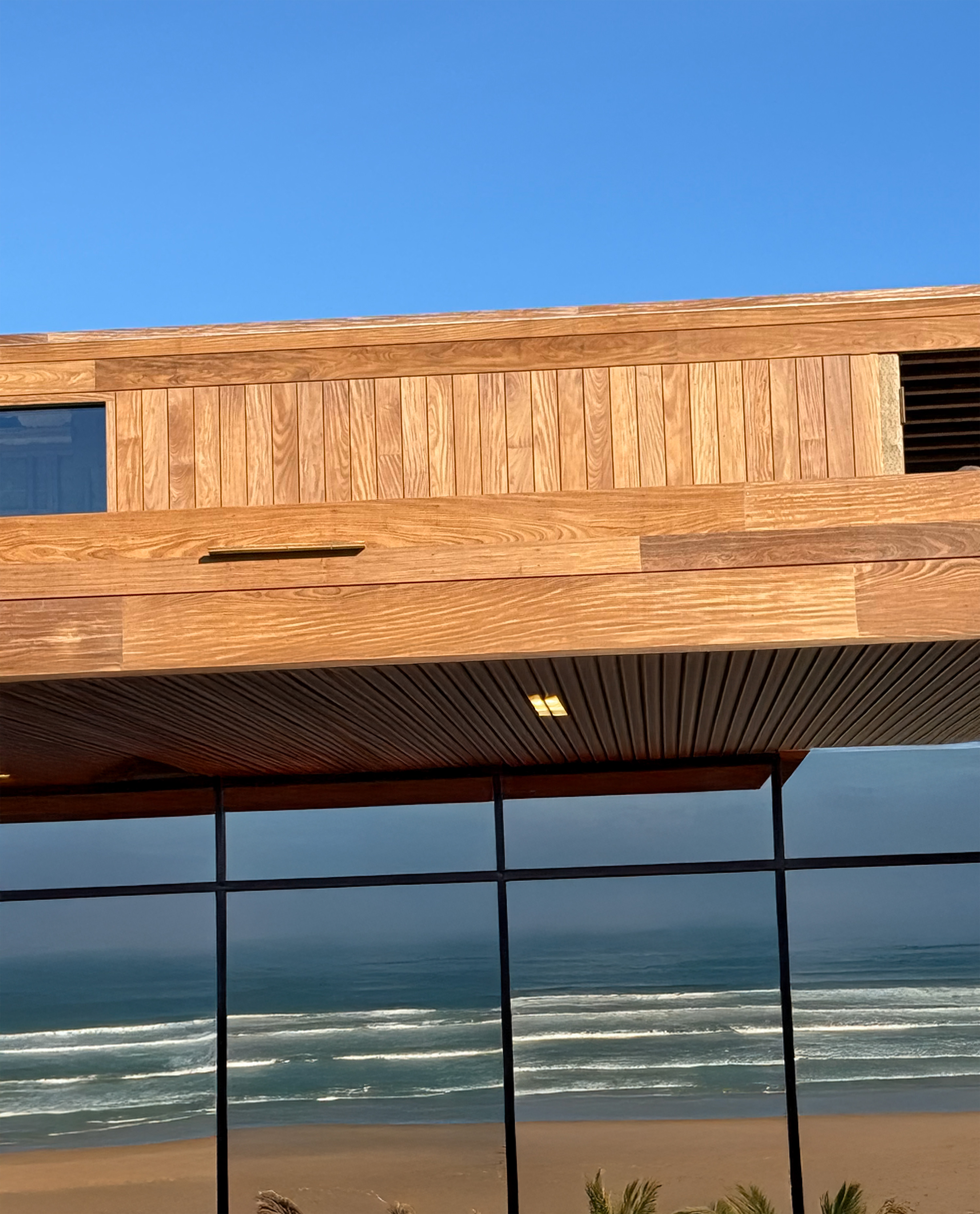
Why Acoustic Performance Matters for Wood-Clad Facades
Exterior noise intrusion ranks among the top three complaints in post-occupancy evaluations of multifamily buildings, yet sound attenuation through the building envelope receives far less design attention than thermal performance or moisture management. For architects specifying wood siding on urban multifamily, mixed-use, and hospitality projects, acoustic performance is no longer optional—it is increasingly codified.
The International Code Council (ICC) references ASTM standards for airborne sound transmission through exterior wall assemblies, and municipalities from Seattle to New York now include specific STC or OITC minimums in their building codes for facades facing roadways, rail corridors, or flight paths. Wood siding, long valued for its aesthetic warmth and sustainability credentials, must now demonstrate quantifiable acoustic performance within these assemblies.
This article examines how wood siding contributes to—and sometimes limits—the sound attenuation of exterior wall systems. We will analyze the physics of sound transmission through wood cladding, compare species by density and damping characteristics, review tested assembly configurations, and provide specification guidance for architects targeting STC 50+ performance with real wood facades.
Fundamentals of Sound Transmission Through Building Envelopes
How Sound Moves Through Wall Assemblies
Sound transmission through an exterior wall follows three primary pathways: direct transmission through the mass of solid materials, flanking transmission through structural connections and air paths, and resonant transmission at the coincidence frequency of panel materials. For wood siding assemblies, all three pathways matter, but the relative contribution of each depends on the assembly configuration.
The ASTM International standard E90 (laboratory measurement) and E966 (field measurement) define the testing protocols for Sound Transmission Class (STC) and Outdoor-Indoor Transmission Class (OITC) ratings. STC emphasizes mid-frequency performance (500–2000 Hz) relevant to speech privacy, while OITC weights low-frequency performance (80–500 Hz) relevant to traffic and aircraft noise. For exterior facades, OITC is technically the more appropriate metric, though STC remains more commonly specified due to historical precedent and broader familiarity among design teams.
Mass Law and Its Limitations
The fundamental mass law predicts that sound transmission loss (TL) increases by approximately 6 dB for each doubling of surface mass. A 19mm (3/4") board of Ipe at 1,050 kg/m³ delivers roughly 2.5 times the surface mass of a 19mm Western Red Cedar board at 370 kg/m³—a difference of approximately 8 dB in theoretical transmission loss from mass alone.
However, mass law applies only to limp, infinite panels without resonance or coincidence effects. Real wood siding panels have stiffness, finite dimensions, and mounting conditions that create resonant frequencies and coincidence dips. The coincidence frequency—where the bending wavelength in the panel equals the acoustic wavelength in air—creates a significant dip in transmission loss that varies by species, thickness, and grain orientation. For typical wood siding profiles (19–25mm thick), coincidence frequencies fall between 2,000 and 5,000 Hz, overlapping significantly with the STC weighting range.
Mass-Air-Mass Resonance in Rainscreen Systems
Rainscreen cladding systems introduce a critical acoustic variable: the air cavity between the cladding and the weather-resistive barrier (WRB) or sheathing. This creates a mass-air-mass system with its own resonant frequency, typically between 80 and 200 Hz depending on cavity depth and cladding mass. Below this resonant frequency, the double-leaf system performs worse than a single-leaf system of equivalent mass. Above it, performance improves at approximately 12 dB per octave—double the rate of a single-leaf system.
For architects already specifying rainscreen cladding systems for moisture management and thermal performance, this acoustic benefit represents a significant additional value proposition—provided the cavity depth and connection details are optimized for acoustic as well as hygrothermal performance.
Species Density and Acoustic Properties of Common Siding Species
Wood species vary enormously in the properties that determine acoustic performance: density, internal damping (loss factor), stiffness-to-mass ratio, and grain uniformity. The USDA Forest Products Laboratory (FPL) has published extensive data on these properties, and their relevance to cladding acoustics is more nuanced than simple density rankings suggest.
High-Density Tropical Hardwoods
Species like Ipe (Tabebuia spp., 1,050 kg/m³), Jatoba (Hymenaea courbaril, 910 kg/m³), and Cumaru (Dipteryx odorata, 1,070 kg/m³) deliver the highest surface mass per unit thickness. A 25mm Ipe cladding board contributes approximately 26 kg/m² of surface mass—comparable to a 12mm fiber cement panel. These species are available through suppliers like J. Gibson McIlvain's tropical hardwood program, which stocks cladding-grade material in standard profiles.
However, high-density tropical hardwoods also have high stiffness (modulus of elasticity typically 14,000–22,000 MPa), which pushes their coincidence frequency lower into the STC-critical range. The net effect is that their mass advantage is partially offset by a more pronounced coincidence dip between 2,500 and 3,500 Hz. Internal damping (loss factor) in tropical hardwoods ranges from 0.006 to 0.012—moderate by wood standards but lower than softwoods, meaning coincidence effects are less naturally attenuated.
Medium-Density Hardwoods and Modified Wood
Species in the 550–750 kg/m³ range—including White Oak (Quercus alba, 680 kg/m³), Sapele (Entandrophragma cylindricum, 640 kg/m³), and Genuine Mahogany (Swietenia macrophylla, 590 kg/m³)—offer a balanced acoustic profile. Their coincidence frequencies fall higher (3,500–5,000 Hz), partially outside the STC weighting curve, while still providing meaningful mass contribution.
Thermally modified wood products occupy an interesting acoustic position. Thermory ash (treated at 212°C) retains approximately 85–90% of untreated ash density (590–620 kg/m³ vs. 670 kg/m³) while gaining a slightly higher loss factor due to the modification of hemicelluloses. Abodo Vulcan (thermally modified radiata pine) undergoes a similar density reduction but starts from a lower baseline (480–500 kg/m³ treated vs. 530 kg/m³ untreated). Both products show marginally improved damping characteristics compared to their unmodified counterparts, which can partially offset the mass reduction in acoustic calculations. For a deeper comparison of these products, see our guide to wood siding species selection for commercial and multifamily projects.
Lower-Density Softwoods
Western Red Cedar (370 kg/m³), Pine (510 kg/m³), and Spruce (430 kg/m³) deliver less mass per unit thickness but possess higher internal damping and higher coincidence frequencies. Their acoustic contribution within a complete assembly is modest—typically 2–4 dB less transmission loss than an equivalent-thickness high-density hardwood when measured in isolation. However, in a complete rainscreen assembly where the sheathing, insulation, and structure dominate total performance, the species-dependent difference narrows to 1–2 dB in many configurations.
| Species | Density (kg/m³) | Surface Mass at 25mm (kg/m²) | Estimated Coincidence Freq. (Hz) | Loss Factor (η) | Estimated TL at 500 Hz (dB)* |
|---|---|---|---|---|---|
| Ipe | 1,050 | 26.3 | 2,800 | 0.008 | 28 |
| Jatoba | 910 | 22.8 | 3,100 | 0.009 | 27 |
| White Oak | 680 | 17.0 | 3,600 | 0.010 | 25 |
| Sapele | 640 | 16.0 | 3,800 | 0.010 | 24 |
| Genuine Mahogany | 590 | 14.8 | 4,000 | 0.011 | 23 |
| Thermory Ash | 600 | 15.0 | 4,100 | 0.013 | 23 |
| Abodo Vulcan | 490 | 12.3 | 4,400 | 0.014 | 22 |
| Accoya (Radiata Pine) | 510 | 12.8 | 4,300 | 0.012 | 22 |
| Douglas Fir | 530 | 13.3 | 4,200 | 0.011 | 22 |
| Western Red Cedar | 370 | 9.3 | 5,200 | 0.015 | 19 |
| Cypress | 510 | 12.8 | 4,300 | 0.012 | 22 |
| *Estimated single-panel TL at 500 Hz based on mass law with coincidence correction. Assembly TL will be significantly higher. Values are representative and will vary with grade, moisture content, and profile geometry. | |||||
Assembly Configurations and Tested STC Performance
The cladding species matters, but the complete assembly determines whether a project meets its acoustic targets. The American Wood Council (AWC) and the WoodWorks program maintain databases of tested wall assemblies that include STC and OITC data for various wood-frame configurations.
Baseline: Direct-Applied Wood Siding
Wood siding applied directly over sheathing without a ventilated cavity represents the lowest-performing acoustic configuration. Typical assembly: 25mm wood siding → building paper → 12mm OSB sheathing → 2×6 stud cavity with fiberglass batt → 16mm gypsum board interior. This configuration typically achieves STC 38–42 depending on cladding density and stud spacing.
The direct connection between siding and sheathing creates a rigid bridge that efficiently conducts vibrational energy into the structure. Every nail or screw acts as a point of acoustic coupling. While this approach has largely fallen out of favor for moisture management reasons, some budget-driven projects still specify it, and its acoustic limitations should be understood.
Furring Strip Systems: Partial Decoupling
Adding furring strips (typically 19mm × 38mm or 19mm × 64mm) between the siding and sheathing introduces a partial air gap and reduces direct coupling area. This is the most common approach for projects implementing ventilated rainscreen assemblies. The acoustic benefit depends on furring strip spacing, material, and attachment method.
Standard wood furring at 400mm o.c. provides approximately 2–4 dB improvement over direct application—modest but meaningful. The improvement comes primarily from reduced coupling area (the siding contacts the structure only at furring locations) and the introduction of a shallow air cavity that adds mass-air-mass decoupling above the system's resonant frequency.
For projects requiring higher acoustic performance, several strategies improve upon standard furring:
- Increased cavity depth: 38mm furring provides 3–5 dB improvement over 19mm furring due to lower mass-air-mass resonant frequency
- Resilient furring channels: Steel hat channels with resilient mounting provide 6–10 dB improvement over rigid wood furring by introducing a flexible connection that dissipates vibrational energy
- Cavity absorption: Adding 25mm mineral wool or open-cell foam within the rainscreen cavity absorbs standing waves and eliminates cavity resonances, adding 2–4 dB
- Reduced furring spacing: Counter-intuitively, wider furring spacing (600mm vs. 400mm) can improve acoustics by reducing coupling points, though this must be balanced against cladding support requirements
Optimized Rainscreen Assemblies: STC 50+
Achieving STC 50 or above with wood siding requires deliberate acoustic design of the complete assembly. Tested configurations that reach this threshold typically include:
Configuration A (STC 52–55): 25mm dense hardwood siding (Ipe/Jatoba) → 38mm ventilated cavity on resilient clips → self-adhered WRB → 16mm exterior gypsum sheathing → 2×6 studs at 600mm o.c. with mineral wool batt → resilient channel → 2× 16mm Type X gypsum board
Configuration B (STC 48–52): 25mm medium-density siding (Mahogany/Oak/Thermory Ash) → 38mm cavity on wood furring → WRB → 12mm plywood sheathing → 2×6 studs with fiberglass batt → 16mm gypsum board
Configuration C (STC 55–60): 25mm wood siding (any species) → 50mm cavity with 25mm mineral wool absorber → WRB → 16mm exterior gypsum → staggered 2×4 studs on 2×6 plate with mineral wool → resilient channel → 2× 16mm gypsum board
The jump from Configuration B to Configuration C illustrates a critical principle: once the cladding and cavity are reasonably optimized, further acoustic gains come from the structural wall behind—staggered studs, double gypsum layers, and resilient mounting of the interior finish contribute more than upgrading the exterior cladding species.
Mass Timber and CLT Substrates
Cross-laminated timber (CLT) substrates change the acoustic calculus significantly. A 5-ply CLT panel (175mm) provides STC 33–36 on its own—higher mass than a wood-frame wall but with problematic coincidence characteristics due to the panel's orthotropic stiffness. Adding a wood rainscreen cladding system over CLT with proper decoupling can achieve STC 48–55 without interior furring, which is valuable for projects exposing the CLT interior.
Design Variables That Control Acoustic Performance
Cavity Depth Optimization
The rainscreen cavity depth affects both hygrothermal and acoustic performance. From a purely acoustic standpoint, deeper cavities lower the mass-air-mass resonant frequency, extending the frequency range over which the double-leaf benefit applies. The relationship follows:
f₀ = 60 / √(d × (1/m₁ + 1/m₂))
Where f₀ is the resonant frequency in Hz, d is the cavity depth in meters, and m₁ and m₂ are the surface masses (kg/m²) of the two leaves. For a typical assembly with 25mm Ipe cladding (26 kg/m²) and 16mm gypsum sheathing (13 kg/m²) with a 38mm cavity, f₀ ≈ 115 Hz. Increasing to a 50mm cavity drops this to approximately 100 Hz, extending effective double-leaf behavior by roughly one-third octave.
However, cavity depth beyond 50mm provides diminishing acoustic returns while increasing structural demands on furring and clips. The practical optimum for most projects balances at 38–50mm, aligning with the moisture ventilation requirements already specified for durability. For detailed guidance on cavity dimensioning and ventilation, refer to our analysis of rainscreen cladding species profiles and installation details.
Connection Rigidity and Flanking Paths
Every mechanical connection between the cladding and the structure is a potential acoustic bridge. The transmission loss of the most carefully designed assembly can be undermined by rigid point connections that bypass the air cavity's decoupling effect. This is where clip and fastener selection becomes acoustically critical.
Standard aluminum rainscreen clips with direct screw connections transmit approximately 60–70% of the vibration that a fully rigid connection would. Clips incorporating neoprene or EPDM isolation pads reduce this to 20–30%. Purpose-designed acoustic isolation clips (such as those used in interior partition systems adapted for exterior use) can reduce structural transmission to 5–10% of the rigid case.
The challenge for exterior wood cladding is that acoustic isolation clips must also resist wind loads, seismic forces, and thermal movement without degrading over a 30+ year service life. The National Fire Protection Association (NFPA) fire testing requirements for exterior cladding attachments add another constraint—clips must maintain structural integrity during fire exposure, which limits the use of polymer isolation elements in some assemblies.
Joint Design and Air Sealing
Sound travels through the path of least resistance. A 1mm gap in an otherwise STC 55 assembly can reduce field performance to STC 35–40 in the area of the gap. For wood siding, joints between boards, transitions at windows and doors, and penetrations for services all represent potential acoustic weak points.
Tongue-and-groove profiles provide better acoustic performance than open-joint (spaced) profiles because they eliminate direct air paths through the cladding layer. Shiplap profiles fall between—the overlap blocks direct transmission but the gap at the overlap creates a tortuous path that still transmits some sound energy.
Open-joint rainscreen designs, increasingly popular for their contemporary aesthetic and superior ventilation, are acoustically the most challenging. The open joints essentially eliminate the cladding's contribution to mass-based sound blocking at low frequencies, making the assembly dependent entirely on the backing layers for acoustic performance. Projects specifying open-joint wood cladding in acoustically sensitive locations should design the WRB/sheathing assembly to meet acoustic targets independently of the cladding layer.
Profile Geometry and Surface Treatment
Board profile affects acoustic performance in two ways: it determines the effective mass per unit area (a beveled lap siding profile has variable thickness), and surface texture affects diffusion of reflected sound on the exterior face. While the diffusion effect is primarily relevant to exterior acoustic environments (courtyard noise, for example), the mass variation can be significant.
A standard beveled cedar siding profile varies from 12mm at the thin edge to 19mm at the thick edge, yielding an average surface mass of approximately 5.8 kg/m² compared to 7.0 kg/m² for a uniform 19mm board. This 17% mass reduction corresponds to approximately 1.5 dB lower TL—minor individually but additive with other compromises.
Code Requirements and Performance Targets
Current Code Landscape
The International Building Code (IBC) Section 1207 addresses sound transmission in dwelling units, primarily focused on interior partition performance (STC 50 minimum between dwelling units). Exterior wall acoustic requirements vary significantly by jurisdiction and are often triggered by specific site conditions rather than applied universally.
Common triggers for exterior acoustic requirements include:
- Sites within 300m of highways with ADT > 20,000 vehicles
- Sites within noise contours of airports (typically DNL 65+)
- Sites adjacent to rail corridors
- Mixed-use buildings with ground-floor retail/restaurant uses
- Projects seeking LEED, WELL, or Fitwel certification with acoustic credits
When triggered, typical requirements range from OITC 30 (minimal, equivalent to approximately STC 38–40) to OITC 40+ (stringent, equivalent to approximately STC 48–52) depending on the exterior noise level and the intended interior use.
Voluntary Standards and Green Building Programs
The WELL Building Standard v2 requires acoustic performance testing and specifies maximum interior noise levels (35 dBA in bedrooms, 40 dBA in living areas) that effectively mandate exterior wall STC performance based on the site noise environment. For a site with L₁₀ exterior noise of 70 dBA (typical urban arterial), achieving 35 dBA interior requires an exterior wall assembly delivering approximately OITC 35—achievable with most properly detailed wood rainscreen assemblies.
Passive House certification, while primarily thermal, inadvertently supports acoustic performance through its requirements for continuous insulation, air-tight construction, and triple-glazed windows—all elements that also improve sound attenuation. Projects targeting Passive House certification with wood cladding often achieve STC 50+ as a co-benefit of their thermal design. For species suitable for both Passive House and acoustic performance, see our guide to Passive House wood cladding species selection.
Specification Strategies for Acoustic Performance
Performance vs. Prescriptive Specifications
Acoustic performance can be specified prescriptively (defining exact assembly materials and configurations based on tested assemblies) or by performance (requiring a minimum STC/OITC and allowing the contractor flexibility in achieving it). Each approach has implications for wood siding projects.
Performance specifications offer flexibility but create risk: if the contractor's assembly fails testing, remediation of an installed cladding system is enormously expensive. Prescriptive specifications based on laboratory-tested assemblies provide certainty but may limit optimization. The recommended approach for most projects is a hybrid—specify minimum performance with a prescriptive deemed-to-comply option that the contractor may substitute only with equivalent tested data.
Species Selection for Acoustic Targets
For projects where acoustic performance is a primary driver, species selection should be evaluated within the context of the complete assembly. The practical decision tree:
- STC 45–48 target: Any species appropriate for the project's durability, aesthetic, and budget requirements. Assembly design (cavity depth, insulation, interior layers) dominates performance. Cedar, Cypress, Accoya, Thermory, or Abodo Vulcan all work within properly designed assemblies.
- STC 48–52 target: Medium to high-density species (Sapele, Mahogany, White Oak, Thermory Ash) provide meaningful mass contribution. Assembly must include mineral wool in stud cavity and proper decoupling.
- STC 52+ target: High-density tropical hardwoods (Ipe, Jatoba, Cumaru) maximize cladding mass contribution, but the assembly must also include resilient connections, double gypsum interior, and ideally staggered studs. At this level, assembly design contributes 70%+ of performance regardless of species.
Detailing for Acoustic Continuity
The highest-performing laboratory assembly will fail in the field if acoustic flanking paths exist at transitions. Critical details requiring acoustic attention include:
- Window head and sill: The transition from opaque wall to glazing concentrates stress on the weakest acoustic element (typically the window). Cladding returns and trim at windows should maintain the decoupled cavity principle.
- Base of wall/foundation: Siding termination at grade must be sealed against sound flanking underneath the cladding, particularly in areas with continuous insect screening that may create acoustic openings.
- Roof/parapet transitions: Sound flanking over the top of walls is common when the cladding terminates before the roof assembly begins.
- Service penetrations: Each pipe, conduit, or vent through the wall creates an acoustic weak point requiring acoustic sealant and proper sleeving.
- Control joints: Movement joints in the cladding must accommodate thermal expansion while maintaining acoustic continuity—typically achieved with compressible acoustic sealant backing.
Material Sourcing and Chain of Custody
Acoustic performance specifications require consistent material density, which in turn requires reliable sourcing of species with predictable properties. Wild variation in density within a species—common with ungraded tropical hardwoods from inconsistent supply chains—creates unpredictable acoustic performance across a facade.
Working with established suppliers who maintain grading standards and FSC chain-of-custody certification ensures material consistency. The National Hardwood Lumber Association (NHLA) grading rules provide baseline quality assurance, while PEFC certification offers additional chain-of-custody verification for projects requiring sustainability documentation alongside acoustic performance data.
J. Gibson McIlvain's hardwood inventory maintains species-specific grading with documented density ranges, enabling architects to specify acoustic performance with confidence that delivered material will match design assumptions. This is particularly critical for high-density tropical species where plantation-grown and old-growth material can differ by 15–20% in density.
"When architects spec a wall assembly for STC 52 and the cladding density assumption is based on old-growth Ipe at 1,080 kg/m³, but the delivered material is younger plantation stock at 920 kg/m³, that's a potential 2 dB shortfall in the cladding layer. We work with design teams early to confirm species availability and density ranges so the acoustic engineer's model matches what actually goes on the building."
— David McIlvain, President, J. Gibson McIlvain Company
Field Testing and Verification
Laboratory vs. Field Performance
Laboratory STC ratings (tested per ASTM E90 in a transmission loss suite) consistently exceed field STC ratings (tested per ASTM E966 on the installed assembly) by 3–7 dB. This "field-laboratory gap" results from flanking paths, construction imperfections, and the finite panel sizes of real installations. Specifications should account for this gap by targeting laboratory ratings 5 dB above the required field performance.
Commissioning Acoustic Performance
For projects with mandatory exterior acoustic requirements, field testing should be specified as part of building commissioning. ASTM E966 provides the standard methodology for measuring apparent sound transmission loss of exterior building facades. Testing should occur after the facade is complete but before interior finishes that might mask deficiencies—allowing remediation of flanking paths while the wall assembly is still accessible.
Common field deficiencies found during acoustic commissioning of wood-clad facades include:
- Gaps in acoustic sealant at penetrations (accounting for 40% of failures)
- Missing or displaced cavity insulation behind services
- Rigid bridging through acoustic clips due to over-driven fasteners
- Air paths at cladding base where ventilation screening gaps are excessive
- Flanking through window frames where sealant has not been continuously applied
Cost-Benefit Analysis of Acoustic Upgrades
Acoustic performance improvements in wood siding assemblies range from no-cost design decisions to significant material premiums. Understanding the cost-performance relationship helps architects allocate budget effectively.
Low/no cost improvements (0–3 dB gain):
- Specifying tongue-and-groove or shiplap profiles instead of open-joint designs
- Increasing furring strip spacing from 400mm to 600mm where structurally viable
- Ensuring continuous WRB with taped seams (standard practice for moisture, acoustic co-benefit)
- Specifying denser species within the same budget tier (e.g., Douglas Fir vs. Cedar)
Moderate cost improvements (3–6 dB gain, $5–15/m² additional):
- Upgrading from 19mm to 38mm furring cavity depth
- Adding 25mm mineral wool in the rainscreen cavity
- Upgrading to exterior gypsum sheathing from OSB
- Specifying acoustic sealant at all penetrations and transitions
Higher cost improvements (6–12 dB gain, $20–50/m² additional):
- Resilient isolation clips for cladding mounting
- Double gypsum board interior finish
- Staggered stud framing
- Higher-density species (tropical hardwoods vs. softwoods, $30–80/m² material premium)
The American Wood Protection Association (AWPA) standards ensure that preservative treatments—sometimes required for lower-durability species used in cladding—do not significantly affect density or acoustic properties, meaning treatment selection can be made independently of acoustic considerations.
Emerging Technologies and Future Directions
Acoustic Optimization Through Digital Fabrication
CNC-profiled wood cladding panels with integrated acoustic features—perforations, resonator chambers, or tuned mass damper geometries—represent an emerging area where wood siding can provide both sound blocking (transmission loss) and sound absorption (reducing reflected noise in courtyards and urban canyons). While primarily relevant to exterior acoustic environments rather than interior noise control, these dual-function panels may become increasingly specified as urban acoustic regulations expand.
Bio-Based Acoustic Interlayers
Research into cellulose-based acoustic membranes that can be integrated between wood cladding layers offers potential for significantly improved acoustic performance without synthetic materials. Cork-wood composites, mycelium-based panels, and recycled cellulose fiber boards are all being evaluated as cavity absorbers with superior environmental profiles compared to mineral wool.
Predictive Modeling and Optimization
Finite element modeling (FEM) of wood cladding acoustic performance is becoming more accessible, allowing species-specific optimization of profile geometry, fastener patterns, and cavity configurations. As modeling tools improve and species property databases expand, architects will be able to optimize acoustic performance digitally before committing to material procurement—further strengthening the case for long-lifespan hardwood cladding specifications that deliver verified performance.
How McIlvain Would Specify This for a Real Project
When a project requires verified acoustic performance from a wood siding assembly, we approach the specification collaboratively with the acoustic consultant and architect. The starting point is always the target—not the species. A common request might be: "We need OITC 35 on the north facade facing the highway, wood cladding, contemporary horizontal profile, 30-year durability." From there, we work backward through assembly options.
For OITC 35 (roughly STC 45 laboratory equivalent with a 5 dB field margin), almost any species works if the assembly behind is properly designed. We'd typically recommend Thermory ash or Abodo Vulcan for thermally modified stability with moderate density, or Accoya for acetylated durability with consistent dimensional properties. If the project aesthetic calls for a tropical hardwood character, Sapele or Genuine Mahogany provide excellent density-to-cost ratios at this performance level.
For projects needing OITC 40+ (STC 52+ laboratory), we push toward Ipe or Jatoba for the mass contribution, specify 38mm minimum cavity depth on resilient clips, and coordinate with the structural engineer on staggered stud framing or CLT backing. At this performance tier, we also verify density by lot—pulling representative samples from the shipment and confirming specific gravity matches the design assumptions.
Performance and Procurement Checklist
- Confirm target STC or OITC rating with acoustic consultant—distinguish between laboratory target and field requirement
- Determine exterior noise environment (dBA L₁₀ at facade) to validate that the assembly target is sufficient for interior criteria
- Select species based on density requirement, durability class, aesthetic preference, and budget—in that priority order for acoustically driven projects
- Verify available inventory density ranges with McIlvain before finalizing acoustic model assumptions
- Specify profile type (T&G, shiplap, or open-joint) and confirm acoustic consultant has accounted for the profile's air-path characteristics
- Confirm cavity depth aligns with both acoustic optimization (mass-air-mass resonance) and ventilation requirements (minimum 19mm clear for drying)
- Specify clip/fastener type and confirm dynamic stiffness values are included in acoustic model
- Identify all penetrations, transitions, and control joints requiring acoustic detailing
- Include field acoustic testing in commissioning specification if project exceeds STC 48 target
- Coordinate lead times—high-density tropical species typically require 8–12 week procurement; thermally modified products 4–8 weeks
Where Specifications Usually Fail
The most common failure we see is acoustic specifications that reference generic "wood siding" without density parameters. An acoustic model built assuming 650 kg/m³ (hardwood) that gets value-engineered to 370 kg/m³ (cedar) without recalculating the assembly performance loses 4–5 dB of cladding contribution—potentially dropping below the required threshold.
Second most common: projects that specify the right cladding and assembly but fail to detail transitions. A beautifully specified STC 52 wall assembly with a 10mm gap at the base vent screen performs at STC 35–38 locally. We recommend architects issue specific acoustic transition details—not just typical wall sections—for base, head, jamb, corner, and penetration conditions.
Third: treating the cladding specification and the acoustic specification as separate documents. The Division 07 cladding spec says "Ipe, 25mm, rainscreen per detail." The acoustic spec says "STC 50 minimum per ASTM E90." But nobody has confirmed that the specific Ipe profile, clip type, and cavity depth in Division 07 actually delivers STC 50 when tested as a system. We push for an integrated spec note that ties the acoustic requirement to the specific assembly configuration.
Ordering Information to Resolve Before Pricing
- Species and density range (not just species name—specify minimum specific gravity)
- Profile dimensions and type (net thickness after profiling affects surface mass)
- Board length requirements (longer boards = fewer end joints = fewer potential acoustic weak points)
- Grade and allowable characteristics (tight knots, sapwood percentage affect density consistency)
- Certification requirements (FSC, PEFC) and chain-of-custody documentation needs
- Quantity with waste factor (acoustic-grade material with tight density tolerances may require additional procurement buffer)
- Delivery schedule relative to facade installation sequence
- Whether density testing/verification is required per lot
Related McIlvain Guidance and Next Steps
For architects developing acoustic specifications with wood cladding, we recommend reviewing these related resources:
- Commercial Cladding and Rainscreen Systems — assembly configurations, clip selection, and cavity design
- Wood Siding Comparison for Architects — species performance data including density ranges by source
- Passive House Wood Cladding Species — thermal and airtightness co-benefits that support acoustic performance
- Thermally Modified Wood Guide — density and property changes through thermal modification of Thermory and Abodo Vulcan products
Contact our specification support team at mcilvain.com/contact-us or call directly for density verification data on current inventory, acoustic assembly consultation, or sample requests for acoustic testing. We regularly coordinate with acoustic consultants on assembly modeling and can provide certified density data by lot for projects where acoustic commissioning is required.
Frequently Asked Questions
What STC rating can wood siding achieve compared to fiber cement or metal cladding?
Wood siding assemblies can achieve STC ratings comparable to or exceeding fiber cement and metal cladding systems. A properly designed wood rainscreen assembly with high-density species (Ipe, Jatoba) at 25mm thickness can reach STC 52–60 in optimized configurations. Fiber cement typically offers slightly higher mass per unit thickness but lower damping, while metal cladding has very low mass and relies entirely on the backing assembly for acoustic performance. The key insight is that at STC 48+, the assembly behind the cladding—insulation, framing, interior layers—contributes 70% or more of total performance regardless of cladding material.
Does an open-joint rainscreen design significantly reduce acoustic performance?
Yes, open-joint designs reduce the cladding layer's contribution to low-frequency sound blocking because the gaps create direct air paths through the cladding leaf. At frequencies below approximately 1,000 Hz, the cladding's mass-law contribution is significantly compromised. However, this does not mean open-joint designs cannot meet acoustic targets—it means the assembly behind the cladding must be designed to meet targets independently. For projects requiring STC 50+ with open-joint aesthetics, specify exterior gypsum sheathing as the primary sound-blocking layer and treat the wood cladding as a rain screen and aesthetic element only.
How much does wood species selection actually matter for acoustic performance?
Species selection matters most at moderate performance targets (STC 45–52) where the cladding's mass contribution meaningfully differentiates assemblies. Upgrading from Western Red Cedar (370 kg/m³) to Ipe (1,050 kg/m³) at 25mm thickness adds approximately 17 kg/m² of surface mass, translating to 7–9 dB of additional cladding-layer TL. However, in a complete assembly context, this translates to approximately 3–5 dB of system-level improvement—significant but not transformative. At STC 55+, the assembly design dominates and species choice becomes secondary to structural framing type, interior finish layers, and connection details.
Can thermally modified wood (Thermory, Abodo Vulcan) meet acoustic specifications?
Yes. Thermally modified products lose 10–15% of their original density through the modification process, which modestly reduces their mass-based sound blocking. However, they gain slightly higher internal damping (loss factor), which partially compensates by reducing coincidence dip severity. Thermory ash at 600 kg/m³ performs comparably to unmodified Sapele or Mahogany in acoustic assemblies. For projects targeting STC 50+, thermally modified products work within properly designed assemblies—the 1–2 dB difference versus a higher-density species is easily compensated by assembly improvements like increased cavity depth or cavity absorption.
What is the most cost-effective way to improve acoustic performance of an existing wood siding specification?
The single most cost-effective acoustic improvement is adding 25mm semi-rigid mineral wool within the rainscreen cavity. At approximately $8–12/m² installed, this eliminates cavity resonances, absorbs standing waves, and typically adds 3–5 dB to system performance without changing the cladding, structure, or interior finish. The second most effective upgrade is switching from rigid wood furring to resilient isolation clips ($10–15/m² premium), which can add 5–8 dB by decoupling the cladding mass from the structure. Both improvements also enhance thermal performance as co-benefits.
Sources
- ASTM E90-09 — Standard test method for laboratory measurement of airborne sound transmission loss of building partitions and elements
- ASTM E966-04 — Standard guide for field measurements of airborne sound attenuation of building facades and facade elements
- USDA Forest Products Laboratory GTR-190 Chapter 5 — Mechanical properties of wood including density, modulus of elasticity, and damping by species
- American Wood Council — Technical publications on wood-frame wall assembly performance including acoustic data
- WoodWorks — Design resources for wood building systems including acoustic assembly database
- International Code Council — International Building Code Section 1207, sound transmission requirements for dwelling units
- NFPA — Fire testing requirements for exterior cladding attachment systems
- Forest Stewardship Council — Chain-of-custody certification ensuring material traceability and consistency for specification compliance
- Thermory — Technical specifications for thermally modified ash, pine, and spruce cladding products
- Abodo — Vulcan thermally modified radiata pine cladding technical data and installation guidance


