The Calculation
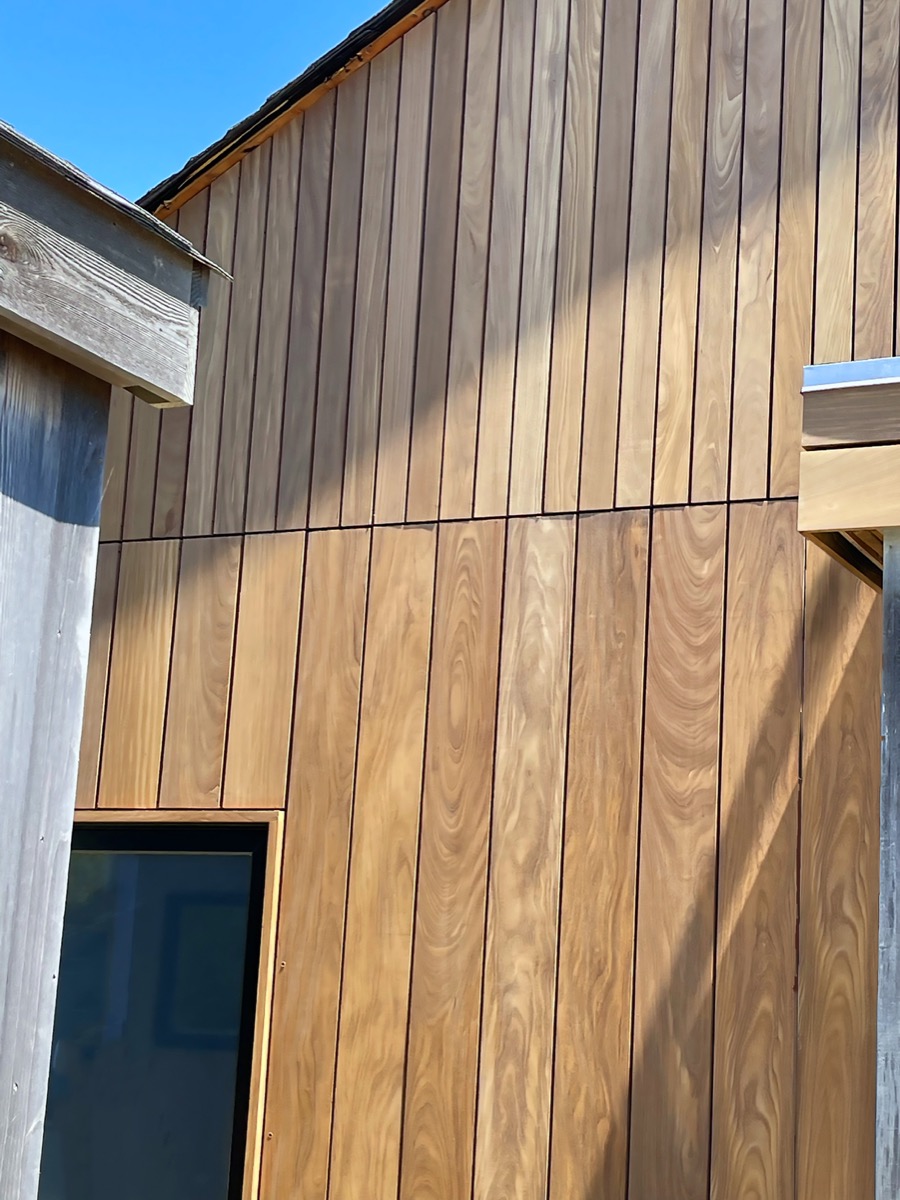
Per the USDA Wood Handbook: Width change = Board width × Shrinkage coefficient × MC change. For 6" flatsawn cedar (tangential shrinkage 0.21%/1% MC) with 10% MC seasonal swing: 6" × 0.0021 × 10 = 0.126" ≈ 1/8".
| Species | Open-Joint Gap | Shiplap Overlap | Reasoning |
|---|---|---|---|
| Western Red Cedar | 1/8" min | 1" overlap min | 5.0% tangential shrinkage |
| Cypress | 5/32" min | 1-1/4" overlap | 6.2% tangential |
| Douglas Fir | 3/16" min | 1-1/4" overlap | 7.8% tangential |
| Thermally Modified Ash | 1/16" min | 3/4" sufficient | 50-70% ASE |
| Accoya | 1/16" or less | 3/4" sufficient | 75% ASE |
Climate Adjustments
- Northeast/Midwest (Zones 4-6): Use full recommendations — maximum humidity swing
- Southeast (Zones 2-3A): Reduce 20% — consistently high humidity narrows MC swing
- Southwest/Mountain (dry): Reduce 30-40% — low humidity = minimal movement
Installation Timing Matters
Installing in summer (boards swollen): install tight — they'll shrink naturally. Installing in winter (boards dry): install with FULL gap — they'll swell shut in summer. Worst case: kiln-dried boards (6-8% MC) installed tight in winter — severe buckling guaranteed.
Always verify MC with a pin meter. See our moisture content guide for regional targets and our warping prevention guide for species stability data.
"The number one installation mistake: boards installed too tight in summer. Come winter they're fine. Next summer they buckle because there's nowhere to expand. Always gap for the DRIEST condition your climate produces."
— Pius Clapsadl, Director of Operations, J. Gibson McIlvain Co.
How McIlvain Would Specify This for a Real Project
For McIlvain, What Is the Recommended Gap Between Wood Siding Boards for Seasonal Expansion and Contraction? is not just a product-selection question. It is a specification question that has to connect architectural exterior cladding with the way the material will be milled, shipped, handled, fastened, and maintained. The right answer starts with exterior hardwood or modified wood, but it only becomes reliable when the species, profile, finish, wall assembly, and field sequencing are written into the same scope.
The practical decision is usually governed by durability, movement control, profile geometry, and jobsite sequencing. A profile that looks correct in a rendering can fail in service if the board width is too aggressive for the species, if the fastener schedule fights seasonal movement, or if the wall has no drying path behind the siding. That is why McIlvain treats exterior wood as a system: the lumber order, the milling profile, the jobsite details, and the finish schedule all have to support the same performance target.
Species choice should also be tied to the owner’s tolerance for maintenance. Thermally modified ash, Accoya, Sapele, Cypress, Western Red Cedar, and Ipe depending on exposure and design intent can all be correct in the right setting, but they do not age, move, or accept finishes the same way. A project that wants a natural silver-gray patina needs different expectations than one that needs a dark factory finish for ten years. A coastal project needs a different fastener and wash-down conversation than a protected inland facade. Those distinctions are where a specialty lumber supplier adds value beyond simply quoting a board price.
Performance and Procurement Checklist
| Item | Why it matters |
|---|---|
| Exposure class | Confirm rain, salt, UV, freeze-thaw, and wall orientation before selecting species. |
| Profile and movement | Match board width, reveal, overlap, and fastening method to the species movement profile. |
| Grade and appearance | Specify clear, vertical-grain, mixed-grain, or architectural grade rather than relying on generic “premium” language. |
| Moisture content | Require a target moisture range and acclimation plan before installation. |
| Milling tolerance | Hold profile geometry, reveal width, and end-match details consistent across the order. |
| Submittals | Review samples, finish schedule, fastener type, and rainscreen details before release. |
Where Specifications Usually Fail
The most common failure is treating exterior wood as a commodity board order instead of a coordinated wall assembly. In practice, that means the drawings may show wood siding, the finish schedule may name a color, and the wall section may show a rainscreen, but nobody has confirmed whether the actual boards can be sourced, milled, and installed in a way that satisfies all three. When that gap is discovered after framing or after the material arrives, the project loses the ability to make a clean specification decision.
The second failure point is ventilation, end-grain sealing, stainless fasteners, and moisture-content control. Exterior wood is forgiving when water can drain and the boards can dry; it is unforgiving when water is trapped at laps, end cuts, trim returns, or fastener penetrations. Every outside corner, window head, sill, soffit return, and transition between profiles should be reviewed as part of the siding package. If the detail cannot be drawn clearly, it usually cannot be installed consistently by a crew under schedule pressure.
The third failure point is substituting material late. A lower-cost species or a similar-looking profile may appear harmless on a spreadsheet, but the substitution can change shrinkage, finish behavior, fastener holding, and service life. McIlvain’s strongest recommendation is to approve physical samples, profile mockups, and finish samples before release, not after the first bundle is opened on site.
Ordering Information to Resolve Before Pricing
- Exposure: inland, coastal, shaded, south-facing, high-rise, WUI, or heavy rain-screen exposure.
- Profile: exact face width, reveal, overlap, tongue depth, kerf, drip edge, and whether the profile is intended for horizontal or vertical use.
- Finish: unfinished weathering, penetrating oil, factory prefinish, paint, or field-applied coating.
- Appearance: clear, near-clear, select knotty, vertical grain, mixed grain, color-matched bundles, or architect-reviewed samples.
- Assembly: furring thickness, WRB, clip system, screw type, corner trim, opening details, and ventilation path.
- Logistics: lead time, jobsite delivery sequence, board lengths, waste factor, attic/garage storage conditions, and replacement stock.
Related McIlvain Guidance and Next Steps
For a project that is close to specification, the next step is to compare the design intent against available species, profile tooling, finish schedule, and delivery timing. McIlvain can help translate a rendering or architectural detail into a practical lumber order, including sample selection and milling recommendations.
Frequently Asked Questions
What gap between wood siding boards?
Open-joint: 1/8" for cedar, 3/16" for fir, 1/16" for modified woods (6" boards, NE climate). Shiplap: 1" overlap minimum for cedar, 3/4" for modified. Calculate based on species shrinkage × board width × local MC range.
What happens if siding is too tight?
Boards buckle outward in humidity, destroying fastener connections. Requires removal and reinstallation. Far more expensive than excessive gapping. Always err toward more gap.
Do modified woods need expansion gaps?
Yes but much smaller — 1/16" vs. 1/8" for cedar. 50-75% less movement. This is why modified woods excel in precision profiles like nickel-gap.
Sources and Standards Referenced
- USDA Forest Products Laboratory — Shrinkage coefficients and dimensional change data
- Western Red Cedar Lumber Association — Installation spacing
- Accsys Technologies — Accoya gap tolerances