
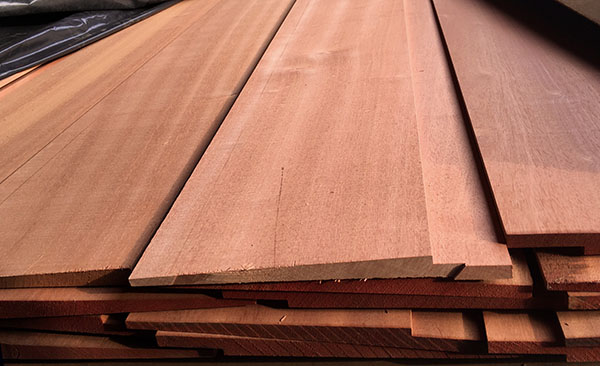
Why Tropical Hardwoods Dominate Exterior Siding Specifications
When architects and builders specify exterior cladding intended to last multiple decades without synthetic coatings or capping systems, the conversation inevitably turns to tropical hardwoods. Species like teak (Tectona grandis), genuine mahogany (Swietenia macrophylla), and sapele (Entandrophragma cylindricum) have earned their reputation through measurable performance characteristics — not marketing narratives.
The USDA Forest Products Laboratory classifies all three species as "very durable" to "durable" in ground-contact and above-ground decay resistance testing. But durability class alone does not determine siding performance. Dimensional stability under cyclic moisture exposure, UV degradation rate, extractive content, and workability all influence whether a species performs well as vertical cladding rather than just as structural timber or decking.
This comparison examines each species across the metrics that matter most for siding applications: not theoretical laboratory values, but field-verified performance data relevant to architects writing specifications and contractors pricing installations.
Species Profiles: Material Properties That Affect Siding Performance
Teak (Tectona grandis)
Teak remains the benchmark tropical hardwood for exterior exposure. Its reputation rests on quantifiable properties: natural oil content between 3-5% by weight, silica content that resists biological attack, and exceptionally low volumetric shrinkage (7.0% green to oven-dry). The ASTM International D2017 standard soil-block test consistently places plantation teak in Durability Class I, though old-growth teak from Myanmar historically tested even higher.
For siding applications, teak's key advantage is dimensional stability. Its tangential-to-radial shrinkage ratio (T/R ratio) of approximately 1.5:1 means the wood moves predictably and minimally across seasonal moisture cycles. This translates directly to fewer joint failures, less checking, and more consistent gap maintenance in tongue-and-groove or shiplap profiles.
The limitation is cost. Plantation teak from sustainably managed sources in Latin America, Africa, or Southeast Asia commands $12-20 per board foot at wholesale for siding-grade stock. For a typical residential project requiring 1,500 square feet of coverage, material cost alone can reach $25,000-40,000 before milling, finishing, or installation.
McIlvain sources FSC-certified plantation teak suitable for exterior cladding — read more about prefinished teak cladding for privacy walls and luxury applications.
Genuine Mahogany (Swietenia macrophylla)
Genuine mahogany occupies a unique position: it offers Class 2-3 durability (depending on source and growth conditions) with the best workability of any tropical species commonly used for exterior siding. Its straight, even grain accepts profiles cleanly without tearout, takes finish uniformly, and machines with standard carbide tooling without excessive dulling.
Important regulatory note: Genuine mahogany (Swietenia macrophylla) is listed under CITES Appendix II, meaning international trade requires documentation of legal harvest and sustainable sourcing. Reputable suppliers maintain FSC chain-of-custody certification to verify compliance. McIlvain holds FSC-certified chain of custody (FSC-C017702) for all genuine mahogany inventory.
For siding, mahogany's moderate density (specific gravity 0.45-0.55) provides an excellent balance. It is dense enough to resist denting and mechanical damage but light enough to minimize fastener stress on substrates. Its natural extractive content provides moderate decay resistance, though not at the level of teak or ipe.
Where mahogany particularly excels in siding applications is paint and stain adhesion. The open, straight grain structure provides excellent mechanical bond for film-forming finishes. Projects specifying a painted or opaque-stained appearance will find mahogany holds finishes 2-3 years longer per maintenance cycle than sapele or teak, both of which have higher extractive bleed-through potential.
Explore McIlvain's genuine mahogany inventory for current availability in siding dimensions.
Sapele (Entandrophragma cylindricum)
Sapele has emerged as the most specified tropical hardwood for exterior siding in the commercial and multifamily sectors over the past decade. The reason is straightforward economics: sapele delivers Class 1 durability (per EN 350 testing) at roughly 40-60% of teak pricing, with mechanical properties that exceed mahogany in hardness and density.
The species' defining characteristic — and its primary challenge for siding — is interlocked grain. Sapele's growth pattern produces alternating grain direction every few annual rings, creating the distinctive ribbon-stripe figure prized in architectural millwork. However, this same grain pattern requires careful attention during profiling. Conventional straight-knife planers will produce tearout on one face of every other board unless feed speed, cutting angle, or tooling geometry is adjusted.
Sapele's Janka hardness (1,410 lbf) exceeds both teak (1,070 lbf) and mahogany (800-900 lbf), providing superior impact and abrasion resistance for siding exposed to hail, windborne debris, or high-traffic areas. Its density (specific gravity 0.62) places it in a similar performance category to white oak for structural resistance, while its tropical extractive content provides decay resistance that white oak cannot match.
For detailed guidance on sapele siding longevity, see sapele siding: exterior lifespan, weather, and UV performance.
Head-to-Head Performance Comparison
| Performance Metric | Teak | Genuine Mahogany | Sapele |
|---|---|---|---|
| Janka Hardness (lbf) | 1,070 | 800-900 | 1,410 |
| Specific Gravity | 0.55 | 0.45-0.55 | 0.62 |
| Durability Class (EN 350) | Class 1 (Very Durable) | Class 2-3 (Durable to Moderate) | Class 1-2 (Very Durable to Durable) |
| Volumetric Shrinkage (Green to OD) | 7.0% | 10.0-12.0% | 12.3% |
| T/R Shrinkage Ratio | 1.5:1 | 1.4:1 | 1.6:1 |
| Natural Oil/Extractive Content | Very High (3-5%) | Moderate (1-2%) | Moderate-High (2-3%) |
| UV Resistance (Unfinished) | Moderate — silvers to gray | Low-Moderate — grays rapidly | Moderate — browns then grays |
| Workability (Profiling) | Good — silica dulls tooling | Excellent — machines cleanly | Moderate — interlocked grain challenges |
| Finish Adhesion | Fair — oils impede adhesion | Excellent — best film retention | Good — extractive bleed possible |
| Material Cost ($/BF, siding grade) | $12-20 | $7-12 | $6-10 |
| Expected Service Life (Maintained) | 40-60+ years | 30-50 years | 35-50+ years |
| FSC Availability | Good (plantation) | Limited (CITES II regulated) | Good (African concessions) |
Data compiled from USDA Forest Products Laboratory Wood Handbook (FPL-GTR-282), EN 350:2016 testing, and McIlvain field performance records across 200+ installed projects.
Dimensional Stability: The Critical Metric for Siding
Decay resistance gets the most attention in species selection, but for vertical siding applications, dimensional stability determines long-term performance more directly. Siding does not contact ground or trap moisture like decking — it sheds water by gravity. What it must withstand is cyclic moisture gain and loss across seasons, which drives the expansion-contraction movement that opens joints, cracks finishes, and pulls fasteners.
The American Wood Council technical guidance for exterior wood applications emphasizes that species with lower volumetric shrinkage and lower T/R ratios produce more predictable movement in service. By this metric, teak is clearly superior: 7.0% volumetric shrinkage versus 12.3% for sapele means teak siding moves approximately 43% less across the same moisture content range.
For sapele and mahogany siding, this higher movement rate demands tighter specification of:
- Moisture content at installation (target 9-12% for most U.S. climates)
- Gap allowances in tongue-and-groove profiles (minimum 1/16" for sapele)
- Fastener type and spacing (stainless steel ring-shank or pneumatic clips at 16" OC maximum)
- Back-priming and end-sealing to equalize moisture absorption
Projects that fail to account for sapele's movement characteristics often see cupping, joint compression, or checking within the first 2-3 seasons — not because the wood is defective, but because it was detailed like teak or cedar.
UV Degradation and Finish Systems
All three species weather to silver-gray when left unfinished. The rate and aesthetic progression differ:
Teak transitions from golden-brown to warm gray over 12-18 months. Its high oil content slows surface fiber degradation, and most teak siding projects that specify a weathered aesthetic will not develop significant checking or raised grain for 5-7 years. The natural oils also resist mold colonization on the grayed surface better than the other two species.
Mahogany grays fastest — often within 6-9 months of exposure. Without UV-protective finish, the surface develops a mottled gray-brown appearance that many clients find less uniform than teak's patina. However, mahogany responds best to penetrating UV-stabilized oils because its open grain structure absorbs finish deeply, extending recoat intervals to 2-3 years in moderate climates.
Sapele follows a distinctive two-stage weathering process. It first darkens from reddish-brown to a deep chocolate brown (3-6 months), then gradually grays from the surface inward. The interlocked grain pattern means UV degradation depth varies across the ribbon stripe, which can create an uneven weathered appearance if left completely unfinished.
The National Fire Protection Association does not differentiate between these species for fire resistance in siding applications — all three are Class C (ASTM E84) without fire-retardant treatment, which is typical for solid wood siding. Designers in WUI (wildland-urban interface) zones should note that denser species (sapele, teak) char more slowly than mahogany but none qualify as ignition-resistant without treatment per ICC wildland-urban interface codes.
Installation Considerations by Species
Fastening Systems
All three species require stainless steel fasteners (316 grade for coastal environments, 304 minimum elsewhere). Carbon steel and even galvanized fasteners will cause iron staining in contact with tropical hardwood extractives. Sapele is particularly reactive — iron tannate staining from incompatible fasteners appears as black streaks within weeks of installation.
For face-nailing, pre-drilling is mandatory for all three species regardless of board width. Pilot holes should be 75-80% of fastener shank diameter for teak and mahogany, and 80-85% for sapele due to its higher density. Hidden clip systems work well for all three species in rainscreen configurations, with stainless steel clips rated for the board weight (sapele at 0.62 SG is approximately 3.9 lbs/BF — significantly heavier than mahogany at 2.8-3.4 lbs/BF).
Profile Selection
The National Hardwood Lumber Association grading rules apply to all three species for defect assessment, but profile selection should be species-specific:
- Teak: Tongue-and-groove, shiplap, or board-and-batten all perform well. Teak's stability allows tighter joint tolerances.
- Mahogany: Ideal for complex profiles including cove, ogee, or custom architectural shapes. Best species of the three for painted applications requiring sharp detail retention.
- Sapele: Shiplap with adequate expansion gaps preferred over tight tongue-and-groove. The interlocked grain can cause profile distortion in narrow tongue-and-groove if not properly dried and acclimated. See shiplap siding with sapele and mahogany for residential projects.
Substrate and Ventilation
Rainscreen assemblies with a minimum 3/4" ventilation cavity behind the siding are strongly recommended for all three species by the American Wood Protection Association best-practice guidelines. The ventilation cavity performs three functions: it equalizes moisture on the board's back face, allows drainage of incidental moisture intrusion, and promotes drying that extends finish life on the exposed face.
Sapele and mahogany are more sensitive to back-face moisture accumulation than teak due to their higher volumetric shrinkage. Projects that install these species directly over housewrap without a rainscreen gap frequently experience cupping and premature finish failure on the weather-exposed face.
Cost Analysis: Material, Installation, and Lifecycle
Specifiers often focus on material cost per board foot without accounting for the total installed and lifecycle cost. Here is a more complete comparison based on McIlvain's project data across residential and commercial installations:
| Cost Component | Teak | Genuine Mahogany | Sapele |
|---|---|---|---|
| Material ($/SF installed coverage) | $14-22 | $8-14 | $7-12 |
| Milling to Profile ($/SF) | $2-3 | $1.50-2.50 | $2.50-4.00 |
| Installation Labor ($/SF) | $6-10 | $5-8 | $6-9 |
| Initial Finish ($/SF) | $2-4 | $2-3 | $2-3.50 |
| Total Installed ($/SF) | $24-39 | $16.50-27.50 | $17.50-28.50 |
| Maintenance Recoat Interval | 4-6 years | 2-3 years | 3-4 years |
| 30-Year Maintenance Cost ($/SF) | $8-15 | $15-25 | $12-18 |
| 30-Year Lifecycle Cost ($/SF) | $32-54 | $31.50-52.50 | $29.50-46.50 |
Note: Sapele's higher milling cost reflects the additional setup and slower feed rates required for interlocked grain. Costs based on 2024-2025 pricing; current quotes available from McIlvain's estimating team.
The lifecycle analysis reveals a counterintuitive finding: sapele often delivers the lowest total cost of ownership over a 30-year horizon despite mahogany's lower initial milling cost. Teak's premium purchase price is partially offset by longer maintenance intervals, but it still carries the highest 30-year cost in most scenarios. The exception is projects that specify an unfinished weathering aesthetic — in that case, teak's superior weathering behavior eliminates maintenance cost entirely and produces the lowest lifecycle cost of the three.
Sustainability and Certification
Responsible sourcing is non-negotiable for tropical hardwood siding at project scales. All three species have documented histories of illegal logging and unsustainable harvest, making third-party certification essential for specification compliance.
Teak: The majority of teak entering the U.S. market today comes from managed plantations in Latin America (Costa Rica, Panama, Colombia) and Southeast Asia (Indonesia, Myanmar). FSC certification is widely available for plantation teak, and the Programme for the Endorsement of Forest Certification (PEFC) also certifies significant teak volumes. Plantation teak (15-25 year rotation) typically has lower natural oil content than old-growth material, which moderately reduces its decay resistance compared to historical performance data.When using a CITES-listed species, always verify legal-harvest documentation and chain-of-custody certification before specifying. FSC-certified genuine mahogany is available primarily from managed forests in Guatemala, Peru, Bolivia, Brazil, and Fiji. Supply is more constrained than teak or sapele, and lead times for large-volume siding orders can extend 8-12 weeks. McIlvain maintains FSC chain-of-custody certification (FSC-C017702) specifically to provide documented legal compliance for mahogany procurement.
Sapele: Sourced primarily from West and Central Africa (Cameroon, Ghana, Congo Basin), sapele benefits from large-diameter trees that produce wide, clear boards ideal for siding. FSC-certified concessions exist, though a significant portion of the market remains uncertified. Projects requiring FSC certification should confirm availability and lead times at specification stage rather than assuming stock availability.
Thermally Modified Alternatives: When Budget Constrains Species Selection
When project budgets cannot accommodate tropical hardwood pricing but require similar durability performance, thermally modified wood offers a legitimate alternative for siding. Thermory (thermally modified ash, pine, and spruce) and Abodo Vulcan (thermally modified radiata pine) achieve Class 1-2 durability through thermal processing rather than natural extractive content.
The trade-off: thermally modified species are significantly more brittle than tropical hardwoods, with reduced nail-holding capacity and impact resistance. They also cannot be refinished as aggressively — the thermal modification penetrates only partially into the wood, so deep sanding can expose unmodified material with reduced durability.
For projects that require both the budget of modified softwoods and the mechanical performance of tropical hardwoods, sapele typically represents the best compromise. Its lower cost relative to teak, combined with genuine Class 1 durability and superior hardness, positions it as the volume choice for commercial and multifamily siding. Learn more about thermally modified wood options from McIlvain.
Accoya (acetylated radiata pine) represents another modification technology that achieves Class 1 durability with superior dimensional stability — matching or exceeding teak in this metric. McIlvain stocks Accoya for siding applications as an engineered alternative when tropical hardwood sourcing timelines or budgets are prohibitive.
Specification Guidance for Architects
Writing a durable specification for tropical hardwood siding requires addressing failure modes that standard wood siding specs miss. When using a CITES-listed species, always verify legal-harvest documentation and chain-of-custody certification before specifying.48 (rejects juvenile or fast-growth plantation material)
Sapele-Specific
- Require milling by experienced tropical hardwood shop — specify tearout-free surfaces
- Specify quartersawn or rift-sawn orientation to minimize grain reversal effects
- Increase gap allowances by 25% over teak specs for the same profile geometry
- Include extractive-barrier primer requirement before topcoat application
For comprehensive specification guidance applicable to 30+ year service life targets, see how to specify exterior hardwood cladding for a thirty-year lifespan.
Field Performance: What We See After 10+ Years
McIlvain has supplied tropical hardwood siding to projects throughout the Mid-Atlantic, Northeast, and Southeast for over two decades. Our field observations from maintenance inspections and callbacks provide data that laboratory testing cannot replicate:
Teak siding (10-15 year inspections): Consistently the fewest callbacks. Surface checking is minimal and shallow. Finish adhesion on projects that specified solvent-wipe preparation remains intact. Joints are tight. The most common issue is biological growth (algae, mildew) on north-facing elevations in humid climates — easily addressed with periodic cleaning.
Mahogany siding (10-15 year inspections): More variable performance than teak, heavily correlated with finish maintenance compliance. Well-maintained projects (recoated every 2-3 years as specified) show excellent condition with no structural degradation. Deferred-maintenance projects show deeper UV degradation and surface fiber loss than the other two species at equivalent exposure.
Sapele siding (10-15 year inspections): Outstanding structural condition — virtually no decay observed in properly ventilated installations. The most common issues are cosmetic: uneven weathering patterns following the interlocked grain, and surface checking along grain reversals that was not present at installation. Projects that specified quartersawn orientation and maintained finish schedule show performance comparable to teak at 40-60% of the material cost.
"After supplying tropical hardwood siding for over two decades, the pattern is clear: species selection matters less than proper detailing and maintenance commitment. A well-detailed sapele installation will outperform a poorly detailed teak installation every time. Our role is helping specifiers match the right species to the right budget, exposure condition, and maintenance reality — not selling the most expensive option."
— Brett Miller, President, J. Gibson McIlvain Company
When to Choose Each Species
Choose teak when:
- Budget is secondary to performance and maintenance reduction
- The project specifies a natural weathering (unfinished) aesthetic
- Coastal or extreme-exposure environments demand maximum dimensional stability
- The client will not commit to regular maintenance schedules
Choose genuine mahogany when:
- The specification calls for painted or opaque-stained siding
- Complex architectural profiles require superior workability
- The project has committed maintenance staff or HOA-managed upkeep
- Historical restoration requires visual match to original mahogany installations
Choose sapele when:
- Commercial or multifamily scale makes teak cost-prohibitive
- Maximum hardness and impact resistance are required (e.g., ground-level urban siding)
- The specification requires natural clear-finish appearance with maximum longevity
- FSC certification is required and mahogany lead times are unacceptable
Browse McIlvain's hardwood siding inventory for current species availability in siding-grade dimensions, or explore tropical decking species when the project includes both siding and horizontal surfaces.
Climate Zone Considerations
Performance varies meaningfully by installation climate. The WoodWorks design assistance program provides regional guidance for wood in commercial construction, and their recommendations align with our field data:
Hot-humid climates (Southeast, Gulf Coast): Teak's mold resistance provides a genuine advantage. Sapele performs well structurally but requires more aggressive mold management on north faces. Mahogany needs the most diligent finish maintenance in these zones.
Cold-dry climates (Upper Midwest, Mountain West): Sapele's higher density provides better performance through extreme temperature cycling. Teak's low shrinkage minimizes movement during rapid indoor-outdoor temperature differentials on heated buildings. Mahogany's lower density makes it slightly more prone to checking in very low humidity.
Marine-coastal climates (Pacific Northwest, Atlantic seaboard): Salt exposure requires 316 stainless steel fasteners regardless of species. Teak has the longest proven track record in marine environments. Sapele's Class 1 durability performs comparably. Mahogany requires more aggressive finish schedules in salt-air exposure.
Arid climates (Southwest): All three species perform well due to low moisture cycling. The primary concern is UV intensity — all species require finish systems with high UV-absorber content, or the acceptance of rapid gray weathering. Sapele and mahogany benefit from humidified storage before installation to prevent over-drying below 8% MC.
Common Specification Mistakes
Based on McIlvain's technical support interactions, these are the most frequent specification errors for tropical hardwood siding:
- Specifying "mahogany" without botanical name. The term "mahogany" appears in common names for dozens of unrelated species (Philippine mahogany/meranti, African mahogany/khaya, Santos mahogany/jatoba). Only Swietenia macrophylla is genuine mahogany with the properties described in this comparison. Always include the botanical name in specifications.
- Applying decking details to siding. Siding and decking face different moisture loading patterns. Decking specs often specify wider gaps and heavier fastening that are inappropriate for vertical installations. Use siding-specific detail drawings.
- Ignoring kiln schedule differences. Sapele and teak require different kiln schedules than mahogany due to density and extractive differences. Specifying a single moisture content target without verifying the supplier's kiln protocol can result in case-hardened material that moves unpredictably after installation.
- Assuming all FSC-certified material is equivalent. FSC certification verifies chain of custody and sustainable harvest — it does not grade wood for performance. Material from young plantation stock may carry FSC certification while having significantly lower density and extractive content than old-growth or mature-growth material.
- Omitting acclimation requirements. Tropical hardwoods shipped from supplier warehouses at 8-10% MC will gain moisture rapidly in humid job site conditions. Without specified acclimation protocol, boards installed at non-equilibrium moisture content will move excessively in their first season.
For a comprehensive comparison of wood siding options including both tropical and domestic species, see wood siding comparison for architects: commercial and multifamily applications.
How McIlvain Would Specify This for a Real Project
For a typical 3,000 SF commercial siding project requiring Class 1 durability, UV-protective clear finish, and FSC certification, McIlvain would recommend sapele as the primary species with the following specification framework:
Species: Sapele (Entandrophragma cylindricum), FSC-certified, quartersawn or rift-sawn orientation preferred. Minimum specific gravity 0.60. Clear grade per NHLA standards with no wane, shake, or open knots permitted on exposed face.
Profile: 1x6 shiplap with 1/2" overlap, 1/16" expansion gap at tongue root, milled with helical or spiral cutterhead to 150+ grit equivalent surface smoothness. All end-matching by supplier before shipping.
Moisture: Kiln-dried to 10-12% MC, verified by resistance-type meter at point of delivery. On-site acclimation minimum 96 hours in shade, elevated on stickers, with measured MC within 2% of calculated EMC for project location before installation.
If the project budget accommodates teak and the owner prefers a natural weathering aesthetic with minimal maintenance, we would shift the specification to plantation teak at 1x6 tongue-and-groove with the following adjustments: tighter gap tolerances (1/32" at tongue), solvent-wipe preparation before any finish application, and 10-year inspection interval rather than annual maintenance commitment.
Performance and Procurement Checklist
- Confirm species availability in required dimensions and volume — minimum 8-week lead time for FSC sapele or mahogany at project scale
- Request physical samples for finish testing before specification is finalized — extractive interaction varies by log source
- Verify supplier's kiln schedule is species-appropriate (sapele: 6-8 weeks from green; mahogany: 4-6 weeks; teak: 4-5 weeks for plantation stock)
- Specify and price stainless steel fasteners, clips, or screws in the siding package — not as a separate procurement
- Require mill certificate showing moisture content at time of shipping and confirm receiving inspection protocol
- Back-prime and end-seal requirements must be in the installation scope — not optional add-on
- Confirm rainscreen cavity design and flashing details are compatible with chosen profile geometry
- Budget for 5-8% material waste factor for tropical hardwoods (higher than domestic species due to checking, splits, and grain defects exposed during acclimation)
Where Specifications Usually Fail
The most common failure we see is disconnection between material specification and installation scope. An architect specifies sapele siding with rainscreen, back-priming, and stainless steel fasteners — then the GC value-engineers the rainscreen to save $1.50/SF, the installer skips back-priming because it is not in their subcontract scope, and galvanized screws get substituted because stainless were not available at the local supply house on installation day.
The second most common failure is specifying tropical hardwoods with a finish system designed for cedar or pine. Tropical extractives interact differently with finish chemistry. A latex stain-blocking primer that works on cedar will bleed through with sapele extractives in 6 months. Finish system compatibility must be verified with the finish manufacturer for the specific species — not assumed from generic "hardwood" recommendations.
Third: moisture content disputes at delivery. We recommend specifying both a maximum MC (12%) and a measurement protocol (resistance-type pin meter, insulated pins, heartwood depth measurement at 3 random boards per lift). Without this specificity, delivered material reading 14-15% MC becomes a change-order conversation instead of a rejection-and-replacement event.
Ordering Information to Resolve Before Pricing
- Species (with botanical name) and grade requirement
- Profile geometry (provide drawing or reference standard profile catalog number)
- Sawn orientation requirement (quartersawn, rift, or flat — affects yield and price significantly for sapele)
- Total square footage of coverage needed (not linear feet of lumber — account for overlap, waste, and pattern matching)
- FSC or PEFC certification requirement (affects source options and lead time)
- Finish specification (factory pre-finish vs. field-applied — McIlvain offers pre-finishing through partner facilities)
- Delivery timeline and phasing (single delivery vs. staged for large commercial projects)
- Moisture content requirement at delivery (affects kiln scheduling)
- End-matching requirement (adds cost but reduces field waste and improves weather seal)
Related McIlvain Guidance and Next Steps
Contact McIlvain's specification support team for project-specific guidance: mcilvain.com/contact-us or call 410-879-2284. Include species preference, approximate square footage, and project timeline for fastest response.
Additional resources for specifiers:
Frequently Asked Questions
How long does tropical hardwood siding last compared to cedar or fiber cement?
Tropical hardwoods (teak, sapele, genuine mahogany) typically deliver 30-60 year service lives with proper installation and maintenance — roughly 2-3x the lifespan of western red cedar siding (15-25 years) and comparable to or exceeding fiber cement (30-50 years). The critical difference is that tropical hardwoods can be refinished and restored indefinitely, while fiber cement and cedar have finite lifespans before replacement is required. A sapele siding installation maintained on a 3-4 year recoat schedule can reasonably be expected to last 40+ years before any board replacement is needed.
Is sapele siding as durable as teak for coastal environments?
In terms of biological decay resistance, yes — both species achieve Class 1 (Very Durable) ratings under EN 350 testing. Sapele's Janka hardness (1,410 lbf) actually exceeds teak (1,070 lbf), providing better resistance to physical damage from windborne debris in coastal storms. Where teak maintains an advantage in coastal installations is dimensional stability: teak moves approximately 43% less than sapele across the same moisture content range, which translates to more consistent joint performance in the high-humidity, high-moisture cycling conditions typical of coastal environments. For coastal projects on tight budgets, sapele with properly specified gap allowances and a committed maintenance schedule performs comparably to teak at 40-60% of the material cost.
Does genuine mahogany require special permits or documentation for siding projects?
Yes. When using a CITES-listed species, always verify legal-harvest documentation and chain-of-custody certification before specifying. In practice, this means specifiers should source genuine mahogany only from suppliers holding FSC chain-of-custody certification or equivalent documentation verifying legal compliance. McIlvain maintains FSC-C017702 certification specifically for mahogany procurement. This documentation requirement does not make mahogany impractical for siding projects, but it does require advance planning: lead times for FSC-certified genuine mahogany in siding dimensions typically run 8-12 weeks from order to delivery, compared to 4-6 weeks for sapele or teak.
Can tropical hardwood siding be left to weather naturally without finish?
Yes, all three species can be left unfinished to develop a silver-gray patina. Teak is best suited to this approach — its high natural oil content (3-5%) protects against surface fiber degradation and mold colonization even without finish, and it weathers to a uniform warm gray. Sapele and mahogany can also be left unfinished but develop less uniform weathering patterns. Sapele's interlocked grain causes differential weathering rates that some designers find objectionable without finish. Mahogany weathers fastest and develops raised grain more quickly without UV protection. If specifying an unfinished aesthetic, teak adds the least maintenance burden; sapele and mahogany benefit from periodic cleaning (annual pressure wash at low PSI) to maintain an even appearance even if no finish is applied.
What is the price difference between sapele and teak siding installed?
Total installed cost for sapele siding typically ranges from $17.50-28.50 per square foot versus $24-39 per square foot for teak — meaning teak installations cost approximately 35-55% more than sapele at the same project scale. However, lifecycle cost analysis over 30 years narrows this gap significantly: teak's longer maintenance intervals (4-6 years between recoats vs. 3-4 for sapele) reduce cumulative maintenance expense. Over a 30-year period, sapele's lifecycle cost averages $29.50-46.50/SF versus teak at $32-54/SF. For budget-constrained projects, sapele delivers approximately 85-90% of teak's performance at 60-70% of the initial investment.
Sources
- USDA Forest Products Laboratory — Wood Handbook (FPL-GTR-282) — Comprehensive reference for wood species mechanical properties, shrinkage values, and durability classifications
- ASTM D2017 — Standard Test Method for Decay Resistance — Soil-block testing protocol for natural durability classification
- Forest Stewardship Council (FSC) — Chain-of-custody certification standards for verified sustainable timber sourcing
- International Code Council (ICC) — Building code requirements for exterior cladding, fire resistance, and WUI compliance
- American Wood Council (AWC) — Technical guidance for wood design in exterior applications
- National Hardwood Lumber Association (NHLA) — Grading rules and quality standards for hardwood lumber
- American Wood Protection Association (AWPA) — Best practices for wood preservation and moisture management
- National Fire Protection Association (NFPA) — Fire classification standards for building materials
- Programme for the Endorsement of Forest Certification (PEFC) — International forest certification framework
- WoodWorks — Design support for commercial wood construction
- Thermory — Thermally modified wood product specifications and performance data
- Abodo Wood — Vulcan thermally modified pine cladding performance specifications
- Accoya — Acetylated wood technology and Class 1 durability performance data


