Why Specify Tropical Hardwood for Residential Shiplap?
For luxury residential projects where the exterior facade is a defining design element, tropical hardwoods like sapele and mahogany offer properties that no domestic softwood can match. The USDA Forest Products Laboratory documents several critical advantages:
- Density (35-45 lbs/cu. ft.): 2× cedar — resists denting from hail, debris, and everyday impact. The facade maintains its appearance for decades without soft-spot development.
- Interlocked grain: Both species exhibit naturally interlocked grain that resists splitting and checking — the most common failure mode in softwood siding through seasonal cycles.
- Natural oils: High extractive content (mahogany's characteristic oils) provides inherent moisture resistance and contributes to finish adhesion and longevity.
- Finish longevity: Dense, tight-pored surfaces hold stain and clear finishes 2-3× longer than open-grained softwoods. Refinishing intervals extend to 5-8 years vs. 2-3 for cedar.
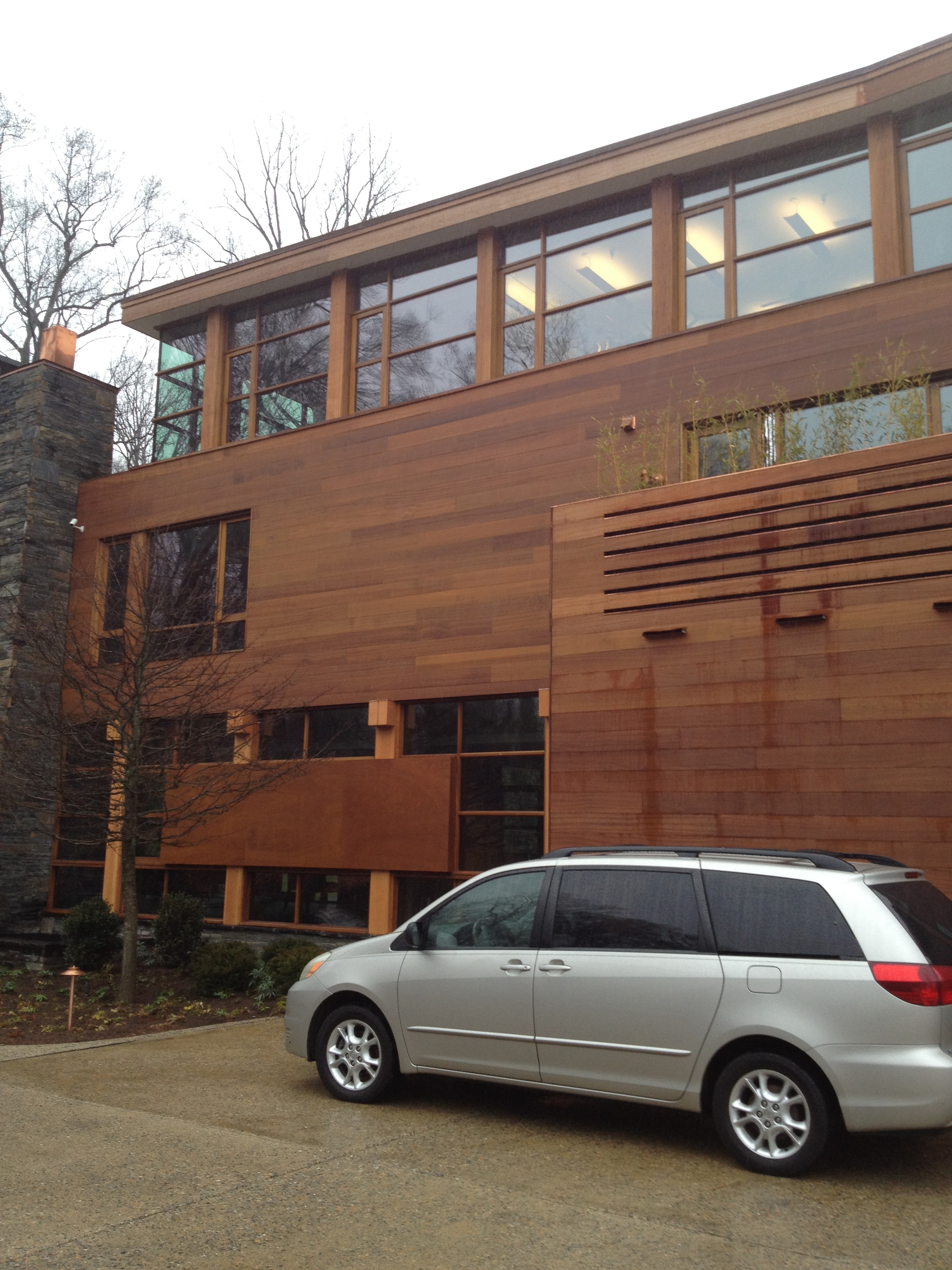
The aesthetic difference is immediately apparent: where cedar reads as "cottage" or "coastal," sapele and mahogany communicate "estate" and "architectural." This matters for luxury residential where the facade sets market positioning.
Sapele vs. Genuine Mahogany: Head-to-Head
| Property | Sapele (Entandrophragma cylindricum) | Genuine Mahogany (Swietenia macrophylla) |
|---|---|---|
| Janka Hardness | 1,410 lbf | 800-900 lbf |
| Durability (EN 350) | Class 2-3 (Moderately Durable) | Class 2 (Durable) |
| Dimensional Stability | Good — interlocked grain resists warp | Excellent — among the most stable hardwoods |
| Grain Character | Ribbon-stripe (interlocked), pronounced figure | Straight to slightly interlocked, uniform |
| Color (fresh) | Reddish-brown, darkens significantly with age | Pink-brown to reddish, deepens to rich red-brown |
| Weathered Color (unfinished) | Dark gray-brown (less uniform than mahogany) | Silver-gray (even, attractive patina) |
| Material Cost (shiplap profile) | $8-$11/sq. ft. | $14-$18/sq. ft. |
| Workability | Moderate — interlocked grain can tear out; sharp tooling required | Excellent — machines, sands, and finishes beautifully |
| FSC Availability | Widely available FSC-certified from Africa | Available FSC-certified from managed plantations |
| CITES / Compliance | Not generally treated as a CITES-controlled substitute in this specification context; verify country-of-origin documentation | CITES Appendix II listed; specify legal harvest documentation, FSC chain of custody where available, and required CITES paperwork |
For a deeper comparison of these species in millwork applications, see our complete sapele vs. mahogany guide.
"For residential shiplap where budget allows, genuine mahogany is still the gold standard — nothing machines as cleanly, finishes as beautifully, or weathers as gracefully. But sapele at 50-60% of the cost gives you 80% of the performance with more dramatic grain character. We're selling about 3:1 sapele to mahogany for residential siding right now — the ribbon-stripe figure is what architects are asking for."
— Camden Zacker, Sales Director, J. Gibson McIlvain Co.
Shiplap Profile Specifications
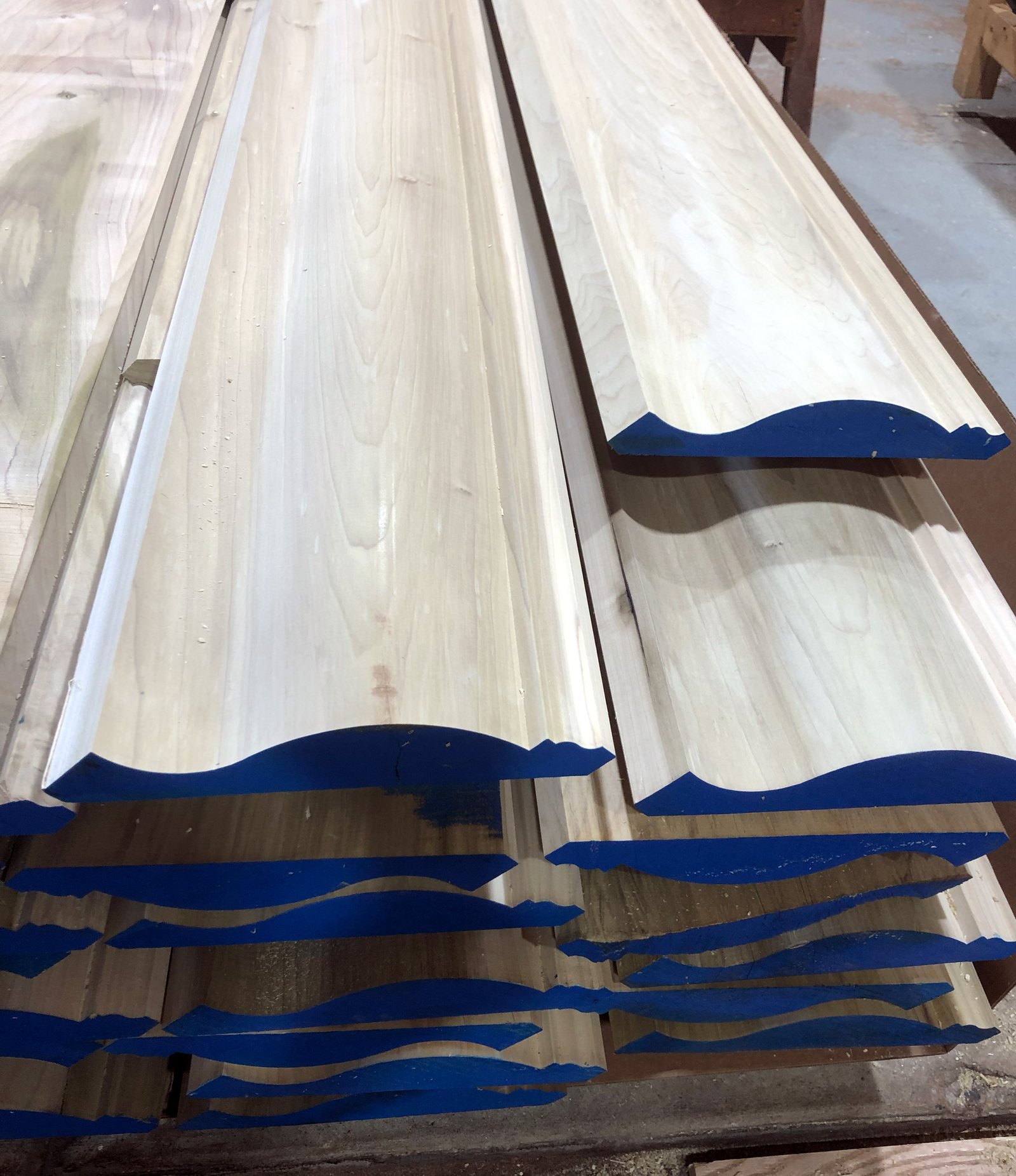
Standard shiplap profiles for hardwood siding differ slightly from softwood conventions due to the higher density and reduced seasonal movement:
- Thickness: 3/4" or 1" (nominal 5/4 stock milled to 1"). Thicker than cedar shiplap (typically 5/8"-3/4") to accommodate the deeper rabbet needed for hardwood.
- Width: 5-1/2" to 7-1/4" face exposure. Wider boards showcase the grain figure better but require quartersawn or rift-sawn selection to minimize cupping in boards over 6".
- Overlap: 1" to 1-1/4" rabbet depth. Provides weather-tight overlap while allowing boards to expand/contract without binding.
- Length: 8-16 feet. Longer boards minimize butt joints — critical for appearance on luxury facades. J. Gibson McIlvain stocks genuine mahogany in lengths to 20 feet for uninterrupted horizontal runs.
Installation Considerations for Hardwood Shiplap
- Pre-drilling required: Both species require pre-drilled pilot holes — face-nailing without pre-drilling splits the wood. Use a countersink bit for a clean finish.
- Stainless steel fasteners only: The tannins in both species react with ferrous metals, causing black staining. Use 316 stainless ring-shank nails or screws exclusively.
- Rainscreen recommended: As with all siding, a ventilated cavity extends lifespan. Particularly important for sapele, which can trap moisture behind its dense surface.
- Acclimate to 10-12% MC: Tropical hardwoods are typically dried to 8-10% for shipping. Allow boards to acclimate to local EMC before installation. See our moisture content guide for climate-specific targets.
- End-grain sealing: Seal all field cuts immediately with wax-based end sealer. Dense hardwoods resist face-grain moisture well but end grain remains vulnerable.
Sustainability, CITES, and Sourcing
Both sapele and genuine mahogany are available through FSC-certified supply chains. J. Gibson McIlvain maintains FSC Chain of Custody certification and sources both species from managed forests and plantations — not old-growth harvesting.
Genuine mahogany (Swietenia macrophylla) also carries an important compliance note: it is listed under CITES Appendix II. That listing does not make genuine mahogany unavailable or inappropriate for high-end residential siding, but it does mean international trade must be controlled and documented. A responsible specification should call for FSC-certified material where available, legal harvest documentation, and the required CITES export/re-export paperwork before the wood is released into the supply chain.
This is one reason sapele is often the easier procurement choice even when genuine mahogany remains the premium benchmark. Sapele can usually be sourced through FSC or PEFC-certified African supply chains with fewer CITES paperwork steps. Genuine mahogany is still available as an FSC-certified product from managed plantations and documented legal sources in regions such as Fiji, Honduras, and Brazil, but it should be treated as a compliance-sensitive material rather than a generic hardwood substitute.
How McIlvain Would Specify This for a Real Project
For McIlvain, Shiplap Siding in Sapele or Mahogany: Premium Hardwood Options for High-End Residential Exteriors is not just a product-selection question. It is a specification question that has to connect profile selection for residential and commercial exterior cladding with the way the material will be milled, shipped, handled, fastened, and maintained. The right answer starts with exterior wood siding profiles, but it only becomes reliable when the species, profile, finish, wall assembly, and field sequencing are written into the same scope.
The practical decision is usually governed by water shedding, reveal depth, shadow line, board width, and milling repeatability. A profile that looks correct in a rendering can fail in service if the board width is too aggressive for the species, if the fastener schedule fights seasonal movement, or if the wall has no drying path behind the siding. That is why McIlvain treats exterior wood as a system: the lumber order, the milling profile, the jobsite details, and the finish schedule all have to support the same performance target.
Species choice should also be tied to the owner’s tolerance for maintenance. Cedar, Cypress, Sapele, Accoya, and thermally modified ash depending on profile tightness and exposure can all be correct in the right setting, but they do not age, move, or accept finishes the same way. A project that wants a natural silver-gray patina needs different expectations than one that needs a dark factory finish for ten years. A coastal project needs a different fastener and wash-down conversation than a protected inland facade. Those distinctions are where a specialty lumber supplier adds value beyond simply quoting a board price.
Performance and Procurement Checklist
| Item | Why it matters |
|---|---|
| Exposure class | Confirm rain, salt, UV, freeze-thaw, and wall orientation before selecting species. |
| Profile and movement | Match board width, reveal, overlap, and fastening method to the species movement profile. |
| Grade and appearance | Specify clear, vertical-grain, mixed-grain, or architectural grade rather than relying on generic “premium” language. |
| Moisture content | Require a target moisture range and acclimation plan before installation. |
| Milling tolerance | Hold profile geometry, reveal width, and end-match details consistent across the order. |
| Submittals | Review samples, finish schedule, fastener type, and rainscreen details before release. |
Where Specifications Usually Fail
The most common failure is selecting a profile by name without matching the actual milled geometry to the climate and design intent. In practice, that means the drawings may show wood siding, the finish schedule may name a color, and the wall section may show a rainscreen, but nobody has confirmed whether the actual boards can be sourced, milled, and installed in a way that satisfies all three. When that gap is discovered after framing or after the material arrives, the project loses the ability to make a clean specification decision.
The second failure point is ventilation, end-grain sealing, stainless fasteners, and moisture-content control. Exterior wood is forgiving when water can drain and the boards can dry; it is unforgiving when water is trapped at laps, end cuts, trim returns, or fastener penetrations. Every outside corner, window head, sill, soffit return, and transition between profiles should be reviewed as part of the siding package. If the detail cannot be drawn clearly, it usually cannot be installed consistently by a crew under schedule pressure.
The third failure point is substituting material late. A lower-cost species or a similar-looking profile may appear harmless on a spreadsheet, but the substitution can change shrinkage, finish behavior, fastener holding, and service life. McIlvain’s strongest recommendation is to approve physical samples, profile mockups, and finish samples before release, not after the first bundle is opened on site.
Ordering Information to Resolve Before Pricing
- Exposure: inland, coastal, shaded, south-facing, high-rise, WUI, or heavy rain-screen exposure.
- Profile: exact face width, reveal, overlap, tongue depth, kerf, drip edge, and whether the profile is intended for horizontal or vertical use.
- Finish: unfinished weathering, penetrating oil, factory prefinish, paint, or field-applied coating.
- Appearance: clear, near-clear, select knotty, vertical grain, mixed grain, color-matched bundles, or architect-reviewed samples.
- Assembly: furring thickness, WRB, clip system, screw type, corner trim, opening details, and ventilation path.
- Logistics: lead time, jobsite delivery sequence, board lengths, waste factor, attic/garage storage conditions, and replacement stock.
Related McIlvain Guidance and Next Steps
For a project that is close to specification, the next step is to compare the design intent against available species, profile tooling, finish schedule, and delivery timing. McIlvain can help translate a rendering or architectural detail into a practical lumber order, including sample selection and milling recommendations.
Frequently Asked Questions
Can sapele be used for exterior siding?
Yes — sapele (Entandrophragma cylindricum) is widely used for exterior cladding, particularly in Europe where it has a 50+ year track record on commercial and residential facades. It achieves Class 2-3 durability under EN 350, with a Janka hardness of 1,410 lbf that resists impact damage. Its interlocked grain provides natural resistance to splitting and checking. With proper rainscreen installation and finish maintenance every 5-7 years, sapele siding lasts 25-40 years in above-ground exterior applications.
Is mahogany good for exterior siding?
Genuine mahogany (Swietenia macrophylla) is excellent for exterior siding — it's one of the most dimensionally stable hardwoods available, achieves Class 2 durability, machines beautifully into precise shiplap profiles, and weathers to an attractive even silver-gray patina. It has been the premium exterior wood species for over 200 years. The main limitation is cost ($14-$18/sq. ft.) — roughly double sapele and triple cedar.
How long does sapele siding last?
Sapele siding lasts 25-40 years in above-ground exterior applications with proper installation (rainscreen cavity, stainless fasteners, back-priming) and periodic finish maintenance every 5-7 years. In less demanding conditions (covered or semi-protected), lifespan can exceed 50 years. Its 1,410 lbf Janka hardness means the surface resists erosion and mechanical damage better than most siding species.
What finish should I use on sapele or mahogany siding?
For maximum longevity on tropical hardwood siding, use a penetrating oil finish with UV blockers (e.g., Penofin, Sikkens Cetol) rather than a film-forming finish. Film finishes (polyurethane, spar varnish) will eventually peel on exterior surfaces, requiring complete stripping. Penetrating oils wear gradually and can be refreshed without stripping — just clean and recoat every 5-7 years. Both species hold penetrating finishes exceptionally well due to their density.
Sources and Standards Referenced
- USDA Forest Products Laboratory — Tropical hardwood species properties and durability data
- Forest Stewardship Council (FSC) — Chain of custody certification standards
- EN 350: Natural Durability of Solid Wood — European durability classification
- NHLA Grading Rules for tropical hardwood lumber