The Short Answer for a Saltwater Dock
Ipe is the best all-around tropical hardwood for dock and pier decking exposed to saltwater, and it earns that position on natural durability class, density, behavior under wet and dry cycling, and fire rating rather than on hardness alone. The species tests at roughly 3,680 lbf on the Janka scale and runs about 1,050 kg/m3 in density. It rates EN 350 Class 1, the top natural durability class. It carries an ASTM E84 Class A fire rating, which means a flame-spread index of 25 or less. Marine contractors have watched a long parade of alternatives arrive and leave, and Ipe is still what they write on the drawing.
The caveat matters as much as the answer. A dock is not a backyard deck with water underneath it. The top face takes salt spray and direct UV, the underside takes reflected UV and splash, brine sits in the gaps between boards, and the whole assembly swings between soaked and baked several times a week. Species selection buys you maybe half the service life. The rest comes from profile, fastener metallurgy, joist spacing, ventilation under the boards, and how the end grain and edges get handled. Specify the best wood on earth and detail it badly, and the dock still fails on schedule.
What Saltwater Actually Does to Wood
Salt does not rot wood; it changes how the wood holds moisture and it dissolves the metal holding the wood down. Sodium chloride is hygroscopic. Once salt crystals work into the surface cells of a deck board, they pull water vapor out of humid marine air and hold the top few millimeters of wood wetter, longer, than the ambient relative humidity alone would. That wet surface sits over a drier core. The gradient drives surface checking, and checks open a path for water and spores to get deeper.
Above the waterline, the decay agents are the same brown rot and white rot fungi you fight on any exterior deck, plus UV degradation of the lignin at the surface. Fungi need free water in the wood, roughly 20 percent moisture content and up, along with oxygen and a temperature range that most coastal climates hand them for eight months a year. The USDA Forest Products Laboratory has documented the moisture thresholds and decay mechanisms in the Wood Handbook: Wood as an Engineering Material (FPL-GTR-282, 2021 edition) for decades, and nothing about a marina changes the biology. It just runs the clock faster.
Below the waterline the problem changes species entirely. Fungi stop mattering and marine borers take over. That distinction is where most dock specifications go sideways.
Reading EN 350 Durability Classes Correctly
An EN 350 Class 1 rating describes resistance to fungal decay, not resistance to marine borers, and confusing the two is the most expensive mistake in dock specification. The European standard sorts heartwood into five classes, from Class 1 (very durable) through Class 5 (not durable), based on graveyard testing against wood-destroying fungi. Ipe, Teak, and Cumaru sit at the durable end. Garapa sits in the middle. Sapwood of every species, including Ipe, is not durable and does not belong on a dock.
Marine borer resistance is a separate, much harsher test. Teredo shipworm and Limnoria gribble attack submerged timber, and very few woods resist them for long without treatment. A Class 1 rating tells you the board will survive salt spray, splash and standing brine on the deck surface. It does not qualify that same board as a submerged pile.
The other half of durability is extractive content. Ipe's decay resistance comes from lapachol and related quinones locked in the heartwood. Those extractives are not renewable. They do not migrate into the sapwood, they do not repair a saw cut, and they are why cut ends and drilled holes deserve attention that a sealed factory face does not need.
The Species That Belong on the Shortlist
Seven tropical hardwoods realistically compete for saltwater dock decking, and they separate on durability class first, movement second, and workability third. Hardness gets quoted in every sales conversation and matters least. A Janka number predicts dent resistance under a dropped anchor or a dock cart wheel. It says nothing about whether the board will cup in year three.
| Species | Janka (lbf) | Density (kg/m3, ~12% MC) | EN 350 Durability | Notes for dock and pier use |
|---|---|---|---|---|
| Ipe | ~3,680 | ~1,050 | Class 1 | Benchmark. ASTM E84 Class A. Low movement in service. Sinks in water. Pre-drilling required. |
| Cumaru | ~3,540 | ~1,070 | Class 1 to 2 | Nearly as hard and slightly denser, more interlocked grain, more seasonal movement. Costs less than Ipe. |
| Massaranduba | ~3,190 | ~1,150 | Class 1 to 2 | Densest of the group. Moves more with humidity swings, so gapping discipline matters. |
| Jatoba | ~2,690 | ~910 | Class 2 to 3 | Excellent interior flooring wood. Marginal for constant saltwater exposure. Better on covered pier structures. |
| Red Balau | ~1,700 to 2,000 | ~850 to 950 | Class 2 | Uniform color, easier to machine, lighter duty. Suited to residential docks with lower traffic. |
| Garapa | ~1,700 | ~800 to 830 | Class 3 | Light golden color, runs cooler underfoot. Moderate durability, so detailing and ventilation carry more load. |
| Teak | ~1,070 | ~655 | Class 1 | Legendary in marine service for its oils and stability. Soft for a working commercial pier. Plantation supply varies. |
| Thermally modified ash (Thermory) and Abodo Vulcan | Varies by substrate | Lower than tropicals | Improved by process | Lengths top out around 16 feet because of kiln size. Carries a manufacturer warranty. |
Read that table with the water in mind. For a commercial pier taking forklift traffic, boat gear and public foot traffic, the top three rows are the real conversation. For a private dock off a residential shoreline, Red Balau and Garapa are honest choices that will not embarrass anyone. Teak remains the finest marine wood ever cut, and on a hundred-foot public pier it costs more than Ipe while giving up the hardness that kind of traffic asks for.
Decking Species Are Not Piling Species
No tropical hardwood decking species should be specified as a submerged structural pile, and J. Gibson McIlvain will tell a caller that before quoting the deck. Piles, cross bracing and anything living below mean high water belong to a different set of materials. Marine-grade pressure-treated Southern Yellow Pine to the appropriate retention, concrete, steel, or composite piling systems cover that zone. Greenheart has a long history there too. The engineer of record makes that call, and it is governed by structural code, not by a decking catalog.
Where tropical hardwood belongs is everything from the pile caps up. Stringers, joists, decking, railings, cleats, benches, gangway treads, fascia. That is the splash zone and the spray zone, and it is exactly where EN 350 Class 1 heartwood outperforms almost everything else available.
"I get calls every spring from someone who wants to build the whole dock out of Ipe, pilings and all. I tell them the same thing every time. Put the Ipe where you walk and where you can see it, and let the engineer pick what goes in the mud. We ship the deck package, the railing stock and the fascia to marinas from Maryland to California, and the ones that last thirty years are the ones where somebody respected that line."
Norm Moton, Director of Sales, J. Gibson McIlvain
Moisture Content, Movement, and Gapping
Dense tropical decking should arrive and be installed at 12 to 16 percent moisture content, and every gap decision on the dock follows from where in that range the boards actually sit. Kiln-dried Ipe leaving a mill at 12 percent will pick up moisture in a Chesapeake summer or a Gulf Coast August. Board width grows. Install tight at 12 percent in dry January air and you will have boards fighting each other by July, with fasteners loosening and edges crushing.
The working method is simple. Sticker the material on site, off the ground, under cover with airflow on all faces, and let it come toward local equilibrium for a week or two before it goes down. Then set gaps for the season you are in. Boards installed on the wet end of the range get tighter gaps because they will shrink. Boards installed dry get wider gaps because they will swell. A 3/16 inch gap is a reasonable center point for 5/4x6 Ipe, and coastal installers running wide open exposure often push toward 1/4 inch to keep drainage moving and salt from bridging.
Estimating is straightforward once you know the coverage math. A 5/4x6 board covers about 2.1 linear feet per square foot of deck, gap included. Multiply deck square footage by 2.1, add for waste and picture framing, and that is the order. The Wood Database entry for Ipe documents the shrinkage values behind all of this if you want the raw numbers.
Fasteners and Profiles for a Salt Environment
In saltwater, 316 stainless steel is the only fastener specification worth writing, and the profile you choose determines whether those fasteners show. Type 304 stainless will pit and streak within sight of the ocean. Hot-dip galvanized hardware is a maintenance schedule, not a solution. Chloride exposure combined with the extractives in dense tropical hardwoods creates a corrosion environment that punishes every shortcut in the hardware schedule. Specify 316 for screws, clips, hangers, bolts and lag hardware, and hold that line through the railing and the gate hinges.
Profile drives the fastening method, and there is no ambiguity here. Shiplap takes visible fasteners. Only tongue and groove works with hidden fasteners. Open dock decking is neither, so most contractors face-screw square-drive 316 stainless through a pre-drilled and countersunk hole and plan on a visible fastener pattern. Pre-drilling is not optional in Ipe or Massaranduba. Skip it and you will snap screws, split ends, and waste an afternoon backing out broken shanks.
On the covered parts of a marine structure, the boathouse soffit, the pier ceiling, the porch of a dockmaster building, the rule changes. Material goes on furring strips or joists, never flat against a solid substrate, and grooves face DOWN so water drains out instead of collecting in the channel. That single orientation detail separates a soffit that lasts from one that grows mushrooms.
Substructure, Spacing, and Ventilation
Dense hardwood decking wants joists at 16 inches on center, and it wants air moving underneath it in both directions. Ipe and Massaranduba are stiff, and the spacing has less to do with deflection than with holding boards flat and giving fasteners enough purchase to resist cupping. Go to 24 inches on center on a commercial pier and you are inviting movement between bearing points. Diagonal decking or heavy point loads pull that spacing tighter still.
Ventilation is the detail nobody wants to pay for and everybody regrets skipping. A deck board that dries on one face and stays wet on the other will cup. Every time. On a dock, the underside is over water, which sounds like ventilation and often is not, because a solid fascia skirt or a tight fit against a bulkhead traps humid air in a dead zone. Keep the underside open. Keep the fascia detached or vented. Keep debris out of the gaps so drainage keeps working. Building Science Corporation has published extensively on wetting and drying balance, and the principle is the same whether the assembly is a wall or a deck. Wood survives wetting it can dry out of.
End grain deserves its own line item. Every field cut opens untreated heartwood. Seal fresh ends with a paraffin or wax-based end sealer as they are cut, not at the end of the day, and pre-drill within a couple of inches of any end.
Where Modified Wood Fits on a Marine Structure
Modified wood belongs on the parts of a dock complex that are not the working deck, and its length limit is the fact that decides most of those layouts. Thermory and Abodo Vulcan cover the thermally modified category, and Accoya covers acetylated pine. All three trade some density for dimensional stability and for a durability improvement that comes from chemistry rather than from tropical extractives. All three also carry manufacturer warranties, which no solid unmodified wood does or should.
The constraint is kiln size. Thermory, Abodo Vulcan and Accoya top out around 16 feet, with the metric lengths landing just under that. A pier deck that wants continuous 20-foot runs is not a modified wood project. A boathouse cladding elevation, a railing system, a dockside bench, a pergola over the gangway, a screen wall by the fuel dock, those are all excellent uses. Accoya in particular holds paint and coatings remarkably well, which matters on a structure that will be repainted in place with a boat lift overhead.
Thermally modified material is more brittle than its unmodified substrate. Pre-drill, use 316 stainless in the salt zone, and follow the manufacturer's fastening schedule if you want the warranty to mean anything.
Fire Rating, Code, and Certification on Commercial Piers
Commercial and municipal piers routinely trigger fire, accessibility and chain-of-custody requirements that residential docks never see, and Ipe answers most of them without a treatment. Ipe's ASTM E84 Class A rating, a flame-spread index of 25 or less, comes from the wood itself. On projects where the authority having jurisdiction wants documented flame spread on an exterior deck over public water, that is a meaningful advantage. Test method details live in ASTM E84 at ASTM International, and the structural design provisions come from the American Wood Council and the model codes published by the International Code Council.
Public piers and gangways carry accessibility obligations. Board gaps, transitions, running slope and landing dimensions on gangways are all addressed in the standards maintained by the U.S. Access Board, and the standard limits how large an opening in a walking surface may be. Check that opening limit against the drainage gap you intend before setting the deck gap.
Certification and documentation follow the same discipline. FSC chain of custody is available on tropical decking and is frequently required on public and institutional work. When using a CITES-listed species, documentation is required and must travel with the shipment, and the current appendices are published by the CITES Secretariat. For designers building the specification section itself, WoodWorks and the National Hardwood Lumber Association grading rules are the reference points that keep language enforceable.
How J. Gibson McIlvain Would Specify This
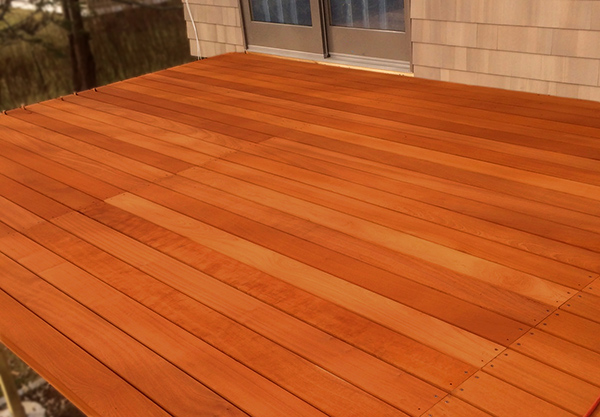
For a working saltwater dock or pier, specify 5/4x6 Ipe decking, S4S with eased edges, FSC available, kiln dried to 12 to 16 percent, over joists at 16 inches on center, fastened with 316 stainless. That is the spec sheet that has held up on marina work up and down both coasts, and every line of it is doing a job.
Write the profile decision first. Face-screwed 5/4x6 with pre-drilled, countersunk 316 stainless square-drive screws is the most serviceable assembly on a commercial pier, because any board can be pulled and replaced by one person in ten minutes. A tight, consistent screw pattern with countersunk or plugged 316 stainless heads gives a cleaner deck for a resort or a residential dock where appearance leads. Reserve tongue and groove, the one profile that takes hidden fasteners, for covered soffits and ceilings, grooves facing down, on furring strips with airflow behind.
Set the gap for the season and the exposure. Order to 2.1 linear feet per square foot for 5/4x6, then add for the picture frame and the miters. Get the material on site early, sticker it under cover with air on all faces, and end-seal every field cut as it happens. Keep the underside open and the fascia vented. Put a maintenance oil on it if you want the color and let it silver if you do not, but do not let anyone sell a film-forming coating for a deck that stays wet.
J. Gibson McIlvain stocks Ipe decking in 5/4x6 and 1x6 in a vast inventory across all standard and custom dimensions, along with Cumaru, Massaranduba, Garapa and Red Balau, and mills to project-specific profiles when the drawing calls for something the catalog does not have. The company has been sorting lumber since 1798, ships nationwide on its own trucks and by common carrier, including regular loads to California, and works at commercial and contractor volume rather than as a retail counter. Deck packages get graded and sorted before they leave the yard, so what arrives at the marina is what the specification asked for.
Send the drawings and the takeoff. See Ipe decking specifications and available dimensions, or call 800-638-9100 to get a quote and talk the detail through with someone who has shipped dock packages before.
Frequently Asked Questions
Is Ipe or Cumaru better for a saltwater dock?
Ipe holds the edge for a saltwater dock. Both are extremely dense, with Ipe at roughly 3,680 lbf Janka and about 1,050 kg/m3 and Cumaru at roughly 3,540 lbf and about 1,070 kg/m3, so hardness is close to a wash. The separation is in durability class and stability. Ipe rates EN 350 Class 1 while Cumaru sits at Class 1 to 2, and Cumaru's interlocked grain moves more with the humidity swings a marina delivers. Cumaru costs less than Ipe and remains a legitimate choice on a residential dock or where budget drives the decision, provided the gapping and fastening are handled correctly.
Can Ipe be used for dock pilings or anything below the waterline?
No. EN 350 Class 1 describes resistance to fungal decay, not resistance to marine borers such as Teredo shipworm and Limnoria gribble, which attack submerged timber. Piles, cross bracing and any member living below mean high water belong to marine-grade pressure-treated Southern Yellow Pine at the appropriate retention, concrete, steel, or an engineered piling system, and that selection is made by the engineer of record. Tropical hardwood belongs from the pile caps up: stringers, joists, decking, railings, gangway treads, benches and fascia.
What fasteners should be used on a tropical hardwood dock in saltwater?
Type 316 stainless steel, throughout. Type 304 stainless pits and streaks in chloride exposure, and hot-dip galvanized hardware becomes a maintenance schedule rather than a solution. Hold the 316 specification across screws, hidden clips, joist hangers, bolts, lag hardware, railing brackets and gate hinges. Pre-drilling and countersinking are mandatory in Ipe and Massaranduba, and pre-drill within a couple of inches of any board end to avoid splitting.
How wide should the gaps be between dock deck boards?
Set the gap for the moisture content at installation and the exposure. A 3/16 inch gap is a reasonable center point for 5/4x6 Ipe. Boards installed at the wet end of the 12 to 16 percent range will shrink, so tighten toward that figure. Boards installed dry will swell, so open up slightly. Coastal installers on fully exposed decks frequently move toward 1/4 inch to keep drainage moving and prevent salt and debris from bridging the gap. On public piers, check the accessibility gap limit before finalizing the number.
How much Ipe decking do I need for a given dock area?
For 5/4x6 decking, figure about 2.1 linear feet of board per square foot of deck, gap included. Multiply the deck area in square feet by 2.1 to get linear footage, then add for waste, picture framing, miters and any diagonal layout. J. Gibson McIlvain can run the takeoff from drawings and quote the package at 800-638-9100.
Can thermally modified wood like Thermory or Abodo Vulcan be used on a dock?
It fits the parts of a dock complex that are not the working deck. Thermory, Abodo Vulcan and Accoya offer strong dimensional stability and carry manufacturer warranties, which no solid unmodified wood does. The controlling limit is kiln size: all three top out around 16 feet, with metric lengths landing just under that, so long continuous deck runs are out. Boathouse cladding, railings, benches, pergolas and screen walls are excellent applications. Pre-drill, use 316 stainless in the salt zone, and follow the manufacturer's fastening schedule to keep the warranty valid.
Does a dock need ventilation underneath if it is built over water?
Yes. Being over water is not the same as having airflow. A solid fascia skirt or a tight fit against a bulkhead traps humid air in a dead zone under the boards, and a board that dries on the top face while staying wet on the bottom will cup. Keep the underside open, vent or detach the fascia, and keep the gaps clear of debris so drainage keeps working. Wood survives the wetting it can dry out of.
Does J. Gibson McIlvain ship dock packages outside the Mid-Atlantic?
Yes. J. Gibson McIlvain ships nationwide on company trucks and by common carrier, including regular loads to California, and works at commercial and contractor volume rather than as a retail counter. Deck packages are graded and sorted before leaving the yard. Send drawings and a takeoff, or call 800-638-9100.
Sources and Standards Referenced
- USDA Forest Products Laboratory
- The Wood Database: Ipe
- American Wood Council: Codes and Standards
- ASTM International
- International Code Council
- U.S. Access Board: ADA Accessibility Standards
- Forest Stewardship Council
- CITES Secretariat
- Building Science Corporation
- WoodWorks: Wood Products Council
- National Hardwood Lumber Association
- J. Gibson McIlvain: Ipe Decking