A Profile Number Is Only a Cross Section
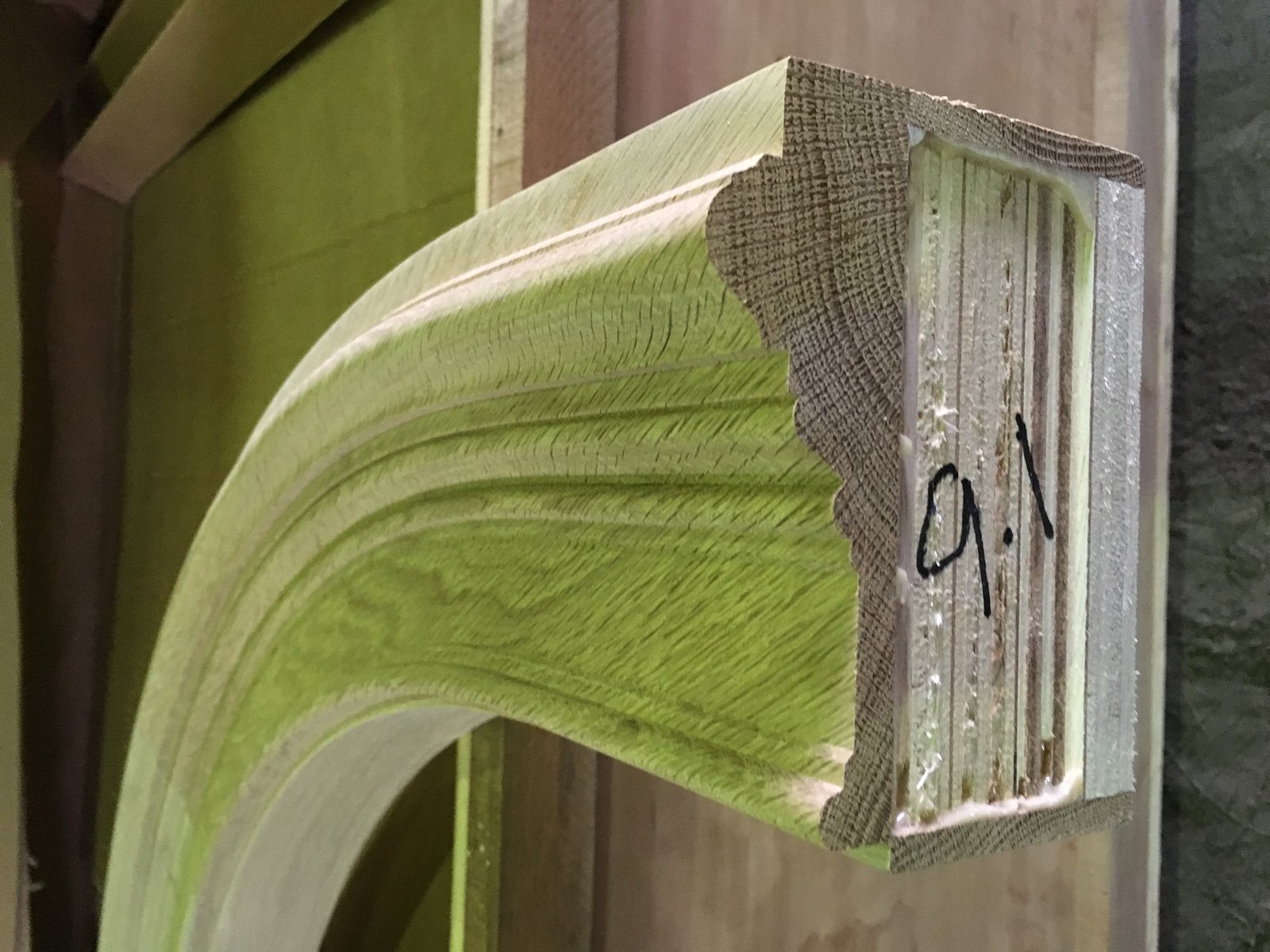
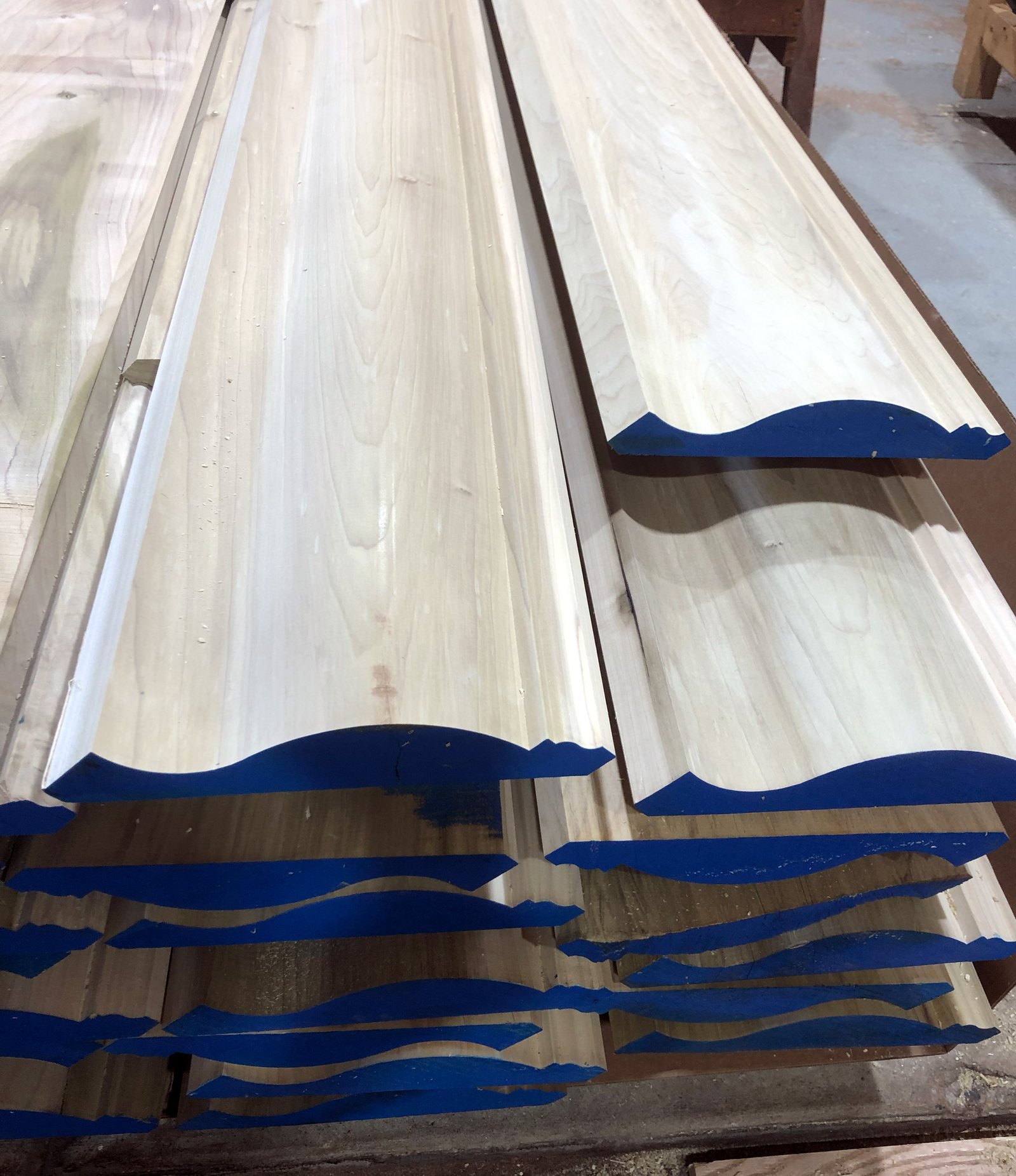
A profile number fixes a shape in two dimensions and settles almost nothing else about the moulding that arrives on the truck. Two shops can both hold a knife ground to the same catalog pattern and deliver crown that does not read as the same product once it is on the wall. The number controls geometry. It is silent on species, on grade, on moisture content at the moment of cut, on the condition of the cutting edge, on feed speed, and on whether the back of the piece was relieved.
Every one of those calls gets made after the number is chosen. Every one of them is visible under raking light. A chair rail with a crisp quirk and a chair rail with a quirk softened by a worn knife and a sanding belt carry the same designation on the submittal and look nothing alike at eye level in a corridor.
Architects usually find this out on phase two. The base in the first building reads sharp at the arris, the base in the second reads rounded, and nobody touched the drawing. A different shop ground a different knife off the same printed section, ran it in a different species, and sent it through a moulder set up for a different throughput.
The remedy is to specify past the number. A purchase order carrying only a catalog reference has quietly handed five material decisions to whoever happens to be running the machine that week.
The Knife Is the Real Variable
The ground steel, not the catalog page, is what actually cuts the profile. A pattern number gets translated into a physical knife by a grinder working from a template, and that translation is where shops separate. J. Gibson McIlvain grinds custom knives every week and holds a moulding profile library of thousands of ground profiles, which means a crown, base or chair rail pattern that has run before runs again off the same steel rather than off a fresh interpretation.
Knife geometry drifts with sharpening. A corrugated back knife reground a dozen times loses a few thousandths at every pass, and the first detail to go is the sharp fillet at the bottom of a cove. What the drawing shows as a crisp intersection comes off the machine as a small radius. Multiply that across a cove, two quirks and a bead and the profile has lost its shadow lines without losing its name.
Hook angle matters as much as shape. A knife ground with an aggressive hook cuts fast and tears out in interlocked grain. A conservative hook leaves a cleaner surface in Sapele or Iroko and takes longer to feed. A shop running one head for everything will produce tearout in some species and burnish in others.
Then there is sharpness, which is not a yes or no condition. A dull edge stops cutting and starts compressing. The surface looks acceptable in the shop and lifts a fuzzy grain as soon as it takes stain or primer. Two shops can run identical steel and deliver different mouldings purely on when each one last pulled the head.
Moisture Content Decides Whether the Shape Holds
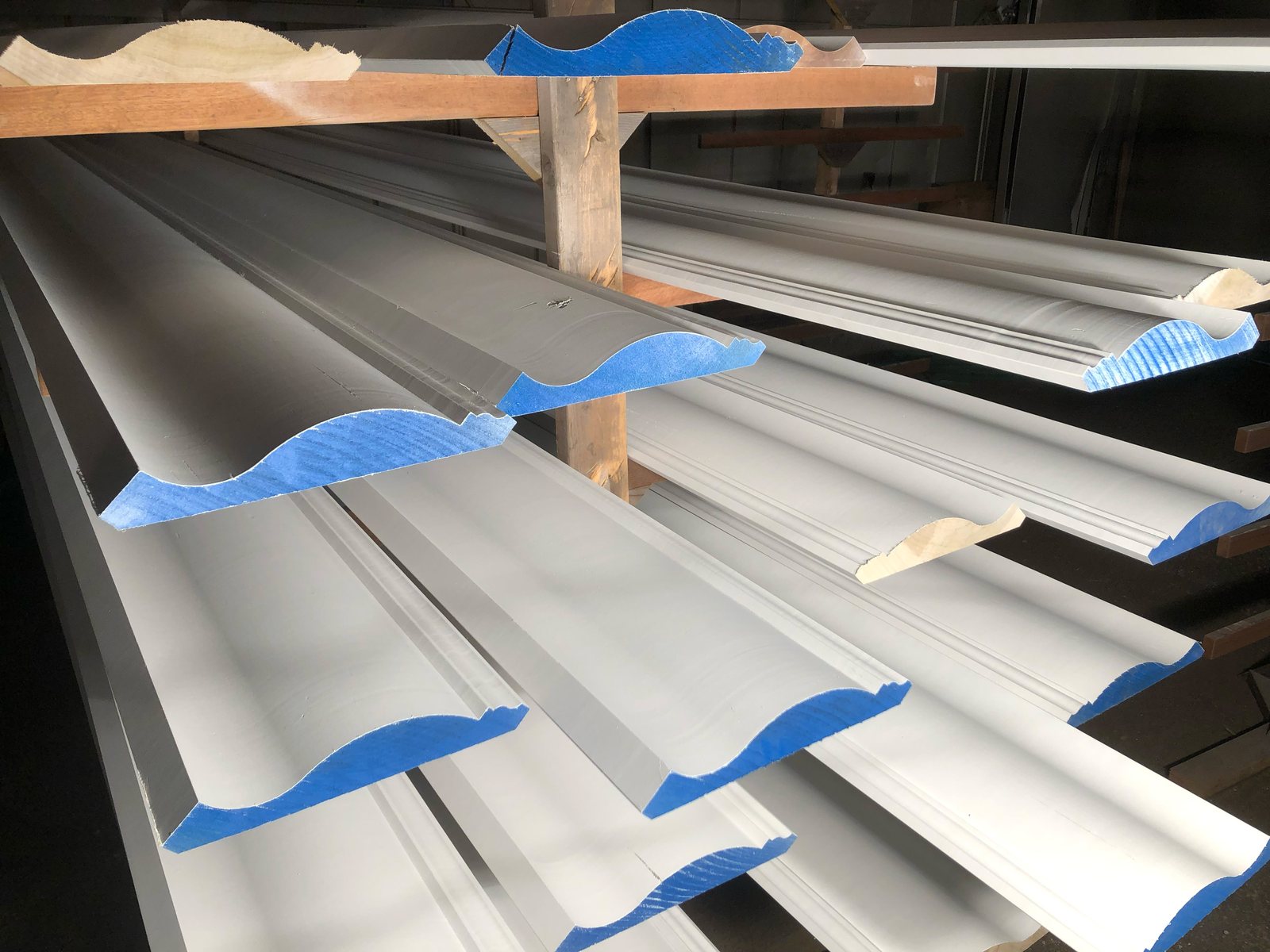
A profile cut at the wrong moisture content stops being that profile within a heating season. J. Gibson McIlvain mills interior trim to an in-service moisture content near 6 to 8 percent and exterior work near 12 to 16 percent, which is the range each environment will drive the wood toward anyway. Wood milled wet shrinks after the cut. The cove flattens slightly, the width pulls in, and miters that closed in the shop open on the wall.
The reverse failure is just as common. Trim milled dry and stored in an unconditioned building picks up moisture, swells across the width, and crushes at the joints. The US Forest Service Wood Handbook covers the dimensional behavior behind both outcomes, and none of it is obscure enough to ignore.
Sawing pattern changes the magnitude. Quartersawn and rift stock move less across the width than plainsawn, which is why they get specified where a painted profile or a panelized surface has to stay flat. A plainsawn base in a wide section will cup more than a rift section of the same pattern, and the pattern number does not record which one you bought.
This is also where a shop's drying discipline shows. Measuring a bundle at the yard tells you what the lot averaged. Measuring the individual blank before it feeds tells you what the moulding will actually do.
Species and Grade Change the Same Number
The same knife in a different species produces a measurably different moulding. Hardness, grain structure and oil content all change how the shape comes off the head. Hard Maple at roughly 1,450 lbf on the Janka scale holds a sharp arris beautifully and burns at the cove if feed slows. Cherry at roughly 950 lbf cuts clean and glassy and dents under a nail gun. White Oak at roughly 1,360 lbf machines predictably and raises grain under waterborne coatings.
For millwork that has to be stable and machinable, the working palette is Sapele, Iroko, Afrormosia, Teak and Utile. Sapele runs roughly 1,410 lbf, takes a profile cleanly, and holds paint better than Genuine Mahogany at roughly 800 lbf while coming in a wider range of sizes and longer lengths. Iroko and Afrormosia machine well and hold detail. Teak and Utile both cut predictably and stay dimensionally calm. Reference data on each sits on the Wood Database entry for Sapele and its companion species pages.
The tropical decking species are a different conversation. Ipe, botanically Tabebuia spp, along with Cumaru, Garapa, Jatoba and Red Balau, are extremely hard and carry high oil content, which makes them difficult to glue and punishing on knives. A millwork house reaches for Sapele, Iroko, Afrormosia, Teak or Utile instead, because a milled and glued component has to accept adhesive and hold a machined edge, not simply survive weather underfoot.
Cedar belongs in the conversation for exterior trim and cladding on its own merits. The distinction that matters on the order is CVG, clear vertical grain, against STK, select tight knot. CVG gives a uniform, knot-free face that machines to a consistent profile. STK carries sound tight knots and reads as a different product in the same pattern. A shop that substitutes one for the other has changed the moulding without changing the number.
Grade rules underneath all of this come from the National Hardwood Lumber Association, and the tolerances that govern finished architectural millwork come from the Architectural Woodwork Institute. Two shops quoting one pattern against two different grade assumptions are not quoting the same thing.
Feed Rate and Cutterhead Setup Show in the Surface
Surface quality off the moulder is a function of knife marks per inch, and that number is a production choice. Spindle speed, the number of knives in the head and feed rate together determine how many cuts land in each inch of travel. A high mark count leaves a surface that needs almost nothing before finish. A low count leaves a visible scallop that gets chased with sandpaper, and sandpaper is exactly what destroys a fine profile.
Hold-down pressure and chip breaker position change the result again. Light pressure lets the blank lift and the profile wanders in depth along the length. Heavy pressure on a softer species marks the face. A shop that sets up for a long clean run and a shop that sets up to clear a short order are not operating the same process even with identical steel in the head.
Sanding after the moulder is where most profile detail dies. A flat belt applied to a moulded face rounds every arris it touches. Profile sanding with a shaped pad or a brush preserves the shadow line. The careful move is to cut clean enough that heavy sanding is never needed, which comes back to sharp knives and controlled feed.
Specification language can carry this. The Wood Moulding and Millwork Producers Association pattern conventions name the shape, and the surface expectation has to be written separately or it will be assumed.
Where Two Shops Diverge on One Pattern
Seven variables account for nearly every complaint about mouldings that were supposedly identical. None of them appear on a catalog page. All of them are specifiable, and a shop that answers each one in writing is telling you something real about how the run will go.
| Variable | How It Differs Between Shops | What Shows Up on the Wall |
|---|---|---|
| Knife condition | Fresh grind to template against steel reground many times | Sharp fillets and quirks against softened intersections and lost shadow lines |
| Species and grade | Clear Sapele or Utile against a lower grade or a substituted species | Uniform machined face against knots, color swing and tearout at figure |
| Moisture at cut | Blank metered individually against a lot average taken at the bundle | Joints that stay closed against miters that open or crush in season one |
| Knife marks per inch | Slow controlled feed against production feed chasing throughput | Ready-to-finish surface against scallop corrected by aggressive sanding |
| Back relief and thickness | Relieved back on a full-thickness blank against a flat back on thin stock | Trim that pulls tight to a bowed wall against trim that telegraphs every hump |
| Priming and prep | Primed and sanded after priming against raw stock or one heavy wet coat | Crisp detail under paint against grain raise or detail buried in film |
| Record after the run | Knife, species and run logged for reorder against no retained record | Phase two that matches against phase two that approximates |
Read the table as a submittal checklist rather than a ranking of vendors. Any shop can answer these questions. The difference is whether the answers were decided or defaulted.
Back Relief and Blank Thickness Change the Reveal
Two mouldings with identical faces behave differently on site when the backs are not cut the same way. A relieved back leaves two bearing edges and a hollow between them. That hollow is what lets base and casing pull tight against a wall that is never truly flat. A flat-backed piece bridges every bow in the substrate and leaves a gap the installing carpenter has to shim or caulk.
Blank thickness drives projection, and projection drives the shadow the profile throws. A crown pattern milled out of thinner stock reaches less far off the wall, and the cove reads shallower even when the knife is correct. A shop working to a thickness convenient to its own inventory, rather than to the thickness the drawing implies, has altered the design without touching the number.
Spring angle is the third piece. Crown run at one spring angle and crown run at another sit differently in the corner and need different miter and bevel settings. The installer discovers that with a saw in hand, not on the submittal, which is why the angle belongs on the order right next to the pattern.
Matching a Run Across Phases and Years
Repeating a profile years later depends entirely on whether anyone kept the knife and the record. J. Gibson McIlvain has been family run and in business since 1798, which is the practical reason a pattern cut for a building in one decade can be cut again for an addition in the next. The steel stays on file. So does the note about what species it ran in, how thick the blank was, and how the back was cut.
A shop without that discipline regrinds from the drawing a second time. The result is close. It is not the same, and close is exactly what fails in a corridor where original trim and new trim meet at a butt joint.
"When a client calls back for a second phase, the question is never whether we can cut the profile. It is whether we still have the knife and the record of how it ran the first time. We keep both, because grinding from a drawing again gets you close, and close is what people notice."
Brett Miller, President, J. Gibson McIlvain
Lot matching sits alongside the knife. Color and grain in Sapele or Utile shift between logs, so a long run pulled from one coherent lot reads as one installation. A run assembled from whatever happened to be open reads as a repair even when every stick is correct.
Priming Changes the Painted Profile
What happens to the moulding after the knife leaves it determines how the profile looks under paint. J. Gibson McIlvain primes millwork in three levels, in both oil-based and water-based systems, with a fungicide additive on exterior primed trim. That choice is not cosmetic. Open-grained and oily species absorb a great deal of finish, so a primer coat evens out the eventual painted surface instead of letting the topcoat sink unevenly into the grain.
Sanding or buffing after priming is the step that separates a crisp primed profile from a soft one. Priming raises grain. Knocking it back while keeping moulded detail crisp takes a shaped approach rather than a flat block. Skip it and the painter sands on site, usually with a flat pad, and the arris goes round.
Film build is the other trap. One heavy wet coat fills a fine bead and the detail the knife cut disappears under the coating. Thin controlled coats preserve it. For painted exterior trim, Sapele is the better specification than Genuine Mahogany, since it holds paint better and comes in a wider range of sizes and longer lengths. Sapele is not milled 1x8 for exterior use, a width too wide to stay stable in that application.
Cupping on exterior trim is worth separating from species. It comes from installation and from whether the assembly has back ventilation, not from the wood on the submittal, and the Building Science Corporation material on cladding assemblies explains why. No solid unmodified wood carries a warranty, in any species, since an organic material responds to its environment. Warranties exist on modified products only.
Historical Matching and Radius Work
A salvaged sample, not a catalog number, is the only reliable starting point for restoration trim. Historical profiles were cut on machines with different conventions, and a modern pattern that looks similar in a book will not line up against original work at a transition. A grinder working from a traced section off the actual piece produces steel that matches. J. Gibson McIlvain grinds to a sample when a profile is not already on the shelf, including difficult historical restoration sections and contemporary shapes.
Historic district review makes this concrete. Like-for-like replacement in both style and species is often the requirement, and National Park Service Technical Preservation Services guidance frames what reviewers expect to see. Wood shutters in louver and panel styles get specified the same way, matched to the original style and species rather than to the nearest stock option.
Radius work leaves the catalog behind completely. A curved casing or a radius base cannot come off a straight moulder in one pass, and the same cross section bent around a plan radius calls for a different approach to the stock itself. ICD, the architectural millwork division of J. Gibson McIlvain, builds radius trimwork and radius millwork planned around a specific opening, along with custom doors, box beams and benches. Its trim profile work is where a pattern that exists as a straight run gets translated into a curve that holds the same face.
How J. Gibson McIlvain Would Specify This
Write the order so that two shops reading it would have no choice but to deliver the same moulding. Name the pattern, then name the species and grade, the sawing pattern where flatness matters, the target in-service moisture content, the blank thickness, the back treatment, the spring angle on crown, the surface expectation off the machine, and the priming level. Nine lines. They remove nearly every variable that produces a mismatch.
For interior trim in a conditioned building, J. Gibson McIlvain mills to 6 to 8 percent and runs the profile off library steel wherever the pattern already exists. Exterior trim targets 12 to 16 percent, and the spec should carry a primer level plus the fungicide additive. Sapele is the default for painted exterior work, with Iroko, Afrormosia, Teak and Utile as the clear-finish options, and CVG cedar where a vertical grain face is wanted. Where the piece is truly custom in plan or section, the work belongs with ICD rather than with a straight moulder.
Reorders deserve one more line. Ask that the knife, the species, the lot and the thickness be recorded against the job, so the second phase is a repeat rather than a reconstruction. J. Gibson McIlvain ships milled and primed trim nationwide, which means a pattern established on one building can be matched for a building in another state without starting the profile over.
To run a pattern, match an existing profile, or have new steel ground to a sample, call J. Gibson McIlvain at 800-638-9100 or start with the millwork service overview. Bring the sample if you have one. A traced section off the real piece beats a catalog number every time.
Frequently Asked Questions
Does a standard moulding pattern number guarantee I get the same product from any shop?
No. A pattern number fixes the cross section and nothing else. Species, grade, sawing pattern, moisture content at the time of milling, blank thickness, back relief, knife marks per inch off the moulder and the priming level are all open decisions after the number is set, and each one changes how the finished moulding looks and behaves. Two shops working honestly from the same number can deliver mouldings that do not match at a butt joint.
What should a moulding order carry besides the profile number?
Nine items cover almost everything. The pattern, the species and grade, the sawing pattern where flatness matters, the target in-service moisture content, the blank thickness, the back treatment, the spring angle on crown, the expected surface condition off the machine, and the primer level if the trim ships primed. An order carrying those nine lines leaves very little room for two shops to interpret the same drawing differently.
Why does the same crown profile look softer in one building than in another?
Usually the knife or the sanding. A corrugated back knife loses a few thousandths at every regrind, and the sharp fillets at the bottom of a cove are the first detail to soften into a small radius. The second cause is a flat sanding belt applied to a moulded face, which rounds every arris it touches. Both produce a profile that carries the correct name and throws a weaker shadow line.
Can a shop reproduce a historic moulding profile that is not in any catalog?
Yes, from a physical sample. A grinder traces the section off the actual piece and cuts steel to match, which is the only approach that lines up correctly against surviving original trim at a transition. J. Gibson McIlvain grinds knives to a sample for restoration sections as well as contemporary shapes. Send a salvaged length rather than a photograph or a sketch, since the traced section is what the knife is made from.
Which species should be specified for painted exterior trim?
Sapele is the stronger choice over Genuine Mahogany. It holds paint better and comes in a wider range of sizes and longer lengths, and at roughly 1,410 lbf it machines to a crisp profile. Sapele is not milled 1x8 for exterior use, since that width is too wide to stay stable outdoors. CVG cedar, clear vertical grain, is a legitimate default where a vertical grain face is wanted, and it should not be confused with STK, select tight knot, which reads as a different product.
Should milled and primed trim come with a warranty?
Not on solid unmodified wood, in any species. Wood is an organic material that responds to the humidity around it, so no supplier can warranty its dimensional behavior. Warranties exist on modified products only. What a specification can enforce instead is the moisture target at delivery, the grade, the surface condition and the priming level, which is where the actual performance risk sits.
Does the species choice for mouldings differ from the species used for decking?
Substantially. The tropical decking species, Ipe at Tabebuia spp, along with Cumaru, Garapa, Jatoba and Red Balau, are extremely hard and carry high oil content, which makes them difficult to glue and hard on cutting edges. A millwork shop running profiles and gluing up components works instead from Sapele, Iroko, Afrormosia, Teak and Utile, which machine cleanly, accept adhesive and hold a crisp machined edge.
Why does back relief matter if the face profile is correct?
Walls are never flat. A relieved back leaves two bearing edges with a hollow between them, which lets base and casing pull tight against a bowed substrate. A flat-backed piece bridges every hump and leaves gaps the installing carpenter has to shim or caulk. Blank thickness matters for the same reason in reverse, since thinner stock reduces projection and makes the cove read shallower even when the knife is exactly right.
Sources and Standards Referenced
- Wood Handbook: Wood as an Engineering Material (USDA Forest Products Laboratory)
- Sapele (The Wood Database)
- National Hardwood Lumber Association
- Architectural Woodwork Institute
- Wood Moulding and Millwork Producers Association
- Building Science Corporation
- Technical Preservation Services, National Park Service
- J. Gibson McIlvain Millwork Service