Who the Markup Comes Back To
A buildability review is a fixed sequence of checks run against your drawing set, not an opinion about your design. A specifying architect sends a plan set and the millwork section of the spec. What comes back is a markup of that same set, with notes written on the sheets where the material and the drawing disagree. None of it is advisory tone. Each note points at one dimension, one length, one width, one coating or one quantity, and states what the wood does at that number.
The order of the checks matters, since each one feeds the next. Thickness is settled first, because a profile that will not come out of the quoted stock changes the board before anyone counts boards. Length comes second. Width follows, then the finish against the species, then the quantity against what the grade can actually produce by the date on the schedule. J. Gibson McIlvain runs those checks in that order and returns the set marked rather than returning a paragraph of commentary.
Keep the returned markup. It is the document you will argue from at the submittal stage, and it is the only record showing that a dimension was flagged before the package went out for bid. Most notes on it resolve without you touching the drawing. A smaller number need your initials.
Finished Dimension Against Rough Thickness
The first check asks whether the finished profile fits inside the rough thickness the spec calls out. Hardwood thickness is quoted in quarters of a rough inch. 4/4 is nominal 1 inch in the rough, 8/4 is 2 inches, and every surfaced dimension on your detail comes off that rough number after the planer takes its share. A crown section drawn with 1 and 1/8 inches between the back face and the highest point of the profile does not come out of 4/4, no matter how the knife is ground.
The trigger is arithmetic. Relief depth plus the material left behind the profile exceeds the surfaced yield of the quoted thickness. The response is one of two moves. Step the stock to 5/4 or 6/4 and the drawing never changes, or hold the thickness and relieve the profile, which does change the drawing and is therefore yours to approve.
Matching an existing profile runs through the same check from the other direction. A field template or a salvaged length of trim gets measured against knives already ground. J. Gibson McIlvain holds thousands of ground profile knives and grinds new ones every week, so a historical cornice is rarely a question of whether the shape can be cut and almost always a question of whether there is enough stock behind it. The Wood Moulding and Millwork Producers Association publishes the standard profile numbering that most sets reference when they do not draw the section themselves.
Required Length Against What the Species Grows
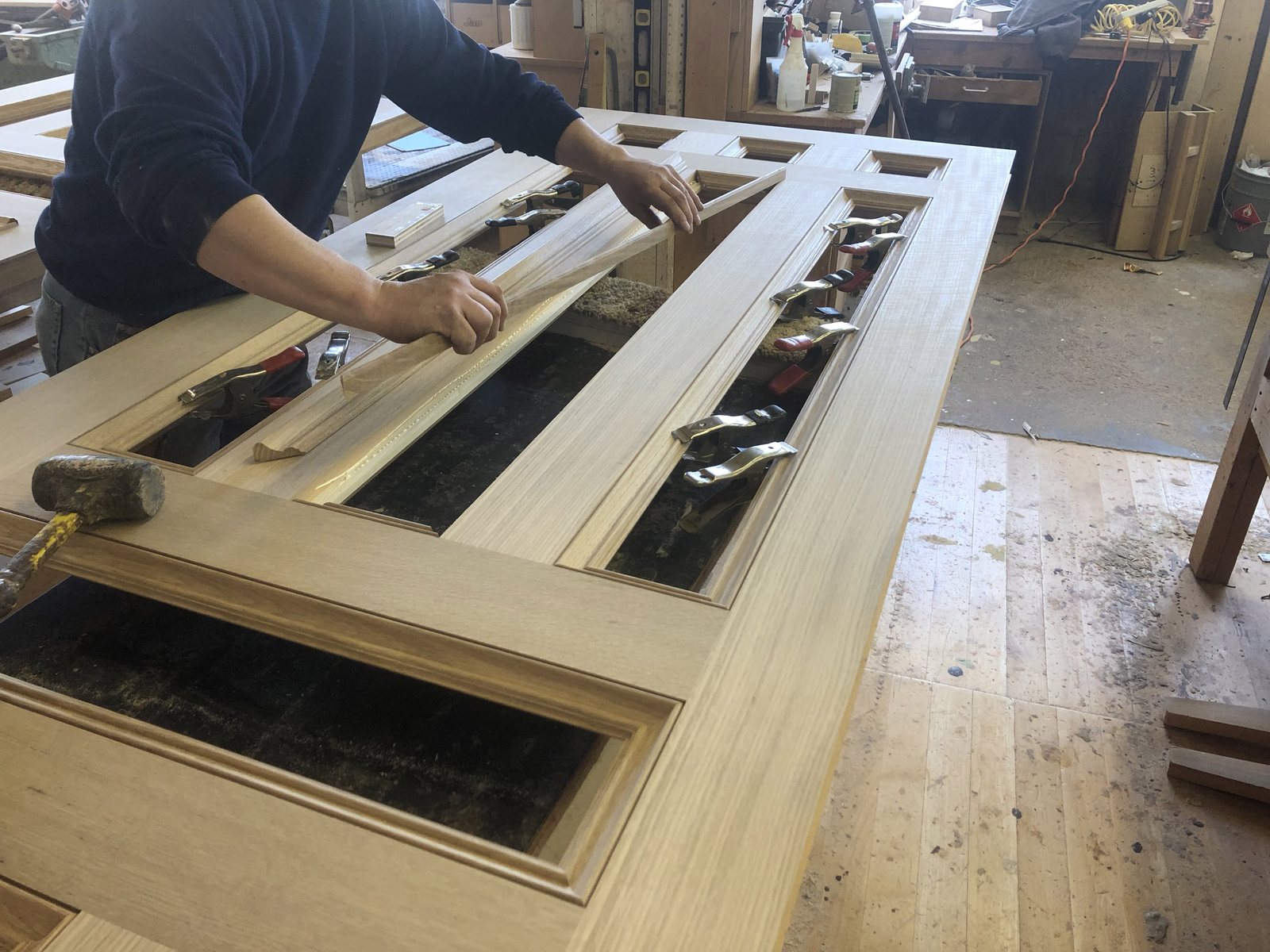
Clear length kills more details than thickness does. A board's maximum clear length is set by how the tree grew and how the log was bucked, not by what the elevation wants. Species on short rotations, and species harvested from plantation stands rather than mature forest, arrive in a length band that no amount of sorting extends. A 20 ft clear run in a species that comes in at 12 ft is not an availability problem that patience solves.
Grade enters here, and it pays to be precise about what grade means. The National Hardwood Lumber Association rules measure a board by the yield of clear face cuttings it produces, not by how it looks across the face. No. 1 Common yields smaller clear cuttings than FAS. Nothing about it is defective. It is the wrong grade for a long clear run and the right grade for short parts, and a spec calling for No. 1 Common on a 16 ft uninterrupted casing has set two requirements that fight each other.
J. Gibson McIlvain pulls and measures real boards in the specified species before answering a length question, rather than answering from a species table. When the answer is short, the markup does not propose a splice location. Where a joint lands in a visible run is a design decision, and the note goes back to you with the available length written next to it.
Width Against Log Diameter
A one piece width is a log question before it is a milling question. Wide clear stock exists only where the logs were big enough to produce it and the drying went right. Grain orientation narrows the yield further. Quartersawn and rift stock comes off the log in narrower boards than plainsawn by the nature of the cut, which is the trade you accept in exchange for the stability.
That stability is usually why the spec asked for it. Quartersawn and rift stock moves less across its width than plainsawn, which is why it gets specified where a painted surface or a panelized face has to stay flat. Ask for 11 inches of clear quartersawn in one piece and the width check will flag it even in a species nobody considers rare.
Exterior work carries a second width limit that has nothing to do with yield. Sapele is a first call for painted exterior trim, and it is not milled 1x8 for exterior use, because at that width it will not hold still through a wet and dry cycle. The published figures on Sapele describe the material well, and the width ceiling is a service decision sitting on top of them. Narrower boards, or a glued panel with the joints placed deliberately, are the two ways out, and choosing between them is yours.
Finish Against the Species Own Behavior
An opaque coating narrows the species list faster than any other line in the spec. Painted exterior trim is the clearest case. Sapele is preferred over Genuine Mahogany there, because it holds paint better and arrives in a wider range of sizes and longer lengths, which means fewer joints under a film that will show every one of them.
Absorption is the next thing the check looks at. Open-grained and oily species absorb a great deal of finish, so a primer coat is what evens out the eventual painted surface, and sanding or buffing after priming knocks back the raised grain while keeping the moulded detail crisp. Teak and Iroko sit at the oily end of that range. A spec calling for an opaque system over them without naming a primer step has left out the step that decides how the finished wall looks.
Cedar belongs in exterior specs and the review does not argue with it. The call that matters is the grade rather than the species. CVG, clear vertical grain, and STK, select tight knot, are different materials under paint and are not interchangeable in a schedule that names only the species. Published grade descriptions are worth putting in front of the client before the sample arrives.
One failure mode gets blamed on species when it should not. Cupping is driven by installation and back ventilation, not by the species on the schedule. Trim that cannot dry from behind cups regardless of what it is made of, which is why the assembly detail behind the trim matters more to the painted result than the line item for the wood.
Quantity Against What the Grade Can Supply
The last check is arithmetic against a real pile of lumber. FAS requires a minimum board 6 inches wide by 8 ft long, so a volume quoted in board feet of FAS is a volume of boards that size or better, in one species, from stock on hand. The number on the takeoff and the number standing in a yard are different numbers, and the gap between them is the whole reason this check runs before the package is issued.
Three variables make a quantity hard. One lot, one grade, one date. Loosen any of the three and the answer usually comes back yes. Hold all three and it depends entirely on depth of inventory in that species. J. Gibson McIlvain holds over seven million board feet of imported and domestic lumber at its Maryland yard, which is what makes a single lot answer possible on a volume that would otherwise be split across three vendors and arrive in three color ranges.
When the quantity does not clear, the markup separates the fixes. Lot matching and staged release against a construction schedule are the supplier's to arrange and need nothing from you. A species substitution, or a grade change that alters the visible face, is yours, and the note names the proposal rather than quietly shipping the alternative.
Where the Number Stops Being a Promise
No supplier can promise that a board stays where it was milled. Interior millwork is milled to an in-service moisture content near 6 to 8 percent, and that figure describes the wood on the day it leaves the mill. After that the building owns it. Material installed into a shell still drying, or into a space the mechanical system has not started conditioning, moves, and that movement is not a milling defect.
The Forest Products Laboratory has documented equilibrium behavior for long enough that none of this is in dispute. Air dried stock settles near the local equilibrium and does not substitute for kiln dried where an interior tolerance has been specified. A spec can name a moisture content at delivery. It cannot name one for month six.
Warranties on solid unmodified wood do not exist. Modified products carry warranties. Solid wood cannot, because it is an organic material that keeps responding to the air around it, and any supplier offering a warranty on plainsawn hardwood is offering something nobody can honor.
Two Kinds of Note on the Returned Markup
Every note on the markup is either something the supplier solves or something you have to decide. That split is the real output of the review, and it is more useful than the findings themselves. A set of twenty notes where eighteen are already handled reads nothing like twenty notes with no sorting on them.
J. Gibson McIlvain marks each note as either closed at the mill or returned for a decision, so the set that comes back separates the work you still owe from the work you do not. Closed notes cover stock stepped up a quarter, a knife ground to match, a lot held for color, a release date moved. Returned notes cover joint locations, visible grain orientation, species substitutions and anything that changes what the finished surface looks like.
A third category never appears on the markup at all. J. Gibson McIlvain supplies and mills, and does not install, coordinate installation or field measure, so every note depending on a dimension taken in the field stays with the installer and has to be closed by somebody else before material is cut. Pretending otherwise is how a set comes back clean and the job still stops.
| Review check | What trips it | Who owns the decision |
|---|---|---|
| Finished dimension against rough thickness | Profile relief deeper than the surfaced yield of the quoted thickness | Supplier when the stock simply steps up, architect when the profile has to be relieved |
| Required length against rotation length | A clear run longer than the species reliably delivers in the specified grade | Architect, since joint location in a visible run is a design decision |
| Width against log diameter | A one piece width the logs will not yield in the specified grain orientation | Architect, choosing between narrower boards and a glued panel |
| Finish against species behavior | An opaque system specified over a species that absorbs heavily or will not hold width | Supplier proposes the substitution, architect approves the visible result |
| Quantity against grade availability | Volume demanded in one grade, one species, one lot, on one date | Supplier through lot matching and staged release, architect only if grade or species changes |
| Moisture against service environment | A delivered moisture content the installed environment will not hold | Neither, the limit belongs to the building and its conditioning |
A Change That Closes One Note Can Open Another
The checks are not independent of each other, so the response that clears one finding frequently creates the next one. This is the part of a buildability review that surprises design teams, and it is the reason a second pass is worth scheduling before the set is considered closed.
Stepping up rough thickness to get the relief a profile needs is the common example. The thicker stock exists, the note closes, and the width yield at that thickness is narrower than it was a quarter lower, because wide boards get scarcer as thickness goes up in every species. A set that cleared the dimension check now fails the width check it had already passed.
Species substitution does the same thing to length. An alternate chosen because it matches the appearance requirement carries its own ceiling on clear length, and a run that was comfortable in the original species can sit right at the limit in the substitute. Quantity behaves the same way. Relaxing a grade to make a quantity obtainable widens what arrives, which can reopen the appearance question the grade was written to settle.
J. Gibson McIlvain runs the checks again against the revised set rather than against the original, which is the only way the interaction shows up. Sending back a markup on a set that has already moved describes a document nobody is building from.
Two passes are usually enough. The first finds the conflicts, the second confirms that the responses did not introduce new ones, and a third is a sign that the specification is being written against what is convenient to approve rather than against what the building needs.
When to Send the Set
The review is worth the most before the spec is issued for bid and worth the least after shop drawings are approved. Early, a flagged length is a line edit. Late, the same flag is a change order with three parties on it. The checks do not get harder over the life of a project. The cost of what they find does.
Sequence it against your own documents. The plan set and the millwork section go over first and come back marked. Your revisions fold into the set that goes out for bid. The markup then travels with the submittal transmittal, so a reviewer looking at shop drawings can see which dimensions were already settled and on what grounds. A retained control sample from the approved lot closes the color question that otherwise reopens at punch list.
Grade of work language from the Architectural Woodwork Institute standards belongs in the same pass, since premium grade and custom grade carry different tolerances, and a markup is far more useful when it knows which one it is checking against.
"Most of what we send back is not a criticism of the drawing. It is a note that the board the detail assumes does not come out of the log that way, and somebody has to pick which way to bend. I would rather have that conversation in April than in August."
Norm Moton, Director of Sales, J. Gibson McIlvain
How J. Gibson McIlvain Would Specify This
Name the grade, the thickness in quarters, the grain orientation and the in-service moisture content, and leave joint locations open until the length check comes back. A spec written that way gives the review something to check against. A spec naming only a species and a finished size forces the supplier to guess at intent, and that guess is what produces the submittal fight later.
J. Gibson McIlvain mills the stock to the moisture content the spec names, matches lots across phases so a second shipment does not read as a different species, and marks the drawing set rather than returning a quote with silent substitutions buried in it. Where the package includes true custom work planned around a specific room rather than linear runs, it goes to ICD, the company's architectural millwork division, and the same checks run against the casework drawings. The company ships nationwide and regularly to California, so a review run out of Maryland is not a regional service.
Send the plan set and the millwork section before the package is issued for bid. Call 800-638-9100 or start from the J. Gibson McIlvain millwork services page and ask for the drawings to be reviewed against available material. What comes back is a marked set with every note sorted into the ones already handled and the ones waiting on you.
Frequently Asked Questions
What does a buildability review actually check, and in what order?
Five things, in sequence. Finished profile depth against the rough thickness the spec quotes in quarters. Required clear length against what the species grows and how the log was bucked. One piece width against log diameter in the specified grain orientation. The coating against how that species absorbs finish and holds dimension. Quantity against what the grade can supply in one lot by the date on the schedule. Order matters because an answer at one step changes the input to the next. A thickness bumped from 4/4 to 6/4 changes the board being counted at the quantity step.
Will the review change my design?
Only where you decide it should. The markup separates notes that get closed at the mill from notes that come back to you, and the dividing line is whether the fix alters what someone sees. Stepping stock up a quarter, grinding a knife to match a template, holding a lot for color, moving a release date, none of those touch the drawing. Joint locations in a visible run, grain orientation on a face, and species substitution all do, and those come back unresolved with the constraint written next to them.
Can any supplier guarantee that installed millwork will not move?
No. Interior millwork is milled to an in-service moisture content near 6 to 8 percent, and that number describes the material on the day it ships. Once it is installed, the building's own conditioning governs. There is no warranty on solid unmodified wood, because it is an organic material that keeps responding to the air around it. Modified products are the only exception. Anyone offering a warranty on plainsawn hardwood is offering something nobody can honor.
When is the right time to send the drawings over?
Before the package is issued for bid. At that point a flagged clear length is an edit to a sheet. After shop drawings are approved the same flag becomes a change order with an owner, a general contractor and a woodworker all holding positions. Send the plan set and the millwork section together, since the section carries the grade, moisture and finish language that half the checks run against.
Why does a wide one piece panel get flagged in a common species?
Width comes out of log diameter, and grain orientation cuts into the available width again. Quartersawn and rift stock is narrower off the log than plainsawn by the nature of the cut, which is the trade for the stability that probably drove the specification in the first place. A clear quartersawn face at 11 inches in one piece is a different request from the same face in plainsawn, even in a species that is not scarce by any measure.
What about dimensions that depend on conditions in the field?
They never get closed on a markup. A note that resolves only after somebody measures a finished opening, a built wall or an installed cabinet run belongs to the installer or the general contractor, and it has to come back as a dimension before material is cut. The review can flag which notes are in that category, which is useful on its own, since those are the ones that quietly hold up a release while everybody assumes the mill is handling them.