Where a Texture Run Starts to Drift
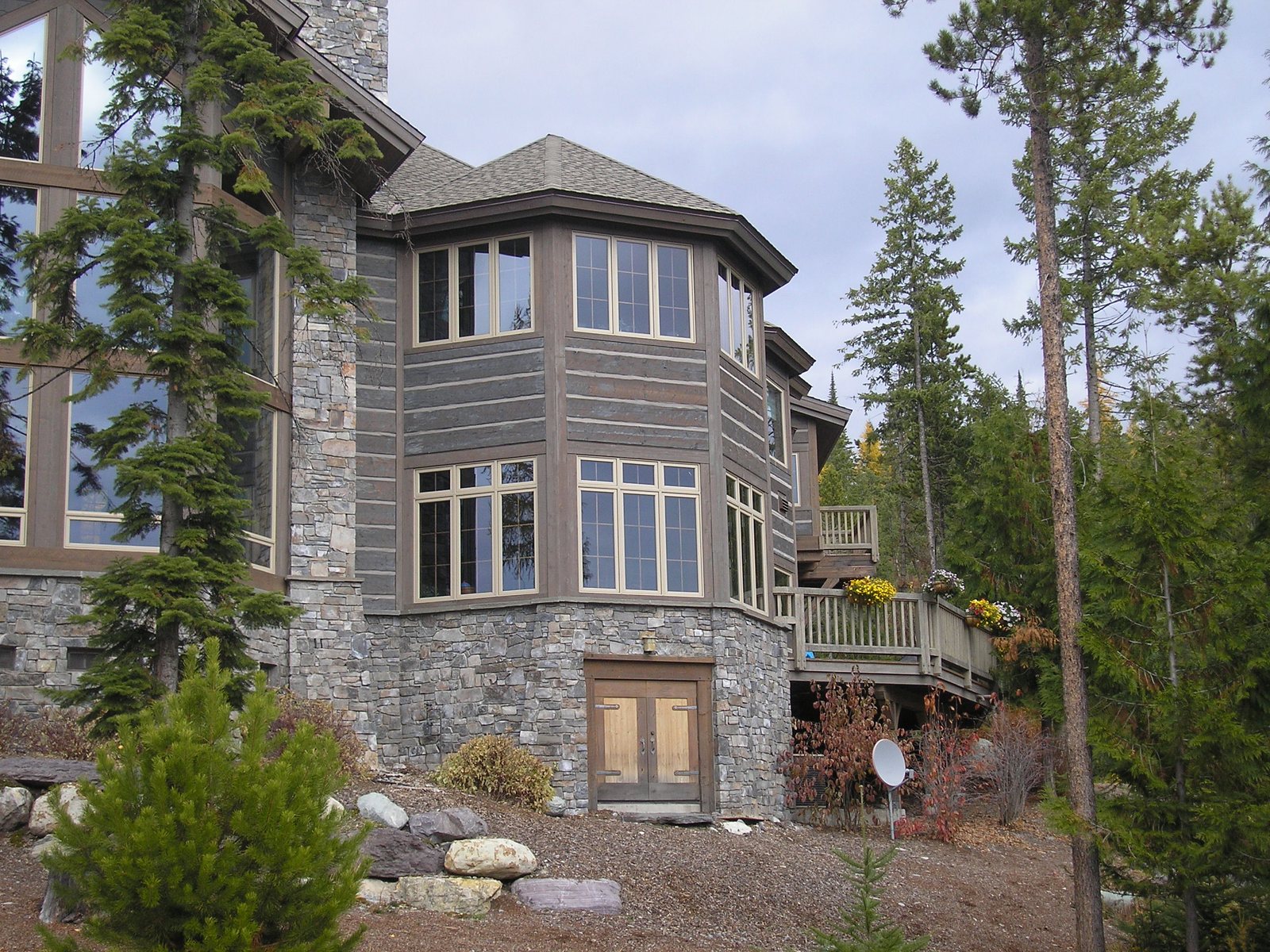
A resawn or hewn face reads as one continuous surface only when the cut behind it has been controlled, sampled and recorded before the first board runs. Most texture complaints are not really about texture. They are about variance. One board carries a tight, even saw pattern, the board beside it carries a coarse one, and the eye finds that seam from across the room.
The causes are a short list. Blade condition changes across a shift, and a dulling band leaves a deeper, woollier mark than a fresh one. Feed rate changes when an operator is chasing a schedule. Grain orientation changes between a flatsawn cant and a quartered one, and the same blade reads differently on each. Moisture content at the moment of the cut decides whether fiber shears clean or tears.
A drawing that says rough sawn face, or hand hewn appearance, and then stops has handed the decision to whoever is standing at the machine that afternoon. Three hundred pieces will not match. The fix is unglamorous. Name the machine, name the sample, name the tolerance, and name who holds the reference piece. Trade quality standards such as those published by the Architectural Woodwork Institute are written around exactly that habit of defining a surface rather than describing it.
The Control Sample Governs the Whole Order
Hundreds of pieces hold one texture only when a single approved sample stays in the shop and every batch is cut back to that piece. Not a photograph. Not a finish schedule note. A physical board, long enough to show the repeat of the saw pattern, signed and dated.
Three copies is the working number. One travels to the architect or the owner for approval, one stays at the machine, and one goes into the job file untouched so there is still an unweathered reference two phases later. Better specifications also carry a range, a lightest acceptable face and a heaviest acceptable face, since a sawn texture is a band of outcomes rather than a single one. Approving the range up front stops the argument at delivery.
J. Gibson McIlvain records the setup that produced the approved sample, the blade, the feed rate and the finished thickness, and mills later batches to that same record rather than to a fresh eyeball judgment. That record is what makes a second or third release of the same order look like the first. It is also what lets a buyer come back for a repair run and get a face that belongs on the same wall.
What the Band Resaw Actually Leaves
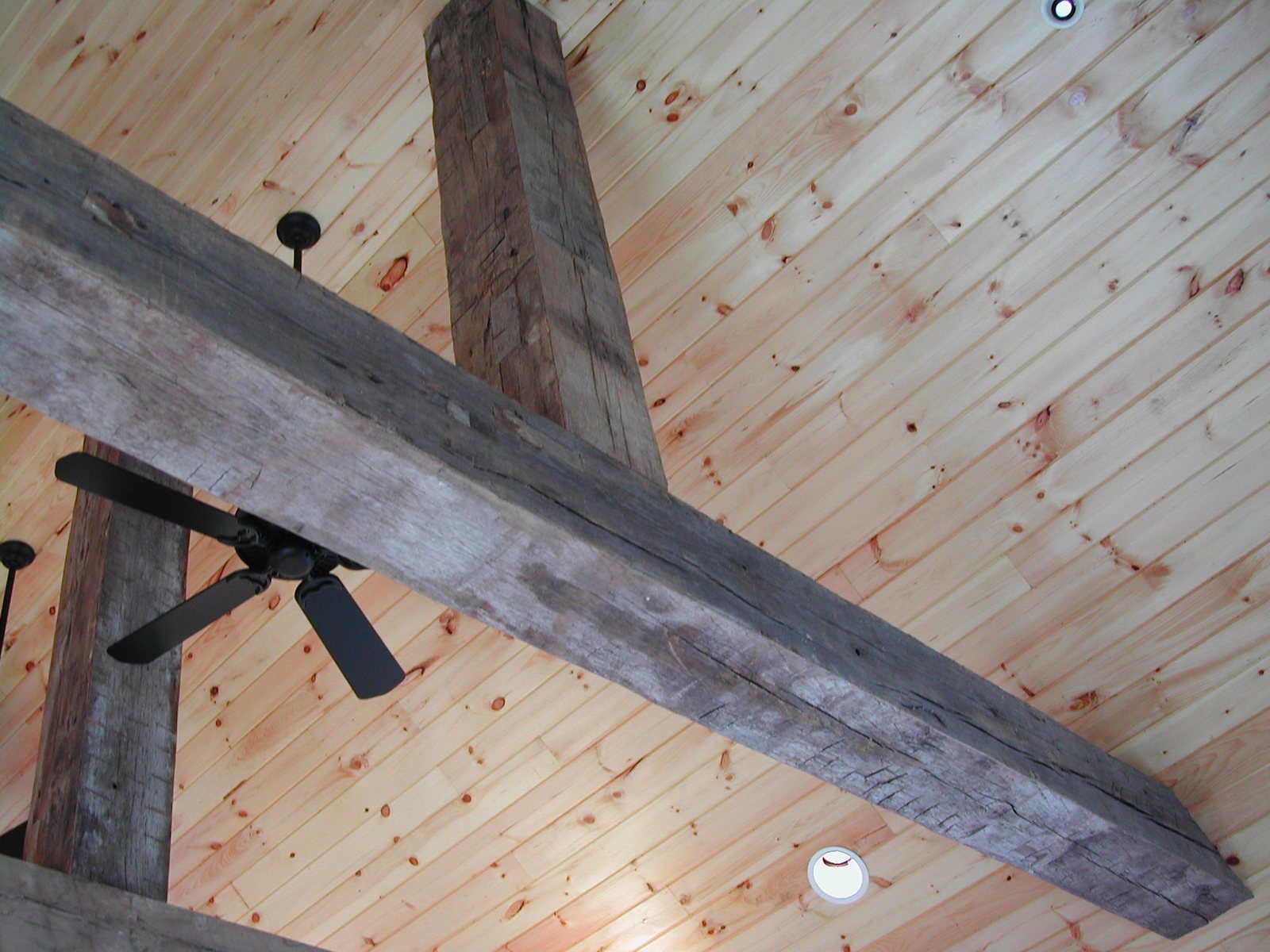
The band resaw is the machine that creates a resawn texture, and its blade, its feed rate and its thickness target decide everything about how the face reads. Band resaws on the floor split thick stock into finished boards, and each pass leaves two faces carrying the mark of that cut. Tooth pitch sets the spacing of the pattern. Feed rate sets its depth.
Thickness is the quiet variable. A board resawn at a loose thickness has to be planed to get to dimension, and planing erases the texture that was the point of the order. The finished thickness has to be fixed before the resaw, not corrected after it, which means the resaw target and the dimension on the drawing are the same number.
Width and length consistency come off different machines. Straight line and gang rip saws hold width across a run, trimming saws hold length, and the moulder puts the joint on the board, a shiplap, a nickel gap or a channel, along with the back relief kerfs that let a cladding board breathe. A textured siding board is still a profiled board, and the profile has to be cut without touching the face.
| Variable | How it shows up on the wall | What holds it steady |
|---|---|---|
| Blade condition | Pattern coarsens as teeth dull, so the last boards of a batch do not match the first | Blade changed on a board count, not on an operator's feel |
| Feed rate | Faster passes leave deeper, wider tooth marks and a busier face | Feed rate written down with the approved sample and reset the same way each batch |
| Grain orientation | Flatsawn and quartered faces take an identical blade very differently | Cants oriented the same direction through the entire run |
| Moisture at the cut | Wet fiber tears and fuzzes, dry fiber shears and stays crisp | Stock conditioned to its in-service target before resawing, not after |
| Batch sequence | Two batches milled weeks apart can read as two different walls | One retained approved sample matched batch to batch |
| Thickness target | Any face planed later loses most of the texture it was bought for | Finished thickness fixed at the resaw with no planing pass after |
Knife Ground Texture and Repeatability
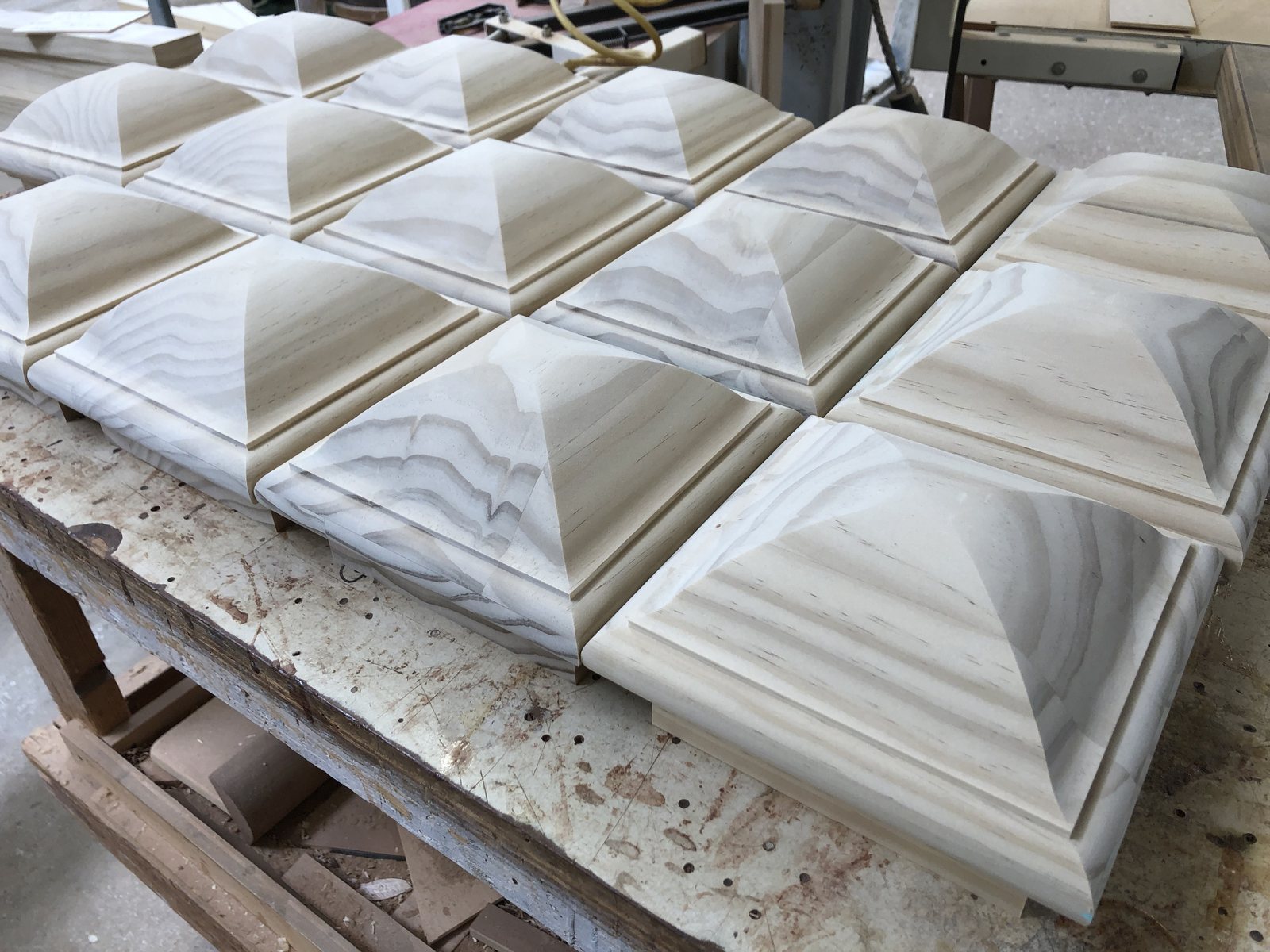
A repeating texture that must land identically on hundreds of pieces belongs on a ground knife rather than on a hand tool. A relieved face, an undulating face, a chamfer broken into facets, a reeded or scalloped panel field, all of it can be ground into steel and run. Every piece then comes off the moulder the same.
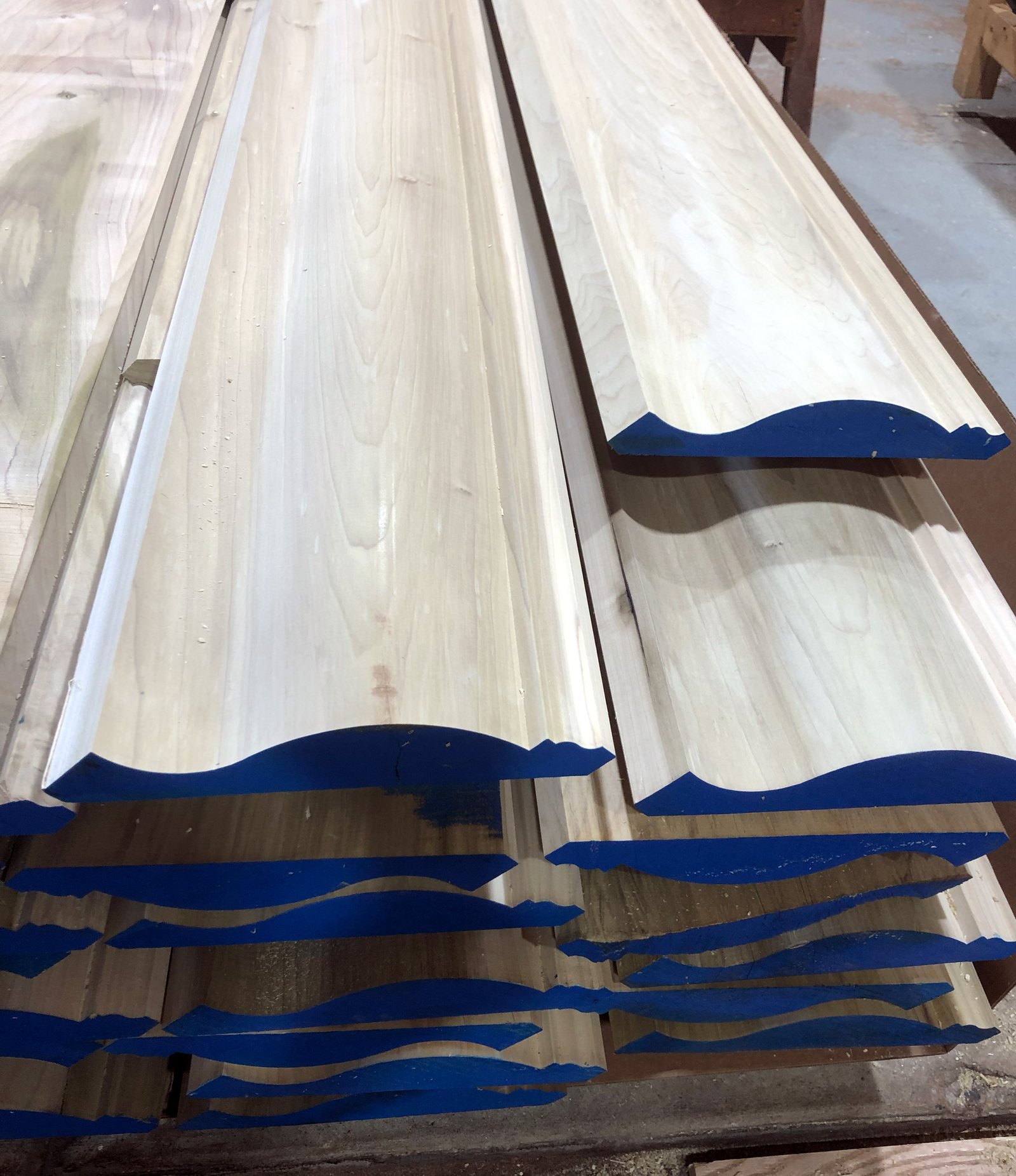
J. Gibson McIlvain grinds new knives every week on its own grinders and keeps a moulding profile library holding thousands of profiles, so a texture profile that does not already exist gets cut into steel to match a sample, including difficult historical restoration profiles where a district requires like for like replacement. Federal preservation guidance, including the Secretary of the Interior's Standards, expects a replacement to match the original in design, texture and material, which is a knife problem before it is anything else.
Identical is occasionally the complaint. A knife ground texture can look too regular next to genuine old work, and the usual answer is to run two setups and shuffle the boards, or to pair a knife cut profile with a resawn face so the repeat is broken by the saw. That decision belongs in the sample approval, not in the field.
Hand Hewn Faces and Where Milling Stops
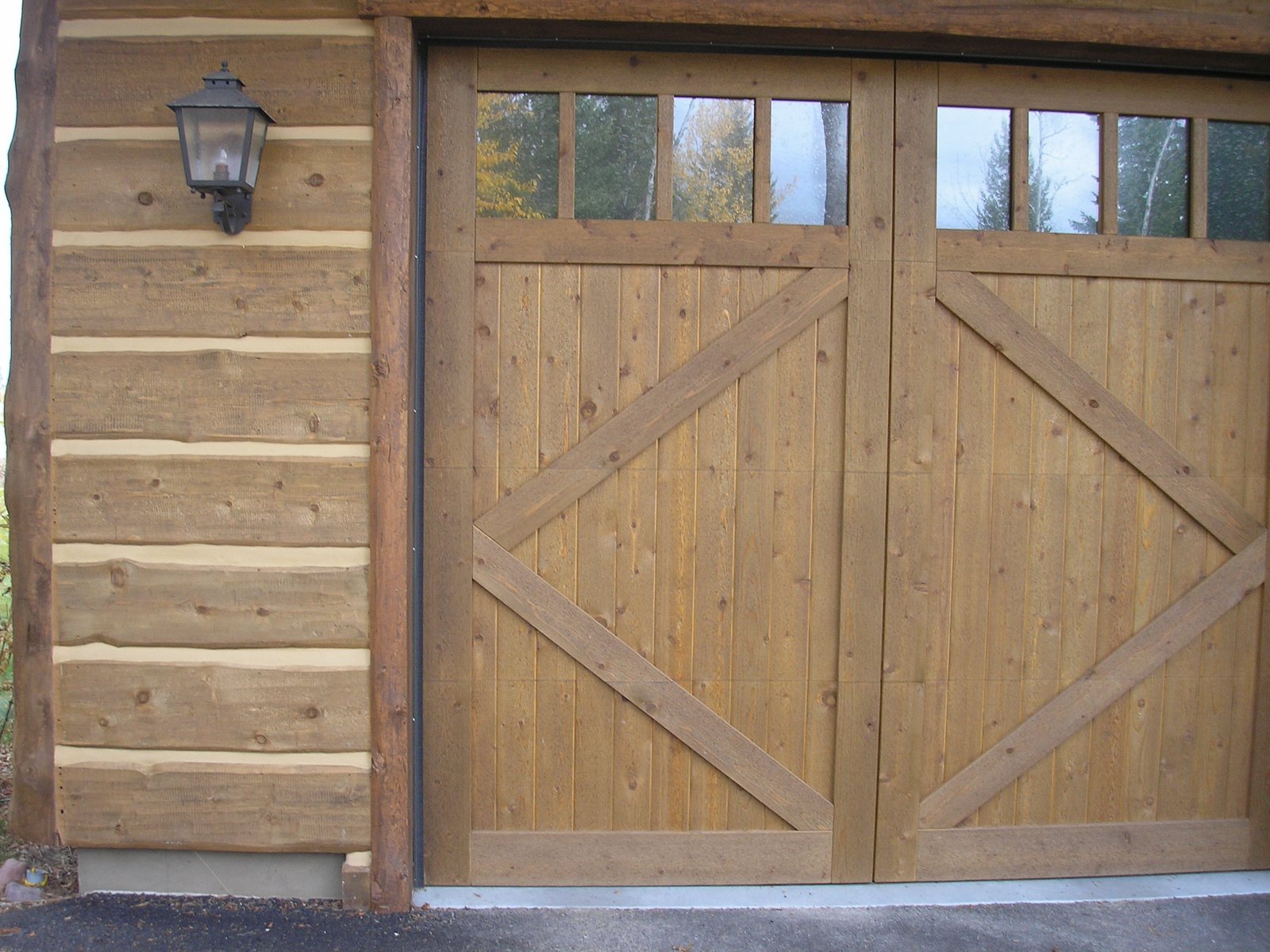
A true axe or adze hewn face is hand work, so on a run of hundreds of pieces the honest division of labor is machine consistency from the shop and hand character from a fabricator. No machine on any millwork floor swings an axe. Pretending otherwise is how a specification ends up unbuildable.
Hand hewing removes material unevenly by design. That has a dimensional consequence most drawings miss. The finished thickness has to be called out at the thinnest point of the hewn face, and the blank has to be milled thicker than the nominal dimension so there is material to lose. Get that backwards and the hewn boards finish under thickness, which shows up at every butt joint and every outside corner.
J. Gibson McIlvain mills the blanks for that work to one thickness, one width and one length, and primes the back and edges before shipping so the fabricator only has to deal with the face. Face priming waits until after the hand texturing is complete. Where a project wants the look without the hand labor, a resawn face or a knife cut relieved face carries most of the character with none of the schedule risk.
Species That Hold a Cut Texture
Sapele, Iroko, Afrormosia, Teak and Utile are the species a millwork shop reaches for when a sawn or knife cut texture has to repeat across a large run. They machine predictably, they hold an edge on a moulded detail, and they come in the sizes and lengths a cladding or paneling run actually needs.
Sapele sits near 1,410 lbf on the Janka scale, which is hard enough that a saw pattern stays crisp instead of crushing under handling. For painted exterior trim and cladding it is the better choice over Genuine Mahogany, which runs nearer 800 lbf, holds paint less well and comes in a narrower range of sizes and shorter lengths. Sapele is not milled 1x8 for exterior use, since that width is too wide to stay stable outdoors. The published species data for Sapele lines up with what the machines show.
Interior paneling widens the palette. White Oak near 1,360 lbf and Hard Maple near 1,450 lbf both take a sawn face cleanly, and Cherry near 950 lbf takes a gentler texture that reads well under a clear finish. Grading rules from the National Hardwood Lumber Association govern what arrives in the pack on the domestic species, which is worth knowing when a textured face will show every defect the grade allows.
Cedar remains a legitimate default for exterior textured siding, and the grade distinction matters more than the species argument. Clear vertical grain, CVG, gives the most uniform face for a repeating texture. Select tight knot, STK, puts knots into the pattern on purpose, which is the right call on a rustic elevation and the wrong call where the face has to stay quiet.
The tropical decking species are a different animal. Ipe, botanically Tabebuia spp, along with Cumaru, Garapa, Jatoba and Red Balau, are extremely hard and carry high oil content, which makes them difficult to glue and awkward in a milled, panelized assembly. They earn their place on a deck. For milled siding, wall panels and trim a millwork house reaches for Sapele, Iroko, Afrormosia, Teak or Utile instead, because those species glue, prime and machine the way a repeating texture requires.
Modified Wood With a Sawn Face
Modified wood is the only material in this category that carries a warranty, and it also imposes hard limits on length and width that a textured run has to be drawn around. It is not possible to warranty solid unmodified wood. Wood is an organic material responding to its environment, and no honest supplier promises otherwise.
Accoya sits near 1,600 lbf, and its acetylation gives dramatically reduced shrinkage and swelling, which is why it holds a textured face and a coating well on a weather exposed elevation. Thermory and Abodo Vulcan are both carried as thermally modified options, and both take a sawn texture, though thermally modified material is more brittle at the fiber than unmodified stock and wants a sharper blade.
The length ceiling is set by kiln size. Modified woods, Thermory, Abodo Vulcan and Accoya, top out around 16 ft, and most are sold on metric lengths just under 16 ft. Anyone drawing a 20 ft textured run in modified wood is drawing a joint whether they have shown it or not. Width has its own ceiling. Thermally modified Ash is not available wider than 8 inches, so a wide textured board in a modified product means Accoya or Abodo Vulcan.
Moisture Content and Whether Texture Stays Put
Texture survives the trip from shop to wall only when the moisture content at milling matches the environment the piece will live in. Interior millwork is milled to an in-service moisture content near 6 to 8 percent. Exterior work is milled nearer 12 to 16 percent. Those are different materials in practice, even in the same species.
Sawing order matters too. Quartersawn and rift stock moves less across its width than plainsawn, which is why it gets specified where a painted or panelized surface has to stay flat. A textured face magnifies movement rather than hiding it, since a cupped board throws a shadow line and the texture then reads unevenly down the wall. Shrinkage behavior and equilibrium moisture content for the species in question are published in the Forest Products Laboratory wood handbook.
Cupping is driven by installation and back ventilation, not by species. A board fastened tight to a solid substrate with no drainage plane behind it will cup no matter what it was milled from. Guidance on rain control and drained claddings from Building Science Corporation and the moisture provisions referenced by the American Wood Council both point the same way. The shop controls moisture at milling. The wall assembly controls it for the next fifty years.
Priming a Textured Face Without Filling It
Priming a sawn or hewn face is a different operation from priming smooth trim, since the goal is to seal the wood without flooding the texture. A heavy, poorly chosen coat will soften a saw pattern into a blur, and no amount of topcoat brings it back.
J. Gibson McIlvain primes in three levels, in both oil-based and water-based systems, and exterior primed trim carries a fungicide additive. Open-grained and oily species absorb a great deal of finish, so a primer coat evens out the eventual painted surface rather than leaving patchy sheen across a wall. On smooth moulded work, sanding or buffing after priming knocks back grain raising while keeping moulded detail crisp. On a textured face that pass gets lightened or skipped by design, since the raised fiber is part of what the buyer approved.
Six faces is the specification to write. Primed back, primed edges and primed ends stop the back of a board from drinking moisture at a different rate than the front, which is the quiet source of cupping on painted cladding. Ends are the worst offenders, and a crew that cuts to length on site should be told in writing to prime the fresh cut before the board goes up. Standards published by the Wood Moulding and Millwork Producers Association treat that sealing step as part of the product rather than as a field option.
Sequencing a Large Run as One Wall
A four hundred piece textured order is not one batch, and the way it is grouped and labeled decides whether the finished wall reads as a single surface. Lot matching comes first. A textured face shows color variation more than a smooth one does, since the saw pattern breaks light across the board instead of reflecting it evenly.
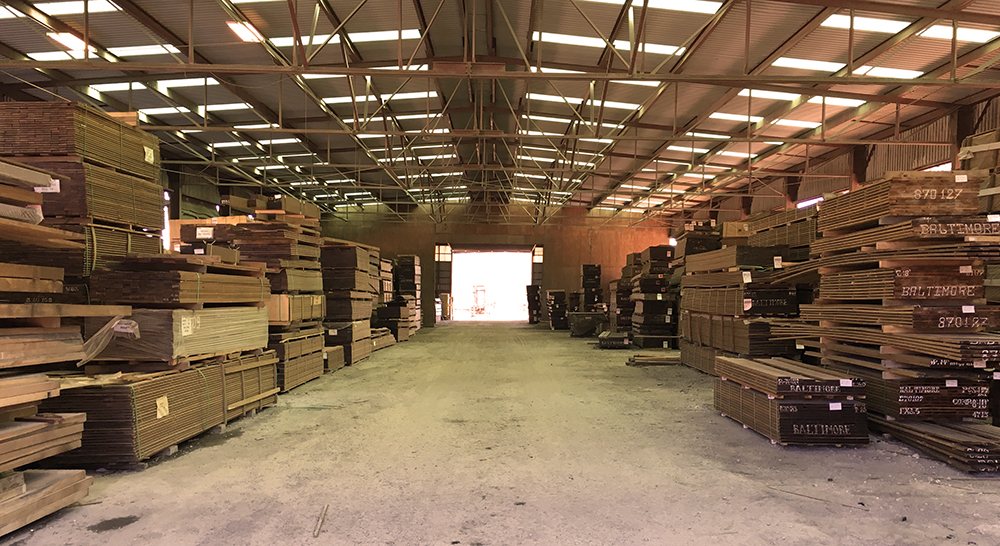
J. Gibson McIlvain holds over seven million board feet of exotic and domestic lumber at its Maryland yard, which is what makes it possible to pull a single textured order from matched lots rather than assembling it from whatever landed that month. J. Gibson McIlvain packages each bundle marked with its batch so an installer is not mixing the first release and the third release on the same elevation. The run also gets sized with attrition built in, since textured boards get culled at a higher rate than smooth ones and a job that orders exactly its take off will come up short.
True custom wall paneling planned around a specific room, rather than cut from stock widths, runs through ICD, the company's architectural millwork division. ICD draws the panel layout to the actual wall and settles the profile and texture decisions against that layout instead of against a stock width. Linear trimwork, finished cladding and primed trim come off the J. Gibson McIlvain mill, and both ship nationwide on one order.
"On a textured order I want the approved sample back in my hand before we release the second batch. That one board settles more arguments than any email thread, and it is the reason a wall milled in March still matches a wall milled in September."
Norm Moton, Director of Sales, J. Gibson McIlvain
How J. Gibson McIlvain Would Specify This
A textured millwork specification that survives hundreds of pieces names the machine, the sample, the tolerance and the moisture target, and leaves nothing about the face to interpretation. Start with the texture method, resawn off the band resaw or knife cut on the moulder, and say which one. Then call out the finished thickness as the resaw target, with no planing pass permitted afterward.
Require three physical samples, with a lightest and a heaviest acceptable face approved as a range. Specify the species from the millwork palette, Sapele, Iroko, Afrormosia, Teak or Utile, with cedar called out by grade as CVG or STK wherever it is used. State the in-service moisture content, 6 to 8 percent for interior work and 12 to 16 percent for exterior. If the design needs a length past 16 ft, draw the joint rather than hoping a modified product will stretch. Priming gets its own line, with the level, the system and all six faces named.
For a hand hewn face, specify the blank oversize and the finished thickness at the thinnest point, and assign the hand texturing to the fabricator in writing. To scope a run, match an existing texture or get a knife ground to a sample, call J. Gibson McIlvain at 800-638-9100 or start with the millwork services overview, and bring the sample board or a photograph of the wall being matched. True custom paneling and casework planned to a specific space is handled through ICD, the architectural millwork division, in the same conversation.
Frequently Asked Questions
How many physical samples should I ask for on a textured siding or paneling order?
Three, and one of them should never leave the shop. One sample goes out for approval, one stays at the machine as the piece every batch is matched against, and one goes into the job file untouched so there is an unweathered reference available on a later phase. On a sawn texture it also pays to approve a range rather than a single board, a lightest acceptable face and a heaviest acceptable face, since a saw pattern is a band of outcomes and not a single fixed result. Approving the range before milling starts removes most of the disagreement at delivery.
Can a resawn texture be matched years later for an addition or a repair?
Yes, if the setup was recorded when the original ran. J. Gibson McIlvain records the blade, the feed rate and the finished thickness behind an approved sample and mills a later release to that record. A knife cut texture is even easier to repeat, since the ground knife reproduces the same face indefinitely. What never matches perfectly is weathered material next to new material, so a repair on an exposed elevation should plan on either a blended transition or a full plane of replacement.
Does a textured face need a different primer approach than smooth trim?
The system is the same, the application is not. The risk on a sawn or hewn face is flooding it, since a heavy coat softens the saw pattern into a blur that no topcoat recovers. Open-grained and oily species absorb a great deal of finish, so a primer coat evens out the eventual painted surface rather than leaving patchy sheen. On smooth moulded work a light sanding or buffing pass after priming knocks back grain raising, and on a textured face that pass gets lightened or skipped on purpose, because the raised fiber is part of what was approved.
What is the longest and widest textured board available in a modified wood?
Modified woods, Thermory, Abodo Vulcan and Accoya, top out around 16 ft, and most are sold on metric lengths just under 16 ft, because of kiln size. A design that needs a longer run needs a drawn joint. On width, thermally modified Ash is not available wider than 8 inches, so a wide textured board in a modified product means Accoya or Abodo Vulcan. Modified products are also the only materials in this category that carry a warranty. It is not possible to warranty solid unmodified wood, since wood is an organic material responding to its environment.
Can a hand hewn look be produced on hundreds of pieces?
A true axe or adze hewn face is hand work and no millwork machine produces it. The workable split is blanks milled to one thickness, one width and one length with the back and edges primed, and the hand texturing executed by the buyer's own fabricator, with face priming held until that work is done. Specify the finished thickness at the thinnest point of the hewn face and order the blank oversize so there is material to lose. Where the schedule will not tolerate hand labor, a resawn face or a knife cut relieved face delivers most of the same character with repeatable results.
Which species hold a sawn texture best on exterior cladding?
Lead with Sapele, Iroko, Afrormosia, Teak and Utile. Sapele near 1,410 lbf is hard enough that a saw pattern stays crisp through handling and installation, and for painted exterior work it beats Genuine Mahogany near 800 lbf on paint holding, size range and available lengths. Sapele is not milled 1x8 for exterior use, since that width is too wide to stay stable outdoors. Cedar is a legitimate default as well, called out by grade, CVG for the most uniform face and STK where knots are meant to be part of the pattern.
Will a textured face make cupping more likely?
Cupping is driven by installation and back ventilation, not by species or by texture. What texture changes is how visible the problem is, since a cupped board throws a shadow line and the saw pattern then reads unevenly down the wall. The controllable items are moisture content at milling, near 6 to 8 percent for interior work and near 12 to 16 percent for exterior, quartersawn or rift stock where a face has to stay flat, priming on all six faces including the ends, and a drained, back ventilated assembly behind the cladding.
Sources and Standards Referenced
- Wood Handbook, Wood as an Engineering Material, USDA Forest Products Laboratory
- Architectural Woodwork Institute, Woodwork Standards
- Rain Control in Buildings, BSD-013, Building Science Corporation
- American Wood Council, Codes and Standards
- The Secretary of the Interior's Standards for the Treatment of Historic Properties, National Park Service
- Wood Moulding and Millwork Producers Association
- National Hardwood Lumber Association, Rules for the Measurement and Inspection of Hardwood
- Sapele, The Wood Database
- Accoya Acetylated Wood, Technical Information