Matching the Decking, Clips, and Fasteners
A hidden-fastener deck is a matched system: the milled groove, the clip that sits in it, and the screw that holds the clip must all fit, so sourcing them together prevents the tolerance mismatch that causes callbacks. The groove is milled roughly 1/4 inch deep at a set height; the clip is designed for that geometry; the screw is sized to the clip and the joist. When these come from different sources, the groove can be wrong for the clip or the fastener wrong for the exposure. One supplier milling the groove to the specified clip keeps the system coherent.
On dense tropical hardwood this matters more, because the boards are too hard to re-groove or re-drill easily in the field. See our Ipe decking guide for how the boards behave. A groove cut for the wrong clip is scrap, not decking. The fix starts with understanding what the clip actually asks of the board.
How Hidden-Fastener Clip Systems Work
A hidden-fastener clip engages a groove milled into the board edge and screws down into the joist, so no fastener penetrates the top face and the deck surface stays clean. Many systems set a consistent board gap near 3/16 inch automatically, which keeps spacing uniform for both drainage and appearance. Because different systems use different groove depths and profiles, the decking must be pre-grooved for the specific clip, which is a milling decision made with the order. The American Wood Council publishes the fastener withdrawal and shear basis these systems are designed to. The clip holds the board, but a screw holds the clip, and that screw's metal is the next choice.
Stainless Fasteners and the Salt-Water Standard
Dense tropical decking must be fastened with stainless steel, and 316 stainless, which contains roughly 2 to 3 percent molybdenum for chloride resistance, near salt water. Carbon-steel fasteners corrode and stain the wood; 305 stainless suits general use while 316 resists the pitting that salt causes on docks and coastal decks, per ASTM stainless fastener standards. A complete package matches the clip and fastener grade to the environment, so a coastal deck ships with 316 hardware rather than the wrong grade. Cheap screws on a saltwater dock are a self-inflicted stain. Grade settles the field of the deck; the ends and edges still need their own answer.
| Component | Spec matched to |
|---|---|
| Pre-grooved boards | Groove milled to the chosen clip system |
| Hidden-fastener clips | Board groove and gap (about 3/16 in) |
| Screws | Clip and joist; stainless, 316 near salt water |
| Starter clips / end fasteners | Board ends and starting courses |
| Plugs (if any face screws) | Milled from matching stock |
Board Ends and Starting Courses
Even a hidden-fastener deck needs a plan for the board ends and the perimeter, where clips cannot reach, so a complete package includes starter clips or discreet stainless face screws for those spots. The first and last courses and butt joints often use a starter clip or a plugged face screw, and a picture-frame border is typically face-fastened with plugged stainless screws milled from matching stock. Supplying these with the deck keeps the ends consistent with the field. See our profile background in the Ipe vs. Cumaru guide.
Specifications of a Matched Package
A matched decking package is defined by the species, the groove-to-clip pairing, the fastener grade, and the joist spacing the fasteners are designed for. Tropical decking is kiln-dried to roughly 12 to 16 percent moisture content, milled 5/4 by 4 or 6 inches, and pre-grooved to the clip. Joist spacing is commonly 16 inches o.c. for 5/4 boards, and the USDA Forest Products Laboratory documents the fastener withdrawal behavior that governs clip holding in dense wood. J. Gibson McIlvain pre-grooves in-house to common clip systems and supplies the matched clips and stainless fasteners with the order. None of that hardware can do its job until the joists are where the clips need them.
Joist Layout and Framing for a Clip System
A hidden-fastener clip screws down into the joist, so the joist layout has to suit both the clip spacing and the dense decking, typically 16 inches on center for 5/4 tropical boards. Each clip fastens at a joist, so the joists must land where the clips need them, and blocking is added at butt joints and the perimeter where board ends fall. The International Code Council residential code sets the 40 lb per square foot live load a residential deck frame must carry, and the American Wood Council publishes the joist span basis. Because dense tropical hardwood adds weight, at roughly 5 to 6 lb per square foot installed for 5/4 Ipe, the frame is sized accordingly.
Getting the joist layout right before the boards arrive is what lets the clip system go down cleanly, since the clips cannot be relocated between joists. J. Gibson McIlvain supplies the matched decking and fastener package and advises on the joist spacing the clip system and species require. A frame laid out wrong cannot be talked into fitting.
Complete Decking-and-Fastener Package vs. Separate Parts
Buying the boards, clips, and screws separately puts the burden of matching them on the buyer, while a complete package arrives with the groove milled to the clip and the fastener grade chosen for the site. When the parts come from different vendors, the groove can be cut for a clip that was later changed, or general-purpose screws can show up where 316 stainless was needed. A supplier that assembles the package mills the groove to the specified clip and includes the matched clips, stainless screws, starter clips, and plug stock, so every component fits. The result installs as one coherent system rather than three parts that have to be reconciled on the jobsite. That is how J. Gibson McIlvain runs a decking order: the side groove is milled to the specified clip system, and the matched clips, stainless screws, starter clips, and plug stock ride in the same shipment, one delivery with nothing to reconcile on site.
Board Gap, Drainage, and Appearance
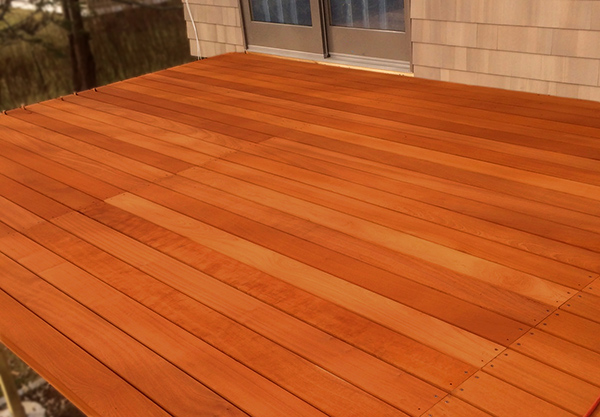
Many clip systems set a fixed board gap near 3/16 inch automatically, which serves both drainage and a uniform look, and the gap is part of what the clip choice determines. A consistent gap lets water clear the surface quickly and gives the deck a clean, even rhythm, which is harder to achieve by eye with face screws. Wider gaps drain faster on wet-exposed decks; tighter gaps look more refined on a protected surface. Because the clip sets the gap, choosing the clip is also choosing the spacing, which is why the system is confirmed with the order. The USDA Forest Products Laboratory notes that free drainage and airflow around boards are what keep a deck dry and sound. That same gap is also what a crew works through when a board eventually needs replacing.
Replacing a Board in a Hidden-Fastener Deck
A hidden-clip deck can be repaired, but replacing a board is more involved than backing out a face screw, so keeping a few matched spare boards and clips from the original order is worth doing. Because each board is held by clips engaged with its neighbors, reaching a damaged board in the field means releasing the adjacent clips and working back to it. Having spare boards and clips from the same lot means a repair matches the original in color and fit rather than standing out. J. Gibson McIlvain can include spare boards, clips, and fasteners with the package so a future repair uses matched material.
Stainless Fastener Grades for Decking
Fastener grade is chosen for the environment per ASTM stainless standards, with 316 for chloride exposure and the withdrawal basis published by the American Wood Council.
| Grade | Molybdenum | Best use |
|---|---|---|
| 304 / 305 | None to trace | General exterior decking |
| 316 | ~2 to 3% | Salt water, docks, coastal decks |
"The calls we get on hidden-fastener decks are almost always a mismatch: the groove does not fit the clip, or someone put 305 screws on a saltwater dock and they are weeping rust. When the boards, the clips, and the screws come from one place, we mill the groove to that clip and send the right stainless for the site. It ships as a system that fits, so the crew just clips it down."
Camden Zacker, Sales Director, J. Gibson McIlvain Company
How J. Gibson McIlvain Supplies a Matched Decking Package
For J. Gibson McIlvain, a decking-plus-fastener order starts by confirming the clip system, then milling the side groove to match on kiln-dried tropical decking, and supplying the matched clips and stainless fasteners, 316 near salt water, with the boards. Starter clips and matching plug stock for board ends and borders are included so the perimeter stays consistent with the field. The result ships as a coherent system rather than three parts sourced separately.
The team frames hidden fasteners as a matching problem: groove to clip, fastener to environment, ends to field. Getting all three from one supplier is what delivers the clean, screw-free surface without the tolerance and corrosion mismatches that cause callbacks.
Package Checklist
| Item | Why it matters |
|---|---|
| Clip system | Groove is milled to match it. |
| Fastener grade | Stainless; 316 near salt water. |
| End detailing | Starter clips or plugged stainless face screws. |
| Board gap | Clip sets it, near 3/16 inch. |
| Joist spacing | Fasteners designed for the spacing. |
Where Hidden-Fastener Decks Go Wrong
- Groove and clip mismatch: The groove must be milled to the specific clip.
- Wrong fastener grade: Use stainless, 316 near salt water, never carbon steel.
- No plan for board ends: Clips do not reach ends; include starter clips or plugged screws.
- Field grooving dense hardwood: Impractical; groove in the shop.
Related J. Gibson McIlvain Guidance and Next Steps
Frequently Asked Questions
Can I buy tropical decking with the clip and fastener system included?
Yes. Some specialty suppliers provide the pre-grooved decking, the hidden-fastener clips, and the stainless screws as one matched package, with the groove milled to fit the specific clip and the fastener grade chosen for the environment. J. Gibson McIlvain pre-grooves tropical decking in-house to common clip systems and can supply the matched clips and stainless fasteners, 316 near salt water, with the order, including starter clips and plug stock for board ends.
Why source the decking and fasteners from the same supplier?
A hidden-fastener deck is a matched system: the milled groove, the clip, and the screw must all fit, and dense tropical hardwood cannot be easily re-grooved in the field. Sourcing them together means the groove is milled to the clip and the fastener grade suits the exposure, which prevents the tolerance and corrosion mismatches that cause callbacks. J. Gibson McIlvain supplies the boards, clips, and stainless fasteners as one coherent package.
What fasteners are used with hidden-clip tropical decking?
Hidden-clip tropical decking uses stainless steel clips and screws, with 305 stainless for general use and 316 stainless, which has about 2 to 3 percent molybdenum for chloride resistance, near salt water. Carbon-steel fasteners corrode and stain the wood. Board ends and starting courses, where clips cannot reach, use stainless starter clips or discreet plugged face screws. A complete package matches the fastener grade to the site.
Do hidden-fastener clips set the gap between deck boards?
Many hidden-fastener clip systems set a consistent board gap automatically, commonly near 3/16 inch, which keeps spacing uniform for both drainage and appearance across the deck. Systems that set the gap mechanically produce cleaner results on large decks than relying on the installer. The board is pre-grooved to match the chosen clip. J. Gibson McIlvain mills the groove to common clip systems and supplies the matched clips.
How are the ends and edges of a hidden-fastener deck fastened?
Board ends, the first and last courses, and the deck perimeter are where clips cannot reach, so they use stainless starter clips or discreet face screws plugged with matching stock. A picture-frame border is typically face-fastened with plugged stainless screws. Including these with the decking package keeps the ends and edges consistent with the clip-fastened field. J. Gibson McIlvain supplies starter clips and matching plug stock with the order.
What joist spacing does a hidden-fastener tropical deck need?
Hidden-fastener tropical decking is commonly installed over joists at 16 inches on center for 5/4 boards, because each clip screws down into a joist and the joists must land where the clips need them. Blocking is added at butt joints and the perimeter where board ends fall. Dense tropical hardwood adds weight, around 5 to 6 lb per square foot for 5/4 Ipe, so the frame is sized to carry it plus the code live load. J. Gibson McIlvain advises on the spacing the clip system and species require.
Can hidden-fastener clips be relocated after the frame is built?
No. A hidden-fastener clip screws into a joist, so it can only go where a joist is, which means the joist layout must suit the clip spacing before the boards arrive. Butt joints and the deck perimeter need blocking so board ends land on support. Planning the frame around the clip system and the board layout up front is essential. J. Gibson McIlvain supplies the matched decking and clip package and advises on the joist and blocking layout.
Sources and Standards Referenced
- American Wood Council - Fastener Design Basis
- ASTM International - Stainless Steel Fastener Standards
- USDA Forest Products Laboratory - Fastener Withdrawal and Wood Mechanics
- EN 350 - Durability of Wood and Wood-Based Products
- Forest Stewardship Council - Chain of Custody Certification
- International Code Council - International Residential Code
- North American Deck and Railing Association
- National Hardwood Lumber Association - Grading Rules
- PEFC - Programme for the Endorsement of Forest Certification
- Building Science Corporation - Assemblies and Moisture
- ASTM E84 - Surface Burning Characteristics