The Short Answer: Match the Species to the Failure Mode, Not to the Janka Number
Ipe wins on hardness, durability class and fire rating; Cumaru delivers nearly the same performance for less; Garapa and Red Balau cost less than both and trade service life for a lighter, cooler, easier board; and the cost per square foot of any of them is decided at least as much by width, length, grade and profile as by the species name on the packing list. That is the whole comparison in one sentence. The rest of this page explains why each part of it is true, and where the conventional ranking misleads people.
Buyers arrive with a hardness chart. They leave with a deck. Between those two moments sit a dozen decisions that the chart never mentions, and the specifiers who get burned are almost always the ones who picked a species from a single column of numbers.
What Janka Hardness Actually Measures, and What It Does Not
Janka measures resistance to denting, not resistance to rot, weathering, movement or checking, and on a deck it is the least predictive of the numbers people rank species by. The test drives an 11.28 mm steel ball halfway into a sample and records the force required. Ipe lands near 3,680 lbf. Cumaru sits close behind at roughly 3,540 lbf. Massaranduba comes in near 3,190 lbf, Jatoba near 2,690 lbf, Red Balau between 1,700 and 2,000 lbf depending on the specific species in the Shorea group, and Garapa near 1,700 lbf. Teak, the species that planked warship decks for two centuries, tests around 1,070 lbf.
Read that last figure again. Teak is less than a third as hard as Ipe and it has outlasted almost everything else ever put on a boat. Hardness and longevity are separate properties. They correlate loosely through density, but the correlation is weak enough that specifying on Janka alone produces bad decks.
Where hardness genuinely matters is surface abuse. Rooftop amenity decks with steel furniture legs. Restaurant patios where chairs drag ten thousand times a season. Municipal boardwalks. Anywhere a scratch is a callback, the top of the hardness range earns its keep. On a private residential deck with padded furniture, the difference between 3,680 lbf and 1,700 lbf is invisible after year one, because both surfaces will have weathered and both will show the same silver patina. The USDA Forest Products Laboratory Wood Handbook documents the mechanical property testing behind these figures in full, and the chapters on shrinkage deserve more attention than the chapter on hardness gets.
The Tropical Decking Field, Side by Side
Six species carry the overwhelming majority of tropical decking work in North America, and each one occupies a defensible position rather than being a lesser version of Ipe. The table below sets the hardness, density, durability class, natural color and relative cost position against one another. Relative cost is expressed against Ipe because Ipe is the reference point every buyer already has in mind.
| Species | Janka (lbf) | Density (kg/m3) | Durability (EN 350) | Color When Fresh | Relative Cost vs Ipe | Best Fit |
|---|---|---|---|---|---|---|
| Ipe | ~3,680 | ~1,050 | Class 1, very durable | Olive brown to dark reddish brown | Reference point, highest of the group | Commercial decks, boardwalks, ASTM E84 Class A specs, longest lengths |
| Cumaru | ~3,540 | ~1,070 | Class 1 to 2 | Medium to dark reddish brown, some yellow cast | Costs less than Ipe | Residential decks wanting near-Ipe performance at a lower number |
| Massaranduba | ~3,190 | ~1,150 | Class 1 to 2 | Deep uniform red | Costs less than Cumaru | Projects wanting saturated red color and extreme density |
| Jatoba | ~2,690 | ~910 | Class 2 to 3 | Orange brown to deep red brown, streaked | Costs less than Ipe | Covered decks, porches, Class A fire rated applications |
| Red Balau | ~1,700 to 2,000 | ~880 | Class 2 | Medium red brown, even | Costs well under Ipe | Value-driven residential decks with a warm red tone |
| Garapa | ~1,700 | ~820 | Class 2 to 3 | Pale yellow to honey blond | Lowest of the tropical group | Rooftops, barefoot areas, weight-limited framing, light color schemes |
| Teak | ~1,070 | ~660 | Class 1 to 2 | Golden brown | Exceeds Ipe substantially | Marine work, high-end detailing, dimensional stability above all |
The pattern in that table is the point. Density tracks hardness reasonably well. Durability class does not track either one cleanly. Teak proves it at one end, Garapa at the other, and Massaranduba sits at the highest density in the group while moving more in service than species lighter than it.
Color: Fresh Sawn, Six Months In, and Ten Years Out
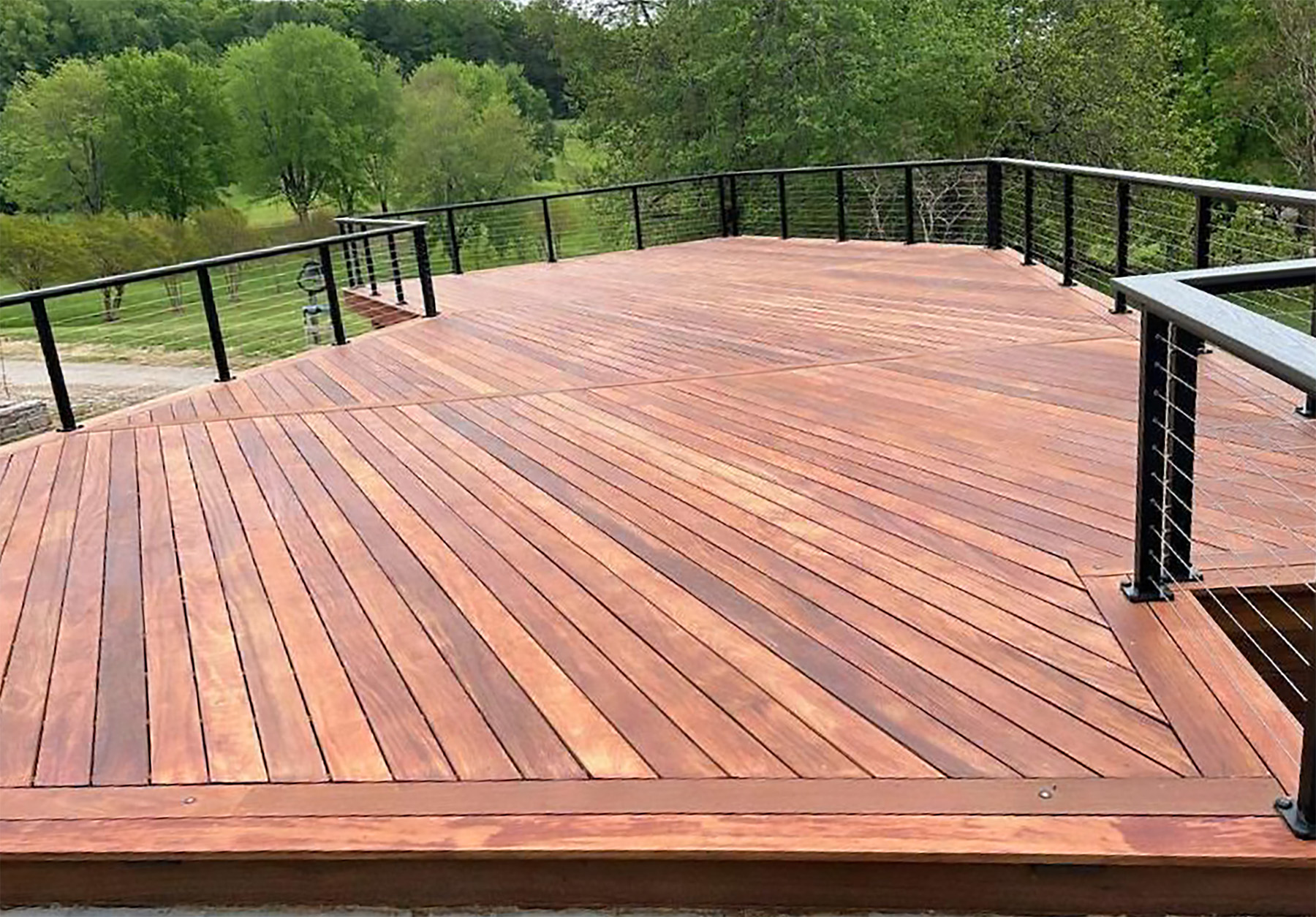
Every tropical species in this comparison ends up the same silver gray if left unfinished, which means color is a decision about the first two years and about maintenance commitment, not about the deck's permanent appearance. Ultraviolet radiation breaks down lignin at the wood surface. The degraded fibers wash away. What remains is a thin bleached layer that reads as silver or gray depending on the light. This happens to Ipe, Cumaru, Garapa, Jatoba, Balau, Massaranduba and Teak alike.
The differences show up in the transition. Massaranduba starts deep red and passes through a rust phase that some owners dislike. It also bleeds tannin heavily in its first rains, which stains concrete, stone and light-colored siding below. Anyone specifying Massaranduba over a limestone patio should plan for it. Garapa goes from blond to a pale driftwood gray that many designers prefer to the gray of the darker species, because the contrast between fresh and weathered is smaller and a partially weathered deck looks intentional rather than neglected.
Ipe's fresh color varies more than its reputation suggests. Boards run from olive to chocolate to reddish brown, sometimes within the same bundle, since the trade name covers several species in the genus Handroanthus. A deck installed from mixed bundles and finished immediately will look mottled. The same deck left to weather for six months will look uniform. Contractors who oil on day one without racking the boards for color first create the problem they then complain about.
Holding color requires a penetrating oil finish with ultraviolet inhibitors, reapplied on a schedule the site dictates. A south-facing pool deck in Arizona may need it annually. A shaded deck in Connecticut may hold two or three years. No coating stops the process permanently. Anyone promising otherwise is selling something.
Durability Class Is a Test Result, Not a Marketing Adjective
EN 350 durability classes rank heartwood resistance to fungal decay on a five-point scale from Class 1, very durable, to Class 5, not durable, and only Ipe reliably sits in Class 1 across the tropical decking group. The classification comes from standardized laboratory exposure to decay fungi, not from field anecdote. Class 1 species show expected in-ground service beyond 25 years. Above ground, on a ventilated deck frame, the numbers stretch dramatically.
Cumaru straddles Class 1 and 2 depending on the source and the specific botanical species supplied under the trade name. Jatoba lands in Class 2 to 3, which is the reason it belongs on covered porches and pool surrounds more comfortably than on an exposed ground-level deck in a wet climate. Garapa and Red Balau sit around Class 2, which still means decades above ground with proper detailing.
Sapwood carries no durability rating in any species. None. The classes describe heartwood only, and a board with a pale sapwood edge is a board with a decay-vulnerable strip running its length. Grade matters here more than species selection, and clear all-heart material is the only thing worth specifying for exterior work.
Certification is a separate axis from durability. FSC chain of custody certification documents responsible forest management and legal harvest, and it is increasingly a hard requirement on institutional and LEED-tracking projects. When using a CITES-listed species, documentation is required through the supply chain, and the CITES species listing database is the authority on which species carry that obligation. Verify it at the order stage rather than at the loading dock.
Cost per Square Foot Is Built From Five Numbers, Not One
The species premium is only one input into installed cost per square foot, and on most projects it is not the largest one. Five variables drive the number, and a buyer who understands all five will make better decisions than one who only compares species.
Width and coverage math comes first. Decking is bought by the board and installed by the square foot, and the conversion is where estimates go wrong. A 5/4x6 board covers roughly 2.1 linear feet per square foot of deck once you account for the actual face width after milling and the gap between boards. Narrower boards mean more linear feet, more fasteners, more labor hours and more waste. A 1x4 deck consumes substantially more material and time per square foot than the same deck in 5/4x6. That difference is real money and it has nothing to do with which species you chose.
Length is the second variable. Long lengths command a premium in every species because the trees that yield them are scarcer and the milling yield is lower. They also cut waste on long runs and eliminate butt joints, which changes both the labor number and the finished appearance. On a 20 foot run, random-length material generates offcuts that a 20 foot board does not.
Grade is third. Clear all-heart material costs more than material carrying sapwood or defect, and it is the only grade appropriate for exterior decking. Comparing a clear price against a lower-grade price is not comparing species, it is comparing grades, and it is the single most common error in bid analysis.
Profile is fourth. Square-edge decking, grooved decking for hidden clips, and custom milled profiles all carry different processing costs. Grooved material adds a milling operation. It also changes the fastener system entirely, which moves cost from the lumber line to the hardware line or the reverse.
Freight is fifth, and on dense tropical hardwood it is significant. Ipe at roughly 1,050 kg/m3 and Massaranduba at roughly 1,150 kg/m3 weigh close to twice what a softwood deck weighs. Distance from the mill and yard to the site is a cost input, and consolidated commercial-volume shipments carry it far more efficiently than piecemeal orders. J. Gibson McIlvain ships Ipe, Cumaru, Garapa, Jatoba and Red Balau decking nationwide from its own yard, including regular deliveries to California, and consolidating a full package on one truck is how contractors keep that line under control.
"The question I get asked is always about the species premium, and it is almost never where the money actually is. I have watched a job swing more on the width and the length schedule than on whether the deck was Ipe or Cumaru. If you tell me the layout and the run lengths before you tell me the species, I can usually find you a package that hits the budget and the look at the same time. Backwards is the expensive way to do it."
Norm Moton, Director of Sales, J. Gibson McIlvain
Fire Rating Separates Commercial Specs From Residential Ones
Ipe, Cumaru and Jatoba all carry an ASTM E84 Class A fire rating without any treatment, and on commercial and multifamily projects that single fact eliminates most of the field before hardness or color enters the discussion. Class A means a flame-spread index of 25 or less under the ASTM E84 surface burning characteristics test. Untreated softwoods land in Class C. Composites vary and frequently require treatment or an assembly approach to reach Class A.
Rooftop decks, elevated podium assemblies, and construction in wildland urban interface zones frequently require Class A material by code. The International Building Code and the local amendments layered on top of it govern which assemblies qualify, and WoodWorks technical resources cover the code pathways for wood in commercial construction in useful detail. On those projects, the species conversation begins and ends with the species that meet the rating natively, and for any other species the flame-spread report has to be confirmed before it reaches the submittal.
Accessibility is a parallel commercial constraint. Where a deck forms part of an accessible route, gap width and surface transitions fall under the Access Board guidance on floor and ground surfaces, and a half-inch gap that looks fine on a residential deck will fail an inspection on a public one.
Installation Carries at Least as Much Weight as the Species
A correctly installed Garapa deck will outlast a badly installed Ipe deck, and the detailing that decides it is the same for every species in this comparison. There is no silver-bullet species. There is a system, and the wood is one component of it.
Deliver the material at 12 to 16 percent moisture content and let it acclimate on site before fastening. Set joists at 16 inches on center for dense hardwood decking, and tighten that spacing for boards narrower than nominal 6 inch or for any diagonal layout. Ventilate underneath. A deck with dead air below it will cup no matter what species it is made from, because the top face and the bottom face are exchanging moisture with the environment at different rates.
Fastener selection follows the profile. Square-edge and shiplap decking take visible face screws, pre-drilled and countersunk, and on dense tropical species pre-drilling is not optional. Only tongue and groove profiles work with hidden fasteners. Material goes down on furring strips or joists, never directly on a solid substrate, and in any grooved or shiplap application the groove faces down so water drains rather than collects. On coastal sites use 316 stainless steel. Not 304. Chloride pitting on 304 in a marine environment is a known failure mode and the cost difference on a deck package is trivial against the cost of pulling a corroded fastener out of a board you cannot replace.
Seal every end cut with wax-based end sealer as it is made. End grain drinks water at a rate the face never approaches, and checking starts at the ends first on every species in this table. The American Wood Council codes and standards library covers the structural side of deck framing, and the Building Science Corporation work on rain control explains the water management physics that a horizontal exterior surface has to survive.
Where Modified Wood Fits, and Where It Stops
Thermally modified and acetylated products solve a different problem than tropical hardwood does, and their hard limit is length. Thermory and Abodo Vulcan thermally modified products, along with acetylated Accoya, deliver dimensional stability and decay resistance from processing rather than from natural extractives. They come in lighter species. They accept coatings well. Unlike solid unmodified wood, these products carry manufacturer warranties, which matters on projects where a warranty is a procurement requirement.
The constraint is the kiln. Modification chambers cap out around 16 feet, and most modified stock arrives on metric lengths that land just under 16 feet. Specify a 20 foot clear run in modified wood and it cannot be filled. That is a physical limit of the process, not an inventory question. Long runs without butt joints require natural tropical hardwood, and Ipe covers the longest lengths in the group.
Hardness is the other difference. Thermal modification reduces hardness slightly rather than increasing it, so a thermally modified board will not compete with Ipe or Cumaru on a heavy-traffic commercial surface. Choose modified wood for stability, warranty coverage, light weight, coating performance and species availability. Choose tropical hardwood for hardness, fire rating, and length.
How J. Gibson McIlvain Would Specify This
Write the specification around the failure mode that actually threatens the project, then let the species fall out of that analysis rather than starting from a hardness ranking. Here is the practical decision path.
For a commercial rooftop or podium deck: Ipe, clear all-heart, 5/4x6, grooved for hidden clips, ASTM E84 Class A documented on the submittal, 316 stainless hardware, joists at 16 inches on center. If the framing has a weight ceiling, Garapa at roughly 820 kg/m3 against Ipe at roughly 1,050 kg/m3 is the move, and it brings the surface temperature down for barefoot areas at the same time.
For a high-end residential deck where the owner wants dark wood and a long life: Cumaru, clear all-heart, 5/4x6, square edge face-screwed and plugged if the budget allows, oiled annually for the first two years. Cumaru costs less than Ipe and gives up very little that a homeowner will ever notice.
For a covered porch or pool surround: Jatoba brings Class A fire rating and a deep red color at a number below Ipe, and the cover addresses its Class 2 to 3 durability rating directly.
For a value-driven residential deck in a warm red tone: Red Balau. For long clear runs with no butt joints: Ipe, since modified wood stops around 16 feet and the other tropical species yield fewer long lengths.
Specify clear all-heart on every line. Specify 12 to 16 percent moisture content on delivery. Specify the profile and the fastener system together, since choosing one chooses the other. And put the length schedule in the request rather than ordering random lengths and hoping.
J. Gibson McIlvain maintains a vast Ipe decking inventory across all standard and custom dimensions, mills to profile in house, and supplies architects, contractors and commercial buyers nationwide. To price a package against a real length and width schedule, call 800-638-9100 or request a quote through J. Gibson McIlvain with your layout in hand. The estimate you get back will be worth more than any hardness chart.
Frequently Asked Questions
Which tropical decking species is the hardest, and does that make it the best choice?
Ipe is the hardest at roughly 3,680 lbf on the Janka scale, with Cumaru close behind at roughly 3,540 lbf and Massaranduba at roughly 3,190 lbf. Hardest does not automatically mean best. Janka measures resistance to denting, not resistance to decay, weathering or movement. Teak tests at only about 1,070 lbf and has been the benchmark marine decking species for two centuries. Hardness earns its premium on commercial surfaces that take real abuse, such as rooftop amenity decks with steel furniture, restaurant patios and municipal boardwalks. On a residential deck the difference between 3,680 lbf and 1,700 lbf will not be visible after the first year.
Do all tropical decking species turn gray, or do some hold their color?
All of them turn silver gray if left unfinished. Ultraviolet radiation breaks down lignin at the wood surface on Ipe, Cumaru, Garapa, Jatoba, Red Balau, Massaranduba and Teak alike. Holding the original color requires a penetrating oil finish with ultraviolet inhibitors, reapplied on a schedule the exposure dictates, which can mean annually on a south-facing deck in a hot dry climate and every two to three years on a shaded northern deck. Garapa is worth noting for owners who plan to let a deck weather naturally, since its blond-to-driftwood transition produces less contrast between fresh and weathered areas than the darker species do.
What actually drives the cost per square foot of a tropical hardwood deck?
Five variables, and the species name is only one of them. Width and coverage math matter first, since a 5/4x6 board covers roughly 2.1 linear feet per square foot of deck and narrower boards mean more linear feet, more fasteners and more labor. Length is second, since long lengths carry a premium but cut waste and eliminate butt joints. Grade is third, and clear all-heart is the only grade appropriate for exterior work. Profile is fourth, since grooved material adds a milling operation and changes the fastener system. Freight is fifth and it is significant on material near 1,050 kg/m3. A width and length schedule is worth more at the quoting stage than a species preference.
Which tropical decking species carry a Class A fire rating?
Ipe, Cumaru and Jatoba all achieve an ASTM E84 Class A rating with no treatment, meaning a flame-spread index of 25 or less. That matters on rooftop decks, elevated podium assemblies, multifamily projects and construction in wildland urban interface zones where code requires Class A material. Untreated softwoods land in Class C. On projects with a Class A requirement, the species field narrows to those three before hardness or color enters the discussion, and any other species needs its flame-spread report confirmed for that species.
Can I get modified wood such as Thermory, Abodo Vulcan or Accoya in 20 foot lengths?
No. The modification kilns cap out around 16 feet, and most modified stock arrives on metric lengths that land just under 16 feet. This is a physical limit of the thermal modification and acetylation processes rather than an inventory question. Long clear runs without butt joints require natural tropical hardwood, and Ipe covers the longest lengths in the group. Modified products do offer manufacturer warranties, dimensional stability, lighter weight and good coating performance, which solid unmodified wood does not.
Is Garapa durable enough for a real deck, or is it a budget compromise?
Garapa sits at EN 350 Class 2 to 3, which means decades of service above ground with proper detailing. At roughly 1,700 lbf it outranks Teak by a wide margin. It is the correct choice, not a compromise, when the framing has a weight limit at roughly 820 kg/m3 against Ipe at roughly 1,050 kg/m3, when barefoot surface temperature matters around a pool, or when the design calls for a light color. It gives up service life against Ipe and Cumaru, and it costs less than both.
What fasteners and joist spacing should a tropical hardwood deck use?
Set joists at 16 inches on center for dense hardwood decking, and tighten that for boards narrower than nominal 6 inch or for diagonal layouts. Square-edge and shiplap decking take visible face screws, pre-drilled and countersunk, since pre-drilling is not optional in material this dense. Only tongue and groove profiles work with hidden fasteners. Material goes on furring strips or joists, and in grooved or shiplap applications the groove faces down so water drains. Use 316 stainless steel on coastal sites, not 304, since chloride pitting on 304 in a marine environment is a documented failure mode. Seal every end cut with wax-based end sealer as it is made.
Does FSC or CITES documentation apply to tropical decking orders?
FSC chain of custody certification documents responsible forest management and legal harvest, and it is increasingly a hard requirement on institutional projects and anything tracking LEED credit. Separately, when using a CITES-listed species, documentation is required through the supply chain, and the CITES species listing database is the authority on which species carry that obligation. Both should be confirmed at the order stage rather than when the truck arrives.
Sources and Standards Referenced
- USDA Forest Products Laboratory, Wood Handbook: Wood as an Engineering Material (GTR-190)
- ASTM E84 Standard Test Method for Surface Burning Characteristics of Building Materials
- American Wood Council Codes and Standards
- International Code Council, 2021 International Building Code
- WoodWorks Technical Resources for Wood in Commercial Construction
- Forest Stewardship Council
- CITES Listed Species Database
- US Access Board, Chapter 3: Floor and Ground Surfaces
- Building Science Corporation, BSD-013: Rain Control in Buildings