
Thermal modification drives the water and the digestible sugars out of the cell wall, and that one change is the reason a modified board cuts, glues, fastens and finishes differently from the same species straight off the saw.

The process is heat and steam in a sealed kiln, no chemistry added. Temperatures run high enough to break down the hemicellulose, which is the fraction of the cell wall that holds the most water and feeds the most fungi. What comes out the other side is darker all the way through, lighter in weight, far less interested in absorbing moisture, and measurably more brittle than it went in. For a balcony rail cap or an entry surround, those four traits decide almost everything about how the component gets milled.
Specifiers tend to read thermal modification as a durability spec and stop there. The shop reads it as a machining spec. A stair-nose profile that runs clean in Sapele at a given feed rate will chip at the arris in thermally modified Ash unless the knife is sharper and the feed is slower. A miter that closes tight in Utile can open in modified stock if the adhesive was chosen for the wrong surface chemistry. None of this makes the material difficult. It makes it specific, and it rewards a shop that has run it before.
The strength loss is real, it lands in bending and impact rather than in hardness, and it is the single property that should govern which balcony components get specified in modified wood.
Published work through the USDA Forest Products Laboratory Wood Handbook and the wider literature on heat treatment is consistent on direction. Modulus of rupture drops. Work to maximum load and impact toughness drop harder, sometimes dramatically, depending on treatment temperature and duration. Modulus of elasticity moves less. Surface hardness often holds or improves slightly as the ratio of density to remaining substance shifts.
Read that against a balcony assembly and the sorting is obvious. Cladding, trim, a screen slat, a soffit board, a non-structural rail infill, all of these are fine candidates. A guard post carrying a horizontal load, a stair stringer, a beam that spans, a gate stile hung on hinges and swinging every day, these are not places to introduce a material with reduced toughness just to gain rot resistance. The exterior millwork that ICD, the architectural millwork division of J. Gibson McIlvain, builds for entryways and balconies routinely mixes the two families for exactly this reason, with modified stock in the exposed skin and unmodified tropical hardwood in anything that carries.
Load-bearing exterior guard components also answer to code, not to preference. The prescriptive requirements live in the International Code Council documents and the structural design provisions sit with the American Wood Council. A shop mills to the dimension the engineer of record sets. It does not set that dimension by choosing a species.
Modified wood cuts cleanly and consumes tooling slowly, but it fractures at the exit of a cut rather than tearing, so the fixes are sharper geometry, slower feed, backing on the exit side and serious dust extraction.

The extractives that gum up a knife in an oily tropical species are largely gone after modification. Pitch loading drops. Blades stay clean longer. That is the good news, and it is genuine.
The tradeoff shows up at every point where the cutter leaves the wood. With the hemicellulose matrix degraded, the fiber no longer bends and tears the way green-cut wood does. It snaps. Cross-cut exits blow out. Mortise walls crumble at the shoulder. A deep rabbet on a thin edge can shell off in a chip rather than lifting a shaving. The shop answers with a higher hook angle where the profile allows it, tighter chipbreaker settings, scoring on panel cuts, sacrificial backing behind exit points, and a climb-cut pass to break the arris before the finish pass.
Dust is the other operational difference. Modified stock produces fine, dry, dark dust in place of the curled shavings a wetter board throws. It travels, it settles on freshly primed surfaces, and it is a housekeeping problem in any shop that is finishing in the same building. Extraction at the moulder hood matters more here than it does with unmodified material.
One more thing belongs in the schedule. Modified boards are measurably lighter, which changes how they behave on a long moulder bed. Light stock chatters more readily on a long unsupported run. Hold-down pressure gets raised and outfeed support gets added, or the profile picks up a faint ripple that shows badly once a coating goes on.
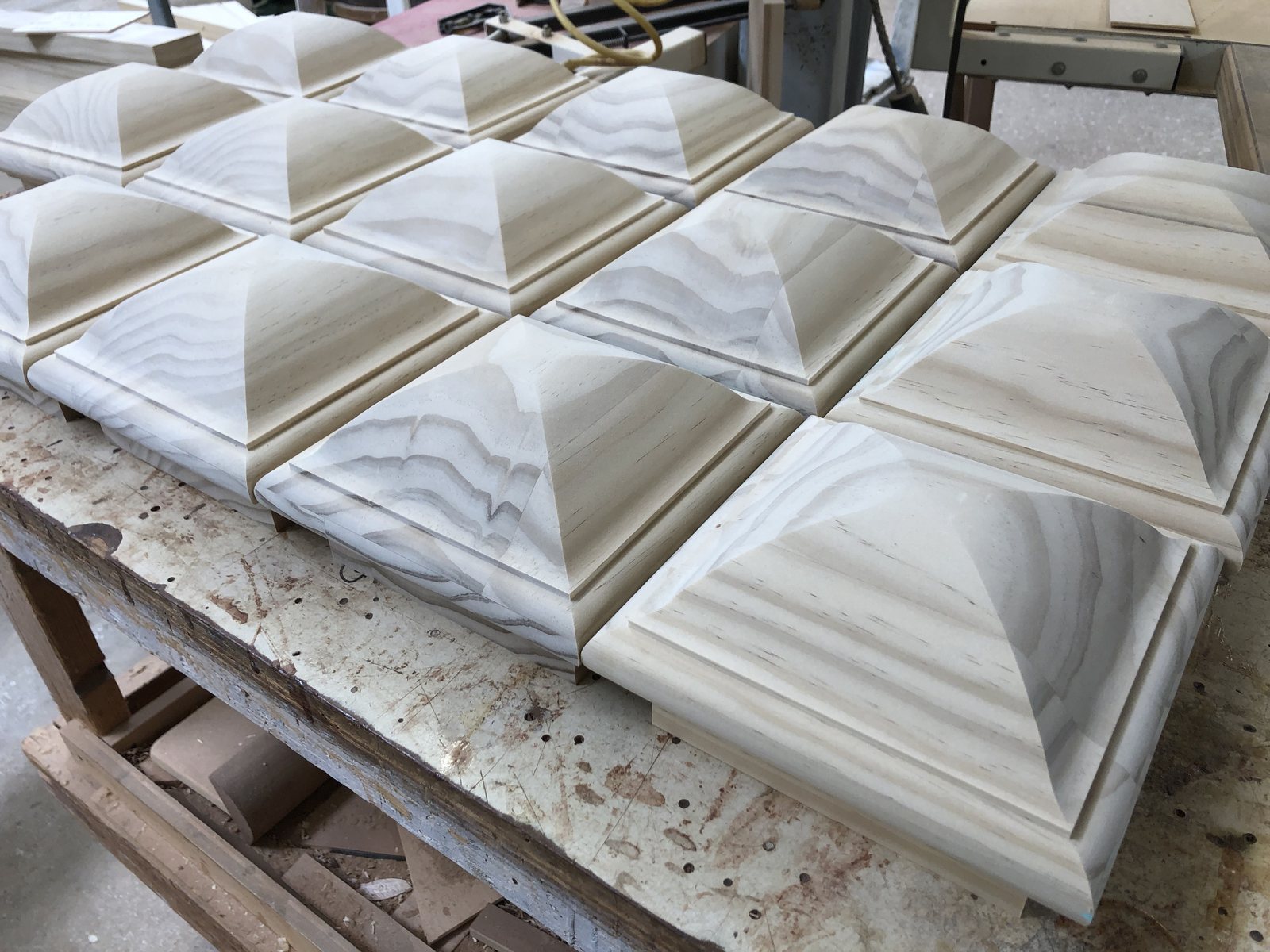
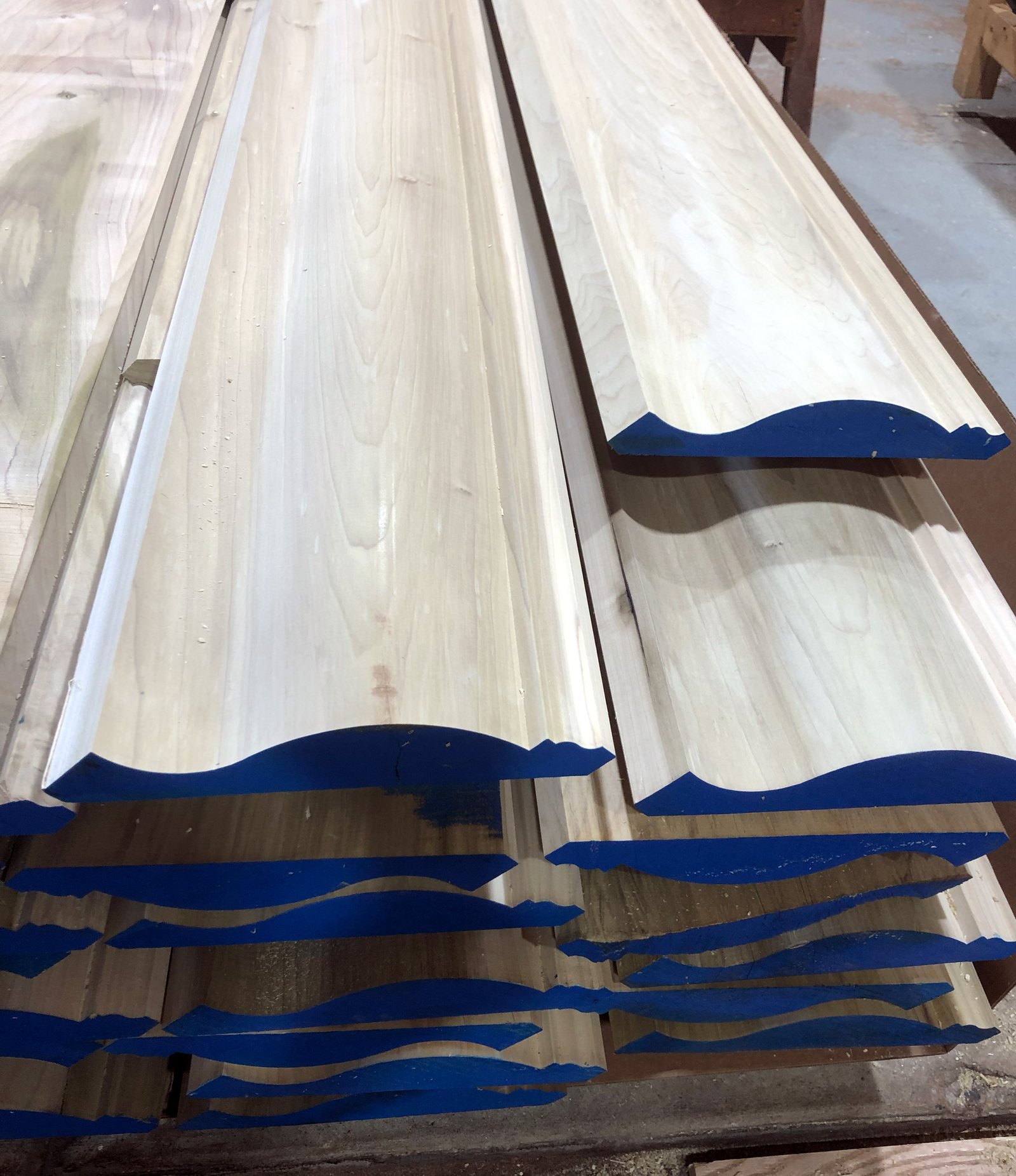
A moulding profile drawn for unmodified hardwood usually needs its fragile details softened before it is run in modified stock, and that is a knife-grinding decision rather than a field decision.
Sharp arrises, fine quirks, thin fillets and undercut beads all survive in Sapele or Teak. In thermally modified Ash they become the places the profile chips, during milling, during handling, and during the installer's first contact with a nail gun. The practical remedy is to add a small radius where the original drawing shows a knife edge, rarely more than a sixteenth, which reads as identical from four feet away and survives everything.
J. Gibson McIlvain holds a moulding profile library running to thousands of ground knives and grinds new ones every week, so a profile drawn for an unmodified entry casing can be reground with the modified-stock relief built in and both versions kept on file under the same job. That matters on phased work. A lobby entry run in year one and a matching balcony run in year three come off knives still sitting in the rack, which is the practical benefit of a seventh-generation family business that has kept records since 1798. Radius trimwork follows the same logic, with one added caution. A tight-radius curved casing in modified stock is better laminated up from thin plies than bent from a single thick blank, since the material that resists moisture also resists persuasion.
Profile classification and tolerance conventions used across the trade are published by the Wood Moulding and Millwork Producers Association, and the quality grade definitions most architectural specifications lean on come from the Architectural Woodwork Institute.
Every shop operation changes in a predictable direction once the stock is modified, and knowing the direction ahead of time is what keeps a run from producing scrap.
The table below is the working summary a millwork estimator uses when a modified species lands on a cut list for exterior entryway and balcony components. It is arranged by operation rather than by species, because the species question is usually settled before the shop sees the drawing and the operation question never is.
| Shop operation | What changes versus unmodified stock | How the shop compensates |
|---|---|---|
| Straight line and gang ripping | Less feed resistance and less blade loading, but the cut edge fractures instead of feathering | Sharper carbide, reduced feed on narrow rips, scoring where a finished edge is exposed |
| Moulding and profiling | Fine details chip at the arris, and lighter stock chatters on long unsupported runs | Relief radius ground into fragile details, added hold-down pressure, outfeed support |
| Band resawing | Cuts easily and stays flatter after release because internal stress is largely relieved | Standard setup, with attention to dust extraction rather than to blade heat |
| Cross-cutting and trimming | Exit-side blowout on the underside of the cut | Sacrificial backer, scoring pass, zero-clearance support at the blade |
| Mortise, dado and lock miter | Shoulders crumble and thin walls shell rather than compress | Multiple shallow passes, open chip clearance, joint geometry sized with more meat behind it |
| Edge gluing and lamination | Lower surface polarity and very low moisture shorten open time and slow bond development | Fresh-machined faces, adhesive rated for exterior modified stock, controlled clamp pressure |
| Sanding and surface prep | Loads paper with fine dark dust and burnishes quickly at high grits | Stopping at a mid grit, frequent paper changes, thorough dust removal before priming |
| Priming and coating | Absorbs far less coating, so the film sits on top instead of soaking in | Primer system matched to a low-absorption substrate, fungicide additive on exterior work |
Gluing and fastening are where modified wood punishes habit, since the adhesive, the clamp time and the pilot hole that worked on unmodified hardwood all have to be reconsidered.
Two things work against a standard shop glue-up. The surface has fewer accessible hydroxyl groups after modification, so it is less chemically hospitable to a water-borne adhesive. And the substrate is so dry that it pulls water out of the glue line fast, which shortens open time and can starve the joint before pressure is applied. Neither problem is exotic. Both are answered by choosing an adhesive rated for exterior modified wood, machining the faces fresh rather than gluing a surface that has sat for a week, and holding clamp pressure without crushing fiber that has less give than it used to.
Box beams for an entry portico or a balcony fascia are the clearest example. ICD builds box beams with a real joinery choice behind them. Butt joints give the most minimal profile, the fastest turnaround and the easiest on-site assembly, but they leave visible seams and visible end grain and they are the weakest of the three. Dado joints are strong and still assemble easily on site, though seams and end grain still read. Lock miter joints show no visible seam and are the strongest. In modified stock the lock miter deserves extra thought, since the tongue is exactly the kind of thin projecting wall that shells off if it is cut in one pass. Run in stages with proper support, it holds beautifully and hides the end grain that would otherwise wick water on an exterior beam.
Fastening is the same story told in metal. Reduced toughness means a fastener driven near an end or an edge will split a piece where unmodified hardwood would have absorbed the wedging. Pilot holes are not optional on exterior modified trim, particularly near ends. Stainless fasteners are the sensible default for exterior work generally, and with acetylated material such as Accoya the acetic acid liberated at the surface makes stainless the standing recommendation rather than a preference, a point Accoya documents directly. Thermally modified material does not carry that same acid chemistry, though exposure alone still argues for stainless.
J. Gibson McIlvain supplies and mills. It does not install and it does not field measure. What the shop controls is everything that makes the installer's day easier, which means components delivered at the right moisture state, ends sealed, primed on all six faces where the specification calls for it, and dimensioned with enough edge distance that a pilot hole and a fastener have somewhere to live. Back ventilation and flashing detail belong to the installer and the architect, and the moisture management principles behind them are laid out clearly by Building Science Corporation.
"The mistake I see most often is a spec that treats modified wood as a drop-in substitute for the hardwood it replaced. We will run either one. But the drawing has to know which it is, because the profile relief, the joint geometry and the coating system all change. When an architect calls us before the profile is frozen, we can tell them which details will survive the run and which ones will chip, and that conversation costs nothing."
Norm Moton, Director of Sales, J. Gibson McIlvain
Kiln size caps modified wood at roughly 16 feet, most of it sold on metric lengths just under that, and thermally modified Ash is not available wider than 8 inches.
These are hard limits, not negotiating positions, and they should be settled at the drawing stage rather than discovered at the cut list. A modification kiln is a fixed vessel. Nothing longer than the vessel fits inside it. Every thermally modified and acetylated product on the market lives inside that envelope, and most of the stock sold in the United States arrives on metric lengths that land just short of 16 feet.
Width is the more common surprise. A designer drawing a 10 inch fascia board or a wide entry pilaster panel in thermally modified Ash is drawing something that does not exist. Wide boards in a modified product means Accoya or Abodo Vulcan. J. Gibson McIlvain carries both Thermory and Abodo Vulcan along with Accoya, and the Maryland yard holds over seven million board feet of exotic and domestic lumber, which is what makes it possible to lot-match a balcony package across several modified and unmodified items rather than chasing pieces from three suppliers.
The other consequence of the length cap is joint planning. A 22 foot balcony rail cap in modified stock is a scarfed or spliced assembly by definition. Better to place that splice on the drawing, over a post, than to let it land wherever the installer runs out of board.
Modified wood drinks almost nothing, so the primer sits on the surface as a film and the whole coating strategy has to be built around low absorption rather than around soaking the grain.
An open-grained or oily exterior species pulls finish down into the wood and can take several coats before the painted surface evens out. Modified stock does the opposite. The coating stays where it is put, which sounds convenient and is actually a reason for more care, since a film sitting on a slick low-energy surface depends heavily on mechanical key. Sanding to a mid grit rather than a fine one, and removing every trace of that fine dark dust, is what gives the primer something to grab.
J. Gibson McIlvain primes in three levels, in both oil-based and water-based systems, and puts a fungicide additive into primer destined for exterior work. Sanding or buffing after priming knocks back grain raising while keeping moulded detail crisp, which is exactly the step that preserves a relieved arris on a modified entry casing instead of rounding it into mush.
Color is the last finishing variable, and it surprises owners more than any other. Thermal modification darkens wood through the full thickness, so a scratch or a re-cut does not expose a pale core. Left uncoated outdoors, that color still weathers toward grey like any wood. A balcony where the architect wants the dark brown held needs a pigmented or UV-stable coating from day one. Going uncoated is a legitimate choice. It is just not a color-holding one.
For components that carry load, take abuse, or have to be glued into something structural, a millwork house still reaches for Sapele, Iroko, Afrormosia, Teak or Utile rather than a modified product.
Sapele runs roughly 1,410 lbf on the Janka scale, machines predictably, and holds paint better than Genuine Mahogany while coming in a wider range of sizes and longer lengths, which is why it is the better call for painted exterior trim. It is not milled 1x8 for exterior use, since that width does not stay stable in that thickness. Iroko and Afrormosia bring durability close to Teak with better availability. Utile mills cleanly and takes a profile crisply. Teak remains the reference point for exterior stability. Those five are the millwork palette, and property data on each is easy to check through the Wood Database.
The tropical decking species are a different family with a different job. Ipe, botanically Tabebuia spp, along with Cumaru, Garapa, Jatoba and Red Balau, are extremely hard and carry high oil content, which makes them genuinely difficult to glue. A decking contractor loves them. A millwork shop that has to laminate a curved rail or close a lock miter reaches past them for Sapele, Iroko, Afrormosia, Teak or Utile every time. Western Red Cedar also remains a legitimate default for exterior millwork, with CVG, clear vertical grain, specified where stability and a paint-grade face matter, and STK, select tight knot, where a knotty character face is wanted.
One commercial distinction belongs in the open. Warranties exist on modified products. There are no warranties on solid unmodified wood, and there cannot be, since it is an organic material responding to its environment. That is a real reason an owner sometimes wants modified material on the exposed skin even where an unmodified species would perform perfectly well.
Exterior hardwood for architectural work carries paperwork, and that documentation travels with the material rather than being reconstructed after delivery.
J. Gibson McIlvain is an FSC certified importer and miller, which matters on any project where the specification carries sourcing requirements or a certification credit is being pursued through the U.S. Green Building Council. Chain of custody definitions sit with FSC. Where a CITES listed species is involved, permits and chain of custody documentation travel with the material, and the governing framework is published by CITES. Modified products add a layer of their own, since a modification warranty is only worth what the traceability behind it supports.
Historic work adds a third layer. A balcony or entry surround in a historic district frequently has to match an original profile in an approved species, and the review standards that govern that work come from National Park Service Technical Preservation Services. Modified wood is not always an acceptable substitution in those districts. The profile library tends to be the more useful tool there, since matching the original moulding exactly in an approved unmodified species clears review faster than arguing for a new material.
How J. Gibson McIlvain Would Specify This
Start by splitting the component schedule into two columns before a species is named. Anything that carries load, resists impact or swings on hinges goes in the unmodified column. Anything that is skin, trim, cladding, slat or infill is a candidate for modified stock. That single sort prevents most of the failures attributed to thermally modified wood, which are almost always failures of placement rather than of material.
Freeze the profile with the substrate in mind. J. Gibson McIlvain grinds custom knives every week and keeps a library running to thousands of profiles, so a modified-stock version of an entry casing with a relieved arris gets ground, recorded and filed alongside the unmodified original, and both stay available when phase two lands two years later. If the profile is historical, it gets matched. If it is contemporary and does not exist yet, it gets originated.
Check the envelope next. Nothing modified runs past roughly 16 feet, most of it arrives just under that on metric lengths, and thermally modified Ash stops at 8 inches wide. Wide modified boards means Accoya or Abodo Vulcan. Splices get drawn, not improvised.
Set the moisture target by location. Interior millwork is milled to an in-service moisture content near 6 to 8 percent and exterior work near 12 to 16 percent for unmodified stock, with modified material naturally sitting lower and moving far less in service. Accoya runs roughly 1,600 lbf Janka, with acetylation giving dramatically reduced shrinkage and swelling. Quartersawn and rift stock moves less across its width than plainsawn, which is why it earns its place on any painted or panelized face that has to stay flat.
Specify the coating with the order rather than after it. Priming is available in three levels, oil-based or water-based, with a fungicide additive on exterior work, and priming all six faces before the parts leave the building is what protects a component that will sit on a job site for weeks before it goes up.
Order the linear and the custom together. A full millwork shop sits on site at the Maryland lumber yard, and the architectural millwork division, ICD, builds the true custom work planned around a specific space, which is where rafter tails, box beams, radius trimwork, pergolas, benches, railings, gates, custom doors and shutters come from. Linear trimwork, finished cladding and primed trim come from the J. Gibson McIlvain millwork service. One order, one moisture target, one profile record. J. Gibson McIlvain runs its own fleet of trucks with a section of the mill dedicated to packaging, ships nationwide and regularly to California, and stores finished millwork for inventory control when a site is not ready to receive it.
For a balcony or entryway package where modified and unmodified components have to sit next to each other and read as one piece of work, call 800-638-9100 and walk the component schedule through with the sales desk before the profiles are frozen. The ICD working process page lays out how a custom scope moves from drawing to delivered part.
Frequently Asked Questions
Does thermally modified wood dull cutting tools faster than unmodified hardwood?
No, and that is one of the genuine advantages. Modification drives off most of the extractives that load a knife with pitch, so blades stay cleaner and run longer than they do in an oily unmodified tropical species. The tooling issue with modified stock is not wear, it is geometry. A dull edge that would merely leave fuzz on unmodified wood will crush and fracture modified fiber, so the practical rule is to change knives on condition rather than on hours and to keep the edge sharper than the job seems to require.
Why does a lock miter that runs fine in Sapele chip out in thermally modified Ash?
The lock miter tongue is a thin projecting wall of wood, and modified fiber shells rather than compressing when a cutter loads it. Cut in a single full-depth pass, the tongue breaks at its root. The fix is staged passes with full support under the workpiece and open chip clearance so cut material does not get pressed back into the profile. Run that way, a lock miter is still the right joint for an exterior box beam, since it shows no visible seam and hides the end grain that would otherwise wick water.
Can a 20 foot balcony rail cap be supplied in one piece in modified wood?
No. Every thermally modified and acetylated product is limited by the size of the modification kiln, which tops out at roughly 16 feet, and most of what reaches the United States arrives on metric lengths that land just under that. A cap longer than the limit is a spliced or scarfed assembly. The right move is to draw the splice where it is least visible, over a post or at a change of plane, rather than leaving the location to whoever is holding the board on site. An unmodified species such as Sapele or Iroko is available in longer lengths if a single piece is the priority.
Which is better for a wide exterior fascia in a modified product, thermally modified Ash or Accoya?
Thermally modified Ash is not available wider than 8 inches, so anything wider is an Accoya or Abodo Vulcan question rather than an Ash question. Accoya runs roughly 1,600 lbf on the Janka scale and acetylation gives it dramatically reduced shrinkage and swelling, which suits a wide flat board that has to stay put. Abodo Vulcan is the other route to width. Both carry warranties, which solid unmodified wood cannot, since unmodified wood is an organic material responding to its environment.
Does thermally modified wood need to be sanded differently before priming?
Yes, and the instinct to sand finer is the wrong one. Modified wood absorbs very little coating, so the primer forms a film on the surface rather than soaking into the grain, and that film depends on mechanical key for adhesion. Sanding to a mid grit leaves more tooth than sanding to a fine one, and high grits burnish the surface quickly. The other requirement is dust removal, since modification produces fine dark dust that settles everywhere and will contaminate a primer coat if it is not cleaned off thoroughly.
Is thermally modified wood acceptable for a balcony guard post or a swinging gate stile?
It is a poor choice for either. Thermal modification reduces modulus of rupture and cuts impact toughness substantially, which matters most in exactly the components that take bending and shock loads. Guard posts answer to code-prescribed load requirements set by the engineer of record, and a gate stile takes repeated impact every time the gate closes. Those parts belong in an unmodified species such as Sapele, Iroko, Afrormosia, Teak or Utile, with modified stock reserved for cladding, trim, infill and screening where its stability and rot resistance pay off without any structural demand.
Will the brown color of thermally modified wood stay brown on an exposed balcony?
Only with a pigmented or UV-stable coating applied from the beginning. Modification darkens the wood through its full thickness, which is why a scratch or a fresh cut does not expose a pale core, but ultraviolet light still degrades the surface and weathers it toward grey the way it does with any wood. Leaving it uncoated is a perfectly legitimate design decision as long as the owner understands they are choosing a silvering surface rather than a brown one.
Does J. Gibson McIlvain install the millwork it supplies?
No. J. Gibson McIlvain supplies and mills, and it does not install or field measure. What it controls is everything upstream of the installer, which includes milling to the right in-service moisture content, grinding the profile, priming in three levels in oil-based or water-based systems with a fungicide additive on exterior work, packaging in a dedicated section of the mill, and shipping on its own fleet nationwide. Installation, back ventilation and flashing detail belong to the buyer's own installer and the architect of record.
Sources and Standards Referenced
- Wood Handbook, Wood as an Engineering Material (FPL-GTR-282), USDA Forest Products Laboratory
- American Wood Council Codes and Standards
- Architectural Woodwork Institute
- Wood Moulding and Millwork Producers Association
- Building Science Corporation, Rain Control in Buildings (BSD-013)
- Accoya, acetylated wood technical information
- Thermory, thermally modified wood
- The Wood Database, Sapele
- Forest Stewardship Council, chain of custody
- CITES, Convention on International Trade in Endangered Species of Wild Fauna and Flora
- National Park Service Technical Preservation Services
- J. Gibson McIlvain Millwork Service