What Plantation Teak Is on Today's Market
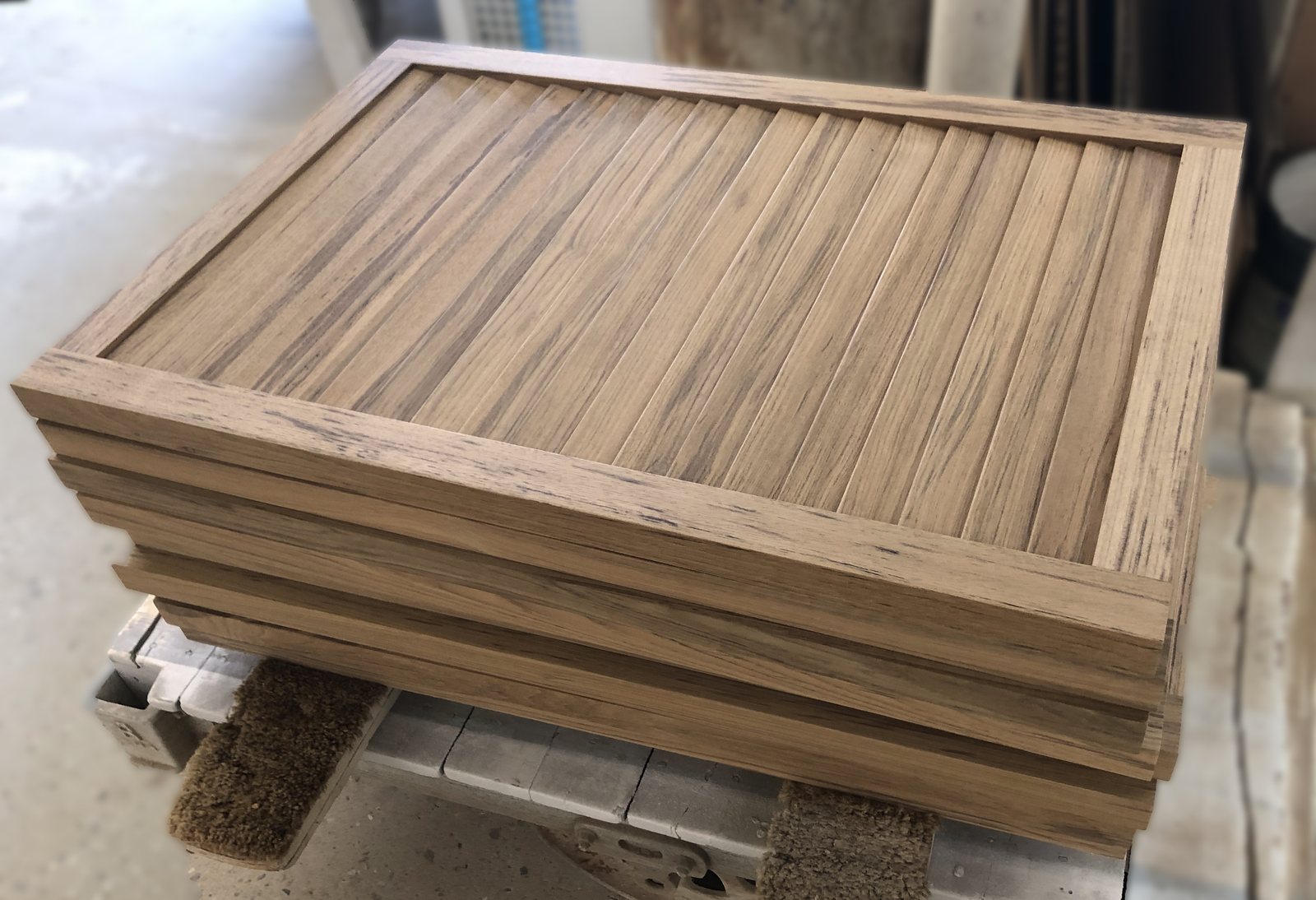
Teak sold for interior architectural work today is plantation teak, and the stock J. Gibson McIlvain buys for this category is Indian plantation teak. That came out of the company's own search for the best plantation material on the market, and it is what the company keeps buying going forward. Teak is imported and arrives against export grades and the written description on the order rather than the North American hardwood grading rules, so the description carries the entire specification. Width, length, sapwood tolerance and face selection all have to be written down by somebody.
A plantation tree is younger than the forest teak that built the reputation of the species. Rings sit further apart. Extractive content runs lower. A rotation length log gives up boards that are narrower and shorter than what an architect may have handled on a yacht refit two decades ago.
The parts have to be drawn around what the stock actually yields rather than around remembered stock. The trouble starts with a cutting list written for old growth dimensions, handed to a supplier who then has to say no three times before the drawing changes.
Why Burmese Teak Is Not a Specification Option
Myanmar origin teak cannot be bought legally today, so a drawing that still calls for Burmese teak is calling for material no legitimate supplier will quote. J. Gibson McIlvain last bought it in 2003 and has not gone back.
Burmese teak keeps coming up anyway, and there is a good reason for that. It is already installed. It sits in older vessels, in older buildings, in deck houses and library panelling that somebody is now asked to repair or extend. Reclaimed material out of those sources moves through the market, and J. Gibson McIlvain does not trade in it.
When new work has to live next to original Burmese joinery, the job turns into a matching exercise rather than a sourcing one. Indian plantation teak selected tight, cut to keep sapwood off every exposed face and finished toward the existing tone will read correctly in the room. On a protected interior the National Park Service technical preservation guidance sets how close like for like has to be, and that answer decides how hard the selection has to be pushed.
Paperwork belongs in this conversation too. J. Gibson McIlvain is an FSC certified importer and miller, so chain of custody documentation on imported teak travels with the material, which is what a specification written against third party chain of custody requirements is actually asking for. Origin is a line item on a submittal, not a handshake.
Where Sapwood Sits in a Plantation Log
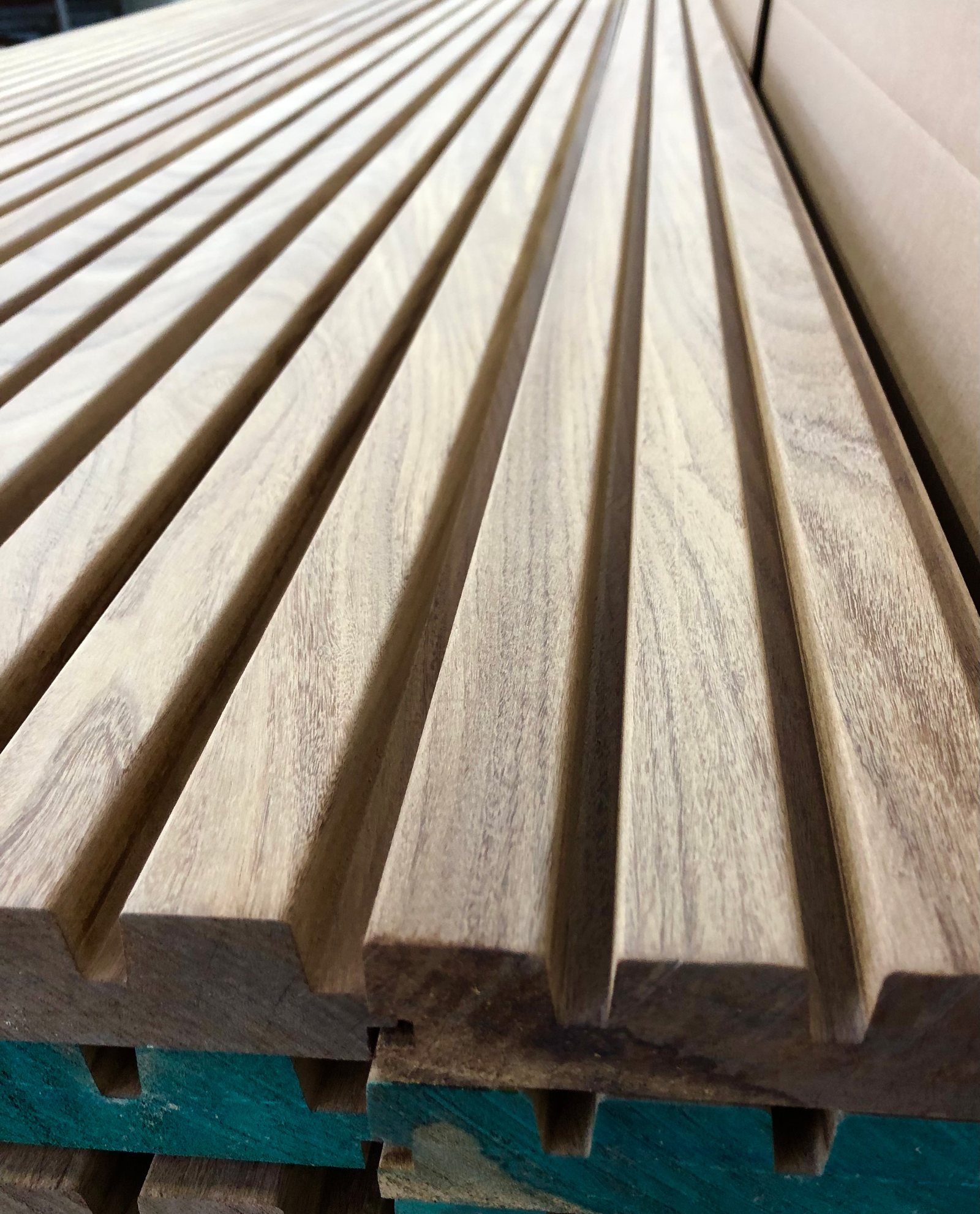
Teak sapwood is the pale creamy band at the outside of the log, and in a rotation length plantation tree that band takes up a larger share of the cross section than it does in an old growth log. Heartwood holds the golden brown color, the extractives and the durability the species gets bought for. Sapwood holds none of it. Under oil or varnish the two read as different woods, and no amount of toning fully buries the boundary between them.
Geometry decides where it lands on your parts. A smaller diameter log gives up fewer wide clear heartwood boards and more boards that carry sapwood along one edge. The outer boards of a flitch show the most of it. Boards taken closer to the heart come through clean, which is why two lifts off the same container can behave differently on the same cutting list.
The part matters more than the board. Rip a 1 inch reveal stop out of a 6 inch board and the sapwood edge usually falls in the offcut. Lay out a 5 inch casework stile on that same board and the sapwood runs the full length of a face somebody will stand in front of. Nothing changed about the lumber at all.
Sorting Sapwood Against the Cutting List
Sapwood is a yield question before it is a defect question, so the parts that cannot carry any of it should be counted and stated before the order gets placed. An order written as clear heartwood, no sapwood, every part, schedules like a different product than one that reserves full exclusion for the faces a person actually sees. Both orders are legitimate. Only one of them is usually necessary.
Interior work sorts into three honest categories. Parts with a wide exposed face and a visible full length. Parts narrow enough that sapwood almost always rips away into waste. Parts nobody looks at once the job closes. The Architectural Woodwork Institute grade a casework package is written to will tell you how much latitude you have on face selection before a reviewer calls it out.
| Part type | Sapwood on an exposed face | Clear length and width demand | How the stock gets cut |
|---|---|---|---|
| Casing, base and jamb stock | None on the show face, acceptable on the back and on a buried edge | Moderate width, long clear length | Ripped from heartwood boards with the sapwood edge sent to the offcut |
| Casework face frames and stiles | None, the face reads end to end | Narrow width, moderate length, high clear yield | Laid out away from the outer boards of the flitch |
| Frame and panel cabinet doors | None on rails, stiles or the panel face | Panel width routinely exceeds board width | Panels glued up from color matched heartwood boards |
| Drawer fronts in a matched bank | None, and color drift matters as much as sapwood here | Short lengths, consistent width | Pulled from one or two boards so the bank reads as a single piece |
| Shelf edges, light rails and reveal stops | Rarely survives a narrow rip | Short lengths, narrow width | Taken off the sapwood edge of wider boards, which is where that material earns its keep |
| Carcase parts, cleats and blocking | Not a consideration | Low on both counts | Cut from boards that would be set aside for face work |
J. Gibson McIlvain sorts the lift against a list like that before it ships, which is the point where sapwood stops being a surprise in somebody else's shop. The sort is only as good as the information behind it. A cutting list with part widths and finished lengths produces a usable sort. A line item that says teak, 4/4, 500 board feet produces a pile of average boards.
Clear Lengths and How Runs Get Broken
Long single piece clear lengths are the hardest thing to buy in plantation teak, and that one constraint changes more drawings than anything else on this list. A rotation length log is shorter than an old growth log and it tapers sooner. The clear heartwood length comes out of the butt. Ask for 16 ft of clear teak in a 6 inch width and the yard is pulling against the ceiling of what the species currently delivers.
Depth of inventory is what makes that pull possible at all. J. Gibson McIlvain holds over seven million board feet of exotic and domestic lumber at its Maryland yard, and a long clear teak requirement gets filled by working through volume rather than by waiting on the next container. Volume also means the long boards can be held back for the parts that need the length instead of being chopped up for short casework rails.
Where the length genuinely is not there, the useful move is deciding in advance where the joints go. A continuous base run down a 24 ft wall will have joints in it whatever the species. The buyer's own shop or installer places and cuts those joints, and the Wood Moulding and Millwork Producers Association trade practices cover how running trim is normally supplied in random lengths. What a specification can usefully say is how many joints per run are acceptable and which walls have to come in as one piece.
Door and window casing is where this bites first. Head casings are short and easy. Legs on a tall opening eat the long clear stock, and a run of twelve openings in a lobby can consume the best material in a lot before the base even gets cut. Sequence the order so the long parts are pulled first.
Usable Widths, Panels and Casework Faces
Wide clear teak faces in plantation stock come out of glued panels, not out of single boards, and treating that as a design decision rather than a compromise gets a better looking cabinet. A 20 inch door panel in a single board of clear teak heartwood is not a realistic ask from current material. Four boards with the glue lines placed deliberately, grain running the same direction and color matched across the joints, is both realistic and more stable.
Quartersawn and rift stock moves less across its width than plainsawn, which is why it gets specified where a panelized surface has to stay flat. On a tall casework door or a run of flush panels that stability is worth more than the figure a flatsawn board would show. The straighter ray pattern also hides a glue line better than a cathedral grain does.
Teak carries enough oil in the surface that a glue joint wants fresh wood. Joint faces get machined shortly before glue up rather than jointed a week early and left on a cart, and that sequencing belongs to whoever is doing the assembly. For true custom casework the company's architectural millwork division, ICD, builds the cabinets and case work around how the space is used rather than assembling it from standard modules, which is what produces filler strips and face frames that do not line up.
Ring Spacing, Density and Machining Behavior
Wider ring spacing in plantation teak shows up at the cutter rather than in the finished dimensions. Teak is not a hard wood by the numbers. It sits well under Sapele at roughly 1,410 lbf and under White Oak at roughly 1,360 lbf on the Janka scale, and the Wood Database entry for teak carries the species figure. Hardness was never the issue with this wood. Mineral content is.
Teak dulls tooling faster than its hardness suggests, and anybody who runs a lot of it builds that into the knife schedule. Crisp arrises on a profile need sharp cutters and a light final pass. The wider earlywood bands in plantation material also feel slightly softer under a cutter and show more contrast between bands once finish goes on, so aggressive sanding after moulding does more harm here than it would on Hard Maple at roughly 1,450 lbf.
This is also where the millwork palette separates itself from the decking palette. The tropical decking species, Ipe, Cumaru, Garapa, Jatoba and Red Balau, are extremely hard and carry high oil content, which makes them difficult to glue and a poor fit for machined and assembled interior parts. A millwork house reaches for Sapele, Iroko, Afrormosia, Teak and Utile, which is sold as Sipo, for exactly that reason. Ipe, Tabebuia spp, is decking stock and stays on the deck.
Moisture Content for Interior Teak Work
Interior teak gets milled to an in service moisture content near 6 to 8 percent, and imported stock does not arrive there on its own. Shipping moisture content on container material runs higher than any interior tolerance. J. Gibson McIlvain mills interior teak trim and casework stock to that 6 to 8 percent band before it goes out. Exterior teak work runs near 12 to 16 percent, a different number for a different exposure, and the two should never get mixed on one order.
Air dried stock settles near the local equilibrium and is not a substitute where an interior tolerance matters. That distinction gets glossed over on imported material more than it does on domestic hardwood, and it shows up later as a panel that shrank out of its groove. Building Science Corporation has the background on interior humidity and how far a conditioned space actually swings through a year.
One job site condition decides whether the number holds. The space has to be at its operating humidity before the material comes in, and that is a general contractor question rather than a milling one. Teak is stable for a tropical hardwood. It is still wood, and nothing about a 6 to 8 percent delivery survives a slab that is still drying.
Finishing Teak Interiors Without Paint
Teak is a stained, oiled or varnished product, or it is left to silver, and none of those paths includes paint. Specifying a painted teak interior wastes the only thing the species is bought for. Open-grained and oily species absorb a great deal of finish, so a first coat on teak largely disappears into the wood before the film starts to build, and the schedule has to allow for that rather than treating coat one as a sealer that will look like anything.
Oiled teak reads warm and gold and needs maintenance on a surface people touch. Varnish holds up better on a casework face and a handrail cap, at the cost of looking like a film. Either way the color moves. Fresh teak is lighter than most people expect and it ambers with light exposure over the first year, so a sample approved in February under one exposure will not be the same color in the finished room.
Sapwood stays pale under every one of those systems. Stain pushes it closer but never all the way, and a toned sapwood edge usually looks worse than an honest one. That is the second argument for keeping it off the show faces at the cutting stage rather than trying to solve it in the finish room.
Ordering, Lot Matching and Phased Release
A teak interior package gets bought as a lot rather than as a running quantity, because color consistency across a room is as visible as the profile is. Teak from two purchases will differ in tone, and the difference lands exactly where a reviewer looks first, on the adjacent faces of the same cabinet bank. Buy the whole package at once. Mill it in one run.
Phasing is the practical problem that follows. A lobby and six floors of casework do not get installed in the same month, and milled teak sitting on a job site in a plastic wrap is a liability. J. Gibson McIlvain stores finished millwork for inventory control, so one lot can be milled together and released floor by floor as the schedule opens up, which keeps the color matched without parking the material in a corridor.
"The teak orders that go smoothly are the ones where somebody tells us what the parts are. Give us widths and finished lengths and we put the heartwood on the faces that get seen. Give us a board footage number and a species name and we are guessing on your behalf."
Norm Moton, Director of Sales, J. Gibson McIlvain
Submittal samples deserve one note of their own. A 6 inch sample of clear quartersawn heartwood sets an expectation the whole lot has to meet, and approving an unrepresentative sample is how a job ends up rejecting good material. Submit a sample that shows the range the order will actually carry.
How J. Gibson McIlvain Would Specify This
Write the specification around Indian plantation teak, state the sapwood rule per part type rather than per order, and put the long clear lengths where they are visible. The company's lumber desk reads a teak specification the same way the mill does, part by part. Call out which runs have to arrive in single lengths and accept random lengths on the rest.
Set the moisture content at 6 to 8 percent for interior work in the body of the specification, not in a note. Specify quartersawn or rift stock where a wide panel or a tall casework door has to stay flat, and let the flatsawn material go to shorter parts where figure is an asset. Name the finish system, since teak behaves differently under oil than under a film, and nothing in a teak interior gets painted.
The rough mill work and the millwork services happen on site at the lumber yard, and the true custom casework runs through ICD, the company's architectural millwork division. J. Gibson McIlvain ships teak nationwide, including regularly to California, and the material arrives milled and sorted for the cutting list it was bought for. Joint placement, final fitting and field dimensions belong to the fabricator on the job. J. Gibson McIlvain grades the interior stock for sapwood against the rule written per part type and marks each bundle with the part it belongs to. J. Gibson McIlvain pulls the long clear lengths for the visible runs first, which is the only sequence that works when one casework package carries both the visible and the hidden parts. Where a profile has to be matched, ICD grinds the knife from the section that was supplied rather than from a photograph of it.
Bring the cutting list to the conversation rather than a board footage total. Call J. Gibson McIlvain at 800-638-9100 to price and schedule an interior teak package, and bring the widths, the finished lengths and the sapwood rule you intend to hold.
Frequently Asked Questions
Where can I buy teak lumber for architectural interior work?
J. Gibson McIlvain supplies Indian plantation teak for interior trim and casework out of its Maryland yard and ships it nationwide. The practical step is to bring a cutting list rather than a board footage total, because teak gets sorted and cut to parts. Part widths, finished lengths and a stated sapwood rule per part type let the mill put heartwood on the faces that get seen. Call 800-638-9100 to price and schedule a package.
Is plantation teak lower quality than the old growth teak people remember?
It is different material, not lesser material. A plantation tree is younger, so rings sit further apart, extractive content runs lower, and a rotation length log yields boards that are narrower and shorter. Plantation teak is also the teak that is legally and actually available for new work. Drawn around what it yields, in glued panels for wide faces and with long clear stock reserved for visible runs, it performs.
Can I still buy Burmese teak for a restoration?
No. Myanmar origin teak cannot be bought legally today. The EU closed its market to it in 2003, Lacey Act enforcement in the United States followed, and J. Gibson McIlvain stopped buying Myanmar origin teak in 2003. Burmese teak exists only as material already installed in an older vessel or building. Where new work has to sit next to it, the job becomes a selection and finish matching exercise in Indian plantation teak.
How much sapwood should I allow in an interior teak order?
Write the rule per part type instead of per order. Faces with a visible full length, meaning casework stiles, face frames, door rails and panel faces and drawer fronts, should carry none. Narrow parts such as reveal stops, light rails and shelf edges rarely carry sapwood through a rip at all. Carcase parts, cleats and blocking do not need the rule. An order demanding zero sapwood on every part schedules like a different product.
What is the longest clear length I should specify in plantation teak?
Long single piece clear lengths are the hardest thing to buy in this species, since a rotation length log is shorter than an old growth log and tapers sooner. A request for 16 ft of clear teak in a 6 inch width pushes the ceiling of what the material delivers. Reserve those lengths for casing legs on tall openings and the walls that must be single piece, accept random lengths elsewhere, and state how many joints per run are acceptable.
Does imported teak need to be dried again before interior millwork?
Yes. Shipping moisture content on container material runs higher than any interior tolerance. J. Gibson McIlvain mills interior teak trim and casework stock to an in service moisture content near 6 to 8 percent, while exterior teak work runs near 12 to 16 percent. Air dried stock settles near the local equilibrium and is not a substitute. The conditioned space also has to be at its operating humidity before the material goes in.
Can teak interior trim or casework be painted?
Teak is a stained, oiled or varnished product, or it is left to silver. Painting it buries the color and figure the species is bought for. Open-grained and oily species absorb a great deal of finish, so the first coat on teak largely disappears before a film starts to build, and the finish schedule has to account for that. Fresh teak also ambers with light exposure through the first year, so approve samples with that shift in mind.
Why do millwork shops use teak, Sapele and Iroko instead of the tropical decking species?
The tropical decking species, Ipe, Cumaru, Garapa, Jatoba and Red Balau, are extremely hard and carry high oil content, which makes them difficult to glue and a poor fit for machined and assembled interior parts. Ipe, Tabebuia spp, belongs on a deck. For milled and glued interior work the palette is Sapele at roughly 1,410 lbf, Iroko, Afrormosia, Teak and Utile, which is sold as Sipo.