The Short Answer
Cumaru is the strongest value alternative to Ipe for a residential outdoor living space, delivering nearly identical hardness and comparable decay resistance at a lower material cost, and it earns that reputation only when the deck is detailed the way a dense tropical hardwood demands. Start with the numbers. Ipe measures roughly 3,680 lbf on the Janka hardness scale at a density near 1,050 kg/m3. Cumaru measures roughly 3,540 lbf at a density near 1,070 kg/m3. The hardness gap is under four percent, and Cumaru is the denser of the two. Nobody walking barefoot from a grill to a patio table will ever feel that difference.
What separates the two species has almost nothing to do with strength. It shows up in color consistency, in grain behavior, in how boards move through their first full season, and in whether the installer respected the material. A Cumaru deck built on 16 inch centers with proper airflow underneath and stainless fasteners will still be there in thirty years. A Cumaru deck laid tight over damp joists on a slab with no drainage will cup and check by the second summer, and the species will get blamed for a detailing failure.
What Cumaru Actually Is
Cumaru is the trade name for lumber from Dipteryx species, a South American legume harvested primarily in Brazil and Peru, and it is a different genus from Ipe with a different look and a different working personality. Ipe comes from Handroanthus species. The two get lumped together as "Brazilian hardwood decking" because both are heavy, dark and rot resistant, but they are not close relatives.
Freshly milled Cumaru runs medium to reddish brown, sometimes with a yellow or olive cast, and it carries visible tan and gold streaking. Ipe is more uniformly olive brown to near black. Cumaru also carries a distinct scent when cut. The same genus produces the tonka bean, and the coumarin in the wood gives fresh cuts a vanilla or fresh hay note that fades within weeks of installation. Some crews notice it. A few installers report sinus irritation from the dust, which is one more reason for respirators on any tropical hardwood job.
Grain is the bigger practical difference. Cumaru has interlocked grain, meaning fiber direction reverses in alternating layers as the tree grows. That produces the ribbon figure buyers like and the tearout that hand planers hate. The Wood Database entry for Cumaru documents the interlocked structure and the moderate blunting effect on cutting edges. Ipe blunts tools too, mostly from silica content. Either way, carbide is not optional.
Hardness, Density and What Those Numbers Predict
Janka hardness predicts dent and scratch resistance, not lifespan, and both Ipe and Cumaru sit so far up the scale that the number stops being a useful discriminator between them. The Janka test measures the force required to embed a steel ball halfway into the wood. Ipe at 3,680 lbf and Cumaru at 3,540 lbf are both more than triple the hardness of Teak at 1,070 lbf and roughly ten times harder than Western Red Cedar. Dropping a cast iron pan on either one leaves a mark you can barely find.
Density is where Cumaru quietly edges ahead. At roughly 1,070 kg/m3, Cumaru boards sink in water, resist crushing at fastener heads, and hold screw threads with real bite. That density also means weight. A 5/4x6 Cumaru board is a two-person carry on a long run, and second-story decks need framing that accounts for the dead load. The USDA Forest Products Laboratory publishes the Wood Handbook data behind that calculation, and the project's structural engineer is the one who runs it. Schedule that hand-off before a designer specifies tropical decking over a living space.
Density does something else. It slows water uptake, restricts fungal access to cell walls, and makes both species dimensionally sluggish. Sluggish and stable are two different properties, and buyers routinely conflate them. Dense tropicals move less quickly than pine, but the movement they do make carries enormous force.
Decay Resistance and Real Service Life
Ipe rates EN 350 Class 1 for durability, the highest available class, and Cumaru rates Class 1 to Class 2 depending on the test data and the specific Dipteryx species, which in residential above-ground service translates to a functionally equivalent deck. EN 350 durability classes describe heartwood resistance to fungal decay in ground contact. Class 1 means very durable. Class 2 means durable. The class boundary matters enormously for a fence post buried in wet soil. It matters far less for a deck board sitting in ventilated air eighteen inches off grade.
Field expectations line up with that. Decking suppliers and installers commonly put a correctly built Ipe deck at forty years and up, and a correctly built Cumaru deck at twenty-five to thirty years and up. Those are trade estimates drawn from decks that are standing today rather than results from any standardized durability test, and the ranges overlap heavily in practice. Both figures assume the same four things. Air moving under the boards. No trapped debris. No standing water at the ends. No direct soil contact. Deck boards do not rot from the top.
Sapwood is the variable that decides whether those numbers hold. Neither species is durable in the sapwood, only in the heartwood. Decking milled from properly sorted material is all heartwood. Decking milled to hit a price target sometimes is not, and a pale streak along one edge of a board is the tell. That sorting happens at the mill and at the importer, which is exactly why the supply chain matters more than the species name on the packing list. Which is also why no supplier will write a decay warranty on solid unmodified wood, in any species. What the material carries instead is a track record and a grading standard, and that is the whole of it.
Where the Savings Come From
Cumaru costs less than Ipe because it grows faster, yields more usable board footage per log, and faces less demand pressure from the commercial boardwalk market, not because it is a lesser material. Ipe trees grow scattered through the forest at low density and yield relatively little clear decking stock per tree. Municipal boardwalks, piers and high-traffic commercial installations consume Ipe in volume because it is the benchmark specification. Cumaru grows in more concentrated stands and mills out with better recovery. Simple supply mechanics do the rest.
The spread between the two is meaningful on a residential deck of any size, and it widens as the deck grows. For a homeowner weighing a large outdoor living space against a budget, that gap is often what makes tropical hardwood possible at all instead of falling back to a composite. Cumaru also costs more than Garapa or Red Balau, and both of those cost more than pressure treated pine. Knowing which rung of that ladder a project actually needs saves a lot of back and forth later.
The material is only part of the number. Dense tropical hardwood demands predrilling on every fastener, stainless hardware, carbide tooling, and framing on tighter centers. Installation labor on Cumaru and Ipe runs essentially identical, because the crew treats them the same way. A homeowner who saves on Cumaru boards and then hires a crew that has never predrilled a tropical deck has not saved anything.
The Tradeoffs Nobody Puts in the Brochure
Cumaru's real drawbacks are color variation, a greater tendency to check and cup than Ipe, and interlocked grain that punishes careless milling, and all three are manageable if the buyer knows about them before the truck arrives.
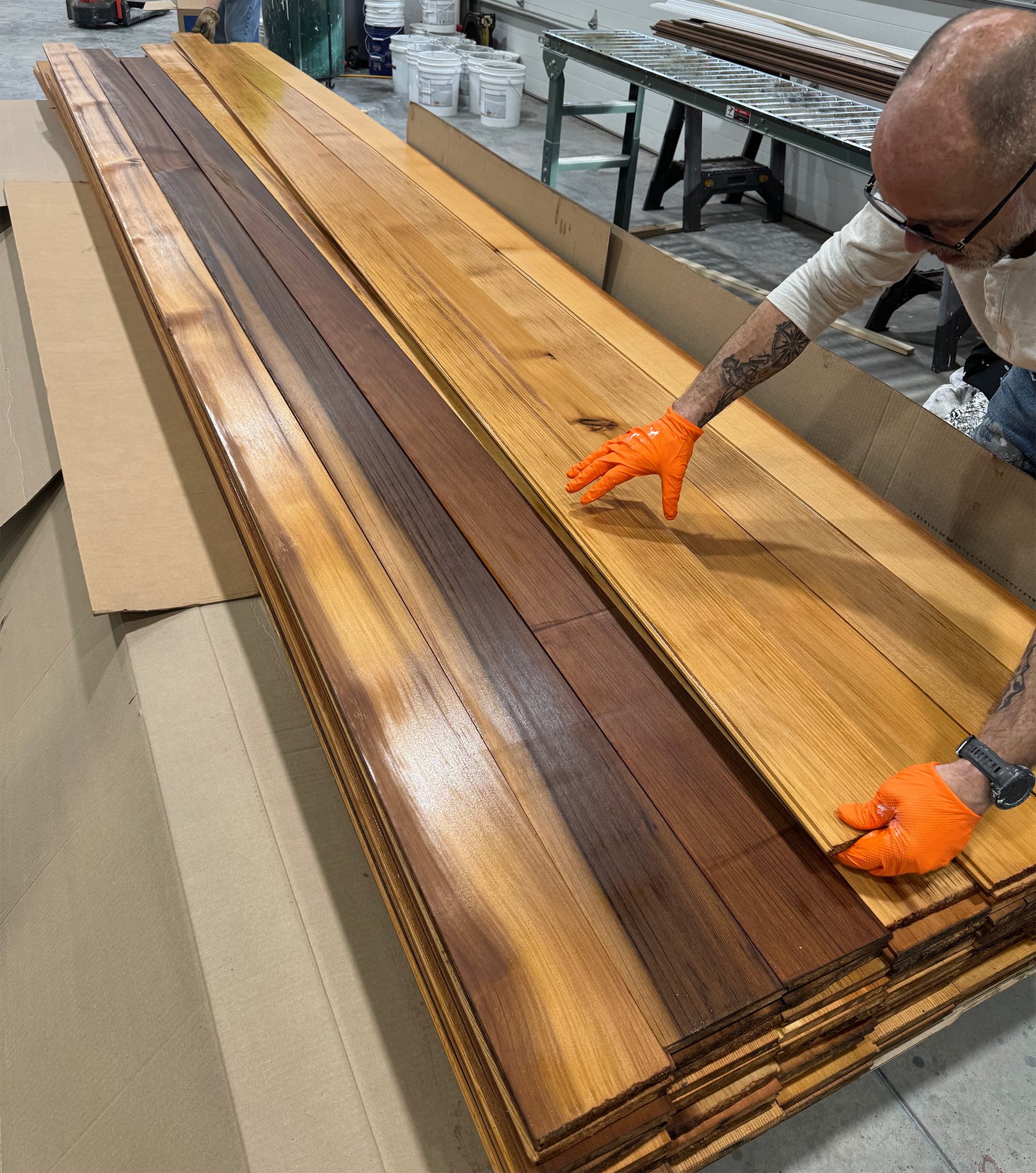
Color first. Cumaru arrives with more variation board to board than Ipe does. Some pieces run reddish, some run yellow-brown, some carry olive streaks. Left unfinished, all of it weathers to the same silver gray within a year, and the variation becomes irrelevant. Finished with a UV-inhibiting oil to hold the brown tone, the variation stays visible. Buyers who want a uniform chocolate deck and refuse to rack boards for color are the buyers who end up disappointed with Cumaru. Racking a pallet before installation solves it in an hour.
Movement second. Cumaru is slightly more prone to end checking and to cupping than Ipe, mostly a function of the interlocked grain and how it responds to moisture cycling. Boards that arrive at 12 to 16 percent moisture content and then sit stickered in the sun for a week before installation will check. Boards that get installed at equilibrium with the site, on ventilated framing, with sealed end grain, behave. Building Science Corporation has published extensively on why assemblies fail at moisture management rather than at material selection, and deck framing is a textbook case.
Milling third. Interlocked grain tears out under dull knives and under the wrong feed direction. This one lands squarely on the mill, and it is solved by buying decking from an operation that runs its own moulders and knows the species. Boards that arrive with fuzzy grain or torn shoulders on the groove never quite recover.
How Cumaru Compares Across the Deck Board Shelf
Cumaru occupies the sweet spot between Ipe's benchmark performance and the mid-tier tropicals, and a specifier should see the whole range before locking a species. The table below covers the species that show up most on residential outdoor living projects.
| Species | Janka (lbf) | Density (kg/m3) | EN 350 durability | Where it fits |
|---|---|---|---|---|
| Ipe | ~3,680 | ~1,050 | Class 1 | Benchmark. Boardwalks, commercial, high-end residential. Documented ASTM E84 Class A. |
| Cumaru | ~3,540 | ~1,070 | Class 1 to 2 | Residential decks wanting Ipe performance for less. More color variation. |
| Massaranduba | ~3,190 | ~1,150 | Class 1 to 2 | Heaviest of the group. Deep red. Checks more readily in dry climates. |
| Jatoba | ~2,690 | ~910 | Class 2 to 3 | Better suited to covered porches than fully exposed decks. |
| Red Balau | ~1,700 to 2,000 | ~800 to 900 | Class 2 | Mid-tier tropical. Consistent red-brown. Good value step below Cumaru. |
| Garapa | ~1,700 | ~830 | Class 2 to 3 | Light golden. Runs cooler underfoot. Entry point into tropical decking. |
| Teak | ~1,070 | ~650 | Class 1 | Marine and luxury. Durable but soft. Dents under furniture. |
| Thermally modified (Thermory, Abodo Vulcan) | Varies by substrate | Varies by substrate | Class 1 to 2 (modified) | Stable, light, warranted. Kiln size caps lengths near 16 ft. |
| Accoya | Varies by substrate | Varies by substrate | Class 1 (modified) | Acetylated. Extremely stable, warranted, paints well. Lengths near 16 ft. |
| Western Red Cedar (CVG / STK) | ~350 | ~370 | Class 2 | Default standard. CVG for clear stable stock, STK for character knots. Light and easy to work. |
Cedar deserves a word, since it gets dismissed unfairly in tropical hardwood discussions. Clear vertical grain cedar is a stable, decay-resistant, easily worked material that has performed on American decks and porches for a century. Select tight knot cedar delivers the same durability with character knots and a lower entry point. Cedar dents. It also weighs a fraction of Cumaru, works with ordinary tooling, and takes finish beautifully. Different job, different tool.
Modified woods answer a different question again. Thermory and Abodo Vulcan deliver thermal modification with dimensional stability and manufacturer warranties that no solid unmodified tropical can offer. Accoya delivers acetylation with the same warranty backing. All of them are limited by kiln chamber size, which caps board lengths at roughly 16 feet, with metric-run products landing just under that. On a long uninterrupted deck run, that constraint decides the layout before anything else does.
Fire Ratings, Codes and Elevated Decks
Ipe carries documented ASTM E84 Class A test results, and any Cumaru specified into a wildland-urban interface zone or an elevated commercial application needs its own test report rather than an assumption inherited from Ipe. A Class A rating under ASTM E84 means a flame-spread index of 25 or less. That threshold appears in California WUI requirements, in some municipal codes, and in specifications for elevated walkways and multifamily balconies.
Density correlates with fire performance, and Cumaru is dense. Correlation still leaves you guessing until a lab runs the panel. Ask for the actual E84 documentation tied to the material being shipped, and treat any supplier who waves the question off as a supplier to skip. The International Code Council publishes the model codes that most jurisdictions adopt, and the American Wood Council maintains the wood-specific standards those codes reference, including the DCA 6 residential deck construction guide that most inspectors work from.
Accessibility needs a look on any deck that connects to a public or commercial space. The US Access Board sets the standards for openings, thresholds and surface conditions, and gap spacing on a hardwood deck can matter to compliance.
Installation Decides More Than Species
The single largest predictor of how long a Cumaru deck lasts is not the species at all, it is the framing, the fasteners, the profile, the airflow and the detailing. There is no silver-bullet species. There is only a correctly built deck or an incorrectly built one.
Framing comes first. Dense hardwood decking wants joists at 16 inches on center, and 12 inches on center for diagonal patterns or heavy commercial traffic. Sixteen inch spacing is the working default. Boards go over joists or over furring strips, never flat on a slab, never flat on a membrane, and never in soil contact. Air has to move under the deck. Where a deck sits close to grade, the framing plan needs cross ventilation designed in from the start.
Fasteners next. Predrill and countersink every hole in Cumaru. The wood will not accept a screw driven cold, and it will not forgive the attempt. Use 305 stainless inland and 316 stainless anywhere within salt spray range of the coast. Coated deck screws stain tropical hardwood and fail early.
Profile determines what the fastener system can even be. Shiplap takes visible fasteners, full stop. Only tongue and groove works with hidden fastener clips. Grooved-edge decking is milled specifically for hidden systems and needs the manufacturer's clip spacing followed exactly. On covered porch flooring and on siding runs, the groove faces down so that water drains out rather than collecting in the joint. Every one of those choices gets made at order time, long before the crew shows up.
Moisture last and most important. Deliver and install at 12 to 16 percent moisture content, the equilibrium range for exterior service across most of the country. Seal every fresh end cut with an end-grain sealer, including the cuts made on site. Sticker and cover the material on delivery. Do not let a pallet of Cumaru bake in a driveway for two weeks before the crew shows up.
Grading, Moisture and Legal Documentation
Tropical decking is graded by the exporting mill, not by a domestic hardwood grading rule, so the importer's own sorting standard is the only quality control a buyer actually gets. The National Hardwood Lumber Association rules govern domestic hardwood lumber and do not apply to imported decking. What that means in practice is that two pallets labeled "Cumaru decking, clear" can be genuinely different products, and the difference shows up as sapwood inclusions, wane, knots, torn grain and undersized boards.
Legality documentation travels with the material. CITES appendices change over time, and several tropical decking species have been subject to listing action in recent years. When using a CITES-listed species, documentation is required at export and at import, and it must be in place before the material moves, not after. Lacey Act declarations apply to imported wood products regardless of CITES status. Any importer worth buying from tracks listing changes and holds the paperwork on file. FSC chain of custody certification adds a layer of third-party verification on top of that, and it is the credential most commonly written into commercial and institutional specifications. For project teams building a documentation package, USGBC materials credits are the usual reference point, and the technical library at WoodWorks is one more outside resource some commercial teams consult on certification questions.
How J. Gibson McIlvain Would Specify This
For a residential outdoor living space where the buyer wants Ipe performance without the Ipe premium, specify 5/4x6 Cumaru, all heartwood, kiln dried to 12 to 16 percent, over joists at 16 inches on center, fastened with predrilled 305 stainless or 316 stainless at the coast. That is the spec that has held up on decks from Maryland to California.
The details that go with it are short and non-negotiable. Order 10 to 15 percent overage for cutting waste and for color racking. Specify random lengths and lay out to minimize butt joints, because Cumaru comes in long lengths and there is no reason to chop a 16 foot board into two 8 foot runs. Seal every end cut on site. Leave 3/16 inch gaps between boards for drainage and airflow. Estimate material with the standard rule. A 5/4x6 board covers about 2.1 linear feet per square foot of deck, so a 400 square foot deck needs roughly 840 linear feet before overage.
Choose the profile first, then pick the fastener system that fits it. Grooved-edge Cumaru for hidden clips gives the clean surface most homeowners picture. Square-edge Cumaru with predrilled and plugged stainless screws is the more forgiving installation and the easier one to repair a decade later. Both are correct. They are simply different decisions, and reversing them mid-project is expensive.
Where the project involves painted exterior trim around the deck, on posts, rails, columns or fascia, specify Sapele rather than Genuine Mahogany. Sapele holds paint better and comes in longer lengths, which matters on a fascia run.
Where dimensional stability outranks hardness, on a covered porch floor or a rail cap that has to stay dead flat, thermally modified material from Thermory or Abodo Vulcan, or acetylated Accoya, is the better call. Those products carry manufacturer warranties. Solid unmodified wood does not, in any species, from any supplier. Just remember the 16 foot ceiling on modified lengths when laying out long runs.
"The question I get most from homeowners is whether Cumaru is a compromise. It isn't. I've walked Cumaru decks that are twenty years old and still tight. What I've also seen is Cumaru laid over damp framing with no air under it, and that deck failed in three years. The species didn't fail. The detail did. If you build Cumaru the way you'd build Ipe, you get an Ipe deck for less money."
Norm Moton, Director of Sales, J. Gibson McIlvain
J. Gibson McIlvain mills and stocks Cumaru decking in 5/4x6 and 1x6, square-edge and grooved, in long lengths and in custom profiles run on in-house moulders. The same yard holds a vast Ipe inventory across every standard and custom dimension, so a project team comparing the two is comparing real material on the ground rather than a lead time. Both ship by truckload nationwide, including regular deliveries to California, and both get graded against an in-house sorting standard before they leave. This is contractor-volume and commercial supply for architects, builders and commercial buyers, a business the company has run since 1798, rather than a retail counter.
To price a deck, confirm current lengths and profiles, or talk through a species decision with someone who has specified all of them, see the Ipe and tropical decking line at J. Gibson McIlvain or call 800-638-9100 for a quote. More on the company and its full species range is on the J. Gibson McIlvain website.
Frequently Asked Questions
Is Cumaru really as hard as Ipe, or is that marketing?
It is close enough that the distinction stops mattering in service. Ipe measures about 3,680 lbf on the Janka scale and Cumaru about 3,540 lbf, a gap of under four percent. Cumaru is actually denser at roughly 1,070 kg/m3 against Ipe's 1,050 kg/m3. Both are far beyond anything patio furniture, dog claws or foot traffic will dent. Janka measures dent resistance only, and neither species is dentable in normal residential use.
Will a Cumaru deck last as long as an Ipe deck?
In residential above-ground service, functionally yes. Ipe rates EN 350 Class 1 durability and Cumaru rates Class 1 to 2 depending on the test data. Suppliers and installers commonly put Ipe at forty years and up and Cumaru at twenty-five to thirty and up, figures that come from decks standing in the field rather than from a standardized test, and both assume the same conditions: all-heartwood material, ventilated framing, no trapped debris, no soil contact and sealed end cuts. The durability class gap matters for buried posts. It barely registers for a deck board in moving air. Neither species comes with a decay warranty, since no solid unmodified wood does; what a buyer is really paying for is the sorting standard behind the pallet.
Why does Cumaru cost less than Ipe if it performs almost the same?
The answer is supply, and it has nothing to do with quality. Two forces set the gap. The first is log yield: every Ipe tree gives up a fairly small volume of clear decking stock, while Cumaru mills out with better recovery from stands that grow more thickly. The second is who else is standing in line. Municipal boardwalks, piers and commercial walkways buy Ipe by the container because Ipe is the written benchmark on those specifications, and that steady institutional demand keeps a floor under the price all year. Cumaru faces nothing like it. So a homeowner gets the same hardness and the same class of durability for less, for reasons that live in the forest and the order book rather than anywhere in the wood itself.
What are the actual downsides of Cumaru compared to Ipe?
Three. Color varies more board to board, running from reddish to yellow-brown to olive-streaked, which matters only if the deck will be oiled to hold its brown tone rather than left to weather silver. Cumaru is somewhat more prone to end checking and cupping if it is not installed at 12 to 16 percent moisture content on ventilated framing with sealed end cuts. And the interlocked grain tears out under dull tooling, which is a milling issue solved by buying from an operation that runs the species regularly. Racking a pallet for color takes about an hour and eliminates the first complaint entirely.
Can Cumaru be used with hidden fasteners?
Yes, with grooved-edge or tongue and groove profiles. Shiplap takes visible fasteners only. Grooved-edge decking is milled specifically for hidden clip systems and the manufacturer's clip spacing has to be followed exactly. Square-edge Cumaru with predrilled, countersunk and plugged stainless screws is the more forgiving installation and easier to repair later. Either way, predrill every hole. Cumaru will not accept a screw driven cold.
Does Cumaru have a Class A fire rating like Ipe?
Ipe carries documented ASTM E84 Class A test results, meaning a flame-spread index of 25 or less. Cumaru is dense enough that good fire performance is plausible, though a code official will still want the lab report in hand. For a wildland-urban interface zone, an elevated walkway, or a multifamily balcony where code requires it, ask for the actual E84 documentation tied to the material being shipped rather than assuming Cumaru inherits Ipe's rating.
What joist spacing does Cumaru decking need?
Sixteen inches on center is the working default for dense hardwood decking, tightening to 12 inches on center for diagonal board patterns or heavy commercial traffic. Boards go over joists or furring strips only, never flat on a slab or membrane, and cross ventilation under the deck has to be designed in from the start rather than added later. Weight matters too, since Cumaru is heavy enough that second-story framing needs the dead load accounted for.
How much Cumaru does a deck need?
Multiply your square footage by 2.1. That is the coverage figure for a 5/4x6 board, so 400 square feet of deck lands around 840 linear feet and 600 square feet lands around 1,260. Then add 10 to 15 percent on top of whatever that number is. The overage covers two separate things: the offcuts from every angle and butt cut, and the boards a crew sets aside while racking a pallet for color. Order random lengths and lay the deck out so butt joints fall where they are least visible. Cumaru runs long, so nobody should be sawing a 16 foot board in half to make a pattern work.
Sources and Standards Referenced
- USDA Forest Products Laboratory
- The Wood Database: Cumaru
- American Wood Council: Codes and Standards
- ASTM E84 Standard Test Method for Surface Burning Characteristics of Building Materials
- International Code Council
- CITES
- Forest Stewardship Council
- National Hardwood Lumber Association
- Building Science Corporation
- WoodWorks Wood Products Council
- US Access Board
- US Green Building Council