The short answer on which shops can do this
A resawn face comes from a mill that runs its own band resaws and moulders, and J. Gibson McIlvain runs both on the floor. The texture buyers call resawn is not a coating or an embossed pattern. It is the mark a bandsaw blade leaves across the face of a board when a thick blank is split into two thinner pieces. Shops that buy surfaced boards from a distributor and only cut them to length cannot produce that surface at all. They can order material that already has it, and they are at the mercy of whatever the source mill decided the texture should look like.
Hewn is a different animal. A hewn face is a hand-tool surface, historically laid down with a broadaxe and an adze, and it is applied by hand or by a specialty texturing line rather than by a saw or a moulder. J. Gibson McIlvain mills, dries, patterns, primes and ships the stock. Hand tooling of a hewn face is work for the buyer's own fabricator or finisher. That distinction is the whole reason this question keeps getting muddy answers, and settling it before a submittal goes out saves a fight later.
What a resawn surface actually is
The resawn face is a controlled defect, and the machine setup decides whether it reads as coarse rustic or as a fine linear texture. Blade width, tooth pitch, feed speed and wheel condition all leave their signature. A wide blade run slow across dense tropical hardwood gives a tight, almost pinstriped face. A narrower blade pushed harder through softer stock gives deeper, more irregular tooling with visible wash marks where the blade wandered.
That variability is why the sample matters more than the word. Two suppliers can both write resawn on a submittal and deliver faces that look nothing alike. Architects specifying a textured elevation should approve a physical range sample, not a single perfect piece, because a saw face carries natural variation from board to board and an installed wall averages that variation out. The relevant question for a spec writer is how deep the tooling runs and how consistent the direction of the marks stays across a run.
Depth also matters structurally. A resawn face raises the effective surface area of the board, which changes how much finish it drinks and how fast the surface sheds water. The U.S. Forest Products Laboratory Wood Handbook covers the underlying mechanics of surface roughness, moisture uptake and coating adhesion in detail, and it is the reference most mills fall back on when a finish argument starts.
Hewn, adzed and the honest boundary
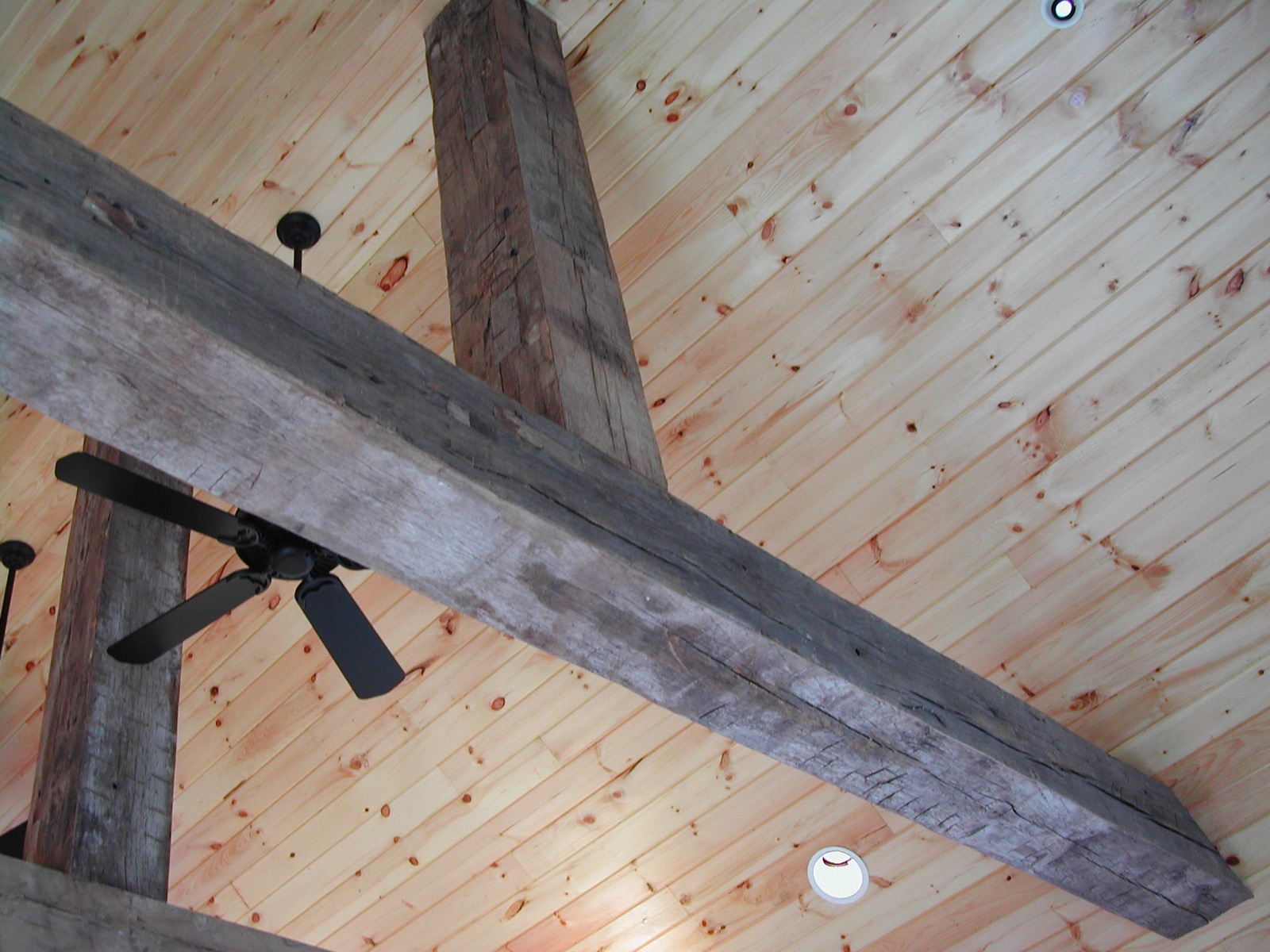
Nobody produces a true hewn face with a saw, and any supplier who tells a buyer otherwise is selling a stamped imitation. Hand hewing removes wood in scallops. The tool bites across the grain and leaves a cupped, faceted surface with torn fiber at the edge of each cut. That look reads as handwork because it is handwork, and reproducing it on a production line means either hand tooling every piece or pressing the surface with a textured roller.
For restoration projects in historic districts the review board is often looking for exactly that hand character on replacement work, and the National Park Service Preservation Briefs set the standard most commissions apply when judging whether a replacement matches the original in material, texture and profile. What a mill contributes to that project is the substrate. Correct species, correct grain orientation, correct thickness, dried to the right moisture content, milled to the original pattern with knives ground to match the historic profile. Hewing the face is then a hand operation carried out by the restoration carpenter or the specialty finisher on the job.
Say that plainly in the submittal and everyone stays out of trouble. A buyer who assumes the mill is delivering a hewn face and receives a bandsawn one has a schedule problem that shows up on site, which is the worst possible place to discover it.
The equipment that decides whether a shop can offer this
Ask the shop what machines are on its floor, because the answer sorts real millwork operations from resellers in about thirty seconds. Resawn cladding requires band resaws to split the stock. Straight line and gang rip saws square the edges and bring boards to consistent width before the pattern is cut. Moulders run the shiplap, nickel gap, channel or bevel pattern and put a back cut in for ventilation. Trimming saws bring the pieces to length. Custom knife grinders let the shop cut a profile that is not already in the library.
J. Gibson McIlvain keeps a moulding profile library holding thousands of profiles and grinds new knives every week. A pattern that does not exist in the library gets ground to match, which covers both historic restoration profiles taken from a physical sample and contemporary details drawn by an architect who wants something nobody else has. The Wood Moulding and Millwork Producers Association publishes the standard pattern numbers most of the trade works from, and those patterns are the starting point rather than the ceiling.
One more piece of the answer that gets skipped. A mill that can resaw but cannot store finished material forces the buyer to take delivery of an entire elevation at once. J. Gibson McIlvain stores finished millwork for inventory control, which lets a contractor pull cladding in phases as the building envelope goes up instead of tarping stacks of primed siding in a mud lot.
Species that hold a texture, and the limits of modified wood
Coarse and open-grained woods take a resawn face beautifully, and tight, dense, closed-grain species produce a subtler texture that reads more as a sheen than as tooling. Cedar is the default for textured exterior siding for good reason. It holds a saw face crisply, it is dimensionally calm, and it is available in two very different grades that buyers confuse constantly. Clear vertical grain, CVG, is the quartersawn clear material that stays flat and paints or stains uniformly. Select tight knot, STK, carries sound intergrown knots and reads as a rustic wall, which is often exactly what a textured elevation wants. Both are legitimate. They are not interchangeable on a submittal.
Among the imported hardwoods, Iroko resaws to a clean open texture, weathers to a silver grey and holds that open saw face without the tooling closing up. Utile takes a resawn face cleanly and mills predictably at the pattern head. Sapele resaws cleanly as well, and its interlocked grain leaves a finer, more even texture that suits a wall running into painted trim. The tropical decking species also resaw well, and Ipe, botanical name Tabebuia spp, holds a fine dense texture on exposed elevations where softer species would not, with Cumaru and Jatoba behaving similarly and Garapa and Red Balau showing the saw marks more plainly against a lighter color. A millwork shop still reaches for those three first, because the decking species are harder on knives and slower through a moulder, and their high oil content makes them difficult to glue wherever a detail is built up rather than simply fastened. J. Gibson McIlvain supplies Sapele, Iroko and Utile as siding and rainscreen stock, along with the decking species where a dense natural finish wall is wanted, resawn and patterned in house, and ships nationwide including regular deliveries to California.
For painted exterior trim running alongside a textured wall, Sapele is the better choice over Genuine Mahogany. It holds paint better and comes in a wider range of sizes and longer lengths. Sapele is not milled 1x8 for exterior use because that width will not stay stable outdoors. Cupping, when it happens, is driven by installation and back ventilation rather than by the species itself, which is a point worth defending when a claim arrives. Janka numbers give a rough sense of surface hardness and how sharply a saw face will hold up under handling. Sapele runs roughly 1,410 lbf, White Oak roughly 1,360 lbf, Iroko roughly 1,260 lbf, Utile roughly 1,180 lbf, Genuine Mahogany roughly 800 lbf. The Wood Database is a reasonable public cross-check on those figures.
Modified woods take a resawn face and carry a manufacturer warranty, and their dimensional limits are set by kiln size rather than by preference. Accoya, acetylated and running roughly 1,600 lbf, delivers dramatically reduced shrinkage and swelling, which is the single most useful property on a wide textured board that has to stay flat on a sunny elevation. Thermory and Abodo Vulcan are both carried and both take a saw face well.
The limits are firm. Modified woods, Thermory, Abodo Vulcan and Accoya, top out around 16 ft, and most are sold on metric lengths just under 16 ft, because the kilns are only so long. Thermally modified Ash tops out at 8 inches wide, which pushes any wide-board modified detail toward Accoya or Abodo Vulcan. Anyone quoting longer or wider is either substituting a different product or is going to disappoint somebody at delivery. Manufacturer technical data from Accoya, Thermory and Abodo Vulcan is public, and reading it before a wide textured elevation gets drawn prevents a substitution fight at submittal.
Warranties follow the same logic. Modified products carry them. Solid unmodified wood does not, and no honest supplier will write one. It is an organic material responding to its environment, and a piece of paper does not change how it behaves in July.
Comparing the textured faces buyers ask for
Six surface treatments come up repeatedly on siding and wall panel submittals, and only some of them originate inside a lumber mill. The table below sorts them by how the surface is produced, because that is what determines who the buyer needs to call.
| Surface | How it is produced | Effect on finish behavior | Typical use in the wall assembly | Produced in house at J. Gibson McIlvain |
|---|---|---|---|---|
| Bandsawn resawn face | Band resaw splits a thick blank, leaving the blade signature on both new faces | Absorbs more stain and primer than a dressed face, holds solid color coatings well | Exterior lap and rainscreen cladding, rustic interior accent walls | Yes, on band resaws |
| Skip dressed, hit and miss | Moulder head set to leave the low spots of the board untouched | Mixed absorption across the face, reads as intentional irregularity under stain | Interior feature walls and covered exterior soffit work | Yes, moulder pass |
| Smooth moulder dressed | Full moulder pass with knives ground to the pattern | Most predictable coating film build, cleanest paint line | Painted lap siding, primed trim, panelized interior wall systems | Yes, moulder and custom ground knives |
| Wire brushed | Abrasive brush line raises the hard latewood and scours out early wood | Deep grain relief that pools stain in the softer grain | Interior panels and protected exterior applications | No, handled by the buyer's finisher on supplied stock |
| Hand hewn or adzed | Broadaxe and adze worked by hand, or a specialty texturing roller | Very high absorption, uneven film, usually finished with penetrating oil | Historic restoration matching, timber-look accent walls | No, hand work by the restoration carpenter or specialty fabricator |
| Circular sawn look | Circular head leaves arced kerf marks distinct from a band saw signature | Similar absorption to a bandsawn face, coarser visual rhythm | Rustic exterior elevations, barn-style walls | No, the in house saw texture is the bandsawn face |
Moisture content is what makes a textured wall stay flat
Texture hides nothing about movement, and a resawn board delivered at the wrong moisture content telegraphs its problems within one season. Interior millwork is milled to an in-service moisture content near 6 to 8 percent. Exterior work is milled near 12 to 16 percent. Those are not arbitrary numbers. They are where the wood will settle in service, and delivering material outside that window means the wall shrinks or swells after installation regardless of how the face was tooled.
Grain orientation compounds it. Quartersawn and rift stock moves less across its width than plainsawn, which is why it gets specified anywhere a painted or panelized surface has to stay flat. On a textured elevation the specification argument shifts a little. Some movement in a rustic wall is tolerable and even wanted. On a nickel gap interior panel wall with tight reveals, it is not, and quartersawn material earns its place.
Back ventilation finishes the job. A rainscreen cavity behind textured siding lets the back of the board dry at something close to the rate the face does, which is the actual mechanism that prevents cupping. Building Science Corporation has published extensively on drained and back-ventilated cladding assemblies, and the reasoning applies to a resawn board exactly as it does to a smooth one. A mill can put a back cut or kerf relief into the pattern to help. What happens behind the board on site belongs to the installer.
Priming a textured face is a different job from priming a smooth one
A resawn face swallows finish, and skipping the primer step on textured exterior stock is the fastest way to an uneven painted wall. J. Gibson McIlvain primes wood in three levels, in both oil-based and water-based systems. Exterior primed trim should carry a fungicide additive. Open-grained and oily exterior species absorb a great deal of finish, and a primer coat evens out the eventual painted surface so the topcoat lands consistently instead of flashing wherever the substrate drank more.
Sanding or buffing after priming knocks back the grain raising that water-based systems cause while keeping moulded detail crisp. On a textured face that step needs judgment. Buff too aggressively and the saw marks flatten into a vague fuzz. Leave the raised fiber alone and the topcoat sits on loose fiber that will shed. The right answer sits between those, and it is a conversation to have with the mill before the order runs, not after the primed stock arrives.
Priming both faces and all four edges before the boards leave the shop is the practice that actually protects a textured wall. Field priming cut ends is then the installer's responsibility, and it is the step most commonly skipped on a fast-moving job.
What belongs in the specification and the submittal
A textured siding spec that names only a species and a pattern number will get filled six different ways by six different suppliers. Name the species and grade, and for cedar say CVG or STK rather than leaving it open. Name the face treatment and reference an approved physical range sample. Name the pattern, whether that is a WMMPA number or a custom profile to be ground from a drawing or from a sample board taken off the existing building. Name the moisture content window. Name the priming level and whether the system is oil-based or water-based, and call for the fungicide additive on exterior work.
Grading language matters too. Hardwood grading rules published by the National Hardwood Lumber Association govern how the rough stock is graded before it ever reaches a resaw, and understanding that a grade describes yield of clear cuttings rather than appearance of a finished face prevents a lot of arguments. Chain of custody documentation is separate and travels with the material. J. Gibson McIlvain is FSC certified, and where a CITES listed species is involved, the documentation and chain of custody travel with the material as a matter of course.
For assemblies where fire performance, structural sheathing or code compliance intersect with the cladding, the American Wood Council codes and standards library is the place to start, and WoodWorks publishes project-level guidance for commercial wood construction. Those documents govern the assembly. The mill supplies material that meets what the assembly calls for.
Where a stock pattern stops and true custom work begins
Linear textured cladding is a J. Gibson McIlvain service, and a wall that stops being linear becomes custom millwork. Straight runs of resawn siding, finished cladding and primed trim run through the mill as a production item. Radius trimwork, curved wall panels, a paneled wall engineered around a specific room, custom doors set into a textured elevation and exterior items such as rafter tails and pergolas are the work of ICD, the company's architectural millwork division, which applies the same 67 years of experience to custom millwork. ICD plans work to fit a specific space rather than adapting a standard module to it, and its exterior millwork group handles the pieces that a moulder alone cannot produce.
"When somebody calls asking for resawn siding, the first thing I want to know is whether they have seen a sample from the actual saw. Two mills can both call it resawn and hand you two completely different walls. We would rather send the range sample and settle it in a week than have an architect standing on a job site in month six explaining to an owner why the texture is not what was drawn."
Norm Moton, Director of Sales, J. Gibson McIlvain
How J. Gibson McIlvain Would Specify This
Start with the wall assembly, work back to the board, and settle the face texture with a physical sample before anything else gets locked. On an exposed exterior elevation the sequence runs like this. Confirm whether the wall is a drained and back-ventilated rainscreen or a face-sealed assembly, because that decides how much dimensional movement the board is allowed. Choose the species against exposure and against the finish. Cedar in CVG for a painted or lightly stained wall that has to stay calm, cedar in STK where the knots are wanted, Iroko or Utile where an imported hardwood has to hold an open saw face and weather without maintenance, Sapele where the wall runs into painted trim and the two have to match, Ipe or Cumaru where density and exposure argue for a decking species on a fastened wall, Accoya or Abodo Vulcan where a wide board has to stay flat and a warranty is required.
Set the moisture content next, near 12 to 16 percent for exterior and near 6 to 8 percent for interior panel work, and hold the supplier to it. Specify quartersawn or rift where flatness is not negotiable. Then approve the resawn face from a range sample cut on the same saw that will run the order, and write the approved sample into the submittal so there is no argument later.
Pattern and priming close it out. Pull a standard shiplap, nickel gap, channel or bevel profile from the library, or send a drawing or an original sample board and have a knife ground to match. Add back cut relief where the assembly wants it. Prime both faces and all four edges before shipping, in the system the finish schedule calls for, with a fungicide additive on exterior work. Ask for the material to be held in storage and released in phases so primed cladding is not sitting outside waiting on the framing crew. Where the wall includes a radius, a custom door surround or a paneled feature, bring ICD in early rather than trying to force a curved condition out of a straight pattern.
Anything involving a hewn or adzed face, wire brushing, or the installation itself sits with the buyer's own fabricator, finisher and installer. J. Gibson McIlvain supplies and mills. Being straight about that line is what keeps a project on schedule. To review a textured siding or wall panel package, get a range sample, or work through a profile that needs a knife ground, call J. Gibson McIlvain at 800-638-9100 or start with the millwork services page.
Frequently Asked Questions
Is a resawn face the same thing as a rough sawn face?
Close, but not identical. Rough sawn usually describes the surface of a board straight off the headrig or the primary saw at the sawmill, before any dressing. Resawn describes the face created when a thicker board is split on a band resaw, which is a controlled operation done at the millwork shop. The resawn face tends to be more consistent in depth and direction because the operator is choosing blade width, tooth pitch and feed speed for the look. On a submittal, write resawn face and reference an approved physical range sample rather than relying on either term alone.
Can J. Gibson McIlvain produce a hand hewn or adzed face on siding?
No. A hewn face is hand tool work, and it is applied by the restoration carpenter or a specialty finisher. What the mill supplies is the substrate for that work, which means the right species, the right grain orientation, the right thickness, dried to the right moisture content and cut to the correct pattern. On historic restoration projects that is the split most review boards expect anyway, since hand character is precisely what the hand operation is supposed to produce.
Which species takes a resawn texture best for exterior siding?
Cedar is the workhorse and holds a saw face crisply in both CVG and STK grades. Among the imported hardwoods, Iroko resaws to a clean open texture and Utile mills predictably at the pattern head, which is why a millwork shop reaches for them ahead of the denser decking species. Ipe, botanical name Tabebuia spp, Cumaru, Jatoba, Garapa and Red Balau all resaw well too, though they are harder on knives and slower through a moulder. Where a wide board has to stay flat and a written warranty is required, Accoya or Abodo Vulcan are the answer, keeping in mind that modified products top out around 16 ft and thermally modified Ash is not available wider than 8 inches.
Does a resawn face need primer, or can it be stained directly?
Either works, but the decisions are different. A penetrating stain suits a saw face well since the texture holds pigment. For a painted wall, priming is the difference between an even topcoat and a blotchy one, because a textured face has far more surface area and absorbs a great deal more finish. J. Gibson McIlvain primes in three levels in both oil-based and water-based systems, and exterior primed trim should carry a fungicide additive. Priming both faces and all four edges before shipping is the practice that actually protects the wall.
Can the same shop produce matching resawn trim and smooth painted trim for one elevation?
Yes, and that is the practical reason to source both from one mill. The moulders that run the smooth painted trim profile and the band resaws that produce the textured cladding are on the same floor, working from the same stock. Sapele is the preferred species for painted exterior trim over Genuine Mahogany because it holds paint better and comes in a wider range of sizes and longer lengths, though it is not milled 1x8 for exterior use since that width will not stay stable outdoors.
What moisture content should textured siding be delivered at?
Exterior work is milled near 12 to 16 percent, interior panel work near 6 to 8 percent. Those windows are where the material will settle in service. Delivering outside them means the wall moves after installation no matter how the face was tooled. Quartersawn and rift stock moves less across its width than plainsawn, which is why it gets specified on interior panel walls with tight reveals.
Is there a warranty on solid wood resawn siding?
No. Warranties exist only on modified products such as Accoya, Thermory and Abodo Vulcan. Solid unmodified wood is an organic material responding to its environment, and it is not possible to warranty that behavior. What a buyer can hold a supplier to is species, grade, moisture content, pattern, priming level and an approved face sample, all of which belong in the submittal.
Who handles installation of textured cladding?
The buyer's own installer. J. Gibson McIlvain supplies and mills, and does not install or coordinate installation. That matters on textured siding more than most products, since cupping is driven by installation and back ventilation rather than by species. The mill can put back cut or kerf relief into the pattern, but the drained and ventilated cavity behind the board, the fastening pattern and field priming of cut ends all belong to the installer.
Sources and Standards Referenced
- Wood Handbook, Wood as an Engineering Material, USDA Forest Products Laboratory
- Preservation Briefs, National Park Service Technical Preservation Services
- Wood Moulding and Millwork Producers Association
- National Hardwood Lumber Association
- Building Science Corporation
- American Wood Council Codes and Standards
- The Wood Database
- Accoya Acetylated Wood Technical Information
- Thermory and Abodo Vulcan Thermally Modified Wood
- Forest Stewardship Council
- CITES, Convention on International Trade in Endangered Species
- WoodWorks Wood Products Council