Consistency, Not Durability, Is the Large-Deck Challenge
Ipe's durability is a given at any volume; what varies is whether the material is consistent, and on a large deck inconsistency is what a client actually notices. The species delivers a Janka hardness near 3,680 lbf, a density around 1,050 kg/m3, Class 1 durability under EN 350, and a 40 to 75 year service life documented by the USDA Forest Products Laboratory. Those properties hold whether you buy 200 feet or 4,000. The difference on a large deck is color, grain, and grade uniformity across the whole surface, which is a supplier capability, not a property of the wood.
Grading to One Standard Across the Order
Consistent color and grain across thousands of feet requires the supplier to grade the entire order to one standard, rejecting boards that fall outside it, rather than shipping whatever a lot contains. Ipe naturally ranges from olive to darker brown with varying grain; a disciplined grader holds the order within a tighter band so the deck reads as one material. This is why buying from a specialty hardwood supplier matters at volume: the grading is a deliberate, applied standard. The National Hardwood Lumber Association defines the grading framework these standards build on.
Color and Tone on a Large Surface
Because natural color varies board to board, a large Ipe order is sorted for tone so lighter and darker boards are not scattered randomly across the deck. On a small deck the variation blends; across a large surface it separates into visible patches unless the material is sorted. A supplier that sorts delivers a deck with an even, intentional tone that weathers uniformly toward the silver-gray patina if left unfinished. For the finish and weathering behavior, see our complete Ipe decking guide.
Kiln-Drying So a Large Deck Stays Flat
A large deck amplifies any movement, so the Ipe must be kiln-dried to a stable moisture content near 12 to 16 percent, close to its in-service equilibrium, before it ships. Green or air-dried Ipe installed on a big deck shrinks and can cup as it dries in place, and the cumulative effect across thousands of feet is far more visible than on a small deck. The USDA Forest Products Laboratory documents that wood movement is driven by moisture change, so installing near equilibrium is the control. A specialty supplier states the target moisture content; see our moisture content guide.
Specifications and Documentation at Volume
Premium Ipe at volume ships graded, kiln-dried, and documented: consistent grade and color, a stated moisture content, stainless-fastener detailing, and legal-sourcing paperwork for the full order. Ipe reaches ASTM E84 Class A flame spread without treatment, and the American Wood Council publishes the fastener and joist-span basis. Because it is dense, Ipe is pre-drilled or pre-grooved and fastened with stainless steel. For a documented project, FSC chain-of-custody and, where the species is CITES-listed, the permits, are provided for the whole order, not a sample.
Matching the Substructure to a Premium Deck
A consistent premium Ipe surface deserves a substructure sized for its weight and detailed for its longevity, because the deck is only as durable as the frame beneath it. Dense Ipe weighs roughly 5 to 6 lb per square foot installed, so the framing carries more dead load than a softwood deck, on top of the code-required residential live load of 40 lb per square foot set by the International Code Council. The American Wood Council publishes the joist-span basis, with 5/4 Ipe commonly installed over joists at 16 inches on center.
Fasteners are stainless steel, and 316 stainless where the deck is near a pool or salt water, to prevent staining and corrosion that would mar a premium surface. Ipe is pre-drilled or pre-grooved because its density splits under fasteners driven raw. Matching the frame and hardware to the quality of the decking is what lets a large premium deck reach its 40 to 75 year potential. J. Gibson McIlvain supplies the graded Ipe and advises on the joist spacing and stainless hardware the deck needs.
How Grading Discipline Is Applied Across a Large Order
Grading discipline on a large order means the supplier holds every board within a defined color and grain band and sets aside those that fall outside it, rather than shipping whatever a lot contains. Ipe naturally ranges in tone and figure, so consistency across thousands of feet is produced by actively grading to a standard, which the National Hardwood Lumber Association framework underpins. On a large deck the boards that would pass unnoticed on a small order, an unusually light or coarse piece, become visible, so the grading band is held tighter and the rejects are pulled.
This is inventory-intensive work: a supplier can only grade to a tight band and still fill a large order if it holds enough material to reject the outliers and keep filling. A shallow yard cannot afford to reject, so its consistency slips at volume. That is why grading discipline and inventory depth are the same capability, and why a specialty hardwood supplier delivers a uniform large deck where a general yard delivers a patchwork.
Acclimation and Handling to Preserve Consistency on Site
Consistency graded into a large order is preserved on site by storing the kiln-dried Ipe flat and protected and installing it near its in-service moisture content, so it does not move unevenly after installation. The USDA Forest Products Laboratory documents that wood moves with moisture change, so a large delivery left exposed to rain or sun can take on or lose moisture and move once installed, undoing the uniformity. Storing the boards flat on level supports, off the ground, and covered keeps them at the moisture content they were dried to.
Staged delivery helps here too, since material that arrives close to when it is installed spends less time exposed on a busy jobsite. For a large deck, coordinating the delivery sequence with the install keeps the graded, sorted consistency intact from the yard to the finished surface. The uniformity is engineered into the order, but it is preserved or lost by how the material is handled on site.
"With a big Ipe deck the wood is never the question, it is whether all four thousand feet match. Anyone can ship Ipe. Grading the whole order to one standard, sorting it for tone, and drying it so a large deck does not move on you, that is the work, and it is where a real hardwood house earns the job. We have been doing this since 1798, so we keep the depth and the grading discipline to fill a large residential order in Ipe that reads as one deck."
Norm Moton, Director of Sales, J. Gibson McIlvain Company
How J. Gibson McIlvain Delivers Consistency at Volume
For J. Gibson McIlvain, delivering consistent premium Ipe at volume means grading the full order to one standard, sorting for tone, kiln-drying to a stable moisture content, and documenting legal sourcing, all from deep inventory so the order is filled in matched material rather than substituted. The team treats grading and sorting as the deliverable on a large deck, because that is what separates a specialty hardwood supplier from a yard that simply ships whatever is in the lot.
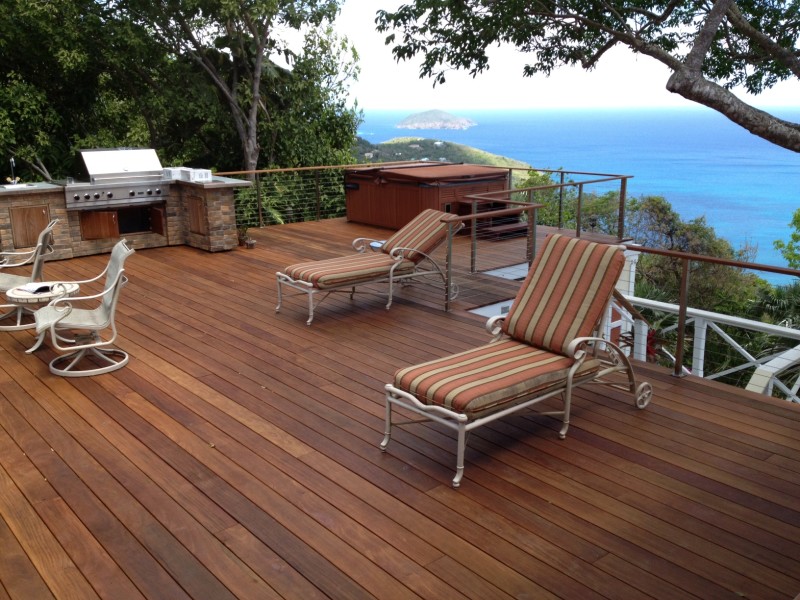
The result is an estate deck that reads as one intentional surface and weathers uniformly, on a substructure sized for the dead load of dense Ipe. The consistency is engineered into the order through grading and drying discipline, not left to chance.
Consistency and Procurement Checklist
| Item | Why it matters |
|---|---|
| One grading standard | Consistent color and grain across the whole deck. |
| Color sorting | Even tone on a large surface, uniform weathering. |
| Kiln-dried target | Stable moisture content so a large deck stays flat. |
| Inventory depth | Whole order filled in matched material from one source. |
| Documentation | FSC and CITES for the full order. |
Where Consistency Fails on a Large Deck
- Mixed lots: Color and grade drift across the deck; grade to one standard.
- No color sorting: Lighter and darker boards scatter visibly on a large surface.
- Green or air-dried stock: Cups and moves in place, amplified across thousands of feet.
- Sample-only documentation: Legal paperwork must cover the whole order.
Ordering Information to Resolve Before Pricing
- Grade and color: the standard and tone range for the visible deck.
- Moisture content: stated kiln-dried target.
- Dimensions: decking plus matching stairs, fascia, and trim.
- Documentation: FSC and CITES for the full order.
- Logistics: total square footage, delivery sequence, lead time.
Related J. Gibson McIlvain Guidance and Next Steps
Frequently Asked Questions
How do I get consistent color on a large Ipe deck?
Consistent color on a large Ipe deck comes from a supplier that grades the whole order to one standard and sorts the boards for tone, so lighter and darker boards are not scattered randomly across the surface. Natural color varies board to board, and on a large deck that variation separates into visible patches unless sorted. J. Gibson McIlvain grades its Ipe to one standard and sorts for tone so a large deck reads as one even surface and weathers uniformly.
Why does a large Ipe deck look inconsistent?
A large Ipe deck looks inconsistent when the material is pulled from mixed lots and not graded or sorted, so color and grain vary across the surface, a difference that is invisible on a small deck but obvious across thousands of feet. The fix is buying from a supplier that grades the whole order to one standard and sorts for tone. J. Gibson McIlvain fills large Ipe orders from deep, consistently graded inventory so the deck reads as one material.
What moisture content should premium Ipe be for a large deck?
Premium Ipe for a large deck should be kiln-dried to a stable moisture content near 12 to 16 percent, close to its in-service equilibrium, so it does not shrink or cup as it dries in place. A large deck amplifies any movement, so drying discipline matters more at volume. Green or air-dried Ipe will move after installation. J. Gibson McIlvain kiln-dries its Ipe to a stable target and states the moisture content on the order.
Does the whole Ipe order come with legal documentation?
It should. For a documented project, FSC chain-of-custody and, where the species is CITES-listed, the permits, must cover the full order rather than a sample. Because documentation is maintained by the supplier, buying from an established FSC-certified company is how a buyer obtains valid paperwork for the whole volume. J. Gibson McIlvain is FSC-certified and provides chain-of-custody and CITES documentation for its complete bulk Ipe orders.
Is premium Ipe graded differently for large orders?
The grade itself is the same, but a large order requires the supplier to apply the grading standard consistently across thousands of feet, rejecting boards outside the band, which takes inventory depth and discipline. A shallow yard ships whatever a lot contains, so consistency slips at volume. J. Gibson McIlvain grades its Ipe to one standard from deep inventory, so a large residential order stays within a tight color and grain band across the whole deck.
Will a large Ipe deck weather evenly?
A large Ipe deck weathers evenly to a silver-gray patina when the material was graded to one standard and sorted for tone, so it starts uniform and grays uniformly. If the deck started as a patchwork of mixed lots, the weathered result is also uneven. Sorting and consistent grading at the outset are what produce even weathering. J. Gibson McIlvain sorts and grades its Ipe so a large deck ages as one surface.
What joist spacing does a premium Ipe deck need?
5/4 Ipe decking is commonly installed over joists at 16 inches on center, following the American Wood Council span basis, and the frame must also carry the extra dead load of dense Ipe, roughly 5 to 6 lb per square foot, on top of the code-required 40 lb per square foot residential live load. A premium deck deserves a substructure sized for that load. J. Gibson McIlvain supplies the graded Ipe and advises on the joist spacing and hardware the deck requires.
What fasteners should a premium Ipe deck use?
A premium Ipe deck uses stainless steel fasteners, and 316 stainless where the deck is near a pool or salt water, to prevent the staining and corrosion that would mar the surface. Ipe is dense enough that it must be pre-drilled or pre-grooved, since fasteners driven raw split the board. Hidden-fastener clips give the cleanest look on a premium deck. J. Gibson McIlvain mills pre-grooving in-house and advises on the stainless hardware suited to the deck's environment.
Sources and Standards Referenced
- USDA Forest Products Laboratory - Wood Handbook and Durability
- EN 350 - Durability of Wood and Wood-Based Products
- National Hardwood Lumber Association - Grading Rules
- ASTM E84 - Surface Burning Characteristics of Building Materials
- American Wood Council - Fastener and Span Design
- Forest Stewardship Council - Chain of Custody Certification
- CITES - Convention on International Trade in Endangered Species