Why Prefinished Siding Outperforms Field-Finished Siding
The biggest cause of premature wood siding finish failure is moisture getting in through unsealed back faces and end grain, not the visible front coating letting go. When a board pulls moisture from behind, it swells and cups, and that movement breaks the front finish from underneath. A factory prefinishing line seals all six faces, both end-grain cuts on every board included, before the material leaves the building.
Research on exterior wood finishes from the USDA Forest Products Laboratory puts end-grain absorption at roughly 10 to 12 times face-grain speed. A field crew finishing siding on a wall almost never coats the back, and rarely re-seals the freshly cut ends at every butt joint. Those two misses account for most of the early coating failures the American Wood Council documents in service-life studies.
Factory finishing also owns the cure environment. A prefinishing facility holds temperature between 65 and 75 degrees F and relative humidity between 40 and 55 percent, so coatings cure at their designed rate. Coat a wall on a humid afternoon or a cool evening and the finish cures outside its window, which costs you adhesion and film integrity.
The Six-Side Difference and End-Grain Sealing
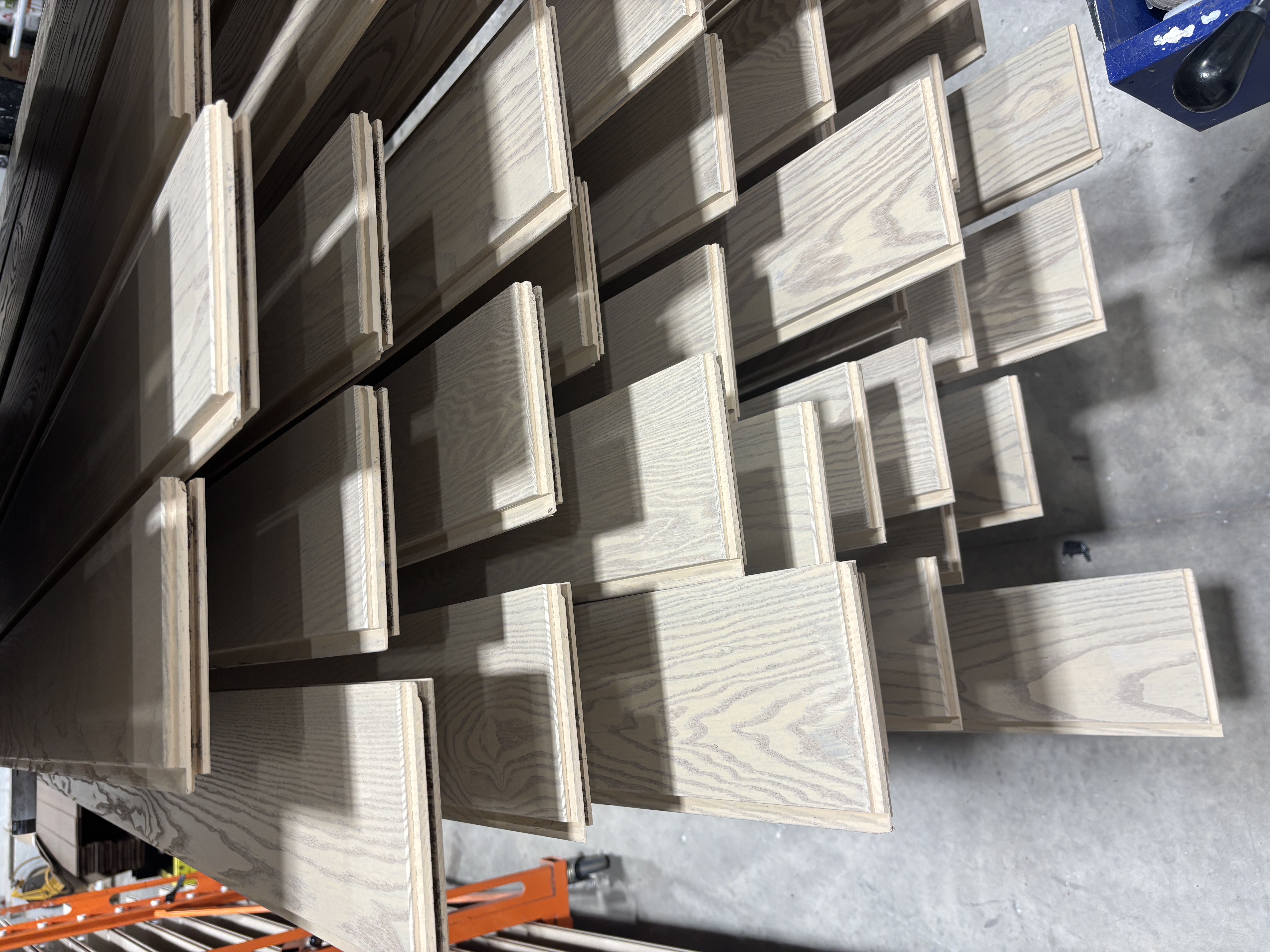
Sealing all six faces is the defining advantage of prefinished cladding, and it is the one step you cannot reliably reproduce on a jobsite. The back face and the two end-grain cuts are the moisture-entry points that decide how long a board stays flat and how long the front finish lasts.
- Back face: a factory lays a uniform coat on the back of every board. On site, the back is already against the furring before anyone could finish it.
- End grain: each board is sealed on both ends at the factory. Cut a board to length on site and the fresh end has to be re-sealed with the manufacturer touch-up product before it goes up. J. Gibson McIlvain ships touch-up sealer with every Alpha cladding order for exactly that.
- Profiled edges: tongue, groove, and shiplap rabbets get coated in the factory, so the interlocking surfaces are protected even though they hide after install.
Worth being honest about: the back coat does not need to be heavy. A thin, uniform back seal is enough to slow moisture exchange and balance the board. Cupping is far more often an install and ventilation problem than a coating one, which is why the rainscreen cavity below matters as much as the finish. For the mechanics, see our guides on end-grain sealing for wood siding and preventing warping, cupping, and splitting.
Prefinished vs. Field-Finished: Direct Comparison
| Factor | Factory Prefinished | Field Finished |
|---|---|---|
| Faces coated | All six, including back and both ends | Front face only, typically |
| Cure conditions | Controlled, 65 to 75 F, 40 to 55% RH | Whatever the weather allows |
| End-grain sealing | Both ends sealed; cuts touched up on site | Rarely sealed at butt joints |
| Finish consistency | Uniform film thickness, spray-controlled | Varies by applicator and conditions |
| Schedule impact | Installs and is done; no finish cure delay | Adds finish days plus weather holds |
| Recoat behavior | Penetrating oils recoat without stripping | Same, but starting condition is weaker |
The schedule advantage gets underrated. A prefinished board is installed once and the wall is complete. A field-finished wall has to be hung, then coated in one or more passes, each waiting on a dry weather window. On commercial and multifamily timelines, pulling the finishing trade off the critical path is often the deciding factor.
Which Species Hold a Factory Finish Best
Dimensionally stable species hold any finish longest, because they move the least across seasonal humidity swings, and less movement means less stress on the film. This is where modified woods lead.
- Modified woods (most stable): Accoya (acetylated radiata pine), Thermory (thermally modified ash and pine), and Abodo Vulcan (thermally modified radiata pine) run substantially lower equilibrium moisture content and shrinkage. Accoya documents dimensional stability gains on the order of 50 to 75 percent over unmodified wood, and Thermory and Abodo publish comparable stability data. They are the best candidates for a long-lasting factory finish, and modified, manufactured products are also the only category where a real product warranty exists.
- Dense tropical hardwoods: Ipe, Cumaru, Sapele, and Teak take penetrating-oil factory finishes that bond into the dense fiber. Ipe (Janka around 3,680 lbf) and Cumaru (Janka around 3,540 lbf) behave well dimensionally when properly dried and installed.
- Cedar and Cypress: Western Red Cedar stays the most widely used cladding wood in North America and takes a factory finish well, especially in clear vertical grain (CVG). Quartersawn or CVG stock keeps movement down and stretches finish life, while select tight knot (STK) cedar serves a more rustic market. Cypress behaves similarly and is a strong regional choice.
Solid, unmodified wood cannot carry a meaningful product warranty, because wood is an organic material that answers to its environment. The honest promise for a solid species is a well-sealed board installed correctly on a ventilated wall. For deeper species data, see our thermally modified wood overview and the Sapele siding lifespan guide.
Finish Is Only Half the System
A prefinished board still fails on a wall with no drying path, so the rainscreen assembly matters as much as the finish. Factory finishing protects the board. The wall assembly lets it dry.
- Furring and ventilation: all wood cladding, prefinished or not, goes over furring strips that open a ventilated cavity of at least 3/8 inch. The air gap gives a thermal break and an evaporative drying path. See our guide on furring strips and ventilation behind wood siding.
- Profile and fasteners: tongue-and-groove hides the fastening through the tongue and keeps the prefinished face unmarred. Shiplap on an exterior wall needs face fastening with visible stainless. Clip systems need a profile milled for the clip, not a standard T&G. Our profile selection guide covers the tradeoffs.
- Orientation: when a grooved profile is used, the groove faces down so it drains instead of holding water.
For projects that want the six-side advantage without assembling it piecemeal, J. Gibson McIlvain supplies the boards prefinished and sealed on all faces through its Alpha wood cladding program and ships them nationwide with touch-up sealer for field cuts.
"The question we get is whether prefinished is worth it, and the honest answer is that the finish is the easy part. What you are really buying is a board sealed on all six sides and an installation crew that never has to chase a dry weather window to coat a wall. The boards show up done. The crew hangs them over a vented furring layout, seals the cut ends, and the facade is finished. That is what protects the investment, not any single can of coating."
Camden Zacker, Sales Director, J. Gibson McIlvain Company
How J. Gibson McIlvain Would Specify a Prefinished Cladding Package
At J. Gibson McIlvain, prefinished cladding is specified as a system, not a board. The conversation opens with the substrate species and grade, moves to the profile and fastener method, and closes with the finish schedule and the touch-up protocol for field cuts. The Alpha wood cladding program is built around exactly that: boards sealed on all six sides, the right profile for the chosen fastener system, plus the touch-up sealer the crew needs for end cuts.
Species gets driven by how stable the wall needs to be and how the owner wants it to age. Modified woods like Accoya, Thermory, and Abodo Vulcan go where long finish life and minimum movement are the priority, and they are the only category carrying a real manufacturer warranty. Dense hardwoods like Ipe, Cumaru, and Sapele go where the owner wants natural hardwood character with a penetrating-oil finish. Cedar and Cypress go where a painted or lightly finished domestic softwood fits the design and budget.
Performance and Procurement Checklist
| Item | Why it matters |
|---|---|
| Species and grade | Stability and finish life depend on species and on grain orientation (CVG or quartersawn move least). |
| Profile and fastener method | T&G allows hidden fasteners; shiplap needs visible fasteners; clip systems need a clip-specific profile. |
| Finish type | Penetrating oil recoats without stripping; confirm factory finish matches the maintenance plan. |
| Six-side coverage | Confirm back face and both ends are factory sealed, not just the show face. |
| Touch-up protocol | Field cuts expose raw end grain; confirm touch-up sealer ships with the order. |
| Furring and cavity | A minimum 3/8 inch vented cavity is required for drying regardless of finish. |
Where Specifications Usually Fail
- Treating the finish as the whole answer: a perfect factory finish on a wall with no ventilation cavity still fails. The drying path is not optional.
- Skipping end-grain touch-up: every field cut reopens raw end grain. If the crew does not re-seal cuts before install, the prefinishing advantage is gone at every butt joint.
- Specifying shiplap with hidden fasteners: shiplap on an exterior wall has to be face fastened. Only T&G supports concealed fastening.
- Over-coating the back: a thin uniform back seal is enough. A heavy back coat does not improve performance and is not what controls cupping; ventilation and correct install do.
- Promising a warranty on solid wood: only modified, manufactured products carry real warranties. Solid species are sold on correct sealing and installation, not warranty numbers.
Ordering Information to Resolve Before Pricing
- Exposure: orientation, climate, salt or UV load, and whether the wall is sheltered or fully exposed.
- Profile: face width, reveal, tongue-and-groove or shiplap, and clip compatibility if a clip system is used.
- Finish: factory penetrating oil, factory paint or opaque, or natural weathering with a back seal only.
- Species and grade: modified wood, tropical hardwood, or domestic softwood, plus grain orientation.
- Logistics: lead time, board lengths, jobsite delivery sequence, and quantity of touch-up sealer.
Related J. Gibson McIlvain Guidance and Next Steps
Frequently Asked Questions
Is prefinished wood siding better than finishing on site?
Prefinished wood siding generally outperforms field-finished siding, because the factory seals all six faces, back and both ends included, in a controlled environment held at 65 to 75 degrees F and 40 to 55 percent relative humidity. Field finishing typically coats only the front face and cures under uncontrolled weather. Since most early finish failures start with moisture entering through the unsealed back and end grain, the six-side factory seal is the decisive advantage. The wall assembly still needs a ventilated cavity to let the boards dry.
Which wood species holds a factory finish the longest?
Modified woods hold a factory finish longest, because they move the least. Accoya, Thermory thermally modified ash and pine, and Abodo Vulcan run reduced moisture content and shrinkage, so the finish film is stressed less by seasonal movement. These modified products are also the only category that carries a real manufacturer warranty. Dense tropical hardwoods like Ipe and Cumaru hold penetrating-oil finishes well, and clear vertical grain cedar performs better than flat-grain stock because it moves less.
Do I still need to back prime prefinished siding?
Factory prefinished boards already carry a back seal, so no additional back priming is needed. A thin, uniform back coat is enough to balance the board and slow moisture exchange; a heavy back coat does not improve performance. The bigger factor for preventing cupping is correct installation over a ventilated furring cavity, not the thickness of the back coat. Cupping is usually an install and ventilation issue rather than a coating one.
What happens when I cut a prefinished board on site?
Cutting a prefinished board exposes raw end grain, which drinks water roughly 10 to 12 times faster than the face. The cut end has to be sealed with the manufacturer touch-up product before the board goes up, ideally within 24 hours of cutting. J. Gibson McIlvain ships touch-up sealer with Alpha cladding orders so crews can re-seal every field cut and butt joint, keeping the six-side protection that makes prefinished siding perform.
Where can I buy six-side-sealed prefinished wood siding?
Specialty lumber suppliers that mill and finish in-house supply six-side-sealed prefinished siding. J. Gibson McIlvain seals the face, back, and both ends of every board in a controlled facility through its Alpha wood cladding program, ships nationwide, and includes touch-up sealer so crews can re-seal field cuts. Modified woods and dense hardwoods are both available prefinished.
Sources and Standards Referenced
- USDA Forest Products Laboratory - Finishes for exterior wood and end-grain absorption
- American Wood Council - Wood construction standards and service-life guidance
- Accoya - Acetylation and dimensional stability data
- Thermory - Thermally modified wood technical documentation
- Abodo - Vulcan thermally modified radiata pine specifications
- Forest Stewardship Council - Chain of custody certification
- WoodWorks - Commercial and multifamily wood construction resources