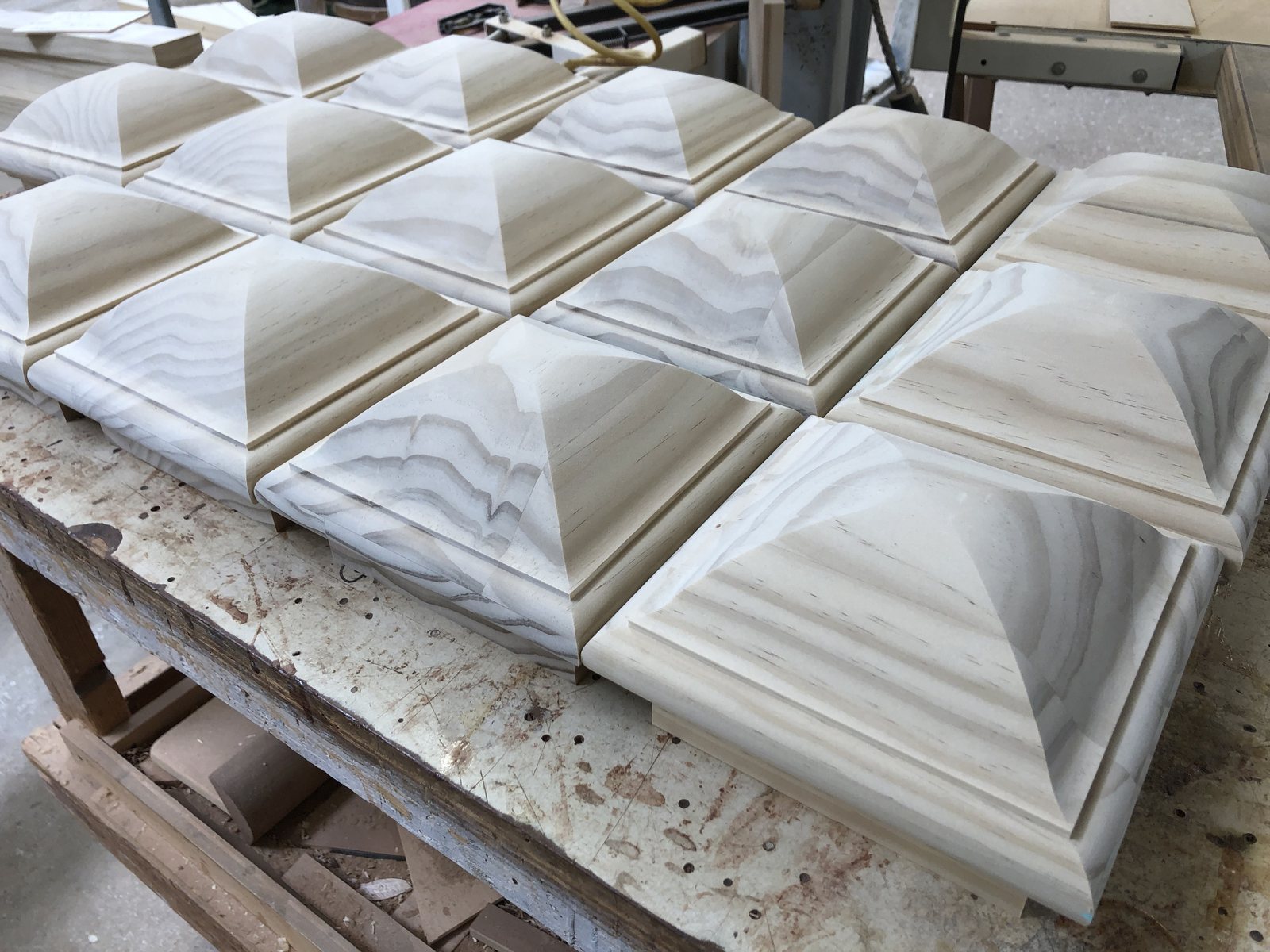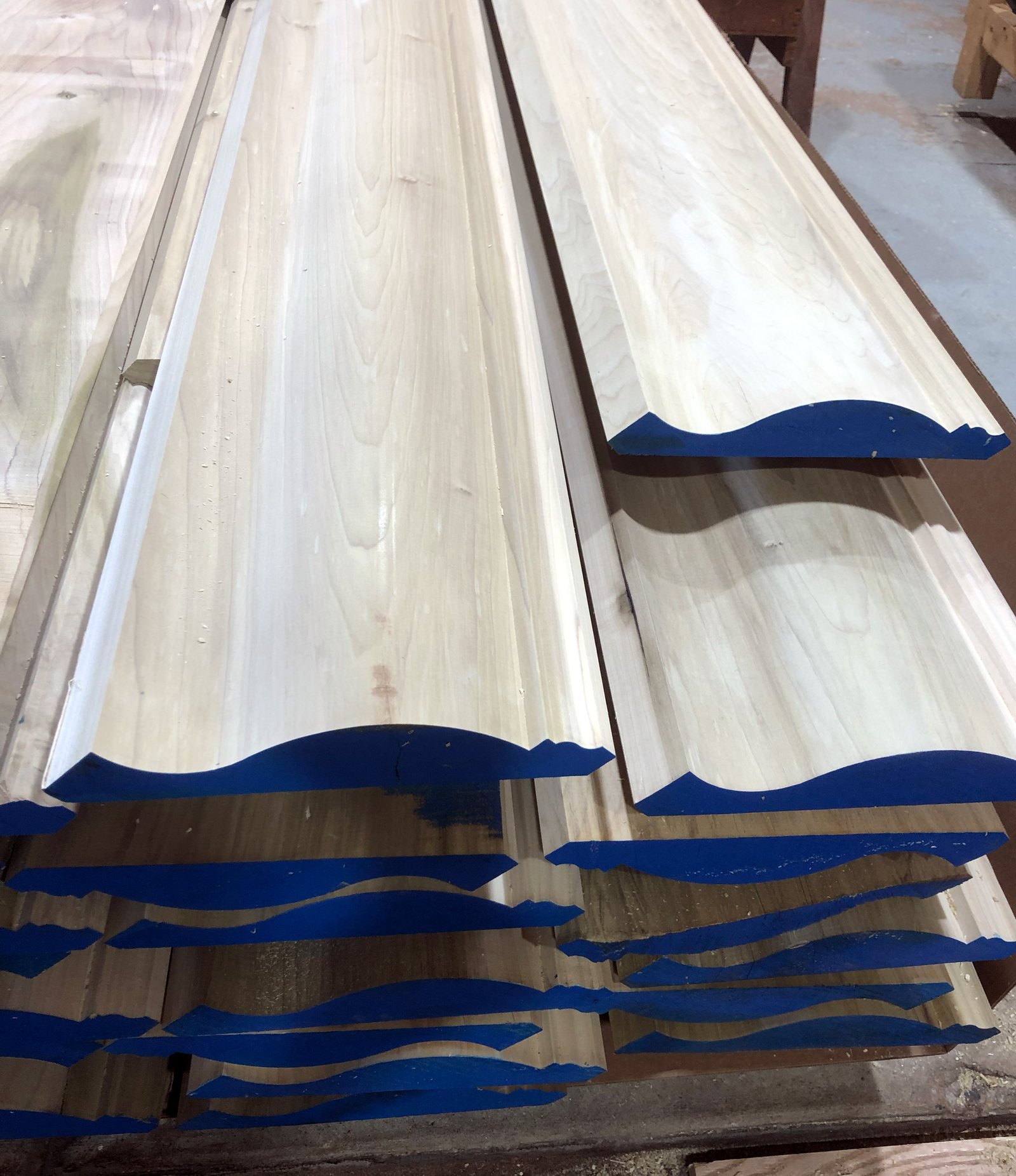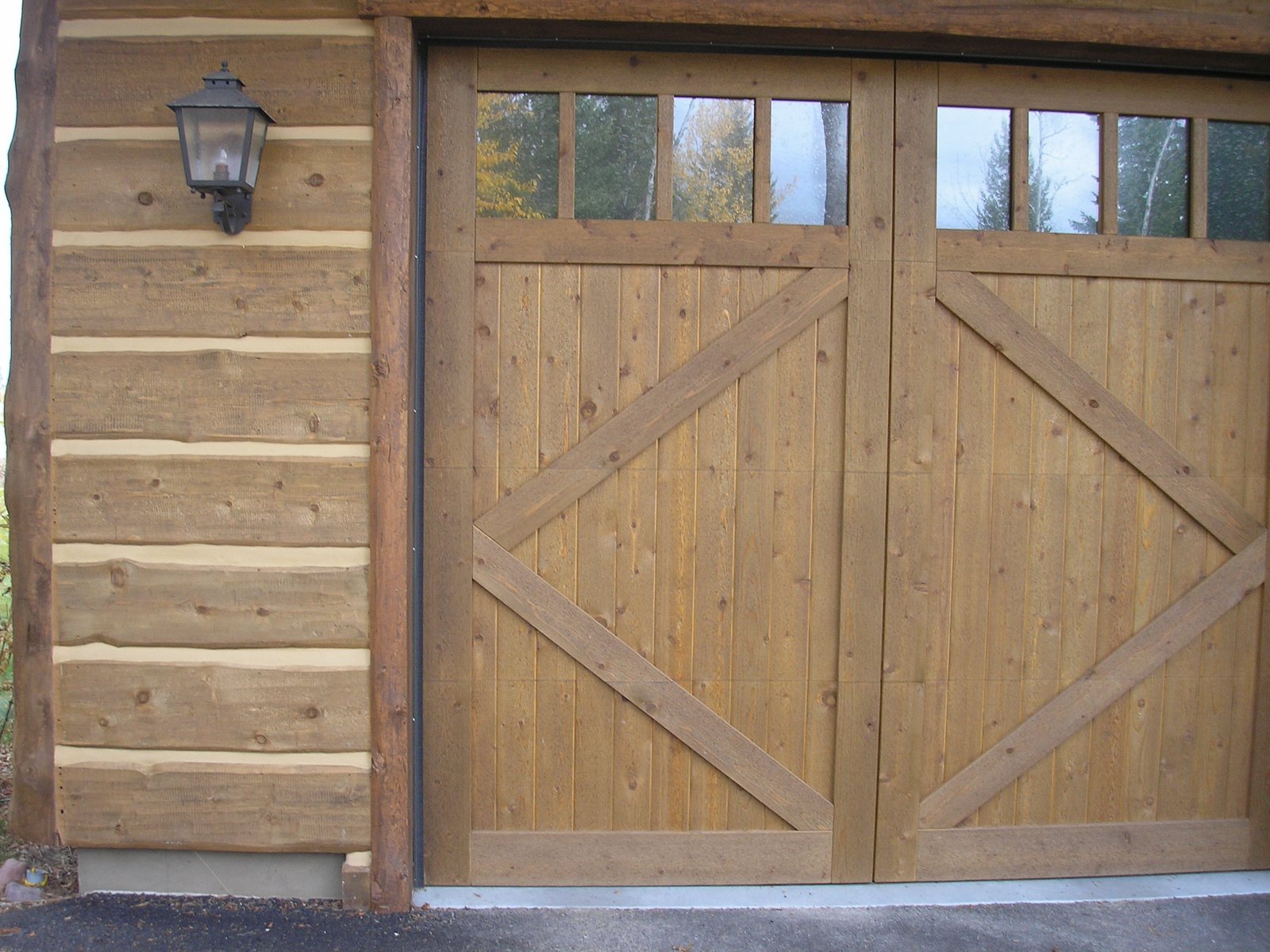

Release a curved interior package to one shop, at one time, the moment the radius geometry is field verified and the lumber for it is committed, and expect that shop to be the same one running your straight casing off the same ground knife.

Buyers searching for a millwork shop that handles both linear and radius moulding are usually solving a scheduling problem, not a craftsmanship problem. Two shops means two knives, two lumber buys, two queues and two delivery dates that will not line up. One shop means one knife, one release, one clock.
The harder question is when to pull the trigger. Release too early and the shop mills to a wall radius that changes in the field. Release too late and you are asking a moulder queue to absorb a package it cannot absorb, which is how a trim schedule quietly loses a month. J. Gibson McIlvain mills linear trimwork, finished cladding and primed trim on its own moulders, straight line and gang rip saws, band resaws and trimming saws, and grinds new knives every week for profiles that are not already in the library. That combination is what makes a single release date honest instead of aspirational.
A millwork package runs on four clocks at once, and most construction schedules only track one of them.
The clock everyone watches is machine time. How long does it take to run four thousand feet of casing. That is the shortest of the four and the least likely to cause a problem.
The other three matter more. There is material time, which covers sourcing the right thickness and length in the right species and getting it to the right moisture content. There is tooling time, which covers grinding a knife, running a trial sample and waiting on approval of that sample. And there is finish time, which covers priming, cure, sanding back and safe stacking. A schedule that assigns two weeks to millwork because the moulder pass takes two days has already failed.
Sequence those four honestly and you get a release date you can defend to a general contractor. The Architectural Woodwork Institute publishes standards that describe grade requirements and submittal expectations for architectural woodwork, and those submittal loops are calendar, not paperwork.
Lumber procurement, not machining, is the long pole on almost every curved interior package.

A straight casing run wants clear, dry, reasonably long stock in a standard thickness. A radius member wants something else entirely. Curved trim is built up from segments cut out of wider and thicker blanks, or it is laminated from thin laminations bent around a form and then run. Either path burns more board footage per linear foot of finished trim than a straight run does, and it demands thicker stock than the finished section suggests.
That is where the species conversation starts. The millwork palette is Sapele, Iroko, Afrormosia, Teak and Utile, and each of those behaves predictably under a knife and takes glue in a laminated bend. Sapele sits around 1,410 lbf on the Janka scale and is available in a wide range of sizes and long lengths, which is why it carries so much of the interior and painted exterior work. Utile machines cleanly and matches Sapele closely in color family. Iroko and Afrormosia hold up where exposure is a factor. Teak remains the reference point for stability. The Wood Database entry for Sapele is a reasonable starting point for anyone comparing working properties across that group.
The tropical decking species are a different conversation. Ipe, botanically Tabebuia spp, along with Cumaru, Garapa, Jatoba and Red Balau, are extremely hard and carry high oil content. That oil is exactly what makes them difficult to glue, and a laminated radius member is a glue joint problem before it is anything else. A millwork house reaches for Sapele, Iroko, Afrormosia, Teak or Utile for milled, glued and machined components for that reason, and saves the decking species for decking.
Where a species falls under CITES control, documentation and chain of custody travel with the material, and that paperwork has its own timeline that runs parallel to the wood. FSC certified material carries chain of custody records as well. J. Gibson McIlvain is an FSC certified importer and miller, and both sets of documentation are handled as part of the buy rather than chased after the fact. The CITES Secretariat and FSC both publish current requirements.
Moisture content sets the earliest honest release date, and no amount of scheduling pressure moves it.
Interior millwork is milled to an in service moisture content near 6 to 8 percent. Exterior work sits near 12 to 16 percent. Those are not preferences. They are the equilibrium the wood will find in service, and milling a profile at the wrong moisture content means the profile changes shape after it is installed.
Lumber that arrives at 11 or 12 percent and is destined for a conditioned interior needs redry time before it goes near a moulder. That is days to weeks depending on thickness, and it happens before machining, not during. The USDA Forest Products Laboratory Wood Handbook documents equilibrium moisture content behavior in detail, and Building Science Corporation covers what happens inside a building enclosure that has not reached operating conditions.
This is the single most common reason a package should not release on the day the drawings are approved. If the building is not dried in and conditioned, finished millwork arriving on site will move. Quartersawn and rift stock moves less across its width than plainsawn, which is why it gets specified where a painted or panelized surface has to stay flat, and it is worth pulling that call forward into the release decision rather than treating it as a shop detail.
Radius work runs on a longer and less forgiving clock than linear runs, so it releases first.
Straight moulding is a setup and a pass. Curved moulding is layout, template work, segmenting or lamination, glue cure, cleanup and then a pass, and the pass itself is not a straight feed through a moulder.
Every one of those steps depends on a radius that is actually correct. A wall shown at a nine foot radius on a plan and framed at eight foot nine in the field will produce trim that does not touch the wall through the middle of its arc. Field verification of the as built radius is the gate. Until somebody has measured the framed opening or the curved wall and confirmed it against the drawing, releasing the radius portion of a package is a gamble.
Radius trimwork and radius millwork are handled through ICD, the architectural millwork division of J. Gibson McIlvain, which builds custom work planned around a specific space. The ICD trim profile work is where the curved members and the profile matching come together. The straight runs of the same profile come off the J. Gibson McIlvain millwork service moulders using the same ground knife, which is the entire point of keeping both halves under one roof.
Whether a shop grinds its own knives is the difference between a two day tooling step and a two week one.
J. Gibson McIlvain maintains a moulding profile library holding thousands of profiles and grinds new knives custom every week. A profile already in that library removes an entire block from the schedule. A profile that is not in the library gets ground to match, including difficult historical restoration profiles and contemporary ones that no catalog carries.
Shops that send knife grinding out add a round trip nobody puts on the schedule. Ask the question directly when you are evaluating capacity. A shop with custom knife grinders on the floor can iterate on a sample in days. A shop without them iterates in weeks, and a rejected sample restarts the loop.
There is a second reason the library matters for curved work. When a radius member and a straight run come from the same knife, the profile registers across the transition. Two separately ground knives at two shops produce two profiles that are close, and close reads as wrong at a wall to arch transition where the eye can see both at once. Standard profile references such as the Wood Moulding and Millwork Producers Association series are a useful common language on a submittal, but the physical knife is what governs the match.
Priming is a scheduled operation with a cure period, not a step you add on the loading dock.
Wood priming is offered in three levels and in both oil based and water based systems. Exterior primed trim should carry a fungicide additive in the primer. Open grained and oily exterior species absorb a great deal of finish, and a primer coat evens out what the eventual painted surface will look like. Sanding or buffing after priming knocks back the grain raising that the first coat causes while keeping the moulded detail crisp.
Each of those operations takes floor space and time. Primed material has to dry before it can be stacked, and stacked wrong it prints. Build that into the release date instead of discovering it during loading.
For painted exterior trim, Sapele is the better call than Genuine Mahogany. It holds paint better and comes in a wider range of sizes and longer lengths. Sapele is not milled 1x8 for exterior use because that width is too wide to stay stable in that application. Cupping in exterior trim is driven by installation and back ventilation, not by species, so the detail behind the board matters more than the species stamped on the submittal.
| Work type | Must be locked before release | What sets the shop clock | What slips if it releases late |
|---|---|---|---|
| Radius moulding, curved walls and arches | Field verified as built radius, spring point locations, profile sample approved | Blank thickness sourcing, lamination and glue cure, template layout | Everything downstream, since straight runs must match the same knife |
| Linear trimwork and casing | Final profile selection, species, quantities by run length | Moulder queue and knife availability | Recoverable if the knife is already ground and in the library |
| Finished cladding | Elevation layout, board widths, coursing and end conditions | Rip and resaw capacity, moisture conditioning | Facade sequence, since cladding usually gates other exterior trades |
| Primed exterior trim | Primer system choice, oil or water based, fungicide additive confirmed | Prime, cure, sand back, safe stacking | Dry in date, because primed trim cannot be rushed through cure |
| Box beams | Joinery selection among butt, dado and lock miter, plus finished face dimensions | Rip accuracy, joint machining, assembly and clamp time | Ceiling framing coordination and any lighting integrated into the beam |
| Historical profile match | Physical sample or accurate section of the original profile in hand | Custom knife grinding, trial run, approval loop | The approval loop itself, which is buyer side calendar |
Read a shop's capacity by what sits on its floor and what it stores, not by the date it quotes you.
Any shop will give you a date. The date is only as good as the equipment behind it. There are five questions that separate a real answer from an optimistic one.
Does the shop grind its own knives. Does it run its own rip and resaw operations, or does it buy dimensioned stock and hope the sizes exist. Does it prime in house. Can it store finished millwork, so that a package can be completed and held when a site is not ready. And does it ship nationwide, so that a delivery to a job three time zones away is routine rather than an experiment.
J. Gibson McIlvain answers yes to all five. Finished millwork can be stored for inventory control, which is the release valve when a construction schedule slides after the shop has already run the work. Shipping goes out nationwide, regularly to California.
"The packages that go wrong are almost never the complicated ones. They are the ones released before anybody walked the curved wall with a tape. We would rather hold a release for three days and grind one knife than run two thousand feet to a radius that was never verified."
Norm Moton, Director of Sales, J. Gibson McIlvain
Release in sequenced packages rather than one monolithic order, and lead with the work that has the longest recovery time.
A single release for an entire building looks tidy on a purchase order and behaves badly in practice. Split it.
The first release should carry the radius work and any profile that needs a new knife ground. Those two items have the longest path and the least tolerance for a late change. The second release carries the straight runs of the same profiles, which can follow closely once the knife is proven on a sample. Exterior primed trim goes early if dry in is early, because the prime and cure cycle does not compress. Interior work that depends on a conditioned building goes last, and it goes last on purpose.
Box beams sit somewhere in the middle and their placement depends on the joinery. Butt joints give the most minimal profile, the fastest turnaround and the easiest on site assembly, but they leave visible seams and visible end grain and they are the weakest option. Dado joints are strong and still easy to assemble on site, though seams and end grain still show. Lock miter joints show no visible seams and are the strongest, and they take the most shop time. Pick the joint before the release, not after, because the joint changes the machining sequence.
What arrives on site is milled, primed and packaged material, and the conditioning and installation belong to the installer.
J. Gibson McIlvain supplies and mills. It does not install and does not perform field measurement. That boundary is worth stating plainly during release planning, because it determines who owns two critical tasks.
Somebody on the buyer's side has to field verify the radius and provide it to the shop. And somebody on the buyer's side has to acclimate delivered millwork in the space it will live in before it is fastened. The installer also owns back ventilation on exterior trim and cladding, fastening schedules and any sealant detailing at end grain. Guidance from the National Park Service Technical Preservation Services is the standard reference where historic fabric is involved, and the American Wood Council publishes the structural standards that govern anything doing work in a wall or ceiling.
None of that reduces what the shop owes. It clarifies it. The shop owes correct profile, correct species, correct moisture content, correct finish prep and material that arrives intact and labeled to the run it belongs to.
How J. Gibson McIlvain Would Specify This
Confirm the geometry, commit the lumber, grind one knife, and release the curved work first.
Start with a field verified radius and a physical profile sample. Specify Sapele for painted exterior trim and for long interior runs where size range and length matter, with Utile as the close companion where color family has to hold. Reach for Iroko, Afrormosia or Teak where exposure or stability drives the choice. Keep the decking species out of the glued and machined components.
Call the moisture content in the specification, near 6 to 8 percent for interior and near 12 to 16 percent for exterior, and specify quartersawn or rift stock anywhere a painted or panelized face has to stay flat. Note the priming level and whether the system is oil based or water based, and require the fungicide additive on exterior primed trim. Name the box beam joinery explicitly.
Understand that there are no warranties on solid unmodified wood. It is an organic material responding to its environment, and that cannot be warrantied. Warranties exist only on modified products such as Accoya, which runs around 1,600 lbf on the Janka scale with acetylation giving dramatically reduced shrinkage and swelling, and on thermally modified products such as Thermory and Abodo Vulcan. All three of those top out around sixteen feet, most sold on metric lengths just under sixteen feet, limited by kiln size. Thermally modified Ash is not available wider than eight inches, so a wide board in a modified product means Accoya or Abodo Vulcan. Technical documentation is published by Accoya and Thermory.
Then release. Radius and new knives first, straight runs behind them, exterior primed trim aligned to dry in, conditioned interior work last. If the site slides, the finished millwork can be stored rather than delivered into a building that is not ready for it.
Bring the drawings, the radius dimensions and the profile sample to J. Gibson McIlvain at 800-638-9100 and the release schedule gets built backward from the install date rather than forward from a hope.
Frequently Asked Questions
How far before the install date should a curved interior millwork package be released?
Work backward from the install date rather than forward from the design date. Add up material time, which includes sourcing the correct thickness and length and bringing the stock to a moisture content near 6 to 8 percent for interior work, plus tooling time for grinding a knife and getting a sample approved, plus machining and glue cure for the radius members, plus priming and cure where the trim is painted. The gate that cannot be skipped is field verification of the as built radius. Release the curved portion as soon as that measurement exists and the lumber is committed, then release straight runs of the same profile behind it.
Can the radius portion and the straight runs be split between two shops to save time?
Splitting them almost never saves time and reliably costs quality. Two shops grind two knives, and two separately ground knives produce two profiles that are close rather than identical. At a wall to arch transition where both are visible at once, close reads as wrong. Keeping both halves under one roof means one knife, one lumber buy and one delivery schedule. J. Gibson McIlvain runs the straight moulder work while ICD, the architectural millwork division, handles the radius trimwork and radius millwork off the same ground profile.
What information does a millwork shop actually need before it can start on curved trim?
A field verified radius rather than the drawing radius, spring point locations where the curve begins and ends, the finished profile as a physical sample or an accurate section, the species, and the quantities broken out by run length. Without the verified radius the shop is guessing at geometry. A wall drawn at nine feet and framed at eight feet nine inches produces trim that does not touch the wall through the middle of its arc.
Which species should be specified for a laminated or segmented radius member?
Sapele, Utile, Iroko, Afrormosia and Teak are the millwork palette and all machine and glue predictably. Sapele carries most of the work because of its size range, long lengths and roughly 1,410 lbf Janka hardness. The tropical decking species, Ipe, botanically Tabebuia spp, along with Cumaru, Garapa, Jatoba and Red Balau, are extremely hard and carry high oil content that makes them difficult to glue, so they are a poor choice for any laminated or heavily machined component and belong on the decking side of the job.
Does J. Gibson McIlvain field measure the curved wall or install the trim?
No. J. Gibson McIlvain supplies and mills. Field measurement and installation stay with the buyer's own contractor or installer. That installer also owns acclimating delivered millwork in the conditioned space before fastening, back ventilation on exterior trim and cladding, fastening schedules and sealant detailing at end grain. The shop owns correct profile, correct species, correct moisture content, correct finish preparation and material that arrives labeled to the run it belongs to.
What happens to a finished package if the job site is not ready?
Finished millwork can be stored for inventory control rather than delivered into a building that has not been dried in and conditioned. That storage is the release valve when a construction schedule slides after the shop has already run the work, and it prevents the far worse outcome of interior trim sitting in an unconditioned building and moving before it is ever fastened.
Is a historical profile match slower than a contemporary one?
The machining is not slower. The approval loop usually is. A historical profile requires a physical sample or an accurate section of the original, a custom knife ground to match, a trial run and then sign off, and that sign off sits on the buyer's calendar rather than the shop's. J. Gibson McIlvain maintains a profile library holding thousands of profiles and grinds new knives every week, so if the profile already exists in the library that block drops out of the schedule entirely.
Do any of these millwork products carry a warranty?
There are no warranties on solid unmodified wood. It is an organic material responding to its environment, and that cannot be warrantied. Warranties exist only on modified products such as Accoya, which runs around 1,600 lbf Janka with acetylation giving dramatically reduced shrinkage and swelling, and thermally modified products such as Thermory and Abodo Vulcan. All of those top out around sixteen feet because of kiln size, with most sold on metric lengths just under sixteen feet, and thermally modified Ash is not available wider than eight inches.
Sources and Standards Referenced
- USDA Forest Products Laboratory, Wood Handbook, Wood as an Engineering Material
- Architectural Woodwork Institute
- Wood Moulding and Millwork Producers Association
- National Park Service, Technical Preservation Services Standards
- American Wood Council, Codes and Standards
- Building Science Corporation
- CITES, Convention on International Trade in Endangered Species
- Forest Stewardship Council
- The Wood Database, Sapele
- J. Gibson McIlvain Millwork Service
- ICD Trim Profiles