A Species Substitution Is a Written Request
Putting iroko into a drawing that says teak is a submittal, and it is approved or rejected on the evidence attached to it rather than on the merits of the wood. The architect of record carries that decision for the life of the building. An owner's representative often carries it alongside them. Neither one is going to take a species change on a phone call from a purchasing desk, and neither one should.
The request lands in the project record and stays there. If an exterior element cups, checks or bleeds into an adjacent material four years out, the file gets opened and the substitution page is the first thing read. That is why a thin request fails. Not because iroko is a weak species, but because the page gives the reviewer nothing to stand on.
Architectural woodwork submittals already have a convention for this, and a species request reads better inside that convention than in a format invented for the occasion. The Architectural Woodwork Institute standards set what a submittal carries and how it gets reviewed. Name the species. Show the material. State plainly what changes, what does not change, and which details on the drawing are affected.
What the Reviewer Is Protecting
A teak line on an exterior elevation is usually protecting three separate things, and a request that answers only one of them gets sent back. The first is movement in service on a component that wets and dries through the year. The second is weathering behavior where nothing film forming is going over the wood. The third is continuity, which means the new work has to live next to something already standing or already approved as a sample.
Movement is the one with real consequences on a detail. A stile that grows across its width binds a door. A wide flat board that moves unevenly telegraphs through a coating and opens a joint at the end grain. The reviewer specified a species with a settled reputation for sitting still, and any replacement has to speak to that in terms a reviewer can verify rather than in adjectives.
Weathering is the second concern and it is specific. Teak left uncoated goes gray and keeps going gray without a maintenance cycle built around a film finish. An owner who was shown that outcome expects it. If the substitution changes what the elevation looks like in year three, the request has to say so on the page, not discover it on the building.
Continuity is the one buyers underweight, and one clause about grading belongs here because it trips people on both species. Imported teak and iroko arrive against export grades and against the written description on the purchase order rather than against the National Hardwood Lumber Association rules that govern North American hardwood, so a request arguing FAS equivalence for either side of the comparison is quoting a rulebook that does not reach the material.
Iroko Claims That Hold Up in Writing
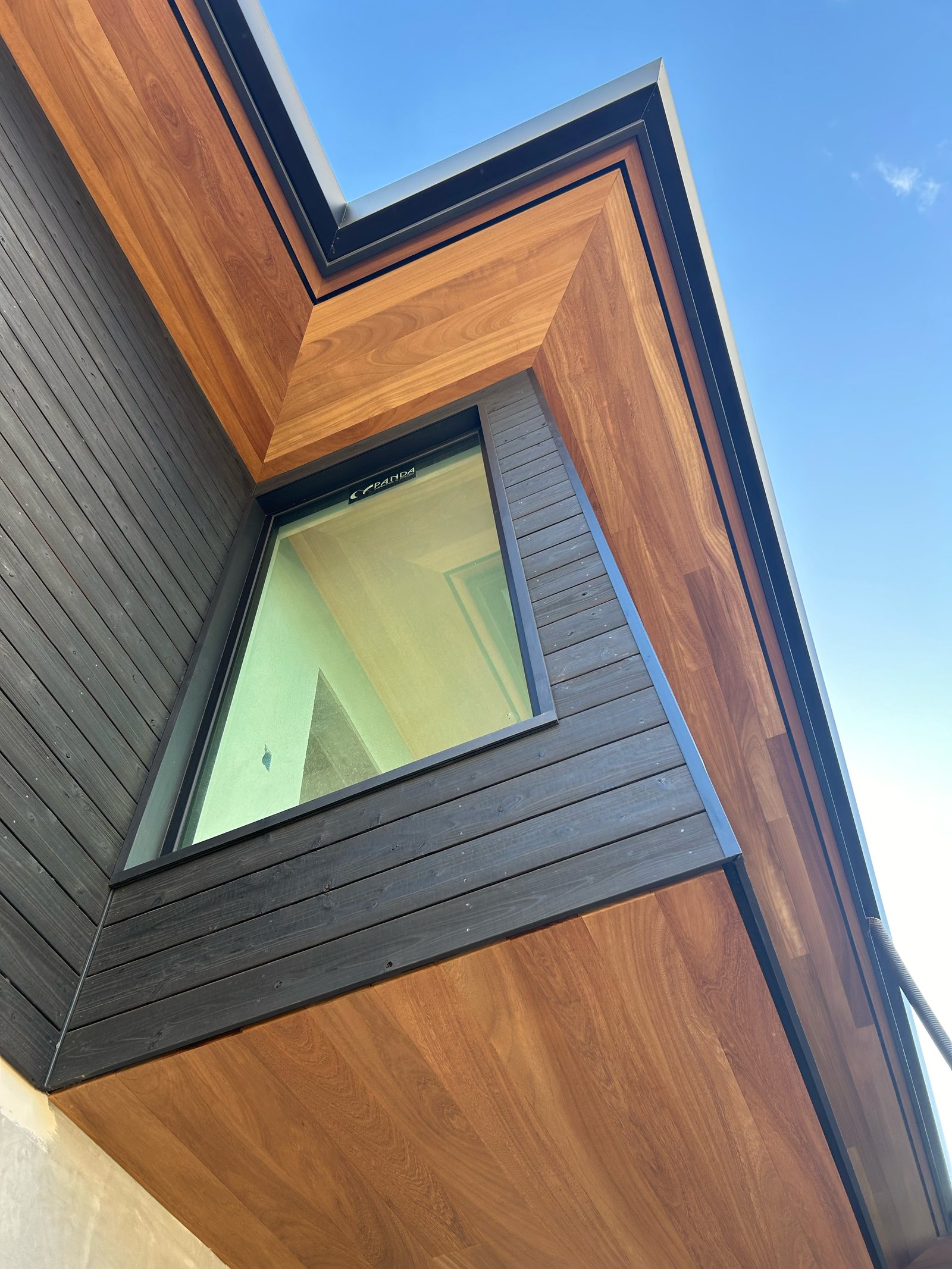
Four arguments for iroko survive a careful reviewer, and all four can be evidenced instead of asserted. Decay resistance in exterior exposure is the first. Iroko has a long record outdoors in joinery and exterior trim work, and the species data a reviewer will check is public at the Wood Database entry for iroko. Point them to it rather than quoting a number from memory.
Dimensional behavior is the second, and it is the claim worth spending effort on. The honest version is not that iroko matches teak point for point. It is that the delivered material will arrive at an exterior moisture range near 12 to 16 percent, sawn to the orientation the detail needs, and that quartersawn and rift stock moves less across its width than plainsawn, which is what keeps a wide flat member flat. That argument is about the boards being shipped, and it can be checked with a meter on delivery.
Availability in the sizes the drawing calls for is the third, and a reviewer can test it in an afternoon. A substitution that solves a schedule problem and creates a sizing problem is not a substitution. J. Gibson McIlvain stocks over seven million board feet of exotic and domestic lumber in Maryland, which is why a request can state the lengths and widths available before the reviewer asks for them rather than after.
Documentation is the fourth. A request that arrives with chain of custody already answered removes an objection the reviewer has not yet raised. J. Gibson McIlvain ships as an FSC certified importer and miller, and the due care expectations behind that paperwork are laid out plainly by the Forest Legality Initiative. Where a specification carries sourcing requirements, that page of the request often gets read first.
Claims That Will Not Survive Review
The fastest way to lose a substitution is to overclaim equivalence. Iroko is not teak. It is a different species with its own color, its own interlocked grain and its own way of taking a finish. A request that calls the two interchangeable invites the reviewer to find the one place where they are not, and there is always one place.
Color is where overclaiming usually starts. Iroko runs a yellow brown when fresh and settles darker with light exposure. Teak runs honey brown and moves toward gray outdoors. Those are two trajectories, and the request should show them as two, with samples, instead of smoothing the difference into a phrase like close visual match.
Warranty language is the second trap. There is no warranty on solid unmodified wood of any species, teak or iroko, because an organic material responding to its environment cannot be warranted. Modified products are the exception. Accoya, acetylated and running near 1,600 lbf on the Janka scale with dramatically reduced shrinkage and swelling, does carry a warranty, and so does Abodo Vulcan. Modified stock tops out around 16 ft, with most sold on metric lengths just under 16 ft because of kiln size, so a reviewer who wants a warranty on a long single run has to accept a joint.
Hardness is the third. Janka numbers get quoted in substitution requests constantly, and they measure surface indentation rather than exterior durability or stability. If a figure belongs in the request at all, cite it to a source the reviewer can open, such as the Wood Database entry for teak, and do not build the durability argument on it.
What the Request Package Has to Carry
A substitution request that gets approved is mostly material and paperwork, not argument. Two sample boards. One finish sample under the coating schedule actually specified, or an uncoated sample where nothing is going on the wood. A statement of delivered moisture content and sawing orientation. The lengths and widths confirmed available. A marked set of the affected details. That package is short, and it is far harder to reject than three paragraphs of prose.
The samples have to come off the lots that would actually ship, and this matters more on the teak side than most buyers expect. Plantation teak grown on a rotation does not deliver the uniform heartwood color a reviewer is carrying in their head from an older sample board, so the comparison worth submitting is delivered iroko against delivered Indian plantation teak rather than iroko against a memory. J. Gibson McIlvain pulls sample boards from the specific lot under discussion and records which lot they came from.
The finish mock-up is the piece most often skipped and most often decisive. Two species under the same coating schedule do not land in the same place, and a reviewer who has seen the panel stops arguing about adjectives. Build it at a size large enough to read from the distance the element is actually seen from, not at sample chip size.
One more line belongs in the request, stated plainly. Cupping on an exterior board is driven by installation and back ventilation rather than by the species on the drawing, so the detail that lets the back of the board dry is part of the substitution conversation and belongs with the installing contractor rather than with the mill. The physics behind that is well covered by Building Science Corporation, and citing it keeps the discussion off species blame.
Component by Component on an Exterior Elevation
Substitution difficulty is a property of the component, not of the project. The same iroko request can be routine on one line of the elevation and a waste of everyone's week on another. Sort the scope before writing anything, because a request that covers the easy components and the hard ones together gets rejected as a single unit.
| Exterior component | Substitution outlook | What the request has to carry |
|---|---|---|
| Concealed blocking and subframing | Straightforward | Species identity and delivered moisture content. The component is never seen and the reviewer is protecting decay resistance only. |
| Fascia, frieze and trim on a coated elevation | Straightforward | Finish mock-up under the specified coating, plus sawing orientation called out on members over 6 inches wide. |
| Louver blades and vent frames | Straightforward | Blade thickness available in the length the opening needs, and moisture content at delivery. |
| Screens, slats and brise soleil runs | Conditional | A single lot for the whole run, because color variation reads hard across repeated members seen against sky. |
| Door and window frames, jambs and units | Conditional | Shop drawings from the millwork house, a finished unit mock-up, and agreement on how concealed edges are treated. |
| Benches, seating slats and uncoated horizontals | Conditional | A weathered sample of each species, since the owner is buying the year-three appearance rather than the delivered one. |
| Deck boards and stair treads in an uncoated field | Conditional | Thickness and length availability, plus a written note that uncoated iroko and uncoated teak gray at different rates. |
| Repair or extension of existing teak work | Not worth proposing | Nothing. This is a matching problem, and the answer is teak or a redesign of the whole run. |
Two rows carry most of the approvals. Concealed work and coated trim are where a reviewer has the least exposure, and a request confined to them often comes back signed without a meeting. The conditional rows are winnable, but each one costs a mock-up and a week.
Where a Partial Substitution Clears Faster
Splitting the request is the most effective move available and almost nobody makes it. A whole elevation substitution asks the reviewer to accept every risk at once. A partial substitution asks them to accept the risks they can see are small, keeps teak where the eye lands, and usually closes in days rather than weeks.
The split that works best follows sightlines. Keep teak on the components a person stands next to or touches, meaning entry surrounds, rails and anything at eye level on the primary elevation. Move iroko into the secondary elevations, the high trim, the service side and everything concealed. The owner sees no change where they look, and the schedule gets its relief where it matters to the buyer.
There is a second split worth knowing. Coated components are easier to substitute than uncoated ones, since a film finish takes the color argument off the table entirely and leaves only movement and decay resistance, both of which are evidenced on paper. Where the schedule calls for a clear or oiled finish, the color argument comes straight back and the mock-up is not optional.
Elevations Where No Substitution Should Be Offered
Some teak callouts should be bought as teak, and proposing around them costs credibility the next request will need. Matching existing teak on the same building is the clearest case. A repair, an extension or a phase two addition to a run already standing is a matching exercise, and a second species in the same plane reads as a mistake no matter how well it performs.
Historic work is the second case. Where a review board or a preservation authority has already approved a species, that approval is the specification, and the substitution path runs through the board rather than through the architect. The National Park Service Technical Preservation Services standards govern how like for like replacement gets judged, and a buyer who proposes a different species into that process has started a different and much longer conversation.
The third case is the simplest. If the owner asked for teak by name and was shown teak, the species is a preference rather than a performance requirement, and preferences do not get argued out of people with technical documents. Quote the teak, state the lead time honestly, and spend the effort on scheduling the lot instead.
Timing the Request Against Production
A substitution raised after production starts is a schedule argument wearing a technical costume. The window is before the lot is committed, before shop drawings are released and before a finish mock-up has been approved on the original species. Inside that window the request is about material. Outside it, the reviewer is being asked to absorb somebody else's lateness and will read the request that way.
Sequence it deliberately. Confirm availability and lengths in both species first. Pull samples second. Build the finish panel third. Submit fourth, with the lead time difference stated as a date rather than as a vague number of weeks. J. Gibson McIlvain mills the samples for both species to the same thickness and the same exterior moisture range so the reviewer is comparing material rather than preparation.
"The requests that get approved show up with two boards and a finish panel, not with three paragraphs. I can put an iroko board and a teak board from the lots we would actually ship on the same pallet, and the argument about which one looks right ends in about a minute."
Norm Moton, Director of Sales, J. Gibson McIlvain
Keep the approval in writing once it comes. A verbal yes in a coordination meeting does not survive a change of project architect, and the document that settles the question later is the signed substitution page with the samples referenced on it.
Write the approval to cover the phases the job actually has. An approval granted for one elevation does not automatically reach the second building, the later addition or the repair stock bought three years on, and a reviewer who signed iroko for the service side will reasonably ask the question again when it turns up somewhere else. Name the scope the approval covers, say whether later phases are included, and have the lot recorded against the approval so a second pull can be matched to the samples the reviewer actually held.
How J. Gibson McIlvain Would Specify This
Write the substitution so the reviewer has nothing left to ask. Call out both species by botanical name, Tectona grandis for teak and Milicia excelsa for iroko, so nobody is trading on a trade name. Where the teak is plantation material, write Indian plantation teak rather than plantation teak, because the origin is part of what the reviewer is approving.
State the delivered condition rather than the published averages. Specify exterior moisture content near 12 to 16 percent at delivery, name quartersawn or rift stock on any wide flat member that has to stay flat, and confirm the maximum lengths available in the species being proposed before the detail gets drawn around a length nobody can supply. J. Gibson McIlvain stocks both species at the Maryland yard and sorts a lot for a specific run rather than shipping whatever comes off the top of the pile.
Where the substitution touches a manufactured unit rather than a stock profile, route it through the shop early. ICD, the architectural millwork division of J. Gibson McIlvain, builds true custom work planned around a specific opening, including exterior millwork where a species change affects joinery and not only appearance. Shop drawings on the substituted species are worth more to a reviewer than any argument made without them.
Finally, put nothing in the request that cannot be backed. No warranty on solid wood. No claim that two species weather alike. No hardness figure standing in for durability. J. Gibson McIlvain delivers approved material nationwide, including regularly to California, and holds the documentation that travels with it. To confirm lengths in both species, or to request sample boards off a current lot, call 800-638-9100 or start with the J. Gibson McIlvain millwork services page.
Frequently Asked Questions
Can a contractor substitute iroko for teak without the architect signing off?
No. A species named on an approved exterior drawing is part of the specification, and changing it is a substitution submittal that the architect of record, and often the owner's representative, has to approve in writing. A verbal agreement in a coordination meeting does not protect anyone later, because the project record is what gets opened if an element moves, checks or discolors years after handover. Make the request on paper, attach the samples, and keep the signed approval with the submittal log.
What belongs in the substitution request itself?
Two sample boards off the lots that would actually ship, a finish sample under the coating schedule specified, or an uncoated sample where nothing is going on the wood, a statement of delivered moisture content and sawing orientation, confirmed lengths and widths, chain of custody documentation, and a marked set of the affected details. Keep the written argument short. Reviewers reject prose and approve evidence, and a package that answers the questions before they are asked moves faster than one built around claims.
Will iroko and teak weather to the same color if both are left uncoated?
They both go gray outdoors, but they do not travel there on the same path or at the same rate. Iroko starts yellow brown and darkens with light exposure before it grays. Teak starts honey brown and silvers more evenly. Where the owner is buying the year-three appearance rather than the delivered appearance, submit a weathered sample of each species rather than a fresh one, because a fresh pair of boards answers the wrong question.
Can we get a warranty on iroko if the substitution is approved?
No, and the same answer applies to teak. Solid unmodified wood cannot be warranted because it is an organic material responding to its environment. Warranties exist on modified products only, such as Accoya and Abodo Vulcan. If a reviewer is holding out for a warranty, the conversation has to move to a modified product, which brings its own constraint. Modified stock tops out around 16 ft, with most sold on metric lengths just under 16 ft because of kiln size.
Is imported teak graded FAS the way domestic hardwood is?
No. FAS, F1F, Selects and No. 1 Common are National Hardwood Lumber Association grades written for North American hardwood. Imported teak arrives against export grades and against the written description on the purchase order. A substitution request that argues grade equivalence between the two species is citing rules that do not govern the material, which is an easy thing for a reviewer to catch and a fast way to lose the rest of the page.
Where does a partial substitution make the most sense on an exterior elevation?
Follow sightlines. Keep teak on what a person stands beside or touches, meaning entry surrounds, rails and primary elevation work at eye level, and move iroko into concealed blocking, high trim, secondary elevations and the service side. Coated components are easier to approve than uncoated ones, since a film finish removes the color argument and leaves only movement and decay resistance, both of which can be evidenced on paper rather than argued in a meeting.
What if the reviewer rejects the substitution outright?
Buy the teak and manage the schedule instead of relitigating the species. That is the right answer whenever the callout exists to match an existing run on the same building, whenever a preservation authority has already approved the species, and whenever the owner asked for teak by name and was shown teak. Confirm lengths and widths early, commit the lot, and put the effort into delivery sequencing. To check current availability in either species, call 800-638-9100.
Sources and Standards Referenced
- Architectural Woodwork Institute standards and submittal practice
- National Hardwood Lumber Association grading rules
- Forest Stewardship Council
- Forest Legality Initiative, due care and documentation
- The Wood Database, Iroko
- The Wood Database, Teak
- National Park Service Technical Preservation Services
- Building Science Corporation
- Accoya acetylated wood