Close on Performance, Different on Price
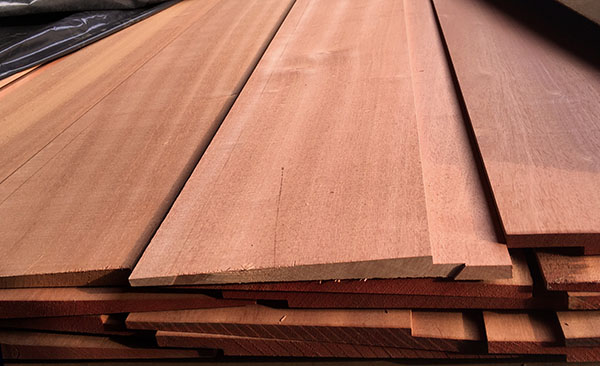
Ipe and Cumaru sit in the same top tier of decking performance, so the price difference is not a performance gap; it is a market and material gap. Ipe carries a Janka hardness near 3,680 lbf and Cumaru near 3,540 lbf; both are Class 1 durable under EN 350 and reach ASTM E84 Class A flame spread without treatment, as documented by the USDA Forest Products Laboratory. In service both build a multi-decade deck. So the cost difference comes from the factors below, not from one being far more durable. For the head-to-head, see our Ipe vs. Cumaru guide.
What Actually Drives the Cost Difference
The per-foot cost gap between Ipe and Cumaru is driven by availability and import volume, market demand and reputation, grading and color sorting, and workability, not by durability.
- Availability and demand: Ipe is the most requested tropical decking by name, and its premium reputation supports a higher price; Cumaru is the value alternative, so it trades below Ipe.
- Color uniformity: Ipe runs more uniform in color, while Cumaru varies more and must be color-sorted to look consistent, which affects how it is graded and priced.
- Density and yield: both are dense, but subtle differences in how each mills and yields clear decking influence cost.
- Workability: Cumaru's interlocked grain requires more care to work, which is a jobsite consideration more than a material-cost one.
| Factor | Ipe | Cumaru |
|---|---|---|
| Janka hardness | ~3,680 lbf | ~3,540 lbf |
| Durability (EN 350) | Class 1 | Class 1 |
| Fire (ASTM E84) | Class A | Class A |
| Color | More uniform, olive-brown | More variation, tan to red-brown |
| Relative cost per foot | Higher | Lower |
| Service life | 40 to 75 years | 30+ years |
What the Ipe Premium Buys
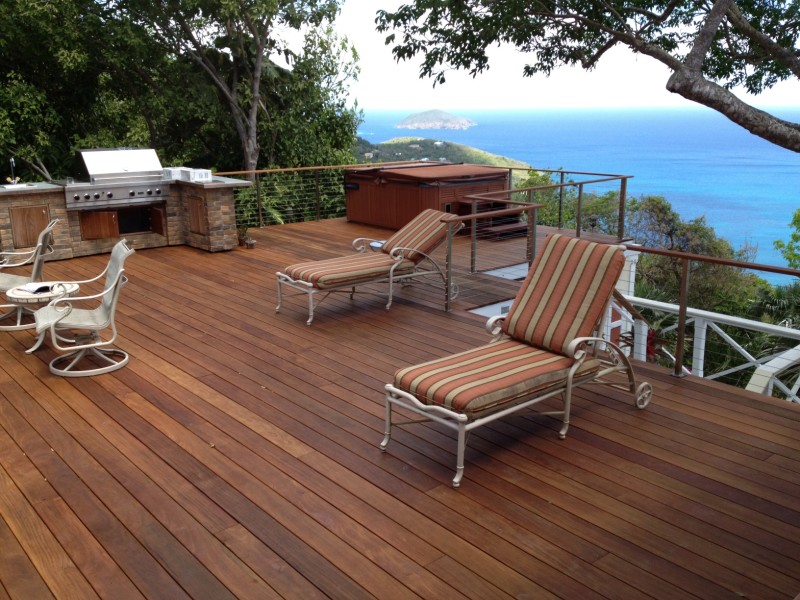
The Ipe premium buys marginally higher hardness, a longer expected service life, more uniform color, and the market recognition of the name, not a categorical performance advantage over Cumaru. Ipe's 40 to 75 year service life edges Cumaru's 30-plus years, and its color uniformity means less reliance on sorting. For a signature deck where those margins and the Ipe name matter, the premium is worth it. For a project that wants tropical-hardwood durability at a lower cost, Cumaru captures most of the performance for less. The choice is a value judgment, not a durability one.
Cost Is Also About How You Order
Beyond the species, the installed per-foot cost is shaped by grade, lengths, waste, and whether the order is optimized to a cut list, which a deep supplier does to minimize the waste of premium material. Coverage is figured from actual board width plus gap, so a 5/4x6 board covering about 5-1/2 inches plus a 3/16 inch gap yields roughly 2.1 linear feet per square foot, per NHLA measurement rules. Ordering to a cut list tightens the waste factor and reduces jointing, which affects the delivered cost as much as the species choice. For estimating, see our board feet guide.
Supply, Volume, and How a Deep Supplier Levels the Cost
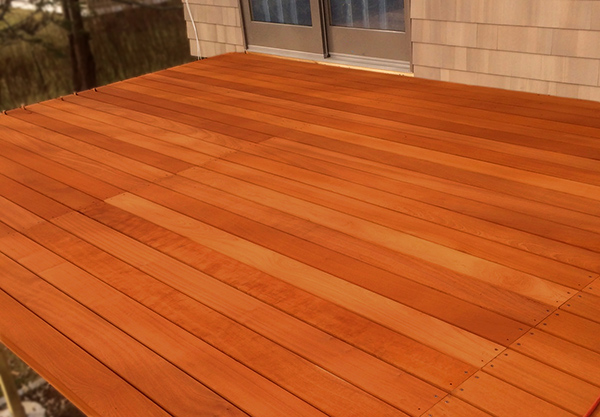
Both Ipe and Cumaru are imported tropical hardwoods, so availability, import volume, and a supplier's inventory depth shape the delivered per-foot cost as much as the species itself. A shallow yard buying small lots pays more and passes it on, and cannot fill a large order in matched material without substitution, which drives hidden cost in waste and mismatch. A deep supplier that imports in volume and grades to one standard delivers consistent material more efficiently on either species. Legal-sourcing documentation, FSC chain-of-custody per the Forest Stewardship Council, is part of a responsible import and does not meaningfully change the relative gap between the two species.
Installed cost also depends on the substructure and fastening the deck requires. The American Wood Council publishes the joist-span and fastener basis, and both dense species are pre-drilled or pre-grooved and fastened with stainless, so the install labor is similar between them. The species choice, then, mostly affects the material line, while the supplier's depth and the order's optimization affect the delivered total. J. Gibson McIlvain imports both in volume and optimizes the order to a cut list.
Why Ipe Commands the Premium in the Market
Ipe carries a market premium over Cumaru mainly because it is the tropical decking most requested by name, which sustains demand and, with it, price, independent of any large performance gap. Decades of specification have made Ipe the default reference for premium hardwood decking, so architects, builders, and homeowners ask for it specifically. That name recognition is itself a price driver, in the same way any established premium brand commands more than an equivalent alternative. Cumaru, close on the measurable properties documented by the USDA Forest Products Laboratory, trades as the value option precisely because it is the alternative rather than the headline.
Color uniformity reinforces the premium: Ipe runs more consistent in tone, so it needs less sorting to look uniform, while Cumaru's wider color range requires the supplier to sort. That extra step, and the perception of Ipe as the more refined surface, supports its position at the top of the market. None of this reflects Cumaru being a lesser wood; it reflects Ipe's established demand and uniformity, which is why the gap is a market gap rather than a durability one.
Grade and Consistency Affect What You Pay For
Within either species, grade and consistency shape the relative cost, because a tightly graded, color-sorted, kiln-dried order costs more to produce than an unsorted one, and that shows up in the delivered material. A supplier that grades to a tight band, sorts for color, and dries to a stated moisture content near 12 to 16 percent is doing more work than one that ships whatever a lot holds, and that work is part of what a premium order reflects. The National Hardwood Lumber Association framework defines the grades this work builds on.
This matters when comparing Ipe and Cumaru because an unsorted Cumaru order can look inexpensive next to a graded Ipe one, but the two are not the same product: the sorted, graded order is what produces a deck that reads as one surface. So part of any per-foot comparison is confirming that both are quoted at a comparable grade and consistency, not comparing a sorted premium order against unsorted stock. A deep supplier grades both species to a consistent standard, which is the fair basis for comparison.
"People ask what the price difference is between Ipe and Cumaru, and the real answer is why there is one. It is not that Cumaru is a big step down, it is right there on hardness and durability. Ipe costs more because it is the name everyone asks for, it runs more uniform in color, and it lasts a touch longer. If you want the Ipe look and the Ipe name, pay for it. If you want a tropical hardwood deck that lasts and saves money, Cumaru is the call. For today's numbers, ask us for a quote."
Camden Zacker, Sales Director, J. Gibson McIlvain Company
How J. Gibson McIlvain Would Frame the Choice
For J. Gibson McIlvain, the Ipe-versus-Cumaru cost question is framed around value rather than a headline number. The team explains that both are top-tier tropical hardwoods, so the premium on Ipe pays for uniformity, a slightly longer life, and the name, while Cumaru delivers most of the performance for less. Because the company stocks both, kiln-dried and graded, a buyer can compare them directly and decide where the premium is worth it, with a quote for current figures.
The team also notes that how the order is built, grade, lengths, and cut-list optimization, shapes the installed cost as much as the species, which is why a deep supplier that optimizes the order adds value on either choice.
Ipe-or-Cumaru Decision Checklist
| If you want... | Choose |
|---|---|
| Longest life and most uniform color | Ipe |
| The recognized premium name | Ipe |
| Near-Ipe performance for less | Cumaru |
| A warmer, redder tone | Cumaru |
| Consistent color from either | Color-sorted stock from a deep supplier |
Where the Cost Comparison Misleads
- Reading the gap as a quality gap: Both are Class 1 durable; the difference is mostly market.
- Ignoring color sorting: Unsorted Cumaru looks cheaper for a reason; sorted, it is consistent.
- Comparing by rough footage: Order to a cut list to compare true installed cost.
- Overlooking service life: Ipe's longer life factors into lifetime value.
Ordering Information to Resolve Before Pricing
- Species: Ipe or Cumaru, with a quote for current figures.
- Grade and color: sorting requirements for a consistent deck.
- Cut list: dimensions and lengths to compare true installed cost.
- Profile: square-edge or pre-grooved for hidden fasteners.
- Logistics: total square footage, delivery, lead time.
Related J. Gibson McIlvain Guidance and Next Steps
Frequently Asked Questions
Why does Ipe cost more than Cumaru?
Ipe costs more than Cumaru per linear foot mainly because of market factors, not durability: Ipe is the most-requested tropical decking by name, it runs more uniform in color, and it has a slightly longer service life and higher hardness. Both are Class 1 durable, Class A fire-rated hardwoods, so the premium pays for uniformity, longevity, and reputation rather than a categorical performance jump. J. Gibson McIlvain stocks both and can quote current figures for a direct comparison.
Is Cumaru decking cheaper than Ipe?
Yes, Cumaru generally costs less than Ipe per linear foot while delivering close performance: a Janka hardness near 3,540 lbf versus Ipe's 3,680, the same Class 1 durability, and the same Class A fire rating. Cumaru is the value alternative, trading below Ipe because Ipe carries a premium reputation and more uniform color. For a tropical hardwood deck that lasts at a lower cost, Cumaru is the practical choice. J. Gibson McIlvain stocks both for a direct comparison.
Is the price difference between Ipe and Cumaru worth it?
It depends on what you value. The Ipe premium buys marginally higher hardness, a longer 40-to-75-year service life versus Cumaru's 30-plus years, more uniform color, and the recognized name, not a categorical performance advantage. For a signature deck where those margins matter, the premium is worth it; for value, Cumaru captures most of the performance for less. J. Gibson McIlvain stocks both, kiln-dried and graded, so buyers can decide with a quote for current figures.
Do Ipe and Cumaru perform differently on a deck?
Not dramatically. Both are top-tier tropical hardwoods: Class 1 durable under EN 350, Class A fire-rated under ASTM E84, and very hard (Ipe ~3,680 lbf, Cumaru ~3,540 lbf). Ipe edges Cumaru slightly on hardness, color uniformity, and service life, while Cumaru is warmer in tone and varies more in color. Both build a multi-decade deck. The cost difference reflects market and uniformity factors more than performance. J. Gibson McIlvain stocks both graded and kiln-dried.
How do I compare the true installed cost of Ipe and Cumaru?
Compare true installed cost by ordering each to a measured cut list rather than a rough footage number, since coverage, lengths, waste, and grade all shape the delivered per-foot cost. A 5/4x6 board covers about 2.1 linear feet per square foot after the gap. Ordering to a cut list tightens the waste factor and reduces jointing on either species. J. Gibson McIlvain optimizes the order to a cut list and quotes current figures so the comparison is accurate.
Does buying in volume change the Ipe or Cumaru price?
Yes. Both are imported tropical hardwoods, so a supplier's import volume and inventory depth shape the delivered per-foot cost: a deep supplier that buys in volume and grades to one standard delivers consistent material more efficiently and can fill a large order without the waste and mismatch of piecing it from small lots. This affects both species similarly, so it does not change which is cheaper, but it does affect the delivered total. J. Gibson McIlvain imports both in volume.
Is the installation cost different for Ipe versus Cumaru?
Installation cost is similar between Ipe and Cumaru because both are dense tropical hardwoods that must be pre-drilled or pre-grooved and fastened with stainless steel over a properly sized substructure, following the American Wood Council span and fastener basis. The species choice mostly affects the material line rather than the labor. So the per-foot difference people ask about is largely a material and market difference. J. Gibson McIlvain supplies both and advises on the shared install requirements.