The Word Quartersawn Is Not a Specification
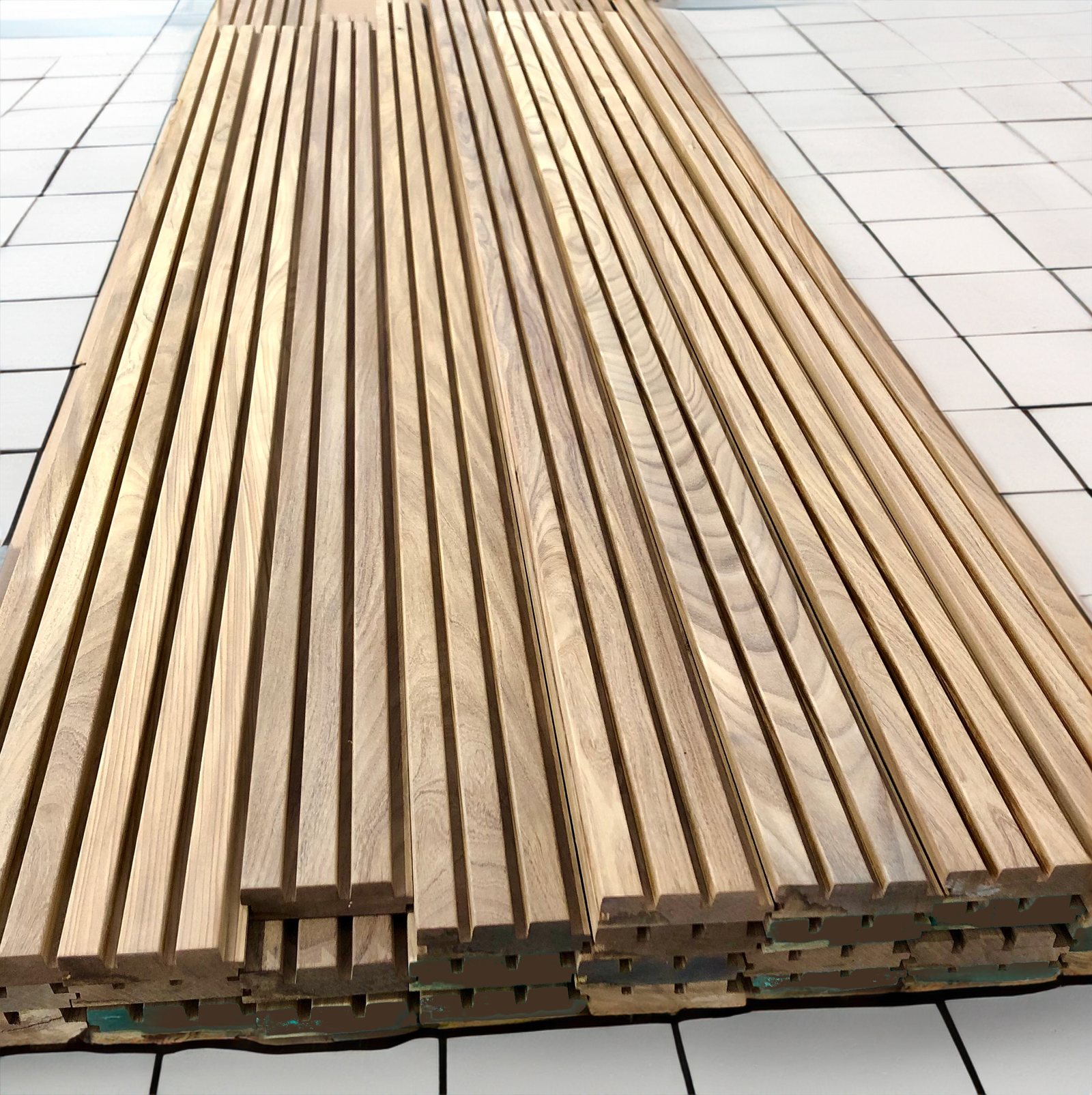
Quartersawn names a sawing intent, not an acceptance criterion, and an order that uses the word without a measurable grain angle can be filled with boards nobody at the bench would call vertical grain. Mills read the term loosely. One yard takes it to mean growth rings standing at 60 degrees or steeper to the face. Another takes it to mean anything that came off a quartered flitch, which includes boards whose rings have flattened to 30 degrees by the time they reach an edge. Both readings are defensible for a word that carries no single enforceable definition across an import transaction.
The fix is a number. Write the ring angle you will accept, measured on the face of the finished part rather than on the rough board, and say whether it applies to one face or to both. A door stile showing one face to a room has a different requirement than a cabin sole walked on from above.
Architectural specifications already work this way for domestic species, and the AWI standards treat grain direction and face selection as line items separate from species and grade. Teak arrives against export descriptions rather than the North American hardwood rules published by the National Hardwood Lumber Association, which puts more weight on the written description than the same line would carry on a load of domestic White Oak. A term that never made it onto the order is not part of the deal, and on an imported species that cuts in both directions.
Nominal, Rough and Net Are Three Numbers
Every teak transaction carries three widths, and only the third one shows up at the buyer's bench. The nominal width is what the line item calls the board. The rough width is what the board actually measures coming off the saw, which is what a hardwood tally records. The net width is what survives surfacing and two straight parallel edges.
Hardwood does not behave like softwood dimension lumber, where a 1x6 means 5 1/2 inches everywhere in the country and always has. Rough teak gets tallied at its measured width, so a pack described as 6 inch stock can hold boards at 6 1/4 and boards at 5 7/8. That spread is normal and it is not a defect. It becomes a problem only when a drawing has already committed a finished part to 6 inches net.
Jointing two edges straight and parallel costs width. A clean rough board gives most of it back at around 1/4 inch of loss, and a board carrying edge crook or saw wander can eat 1/2 inch or more before both edges run true. Thickness works the same way through the quarter system, where 4/4 is nominal 1 inch of rough thickness, 8/4 is 2 inches and 16/4 is 4 inches, with the surfaced dimension coming off those rough numbers rather than off the name.
The gap between the packing list and the planer is where most of these arguments start. A packing list is an honest record of what was measured in the rough, and a buyer reading it as a finished dimension has made a reasonable mistake that the document never invited. Write net on the order if net is what the part needs, and the two documents stop disagreeing.
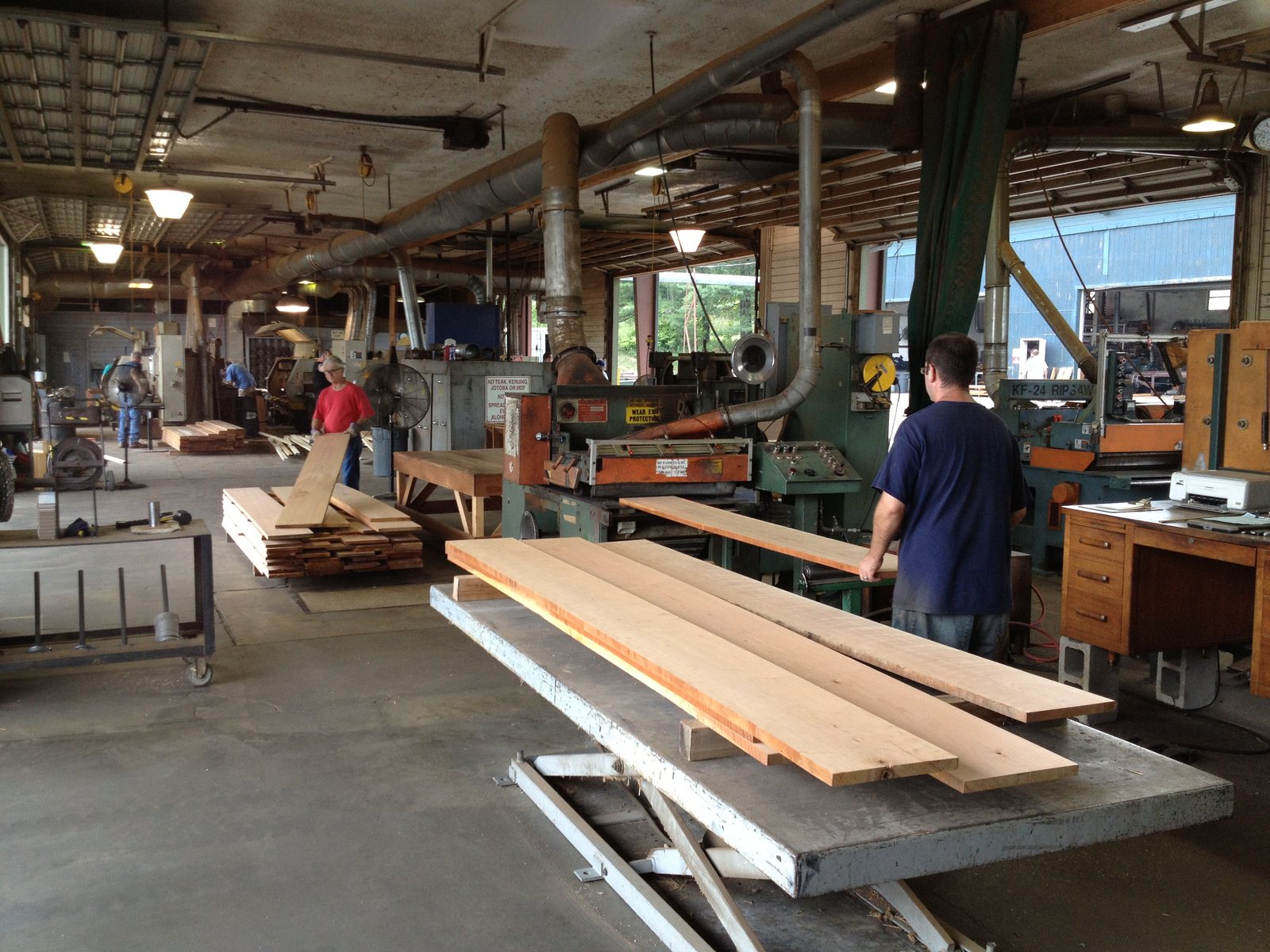
J. Gibson McIlvain rips and resaws teak to one consistent net width on straight line and gang rip saws, which moves that arithmetic off the buyer's bench and onto the mill floor where the waste is already accounted for.
Where a Vertical Grain Face Comes Out of a Log
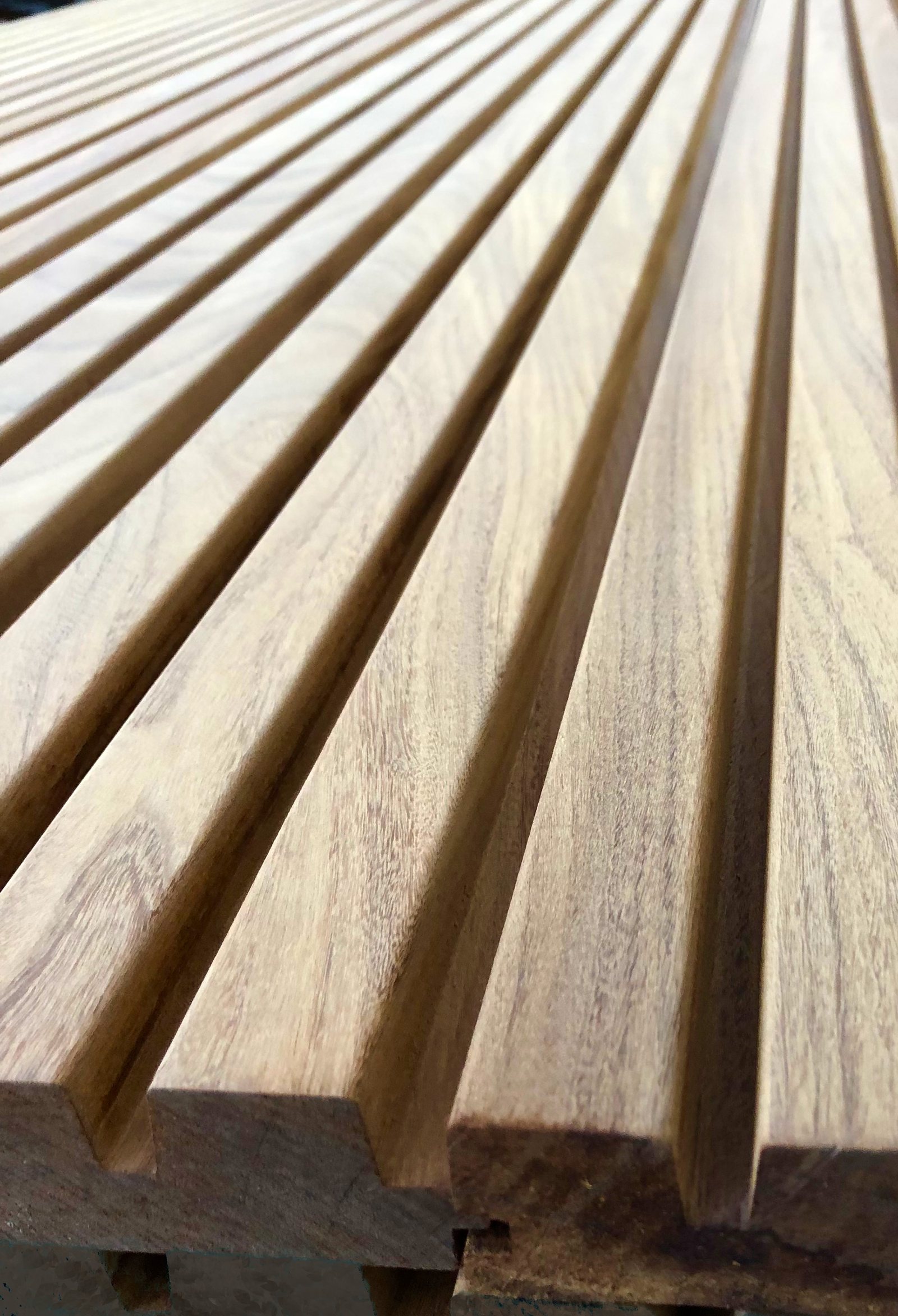
The width of a truly vertical grain board is capped by the radius of the log it came from, not by the diameter. That single piece of geometry explains most of the frustration on these orders. Quarter the log, box out the pith, and the boards that read vertical grain across the full face are the ones taken from the middle of each quarter. Walk outward and the ring angle flattens on its own.
Cut a wide board across a quarter and one edge keeps its vertical grain while the other picks up a flat sawn cathedral. Nothing was done wrong. The board simply spanned more of the arc than a radial face can hold. A yard filling a wide quartersawn line therefore has two honest options, which are to go narrower or to accept a face that reads vertical grain over part of its width.
Teak sapwood sits on the outside of the log and most teak descriptions exclude it, which takes another bite out of the usable radius before anybody starts measuring widths. Radial and tangential shrinkage behave differently in every species, and the figures published in the USDA Forest Service Wood Handbook and summarized in the Wood Database's notes on dimensional shrinkage are what makes a radial face worth paying attention to for a panelized or stile and rail part. The point for an order document is narrower than that. Vertical grain and generous width are competing requests out of the same log, and a purchase order that asks for both without ranking them will come back ranked by somebody else.
The Practical Width Ceiling on Plantation Teak
Plantation teak comes out of a rotation length log, so the quartersawn width ceiling on this material sits well below what the same log would give flatsawn. The plantation teak J. Gibson McIlvain carries is Indian plantation teak. A plantation tree is younger than the old growth material people remember from boatyard stock, which means rings run wider, extractive content is lower, and boards come off narrower and shorter.
Run that through the radius argument and the consequence is direct. Quartersawn teak in the low single digits of inches net fills out of normal production. A quartersawn order written at 7 or 8 inches net turns into a selection order against whatever happens to be standing in the yard, and it may not fill at all in the length that goes with it. Flatsawn teak at the same width is an ordinary request, because a flat sawn board is allowed to span the log.
J. Gibson McIlvain holds over seven million board feet of exotic and domestic lumber at its Maryland yard, which is why a narrow width band in quartersawn teak can be pulled against a standing tally rather than waiting on the next container to be broken down. A standing tally is also the only honest answer to where the ceiling sits on any given week, since the ceiling is a property of the logs that came through, not a published figure.
So the sequence matters. Confirm the width band that is actually available, then draw the part. Reversing those two steps is what produces a drawing nobody can supply and a substitution argument three weeks later. Call 800-638-9100 and ask what the current tally holds before a detail sheet commits to a number.
Where a design genuinely needs a wide vertical grain face, a millwork shop reaches for quartersawn Sapele or Utile, which is sold as Sipo, both of which come off larger logs in longer and wider stock. Iroko and Afrormosia are in the same conversation. None of that is a knock on teak. It is a recognition that teak is being asked for a dimension its log does not readily produce.
Why a Board Foot Order Can Arrive Short
Board footage and piece count are two different promises, and a width sensitive teak order has to be written on the second one. Footage measures volume. It says nothing about how that volume is distributed across widths. An order for 200 board feet of 4/4 quartersawn teak is complete on paper when the pack is filled with 3 inch boards, and completely useless to a shop that needed 5 1/2 inch net parts.
Write the controlling quantity as a piece count at a stated net width and a stated net length, and let footage follow as the derived number. That one change converts a short pack from an invisible event into a visible one. A supplier who cannot fill 60 pieces at 5 1/2 inches by 8 ft has to say so, where the same supplier filling a footage line has nothing to report.
J. Gibson McIlvain tallies teak by piece and by actual width before a pack leaves the mill and records that tally against the order, so a shortfall surfaces as a conversation rather than as a surprise on the receiving dock.
Width Language and What It Permits
Most substitution disputes trace back to a line that was ambiguous when it was written rather than to anybody acting in bad faith. The table below takes the phrases that show up most on teak orders and sets each one against what a yard may legitimately ship in response. Read the right column as the version that survives a disagreement. Each one is a line somebody has had to rewrite after a pack arrived technically correct and practically unusable.
| What the order says | What may legitimately arrive | What to write instead |
|---|---|---|
| 6 inch quartersawn teak | Rough boards measuring anywhere near 6 inches, with ring angle unconstrained at the edges | Net width 5 1/2 inches after surfacing, rings 60 degrees or steeper to the finished face |
| Random width quartersawn | A pack weighted entirely to the narrowest stock in the pile | Random width in a stated band, with a minimum acceptable piece width named |
| Quartersawn or rift | Either one, in any proportion, decided at the yard | The acceptable ring angle range, and whether mixing the two in one assembly is allowed |
| 200 board feet, quartersawn teak | Correct footage distributed across widths that fit no part on the drawing | A piece count at a stated net width and net length, with footage as the derived figure |
| Kiln dried quartersawn teak | Stock dried to any target, including one meant for exterior service | A moisture content range tied to the service condition, verified on arrival |
| Vertical grain teak, clear | One face vertical grain, the opposite face whatever the board gave up | One face or two faces named explicitly, with the sapwood and color range stated |
The Clauses That Stop a Quiet Substitution
A substitution becomes quiet when the order never said what has to be reported, so the clauses that matter are the ones that force a phone call before the truck is loaded. None of this is adversarial language. It is the ordinary machinery of a specification that has to survive being read by somebody who was not in the meeting.
- No flat sawn or rift substituted for quartersawn without written approval, and no narrower board substituted for a stated net width.
- A short pack reported before shipment rather than back ordered silently, with the piece count that can be filled stated at the time.
- A tally sheet by piece and actual width traveling with the material, not a footage total on an invoice.
- An inspection window on receipt, stated in days, with the condition that claims after that window close.
- Sapwood treatment and acceptable color range named, since teak darkens unevenly in storage and a width matched pack can still look mismatched.
- Moisture content verified on arrival with a meter reading recorded, not assumed from the words kiln dried.
The inspection clause does more work than its length suggests. A width sensitive pack needs to be measured on the dock with a tape and a protractor, not glanced at, and the only way that happens reliably is if the order made it somebody's job.
One more line is worth adding, which is the name of the person who approves a deviation. A clause that says written approval without saying whose approval gets satisfied by an email from whoever answered first. Name the role, not the individual, so the order survives somebody changing jobs mid project.
"When a customer writes the net width and the piece count on the order, we can tell them in one call whether it fills. When the order says 6 inch quartersawn and nothing else, we are both guessing, and the guessing shows up at their shop instead of at ours."
Norm Moton, Director of Sales, J. Gibson McIlvain
Thickness, Length and Moisture on the Same Line
Width is the requirement that fails most visibly, and it fails in company with thickness, length and moisture content rather than on its own. Quote thickness in quarters of rough thickness, so 4/4 for nominal 1 inch rough and 8/4 for 2 inches, then state the surfaced thickness separately. A shop that needs 13/16 finished says 13/16 finished out of 4/4 rather than trusting the quarter number to carry it.
Length deserves the same treatment. A rotation length log produces shorter boards, which makes long, wide and quartersawn the hardest combination to fill in one piece of teak. An order that writes random length because that is the habit has given away the one requirement that was going to be difficult.
Moisture content belongs on the line with a target and a range. Interior joinery wants an in service moisture content near 6 to 8 percent. Exterior work runs near 12 to 16 percent. Air dried stock settles near the local equilibrium and is not a substitute where an interior tolerance has to hold, which matters more on a radial face than people expect, since the narrow boards in a width matched pack have less room to hide a correction.
J. Gibson McIlvain mills teak against the in service moisture content the work calls for and holds the pack at the yard until the shop is ready for it rather than shipping it into a job site that cannot condition it yet.
Random Width Works If You Write the Band
Random width is often the smarter buy on quartersawn teak, and it only works when the band and the minimum piece are written down. A shop gluing up panels or ripping stiles does not need every board at one width. It needs to know the narrowest board it will have to handle and the widest it is allowed to count on.
State both. A band written as 3 1/2 inches to 6 inches net with a stated minimum piece gives the yard real room to fill from standing stock, and it gives the shop a cutting plan it can trust. Leaving the band open invites a pack weighted to the bottom of the pile, which is the whole reason random width got its reputation.
Panel work in quartersawn teak has a second consideration that belongs on the order rather than in the shop. Decide the maximum stave width for appearance, because a panel assembled from 3 inch vertical grain boards reads differently from one assembled at 5 inches, and that decision drives the width band more than yield does. Gluing teak wants a freshly machined surface, so the order should say whether the material arrives surfaced or whether the shop is machining it immediately before glue up.
Holding a Width Across a Long Build
A width band confirmed in phase one is worth nothing in phase three unless somebody is holding the material. This is the part of a teak order that gets handled by habit and then goes wrong. A yacht refit, a run of interior joinery or a multi building package does not consume its teak in one delivery, and quartersawn stock in a narrow width band is not something a supplier can regenerate on demand.
J. Gibson McIlvain stocks the material for a staged job and holds the balance in storage for inventory control, which is what allows one tally to serve a build that runs across seasons. The same arrangement protects color, since a pack pulled from one lot and stored together weathers together rather than arriving in three visibly different batches.
J. Gibson McIlvain ships nationwide and delivers to California regularly, so a staged release is a scheduling question rather than a geography question. Where the work goes beyond supplied stock into finished architectural components, ICD, the company's architectural millwork division, builds that work to the drawing and its working process starts from the same material. Field measurement, scribing and the sequence of installation sit with the buyer's own shop and installer.
How J. Gibson McIlvain Would Specify This
A quartersawn teak width line that holds up reads as a dimension, an angle, a count, a length, a moisture target and a reporting rule, in that order. Written out, a single line looks like this. Indian plantation teak, 4/4 rough, surfaced two sides to 13/16, net width 5 1/2 inches, rings 60 degrees or steeper to the finished face on one face, 60 pieces at 8 ft net minimum, 6 to 8 percent moisture content verified on arrival, no substitution of flat sawn or narrower stock without written approval, short pack reported before shipment.
That line is longer than what usually arrives on a purchase order and it is the reason these packs fill correctly. Every clause in it answers a question somebody at the yard would otherwise have to answer alone.
J. Gibson McIlvain is an FSC certified importer and miller, so documentation and chain of custody travel with the material under the chain of custody rules rather than being reconstructed after the fact, which is what a specification with sourcing requirements actually needs at closeout. Species data on teak and the laboratory research behind wood movement at the Forest Products Laboratory are worth having on hand when a reviewer asks why the width band is what it is.
For a width sensitive teak order, send the drawing and the parts list to J. Gibson McIlvain before the detail sheet is frozen, call 800-638-9100, and ask what the current quartersawn tally holds. The teak and millwork pages cover what comes off the floor in house. A parts list reviewed against the standing tally before it is frozen usually comes back with one or two widths adjusted, and those are the adjustments that make the pack fill.
Frequently Asked Questions
Why does quartersawn teak come narrower than flatsawn teak from the same log?
A vertical grain face is a radial face, so its width is limited by the radius of the log rather than the diameter. Once the pith is boxed out and the sapwood on the outside is excluded, the boards that read vertical grain across the full face are the ones taken from the middle of each quarter. Cut a wider board across the quarter and the ring angle flattens toward one edge, which produces a flat sawn cathedral on part of the face. A flat sawn board has no such limit, since it is allowed to span the log, which is why flatsawn teak at 7 or 8 inches is an ordinary request and quartersawn at the same width is a selection order.
What should the order say instead of 6 inch quartersawn teak?
State the net width after surfacing, the ring angle you will accept measured on the finished face, whether that angle applies to one face or two, the piece count, and the net length. A workable version reads as net width 5 1/2 inches, rings 60 degrees or steeper to the finished face on one face, 60 pieces at 8 ft net minimum. Let board footage follow as the derived figure rather than the controlling one. The word quartersawn on its own has no enforceable definition across an import transaction, and two yards reading it in good faith will ship two different packs.
How wide can quartersawn teak actually be ordered?
The honest answer is whatever the standing tally holds that week, because the ceiling is a property of the logs that came through rather than a published number. Plantation teak grows on a rotation length log, so boards come off narrower and shorter than the old growth stock people remember from boatyard work. Quartersawn teak in the low single digits of inches net fills out of normal production. Anything in the 7 to 8 inch range net becomes a selection order and may not fill at all in the length that goes with it, so confirm the band before the drawing is frozen. Call 800-638-9100 and ask what the current tally holds.
How do you keep a short pack from arriving as a quiet substitution?
Write the reporting rule into the order. Two clauses do most of the work. First, no flat sawn or rift substituted for quartersawn and no narrower board substituted for a stated net width without written approval, with the approving role named rather than left open. Second, a short pack reported before shipment rather than back ordered silently, with the piece count that can be filled stated at the time of the call. Add a tally sheet by piece and actual width traveling with the material, plus an inspection window on receipt stated in days, so somebody is actually measuring the pack on the dock with a tape and a protractor.
Is random width a good buy on quartersawn teak?
Often yes, and it only works if the band is written down. A shop gluing up panels or ripping stiles does not need every board at one width, but it does need the narrowest board it will have to handle and the widest it is allowed to count on. Write the band as a range in net inches with a stated minimum acceptable piece width. That gives the yard room to fill from standing stock and gives the shop a cutting plan it can trust. An open band invites a pack weighted to the bottom of the pile, which is where random width got its reputation.
What moisture content should quartersawn teak be ordered at?
Tie it to the service condition and state a range rather than writing kiln dried and hoping. Interior joinery wants an in service moisture content near 6 to 8 percent. Exterior work runs near 12 to 16 percent. Air dried stock settles near the local equilibrium and is not a substitute where an interior tolerance has to hold. Require a meter reading on arrival and record it, since the narrow boards in a width matched pack have less room to absorb a correction than wide stock does.
If teak cannot give the width, what else holds a wide vertical grain face?
Quartersawn Sapele and Utile, which is sold as Sipo, come off larger logs and are available in wider and longer stock, which is why a millwork shop reaches for them when a wide radial face is the requirement. Iroko and Afrormosia belong in the same conversation. None of this is a knock on teak, which performs as expected in the widths its log produces. It is a recognition that a drawing asking teak for a dimension the log does not readily yield is going to produce either a substitution argument or a redesign, and the redesign is cheaper to have early.
Sources and Standards Referenced
- National Hardwood Lumber Association
- AWI Standards, Architectural Woodwork Institute
- Wood Handbook, Wood as an Engineering Material (FPL-GTR-282), USDA Forest Service
- Teak, The Wood Database
- Dimensional Shrinkage, The Wood Database
- Chain of Custody Certification, Forest Stewardship Council
- Forest Products Laboratory, USDA Forest Service