
An exterior hardwood bench fails at its water traps and its joints long before the slats wear out, so drainage geometry and joinery method decide how long the piece lasts.

Seating takes abuse that no other piece of exterior millwork sees. Rain lands on a horizontal surface and sits there. Leaves pack into slat gaps. People sit down wet, set drinks on the arm, drag the frame across stone. A pergola rafter sheds water in seconds. A bench seat holds it against a glued joint for hours.
That changes what a shop has to build. Every horizontal face wants a pitch or a crown. Every joint wants mechanical strength that does not rely on the adhesive line alone. Every downward-facing end grain wants to be off the ground and sealed. Get those three right and a bench in Sapele or Iroko will outlast the hardware holding it down. Get them wrong and the piece will look fine for two seasons, then open at the seat rail and start to check.
Custom exterior seating runs through ICD, the architectural millwork division of J. Gibson McIlvain, which builds true custom work planned around a specific space rather than adapted from a catalog module. Benches sit alongside gates, pergolas, railings, shutters and rafter tails on that side of the shop. The species, the section sizes and the profile work all come out of the same building.
Built-in and freestanding benches are two different structural problems, and the mounting condition drives the joinery before species ever enters the conversation.
A freestanding bench carries its own load path. Legs, stretchers, seat frame and slats have to resist racking on their own, which means the frame joints are structural. They see prying every time someone slides the bench or sits hard on one end. Through mortise and tenon, drawbored, is the traditional answer and still the right one. Loose tenon joinery machined to the same shoulder tolerance performs nearly as well when the section sizes allow it.
A built-in bench borrows structure from the wall, the planter, the deck framing or the railing it attaches to. The frame joints carry less, but a new failure mode shows up. Anywhere the bench meets a vertical surface there is a horizontal ledge, and that ledge collects water and debris against a wall assembly that was detailed to drain. The bench should never dam a drainage plane. Building Science Corporation's work on rain control in buildings is the right frame of reference for that junction, and the millwork has to be shaped so the water has somewhere to go.
Practically, that means the seat frame stands off the wall by a deliberate gap rather than scribing tight to it. The cleat or ledger is the buyer's fabricator or installer scope. What the shop supplies is the seat assembly, the aprons, the slats and any face frame or skirt, milled so the installer can hold it off the surface and still land a clean reveal.
Drainage on a bench is geometry, not finish, and it comes from slat width, gap width, edge easing and a deliberate pitch.

Slat width is the first decision. A seat made from a few wide boards will cup, because a wide plainsawn face moves more across its width than a narrow one and the top face dries faster than the underside. Splitting the same seat into narrower slats, roughly two and a half to three and a half inches of exposed face each, cuts the movement per piece and gives water a path down between them.
Gap width between slats wants to land around three eighths to one half of an inch. Tighter than that and leaf litter bridges the gap, holds moisture and turns into a wet mat sitting on end-grain-adjacent surfaces. Much wider and the seat gets uncomfortable and starts catching phones and keys.
Edges matter more than people expect. A sharp arris holds almost no film finish, so paint and clear coats fail there first, and a sharp corner on a seat slat is also the first thing to dent. A small chamfer or an eighth-inch easing on every exposed edge sheds water and gives the coating something to hold. On the underside of aprons and skirts, a shallow drip kerf run a quarter inch in from the outer face stops water from tracking back along the bottom and into the joint.
Pitch is the last piece. An eighth of an inch of crown across the seat width, or a degree or two of fall to the front, is enough to move standing water without being noticeable to anyone sitting on it. Back slats leaned back ten to fifteen degrees run water down the back face, so the same gap and easing rules apply to them.
Exterior bench joinery has to hold when the wood is swollen and again when it has shrunk, which rules out glue-dependent details and rewards mechanical locking.
Interior furniture joinery assumes a stable moisture content. Exterior work does not get that. A seat frame cycles through wet and dry repeatedly every season, and every cycle works the glue line. The joints that survive are the ones that would still hold if the adhesive were gone.
Through tenons pegged with a drawbored offset stay tight mechanically. Haunched tenons in the seat rails resist the twist that comes from someone sitting on a corner. Where a hollow leg, plinth or bench base is called for, the box beam options come into play, and the choice is real. Butt joints give the most minimal profile, the fastest turnaround and the easiest on-site assembly, but they leave visible seams and visible end grain and they are the weakest. Dado joints are strong and still easy to assemble in the field, though they still show seams and end grain. Lock miter joints show no visible seams and are the strongest of the three, which is why they are the right call on an exterior bench base that will be handled, kicked and washed down.
Adhesive selection follows the exposure. Wet-use exterior work calls for a structural adhesive qualified for that service, and the ASTM standards covering adhesives for laminated wood products in exterior exposure are the reference architects should be citing in the spec. Oily species need help at the glue line. Freshly machined faces, glued the same day, and a solvent wipe on the mating surfaces make the difference on Teak and Iroko. That oil content is exactly why the extremely hard, high-oil tropical decking species are difficult to glue and why a millwork shop reaches for a different palette when parts have to be laminated or machined.
Fasteners are part of the joinery conversation. Stainless is the default in exterior seating, and it becomes non-negotiable near salt air. Tannin-rich species will stain black around carbon steel the first time they get wet, which shows up as a permanent halo on every screw head.
Most exterior bench rot starts in one of six predictable places, and every one of them can be designed out at the mill.
Failures on seating are boringly consistent. The same details show up on a municipal bench, a courtyard bench and a built-in seat at the base of a pergola post. The table below is the checklist worth running against any bench shop drawing before it gets released.
| Detail | What collects there | What it does to the wood | How the part is milled instead |
|---|---|---|---|
| Slat-to-slat gap | Leaf litter and grit bridging a gap that is too tight | Holds a wet mat against the slat edges, softens the finish, starts edge checking | Gaps held near three eighths to one half inch, both slat edges eased or chamfered |
| Seat-to-apron joint | Water running off the seat into the shoulder line | Cycles the glue line, opens the shoulder, wicks into tenon end grain | Drawbored through tenon, seat slats standing proud of the apron so runoff clears the joint |
| Leg bottom | Splash, snowmelt and standing water at grade | End grain wicks vertically, rot climbs the leg from the bottom up | Leg held above the paving on a stainless standoff or sled foot, end grain sealed before assembly |
| Back slat pocket | Debris packed into the pocket where the back slat lands in the frame | Traps water against two faces at once, the classic hidden rot on a slatted back | Open-bottom pocket or a back slat let into a rabbet that drains, not a blind mortise |
| Fastener counterbore | Rain sitting in the bore around the screw head | Softens the plug glue line, lifts the plug, blackens tannin-rich species around steel | Stainless fasteners, plugs cut from the same board, counterbores kept off the top face where possible |
| Built-in seat against a wall | Water and debris in the scribe line against cladding or a planter | Dams the drainage plane and keeps both the bench and the wall assembly wet | Deliberate standoff gap in the shop drawing, seat frame milled square rather than scribed tight |
The millwork palette for exterior seating is Sapele, Iroko, Afrormosia, Teak and Utile, and each one earns its place for a different reason.
Sapele is the workhorse. It machines cleanly, takes a profile crisply, holds paint better than Genuine Mahogany and comes in a wider range of sizes and longer lengths, which matters when a bench run is long or a seat frame needs full-length rails. Janka lands around 1,410 lbf, hard enough for public seating without being punishing to machine. The published property data on Sapele is a useful cross-check when an architect wants numbers in the spec.
Iroko is the choice when the bench will be left to weather and never coated. It is dimensionally calm outdoors and its natural durability is well documented. Teak does the same job with a finer texture and better feel under the hand, which is why it still owns the high-end freestanding bench market. Afrormosia sits between the two, with a tighter grain that suits smaller sections and finer profile work. Utile machines and finishes much like Sapele and covers the same range of parts.
The extremely hard, high-oil tropical decking species are a different tool for a different job. Ipe, botanically Tabebuia spp, along with Cumaru, Garapa, Jatoba and Red Balau, are superb decking. Their density and oil content make them difficult to glue and hard on knives, so a millwork shop uses them far less than the decking side does. If a project pairs an Ipe deck with seating, the honest answer is to build the bench from Sapele, Iroko, Afrormosia, Teak or Utile and detail the color transition, rather than fight laminations in a species that resists them.
Cedar remains a legitimate default and always has been, particularly for painted or lightly exposed seating. Specify the grade deliberately. Clear vertical grain, CVG, is the stock for milled bench components where a clean face and stable movement matter. Select tight knot, STK, is the right call where the knots read as part of the look and the parts are simple.
Modified woods have a real place in bench work. Accoya runs near 1,600 lbf on the Janka scale and its acetylation gives dramatically reduced shrinkage and swelling, which is exactly what a painted exterior seat frame wants. Thermory and Abodo Vulcan are both carried and both worth considering for slats and cladding elements. Two limits govern the schedule. All of the modified products top out around sixteen feet, most of them sold on metric lengths just under sixteen feet, because of kiln size, so a longer bench run gets broken into scarfed or butted sections by design. And thermally modified Ash is not available wider than eight inches, so any wide board in a modified product means Accoya or Abodo Vulcan.
Exterior bench components are milled near twelve to sixteen percent moisture content, and the sawing pattern is specified separately from the species.
Interior millwork gets milled to an in-service moisture content near six to eight percent. Exterior work is a different target, near twelve to sixteen percent, because that is where the wood will actually live. A bench built from interior-dry stock will swell hard in its first wet season, crush its own fibers at the joints and then shrink back loose. The Forest Products Laboratory Wood Handbook remains the authority on equilibrium moisture content and shrinkage behavior, and it is the document to hand a design team that wants to understand why the number matters.
Sawing pattern is the other half. Quartersawn and rift stock moves less across its width than plainsawn, which is why it gets specified where a surface has to stay flat. On a bench, that means seat slats and back slats first. A quartersawn seat slat that stays flat keeps the gaps even and keeps water moving. A plainsawn slat that cups turns the gap into a trough on one side and a pinch on the other.
Where a CITES-listed species is part of the package, documentation and chain of custody travel with the material. The CITES framework and FSC certification are separate systems answering separate questions, and a commercial specification often calls for both.
"The bench drawings that come to us in good shape all have one thing in common. Somebody has already thought about where the water goes. When I see a seat detail with a crown on it, eased edges and the legs held up off the paving, I know the rest of the job was drawn by someone who has watched one of these fail."
Norm Moton, Director of Sales, J. Gibson McIlvain
End grain is the entry point for nearly every bench rot problem, and the leg bottom is the worst of it.
Wood wicks water along the grain far faster than across it. A leg standing directly on paving is a straw with its lower end in a puddle every time it rains. The fix is mechanical and simple. Hold the leg above the surface on a stainless standoff or a sled foot, and seal the end grain before the bench is assembled rather than after, when the joint faces are no longer reachable.
The same logic applies to every exposed tenon, every mitered return and every through-bolt bore. Seal them at the shop stage. On a freestanding bench that will be moved seasonally, a sled foot spreads the load and keeps the leg bottoms out of standing water on a deck. On a built-in, a continuous cleat and a drainage gap do the same work.
Anchoring, blocking and setting the bench are the buyer's fabricator or installer scope. J. Gibson McIlvain supplies and mills the components, ships nationwide including regular deliveries to California, and can store finished millwork for inventory control when a job is phased and the seating is not needed until late in the schedule.
Finish choice on exterior seating is a maintenance decision, and priming is a real production step rather than an afterthought.
There are three honest paths. Leave the bench unfinished and let it silver, which works well in Iroko and Teak and takes the coating maintenance problem off the table. Use a penetrating oil, which keeps the color and asks for reapplication on a regular cycle. Or paint it, which looks sharpest on architectural built-ins and demands the most disciplined prep.
For the painted path, the shop offers wood priming in three levels, in both oil-based and water-based systems. Exterior primed work should carry a fungicide additive. Open-grained and oily exterior species absorb a great deal of finish, so a primer coat evens out the eventual painted surface. Sanding or buffing after priming knocks back the grain raising while keeping moulded detail crisp, which is the difference between a bench apron with a clean bead and one that reads fuzzy from six feet away.
One caution specific to seating. A film finish on a horizontal surface people sit on will wear through at the front edge and at the middle of the seat before it fails anywhere else. Painted bench frames with oiled or bare seat slats is a common and sensible hybrid. For any painted exterior component, Sapele is the better choice over Genuine Mahogany, since it holds paint better and comes in a wider range of sizes and longer lengths. Note that Sapele is not milled 1x8 for exterior use, since that width is too wide to stay stable outdoors. And cupping is driven by installation and back ventilation, not by species, which is why the underside of a bench seat needs air as much as the top does.
No warranty exists on solid unmodified wood, and no honest supplier offers one. It is an organic material responding to its environment. Warranties live only on the modified products.
Benches rarely arrive alone, and specifying them with the pergola, railing and trim package keeps the species, profiles and moisture content consistent across the whole exterior assembly.
A courtyard bench usually shares its site with a pergola, a run of railing, a set of rafter tails and some finished cladding. Detailing them together is what makes the finished space read as one piece of work. Same species, same sawing pattern where it shows, same profile family on the edge details, same exterior moisture content coming out of the kiln.
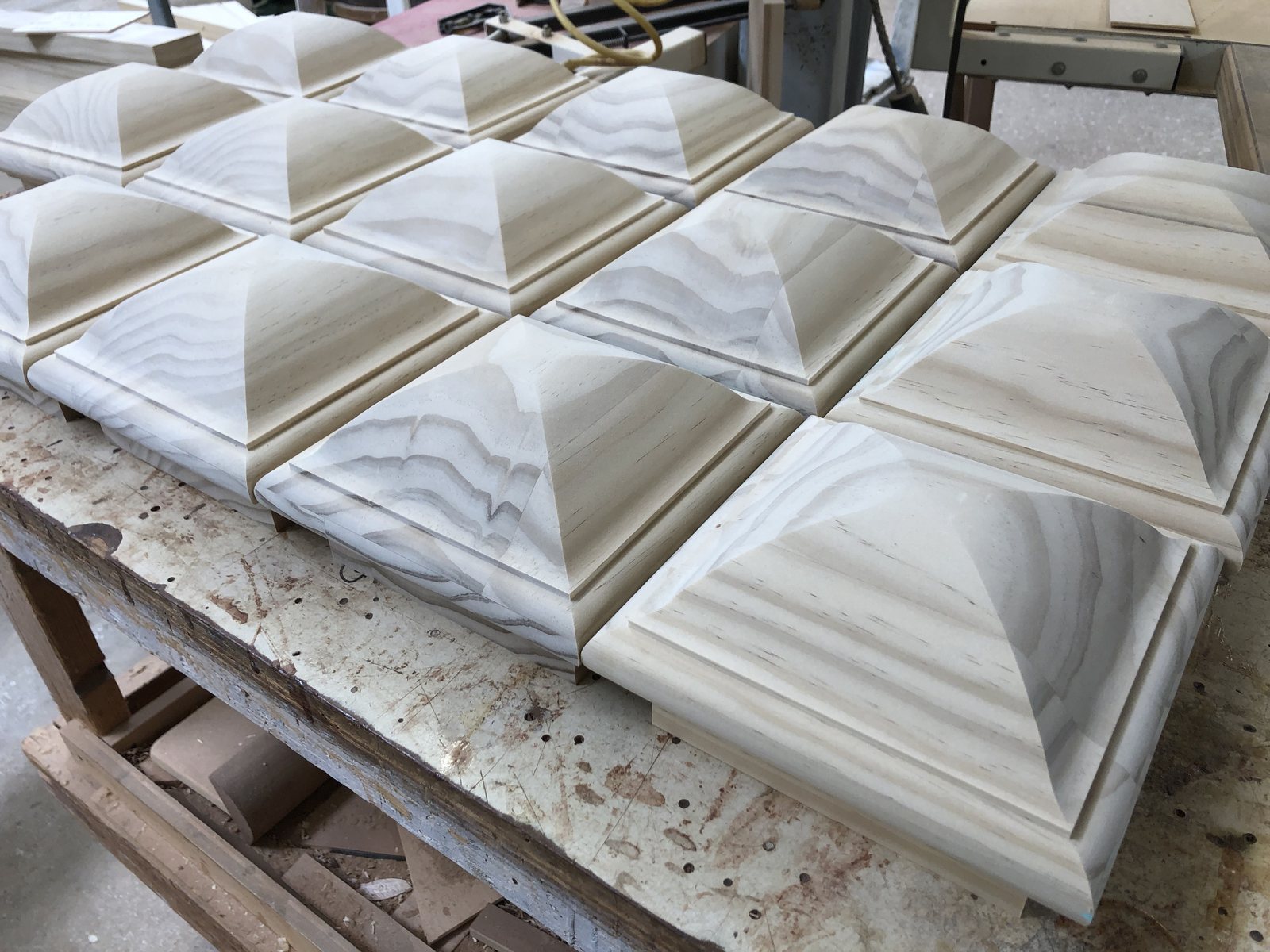
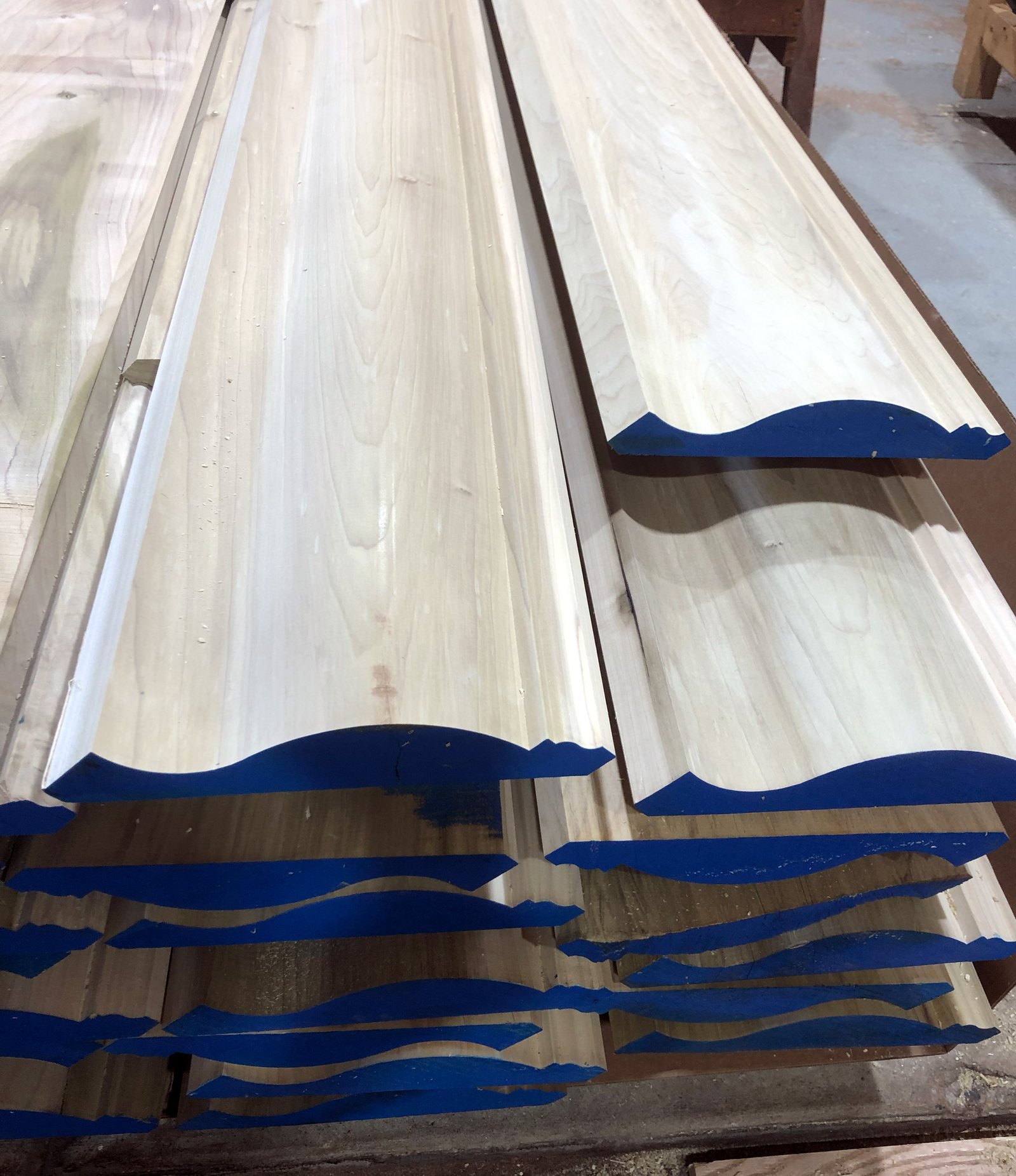
Profile continuity is where a moulder shop earns its keep. The moulding profile library holds thousands of profiles, and new knives are ground custom every week. If a bench apron needs to carry the same ogee as the pergola beam or the porch trim, and that profile is not already in the library, it gets ground to match. The same applies to historical restoration work, where a bench on a preserved property has to match a documented original. The National Park Service Technical Preservation Services guidance is the standard reference for that kind of like-for-like replacement.
Public and commercial seating adds a code layer. Where a bench serves an accessible route or a designated space, the ADA Accessibility Standards govern seat height and back support, and those dimensions have to be resolved before the frame is machined rather than shimmed afterward. Fabrication tolerances and grade expectations for architectural woodwork come from the Architectural Woodwork Institute standards, and hardwood grading itself runs on the National Hardwood Lumber Association rules, which is the language a lumber order is actually written in.
How J. Gibson McIlvain Would Specify This
Start with the exposure and the mounting condition, pick the species from the millwork palette, then let the drainage geometry set the section sizes.
For a painted architectural built-in on a covered terrace, the specification is Sapele or Accoya for the frame and aprons, quartersawn or rift for anything that has to stay flat, milled near twelve to sixteen percent moisture content, primed in the shop with a fungicide additive and buffed after priming. Lock miter box beam construction on any hollow base or plinth, since it shows no visible seams and is the strongest of the three joinery options. Eased edges everywhere. A standoff gap at the wall drawn on the shop drawing rather than left to the field.
For a freestanding bench that will live uncovered and be left to weather, the specification is Iroko or Teak, drawbored through tenons in the seat frame, stainless fasteners throughout, sled feet or standoffs at every leg, seat slats narrow enough to stay flat and gapped near three eighths to one half inch, with a slight crown across the seat. No film finish. Let it silver.
For a long bench run that exceeds what a single length can cover, plan the break points during design rather than at delivery, particularly in modified woods, where the sixteen foot kiln limit is a hard boundary and the pieces should meet at a deliberate joint that looks intentional.
Custom exterior seating, gates, pergolas, railings, rafter tails and radius work run through ICD, the architectural millwork division of J. Gibson McIlvain, where a bench is drawn for its actual location rather than adapted from a stock size. The working process starts with the drawing set and the site conditions. Linear trimwork, finished cladding and primed trim for the surrounding assembly come through the J. Gibson McIlvain millwork service. To get a bench schedule reviewed, or to talk through species and joinery before the drawings are released, call 800-638-9100.
Frequently Asked Questions
How wide should the gaps between exterior bench seat slats be?
Near three eighths to one half of an inch. Tighter gaps bridge with leaf litter and grit, which holds a wet mat against the slat edges and starts edge checking. Wider gaps get uncomfortable and catch small objects. Ease or chamfer both edges of every slat so water sheets off and the finish has an edge it can actually hold, since a sharp arris carries almost no film thickness.
Can an exterior bench be built from the same species as an Ipe deck?
It can be, but a millwork shop usually recommends against it. Ipe, botanically Tabebuia spp, along with Cumaru, Garapa, Jatoba and Red Balau, is extremely hard and carries high oil content, which makes it difficult to glue and hard on knives. Bench frames involve laminations, tenons and machined profiles, so Sapele, Iroko, Afrormosia, Teak or Utile is the better answer. Detail the color transition between the deck and the seating instead of forcing a single species through both jobs.
What moisture content should exterior bench components be milled to?
Near twelve to sixteen percent, which is where the wood will live outdoors. Interior millwork is milled near six to eight percent, and a bench built from interior-dry stock will swell hard in its first wet season, crush fibers at the joints and shrink back loose. Specify quartersawn or rift stock for seat and back slats as well, since it moves less across its width than plainsawn and keeps the slat gaps even.
Which joint should a hollow bench base or plinth use?
Lock miter, if the piece will be handled, kicked and washed down. Lock miter shows no visible seams and is the strongest of the three box beam options. Dado joints are strong and easy to assemble on site but still show seams and end grain. Butt joints give the most minimal profile and the fastest turnaround, though they are the weakest and leave both seams and end grain visible.
Does J. Gibson McIlvain install benches or set them in place?
No. J. Gibson McIlvain supplies and mills. The shop produces the seat assembly, aprons, slats, skirts and any profiled components, primes them where the specification calls for it, and ships nationwide. Anchoring, blocking, cleats and setting the piece are the buyer's own fabricator or installer scope. Drawing the standoff gap and the leg detail into the shop drawing is what lets that handoff go cleanly.
Is a modified wood like Accoya or Abodo Vulcan worth using for bench work?
For a painted frame, yes. Accoya runs near 1,600 lbf on the Janka scale and its acetylation gives dramatically reduced shrinkage and swelling, which is what a painted exterior seat frame wants. Thermory and Abodo Vulcan are both carried as well. Plan around the length limit, since all modified products top out around sixteen feet because of kiln size, and most are sold on metric lengths just under that. Thermally modified Ash is not available wider than eight inches, so any wide board in a modified product means Accoya or Abodo Vulcan.
How do you keep a built-in bench from damaging the wall it attaches to?
Do not scribe it tight. A bench scribed hard to cladding or a planter creates a ledge that collects water and debris against a wall assembly designed to drain. Draw a deliberate standoff gap into the shop drawing and mill the seat frame square rather than fitted to the wall face. The bench then sits on a cleat with air behind it, and both assemblies stay able to dry.
Should an exterior bench be painted, oiled or left bare?
All three are defensible, and the decision is about maintenance rather than durability. Iroko and Teak weather to silver and need nothing. Penetrating oil keeps the color and asks for reapplication on a cycle. Paint suits architectural built-ins and requires the most prep, including shop priming with a fungicide additive and buffing after priming. On a surface people sit on, a film finish wears through at the front edge first, so painted frames with oiled or bare seat slats is a common hybrid.
Sources and Standards Referenced
- Wood Handbook: Wood as an Engineering Material (FPL-GTR-190), USDA Forest Products Laboratory
- BSD-013: Rain Control in Buildings, Building Science Corporation
- ADA Accessibility Standards, U.S. Access Board
- Technical Preservation Services, National Park Service
- Sapele Wood Profile, The Wood Database
- Architectural Woodwork Institute
- National Hardwood Lumber Association Grading Rules
- CITES, Convention on International Trade in Endangered Species of Wild Fauna and Flora
- Forest Stewardship Council
- Accoya Acetylated Wood