
The Short Answer

Soffit, fascia, frieze board and the gate and fence panels that finish the same elevation should be milled as one package, from one lot of stock, to one moisture target, over one knife grind, and primed to one specification before anything leaves the shop. A gate hung next to a fascia run that was milled eight months earlier from a different shipment will not match. Color drifts. Density drifts. Two ogees ground from two different knives sit a sixteenth apart in the reveal, and on a west elevation in raking afternoon light that sixteenth is the only thing anyone looks at.
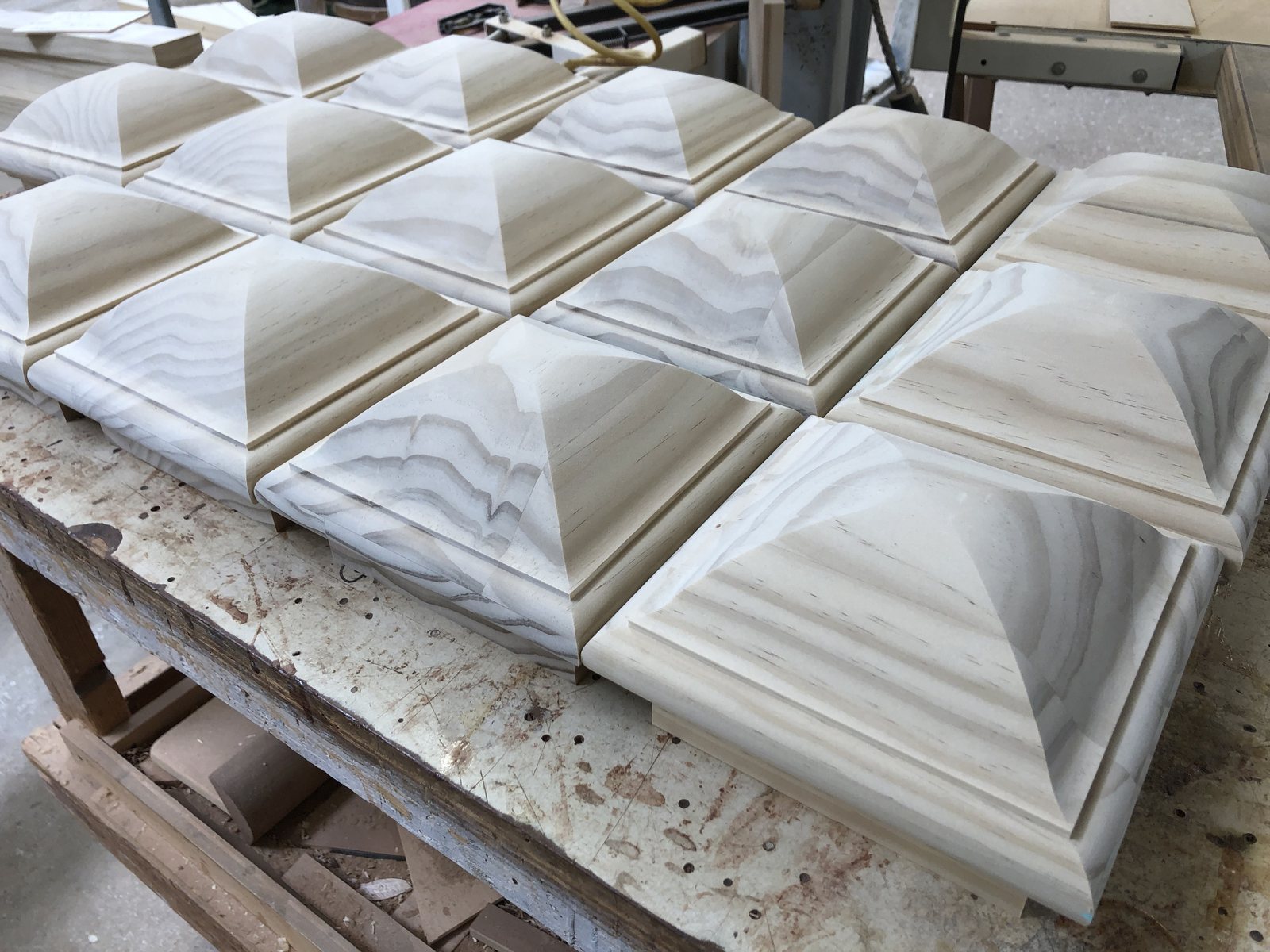
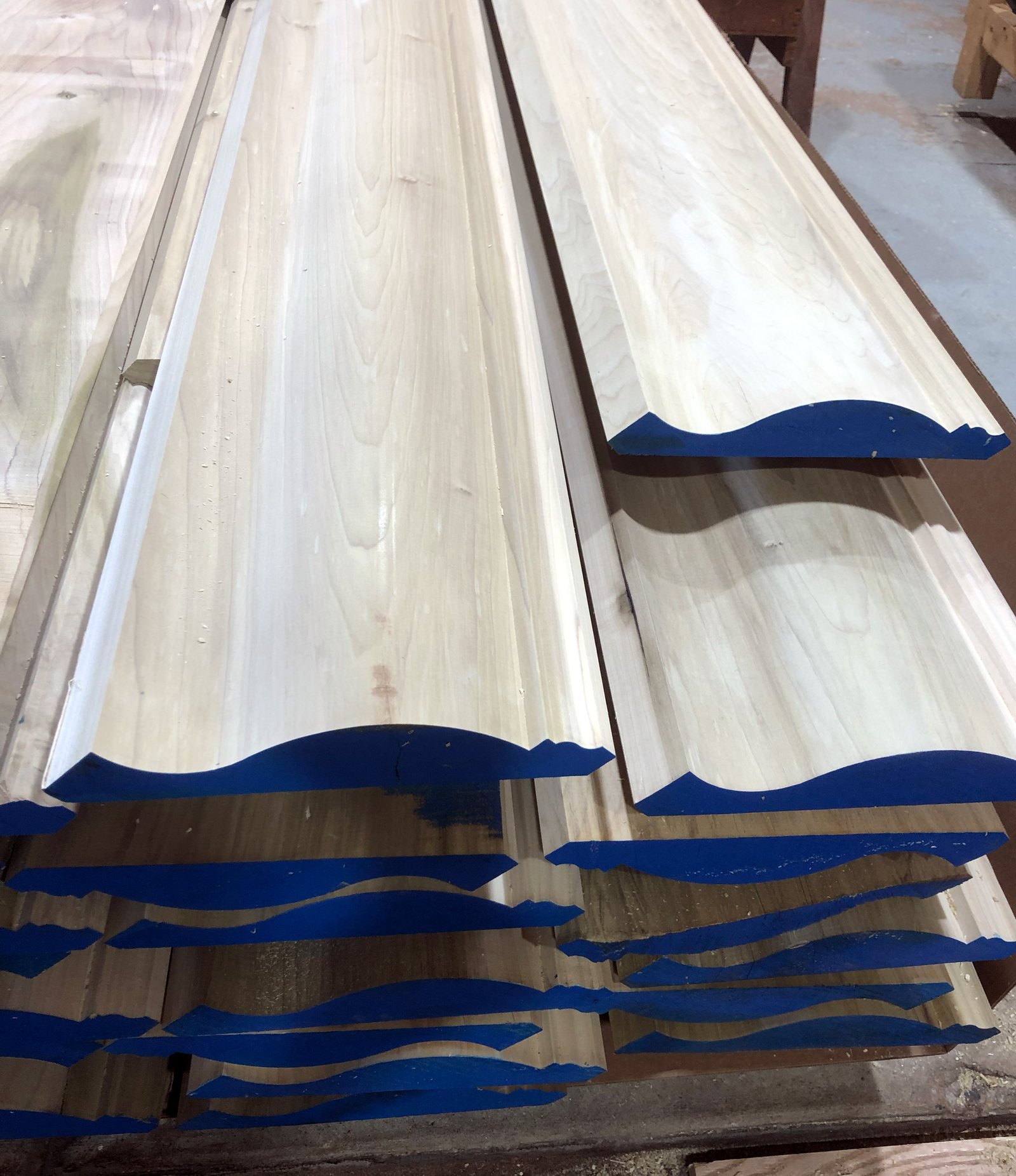
Running the package together controls four variables at once. One lot controls color and density. One knife grind controls profile. One kiln schedule and one shop environment control moisture content. One primer system controls how the eventual paint or stain sits down across every surface in the assembly. J. Gibson McIlvain mills linear trimwork, finished cladding and primed trim to submitted drawings and profiles through its millwork service, and the architectural millwork division, ICD, builds the true custom pieces in the same package, including the gates.
Why the Gate Panels Belong in the Same Shop Run as the Trim
The gate is the part of the exterior package a person touches, stands in front of, and photographs, which is exactly why it should not be ordered last and separately. Most exterior packages are bought in the order the trades arrive. Soffit and fascia go in with the roof. Running trim follows. The gate gets specified months later, after the landscape drawings settle, and by then the original lot is gone.
What you get instead is a gate that is the right species and the wrong wood. Sapele from two different logs can differ noticeably in ribbon stripe and background color. Iroko darkens on exposure at a rate that depends partly on the individual board. Put a fresh gate against three-year-old fascia and the eye reads the mismatch instantly, then reads it as a repair rather than as design.
Sequencing the whole envelope as one order also settles the profile question early. Gate rails, fence cap and the bed mould at the soffit and fascia return often want related profiles rather than identical ones, a family of curves scaled to the section size of each part. That decision is easy to make once, in the shop, with the knives in front of you. It is difficult to reconstruct later.
"When somebody calls with an elevation and only asks about the gate, the first question I ask is what the soffit and fascia are. Half the time we can pull all of it from the same lot and grind one set of knives, and the customer never has to explain a color mismatch to their architect three years later."
Norm Moton, Director of Sales, J. Gibson McIlvain
What Buying One Lot Actually Controls

Lot control is not a marketing idea, it is the only practical way to hold color, figure and density constant across parts that will be machined differently and finished differently. Lumber is graded on the face of the board, under rules that describe clear cutting yield rather than appearance matching. The National Hardwood Lumber Association grading rules tell you how much usable clear material a board carries. They do not tell you the board will look like the one next to it.
A millwork house solves that by pulling the package off one shipment and laying it out before it goes to the moulder. Boards with heavy ribbon go to the gate panels where the figure is a feature. Quieter, straighter material goes to painted soffit and fascia where figure does not matter and stability does. Density matters too. Denser stock takes a crisper profile edge and holds a fastener better, so the gate stiles and the fence rails come off the heavier end of the lot.
Species behavior is documented well enough that these choices are not guesswork. The Forest Products Laboratory Wood Handbook publishes shrinkage coefficients, movement in service and mechanical properties for the commercial species, and those numbers are what tell you a 1x10 painted soffit board in a plainsawn cut is going to be a problem before it ever gets primed.
How Each Component in the Package Gets Milled
Every part of the envelope has a different job, so each one gets a different grain orientation, a different section thickness and a different priming treatment, even though they all come from the same lot. Quartersawn and rift stock moves less across its width than plainsawn does, which is why it gets specified anywhere a painted or panelized surface has to stay flat. That is a real cost in yield, so it goes where it earns its place rather than everywhere by default.
| Component | Grain orientation to specify | Milled moisture target | Priming and prep before shipping |
|---|---|---|---|
| Soffit boards | Rift or quartersawn on any painted board over about 6 inches wide, plainsawn acceptable on narrow beaded stock | Near 12 to 16 percent for exterior service | All six surfaces primed including ends and the back face, sanded after prime to knock back grain raising |
| Fascia and sub-fascia | Rift or quartersawn preferred, straight grain matters more than figure on a long exposed run | Near 12 to 16 percent | Primed all faces, fungicide additive in the exterior primer, top edge treated as an end grain condition |
| Frieze, bed mould and running trim | Whatever cut takes the profile cleanly, quartersawn on wide flat members | Near 12 to 16 percent | Primed after moulding, buffed rather than block sanded so the moulded detail stays crisp |
| Gate stiles and rails | Rift or quartersawn, straight grain running the length of the member, no runout through a mortise | Near 12 to 16 percent, thicker sections conditioned longer to equalize through the section | Primed or sealed after joinery so the glue lines are not contaminated, hardware locations left clean |
| Fence panel infill and slats | Plainsawn acceptable on narrow slats, quartersawn on wide flat panels | Near 12 to 16 percent | Primed all four faces plus both ends before assembly, since faces get covered once the panel closes up |
The end grain line in that table is the one most often skipped in the field. End grain absorbs moisture far faster than face grain, and an unsealed cut end at the bottom of a fence picket is the standard starting point for exterior rot. Priming ends in the shop, before the parts ever get to a site, removes that failure mode from the installer's list of things to remember.
Moisture Content Is Set in the Kiln and Held in the Shop
Exterior millwork is milled to an in-service moisture content near 12 to 16 percent, and interior millwork near 6 to 8 percent, and mixing those two targets in one package is how a gate ends up binding in its frame every August. The number is not arbitrary. It reflects the equilibrium moisture content wood reaches in outdoor service across most of the country, so a part milled to that range has already done most of the moving it is going to do.
Thicker sections are the complication. A gate stile at 8/4 or heavier does not equalize through its section as fast as a 4/4 soffit board, and machining a piece whose core is still wetter than its shell produces a member that cups or twists a week after it is assembled. That is a scheduling issue more than a technical one. Stock for the heavy parts gets pulled and conditioned earlier in the run.
Assemblies also have to be drawn for movement rather than against it. A frame and panel gate lets the panel float in its groove. A glued-up flat slab in a wide exterior panel does not, and it will eventually tell you so. The rain control principles Building Science Corporation publishes for wall assemblies apply just as directly to a fence panel, which is a small wall with weather on both sides.
Decorative Profiles Come Off a Knife, Not a Catalog
Any profile on the gate rail, the fence cap, the fascia or the bed mould can be matched, because knives get ground to the drawing rather than selected from a fixed catalog. The profile library on the floor holds thousands of profiles, and new knives are custom ground every week. If your profile is in the library it runs. If it is not, it gets ground to match, and that includes both difficult historical restoration profiles and contemporary work that has no historical antecedent at all.
For restoration work the input is usually a physical sample. A cut section of the original fascia, a piece of the old fence cap, a rubbing or a scaled section drawing. That gets traced, the knife gets ground, and a sample stick gets run for approval before the production run starts. Anyone working under a historic district review will want that sample stick in hand, since the review board is approving a profile rather than a description of one. The National Park Service preservation briefs on exterior wood are the standard reference those boards work from.
Profile geometry also has to respect what the species will hold. A tight quirk with a sharp arris runs beautifully in Sapele or Hard Maple and can crumble in a soft, open-grained board. Deep coves on a member that is also going to be painted collect primer in the bottom of the curve unless the primer is thinned and the piece is buffed rather than sanded flat. The Wood Moulding and Millwork Producers Association publishes the industry profile numbering that gives everyone a common vocabulary for these members, which is useful shorthand on a submittal even when the actual profile is custom.
What Prefinished Means When the Parts Leave the Shop
Prefinished on an exterior millwork package means factory priming in three levels, in oil-based or water-based systems, not a finished topcoat. That distinction matters on a submittal. The shop delivers a properly sealed, uniformly primed substrate that a painter can topcoat. The painter still topcoats it.
Exterior primed trim should carry a fungicide additive. Open-grained and oily exterior species drink a great deal of finish, and a primer coat is what evens out the eventual painted surface so the topcoat is not soaking into some boards and sitting on top of others. Sanding or buffing after priming knocks back the grain raising the primer causes, and on moulded parts that step is done carefully enough to keep the detail crisp rather than rounding over every arris.
Back priming is the part people cut and then regret. Every face of an exterior board should be sealed, including the back face that will never be seen and the ends that will be buried in a joint. An unsealed back face takes on moisture at a different rate than the primed front, and that differential is what actually cups a board. Cupping is driven by installation and back ventilation, not by species. A well-chosen board installed tight to a solid substrate with no back priming will still cup.
Choosing the Species for the Whole Elevation
For a milled, glued and machined exterior package, the working palette is Sapele, Iroko, Afrormosia, Teak and Utile, with Western Red Cedar and Accoya as the other legitimate defaults depending on what the finish schedule says. These are the species a millwork shop reaches for because they machine cleanly, take glue reliably and come in the section sizes and lengths a real elevation needs.
Sapele runs roughly 1,410 lbf on the Janka scale, mills to a crisp edge and holds paint well. For painted exterior trim it is the better choice over Genuine Mahogany, which sits around 800 lbf, both because it holds paint better and because it comes in a wider range of sizes and longer lengths. One caveat worth putting on the drawing. Sapele is not milled 1x8 for exterior use. That width is too wide to stay stable in a nominal one inch exterior board, so wide soffit conditions get built up from narrower members or moved to a different material. The published property data for the species backs up why.
Iroko and Afrormosia are the choices when the client wants a natural or lightly stained exterior that will silver gracefully rather than being repainted. Teak remains the reference for exposure and dimensional calm, and Utile machines and glues about as agreeably as Sapele. Western Red Cedar is a legitimate default and always has been, and the grade distinction matters more than the species name. Clear vertical grain, CVG, is stable, straight and appropriate for painted soffit and fascia. Select tight knot, STK, carries sound knots and reads as a rustic material, which is right for some fence and gate work and wrong for a formal painted cornice.
The tropical decking species, Ipe (Tabebuia spp), Cumaru, Garapa, Jatoba and Red Balau, are a different conversation. They are extremely hard and carry high oil content, which makes them difficult to glue, so a millwork house uses them far less than the decking side does. If you are building a deck they are excellent. If you are gluing up a gate stile, running a delicate profile and then priming it, Sapele, Iroko, Afrormosia, Teak or Utile is the material that behaves.
Modified woods are the fourth option. Accoya runs roughly 1,600 lbf and acetylation gives it dramatically reduced shrinkage and swelling, which makes it a strong candidate for wide painted boards and for gate components that have to hold a tolerance. Thermory and Abodo Vulcan are both carried and both worth considering. Two constraints govern all of them. Modified woods top out around 16 ft, most sold on metric lengths just under 16 ft, because of kiln size, so a long unbroken fascia run has to be designed with joints. And thermally modified Ash is not available wider than 8 inches, so any wide board in a modified product means Accoya or Abodo Vulcan. Warranties exist only on modified products. It is not possible to warranty solid unmodified wood, an organic material that responds continuously to its environment.
Where a CITES-listed species is involved, documentation and chain of custody travel with the material. The same holds for FSC certified stock on projects chasing certification credit. Both are handled at the order stage rather than discovered at delivery, and CITES paperwork moves with the shipment.
What the Shop Delivers and What the Installer Owns
J. Gibson McIlvain supplies and mills, it does not install, and drawing that line clearly is what keeps a package from arriving with the wrong expectations attached. What ships is milled, profiled, primed and labeled material, cut to the schedule on the approved drawings, with the profile matched to an approved sample.
What the installer owns starts with ventilation. A vented soffit assembly needs its ventilation path detailed and executed on site, and no amount of shop priming substitutes for airflow behind cladding and trim. Fastening is the installer's call as well, including corrosion-resistant fasteners appropriate to the species, since several of these woods react with ordinary steel and leave black staining around every nail.
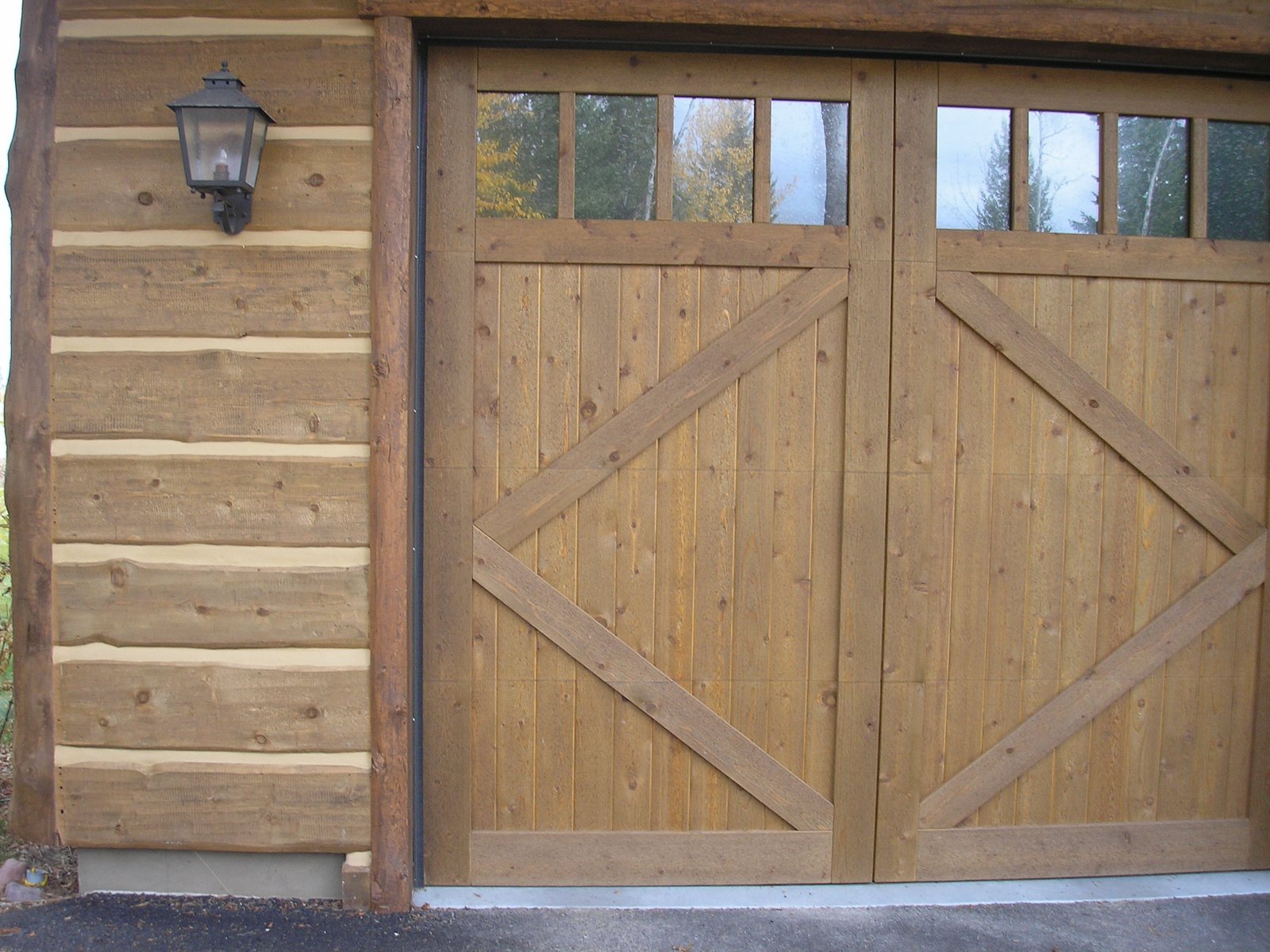
Gate hardware is the other big one. Hinge selection, post setting, latch geometry and the drop and swing of a large gate are field decisions made against real site conditions. Large driveway swing gates in particular require engineering rather than only craftsmanship, because size and weight change what the hinge and post have to carry. ICD, the architectural millwork division, builds pedestrian, garden, courtyard and estate entry gates along with the rest of its exterior millwork, and the engineering conversation on a heavy swing gate happens before the joinery is drawn, not after. Field measurement and installation coordination stay with the buyer's own contractor. The Architectural Woodwork Institute quality standards are a useful common reference for defining that handoff on a submittal, and the American Wood Council publishes the structural side.
Sequencing, Storage and Shipping the Package
Milling the package early and storing it is usually better practice than milling it late, provided the finished millwork is stored properly. Finished millwork can be held in storage for inventory control, which means the whole elevation can be run while the lot is intact and then released to the site in the order the trades need it. Soffit and fascia go out with the roofing package. Running trim follows. Gate and fence panels ship when the site is ready to receive them, not when the shop happens to have capacity.
That sequencing avoids the worst outcome in exterior millwork, which is primed parts sitting on a job site in the weather for two months while the schedule slips. Primed is not finished. Primer is a preparation layer with limited exposure tolerance, and parts that sit out unprotected will need to be cleaned and re-primed before topcoating.
Shipping runs nationwide, regularly to the West Coast including California, and the packing on a prefinished package is different from packing raw lumber. Primed faces get protected, profiled edges get blocked so nothing crushes an arris in transit, and gate components ship as sets so nothing arrives orphaned. Call 800-638-9100 to talk through the sequence before the order is written.
How J. Gibson McIlvain Would Specify This
Specify the entire exterior envelope on one schedule, from one lot, at one moisture target, with one primer system, and name the sample approval step in writing. Here is what that looks like on a submittal.
Name the species and the grade for the whole package, and call the grain orientation by component rather than globally. Rift or quartersawn on painted boards over about 6 inches wide and on all gate stiles and rails. Plainsawn permitted on narrow slats and beaded soffit. State the milled moisture content as near 12 to 16 percent for exterior service, and note that heavy sections are conditioned to equalize through the section before machining.
Call out every profile by drawing or by physical sample, and require a sample stick approval before production. If the work sits in a historic district, get that stick in front of the review board early. Specify the primer by system and by level, oil-based or water-based, with a fungicide additive on all exterior parts, all six surfaces primed including ends and back faces, and a sanding or buffing step after priming that preserves moulded detail.
Put the modified wood constraints on the drawing if modified material is in play. Around 16 ft maximum length, most stock on metric lengths just under that, thermally modified Ash not wider than 8 inches, warranty coverage on modified products only. And state plainly that ventilation, fastening, hardware, field measurement and installation are the installing contractor's scope.
Send the elevations, the section details and any profile samples to J. Gibson McIlvain, and ask for the gate and fence panels to be quoted against the same lot as the soffit, fascia and running trim. Call 800-638-9100. Getting the whole envelope onto one shop run is a scheduling decision that has to be made at the order stage, and it is the single change that does the most for how the finished elevation looks in five years.
Frequently Asked Questions
Can the gate be milled from the same lot as the soffit and fascia if the gate is a custom build?
Yes, and that is the point of ordering the package together. ICD, the architectural millwork division of J. Gibson McIlvain, builds the custom gates, and the stock for those gates can be pulled from the same shipment as the linear trimwork, finished cladding and primed trim milled on the J. Gibson McIlvain side. The practical requirement is timing. The gate has to be specified while the lot is still intact, which usually means committing to the gate design during the same conversation as the trim schedule rather than months later.
Does factory priming replace the painter's topcoat?
No. Priming is delivered in three levels, in oil-based or water-based systems, with a fungicide additive on exterior work, and it produces a uniform, sealed substrate. It is preparation, not a finish. The topcoat is applied by the buyer's painter, and primed parts should not be left exposed to weather for extended periods before that happens. If a job schedule is likely to slip, storing the finished millwork until the site is ready is a better plan than shipping early.
What is the widest exterior board that stays flat on a painted soffit?
It depends on the species and the cut, and the answer is narrower than most people expect. Sapele is not milled 1x8 for exterior use because that width is too wide to stay stable in a nominal one inch exterior board. Wide painted soffit conditions get built up from narrower members, moved to a quartersawn or rift cut, or moved to Accoya, which has dramatically reduced shrinkage and swelling from acetylation and handles width better. Whatever the width, back priming and back ventilation matter more than the number, since cupping is driven by installation and back ventilation rather than by species.
How long can prefinished exterior trim and gate panels sit before installation?
Primer is a preparation layer with limited exposure tolerance. Parts stored under cover, stickered and out of the weather hold indefinitely for practical purposes. Parts stacked outdoors on a job site for weeks will need cleaning and re-priming before topcoating. This is why finished millwork can be held in storage for inventory control and released against the construction schedule, so the material arrives when the site is genuinely ready for it.
Can the whole package be done in modified wood?
Parts of it, with real constraints. Accoya, Thermory and Abodo Vulcan are all carried, and Accoya at roughly 1,600 lbf takes profiles and paint well. Modified woods top out around 16 ft, most sold on metric lengths just under 16 ft because of kiln size, so a long fascia run has to be detailed with joints. Thermally modified Ash is not available wider than 8 inches, so any wide board in a modified product means Accoya or Abodo Vulcan. Warranties exist only on modified products, since it is not possible to warranty solid unmodified wood.
Why not use Ipe or Cumaru for the gate and fence panels since they last so long outdoors?
They are excellent decking materials and poor millwork materials. Ipe (Tabebuia spp), Cumaru, Garapa, Jatoba and Red Balau are extremely hard and carry high oil content, which makes them difficult to glue. A gate is a glued, machined, profiled and often primed assembly, so a millwork shop reaches for Sapele, Iroko, Afrormosia, Teak or Utile instead. Those species machine cleanly, bond reliably and come in the section sizes a gate frame and a matching trim run both need.
What documentation comes with imported species on a certified project?
Where a CITES-listed species is involved, documentation and chain of custody travel with the material. FSC certified stock carries its own chain of custody paperwork for projects pursuing certification credit. Both are arranged at the order stage rather than at delivery, so the certification requirement belongs in the initial conversation about species selection.
Who handles ventilation, hardware and installation on the package?
The buyer's own contractor. J. Gibson McIlvain supplies and mills. It does not install, coordinate installation or field measure. Vented soffit detailing, corrosion-resistant fastener selection, post setting, hinge selection and gate swing geometry are all field decisions made against actual site conditions. Large driveway swing gates require engineering rather than only craftsmanship because of size and weight, and that engineering conversation happens before the joinery is drawn.
Sources and Standards Referenced
- Wood Handbook: Wood as an Engineering Material (FPL-GTR-190), USDA Forest Products Laboratory
- BSD-013: Rain Control in Buildings, Building Science Corporation
- Preservation Brief 10: Exterior Paint Problems on Historic Woodwork, National Park Service
- Wood Moulding and Millwork Producers Association
- National Hardwood Lumber Association Grading Rules
- Architectural Woodwork Institute Standards
- American Wood Council Codes and Standards
- Sapele Species Data, The Wood Database
- Accoya Acetylated Wood Technical Information
- Forest Stewardship Council
- CITES Convention on International Trade in Endangered Species