Where the order goes once the leaf gets big
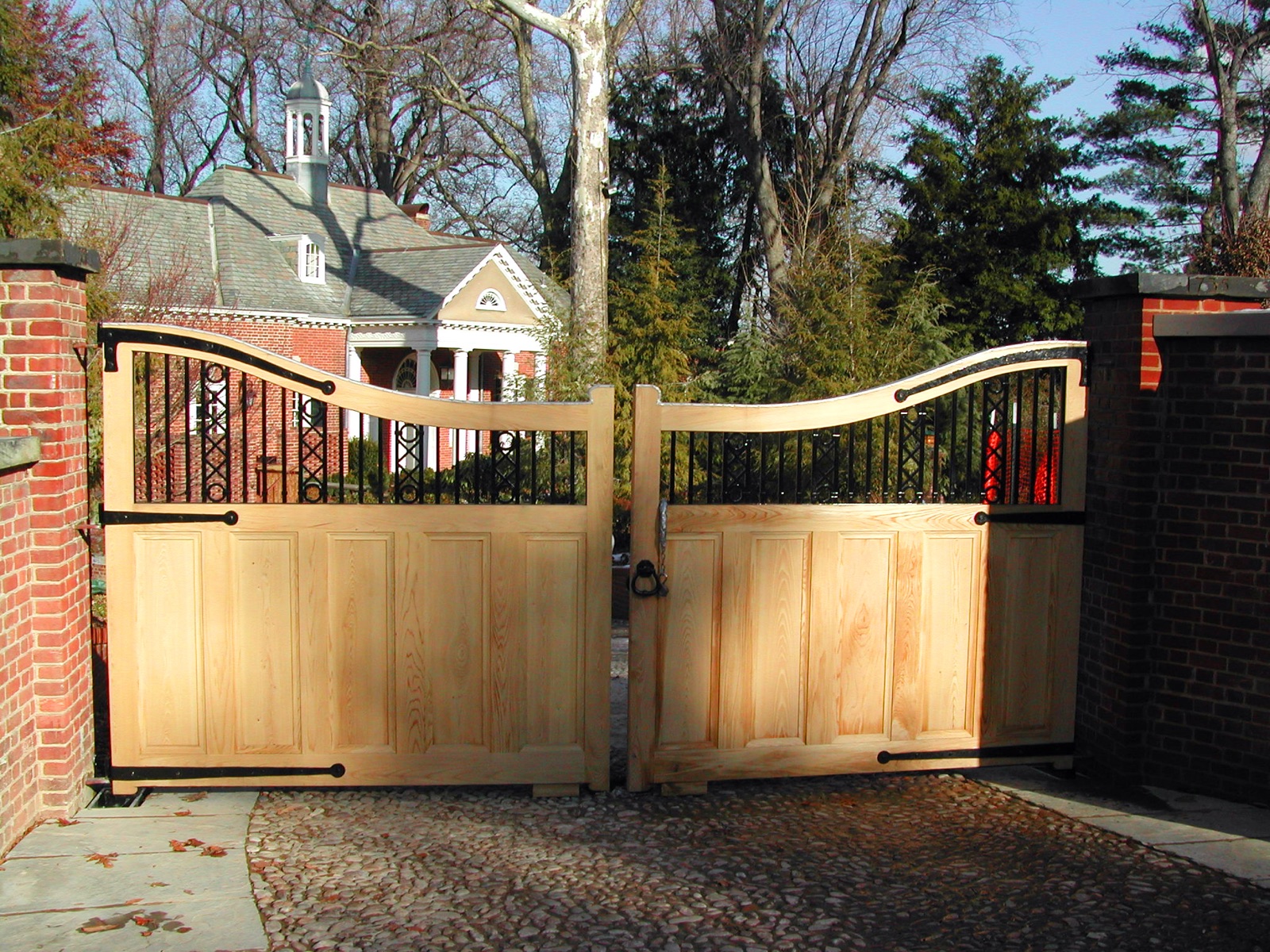
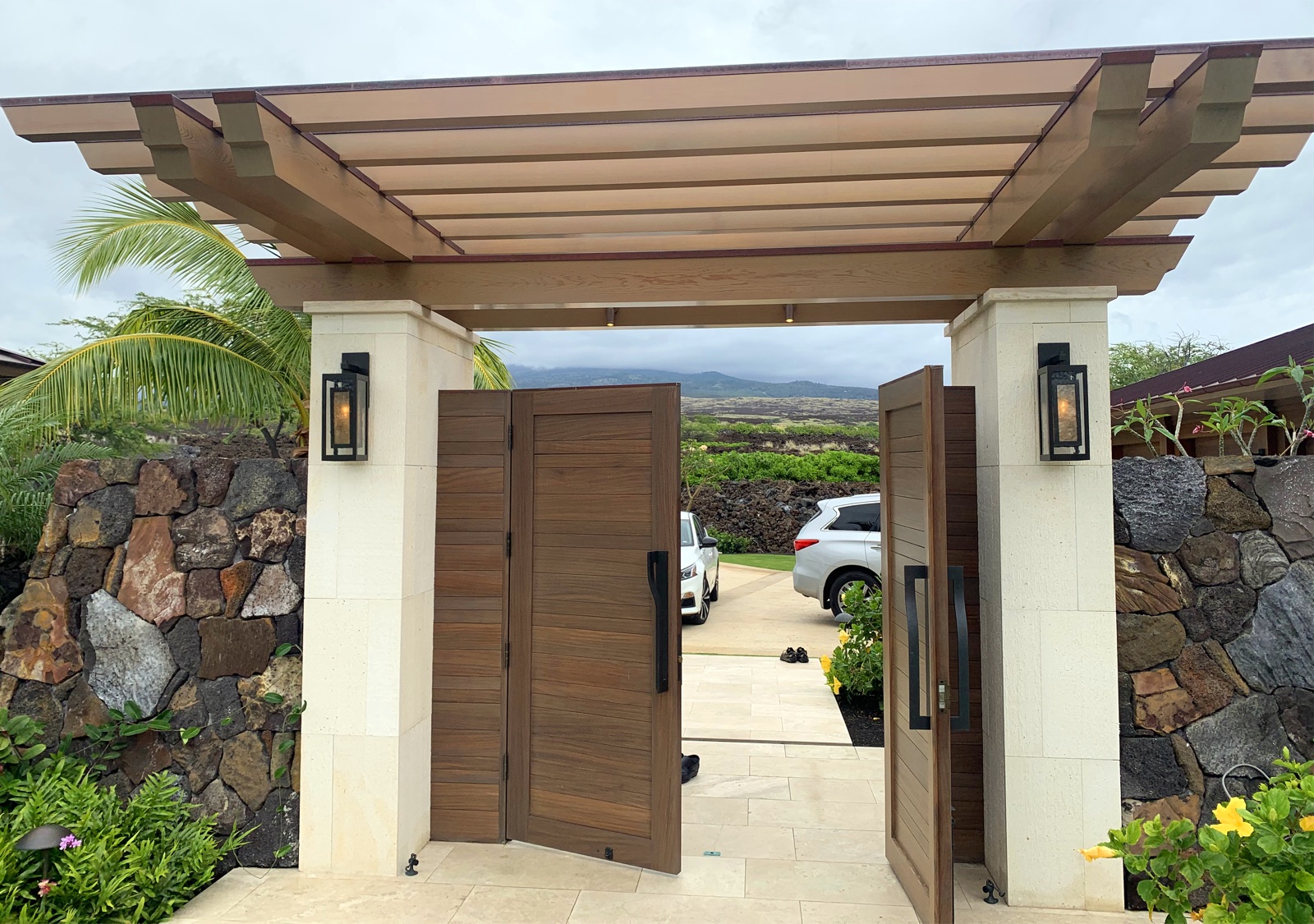
A large hardwood driveway gate belongs with an architectural millwork shop that sizes the frame from the swing load before it draws a stile width, and that shop needs its own moulders, knife grinding and resaw capacity so the sections it calculates are the sections it can actually cut. Nominal opening width is a starting condition, not a specification. Two gates that both fill a fourteen foot drive can differ by a factor of three in leaf mass, and everything downstream of that number changes with it.
Most people looking for where to order custom entry gates and doors in hardwood for residential and commercial projects land in one of two places. A fence and rail contractor who buys gate frames from a jobber. Or an import door program that will build to a drawing but has no relationship with the log the wood came out of. Neither one owns the material, which means neither one can tell you what the finished leaf will weigh, how it will move through a wet spring, or what the hinge line will see in a February gust.
ICD, the architectural millwork division of J. Gibson McIlvain, builds gates as true custom work planned around one specific opening. That is the same shop that produces rafter tails, box beams, pergolas, radius trimwork, shutters, benches, railings and custom doors, and it works from the company's own lumber inventory rather than from whatever a distributor has on the ground that week. The exterior millwork side of ICD is where driveway gates sit. J. Gibson McIlvain mills the linear trimwork, finished cladding and primed trim that surrounds an entry, on straight line and gang rip saws, band resaws and moulders on its own floor, and ships nationwide, including regular loads to California.
Swing weight is a moment, not a number on a scale
The load that tears a gate apart is not the weight of the leaf, it is the weight of the leaf multiplied by the horizontal distance from the hinge line to the center of that mass. Get that one idea and the rest of the engineering follows in order.
Picture a leaf of uniform construction. Its center of mass sits near the middle of its width. Widen the leaf from four feet to eight and you have roughly doubled the mass and simultaneously doubled the lever arm, so the moment at the hinge line goes up by about four times. Nothing else in the assembly changed. The joinery did not get stronger, the post did not get stiffer, and the hinges are the same castings the fence catalog recommended for a garden gate. This is why gates fail at predictable widths rather than at random ones.
That moment resolves into a couple at the hinge line. The upper hinge is pulled away from the post in tension. The lower hinge is driven into the post in compression and carries the vertical bearing load as well. The force in each hinge is the moment divided by the vertical distance between them, so hinge spacing is a design variable, not a detail. Move the hinges farther apart on a tall leaf and the force at each one drops. Cluster them near the middle of the stile because a rail happened to land there and you have quietly multiplied the load on both.
Wind adds a second moment about the same line, and it acts on the face rather than in the plane of the leaf. A solid tongue and groove infill is a sail. A spaced picket or louver infill lets air through and cuts the pressure the frame has to resist. The American Wood Council's codes and standards library is where the wood design values behind those calculations live, and a project engineer working from local wind data is the one who applies them to your site.
What actually changes as the leaf gets wider
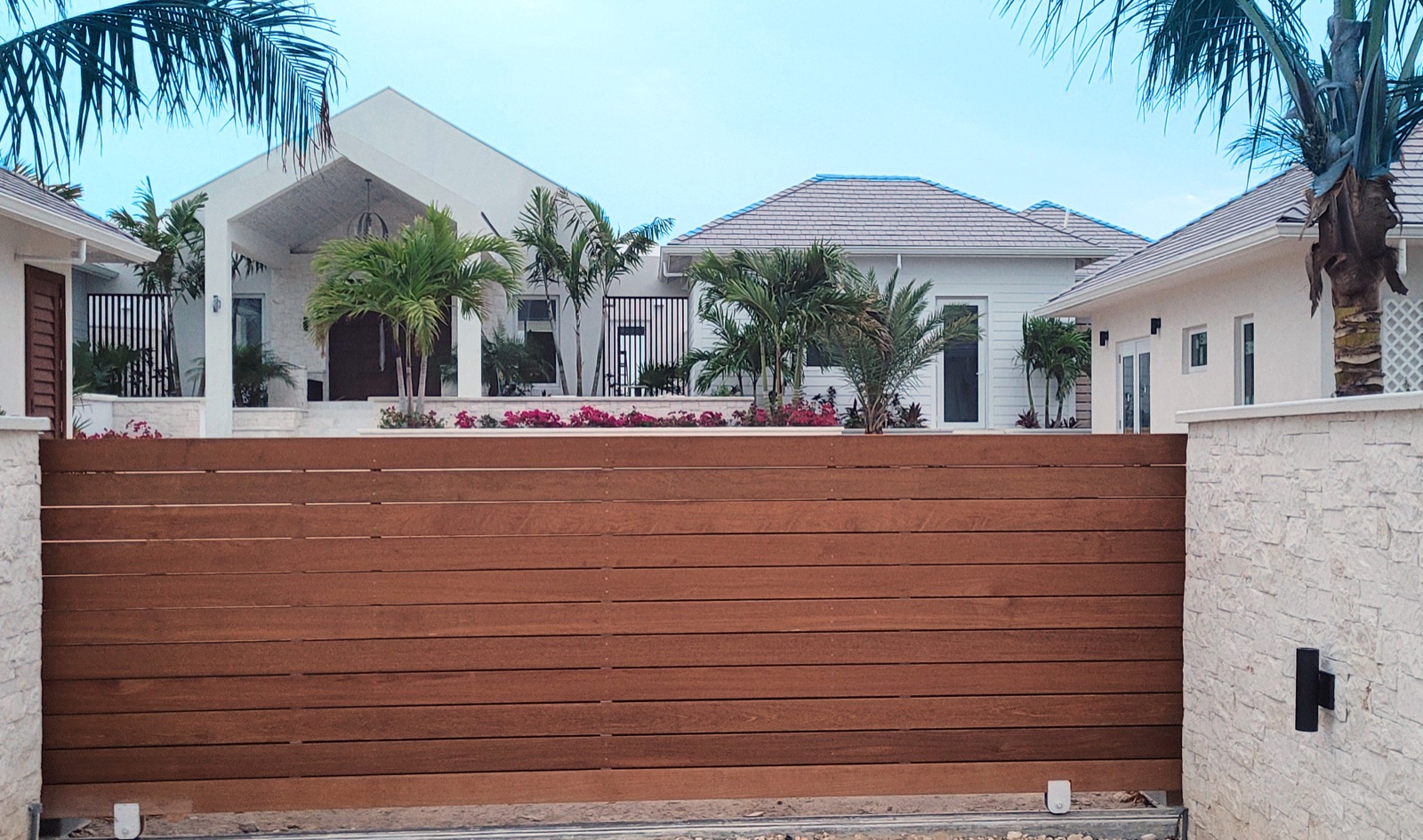
There are recognizable width bands where a hardwood gate stops being a joinery exercise and starts requiring a structural response, and knowing which band you are in tells you what to ask for before you ask for a quote. The transitions are not sharp lines, but they are real, and shops that build this work regularly see them in the same places.
| Leaf width band | Dominant concern | Frame and joinery response | Hinge line duty | Outside engineering input |
|---|---|---|---|---|
| Up to about 4 ft | Seasonal movement and finish life | Conventional mortise and tenon frame, floating panels | Two heavy hinges into a solid post | Not usually required |
| About 4 to 6 ft | Onset of visible sag at the latch stile | Wider stiles, drawbored or wedged tenons, compression diagonal | Three hinges, spacing pushed toward the ends of the stile | Post and footing reviewed by the contractor |
| About 6 to 8 ft | Racking under self weight plus wind on the face | Deeper frame sections, hardware backer blocking milled in | Through bolted heavy barrel hinges or a pivot at the bottom | Post, footing and hinge selection engineered |
| Over 8 ft single leaf | Hinge line couple and post rotation | Species chosen for low density, infill opened up to shed wind | Pivot or roller assist carrying vertical load separately | Structural engineer of record, stamped where the jurisdiction asks |
| Paired leaves over about 12 ft total | Meeting stile alignment across both leaves | Matched frames, drop rod pocket and astragal detailed in the shop | Independent hinge sets, each leaf sized on its own | Operator vendor and engineer working from the same leaf weight |
Read that table as a sequence of questions rather than a rulebook. A six foot leaf in Western Red Cedar and a six foot leaf in Ipe are not in the same band in any practical sense, because the material is doing most of the deciding.
Species density is the first lever you have on swing weight
Before anyone specifies a bigger hinge, the cheapest structural improvement available on a large gate is choosing a lighter species that still survives outdoors. Density varies enough among durable exterior woods that the same drawing can produce leaves of wildly different mass.
Ipe, botanical name Tabebuia spp, runs near sixty nine pounds per cubic foot at service moisture, and the published density and mechanical figures line up with what the material feels like on a cart. It is magnificent stock and it makes a punishing gate leaf, which is why it turns up on fastened infill far more often than on the milled and glued frame around it. Western Red Cedar sits near twenty three pounds per cubic foot. Same drawing, roughly a third of the mass, and a hinge line that sees roughly a third of the moment. Cedar is a legitimate default for gate frames and infill, not a compromise, and the distinction that matters at the order desk is CVG, clear vertical grain, against STK, select tight knot. CVG gives you straight, quiet grain and the best stability for stiles and rails. STK gives you a knotted character face that suits a ranch or agricultural entry and costs less material yield to produce.
In between sit the woods most large gates actually get built from. Sapele lands near forty two pounds per cubic foot with a Janka hardness around 1,410 lbf, and it is the species to prefer over Genuine Mahogany, which runs near 800 lbf, whenever the gate is going to be painted. Sapele holds paint better and comes in a wider range of sizes and longer lengths, which matters when a stile has to run a full leaf height in one piece. Sapele is not milled 1x8 for exterior use, since that width will not stay stable outdoors. White Oak sits around 1,360 lbf and brings its own tyloses driven decay resistance in the heartwood. Iroko sits close to Sapele in weight with a Janka near 1,260 lbf, and it survives outdoors without a coating, which makes it the usual pick where the leaf is left natural. Afrormosia is harder at roughly 1,570 lbf and stiffer with it, useful where a long stile has to resist twisting across a tall leaf. Utile machines and glues much like Sapele and takes a moulded profile cleanly. Teak is the most stable of the group and the least trouble in a wet climate, though its oil content means glue faces get machined fresh and assembled immediately. Cumaru, Jatoba, Garapa and Red Balau are all in the company's inventory too, each with a different weight and movement profile, but the same density and oil content that make them last put them on fastened infill rather than in the glued frame around it.
Accoya deserves its own line on a large gate. Acetylated pine with a Janka around 1,600 lbf, low density relative to the tropical hardwoods, and dramatically reduced shrinking and swelling, which is the property that keeps a wide leaf square through a full year. Accoya publishes its own technical data. Thermally modified stock is the other modified route, and both Thermory and Abodo Vulcan are carried. Two constraints govern all of it. Modified woods top out around sixteen feet in length, most sold on metric lengths just under sixteen feet, because that is the size of the kiln. And thermally modified Ash is not available wider than eight inches, so if the design needs wide boards in a modified product the answer is Accoya or Abodo Vulcan.
Racking is the failure mode, and the frame is the structure
A hardwood gate almost never fails by breaking, it fails by going out of square, and the fix has to be built into the frame rather than bolted on afterward. The symptom is familiar. The latch stile drops, the gate scrapes the drive, and somebody shims the hinge, which buys a season.
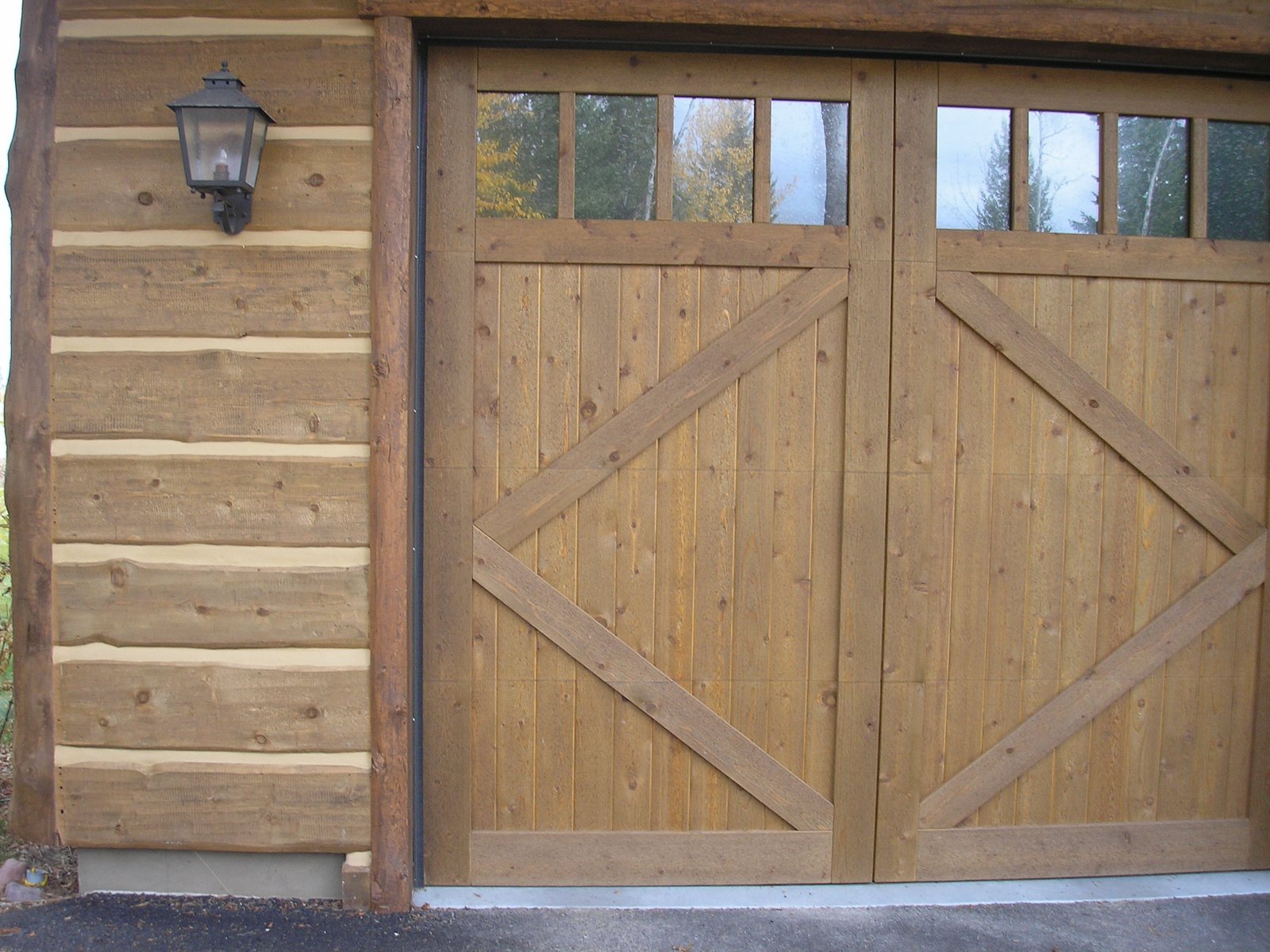
The frame carries everything. On a gate of any size the corner joints are doing the work, and a haunched through tenon with drawbore pins or wedges resists rotation in a way a doweled or pocket screwed corner never will. The panel does not help. Panels have to float in their grooves so the wood can move across its width with the seasons, which means the panel contributes almost nothing to the frame's resistance to going out of square.
Diagonal resistance comes from one of three places. A wood compression brace runs from the bottom hinge corner up toward the top latch corner, and it must run that direction to work, since it is being pushed rather than pulled. A steel tension rod runs the other way, from the top hinge corner down to the bottom latch corner, and it can be tuned with a turnbuckle after the gate hangs. Or the frame is deep enough and the joinery tight enough to resist racking on its own, which is the cleanest look and the most demanding to execute. On wide leaves a metal fabricator sometimes supplies an armature the wood frame is built around, and that armature is theirs, not the millwork shop's.
Grain direction is quietly part of this. Quartersawn and rift sawn stock moves less across its width than plainsawn, which is why it gets specified where a surface has to stay flat, and on a gate that means the stiles. The Wood Handbook from the Forest Products Laboratory gives the shrinkage coefficients that make the difference explicit, and grading rules that govern how that stock is sorted come from the National Hardwood Lumber Association.
Hardware gets chosen before the frame is drawn, not after
Gate hardware is not an accessory added at the end, it is a set of dimensional constraints the shop has to build to, and a frame drawn before the hardware is selected usually has to be redrawn. This is the single most common sequencing mistake on a custom gate order.
Heavy gate hinges come in several families and they impose different things on the wood. A weld on barrel hinge with a bolt through plate needs a solid landing in the stile and enough meat behind it for through bolts with backing washers, so the stile width and the mortise for the panel groove have to be laid out around that plate. A pivot or bottom bearing assembly takes vertical load into a footing instead of into the post, which changes the whole force picture, and it requires a pocket and a plate location that the shop mills before assembly. Ball bearing butt hinges are a door solution and are out of their depth on a driveway leaf.
Latching hardware, drop rods and astragals on a pair of leaves all demand shop layout. A drop rod needs a bored pocket that lines up with a sleeve set in the drive slab, and that dimension has to be fixed before the meeting stiles are milled. Through bolted hardware needs blocking laminated in behind the face so fasteners are not relying on end grain or on a hollow section. When a metal shop or a hardware manufacturer publishes a mounting template, the shop builds to the template, and it has to arrive before the frame goes into the machine.
"Send us the hardware cut sheet with the drawing. When a gate comes back to us for rework it is almost never the wood that failed, it is that the hinge got picked after the frame was already glued up and there was nowhere solid to bolt it. We would rather grind a knife twice than build a leaf twice."
Norm Moton, Director of Sales, J. Gibson McIlvain
Automation rewrites the brief for the whole leaf
An automated driveway gate is a machine with a wooden component, and the operator's published weight and torque limits become hard design constraints on the millwork. Adding an operator to a gate that was designed as a manual leaf is where a lot of expensive rework starts.
Operators carry maximum leaf weight and maximum leaf width ratings, and those two numbers work together. A wide, light leaf and a narrow, heavy leaf can weigh the same and load an operator very differently, because the operator is fighting the same rotational inertia the hinges are. Give the operator vendor the calculated leaf weight from the shop, in the actual species, at the actual service moisture content, rather than an estimate from a catalog.
Safety standards govern the rest. Automated vehicular gate construction is addressed by ASTM F2200, and gate operators fall under UL 325, which together drive entrapment protection, screening of openings within reach of the moving leaf, and restrictions on gaps that can trap a hand. ASTM International publishes the gate construction standard, and where the entry serves a commercial property the requirements of the adopted building code apply on top, through the International Code Council. Screening requirements in particular can change the infill design, which changes wind load, which changes the leaf, which changes the operator sizing. That loop is why hardware, operator and millwork all get settled together.
Moisture, finish, and the weight that comes and goes
Exterior millwork is milled to an in service moisture content near twelve to sixteen percent, and a gate that arrives at that number and gets sealed on all six faces will hold its geometry far better than one that does not. Interior work is a different target near six to eight percent, and using interior stock outdoors is a reliable way to watch a leaf move.
Water is also mass. A large solid leaf that soaks through an untreated end grain foot picks up weight the operator and the hinges were never sized for, and it gains it seasonally rather than once. Sealing end grain, especially at the bottom rail and at every tenon shoulder, is not cosmetic maintenance. It is load control.
J. Gibson McIlvain primes wood in three levels, in both oil based and water based systems, and exterior primed material should carry a fungicide additive. Open grained and oily exterior species drink a great deal of finish, so the primer coat is what evens out the final painted surface instead of letting it blotch, and sanding or buffing after priming knocks back the grain raising while leaving moulded detail crisp. On a gate the sequence matters more than on trim. Prime or seal the parts before assembly so the faces that end up hidden inside a joint are coated, since those are the faces that will never be reachable again. Building science guidance on how wood assemblies dry, collected at Building Science Corporation, applies to a gate leaf as much as to a wall.
One thing to be direct about. There are no warranties on solid unmodified wood. It is not possible to warranty an organic material that responds to its environment, and any supplier offering one on a solid hardwood gate is selling something they cannot back. Warranties exist on modified products, which is a genuine argument for Accoya or Abodo Vulcan on an exposed entry with no overhang.
The matching entry door is a different structural problem
A gate and the entry door it visually matches are engineered on opposite terms, since the door fights cupping and weather sealing while the gate fights swing moment and racking. Buyers ordering both at once should expect two different conversations about the same species.
Door stiles want quartersawn or rift material for the same reason gate stiles do, but the consequence of getting it wrong shows up differently. A door that cups breaks its weatherseal and lets water into the jamb. Cupping is driven by installation and back ventilation more than by species, so a door on a west facing wall with no overhang and no air behind the jamb will misbehave in any wood. For a painted exterior door, Sapele over Genuine Mahogany again, for paint adhesion and for size availability.
ICD builds custom doors and windows as planned work rather than as catalog sizes, alongside custom cabinetry, kitchen cabinetry engineered around how the space is used, and the radius millwork that often surrounds a curved entry. Where the entry structure includes a header or an exposed beam over the drive, box beams come with a real joinery choice. Butt joints are the most minimal profile, fastest to produce and easiest to assemble on site, but they show seams and end grain and they are the weakest. Dado joints are strong and still straightforward on site, and still show seams. Lock miter joints show no visible seams and are the strongest of the three.
What ships from the shop and what your installer and engineer own
J. Gibson McIlvain supplies and mills, it does not install, and drawing that line clearly at the start is what keeps a gate project from stalling. The shop delivers a finished leaf, machined for the specified hardware, at the correct moisture content, primed or sealed to the level ordered.
What belongs to other trades is straightforward. The post or column and its footing, including frost depth and the soil question underneath it, sit with the project's contractor and engineer. Hardware supply and the operator itself come from their manufacturers. Field measurement, hanging, alignment and the final adjustment of a turnbuckle or a pivot belong to the installer. Electrical rough in for an operator, safety loops and photo eyes are an electrician's work under the applicable standards.
The shop's contribution to that handoff is precision and documentation. Finished millwork can be stored for inventory control when a site is not ready, which matters on phased commercial work where the drive is poured months after the gate is approved. Where a CITES listed species is involved, documentation and chain of custody travel with the material, and CITES publishes the framework those permits operate under. FSC certified material is available where a project's sustainability requirements call for it, with the certification scheme documented at FSC. On historic properties, guidance from the National Park Service Technical Preservation Services is the reference reviewers use, and complete historical matching for both style and species is work the shop does routinely on shutters and can extend to a gate in a district that requires like for like replacement. Millwork services on the J. Gibson McIlvain side are outlined at mcilvain.com, and the ICD working process covers how a custom project moves from drawing to delivery.
How J. Gibson McIlvain Would Specify This
Specify the gate in this order, hardware and operator first, then species and leaf weight, then frame sections and joinery, then finish, and the project will not double back on itself. Reversing that order is what produces a beautiful leaf that no hinge on the market will hold.
Start with the opening. Clear width, single leaf or pair, swing direction, slope of the drive and the height of the finished leaf. Then settle the hardware family, hinge or pivot, and the operator if the gate is automated, and get the mounting templates and the maximum leaf weight in hand. Only then choose species, and choose it with weight in mind rather than only appearance. Cedar in CVG for a light frame. Sapele where the gate is painted and the leaf is wide. Accoya or Abodo Vulcan where dimensional stability is the governing risk and a warranty on the material has value. Iroko, Afrormosia, Teak or Utile where the leaf is left natural, since all four survive uncoated and still glue reliably in a frame. Ipe, Cumaru, Jatoba, Garapa or Red Balau where the client specifically wants a dense tropical hardwood, the hinge line has been sized to carry it, and the material sits in fastened infill rather than in the glued frame.
Set frame sections next. Stiles wide enough to take the hardware plate and its through bolts with solid material behind them, rails deep enough to resist racking, joinery detailed as haunched through tenons with drawbore pins or wedges, and a compression diagonal or tension rod decided rather than left to the field. Mill exterior parts to twelve to sixteen percent moisture content. Seal or prime all six faces before assembly, with a fungicide additive in exterior primer, and buff after priming so the profile stays crisp. Confirm the panel floats in its groove with room to move.
Send the shop the hardware cut sheets, the operator specification, elevations with dimensions, the species and grade, the finish level, and the site's exposure. Send the engineer the calculated leaf weight and the hinge reactions. Keep the post, the footing and the install with the trades that own them. Then let the millwork shop do the part it is actually built to do, which is turning that package into a leaf that hangs square for decades.
To start a custom gate or entry door, call J. Gibson McIlvain at 800-638-9100 and bring the opening dimensions and the hardware selections to the first conversation.
Frequently Asked Questions
How do I calculate the weight of a hardwood gate leaf before I choose an operator?
Work from volume and density rather than from a catalog estimate. Add up the cubic footage of every frame member and the infill in the finished dimensions, then multiply by the species density at exterior service moisture content, which is near twelve to sixteen percent. Western Red Cedar sits near twenty three pounds per cubic foot, Sapele near forty two, White Oak near forty seven and Ipe near sixty nine. Add hardware weight on top. The millwork shop can produce this number once the frame sections are set, and that is the figure the gate operator vendor needs, not a rounded guess.
Why does hinge spacing matter as much as hinge rating on a wide gate?
The moment created by the leaf resolves into a horizontal force couple at the hinge line. The top hinge is pulled away from the post and the bottom hinge is pushed into it, and the size of each force equals the moment divided by the vertical distance between the hinges. Spread the hinges farther apart and each one sees less force. On a tall leaf that means placing the top and bottom hinges close to the ends of the stile rather than grouping them where a rail happens to fall.
Does a solid infill or a spaced picket infill make more difference to a large gate?
A great deal of difference, in two ways. A solid tongue and groove face acts as a sail and delivers the full wind pressure of the site to the hinge line and the post. A spaced picket or louver infill lets air pass and reduces that load. Solid infill is also heavier, which raises the swing moment as well. On leaves over about eight feet wide, opening up the infill is one of the most effective moves available to keep both the hardware and the operator inside their ratings.
Can a millwork shop bore and machine my gate for hardware I supply?
Yes, provided the hardware is selected and the mounting templates are in hand before the frame is drawn. Hinge plate locations, through bolt patterns, drop rod pockets and pivot plate pockets are all shop operations that have to be laid out before the stiles are milled and the frame is assembled. Hardware chosen after glue up frequently means there is nowhere solid to bolt it, and the leaf has to be rebuilt rather than modified.
What is the widest single leaf that makes sense in a dense tropical hardwood?
There is no fixed limit, but the practical answer is that past roughly eight feet in a species like Ipe the hardware, post and footing stop being catalog decisions and become engineered ones. Many wide entries are better solved as a pair of leaves, or as a lighter species such as Western Red Cedar, Accoya or Abodo Vulcan with the tropical hardwood reserved for a visible cladding element. Ipe, Cumaru, Jatoba, Garapa and Red Balau all remain available for wide leaves when the hinge line and post have been sized to carry the load.
Do gate hardware and automation standards affect the wood design itself?
They do. ASTM F2200 addresses automated vehicular gate construction and UL 325 covers the operators, and between them they drive entrapment protection, screening of openings within reach of the moving leaf and limits on gaps that can catch a hand. Screening an infill changes the wind load on the leaf, which changes the frame sizing, which changes the leaf weight the operator has to move. The millwork, hardware and operator selections have to be settled as one package rather than in sequence.
Is a modified wood gate a better choice than solid hardwood on an exposed drive?
On a fully exposed entry with no overhang, dimensional stability is often the governing risk, and that favors Accoya or Abodo Vulcan. Accoya carries a Janka around 1,600 lbf with dramatically reduced shrinking and swelling from acetylation. Modified products are also the only place a warranty exists. It is not possible to warranty solid unmodified wood, which is an organic material responding to its environment. Note that modified woods top out around sixteen feet in length because of kiln size, and thermally modified Ash is not available wider than eight inches, so wide boards in a modified product mean Accoya or Abodo Vulcan.
Who handles the gate post, the footing and hanging the gate?
Those belong to the project team, not to the millwork supplier. J. Gibson McIlvain supplies and mills, and does not install or perform field measurement. The post or column and its footing, including frost depth and soil conditions, are the contractor's and engineer's responsibility. Hardware and the operator come from their manufacturers. Hanging, alignment and final adjustment of a turnbuckle or pivot are the installer's work. The shop delivers a leaf machined for the specified hardware, at the correct moisture content, primed or sealed to the level ordered.
Sources and Standards Referenced
- Wood Handbook: Wood as an Engineering Material, USDA Forest Products Laboratory
- American Wood Council: Codes and Standards
- ASTM International
- International Code Council
- The Wood Database: Ipe
- Accoya Technical Information
- Thermory
- National Hardwood Lumber Association
- National Park Service Technical Preservation Services
- CITES
- Forest Stewardship Council
- Building Science Corporation