
A custom milled deck component package is everything on the structure that is not framing lumber and is not the walking surface.

Cap rail. Bottom rail. Guard posts and the wraps that cover them. Balusters, fascia, framing caps over exposed beam and joist tops, stair treads, risers, skirtboards, landing nosings, and the trim that closes the gap where the deck meets the building. On a residential job those parts get bought piecemeal from three sources and they never quite agree with each other. On an architectural exterior they get milled as one order, out of one lot of wood, to one set of profiles.
That is the work ICD does. ICD is the architectural millwork division of J. Gibson McIlvain, and its exterior millwork is planned around a specific structure rather than pulled from a catalog of stock sizes. A balcony guard with a thick cap rail, a drip kerf under the fascia, and stair treads with a bullnose that matches the cap profile is not a set of purchases. It is a takeoff.
Understanding the package this way changes what a specifier writes. Instead of listing six products, the drawing names one species, one moisture target, one grain rule, and a profile sheet. The shop reads it once.
The single most useful thing an architect can send a millwork shop is a component takeoff with lengths, not a rendering.
A deck rail assembly breaks into predictable parts. Cap rail runs in the longest clear lengths available, since every joint in a horizontal top surface is a place water sits. Bottom rail carries less water but takes more abuse from snow shovels and hose spray. Posts and newels are the thickest stock in the package and often the hardest to source in a matched color. Balusters are small, repetitive, and the piece most likely to be under-ordered.
Fascia is measured in lineal feet and specified by face width, and the face width is where most drawings go quiet. A 1x10 fascia in a species that moves is a different risk than a 1x6 in the same species. Framing caps are milled cap stock that sits on top of exposed joists and beams, usually with a slight bevel or a crown so water leaves rather than pools.
Stair parts carry the most geometry. Tread thickness, nosing radius, riser height, skirtboard rake angle and the landing nosing return all interact, and the rake angle is set by the framing rather than by the shop. Send it. A shop that has the rake angle can mill the skirt to length with the housings already cut. A shop that does not has to ship square stock and let the field figure it out.
Add a margin on balusters and small stair components. Not because anyone is careless, but a saw kerf and a cull rate are real, and a second order of six balusters months later will come from a different flitch and will not match.
Cap rail is the component that decides whether a wood guard reads as architectural or as lumberyard work.

Thickness is the first choice. A cap milled from 5/4 stock looks thin over a substantial post, and it leaves little meat for the drainage and edge detail. Most architectural work runs 6/4 or 8/4 through the moulder, which yields a finished cap in the 1-1/4 to 1-3/4 inch range with room for an eased or ovolo edge on both sides and a shallow crown across the top face.
The crown matters more than the profile. A dead flat cap rail holds a film of water across its full width after every rain. A cap milled with even a slight convex top sheds it. Where the design demands a flat top, the fallback is a pair of shallow relief kerfs on the underside near each edge, which break surface tension and stop water from wrapping around to the inside face.
Guard geometry is governed by code, and the numbers come from the building code the project is permitted under and the standards referenced by the American Wood Council, not from the millwork shop. Where the guard doubles as a handrail on a public or accessible route, graspability requirements from the US Access Board constrain the profile before anyone picks a species. A shop can grind a knife to any of those shapes. It cannot make a wide flat cap satisfy a graspable handrail requirement, so the drawing has to resolve which role the part is playing.
Post wraps deserve one specific note. A wrap assembled from four flat boards with butt corners will telegraph every seasonal movement at the corners. Mitered and splined corners hold better, and a wrap milled with a rabbeted lap is easier to close up tight in the field than a straight miter that has to be perfect on the first try.
Fascia and framing caps take more water than any other milled part on a deck, and they are the two components most often specified as an afterthought.
Fascia hangs vertically, which helps, but its top edge sits directly under the decking overhang where runoff concentrates. Two milled details do most of the work. A back bevel on the top edge tips water away from the framing behind. A drip kerf on the underside of the bottom edge, set in from the face, stops water from tracking back along the underside and into the rim joist.
Neither detail is exotic. Both have to be drawn or they do not exist, and both come off the moulder in the same pass as the face profile, so they add nothing to the run once the knife is ground.
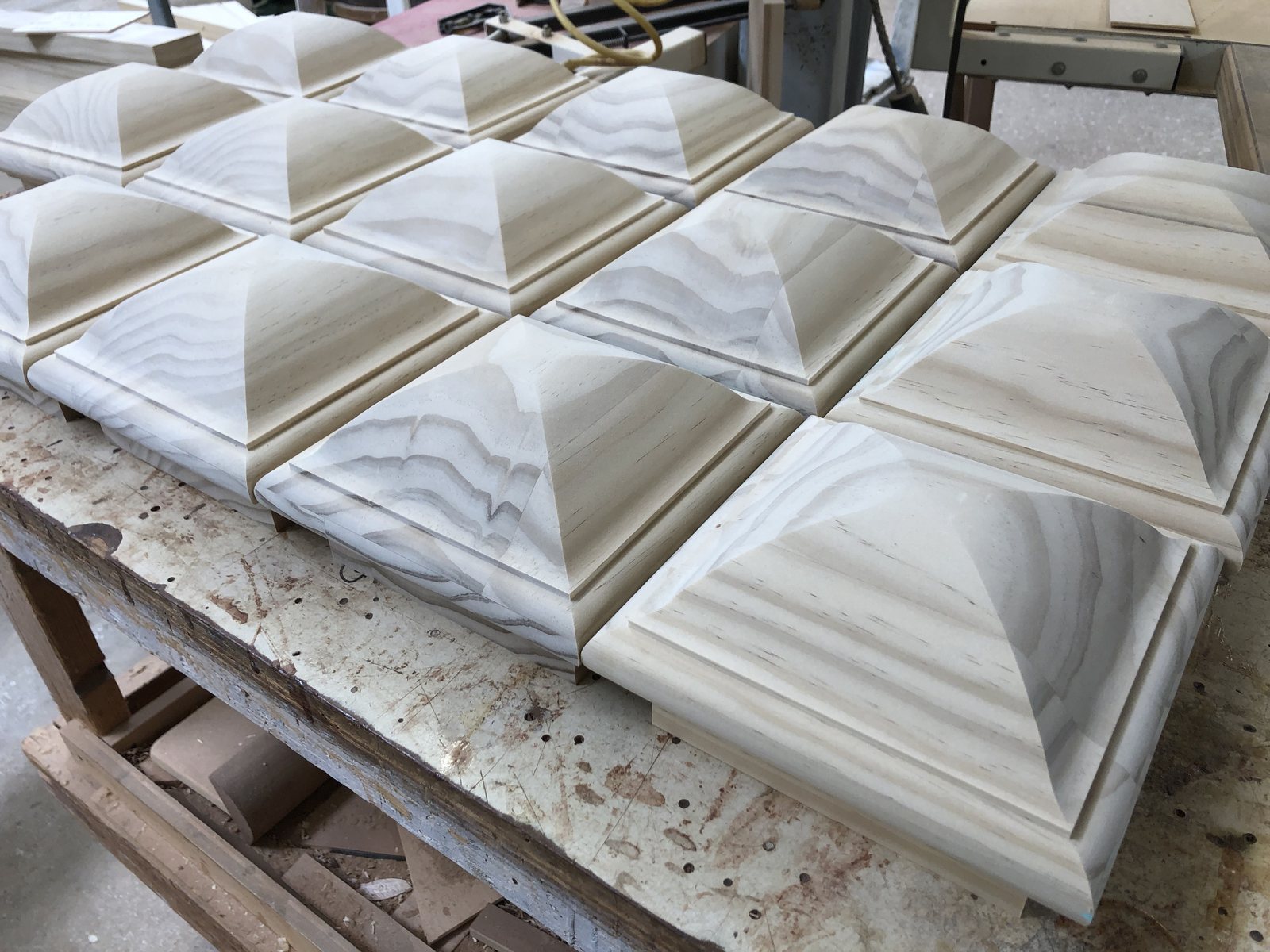
Framing caps are the part carpenters improvise and shops should not. Where beam or joist tops stay exposed, a milled cap in a durable species covers the end grain and the top face, and it can carry a center crown or a single-direction slope so water leaves in a known direction. The cap should overhang the framing member slightly on each side so the drip line falls clear of the face below. On a structure with exposed rafter tails, the same logic applies to the tail ends, and the tail profile and the cap detail belong on the same drawing so they do not fight each other visually.
Water management on horizontal wood is a drainage problem before it is a coatings problem. The rain control principles laid out by Building Science Corporation apply to a deck rail the same way they apply to a wall. Shed it, drain it, dry it. A finish is the last line, not the first.
Exterior stair parts fail at end grain and at the underside, which is exactly where a milled package helps and a stock purchase cannot.
Treads are the headline part. Thickness runs from 5/4 finished up through 8/4 for long unsupported spans, and the nosing profile should match whatever edge detail is running on the cap rail so the assembly reads as one piece of work. The underside of the nosing wants a drip kerf for the same reason the fascia does.
End grain on a tread is the most vulnerable surface on the whole structure. Sealing cut ends is field work and it is the installer's responsibility, but a shop can reduce how much of it there is. Treads milled to exact finished length, with the ends already machined and, where specified, primed on all six sides, leave far fewer raw cuts for the field crew to chase. Treads shipped long and cut on site leave two fresh end grain faces per piece.
Skirtboards are the part most worth ordering custom. A skirt milled to the rake angle, with the tread and riser housings already cut, turns a difficult scribe into a set piece. Riser stock in an open riser design is often omitted entirely, which shifts the visual weight onto the tread edge and the skirt, and that makes the tread thickness decision more consequential than it looks on paper.
Landing nosings and the transition where stair meets deck surface deserve their own detail. That joint is a horizontal seam in a high traffic area with water running through it, and a milled nosing with a return is a better answer than a butt joint dressed with caulk.
For milled, glued and machined exterior deck components, the working palette is Sapele, Iroko, Afrormosia, Teak and Utile, not the tropical decking species.
This distinction confuses people, so it is worth being direct. Ipe, botanically Tabebuia spp, along with Cumaru, Garapa, Jatoba and Red Balau, are outstanding walking surfaces. They are extremely hard and carry high oil content. Those same two properties make them difficult to glue and hard on knives, which is why a millwork house reaches for a different set of species when the part has to be moulded, laminated into a thick cap rail, or machined to a housed joint. The deck boards can be one thing and the milled components another. That is a normal, defensible specification.
Sapele runs roughly 1,410 lbf on the Janka scale, machines cleanly, and comes in a wider range of thicknesses and longer lengths than Genuine Mahogany, which sits near 800 lbf. For any deck component that will be painted, Sapele is the better call. It holds paint better and the size range is simply broader. One limit belongs in the spec. Sapele is not milled 1x8 for exterior use, since that width is too wide to stay stable in that thickness. Where a wide fascia is required, the answer is a thicker section, a different species, or two narrower boards with a milled reveal between them.
Iroko is the workhorse for exposed components where a natural or oiled finish is wanted, and it is dimensionally calm. Afrormosia machines to a very crisp edge, which shows on a moulded cap rail. Teak needs no argument. Utile behaves much like Sapele and is often the right substitute when a particular size or length is short. Technical data on Sapele and its relatives is public and worth checking against what a drawing assumes.
Western Red Cedar remains a legitimate default and always has been. The grade language is what matters. CVG, clear vertical grain, is a stable, knot free, quartersawn product that takes paint well and holds a milled profile. STK, select tight knot, is a different material with a different look and a different finishing expectation. Writing "cedar" without the grade on a rail package is how a job ends up with the wrong one.
Where dimensional stability outranks everything, modified wood answers. Accoya runs roughly 1,600 lbf, and acetylation gives it dramatically reduced shrinkage and swelling, which makes it a strong candidate for painted cap rail and wide fascia. Thermory and Abodo Vulcan are both carried and both worth considering. Two hard constraints travel with all of these. Modified woods top out around 16 feet, and most are sold on metric lengths just under 16 feet, because the kiln sets the limit. Thermally modified Ash is not available wider than 8 inches, so a wide board in a modified product means Accoya or Abodo Vulcan. Reference data from Thermory is a reasonable starting point on the thermal products.
One more item belongs in the specification rather than in a conversation later. Warranties exist on modified products. They do not exist on solid unmodified wood, and no supplier can offer one, since solid wood is an organic material that responds to its environment for as long as it is in service.
| Component | Cut and grain preference | Milled detail that sheds water | Set by the installer, not the shop |
|---|---|---|---|
| Cap rail | Quartersawn or rift where painted, longest clear lengths available | Slight top crown, eased edges both faces, relief kerfs on underside | Joint locations, fastener concealment, sealing of field cuts |
| Guard posts and post wraps | Heavier stock, vertical grain on exposed faces | Sloped or capped top, mitered and splined or rabbeted corners | Anchorage, blocking, load path into framing |
| Fascia | Flatsawn acceptable at narrow widths, quartersawn at wide face | Back bevel on top edge, drip kerf on underside of bottom edge | Back ventilation gap, fastener pattern, board spacing |
| Framing caps | Durable species, straight grain, milled thicker than looks necessary | Center crown or one-way slope, overhang past framing on both sides | Attachment method, sequencing before decking goes down |
| Stair treads | Quartersawn preferred, milled to exact finished length | Nosing profile with drip kerf underneath, machined ends | Riser height consistency, end grain sealing, support spacing |
| Skirtboard and landing nosing | Stable stock, rake angle and housings cut in the shop | Returned nosing rather than a butt joint at the landing | Field scribe to the structure, drainage plane behind |
Exterior deck components are milled to a 12 to 16 percent in-service moisture content, and putting interior numbers on exterior parts causes a specific, predictable failure.
Interior millwork is milled near 6 to 8 percent. Exterior work runs near 12 to 16 percent, which is where the wood will actually sit once it is outdoors in most of the country. Parts milled dry for an interior target and then installed outside will take on moisture, swell, and push joints apart. Parts milled wet will shrink and open gaps. The equilibrium moisture behavior behind all of this is documented in the Wood Handbook published by the USDA Forest Products Laboratory, and it is the single reference most worth having open while writing an exterior millwork spec.
Grain orientation is the other half. Quartersawn and rift stock moves less across its width than plainsawn, which is why it gets specified anywhere a painted or panelized surface has to stay flat. On a cap rail 5 inches wide and painted, the difference between quartersawn and plainsawn shows up as whether the paint film survives the second season. On a narrow baluster it barely registers.
Cupping deserves plain language, since it gets blamed on the wrong thing constantly. Cupping is driven by installation and back ventilation, not by species. A board that dries on one face and stays wet on the other will cup regardless of what tree it came from. Air behind the fascia and a drainage path under the framing cap do more for flatness than any species upgrade.
Grading language matters too. Hardwood grades follow National Hardwood Lumber Association rules, which describe clear cutting yield rather than the appearance of a finished face, and moulding and millwork conventions are set out by the Wood Moulding and Millwork Producers Association. A specification naming a grade and a moisture target has removed most of the ambiguity a shop would otherwise guess at.
A custom profile is not a special request, it is a knife grind, and new knives get ground every week.
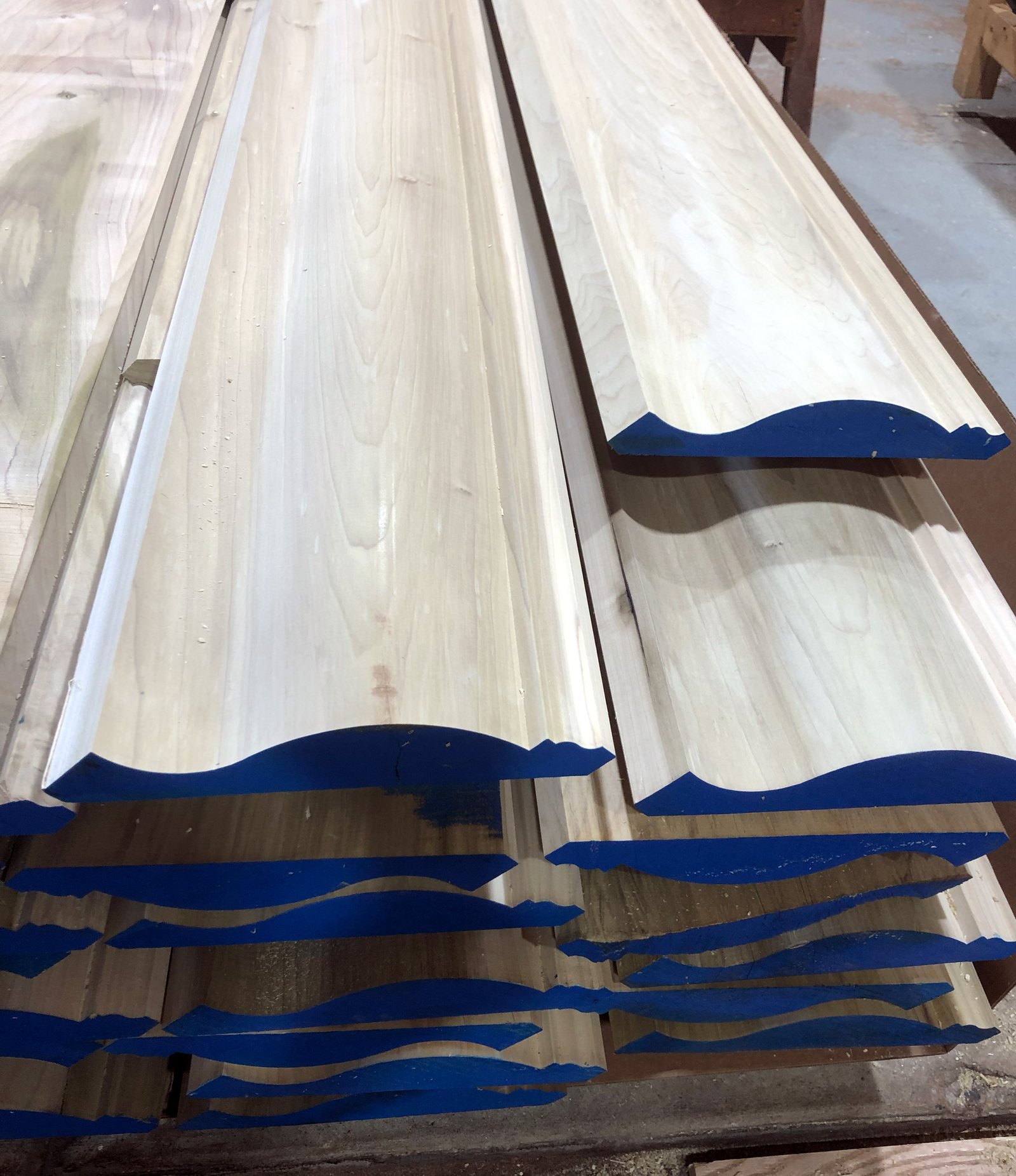
J. Gibson McIlvain runs moulders, custom knife grinders, straight line and gang rip saws, band resaws and trimming saws on its own floor, and maintains a moulding profile library holding thousands of profiles. If a cap rail profile, a fascia detail or a stair nosing is not already in that library, it gets ground to match, including difficult historical restoration profiles and contemporary shapes that exist nowhere in stock form.
That capability changes how a detail should be drawn. There is no reason to bend a design toward a stock ovolo when the correct profile can be ground from a full size section drawing. Send a section at full scale, or send a physical sample of the existing profile on a restoration job. On historic district work where like for like replacement is required, matching an existing exterior profile is standard practice, and the National Park Service preservation standards usually govern what matching means.
Radius work belongs in this conversation as well. Curved cap rail on a radiused balcony, a curved skirt at a winder, or a segmented fascia on a bowed edge are all buildable as radius trimwork and radius millwork. They need a full size template or a dimensioned radius with a spring line, not a note that says curved. ICD's trim profile work and its working process both start from that kind of drawing.
Priming exterior deck components in the shop produces a better painted surface than priming them on a sawhorse, and the reason is grain raising, not convenience.
Wood priming is offered in three levels, in both oil-based and water-based systems. Exterior primed trim should carry a fungicide additive in the primer. Open-grained and oily species absorb a great deal of finish, and a primer coat evens out what the eventual topcoat sits on, which is why a shop primed part paints out more uniformly than a raw one.
The step people skip is the one that matters most on a moulded part. Sanding or buffing after priming knocks back the grain raising the first coat causes while keeping the moulded detail crisp. Do that on a cap rail with a fine ovolo and the edge stays sharp. Skip it, and the second coat buries the profile in fuzz.
Six sided priming is the right call on fascia, framing caps and stair treads. The back face and the ends are where moisture gets in, and a part primed on five sides has a designed-in weak point. Field cuts still have to be sealed by whoever makes them, and that is genuinely the installer's job, but the fewer field cuts a package requires, the fewer chances there are to miss one.
Where the design calls for a natural finish rather than paint, the maintenance conversation should happen at specification time. An oiled Iroko or Teak cap rail on a south facing balcony will need recoating on a schedule. That is not a defect. It is the cost of the look, and it should land in the project's maintenance documentation rather than surface in year three as a complaint.
A milled deck package is only as good as its condition on the day the installer opens it, which makes storage and sequencing part of the specification.
Finished millwork can be stored for inventory control, which matters more on exterior work than most people expect. Deck components are frequently ready before the structure is. Holding primed cap rail and stair parts in a controlled environment until the framing is topped out beats delivering early and letting the package sit on a job site under a tarp, taking on moisture and drifting off the 12 to 16 percent target it was milled to.
J. Gibson McIlvain mills and ships these packages nationwide, regularly to California, so a matched order of rail, fascia, stair parts and framing caps can arrive in one delivery anywhere in the country. What ships is milled material. The company supplies and mills. It does not install and it does not perform field measurement, so dimensions have to come from the project team or the fabricator holding that responsibility.
That division of labor works best when the drawings are explicit about it. The shop controls species, grade, moisture content, profile, machining, priming and length. The installer controls fastener selection, back ventilation, blocking and anchorage, sealing of every field cut, and the drainage plane behind the fascia. Both lists have to be complete or the parts arrive correct and the assembly still fails.
Where a CITES-listed species is part of the package, documentation and chain of custody travel with the material, and the framework is published by CITES. Projects pursuing certified material can specify FSC chain of custody, which J. Gibson McIlvain carries as an FSC-certified importer and miller.
"The jobs that go smoothly are the ones where we get the stair rake angle and the finished lengths up front. We will grind the knife, we will hit the moisture target, we will prime all six sides. What we cannot do is guess at a dimension nobody measured, and I would rather have that conversation in week one than after the wood is milled."
Norm Moton, Director of Sales, J. Gibson McIlvain
How J. Gibson McIlvain Would Specify This
Start with exposure and finish, then pick the species. A painted rail and fascia package points to Sapele, or to Accoya where movement has to be near zero. A natural finish points to Iroko, Teak, Afrormosia or Utile. Cedar in CVG grade is a sound default where the budget and the look call for it, and the grade has to be written out. Tropical decking species stay on the walking surface, where their hardness earns its keep, and off the milled components, where their oil content works against glue lines and knives.
Write one moisture target, 12 to 16 percent, and put it on the component schedule rather than in a general note. Write the grain rule next. Quartersawn or rift on cap rail, wide fascia and stair treads. Plainsawn is acceptable on narrow parts and balusters.
Draw the water details at full size. Back bevel and drip kerf on fascia. Crown or one-way slope on framing caps with an overhang past the member. Drip kerf under the stair nosing. Crown or relief kerfs on cap rail. These are moulder passes, not custom fabrication, and a shop that has them on the drawing will simply cut them.
Specify shop priming at the level the project needs, in an oil-based or water-based system with a fungicide additive for exterior work, six sided, with a sand or buff after the prime coat. Then specify finished lengths wherever they are known, so the field makes as few fresh cuts as possible.
Name the profile source. Library match, custom grind from a full size section, or match to a physical sample on restoration work. Any of the three is workable. Silence is not.
Then call. Rail, fascia, stair parts and framing caps for an architectural exterior get quoted from a takeoff, not from a catalog, and the fastest route through it is a conversation with someone looking at the drawings. Reach the millwork team at 800-638-9100, review the J. Gibson McIlvain millwork service for linear trimwork, finished cladding and primed trim, and see what ICD builds on the true custom side at icdwoodwork.com. Structural and code questions on guards and stairs belong with the project's engineer of record and the standards published by WoodWorks and the American Wood Council. Component quality standards for architectural millwork come from the Architectural Woodwork Institute and are worth citing in the specification itself.
Frequently Asked Questions
Can the same species be used for the deck boards and the milled rail, fascia and stair parts?
It can, but on an architectural exterior it usually should not. Ipe, botanically Tabebuia spp, along with Cumaru, Garapa, Jatoba and Red Balau, are excellent walking surfaces because they are extremely hard. That hardness plus high oil content makes them difficult to glue and hard on knives, which is a problem for parts that get moulded, laminated into a thick cap rail, or machined to a housed joint. A millwork house reaches for Sapele, Iroko, Afrormosia, Teak or Utile on the milled components and lets the decking species do what it is good at underfoot. Specifying two species on one structure is normal practice, not a compromise.
What is a framing cap and why would I specify one instead of letting the carpenter improvise?
A framing cap is milled cap stock that sits on top of an exposed beam or joist, covering the end grain and the top face. Milled properly it carries a center crown or a one way slope so water leaves in a known direction, and it overhangs the member slightly on each side so the drip line falls clear of the face below. Improvised caps are usually flat stock cut to width, which holds water on the exact surface you were trying to protect. Drawing the cap means the crown and the overhang come off the moulder rather than getting negotiated on site.
How long can cap rail and fascia be supplied in a single piece?
That depends on the species. Solid tropical hardwoods such as Sapele, Iroko and Utile come in longer lengths than Genuine Mahogany and are the reason Sapele gets specified so often on long runs. Modified woods are a different story. Accoya, Thermory and Abodo Vulcan all top out around 16 feet, and most are sold on metric lengths just under 16 feet, because the kiln sets the limit. Anyone quoting a modified product longer than that is describing something that does not exist.
Which grain orientation should I call out for stair treads and wide fascia?
Quartersawn or rift where the part is wide, painted, or has to stay flat. Quartersawn and rift stock moves less across its width than plainsawn, which is why it goes on cap rail, wide fascia and stair treads. Plainsawn is fine on balusters and narrow trim where the total movement across the face is small. Note that cupping is driven by installation and back ventilation rather than by species, so grain choice helps but a fascia with no air behind it will still cup.
Does shop priming cover the field cuts, or does someone still have to seal ends on site?
Someone still has to seal them on site. Shop priming can be specified six sided on fascia, framing caps and stair treads, in oil based or water based systems, with a fungicide additive for exterior work. Every fresh cut made in the field exposes new end grain, and sealing those cuts is the installer's responsibility. The way to reduce the exposure is to have parts milled to exact finished length wherever the dimension is known, so there are fewer cuts to make and fewer chances to miss one.
Can a curved balcony cap rail or a curved stair skirt be milled to match a straight run?
Yes. Curved cap rail, curved skirtboards and segmented fascia on a bowed edge are all buildable as radius trimwork and radius millwork through ICD, the architectural millwork division of J. Gibson McIlvain. What the shop needs is a full size template or a dimensioned radius with a spring line, not a note reading curved. The straight and curved runs can be milled from the same profile and the same lot of wood so they read as one continuous element.
Is there a warranty on solid wood deck components?
No, and no supplier can honestly offer one. Solid unmodified wood is an organic material that responds to its environment for as long as it is in service, so it cannot be warranted. Warranties exist on modified products such as Accoya, Thermory and Abodo Vulcan. If long term movement is the governing concern on a painted cap rail or a wide fascia, that is the argument for specifying a modified product rather than for extracting a promise nobody can keep on solid stock.
What information should I send with a request for a deck component package?
A component takeoff with quantities and lengths, the species and grade, the finish intent, full size sections for every profile, and the stair rake angle. The rake angle in particular is set by the framing rather than by the shop, and having it means skirtboards can be milled to length with the tread and riser housings already cut. Add the fascia face width, the tread thickness, and whether risers are open or closed. Call 800-638-9100 with the drawings in front of you and most of this gets resolved in one conversation.
Sources and Standards Referenced
- Wood Handbook, Wood as an Engineering Material (FPL-GTR-190), USDA Forest Products Laboratory
- Codes and Standards, American Wood Council
- BSD-013: Rain Control in Buildings, Building Science Corporation
- ADA Guide, Ramps and Curb Ramps, US Access Board
- Sapele, The Wood Database
- Iroko, The Wood Database
- The Secretary of the Interior's Standards for the Treatment of Historic Properties, National Park Service
- National Hardwood Lumber Association
- Wood Moulding and Millwork Producers Association
- Architectural Woodwork Institute
- Accoya Acetylated Wood
- Thermory Thermally Modified Wood
- CITES, Convention on International Trade in Endangered Species
- Forest Stewardship Council