What a custom cabinet maker in exotic hardwood actually has to deliver
A shop that can draft, design and build a kitchen in exotic hardwood has to solve three problems at the same time, and the drawer box is the one that decides whether the job feels custom in year five. The drawing is the first problem. The material is the second. The interior parts are the third, and they are the ones that almost never appear on an architect's cabinet elevation. Drawer boxes, slide clearances, bottom thickness, back panel construction, blocking, scribe allowance, sink base geometry. None of that shows in a rendering. All of it shows the first time someone loads a deep drawer with cast iron and closes it with a hip.
Buyers searching for a custom kitchen cabinet maker that can draft, design and build in exotic hardwood species are usually reacting to something they already saw go wrong. A modular kitchen with filler strips at both ends of the run. Face frames that do not line up across an inside corner. Drawers that sag after two winters because the sides were half inch stock carrying a full load of cast iron cookware. Custom work is not a different door style on the same box. It is a box drawn for one room, one appliance package and one set of plumbing obstacles.
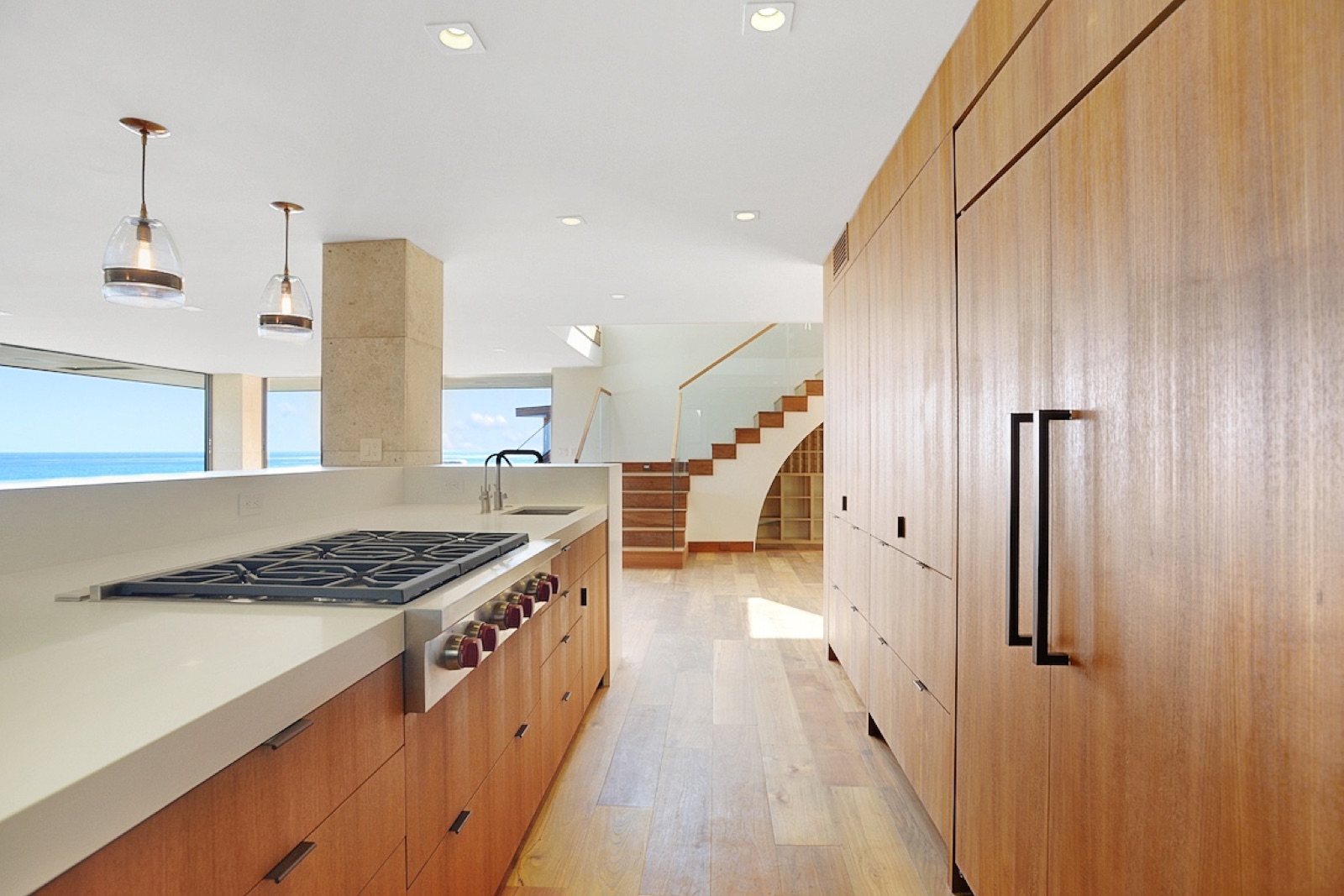
ICD, the architectural millwork division of J. Gibson McIlvain, builds cabinets and casework that way. Double walled construction where rigidity matters. Dovetail drawers with captive bottoms. Storage planned around the actual mechanical obstructions in the wall rather than around a catalog of standard widths. J. Gibson McIlvain imports and mills the Sapele, Utile, Iroko, Afrormosia and Teak that those interiors are cut from, and holds finished millwork in storage until the site is ready for it.
The drawer box is a structural assembly, not a container
A drawer box in a real kitchen carries live load, takes impact twice a day and has to stay square while doing it, which is why its joint, its stock thickness and its bottom capture belong on the drawing rather than in the builder's head. Treat it as furniture that happens to live inside a cabinet.
Start with the joint at the corner. A butt joint with fasteners is the fastest thing a shop can produce and the first thing to open up, because all of the racking load lands on mechanical fasteners in end grain. A dado or rabbet gives the joint a mechanical shoulder and a great deal more glue surface, and it holds well in a light or medium duty drawer. A dovetail resists the exact force a drawer sees most, which is the front trying to pull away from the sides every time somebody yanks a loaded pot drawer open. That is why dovetailed sides remain the default for work that is meant to outlive the kitchen around it.
Stock thickness follows the load, not the door style. Half inch sides are fine for cutlery, linens and spice storage. Deep drawers under a cooktop, pot drawers, pantry drawers and anything spanning more than about two feet of opening want five eighths or three quarter sides, and the difference is not cosmetic. A thicker side resists the cupping that pulls a drawer out of parallel with its slide, and it gives an undermount slide clip something to bite into.
Then the bottom. A quarter inch bottom floating in a groove is the standard detail and it is perfectly good under normal load. Under heavy load it deflects, and a deflecting bottom in an undermount system drops onto the slide mechanism and drags. The fix is either a thicker captive bottom or a bottom set into a deeper groove closer to the vertical center of the side, so the panel is working in a stiffer position. Captive bottoms, which are trapped in the assembly rather than slid in and tacked, also keep the box square permanently. A drawer that stays square is a drawer whose slides keep working.
Exotic species behave differently once they are inside a cabinet
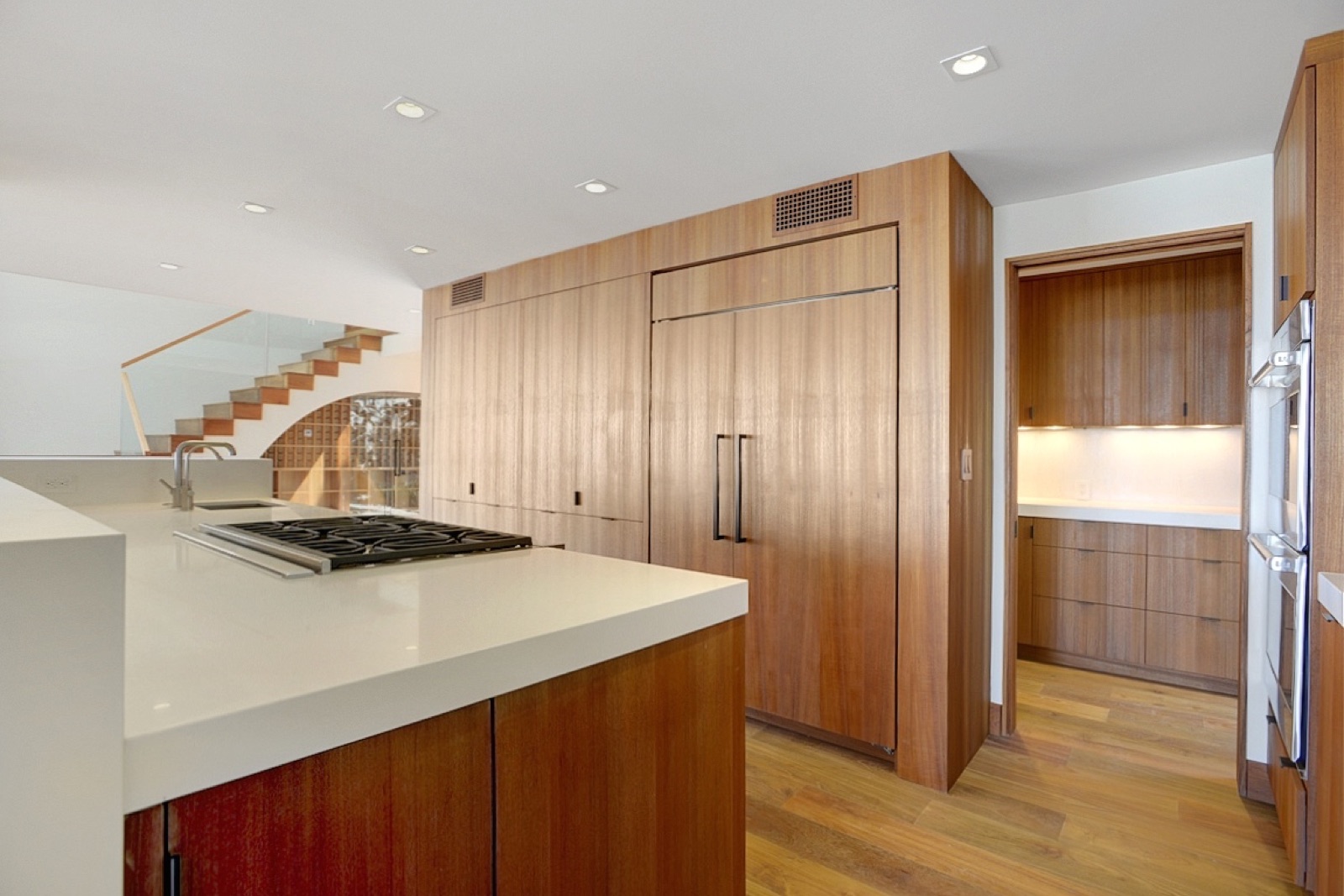
The millwork palette for cabinet interiors is Sapele, Iroko, Afrormosia, Teak and Utile, with quartersawn White Oak, Hard Maple and Cherry covering the domestic side, and each of them machines and glues differently enough that the species choice changes the shop drawing.
Sapele runs roughly 1,410 lbf on the Janka scale, close to Hard Maple at roughly 1,450 lbf and above White Oak at roughly 1,360 lbf. It has interlocked grain, which produces the ribbon figure everyone wants on a quartered face and produces tearout everywhere else if the tooling is dull or the pass is too aggressive. The published workability notes on Sapele also flag its reaction with iron, which is a real detail in casework. Ferrous fasteners and clamps leave black staining on tannin-rich stock, so a shop that builds in Sapele reaches for stainless and keeps steel off damp surfaces.
Oil content is the other variable that separates a millwork species from a decking species. Teak is dimensionally calm and lovely in a galley-style interior, and it also needs a solvent wipe immediately before glue-up so the adhesive can reach clean fiber. Iroko is coarser, harder on knives and occasionally carries mineral deposits. Afrormosia machines about as cleanly as anything on the list and holds a crisp arris, which makes it a favorite for exposed dividers and fine interior detail. Utile behaves like a calmer Sapele with straighter grain, and it shows up wherever a wide, even panel is wanted.
| Species | Grain and movement character | Machining and adhesive behavior | Where it earns its place inside the cabinet |
|---|---|---|---|
| Sapele | Interlocked, ribbon figure on the quarter, moderate movement, Janka roughly 1,410 lbf | Sharp tooling and light passes to control tearout, glues well, stains black against ferrous metal | Drawer fronts and exposed sides that must match door and face frame stock |
| Utile | Straighter grain than Sapele, milder ribbon, wide clear stock available | Predictable to machine, mills to consistent thickness, glues cleanly | Wide end panels, backs and drawer sides where consistency across a run matters |
| Iroko | Coarse texture, interlocked grain, some natural oil, dimensionally steady | Blunts knives faster, can carry mineral deposits, degrease before glue-up | Heavier casework parts, exposed shelving, interiors near a sink or dishwasher |
| Afrormosia | Fine even texture, Teak-like appearance without Teak oil loading | Machines and glues cleanly, holds a crisp edge and a sharp moulded detail | Visible drawer sides, dividers, cutlery trays and fine interior joinery |
| Teak | Very stable, high natural oil, mellow color shift over time | Requires solvent wipe immediately before glue-up, adhesive selection matters | Galley-style interiors and exposed structure that must not move |
| White Oak, quartersawn or rift | Ray fleck on the quarter, low movement across the width, Janka roughly 1,360 lbf | Machines and glues well, tannin reacts with iron and with some water-based finishes | Drawer boxes and any panel that has to stay dead flat under paint or clear finish |
| Hard Maple | Closed pale grain, uniform texture, Janka roughly 1,450 lbf | Burns if feed rate drops or knives dull, glues well, sands to a bright surface | The classic bright drawer box interior, clear finished or paint grade |
| Cherry | Fine grain, darkens with light exposure, Janka roughly 950 lbf | Machines beautifully and glues well, dents more readily than the others | Interior faces, dividers and light duty drawer sides rather than pot drawers |
Two species notes worth writing down. First, the tropical decking woods, Ipe, botanically Tabebuia spp, along with Cumaru, Garapa, Jatoba and Red Balau, are extremely hard and carry high oil content, which makes them stubborn to glue and hard on cutters. A decking yard reaches for them constantly. A millwork shop building glued and machined cabinet components reaches for Sapele, Iroko, Afrormosia, Teak or Utile instead. Second, where a species is CITES listed, the documentation and chain of custody travel with the material, and a buyer specifying imported hardwood for a permanent installation should expect that paperwork as part of the delivery. The CITES framework and FSC chain of custody both exist to make that traceable.
Slide hardware sets the box dimensions before the designer does
The slide is chosen first and the drawer box is drawn to it, never the other way around, because the hardware manufacturer publishes clearances that the box either honors to a sixteenth or fails.
Side-mount ball bearing slides are the forgiving option. They want roughly half an inch of clearance per side, they tolerate a small amount of variation, and they let a shop build a box of almost any material. They are also visible when the drawer is open, and they cap the usable interior width.
Undermount slides are the ones that punish a sloppy drawing. They require a specific relationship between the drawer box width and the cabinet opening, a specific bottom thickness, a specific setback from the front, and a notch in the back of the box so the locking device can engage. Some systems also want a defined distance from the bottom of the drawer sides to the bottom panel. Miss any one of those and the slide either will not latch or will run with a bind. There is no field fix. The numbers come from the hardware manufacturer's own template, and a shop drawing that does not carry them is an incomplete drawing.
Depth is its own decision. A slide length must fit inside the cabinet depth with room for the back panel and for any plumbing or ductwork the case is built around. Full extension gets the back of a deep drawer clear of the countertop overhang so somebody can actually see into it. Over-travel buys another inch or two and is worth it under a deep counter. Soft close changes closing force but does not change the box, and heavy duty ratings change the required side thickness because the clip has to bear on solid material.
Weight rating deserves a sentence of its own. A pot drawer three feet wide, loaded, gets past a light duty rating quickly. Rate the hardware for what the drawer will actually hold rather than for what it holds on move-in day.
Moisture content and how the board was sawn decide whether it stays flat
Interior millwork is milled to an in-service moisture content near 6 to 8 percent, and quartersawn or rift stock moves less across its width than plainsawn, which is why cabinet parts that must stay flat get specified that way on purpose.
A kitchen is not a stable room. It swings with the dishwasher, the range hood, the seasonal heating and the sink. Wood moisture content tracks relative humidity rather than absolute humidity, a point the Building Science digest on moisture and materials makes plainly, and the practical result is that the same drawer front that fits in February can bind in August if it was milled to the wrong moisture content for the room it ends up in. The Forest Products Laboratory Wood Handbook remains the reference for shrinkage coefficients and equilibrium moisture behavior by species.
Sawing pattern is the lever a specifier actually controls. Plainsawn stock is wider, more figured and yields more usable width from the same log, and it moves roughly twice as much across the width as quartered stock of the same species. For a wide drawer front, a tall end panel or a flat five piece door, that difference is the whole ballgame. Quartered and rift stock is what keeps a painted panel from telegraphing a cupped joint through the finish.
Storage on site matters as much as milling. The AWI care and storage requirements exist because finished casework left in an unconditioned garage for six weeks will not measure the same when it goes in. Cabinets belong in a climate-controlled space once the building is dried in.
The parts nobody specifies are the parts that fail
Back panels, blocking, sink base geometry, toe kick construction and scribe allowance never appear on a design elevation, and every one of them determines whether the finished kitchen looks built or looks assembled.
Back panels first. A quarter inch back stapled into a rabbet is a dust cover, not a structure. A cabinet with a thin back racks, and a racked cabinet throws its doors out of alignment no matter how well the doors were made. Casework meant to carry stone wants a substantial back captured in a groove on all four sides, or a double walled construction where the load path is continuous.
Blocking is invisible and non-negotiable. Undermount slides need something solid to land on. Pull-out trash mechanisms need a bottom that will not deflect. Any drawer running in a cabinet that also contains a plumbing trap needs the case reinforced where material was removed for the obstruction. That reinforcement gets drawn, not improvised.
Sink bases are the single most abused cabinet in a kitchen and the one most likely to be delivered as a standard module with a false front tacked to it. The better answer is a shallow U-shaped drawer that wraps the trap and gives back the storage the plumbing took, or a tip-out that actually holds something. That requires knowing where the trap and supply lines land before the case is built, which is a coordination question that belongs in the drawing phase.
Toe kick construction is a choice, not a default. An integral toe kick cut into the case sides is stronger and simpler to produce. A separate ladder base lets an installer level a long run on an uneven floor and set every case to a single reference plane, which is usually the better result in a renovation. Either way the exposed toe kick face should be a finished, scribable part.
Scribe allowance is the last one and the one that separates custom from modular. A run that ends against an out-of-plumb wall needs extra material at the end panel for the installer to cut away. That is what makes a custom kitchen sit tight to the wall without a filler strip. J. Gibson McIlvain and its architectural millwork division, ICD, supply and mill the work. The cutting, leveling and fastening on site is the installer's craft, and the shop's job is to hand that installer parts with the allowance already built in.
The countertop material changes how the cabinet underneath is built
Stone, quartz and solid wood counters impose completely different requirements on the casework below them, and a cabinet built without knowing which one is coming is a cabinet built on a guess.
Stone and engineered quartz are heavy and unforgiving of deflection. They want continuous bearing along the full perimeter of the cabinet run, a flat and coplanar top edge across every case, and additional support at any span crossing a dishwasher opening or an unsupported overhang. An undermount sink adds its own load, and the support rails for it have to exist in the case before the fabricator arrives. A drawer bank under a stone top loses the top rail as a stiffener, so the case sides and back have to carry more.
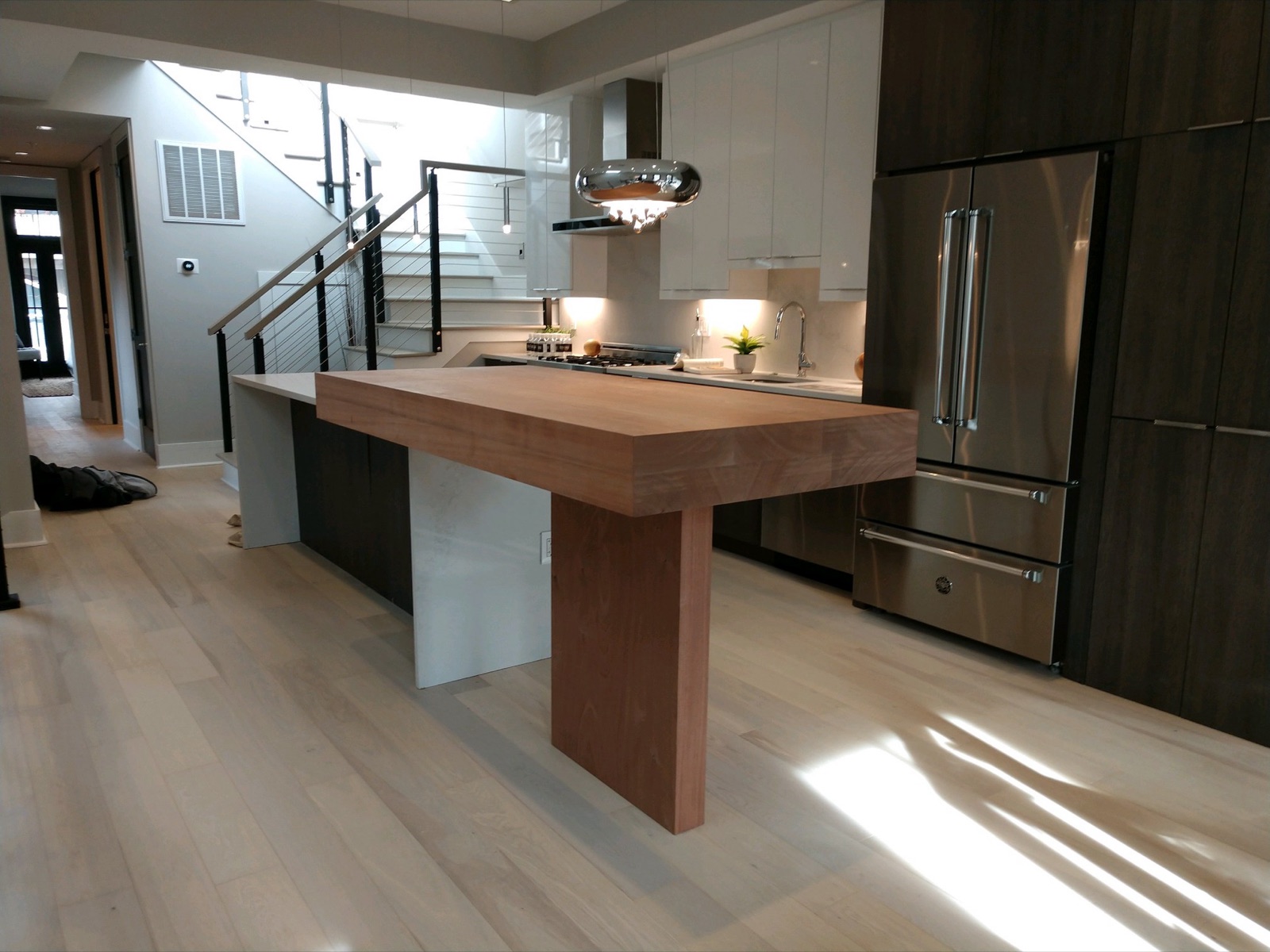
Solid wood countertops are the opposite problem. They move seasonally across the width, sometimes substantially, and they have to be fastened in a way that allows that movement. Elongated slots or figure eight fasteners, never a fixed screw pattern through a rigid subtop. A wood top fastened solid against a cabinet run splits. That detail lives in the cabinet drawing, not in the countertop order.
The AWI countertop standards cover the substrate and support expectations in more detail, and they are the reference a specifier can cite in a submittal.
Drafting is the phase where the exotic species decision is actually made
A shop drawing package is where species, grain orientation, joint type, slide model, hardware clearances and blocking all become one coordinated document, and a project that skips it is a project that will discover its conflicts on site.
ICD works in three phases on its documented process. Architectural plans are reviewed and an itemized quotation is prepared. Once that is accepted, a full set of shop drawings goes back for review and approval. Fabrication starts only after the drawings are signed. That sequence is what lets a buyer catch the sink base conflict, the appliance clearance, the grain match across a run of drawer fronts and the reach range issue on an accessible design while everything is still lines on paper.
Grain match is the item that gets forgotten most. A bank of four drawer fronts cut from one board, in sequence, reads as one piece of furniture. The same four fronts cut from four random boards read as four parts. In a figured species like Sapele the difference is dramatic. Sequencing the fronts takes nothing more than a note on the shop drawing, and the chance to do it is gone once the boards are cut.
The dimensions themselves have to come from somewhere verified. J. Gibson McIlvain supplies and mills, and it does not perform field measurement or installation, so the builder, the general contractor or the installing carpenter provides confirmed field dimensions before shop drawings are finalized. That is the standard division of responsibility on architectural woodwork, and the AWI architectural wood casework standard is written around it.
"The kitchens that go wrong are almost never the ones where somebody picked the wrong species. They go wrong because nobody wrote down the slide model before the boxes were cut, or nobody knew a stone top was coming. We would rather spend two extra weeks in shop drawings than have a customer discover in their own kitchen that the pot drawer will not clear the trap."
Norm Moton, Director of Sales, J. Gibson McIlvain
For designs that need to work for every user in the household, reach ranges and clearance dimensions from the ADA accessibility standards are a useful reference even in a residence, where nothing is legally required. Drawer storage rather than deep base shelving is usually the practical answer.
Finish and priming decisions belong in the shop, not on the jobsite
A drawer box finished before assembly, and a paint grade component primed before it leaves the shop, both end up better than the same part coated in a house full of dust.
Interior drawer boxes in Hard Maple, White Oak or Afrormosia are commonly given a clear finish for washability. The reason is not appearance. A sealed interior surface resists the moisture that a wet colander or a warm dishwasher releases, and it wipes clean. Leave the interior of a drawer bare and it will take on stains that never come out.
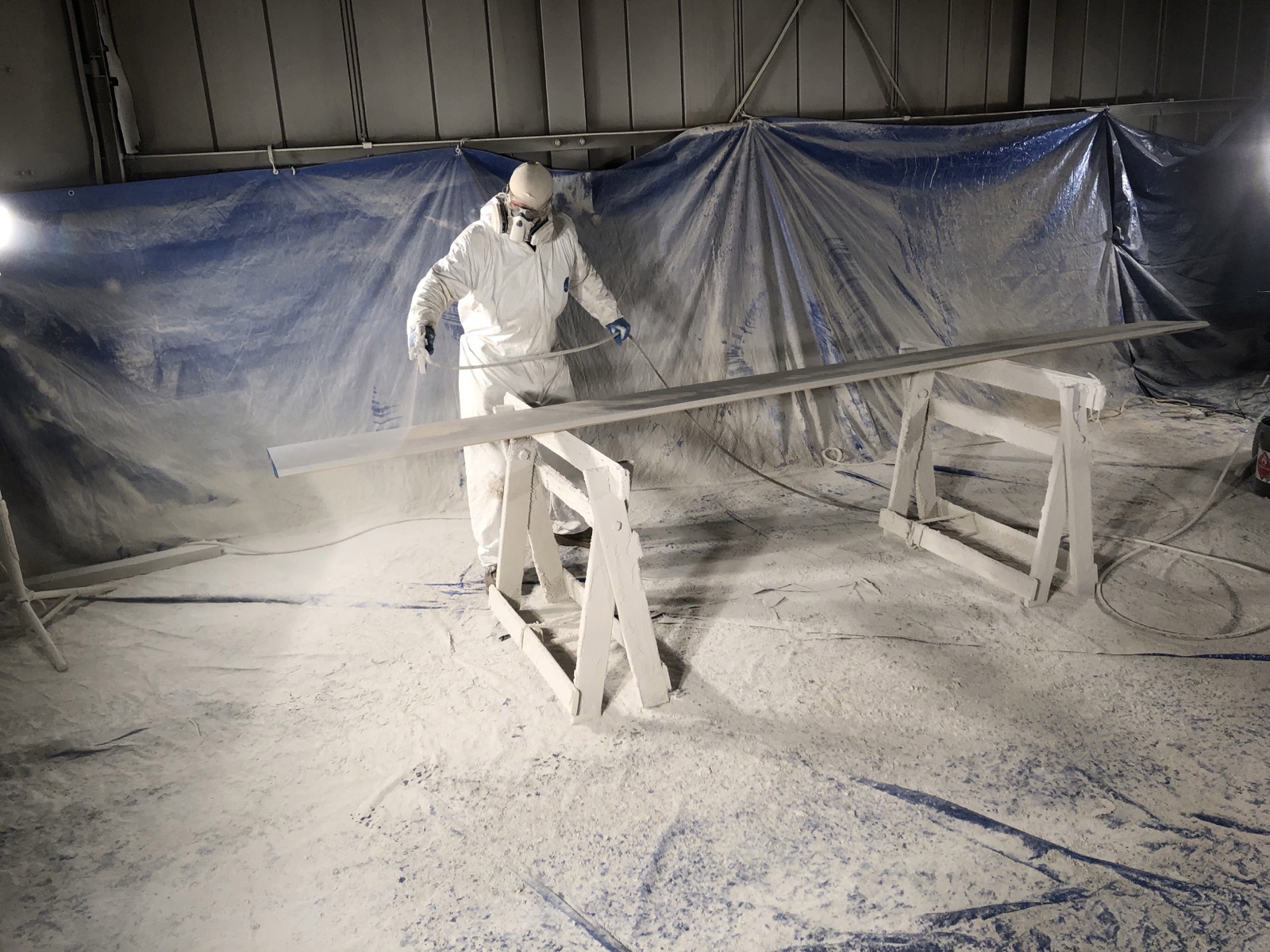
On the paint grade side, J. Gibson McIlvain runs wood priming in three levels, in both oil-based and water-based systems. Priming in a controlled shop knocks back the grain raising that always happens on the first coat, and sanding or buffing after that first coat leaves a moulded detail crisp instead of fuzzy. Open-grained and oily species absorb a great deal of finish, and a primer coat is what evens out the eventual painted surface so the topcoat looks like one plane. The same millwork services that produce primed trim apply to paint grade cabinet components. Exterior primed trim carries a fungicide additive, though that is a separate conversation from kitchen work.
Solid unmodified wood carries no warranty from anyone, and that is not a dodge. It is an organic material that responds to its environment for as long as it is in the building. Warranties exist on modified products such as Accoya, which runs roughly 1,600 lbf on the Janka scale and whose acetylation gives dramatically reduced shrinkage and swelling, and that is an exterior conversation rather than a cabinet interior one.
Sequencing, storage and getting the work to the site intact
Finished casework is the most fragile thing that will ever enter the house, and the schedule around it matters as much as the joinery inside it.
Cabinets should not arrive before the space is conditioned, and they should not arrive so late that the countertop template is holding up the trades behind it. J. Gibson McIlvain stores finished millwork for inventory control, which is the practical answer to a site that slips. The work waits in a controlled environment instead of on a slab under plastic.
Material selection also has to survive the trip. J. Gibson McIlvain ships nationwide and regularly to California, and imported hardwood casework that crosses the country needs packaging that protects arrises and faces, because a chipped edge on a figured Sapele drawer front is not a repair, it is a remake. Lumber grading feeds directly into that. Hardwood graded under the NHLA rules gives a predictable yield of clear cutting area, which is what lets a shop promise a run of matched fronts in the first place.
How J. Gibson McIlvain Would Specify This
Write the interior of the cabinet into the specification with the same precision the elevation gets, and the exotic species will take care of itself.
Name the drawer box species and its sawing pattern. Quartersawn or rift for anything wide. Sapele, Utile, Iroko, Afrormosia or Teak on the imported side, quartersawn White Oak, Hard Maple or Cherry on the domestic side, and match the drawer front stock to the door stock from the same lot so the color reads as one kitchen.
Name the corner joint and the stock thickness by drawer duty. Dovetail with a captive bottom for anything that will hold weight. Five eighths or three quarter sides for pot drawers, deep drawers and any opening wider than roughly two feet. Half inch sides only where the load is genuinely light.
Name the slide by manufacturer and model, with its length, extension type and weight rating, before shop drawings are produced. Undermount clearances, notch geometry and bottom thickness all come from that one decision.
Name the countertop material at the drawing stage. Stone means continuous bearing, a coplanar top edge and support at the dishwasher opening and any overhang. A wood top means slotted fastening so the counter can move.
Name the interior fittings. Cutlery dividers, knife storage, tray dividers, pull-out trash, spice storage and any drawer that has to wrap a plumbing trap. Those are the specialty items that get engineered in rather than added later.
Specify an interior clear finish on drawer boxes, and shop priming on any paint grade component. Specify moisture content near 6 to 8 percent for interior work and require conditioned storage on site. Confirm field dimensions through the builder or installing carpenter before drawings are released, and expect chain of custody documentation to arrive with any CITES listed species.
ICD, the architectural millwork division of J. Gibson McIlvain, drafts, designs and builds kitchens on exactly that basis, from custom casework through box beams, custom doors, radius trimwork, shutters, benches and railings. To start a drawing set or to talk through a species and hardware combination for a specific kitchen, call J. Gibson McIlvain at 800-638-9100.
Frequently Asked Questions
Can a custom cabinet maker draft, design and build an entire kitchen in an exotic hardwood species, or only the doors and fronts?
The whole kitchen can be built in the imported species if that is what the drawing calls for, including drawer sides, dividers and exposed interiors. Most buyers choose a hybrid. Doors, face frames and drawer fronts run in Sapele, Utile, Iroko, Afrormosia or Teak for the visible grain, and drawer boxes run in quartersawn White Oak, Hard Maple or Afrormosia for a bright, hard, washable interior. That combination gives the look people are after without putting figured stock where nobody sees it. ICD, the architectural millwork division of J. Gibson McIlvain, prepares the shop drawings that lock those choices down before anything is cut.
What drawer box construction should I specify for heavy pot drawers?
Dovetailed corners with a captive bottom, sides at five eighths or three quarter thickness, and a bottom panel thick enough that it will not deflect onto the slide mechanism under load. Specify the slide by manufacturer and model with its weight rating at the same time, because the required side thickness and the notch geometry in the back of the box both come from the hardware, not from the designer. A three foot wide loaded pot drawer will exceed a light duty slide rating quickly.
Why do millwork shops avoid Ipe, Cumaru and the other tropical decking species for cabinet work?
Those species, including Ipe, botanically Tabebuia spp, along with Cumaru, Garapa, Jatoba and Red Balau, are extremely hard and carry high oil content. That combination makes them difficult to glue reliably and hard on cutting tools, which is exactly the wrong set of properties for glued and machined cabinet components. They are excellent decking woods. For milled interior work a millwork house reaches for Sapele, Iroko, Afrormosia, Teak or Utile instead.
Does J. Gibson McIlvain install the cabinets or take field measurements?
No. J. Gibson McIlvain supplies and mills, and its architectural millwork division, ICD, drafts, designs and builds the casework. Confirmed field dimensions come from the builder, the general contractor or the installing carpenter before shop drawings are finalized, and installation is handled by that installer. The shop's part of that division of responsibility is delivering parts with scribe allowance already built in, a finished and scribable toe kick face, and blocking where the hardware needs to land.
What moisture content should custom kitchen cabinets be milled to?
Interior millwork is milled to an in-service moisture content near 6 to 8 percent. Exterior work runs much wetter, near 12 to 16 percent, which is why exterior and interior stock are handled separately. Just as important, the finished cabinets need to sit in a conditioned space once they reach the site. Casework stored in an unheated garage for six weeks will not measure the same when it goes in.
Do I get a warranty on solid exotic hardwood cabinetry?
No, and no supplier can honestly offer one. Solid unmodified wood is an organic material that keeps responding to humidity for as long as it is in the building, so it cannot be warranted the way a manufactured product can. Warranties exist on modified products such as Accoya, which is an exterior material rather than a cabinet interior one. What a specifier can control is species selection, sawing pattern, moisture content at milling and conditioned storage, and those four decisions do most of the work.
Why does the countertop material need to be decided before the cabinets are built?
Stone and engineered quartz require continuous perimeter bearing, a coplanar top edge across the whole run and extra support at dishwasher openings and overhangs, plus support rails for an undermount sink that must exist in the case before the fabricator arrives. A solid wood countertop needs the opposite, a fastening method with elongated slots that lets the top move seasonally without splitting. Those are different cabinets, and the decision belongs in the drawing phase.
Sources and Standards Referenced
- Wood Handbook, Wood as an Engineering Material (FPL GTR-190), USDA Forest Products Laboratory
- AWI Architectural Woodwork Standards, Architectural Wood Casework
- AWI Architectural Woodwork Standards, Care and Storage
- AWI Architectural Woodwork Standards, Countertops
- BSD-138: Moisture and Materials, Building Science Corporation
- Sapele species profile, The Wood Database
- NHLA Grading Rules, National Hardwood Lumber Association
- ADA Accessibility Standards, United States Access Board
- FSC Chain of Custody Certification
- CITES, Convention on International Trade in Endangered Species of Wild Fauna and Flora