Why a Curved Wall Breaks the Base Line
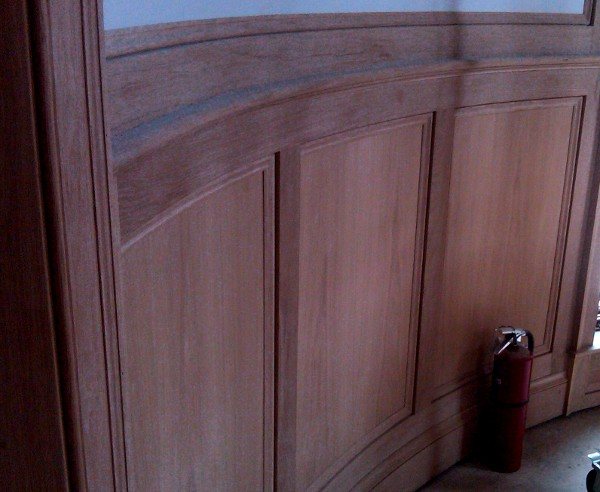
A curved wall asks the base assembly to satisfy two geometries at the same time, the radius of the wall and the plane of the floor, and the shoe is the only member of the stack with any room to negotiate. Straight base lies flat against a flat surface, so fit is a single question of scribe. Set that same stock against a radius and it bears at the two ends only. The gap behind the middle grows with the thickness of the blank and with the tightness of the curve, which is why a 1 inch base on a 4 ft radius is a different problem from the same base on a 20 ft radius.
The floor line is what people read from across the room. A base that climbs or dips as it travels the curve looks like a sagging line even when every joint is tight and every face is flush. Eyes follow the top edge of the base and the shadow under the cap, not the wall surface behind them. Three lines that each wander a little, in different directions, are what make a curved room look assembled instead of designed.
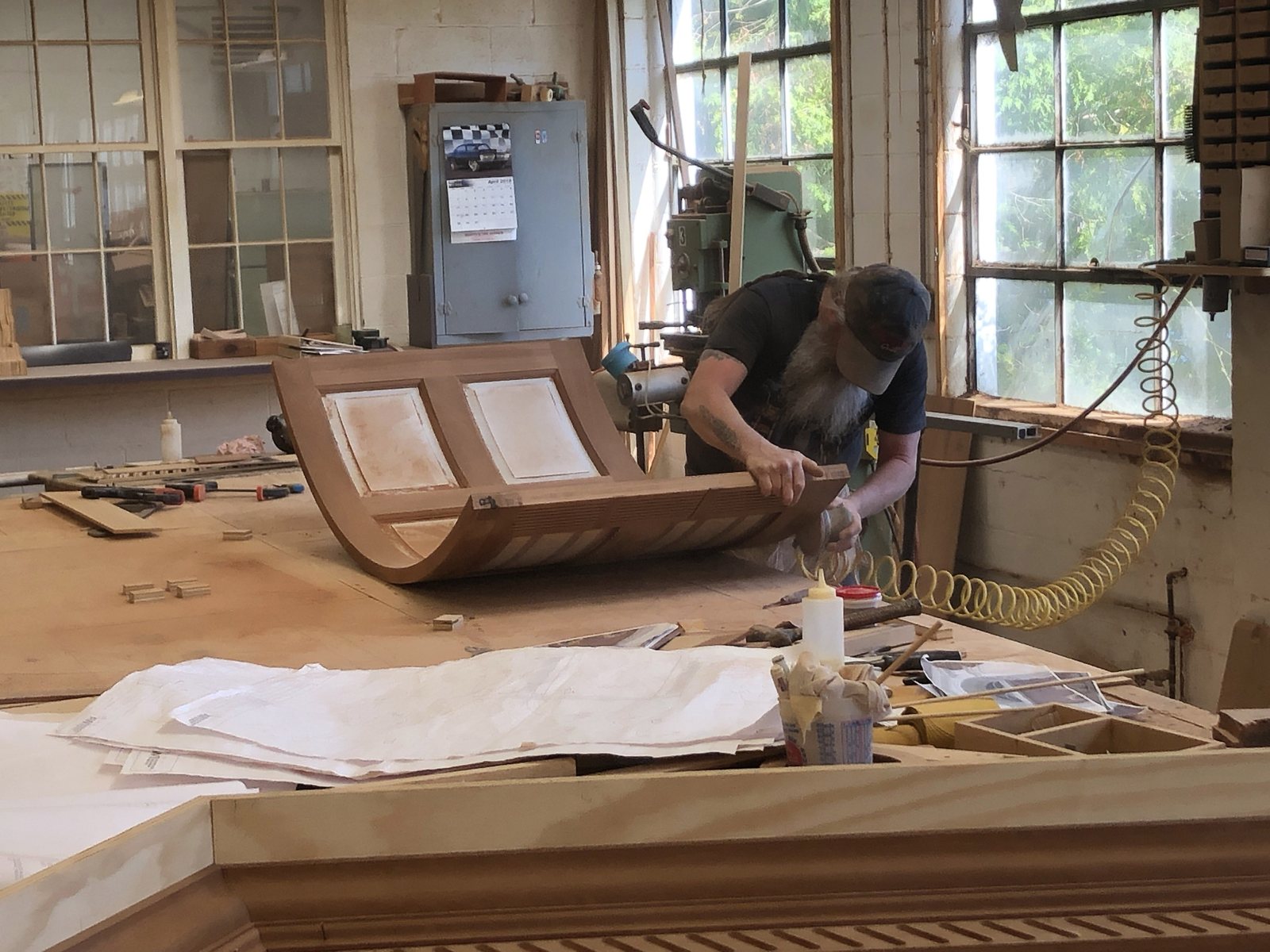
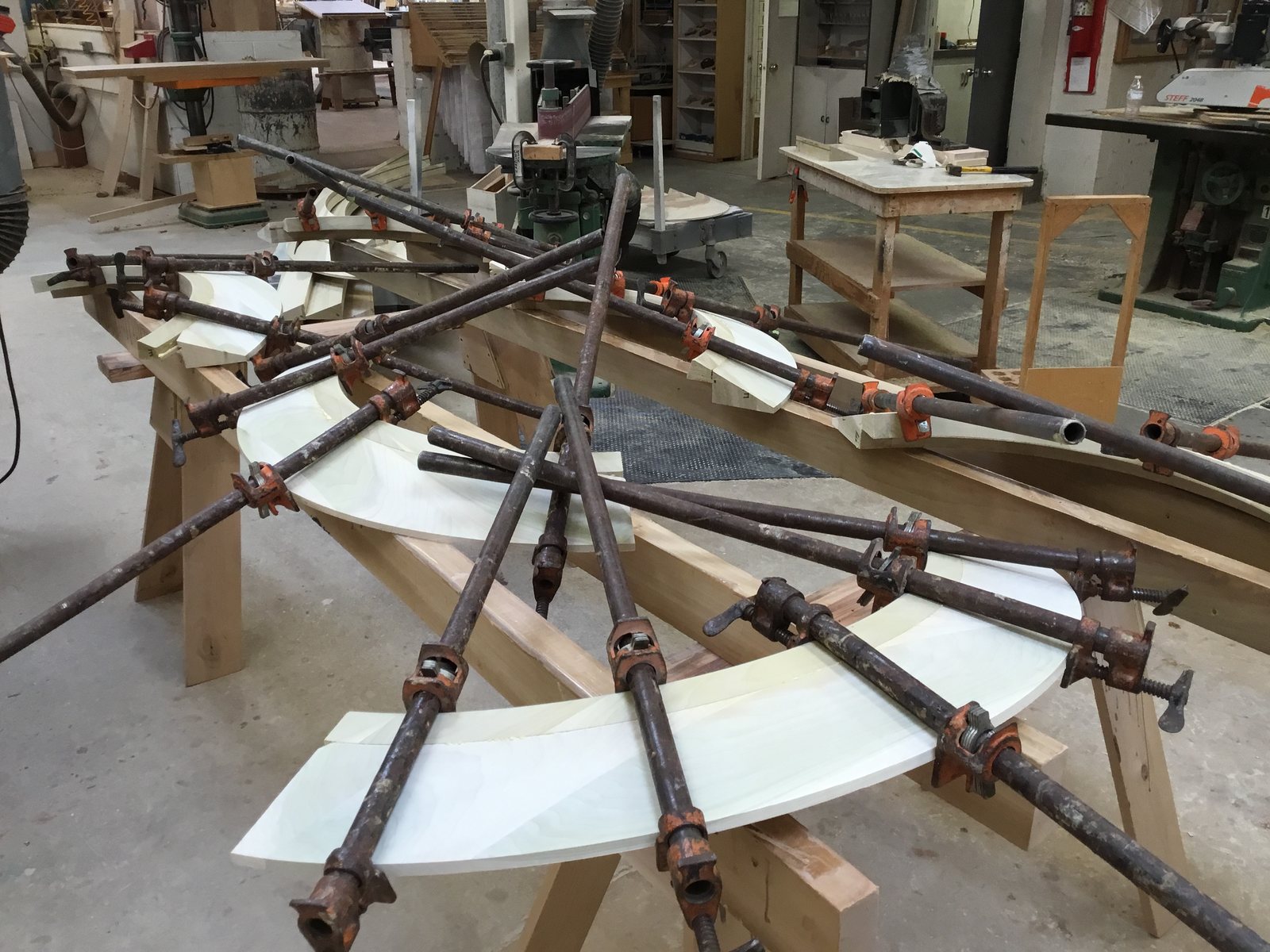
This is a shop problem long before it is a site problem. A crew can scribe a shoe to a wavy floor and can ease a cap into a plaster transition, but nobody can bend a milled base into a true arc at the wall and expect the top edge to stay level. The arc has to be built into the blank, and the blank has to be cut from stock that was dried and graded for that job.
What Each Member of the Assembly Does
Base carries the profile and the height, shoe takes up the floor, and cap resolves the top edge into the wall, and on a radius each one fails in its own way. Treating the three as one line item is the first mistake on a curved interior, since they are produced differently, they move differently and they are set in a different order.
The base board is the thickest member and the least forgiving. It holds the design height, so any change in its vertical dimension around the curve shows up immediately where the curve meets the straight run. It is also the member that has to be laid out from a real radius rather than a nominal one. Drawings give the design radius. Framing, lath, board and skim coat give something else.
The shoe is the working joint. It is small, it is cheap to replace, and its whole purpose is to absorb the difference between a floor that is never perfectly flat and a base that has to stay true. A shoe milled to the radius sits down on the floor and takes the scribe with a light pass. A shoe ripped straight and sprung into place will open at the heel in a few months of seasonal movement.
The cap, where the design calls for one, does the quietest work and takes the most abuse in the layout. It has to hold a constant reveal over the base face while following the same arc, and its back has to meet a wall plane that may be slightly conical rather than cylindrical. Running the cap slightly proud of the base face and planning the reveal as a shadow rather than a flush meeting gives the crew somewhere to put the error.
Three Profiles, Three Knives, One Stack Height
The three members have to be ground and run as a set, so that total height, projection and the reveals between them stay identical where a straight wall turns into a curved one. Each member needs its own ground knife. The set is what makes the transition invisible.
J. Gibson McIlvain holds a moulding profile library of thousands of ground knives and grinds new ones every week, including historical restoration profiles and contemporary profiles that are not yet in the library. A matched base, shoe and cap for a curved room is three records in that library rather than one. The profile ground for the straight run is the profile run on the curved blank, which is the only honest way to get a seamless meeting at the tangent point.
Projection matters more than height on a curve. A deeper profile means more material removed from the back of a curved blank and more visible variation if the arc drifts even slightly, so a buyer specifying base for a tight radius is usually better served by a taller, shallower profile than by a short, heavily sculpted one. The Wood Moulding and Millwork Producers Association publishes standard profile references that make a useful starting point for that conversation, and a custom grind proceeds from there. See WMMPA for the standard series.
ICD, the architectural millwork division of J. Gibson McIlvain, builds the curved members as true custom work planned around the specific space, and the division's trim profile work starts from the same knives that run the linear footage. One drawing, one species lot, one profile set.
Base, Shoe and Cap Compared on a Radius
The three members diverge sharply once a radius is involved, in how the curve gets produced, in how much site error each one can swallow, and in what the grain has to do. The table below is that layout conversation in short form.
| Member | How the curve is produced | Site error it can absorb | Grain and stock call |
|---|---|---|---|
| Base board | Laminated blank built from resawn laminae, or segments cut from solid and joined, with the profile run after the blank holds its arc | Very little, since its height and projection set the design line | Quartersawn or rift stock, matched for color across the whole run including the straight legs |
| Shoe | Milled to the radius from a thin laminated or sawn blank, in short runs with a generous allowance for waste | The most of the three, since its job is to scribe to the floor | Straight grain, small section, same species and lot as the base when stained |
| Cap | Laminated or segmented like the base, run slightly longer than the arc so the tangent cuts happen at the site | Moderate, as long as the reveal over the base face is planned as a shadow | Tight, even grain so the reveal edge stays crisp under paint or finish |
Notice what the table implies about ordering. Shoe is where the waste allowance belongs, base is where the color matching belongs, and cap is where the field cuts belong. A package built that way gives a crew somewhere to absorb reality without touching the member that controls the design line.
Moisture Content Decides Whether the Line Stays True
A curved base assembly milled wet will telegraph every seasonal cycle at the floor line, since a laminated or segmented arc has nowhere to put dimensional change except into its own shape. Interior millwork belongs at an in-service moisture content near 6 to 8 percent. J. Gibson McIlvain mills interior trim to that range before the profile is run.
Straight base can shrink across its width and nobody will notice much beyond a hairline at the top edge. A curved member behaves differently. Shrinkage across a laminated stack tries to change the radius itself, and shrinkage in a segmented arc concentrates at the glue lines, which is where a painted surface will eventually show a line. The Forest Products Laboratory's work on wood and moisture relationships is the standard reference behind that behavior, and it is published openly at fpl.fs.usda.gov.
Grain orientation does the rest of the work. Quartersawn and rift stock moves less across its width than plainsawn, which is exactly why it gets specified where a painted or panelized surface has to stay flat. On a curve that reasoning gets stronger, not weaker. A rift-sawn base holds its arc through a heating season in a way that a plainsawn board of the same species will not.
Site conditions have to be real before delivery. A building still running on temporary heat, with wet trades recently finished, is not a building ready for a curved base assembly. Guidance on interior humidity control and enclosure drying from Building Science Corporation is worth reading before a release date gets set, since a shop can control the wood and cannot control the room.
Species That Hold a Curve and a Paint Film
For milled and glued interior work the palette is Sapele, Iroko, Afrormosia, Teak and Utile, and Sapele carries most curved base and cap work because it machines cleanly, glues predictably and comes in long lengths and wide widths. J. Gibson McIlvain holds over seven million board feet of exotic and domestic lumber at its Maryland yard, which is what makes a color-matched run across both the straight and the curved legs of a room possible out of one lot.
Sapele sits around 1,410 lbf on the Janka scale, hard enough to take abuse at a floor line and still mild enough to run a crisp profile. Utile behaves similarly and often gives slightly wider clear material. Iroko and Afrormosia both earn a place where a harder, more stable interior member is wanted, and Teak gets specified where the room is already using it elsewhere. Species data for each is documented at The Wood Database.
Domestic choices still matter for stained interiors. White Oak runs around 1,360 lbf, and quartersawn White Oak is a traditional specification for curved work for exactly the stability reason above. Hard Maple sits near 1,450 lbf and takes a tight profile edge. Cherry, closer to 950 lbf, is softer at the floor line and better suited to a cap than to a base in a busy room. The grading rules behind those selections come from the National Hardwood Lumber Association.
The tropical decking species are a different conversation. Ipe, botanically Tabebuia spp, along with Cumaru, Garapa, Jatoba and Red Balau, is extremely hard and carries high oil content, which makes it difficult to glue. A laminated or segmented arc is a glue-dependent assembly from end to end, so a millwork shop reaches for Sapele, Iroko, Afrormosia, Teak or Utile instead and leaves the decking species to decking.
Genuine Mahogany comes up constantly in interior trim conversations. It is beautiful and it is soft, near 800 lbf. For painted work Sapele is the better call because it holds paint better and comes in a wider range of sizes and longer lengths. Note that Sapele is not milled 1x8 for exterior use, since that width will not stay stable outside, though interior base at that height is a different matter.
Priming Before the Assembly Leaves the Shop
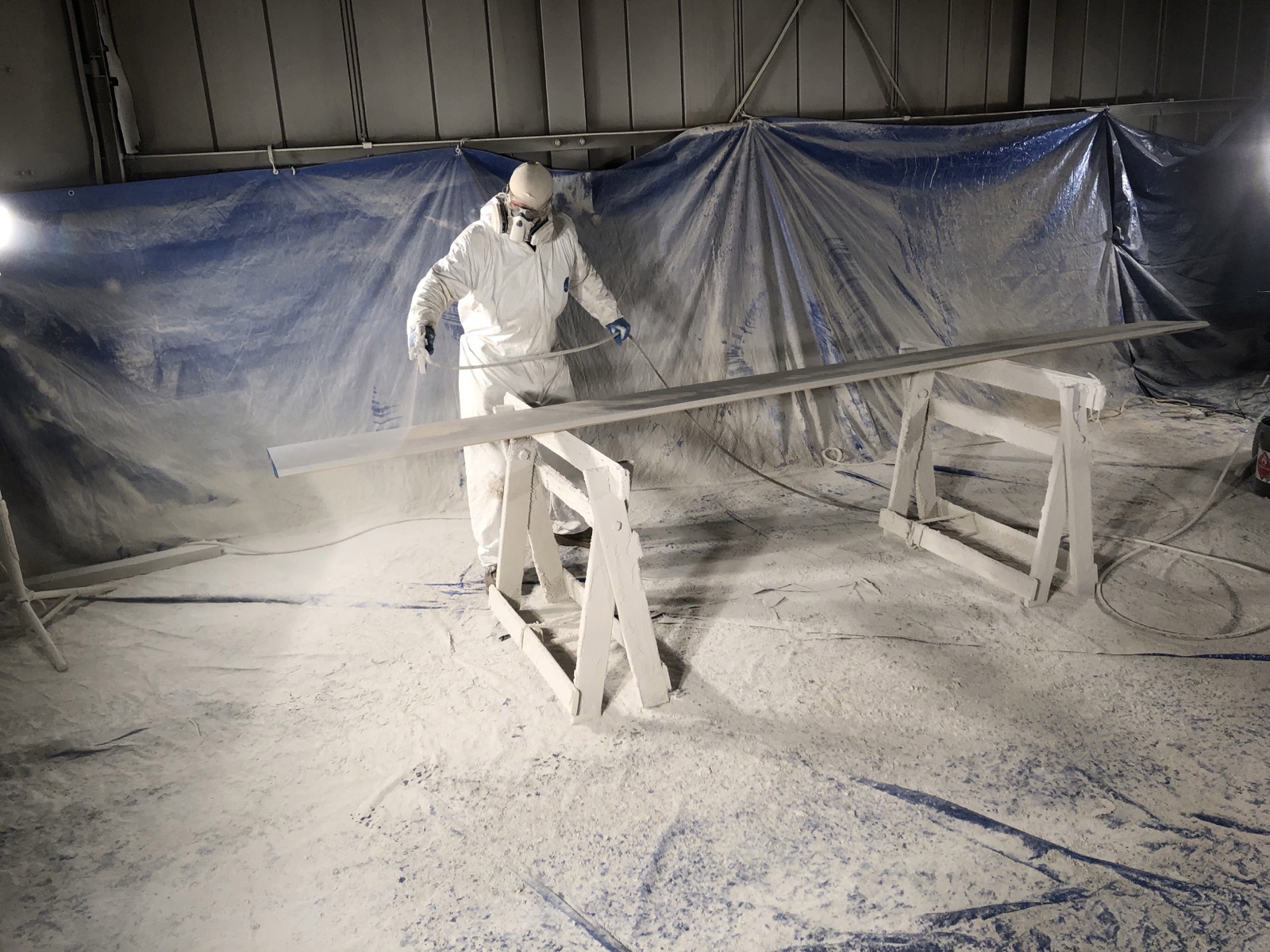
A curved base assembly headed for paint should arrive primed, since the back of a laminated or segmented arc is nearly impossible to coat properly once the member is against a wall. J. Gibson McIlvain primes millwork in three levels, in both oil-based and water-based systems, so a specification can match whatever topcoat the painter is already using.
Open-grained and oily species absorb a great deal of finish, and a primer coat evens out the eventual painted surface so sheen does not vary from one board to the next around a curve. Sanding or buffing after priming knocks back grain raising while keeping the moulded detail crisp, which matters most on the small radii and tight quirks that give a base profile its shadow lines. A curve exaggerates any softness in those details, since light travels along the member instead of hitting it flat.
Shop priming also protects the arc while it waits. A primed member picks up and releases moisture more slowly than a bare one, so a package that sits a few weeks before the painters arrive holds its shape better. Coating performance standards and test methods are catalogued by ASTM International where a specification needs to name them.
One caution on expectations. There are no warranties on solid unmodified wood, and that is not a hedge. Wood is an organic material responding to its environment, and no shop can warranty that behavior. Warranties exist on modified products, not on a milled Sapele base.
What the Shop Needs Before It Cuts the Curve
A curved base package is only as good as the as-built geometry it was cut from, so the shop needs the real radius and not the design radius. This is the most common reason a curved moulding delivery fights the wall.
The useful package of information is small. An as-built chord length with the rise at the midpoint, taken at the finished wall surface rather than at the framing, pins the actual radius. Station points every couple of feet along the arc catch a wall that is slightly out of round. A note on where the curve starts and stops, measured from a known reference in the room, lets the shop cut the tangent ends long so the crew can trim them.
A physical template beats a dimension every time on a tight radius or a compound curve. A thin plywood or hardboard pattern taken off the finished wall, marked for top and bottom and for direction of travel, removes the guesswork. Pulling that pattern and those field dimensions is work for the buyer's own crew or fabricator at the site, and the shop cuts to what they send.
Historic work raises the stakes. Where a curved stair hall or a radiused parlor is being restored, matching the original profile is the specification, and the National Park Service's Technical Preservation Services guidance on repairing and replicating historic interior trim is the right starting document. Those profiles are rarely in any catalog, which is why a knife gets ground to match.
Standards give the rest of the vocabulary. The Architectural Woodwork Institute publishes grade definitions for interior architectural woodwork that let a specification state what flatness, joint and finish quality is expected rather than leaving it to an argument after delivery.
What Arrives at the Site and How It Gets Set
A curved base package should arrive labeled, sequenced and cut long at the tangents, so a crew sets the design line first and absorbs every site variation in the shoe. J. Gibson McIlvain mills and primes the members and ships them nationwide, with the curved and the linear pieces traveling as one package.
The sequence a good crew follows starts with the base. Level line struck around the room, curved members set to that line and fastened into blocking rather than into lath, with the arc allowed to find the wall. Any gap behind the middle of a member gets shimmed, not forced. Forcing a laminated arc into a slightly tighter wall is how glue lines open a year later.
Shoe goes on second and does the real fitting. Scribed to the floor, back-beveled where the floor runs away, fastened to the base rather than to the floor so a wood floor can still move under it. Cap goes on last, with tangent cuts made at the site from members that came long for that purpose.
Spare material belongs in the order. A curved member damaged at the site cannot be re-run from an offcut in the room, so a sensible package carries extra shoe footage and at least one spare base member per radius. The knife stays on file, which is what makes a later run a reorder rather than a redesign.
Finding a Shop That Runs Both Linear and Radius Work
The reason to buy linear trim and radius millwork from one source is that a single profile set, a single species lot and a single moisture target are what make the transition invisible, and splitting the order across two shops puts the seam exactly where the eye lands. Most trim suppliers run linear footage only and send the curved pieces out, which is where the mismatch enters.
J. Gibson McIlvain runs a millwork shop on site at the lumber yard for linear trimwork, finished cladding and primed trim, and ICD, the architectural millwork division, is a full architectural millwork house off site for true custom work planned around a specific space. The linear base and the radius base for one room come off the same order and the same knives. ICD builds the curved members, the radius trimwork and the matching cap as custom work rather than as a catalog item.
"When the straight run and the curved run come out of two different shops, I spend the next month on the phone about a profile that does not line up. We keep them on one order and one knife so that call never happens."
Norm Moton, Director of Sales, J. Gibson McIlvain
Ask a prospective shop three questions. Does it grind its own knives, or buy stock profiles. Does it produce the curved members in house, or broker them out. Does it hold enough of the species to match color across a long run plus a spare. A shop that answers yes, yes and yes is a shop that can keep a floor line true.
How J. Gibson McIlvain Would Specify This
Specify the three members as one matched set, from one species lot, at one moisture target, with the arc produced in the shop and the scribe left to the shoe. That is the whole discipline of a curved base line, and it belongs in the order rather than in a conversation at the site.
On the species line, name Sapele for painted or stained work with Utile, Iroko, Afrormosia or Teak as the alternates, and call quartersawn or rift stock for the base and cap. On the moisture line, specify an in-service content near 6 to 8 percent for interior work and hold delivery until the building is conditioned. On the finish line, name the priming level and the system, oil-based or water-based, that the painter will topcoat.
On the geometry line, require an as-built chord and rise plus station points along the arc, or a hardboard template, taken at the finished wall by the crew that will set the work. Ask for the tangent members cut long. Ask for the shoe in a generous footage. Ask that the knife record stay on file for the next phase of the building.
J. Gibson McIlvain mills the linear trimwork and primes it, ICD builds the radius members to the same profile set, and the package ships together. To talk through a curved interior package, see the millwork services page or ICD's working process, then call 800-638-9100 and ask for the millwork desk with your radius in hand.
Frequently Asked Questions
Can shoe moulding just be bent into place on a curved wall instead of milled to the radius?
On a gentle radius a small shoe section will spring in and look acceptable on day one. It will not stay there. A sprung member is under constant stress and it fights the fastening every time the room changes humidity, which shows up as an open heel at the floor or a cracked finish at the top edge. A shoe milled to the radius sits down with no load in it, so the scribe to the floor is the only work left. The tighter the curve and the heavier the profile, the less negotiable this gets.
What does a millwork shop need from the site to run curved base accurately?
An as-built chord length with the rise measured at the midpoint of that chord, both taken at the finished wall surface rather than at the framing, plus station points every couple of feet along the arc to catch a wall that is out of round. Mark where the curve begins and ends from a fixed reference in the room. On a tight radius or a compound curve a hardboard or thin plywood template is better than any set of numbers. That measuring is the buyer's own crew or fabricator working at the site, and the shop cuts to what they send.
Does the base profile need to change for a tight radius?
Projection is the variable that matters. A deep, heavily sculpted profile removes more material from the back of a curved blank and makes any small drift in the arc visible along the top edge. A taller, shallower profile holds the same design presence with less risk. Where a design or a historic match requires the deep profile anyway, a knife gets ground to match it and the blank gets built accordingly. That is a shop conversation worth having before the moulding schedule is finalized.
Does a curved base, shoe and cap package come with a warranty?
No warranties exist on solid unmodified wood. It is an organic material that responds to the room it lives in, and no shop can warranty that response. Warranties exist on modified products. What a specification can control is what actually drives performance, which is an in-service moisture content near 6 to 8 percent for interior work, quartersawn or rift stock where flatness matters, shop priming on paint-grade members, and delivery held until the building is conditioned.
Will the curved base and the straight base stain to match?
They will if both come out of the same species lot, which is the real argument for buying the whole package from one source. Color variation within a species is wider than most buyers expect, and a curved member fabricated by a second shop out of different stock will read as a different wood under a stain even with an identical profile. Sapele, Utile, Iroko, Afrormosia and Teak all take stain predictably when the lot is consistent. J. Gibson McIlvain pulls the straight and the curved material from the same lot for that reason.
Why not use a tropical decking species for curved interior trim?
Ipe, botanically Tabebuia spp, along with Cumaru, Garapa, Jatoba and Red Balau, is extremely hard and carries high oil content. A curved base or cap is a glue-dependent assembly, whether it is laminated from resawn laminae or built from joined segments, and high-oil species are difficult to glue reliably. Those species earn their place in exterior decking. For milled, glued and machined interior components a millwork shop reaches for Sapele, Iroko, Afrormosia, Teak or Utile.