Why a Large Residential Ipe Order Is Different
A large residential deck can require several thousand linear feet of decking, and at that volume consistency, not availability, is the hard problem. A 1,500 square foot deck in 5/4x6 Ipe needs roughly 3,300 linear feet of board once the gap and coverage are accounted for. Pulled from a shallow yard across multiple lots, that quantity arrives as a patchwork of color and grade, which shows plainly on a large continuous surface.
Ipe itself is up to the job: a Janka hardness near 3,680 lbf, an oven-dry density around 1,050 kg/m3, Class 1 durability under EN 350, and a 40 to 75 year service life documented by the USDA Forest Products Laboratory. The variable is the supplier. For the species fundamentals, see our complete Ipe decking guide.
What to Require From a Bulk Ipe Supplier
The supplier factors that govern a large residential order are inventory depth, grading discipline, kiln-drying, long-length availability, and legal documentation, none of which a general lumberyard reliably offers.
- Inventory depth: enough matched Ipe on hand to fill the whole deck in one grade and color range, not pieced from lots months apart.
- Grading discipline: consistent color, grain, and freedom from defect across thousands of feet, which is a graded standard, not luck.
- Kiln-drying: dried to a stable moisture content near 12 to 16 percent so a large deck does not move after installation. See our moisture content guide.
- Long lengths: lengths that reduce butt joints across long runs, which only a deep supplier stocks.
- Documentation: FSC chain-of-custody and, for CITES-listed species, the paperwork, provided as part of the order.
| Factor | General yard | Specialty hardwood supplier |
|---|---|---|
| Volume in one grade | Limited; multiple lots | Deep, matched inventory |
| Color/grade consistency | Varies across the deck | Graded to one standard |
| Long lengths | Short stock common | Long lengths in stock |
| Kiln-dried target | Often unstated | Stated moisture content |
| Legal documentation | Rarely | FSC and CITES provided |
| Delivery | Local | Nationwide, staged |
Matched Material Across the Whole Deck
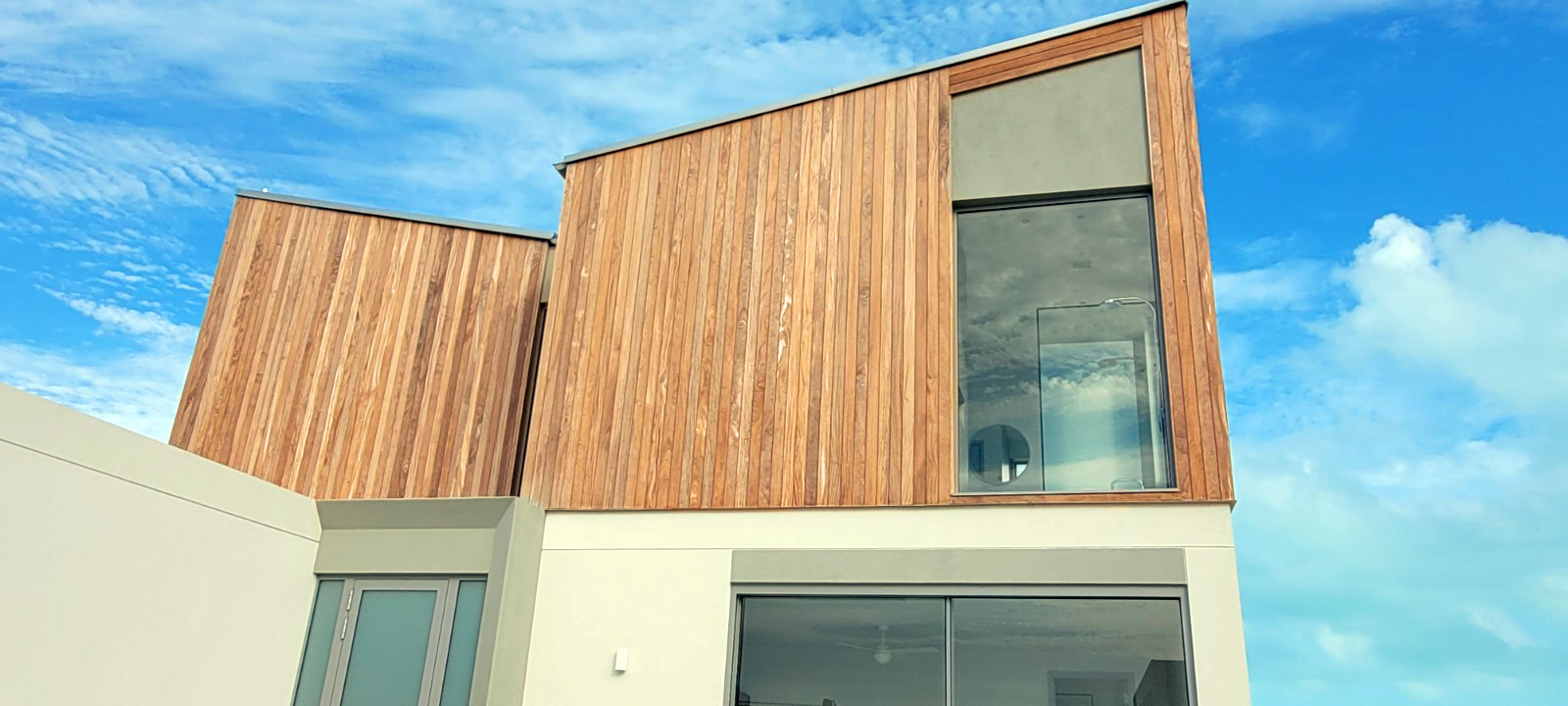
The single biggest quality driver on a large residential Ipe deck is that all of the material comes from one deep source, graded to one standard, so the finished deck reads as one surface. Lot-to-lot variation in color and grain that is invisible on a small deck becomes obvious across a large one. A deep supplier fills the order from consistent inventory and grades it uniformly, so the estate deck looks intentional rather than assembled from whatever was available. This is the same single-source logic that governs large cladding facades, applied to a horizontal surface. See our sourcing discussion in premium wood cladding sourcing.
Ipe Specifications and Volume Math
Planning a bulk Ipe order rests on measurable figures: 5/4x6 decking finishes about 1 inch by 5-1/2 inches, so with a 3/16 inch gap roughly 2.1 linear feet cover one square foot, and at a density near 1,050 kg/m3 the decking weighs about 5 to 6 lb per square foot installed. A board foot is 144 cubic inches, the unit the order is priced in, per NHLA measurement rules. On a 1,500 square foot deck that is roughly 3,300 linear feet and on the order of 8,000 pounds of decking, which shapes both the order and the delivery.
Ipe reaches ASTM E84 Class A flame spread without treatment, and the American Wood Council publishes the fastener and joist-span basis, with 5/4 decking commonly installed over joists at 16 inches on center. Dense Ipe is pre-drilled or pre-grooved and fastened with stainless steel. For estimating, see our board feet guide.
Lead Time, Weight, and Delivery for a Large Order
A large residential Ipe order is a logistics event as much as a lumber purchase: several thousand pounds of dense hardwood milled, graded, kiln-dried, and delivered on a schedule. Because the material is milled and graded rather than pulled off a rack, a large order needs lead time planned backward from the install date, and demand peaks in the spring and summer building season. At roughly 5 to 6 lb per square foot, a 1,500 square foot deck is around 8,000 pounds, enough that site access and offloading are confirmed before the truck rolls, per the load figures documented by the USDA Forest Products Laboratory.
For a large or phased deck, staged delivery sequences the material to the crew so the jobsite is not overwhelmed and the kiln-dried boards are not left exposed. The American Wood Council load basis confirms the structure carries the added dead weight of dense Ipe. J. Gibson McIlvain plans lead time and staged nationwide delivery around the install schedule, and coordinates access and packaging so a large order arrives intact.
Evaluating a Bulk Ipe Supplier Before You Commit
Before committing a large residential order, evaluate a bulk Ipe supplier on the things that predict consistency: a physical sample graded to the order, a stated moisture-content target, references on comparable large decks, and the capacity to fill the cut list without substitution. A sample approved against the order anchors the color and grain you will actually receive, rather than a grade name alone. A supplier that states a kiln-dried target near 12 to 16 percent, per the USDA Forest Products Laboratory guidance on installing near equilibrium, is committing to stability. References on decks of similar size reveal whether the yard has actually filled comparable orders in matched material.
The most telling question is capacity: can the supplier fill the entire cut list now, in one grade and color range, or will the order be pieced from lots that arrive weeks apart? A deep yard answers yes and shows the inventory; a shallow one hedges. Because the grading standard is applied by the supplier and not defined by the species, this operational capability is what separates a large deck that reads as one surface from a patchwork, which is why the evaluation matters more at volume than on a small order.
Long Lengths and Wide Boards Signal a Deep Yard
The clearest outward sign of a supplier deep enough for a large residential order is the availability of long lengths and wider boards in matched grade, because those are exactly what a shallow yard cannot hold. Ipe is milled in a range of lengths, and long, matched boards reduce butt joints across the long runs a large deck contains, which look cleaner and collect less water. A yard that can offer long lengths across the dimension range, rather than only short stock, is demonstrating real inventory depth. The National Hardwood Lumber Association grading framework defines the standards these lengths are graded to.
Wide boards behave the same way as a depth signal: a supplier that can fill a feature area or a wide-plank border in matched Ipe is holding more than a token amount. For a large residential deck, asking specifically about long lengths and wide widths in matched grade is a fast way to tell a deep specialty supplier from a general yard that will run short and substitute mid-order.
"On a big residential deck the homeowner and the builder both assume the hard part is finding Ipe. It is not. The hard part is getting three thousand feet of it that all matches, dried right, in long lengths, so the deck does not look like a quilt or move on you after install. That takes real inventory depth. We have been importing hardwood since 1798, and we keep Ipe deep on purpose, so when a large cut list comes in we can actually fill it in matched material."
Camden Zacker, Sales Director, J. Gibson McIlvain Company
How J. Gibson McIlvain Would Fill a Large Residential Order
For J. Gibson McIlvain, a large residential Ipe order is filled from the cut list backward: the team pulls matched material from deep inventory, grades it to one standard for color and grain, kiln-dries to a stable moisture content, mills any pre-grooving or custom widths, and ships nationwide, staged to the install if the deck is large. Because the inventory is deep, the whole deck is filled in matched Ipe rather than pieced together, and legal-sourcing documentation is handled as part of the order.
The team treats grading consistency as the quiet differentiator on a big deck. Anyone can quote Ipe; filling a several-thousand-foot residential order in consistent color, grain, and long lengths while documenting legal sourcing is where a specialty supplier earns the project.
Bulk Ipe Procurement Checklist
| Item | Why it matters |
|---|---|
| Inventory depth | Whole deck filled in matched material from one source. |
| Grading standard | Consistent color and grain across thousands of feet. |
| Moisture content | Kiln-dried to a stated target prevents movement. |
| Long lengths | Reduce butt joints on long runs. |
| Documentation | FSC and CITES for legal sourcing. |
| Staged delivery | Sequenced to the install for a large deck. |
Where Large Ipe Orders Go Wrong
- Buying from a shallow yard: Forces multiple lots, so color and grade drift across the deck.
- No stated moisture content: Green or air-dried Ipe moves after install on a large surface.
- Short lengths: Excess butt joints on long residential runs.
- Carbon-steel fasteners: Stain and corrode; use stainless and pre-drill.
- Skipping documentation: Legal tropical hardwood requires FSC and CITES paperwork.
Ordering Information to Resolve Before Pricing
- Cut list: deck dimensions and board lengths for the whole project.
- Dimensions: 5/4x6 or 5/4x4 decking, plus any stair, fascia, and trim in matching Ipe.
- Profile: square-edge or pre-grooved for hidden fasteners.
- Documentation: FSC and CITES where applicable.
- Logistics: total square footage, weight, delivery sequence, lead time.
Related J. Gibson McIlvain Guidance and Next Steps
Frequently Asked Questions
Where do I buy Ipe decking in bulk for a large home project?
Bulk premium Ipe for a large residential deck is bought from a specialty hardwood supplier deep enough to fill the whole deck in matched color, grade, and length, since a large deck can need several thousand linear feet that a general lumberyard cannot supply consistently. J. Gibson McIlvain stocks Ipe across all dimensions and long lengths, grades it to one standard, kiln-dries it, and ships nationwide with FSC and CITES documentation, filling large orders to a cut list.
How much Ipe decking does a large deck need?
Coverage is figured from actual board width plus the gap: a 5/4x6 board finishes about 5-1/2 inches wide, so with a 3/16 inch gap roughly 2.1 linear feet cover one square foot. A 1,500 square foot deck therefore needs on the order of 3,300 linear feet of decking, plus a waste factor for cuts. At a density near 1,050 kg/m3, that is also roughly 8,000 pounds of material, which affects delivery. Order to a measured cut list for accuracy.
Why does a large Ipe deck need a single supplier?
On a large continuous deck, lot-to-lot variation in color and grain that is invisible on a small deck becomes obvious, so filling the whole order from one deep source graded to one standard is what makes the deck read as one surface. A shallow yard pulls from multiple lots and the result is a patchwork. J. Gibson McIlvain fills large residential Ipe orders from deep, consistently graded inventory so the finished deck looks intentional.
What moisture content should bulk Ipe decking be?
Ipe decking should be kiln-dried to a stable moisture content near 12 to 16 percent so it is close to its in-service equilibrium and does not move after installation, which matters more on a large deck where cumulative movement is visible. Green or air-dried Ipe will shrink and can cup as it dries in place. A specialty supplier states the target moisture content; J. Gibson McIlvain kiln-dries its Ipe and documents the material.
Can I get long lengths of Ipe for a large deck?
Yes, from a deep supplier. Long Ipe lengths reduce the number of butt joints across long residential runs, which look cleaner and collect less water, but long matched material is exactly what a shallow yard cannot provide. J. Gibson McIlvain stocks Ipe in long lengths across the dimension range, so a large deck can be filled with minimal jointing, milled and shipped to a cut list nationwide.
Does bulk Ipe decking come with legal-sourcing documentation?
It should. Tropical hardwood must be legally sourced, and for a documented project that means FSC chain-of-custody and, where the species is CITES-listed, the corresponding paperwork. Because documentation is maintained by the supplier, buying from an established FSC-certified company is how a buyer obtains valid paperwork. J. Gibson McIlvain is FSC-certified and provides chain-of-custody and CITES documentation with its bulk Ipe orders.
How far ahead should I order bulk Ipe for a large deck?
Order well ahead of the install date, especially in the spring and summer building season, because bulk Ipe is milled, graded, and kiln-dried rather than pulled off a rack, so a large order needs production lead time. Planning the order date backward from installation avoids a schedule crunch and lets the supplier optimize lengths and stage delivery. J. Gibson McIlvain plans lead time and staged nationwide delivery around the install schedule for large residential orders.
How heavy is a large Ipe deck to deliver?
Ipe is dense, near 1,050 kg/m3 or about 66 to 69 lb per cubic foot, so 5/4 decking weighs roughly 5 to 6 lb per square foot installed. A 1,500 square foot deck is therefore around 8,000 pounds of decking, enough that jobsite access and offloading equipment should be confirmed before delivery, and large orders are often staged. J. Gibson McIlvain coordinates access, packaging, and staged delivery so a large, heavy Ipe order arrives intact and on schedule.
Sources and Standards Referenced
- USDA Forest Products Laboratory - Wood Handbook and Durability
- EN 350 - Durability of Wood and Wood-Based Products
- ASTM E84 - Surface Burning Characteristics of Building Materials
- American Wood Council - Span and Fastener Design
- National Hardwood Lumber Association - Grading and Measurement Rules
- Forest Stewardship Council - Chain of Custody Certification
- CITES - Convention on International Trade in Endangered Species