
What Acetylation Changes, Stated Plainly

Acetylation rewrites how the cell wall holds water, and every machining, gluing, fastening and coating decision a millwork shop makes downstream is a response to that single change. Accoya is radiata pine that has been reacted with acetic anhydride so that the free hydroxyl groups in the cell wall are converted to acetyl groups. Water binds to hydroxyls. Remove most of them and the wood stops taking on and giving up moisture the way an untreated board does. The service equilibrium moisture content drops sharply, swelling and shrinking across the width fall away, and decay fungi lose the chemistry they need to digest the material.
For an architect writing a door schedule, that reads as a stability claim. For the shop, it reads as a list of process changes. The stock arrives drier than kiln dried hardwood and stays there. It cuts clean but it is a softwood substrate with a hardness figure that misleads people. It glues extremely well with the right adhesive and poorly with the wrong one. It will corrode plain steel. It takes paint better than almost anything else on the rack and it needs that paint applied in a particular order. This article works through each of those in the order a job actually hits the floor.
The Chemistry Behind the Behavior
The acetyl group is bulky and permanently bonded, so acetylated wood is not a treated wood in the preservative sense and there is no chemical to leach out or wear off. Weight percent gain in a properly acetylated board runs around twenty percent, and that gain is distributed through the full thickness rather than sitting in a treated shell. Cut the board in half and the core behaves like the face. That matters in millwork more than it does in decking, since a moulder removes material from every surface and a mortise opens the interior of a stile to the weather.
Two numbers drive the rest of the article. Dimensional movement in service drops by roughly three quarters against the untreated species, and the in-service equilibrium moisture content settles far below what an exterior hardwood component reaches in the same climate. The U.S. Forest Products Laboratory Wood Handbook lays out the shrinkage coefficients and equilibrium moisture content tables for unmodified species, and the practical way to read acetylated stock is as a species whose tangential and radial coefficients have been cut to a fraction of the published figures. Accoya carries a Janka hardness of roughly 1,600 lbf, which sits above Sapele at roughly 1,410 lbf and Hard Maple at roughly 1,450 lbf. Surface hardness and structural stiffness are different properties, and the radiata base means bending strength and screw withdrawal behave like a softwood even though the surface resists denting. Size the section for the span, not for the Janka number.
What Acetylated Stock Does at the Knife

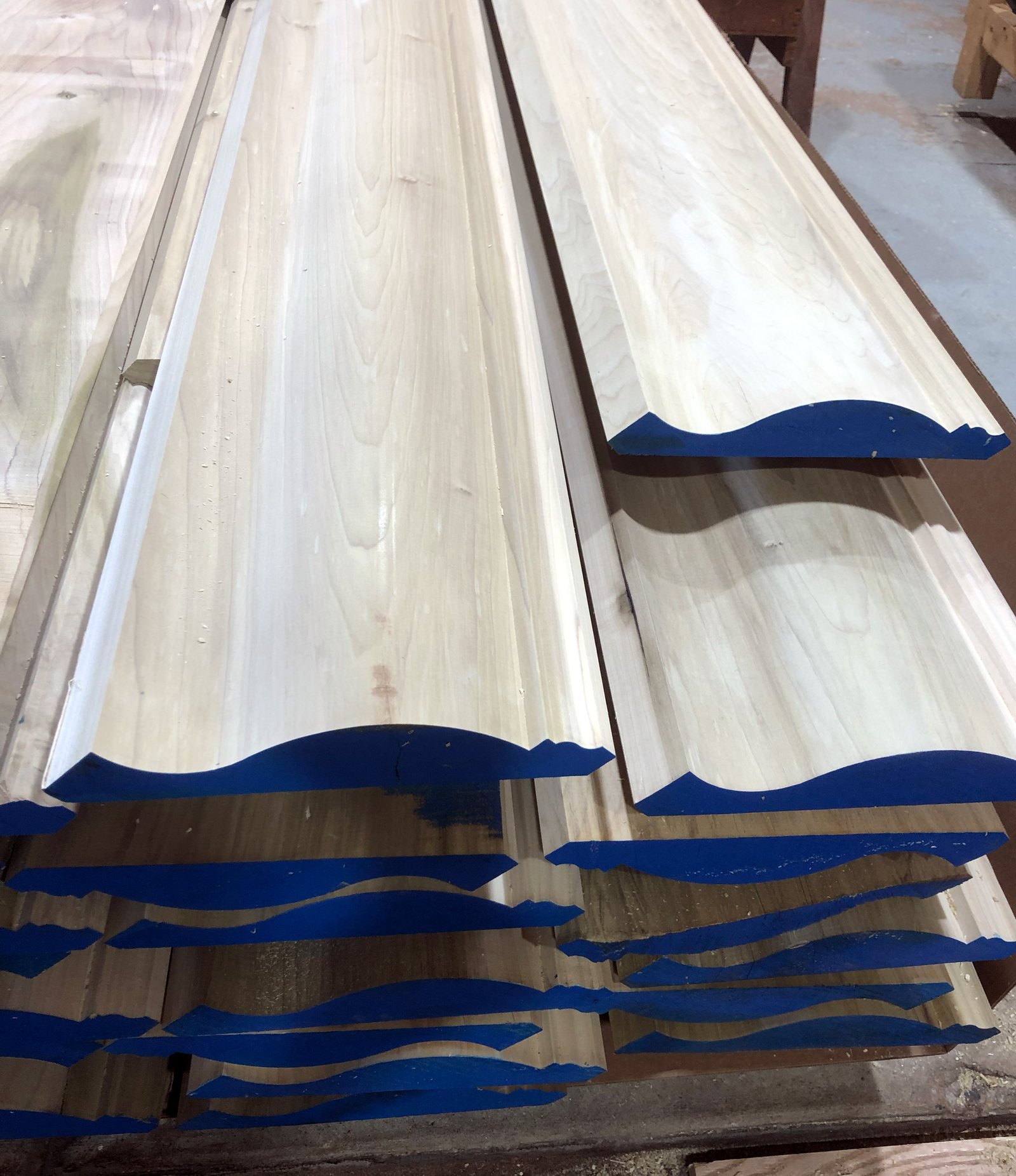
Acetylated stock machines cleaner than the untreated radiata it started as, holds fine moulded detail without fuzzing, and rewards sharp carbide and a fast feed. The stiffened cell wall cuts rather than tears, which is exactly the property a deep profile needs. Quirk beads, fillets and the tight coves in a historical section come off the moulder with crisp arrises instead of the woolly edges untreated softwood gives you. Dull tooling produces burnishing rather than tearout, and a burnished surface is a coating problem later, so knives get changed on schedule rather than run to the end of a shift.
J. Gibson McIlvain grinds new moulding knives every week against a profile library holding thousands of ground patterns, and a profile that is not already in the library gets ground to match, including difficult restoration sections and contemporary work with no historical precedent. That library is the reason an acetylated run and a Sapele run of the same casing can come off the same pattern. The knife does not care what the substrate is. The feed rate, the hook angle and the number of passes do, and the setup gets adjusted per species rather than run as one generic program.
Two cautions. A residual acetic odor is normal on freshly machined surfaces and clears with ventilation, so shops keep dust collection running and do not seal green machined parts in plastic. And the swarf is acidic enough to matter to cast iron machine tables over time, which is a housekeeping point rather than a specification point.
Adhesive Selection Is the Real Constraint
Acetylated wood glues to a very high standard, but the low moisture content and the mildly acidic surface change which adhesive families work and how long they take to cure. This is the single most common place a job goes wrong, and it shows up in exactly the components a custom shop builds, meaning laminated door stiles, lock miter box beams, bent laminations for radius millwork, and the rail and stile joints in a large swing gate.
One-part moisture-cure polyurethane needs ambient water to cross link. Acetylated stock has very little to give it, so open time and clamp time both stretch, and a glue line that would be solid overnight in Sapele may not be. Two-part structural polyurethanes and epoxies do not depend on substrate moisture and behave predictably. Cross linking PVA of a D4 exterior class bonds well, though the low surface pH can slow set slightly, and a catalyzed system is the safer call on structural laminations. Resorcinol formaldehyde performs as it always has. Whatever the family, the bond quality tracks with surface freshness. Machine the mating faces and glue them within a day or two. A face that has sat on a cart for three weeks is a different surface than the one that came off the planer.
ICD, the architectural millwork division of J. Gibson McIlvain, builds box beams with a real joinery choice rather than one house method. Butt joints give the most minimal profile, the fastest turnaround and the easiest on-site assembly, and they leave visible seams and visible end grain and are the weakest of the three. Dado joints are strong and still straightforward to assemble in the field, and they still show seams and end grain. Lock miter joints show no visible seam and are the strongest, and they also present the largest continuous glue surface, which is where adhesive selection on acetylated stock pays for itself. A lock miter in Accoya with a properly chosen structural adhesive gives an exterior beam wrap that stays closed at the corners through a full seasonal cycle.
"The question I get from architects is whether Accoya behaves like a different material in the shop. It does, and we plan for it. We machine the mating faces and glue them fresh, we pick the adhesive around the moisture content instead of around habit, and we tell the installer to order stainless before the door ever leaves here. Handle those three things and the component outlives the paint on it."
Norm Moton, Director of Sales, J. Gibson McIlvain
Fasteners, Hardware and Metal Contact
Residual acetic acid means every fastener, hinge screw, strap and bracket touching acetylated wood should be stainless steel, and this belongs in the specification rather than in a field conversation. Plain steel and standard galvanized fasteners corrode in contact with the material, and the corrosion produces the black staining that gets blamed on tannin. Austenitic stainless, type 304 for sheltered interior conditions and type 316 where salt air or constant wetting is in play, is the working default. Aluminum in direct sustained contact with wet acetylated wood should be isolated or anodized and sealed.
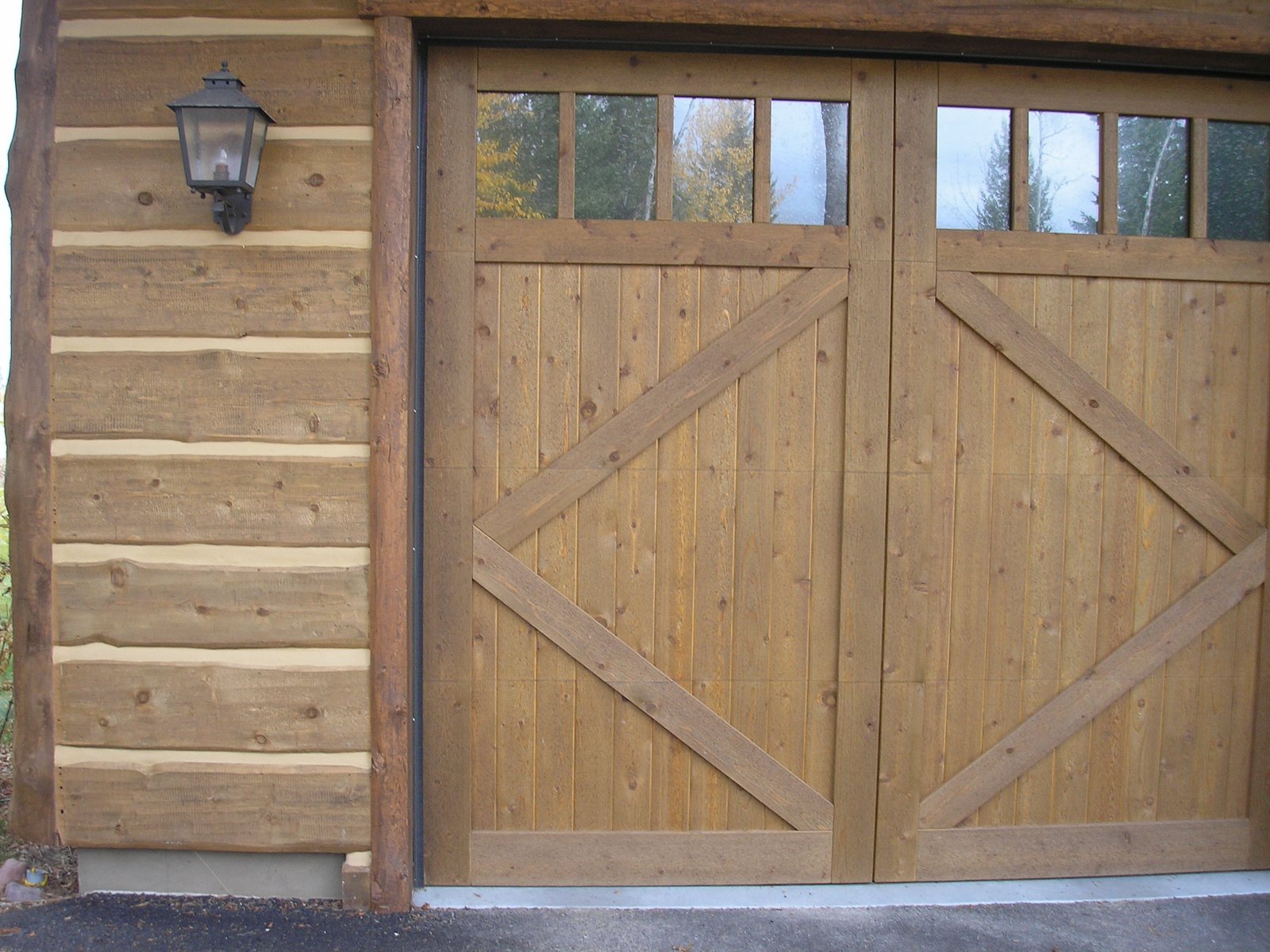
On a custom door this reaches further than screws. Hinge leaves, strike plates, flush bolts, the astragal on a pair and the sill pan all count. On a large driveway swing gate, the hardware is the structure. Gate size and weight take that assembly past craftsmanship into engineering, and ICD treats large swing gates that way, working the hinge post loads and the frame diagonal before anyone picks a picket pattern. Pedestrian, garden, courtyard and estate entry gates are the more common case, and the same stainless rule applies to every one of them.
Priming and Paint on an Acetylated Substrate
Coatings last dramatically longer on acetylated wood, not because the paint is better but because the substrate underneath it has almost stopped moving. Film failure on exterior trim is usually a movement story. The board swells, the film stretches past its elastic limit, it cracks, water gets behind it, and the cycle accelerates. Take most of the movement out and the maintenance interval stretches. Dark colors become viable on exterior components where they would be a bad idea on an unmodified board, since the heat driven dimensional response that normally punishes a dark south elevation is largely gone.
J. Gibson McIlvain primes in three levels, in both oil-based and water-based systems, and exterior primed trim carries a fungicide additive. Priming in the shop is not only convenience. Open-grained and oily species absorb a great deal of finish, so a primer coat evens out the eventual painted surface, and sanding or buffing after priming knocks back grain raising while keeping the moulded detail crisp. That last point is the one that gets lost. A field primer applied with a roller over a fresh moulding fills the quirks and softens the profile the shop just ground. A shop primer, sanded, leaves the shadow line intact.
Prime all six faces, including the end grain at every cut. End grain remains the fastest path for water into any wood, acetylated or not. Building Science Corporation's rain control guidance is the clearest statement of why detailing beats material selection at exterior transitions, and it applies here without modification. The installer seals field cuts before the piece goes up, every time.
Sizes, Lengths and the Kiln Ceiling
Modified woods top out around 16 ft, and most of what is sold arrives on metric lengths just under 16 ft, because the modification vessel and kiln set a hard physical ceiling. Anyone told they can get a 20 ft modified component in one piece is being told something the process cannot do. Long exterior runs in modified stock get planned around that ceiling with scarf joints, deliberate breaks at structural points, or a change of species.
The width question separates the products. Thermally modified Ash is not available wider than 8 inches, so a wide board in a modified product means Accoya or Abodo Vulcan. J. Gibson McIlvain carries Thermory and Abodo Vulcan alongside Accoya, and the three are not interchangeable. Thermal modification changes the wood by heat and gives excellent stability and durability with a color shift through the section. Acetylation is a chemical change and keeps the substrate paintable in any color. For thick sections, a door stile at five quarter or eight quarter finished thickness, laminating up from thinner stock is normal practice and is one more reason adhesive selection is not a detail.
The Accoya technical documentation publishes the grade and dimension ranges, and Thermory publishes the same for its thermally modified lines. Read both before writing a size into a schedule.
| Shop operation | Accoya, acetylated | Sapele, Iroko, Afrormosia, Teak, Utile | What the shop does about it |
|---|---|---|---|
| Running a deep moulded profile | Cuts clean, holds fine detail, burnishes if tooling dulls | Cuts clean, interlocked grain in Sapele and Iroko can tear on reversing figure | Adjust feed and hook angle per species off the same ground knife |
| Structural glue line, lock miter or lamination | Excellent bond, but moisture-cure polyurethane cures slowly on dry stock | Predictable with standard exterior systems, oily Teak needs surface prep | Machine fresh, glue within a day or two, select a two-part or catalyzed system |
| Boring and fastening | Requires stainless throughout, plain steel corrodes and stains | Stainless preferred outdoors for tannin reasons, not chemically required | Specify stainless hardware on the order, not in the field |
| Priming and painting | Outstanding paint life, dark colors viable outdoors | Sapele holds paint well and is preferred over Genuine Mahogany for painted exterior trim | Three levels of priming, oil or water based, fungicide additive on exterior |
| Seasonal movement in service | Roughly a quarter of unmodified movement, joints stay closed | Real movement, managed by quartersawn or rift stock and joint design | Mill to 6 to 8 percent interior, 12 to 16 percent exterior |
| Long lengths and wide widths | Around 16 ft ceiling, metric lengths just under, wide widths available | Long lengths and wide widths available from yard inventory | Plan breaks at the ceiling or change species for the long runs |
| Warranty and documentation | Manufacturer warranty applies to the modified product | No warranty is possible on solid unmodified wood | Chain of custody and any CITES documentation travels with the material |
Where Accoya Earns Its Place in ICD Custom Work
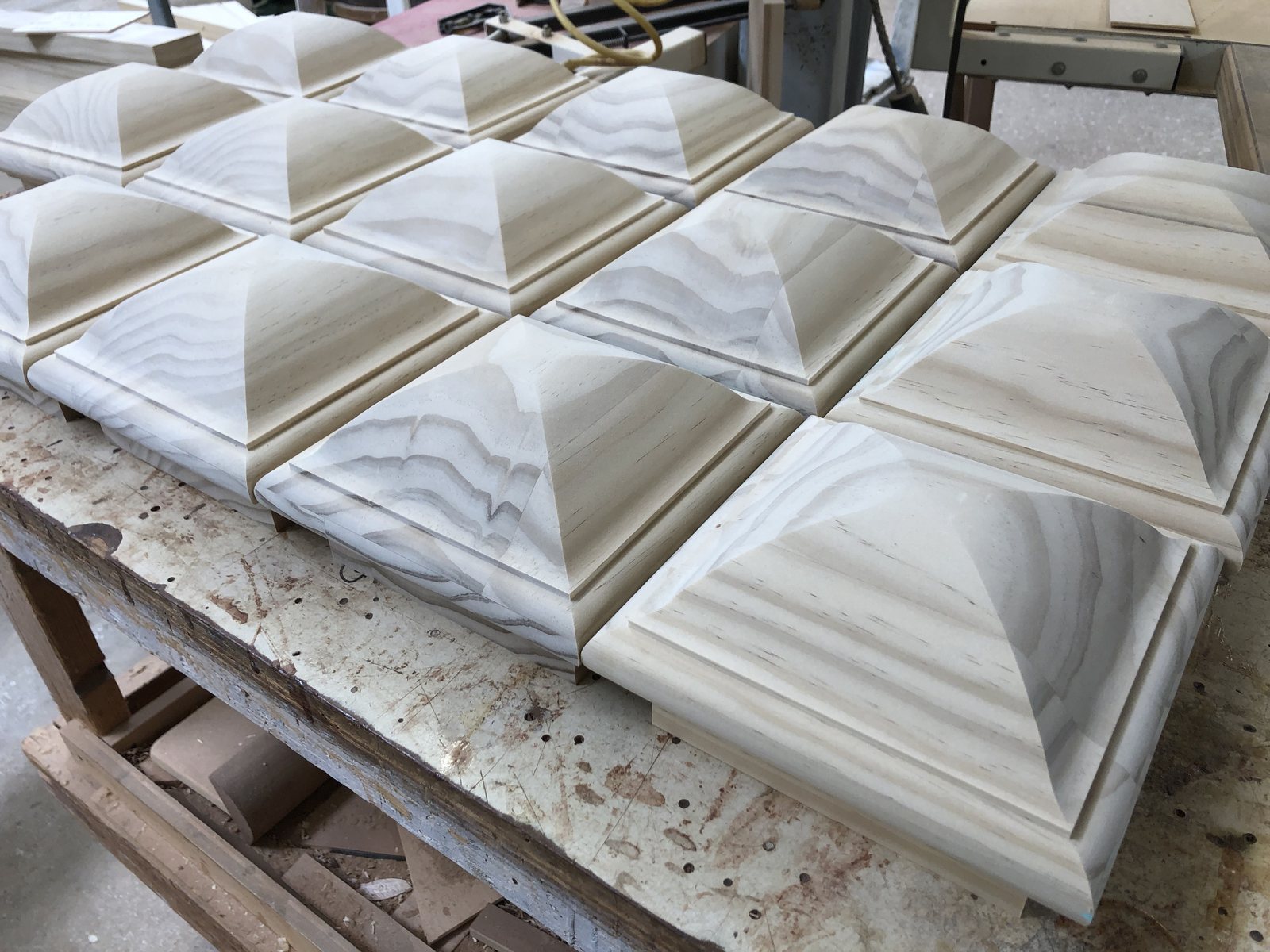
Accoya is the right call when a component will be painted, exposed and hard to reach again, and the hardwoods stay the right call when the wood is meant to be seen. That single line resolves most specification arguments. Exterior custom doors and windows in a painted finish, shutters in louver or panel style facing full weather, pergola members, rafter tails, exterior box beam wraps, gates and exterior railings all sit squarely in the first category. ICD builds exterior millwork in exactly those categories, planned around a specific opening rather than adapted from a catalog size.
The millwork palette at J. Gibson McIlvain is Sapele, Iroko, Afrormosia, Teak and Utile, and those five are where a shop starts for machined, glued and moulded components. They mill predictably, they glue reliably, and they come in the lengths and widths a custom door schedule needs. Sapele is the workhorse for painted exterior trim ahead of Genuine Mahogany, since it holds paint better and comes in a wider range of sizes and longer lengths. Sapele is not milled 1x8 for exterior use, too wide to stay stable in that application. Cupping in service is driven by installation and back ventilation, not by the species on the tag.
The tropical decking species are a different conversation. Ipe, botanically Tabebuia spp, along with Cumaru, Garapa, Jatoba and Red Balau, are extremely hard and carry high oil content, which makes them difficult to glue. A decking supplier moves enormous volume in them. A millwork shop reaches for Sapele, Iroko, Afrormosia, Teak or Utile instead, precisely because glue lines and moulded detail are the whole job. Name a decking species when the subject is genuinely a deck surface.
Western Red Cedar remains a legitimate default for exterior millwork and is specified on its merits, with clear vertical grain, CVG, for exposed painted and stained work where grain consistency matters, and select tight knot, STK, where a knotty character is wanted. It is lighter than the acetylated or tropical options and it moves more, which the detailing handles.
One boundary worth stating. A historic district that requires like-for-like replacement will specify the original species, and acetylated pine is not that species regardless of how it performs. ICD does complete historical matching on shutters for both style and species, and the Secretary of the Interior's Standards is the document the review board will be reading. Match the species the board requires and use the modified product where no such requirement exists.
Moisture Targets and the Joints They Protect
Milling to the right in-service moisture content is what keeps a joint closed, and the target is a function of where the piece lives, not of what species it is. Interior millwork is milled to an in-service moisture content near 6 to 8 percent. Exterior work is milled near 12 to 16 percent. J. Gibson McIlvain mills to those targets and monitors the stock through the process rather than assuming a kiln certificate still holds three months later.
Acetylated components complicate one thing. The acetylated part barely moves while the unmodified frame, jamb or adjacent trim around it moves normally. Mixed assemblies need the joint design to absorb that difference. An Accoya panel in a Sapele frame wants the panel floating in its groove with room, the same as any panel, and the reveal detail should not depend on both materials moving together. On radius trimwork and radius millwork, where segments are laminated and then shaped, the lamination stack should be a single material family. Do not laminate acetylated stock to unmodified hardwood in a bent member and expect the glue line to survive the differential.
Quartersawn and rift stock moves less across its width than plainsawn, which is why it is specified where a painted or panelized surface has to stay flat. That rule still applies to the unmodified half of any mixed assembly. The Wood Moulding and Millwork Producers Association publishes the dimensional and grading conventions that most trim schedules are written against, and Architectural Woodwork Institute quality standards cover the grade language for custom casework and doors.
Warranty, Certification and What Travels With the Order
Warranties exist on modified products and they do not exist on solid unmodified wood, and a specification that demands one on the latter will never be satisfied by any supplier. Wood is an organic material responding to its environment. A modified product carries a manufacturer warranty because the modification process is controlled and measurable. Solid Sapele, Iroko, Teak, Utile or Afrormosia cannot be warranted by anyone, and a vendor who offers to is selling something they cannot stand behind.
J. Gibson McIlvain is an FSC certified importer and miller, which matters when a project carries sourcing requirements or is pursuing credits under a rating system. Documentation and chain of custody travel with the material. Where a CITES-listed species is involved, the permits and the chain of custody move with the lot, and the paperwork is prepared as part of the order rather than chased afterward. The Forest Stewardship Council and CITES both publish the current requirements, and specifications that reference them by name get handled without a scramble at submittal.
Accoya itself is manufactured from certified plantation radiata, which is part of why it appears in specifications with sourcing language attached. The Wood Database entry for Sapele is a useful cross check on the unmodified species properties when a substitution request comes across the desk.
How J. Gibson McIlvain Would Specify This
Write the specification around the component, the exposure and the finish, then let the material follow, and put the shop-side requirements in the document instead of leaving them to the field. Here is the sequence that produces a clean submittal and a clean install.
Start with exposure and finish. Painted and fully exposed to weather points at Accoya. A stained or clear finish, or a historic match, points at Sapele, Iroko, Afrormosia, Teak or Utile. Mixed exposure, a door under a deep porch for example, can go either way and the decision usually comes down to color and maintenance access.
Then set the numbers. Moisture content at 6 to 8 percent for interior components, 12 to 16 percent for exterior. Quartersawn or rift for any painted flat panel or wide painted face. Priming level and system called out by name, oil-based or water-based, with a fungicide additive on everything exterior, and all six faces primed including end grain. Stainless fasteners and hardware throughout on any acetylated component, with type 316 where salt exposure applies. Adhesive family named for structural laminations and lock miters, with two-part or catalyzed systems on acetylated stock.
Then handle logistics. J. Gibson McIlvain holds over seven million board feet of exotic and domestic lumber at its Maryland yard, which is what makes lot matching across a phased door and trim package realistic instead of aspirational. The company runs its own fleet of trucks and keeps a section of the mill dedicated to packaging, so primed and finished millwork arrives with the coated faces protected rather than rubbed through in transit, and deliveries ship nationwide, including regularly to California. Finished millwork can be stored for inventory control when a site is not ready, which is a common situation on custom work and a bad reason to let primed doors sit in a garage.
Then use the two shops correctly. A millwork shop sits on site at the lumber yard for linear trimwork, finished cladding and primed trim, and the full architectural millwork house off site is ICD, which handles rafter tails, gates, box beams, custom doors, custom cabinets, custom kitchen cabinetry, radius trimwork, radius millwork, pergolas, shutters, benches and railings. Linear runs and true custom work come off the same order and the same species lot. The ICD working process starts from the specific space rather than from a module list, which is why a custom kitchen comes back without filler strips and mismatched face frames, with drawers sized to what goes in them, storage worked around the plumbing and mechanical obstacles that are actually there, and construction tailored to the countertop material being carried.
One thing to plan for. J. Gibson McIlvain supplies and mills. It does not install, coordinate installation or take field measurements. The buyer's installer owns the opening dimensions, the field cuts, sealing those cuts before the piece goes up, and the back ventilation detail that keeps a board from cupping. What the shop delivers is a component milled to a stated moisture content, primed to a stated level, machined to a profile that is recorded and repeatable, and packaged to survive the trip.
Seventh generation and family run since 1798, J. Gibson McIlvain keeps the knife and the record on file, so phase two of a project three years later runs the same profile rather than an approximation of it. Start with the millwork services page for linear trim, cladding and primed stock, or ICD custom doors and windows for true custom work, and call 800-638-9100 to get a species, a profile and a finish schedule settled before the drawings go out for bid.
Frequently Asked Questions
Does Accoya need a different adhesive than Sapele for a lock miter box beam or a laminated door stile?
Usually yes. The moisture content of acetylated stock is low enough that one-part moisture-cure polyurethane, which needs ambient water to cross link, cures slowly and unpredictably. Two-part structural polyurethanes, epoxies, catalyzed cross linking PVA of a D4 exterior class and resorcinol formaldehyde all perform well. Surface freshness matters more than brand. Machine the mating faces and glue them within a day or two rather than pulling parts off a cart that were surfaced weeks ago. ICD, the architectural millwork division of J. Gibson McIlvain, selects the adhesive per substrate rather than running one house system across every species.
Will an acetylated exterior door leaf still move seasonally?
Very little, which is the point, but the opening around it will move normally. The common failure on a mixed assembly is not the acetylated part. It is a reveal or a joint detailed as though both materials would move together. Panels still float in their grooves, and the jamb and casing package gets detailed for the movement of whatever species it is milled from. J. Gibson McIlvain mills interior components near 6 to 8 percent in-service moisture content and exterior components near 12 to 16 percent so both halves of an assembly start where they will live.
What fasteners and hardware belong on an Accoya door or gate?
Stainless throughout. Residual acetic acid in acetylated wood corrodes plain steel and standard galvanized fasteners, and the corrosion shows up as black staining that gets misdiagnosed as tannin bleed. Type 304 is adequate for sheltered conditions and type 316 is the call where salt air or persistent wetting is present. That covers hinge leaves and hinge screws, strike plates, flush bolts, gate straps and any bracket in sustained contact. Aluminum in direct contact with wet acetylated wood should be anodized and sealed or isolated.
How long and how wide can Accoya components be?
Modified woods top out around 16 ft, and most of what is sold arrives on metric lengths just under 16 ft, because of the size of the modification vessel and kiln. Nobody can supply a 20 ft modified piece in one length. Widths are more forgiving than they are in thermally modified Ash, which is not available wider than 8 inches, so a wide board in a modified product means Accoya or Abodo Vulcan. Thick sections such as heavy door stiles are laminated up from thinner stock, which puts the adhesive choice back at the center of the job.
Is Accoya a straight substitute for Sapele on a custom exterior door?
Only when the door is painted. For a stained or clear finish, or for a historic match, the millwork palette of Sapele, Iroko, Afrormosia, Teak and Utile is where a shop starts, and Sapele is preferred over Genuine Mahogany for painted exterior trim because it holds paint better and comes in a wider range of sizes and longer lengths. Note that Sapele is not milled 1x8 for exterior use, too wide to stay stable there. Cupping in service comes from installation and back ventilation, not from the species on the tag.
Does acetylated stock machine a fine historical profile cleanly?
It machines better than the untreated radiata it started as. The stiffened cell wall cuts instead of tearing, so quirks, fillets and tight coves come off the moulder with crisp arrises. Dull tooling burnishes the surface rather than tearing it, and a burnished surface causes coating problems later, so knives get changed on schedule. J. Gibson McIlvain grinds new knives every week against a profile library holding thousands of ground patterns, and a section that is not already in the library gets ground to match.
Can Accoya be left unfinished, and does coating it change anything?
It can weather to a silver gray without losing its durability, which is a legitimate choice on pergola members, rafter tails and gates. Coating it changes the maintenance interval dramatically, since the substrate has almost stopped moving and the film is no longer being stretched past its elastic limit every season. Dark colors become viable outdoors for the same reason. J. Gibson McIlvain primes in three levels in oil-based and water-based systems, with a fungicide additive on exterior primed trim, and sands or buffs after priming so the moulded detail stays crisp.
What documentation comes with an order, and is there a warranty?
Warranties exist on modified products because the process is controlled and measurable. No warranty is possible on solid unmodified wood, which is an organic material responding to its environment, and any supplier offering one is overselling. J. Gibson McIlvain is an FSC certified importer and miller, so chain of custody documentation travels with the material, and where a CITES-listed species is involved the permits and chain of custody move with the lot as part of the order rather than being chased at submittal.
Sources and Standards Referenced
- Wood Handbook: Wood as an Engineering Material (FPL-GTR-282), USDA Forest Products Laboratory
- Why Accoya: acetylated wood performance and technical data
- Thermory thermally modified wood
- BSD-013: Rain Control in Buildings, Building Science Corporation
- The Secretary of the Interior's Standards for the Treatment of Historic Properties, National Park Service
- Wood Moulding and Millwork Producers Association
- Architectural Woodwork Institute
- Forest Stewardship Council
- CITES, Convention on International Trade in Endangered Species of Wild Fauna and Flora
- Sapele, The Wood Database