What a Rainscreen Corner Has to Do
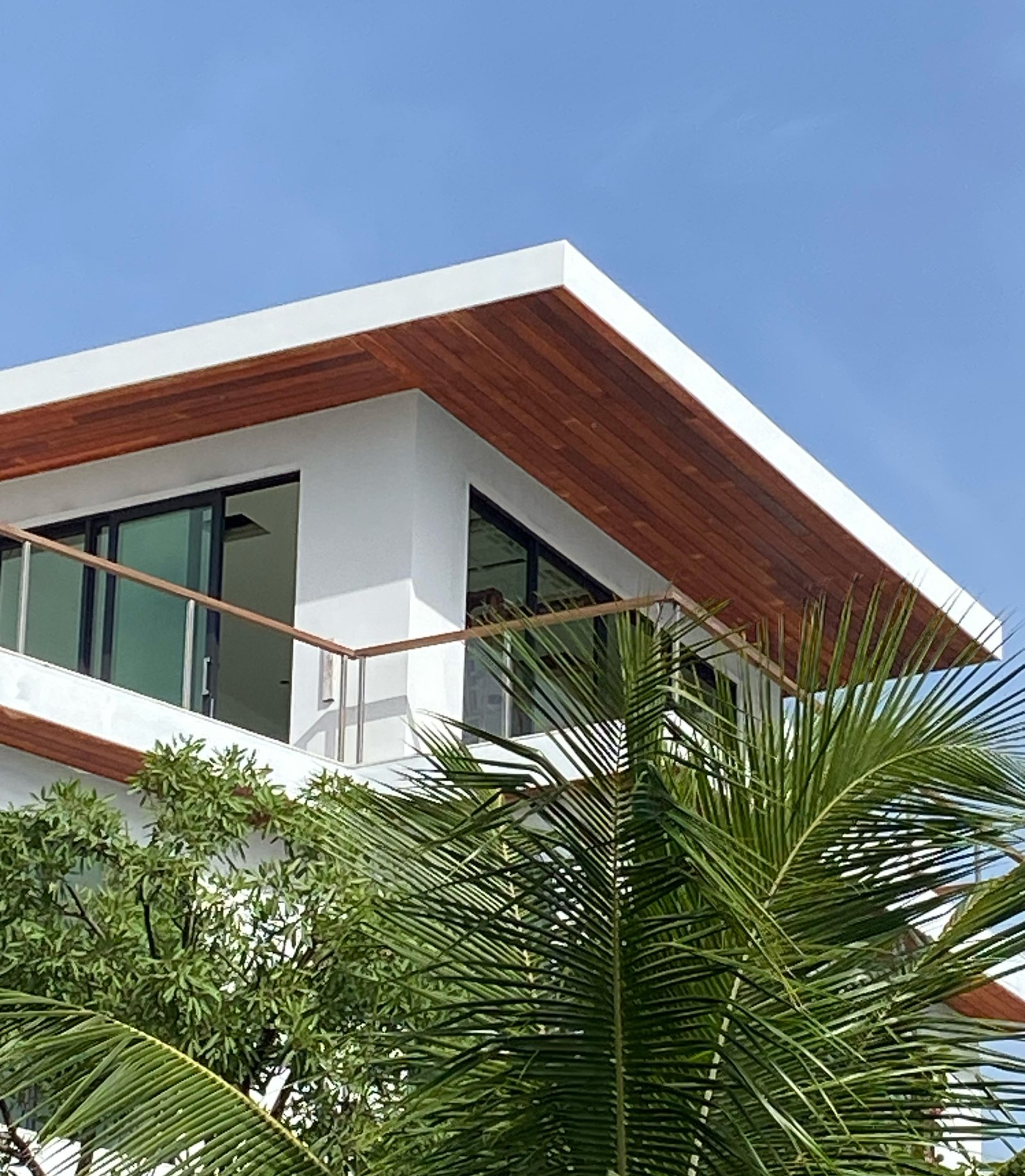
A rainscreen corner has to solve three problems in the same few inches, the cladding joint itself, the continuity of the vented cavity behind it, and the termination of the drainage plane. Miss one and the corner becomes the first part of the wall to fail. Corners see the highest local wind pressures on a building, so wind driven rain arrives there with more energy and from more directions than it does at mid wall.
The cavity is the part most drawings handle badly. A ventilated rainscreen works as a pressure moderated assembly, and the moderation depends on air moving behind the boards. Where two walls meet, the furring doubles up, the airway narrows, and in a lot of built work it stops entirely. Joseph Lstiburek's write ups at Building Science Corporation cover the physics of that drained and back vented layer in detail.
Then there is the wood itself. A corner concentrates end grain, exposes a glue line or a miter to daily wetting and drying, and puts two boards of different width and orientation next to each other. That is a millwork problem before it is an installation problem, which is why the corner details are worth settling in the shop rather than on the scaffold.
Outside Corners, Four Ways
There are four outside corner treatments a wood rainscreen actually uses, and the choice sets how much end grain the weather can see. Corner boards, site mitered courses, a shop built lock miter corner, and a woven or laced corner where alternating courses run long. Each one changes what the mill ships and what the installer has to do with it.
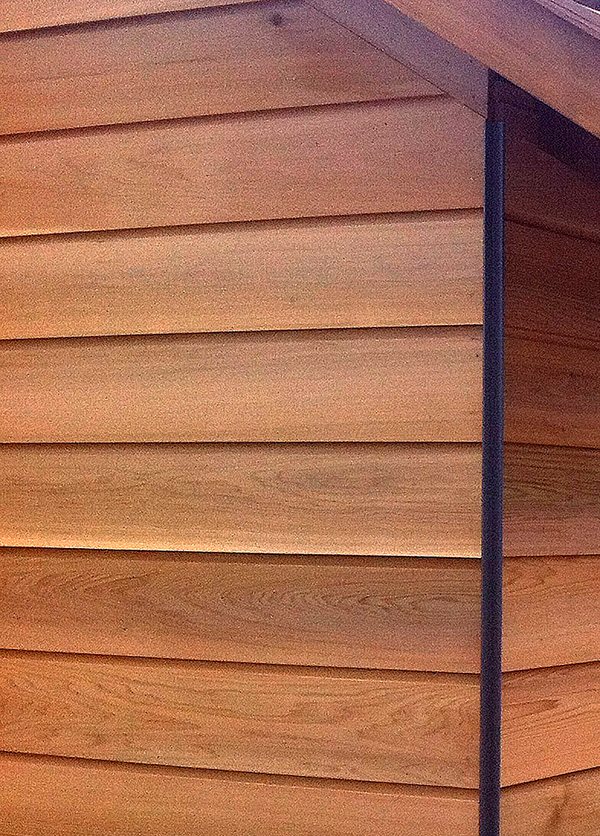
Corner boards are the workhorse. Two boards form an L, the cladding dies into them, and the joint between cladding and corner board is a butt joint that can be caulked or left as a shadow gap. The cladding end grain is hidden behind the corner board rather than exposed to the sky, which is the single biggest reason corner boards outlast site miters on a wall that gets real weather.
Site mitered courses look best and fail first. Every course carries a long grain miter that has to stay closed through seasonal movement, and the outside arris is a knife edge of wood holding a film of coating that wants to break at exactly that point. On a narrow board with tight movement, a miter can hold. On a wide plainsawn board it will open.
A lock miter corner moves that problem into the shop. Two pieces are machined with an interlocking miter profile, glued and clamped on a bench, and delivered as a finished L with no visible seam and no exposed end grain on the face. ICD, the architectural millwork division of J. Gibson McIlvain, cuts and glues those corner assemblies flat rather than asking an installer to hold a miter closed on a wall.
Woven corners belong to thick, rough, wide board applications and to historic work where the original wall was built that way. Courses alternate which wall runs long. It reads as heavy and handmade, it needs every long end sealed, and it needs the cavity behind it to stay open because there is no corner board acting as a chase.
| Corner Treatment | End Grain Exposure | Cavity Continuity | Where the Work Happens | Movement Behavior |
|---|---|---|---|---|
| Corner boards | Cladding ends hidden behind the board, corner board end grain only at top and bottom | Easiest to keep open, the corner board can span a doubled furring chase | Mill supplies boards to length and thickness, installer assembles | Most forgiving, the butt joint absorbs seasonal movement |
| Site mitered courses | None on the face, but a fragile arris and a long grain glue free joint | Depends entirely on furring layout behind the miter | Almost all in the field | Least forgiving, miters open as boards shrink |
| Shop built lock miter | None visible, the joint is machined and glued closed | Corner unit can be sized to bridge the doubled furring | Machined, glued and clamped in the shop | Strong and stable, provided the glue line is prepared correctly |
| Woven or laced courses | High, every alternating course ends exposed | Needs deliberate blocking, no natural chase | Mill cuts to length, installer laces the courses | Each course moves independently, which is the point |
| Radius outside corner | None if milled from solid, joints fall away from the curve | Requires curved furring or a segmented backer | Pattern and template work in the shop | Stable when quartersawn stock is used for the curved members |
Lock Miter Corners and the Glue Line
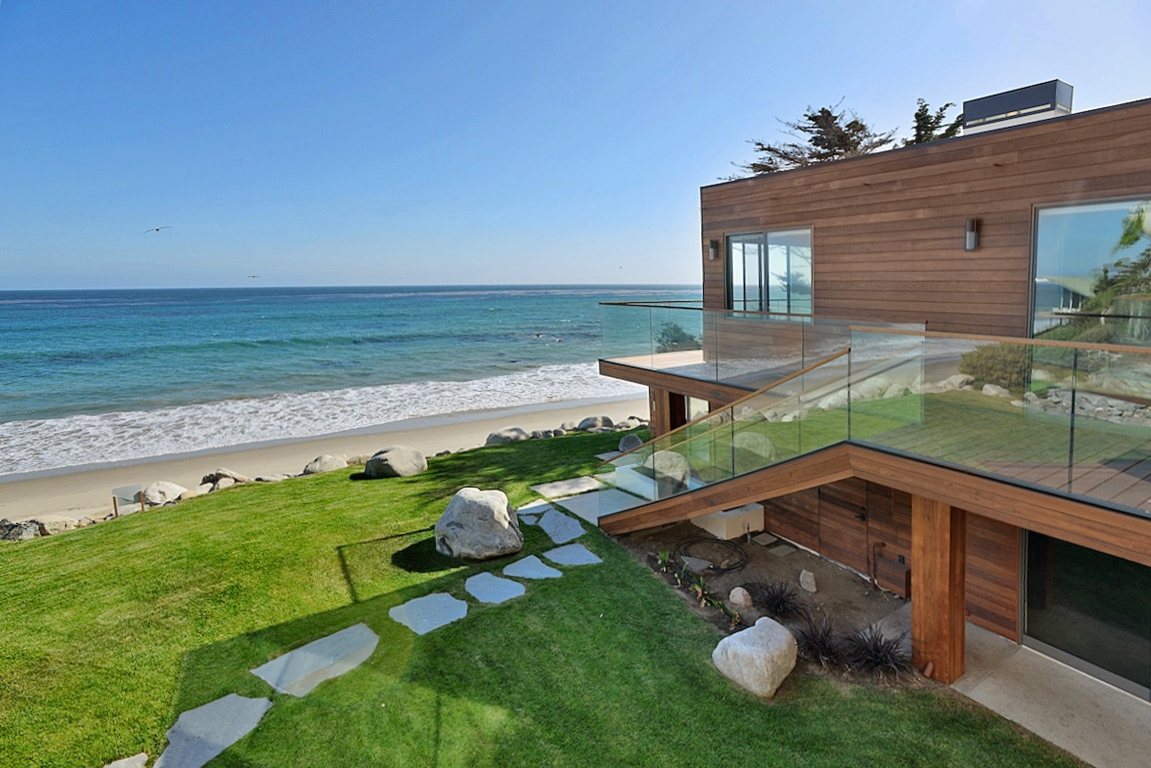
A lock miter corner is only as good as the glue line inside it, and the glue line is decided by species and surface prep, not by clamping pressure. The joint gives a clean arris with no visible seam and real mechanical strength across the corner. It also buries a continuous adhesive bond in the one place on the wall that gets wet most often.
The millwork palette here is Sapele, Iroko, Afrormosia, Teak and Utile. All five machine cleanly, hold a knife edge on a profile, and glue predictably when the faces are milled fresh. Teak carries enough natural oil that the mating faces get wiped with solvent immediately before glue up, which is standard practice and takes nothing away from the species.
The tropical decking woods are a different matter. Ipe, Tabebuia spp, along with Cumaru, Garapa, Jatoba and Red Balau, are extremely hard and carry high oil content, which makes them difficult to glue and hard on knives. They earn their place on a deck. A millwork shop building a glued corner assembly reaches for Sapele, Iroko, Afrormosia, Teak or Utile instead, because those are the species that will still hold a machined joint after ten seasons on a west wall.
Adhesive selection belongs to the exposure class, not to the drawing note. An exterior corner assembly needs a structural adhesive rated for wet use and a joint geometry that keeps the glue line out of standing water. Where the assembly will be painted, a bead of flexible sealant at the back of the miter is cheap insurance against a hairline telegraphing through the coating.
Corner Boards, Returns and the Profile That Has to Match
Corner boards are not plain stock on most jobs, they carry a bead, a chamfer, a reveal or a back band that has to match the rest of the trim package. An outside corner with a 3/8 inch bead on the leading edge reads completely differently from a square edged board, and on a restoration it is the detail a review board will look at first.
J. Gibson McIlvain holds a moulding profile library of thousands of ground knives and grinds new knives every week. If a corner board profile exists in the library it gets pulled. If it does not, the shop grinds a knife to match, which covers both difficult historical restoration profiles and contemporary ones drawn from scratch. The Secretary of the Interior's Standards published by the National Park Service are the reference most historic districts use when they ask for like for like replacement, and a matched knife is how that request gets answered in wood.
Returns are the other half of the profile question. Where cladding runs into a window casing, a frieze or a water table, something has to close the end of the board with the same profile carried around the return. ICD mills those returns as part of the same package, which keeps the reveal consistent instead of leaving an installer to improvise with offcuts. The trim profile work and the exterior millwork side come off the same drawings.
Curved walls change the corner from a joint into a template problem. A bay, a turret or a radiused entry wants radius trimwork, and ICD mills radius corner members and curved water table stock from pattern rather than kerfing straight stock on site. Curved members are laid out so the joints fall on the flat, away from the tightest part of the arc.
Inside Corners and the Cavity That Gets Pinched
Inside corners are where the vented cavity quietly closes itself, and no one notices until the boards on both sides of the corner start cupping. Two runs of vertical furring meet, blocking is added for fastening, and the air path that was supposed to run bottom to top through the whole wall now stops at the corner.
The fix is layout. Furring stops short of the corner with a deliberate gap, or the assembly uses cross battens so the horizontal layer carries air past the vertical blocking. Where horizontal furring alone is used, it has to be notched or spaced so water can drain down and air can move up. Every rainscreen detail that works has a continuous path from the vent at the bottom to the vent at the top.
An inside corner is usually closed with a square stick, a small L, or a simple butt where one run dies into the face of the other. A milled inside corner stick with a slight reveal on each leg is the most forgiving of the three, because the reveal absorbs the movement that a caulked tight joint would fight.
Inside corners also collect water. They are the natural funnel for anything running down the two intersecting faces, so the bottom of an inside corner needs a way out. A kerfed drip on the underside of the closure stick and a clear gap at the base course will handle it.
Closing the End of a Run
Every cladding run ends somewhere, and the four terminations that matter are the base, the head, the jamb and the soffit transition. Those are the details that decide whether the cavity vents, drains and keeps insects out, and they are the ones most often left to be figured out on site.
The base termination carries the most load. Water that got behind the cladding arrives there, air enters there, and the bottom of every board sits there in the splash zone. A base detail wants a starter strip or vented closure that holds the first course out to the plane of the furring, a clear drainage gap, and insect screening that does not block airflow. The bottom edge of the first course gets a kerfed drip so water leaves the board instead of tracking back under it.
Head and jamb terminations are flashing work. Head flashing with end dams, a sloped sill, and a cladding end held back from the trim with a gap rather than sealed tight to it. Wood millwork supplied for those locations should arrive with the back relief and the sealed end grain already handled, because the installer will not have a shop finish available at the moment of the cut. Flashing, membrane lapping and field measurement are the installer's scope. J. Gibson McIlvain supplies and mills the wood and does not perform installation.
"The corner and the end of the run are where I see specifications go quiet. We can ship you a lock miter corner assembly, the matching corner board profile, the return stock and the base closure all cut from the same lot so it looks like one wall. What we cannot do is guess the detail after the fact, so we would rather see the elevation early than fix a corner later."
Norm Moton, Director of Sales, J. Gibson McIlvain
Soffit transitions close the top. The cladding run terminates into a frieze or directly under a vented soffit, and the top of the cavity has to exhaust. A continuous gap behind a frieze board, screened, does the job without showing on the elevation.
Grooving, Back Relief and What Carries Around the Corner
Back kerfs, back relief and joint grooving all have to stop before they reach a corner, or the corner turns into a moisture trap. Relief kerfs on the back face of a wide board reduce cupping stress and give a path for any water that gets behind. Run them out the end of a board into a mitered corner and they become open channels drawing water into the joint.
The shop stops relief kerfs short of both ends on any piece that will be mitered, lapped into a corner board, or used as a return. On a shiplap or tongue and groove profile the rabbet or tongue is trimmed back at the corner so nothing telegraphs past the arris. These are small machining decisions that only get made correctly when the corner detail is known at the time of milling.
Open joint cladding has its own corner logic. The shadow gap between boards wants to continue around the corner at the same dimension, which means the corner member is sized to the gap module and the furring behind it gets a dark colored, UV stable backing so the cavity does not read as a bright line. Gap dimension, board width and corner width get resolved together on paper.
Grooving for concealed fasteners or clip systems has to be held back at corner pieces as well. A clip groove exiting the end of a board at an outside corner leaves a visible slot and a wicking path. J. Gibson McIlvain mills those grooves to the run length called out on the elevation rather than blindly to the full length of the stick.
Species and Lengths for Corner Stock
Corner stock is thicker, longer and more visible than field cladding, so the species decision is made on stability and available length rather than on hardness alone. A corner board that has to run two stories without a joint is a length problem first.
Sapele leads the palette for painted and stained exterior corner work, at roughly 1,410 lbf on the Janka scale, with good paint holding and a wider range of sizes and longer lengths than Genuine Mahogany, which sits near 800 lbf. For painted exterior trim Sapele is the better choice of the two. One limit worth knowing, Sapele is not milled 1x8 for exterior use, because at that width in that thickness it will not stay flat. Cupping on a cladding wall is driven by installation and back ventilation, not by the species on the label.
Iroko, Afrormosia, Teak and Utile round out the millwork palette. Iroko weathers to a quiet grey and machines well for corner profiles. Afrormosia is dense and dimensionally steady. Utile takes a knife edge cleanly and matches Sapele closely enough to live on the same wall. Reference data on Sapele and Iroko is worth reading before a final call.
Cedar is a legitimate default and always has been. The grade distinction is what matters. Clear vertical grain, CVG, is the quartersawn clear material specified where a painted or stained corner board has to stay flat and knot free. Select tight knot, STK, carries sound tight knots and suits a rustic wall or a woven corner where the knots are part of the look.
Modified woods change the math on stability and carry the only real warranties in this category. Accoya runs near 1,600 lbf with acetylation giving dramatically reduced shrinkage and swelling, which makes it the choice for wide corner members and painted work. Thermory and Abodo Vulcan are both carried as well, with Accoya publishing its acetylation data and Thermory publishing the thermal modification side. All of the modified products top out around 16 ft, most sold on metric lengths just under 16 ft, because of kiln size. Thermally modified Ash is not available wider than 8 inches, so a wide board in a modified product means Accoya or Abodo Vulcan.
No warranty exists on solid unmodified wood. It is not possible to warranty an organic material that responds to its environment. Warranties belong to the modified products and nowhere else. Where a CITES listed species is part of the package, documentation and chain of custody travel with the material, so a specification with sourcing requirements gets answered with paper as well as lumber. The registers at CITES and FSC are the primary references for both.
Priming and Finishing the Corner Pieces
Corner pieces get primed on all six faces before they leave the shop, because the two faces buried in the assembly are the ones no one will ever coat again. A lock miter corner has interior surfaces that become permanently inaccessible the moment it is glued. The back of a corner board is against furring for the life of the wall.
J. Gibson McIlvain primes in three levels, in both oil based and water based systems, and exterior primed trim carries a fungicide additive. Open-grained and oily species absorb a great deal of finish, so a primer coat evens out the eventual painted surface. Sanding or buffing after priming knocks back grain raising while keeping moulded detail crisp, which matters on a beaded corner board where a heavy coat would otherwise fill the bead.
Field cuts are the gap in any prefinished package. Every cut a fabricator or installer makes at a corner, a jamb or a base course exposes raw end grain, and that cut needs an end grain sealer before the piece goes on the wall. That work is the installer's, and it should be written into the scope rather than assumed.
Finished millwork also has to survive the trip. J. Gibson McIlvain runs its own fleet of trucks and has a section of the mill dedicated to packaging, so primed corner assemblies and prefinished cladding ship protected rather than strapped raw to a flatbed. Corner pieces are the long, slender, easily damaged items on any cladding load.
Moisture, Movement and Fastening at the Corner
Exterior millwork is milled near 12 to 16 percent in-service moisture content, and a corner detail that ignores the movement that number implies will open within the first year. Interior millwork sits near 6 to 8 percent, which is why an interior return and an exterior corner board are never treated as the same piece of wood.
J. Gibson McIlvain mills exterior cladding and corner stock to that exterior range and records the lot behind it, so a later phase can be matched to the first rather than approximated. Corner boards and field cladding cut from the same lot age together, which is most of what people mean when they say a wall looks right.
Quartersawn and rift stock moves less across its width than plainsawn, which is why it is specified where a painted or panelized surface has to stay flat. On corner members that rule is worth paying attention to twice, since a corner board is usually the widest single piece on the elevation and the most visible. The Wood Handbook from the USDA Forest Products Laboratory carries the shrinkage coefficients by species and orientation.
Fastening at a corner follows one rule. Let each board move. Corner boards get fastened through their own thickness into blocking, not pinned through a mitered joint in a way that locks two pieces moving in different directions. Fastener corrosion resistance is its own question in a vented cavity, and the connection provisions at the American Wood Council along with the building code requirements published by the International Code Council are the documents that govern it.
Industry grading and dimensional standards for milled products sit with the Wood Moulding and Millwork Producers Association, and architectural millwork quality grades come from AWI. Calling a grade in the specification removes most of the argument later.
How J. Gibson McIlvain Would Specify This
The corner details get drawn and milled with the field cladding, as one package, from one lot of lumber, before the first board ships. That is the whole recommendation. A wall where the corner stock was ordered as an afterthought will read as an afterthought.
A workable specification names the corner treatment for outside and inside conditions, the base, head, jamb and soffit terminations, the species and grade, the moisture range, the priming level and system, and where back relief kerfs stop. It also names who seals field cuts. J. Gibson McIlvain mills the cladding, grinds or pulls the corner profile, primes to the specified level with the fungicide additive on exterior work, and ships it packaged for the wall it is going on.
Linear trimwork, finished cladding and primed trim come off the full millwork shop at the Maryland lumber yard. True custom corner assemblies, radius members, custom doors and the rest of the architectural work come from ICD, the company's architectural millwork division, and both can sit on the same order. The ICD working process and the J. Gibson McIlvain millwork service pages outline how a package like this gets built.
J. Gibson McIlvain ships nationwide, regularly to California, and holds finished millwork so a corner package can be released when the wall is ready rather than when the mill happens to finish it. Send elevations and corner details to the millwork team at 800-638-9100 and the profile, species and priming decisions can be settled before anything gets cut.
Frequently Asked Questions
Should outside corners use corner boards or mitered cladding?
Corner boards are the safer detail on almost any wall that gets weather. They hide the cladding end grain behind a solid piece, the butt joint between cladding and corner board absorbs seasonal movement, and the corner board can be sized to bridge the doubled furring so the cavity stays open behind it. Site mitered courses give a cleaner look but put a long grain miter and a fragile painted arris in the wettest spot on the building, and on wide plainsawn boards those miters open. Where the seamless look is required, a shop built lock miter corner assembly delivers it without asking an installer to hold a miter closed on a wall.
Does the ventilation cavity need to stay continuous around a corner?
Yes. A drained and back vented rainscreen depends on air moving from the vent at the base to the exhaust at the top, and a corner is where doubled furring and fastening blocking most often seal that path shut. Either stop the furring short of the corner with a deliberate gap, or use cross battens so a horizontal layer carries air past the vertical blocking. An inside corner is the worst offender because it also funnels water down both intersecting faces, so it needs a clear drainage path at the base as well as an open airway.
Can back relief kerfs run the full length of a cladding board?
Not on any piece that ends at a corner, a return or a jamb. Relief kerfs cut in the back face reduce cupping stress and give trapped water somewhere to go, but if they exit the end of a board they become open channels feeding water straight into a miter or behind a corner board. The kerfs get stopped short of both ends during milling, which means the corner detail has to be known at the time the boards are run, not after they arrive. The same applies to clip grooves for concealed fastener systems.
Which species is right for exterior corner boards on a painted wall?
Sapele, at roughly 1,410 lbf on the Janka scale, is the usual first call for painted exterior corner stock. It holds paint better than Genuine Mahogany, which sits near 800 lbf, and it comes in a wider range of sizes and longer lengths, which matters on a two story corner board that should not carry a joint. Sapele is not milled 1x8 for exterior use because that width in that thickness will not stay flat. Iroko, Afrormosia, Teak and Utile are the rest of the millwork palette. Cedar in clear vertical grain remains a sound default, and select tight knot cedar suits a rustic or woven corner. Where a fully stable wide painted member is needed, Accoya near 1,600 lbf is the modified option.
How long can corner boards and cladding be if a modified wood is specified?
Modified products top out around 16 ft, and most are sold on metric lengths just under 16 ft, which is a kiln size limit rather than a supply question. That applies to Accoya, Thermory and Abodo Vulcan alike. Thermally modified Ash is additionally not available wider than 8 inches, so a wide board in a modified product means Accoya or Abodo Vulcan. Solid unmodified species are where the longer corner board lengths come from, and no warranty exists on solid unmodified wood because it is an organic material responding to its environment.
Can an existing corner board profile on a historic building be matched?
Usually, yes. J. Gibson McIlvain holds a moulding profile library of thousands of ground knives and grinds new knives every week, so a profile already on file gets pulled and one that is not gets ground to match. That covers both difficult historical restoration profiles and contemporary designs drawn from scratch. For a historic district requiring like for like replacement, send a physical sample or a measured section of the existing corner board along with the species, and the matched knife is what produces the replacement stock.
What arrives already finished and what still has to be sealed on site?
Priming is done in three levels, in oil based and water based systems, with a fungicide additive on exterior primed trim. Corner pieces are primed on all six faces, since the back of a corner board and the interior surfaces of a glued lock miter are permanently inaccessible once the wall goes up. What the shop cannot cover is the field cut. Every cut made at a corner, jamb or base course exposes raw end grain and needs an end grain sealer before the piece is fastened. That is the installer's scope and belongs in the specification in writing.
Does J. Gibson McIlvain install the cladding or coordinate the install?
No. J. Gibson McIlvain supplies and mills. The company mills cladding and corner stock, machines the joinery and grooving, primes and packages the material, and ships it nationwide, and ICD, the architectural millwork division, builds the true custom corner assemblies, radius members and other work planned around a specific building. Flashing, membrane lapping, furring layout, field measurement and the installation itself are handled by the builder's own installer or fabricator. Call 800-638-9100 with elevations and corner details to get the shop scope defined.
Sources and Standards Referenced
- BSD-013: Rain Control in Buildings, Building Science Corporation
- Wood Handbook: Wood as an Engineering Material (FPL-GTR-282), USDA Forest Products Laboratory
- Codes and Standards, American Wood Council
- The Secretary of the Interior's Standards for the Treatment of Historic Properties, National Park Service
- Wood Moulding and Millwork Producers Association
- Architectural Woodwork Institute
- Sapele, The Wood Database
- CITES Convention on International Trade in Endangered Species
- Accoya Acetylated Wood
- Thermory Thermally Modified Wood