Sheen Is a Measurement, Color Is a Match
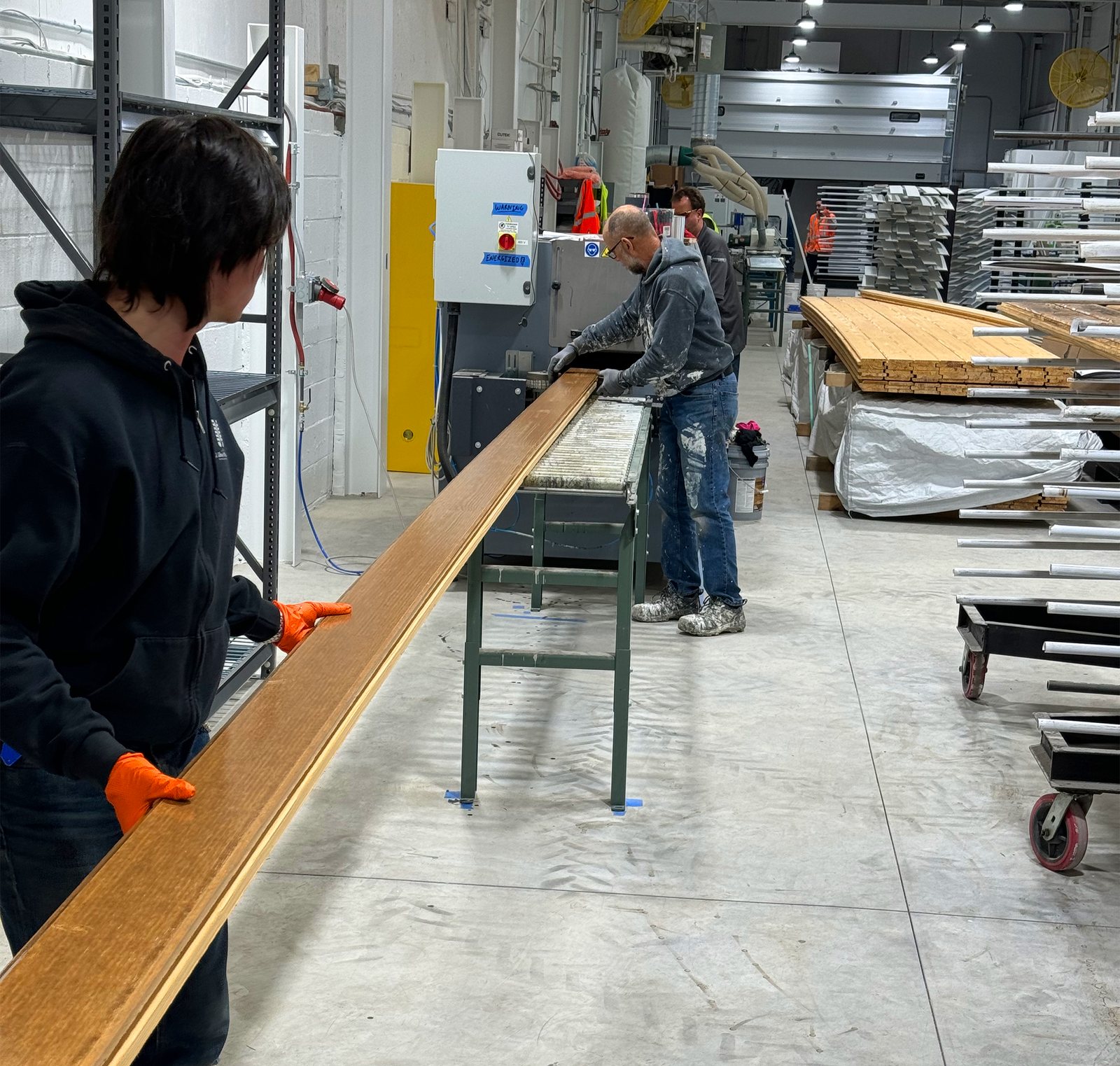
Sheen is a number an instrument can read, color is a judgment an eye has to approve, and that difference explains most of the finish complaints that land on a millwork punch list. Gloss gets measured with a meter that fires light at the surface at a fixed angle and reads how much of it bounces back specularly. The standard method for that reading is ASTM test methodology for specular gloss, and the usual geometry for architectural coatings is 60 degrees, with 20 degrees used for high gloss films and 85 degrees for flat ones.
Color behaves differently. A mismatch in color shows up under diffuse light from any angle and stays visible when you walk around the room. A mismatch in sheen hides until light rakes across the surface. Then it takes over completely.
That is why a finisher gets called back to a job where the casing and the door slab were stained from the same batch, and the architect is certain the color drifted. Nine times out of ten the color is fine. The casing was sprayed with three coats over a sealed, primed substrate and the slab got two coats over bare, open pore wood, so one piece carries a smoother film and throws a harder highlight.
Why the Same Can Reads Two Different Ways
Every satin and eggshell coating owes its low reflectance to a flatting agent suspended in the film, and anything that changes how much of that agent ends up in the dried surface changes the sheen without touching the color. The flatting agent is usually amorphous silica or a treated silica, and it settles. A can that sat on a shelf and got a lazy stir sprays glossier off the top and flatter off the bottom. Two pieces finished an hour apart from the same pail can land a full step apart on the ladder.
Film thickness does the same thing from the other direction. On an open pore species, the first coat sinks and the flatting matrix partially disappears into the wood, so it reads flatter than the label. By the third coat the pores are closed and the film is forming over itself, and the surface reads glossier. More coats of a satin product on porous wood almost always climb in gloss.
Application method matters as much as the product. Sprayed film levels and reads higher gloss than the same material brushed, because brush marks scatter light. Atomization pressure, reducer, flash off time and shop temperature all move the number. So does the grit of the final scuff sand. A 220 scuff under the last coat reads different from a 320 scuff, and a gray pad reads different from either. None of that is a defect. It is a control problem, and it gets controlled by locking the substrate condition before the topcoat is ever opened.
Grain Raising and the Primed Substrate
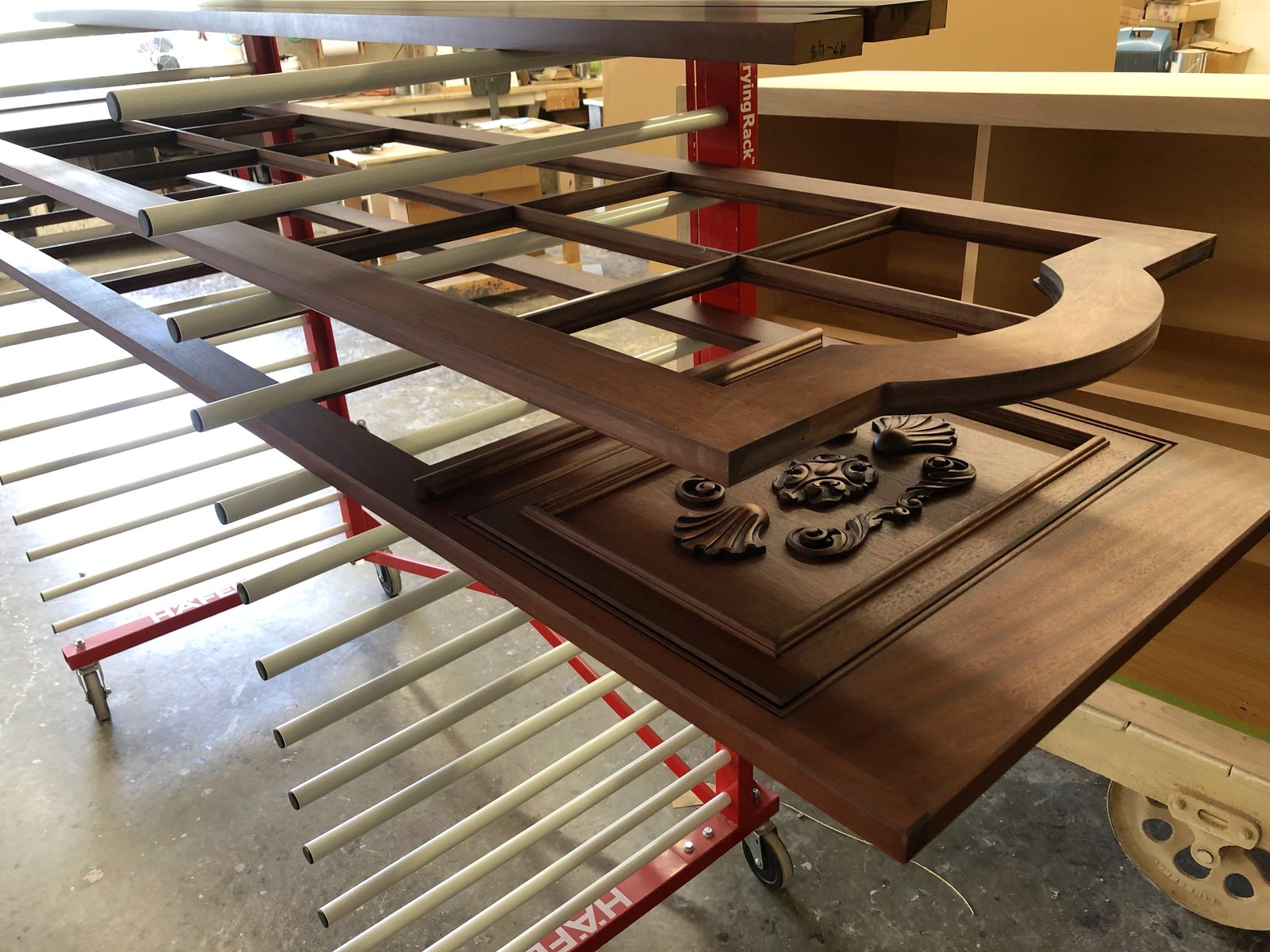
A primed and sanded substrate is the single most effective sheen control available on painted millwork, because it removes the absorption variable that makes one board drink two coats while the board next to it drinks four. Open-grained and oily species absorb a great deal of finish, so a primer coat evens out the eventual painted surface. What arrives at the finisher is then a uniform porosity, not a lottery.
J. Gibson McIlvain primes trim in three levels, in both oil based and water based systems, and exterior primed trim carries a fungicide additive. The level gets chosen against what the finish schedule asks for. A piece heading for a dead flat interior paint does not need the same buildup as a run of exterior casing that has to hold a semi gloss acrylic through a decade of weather.
Waterborne primers raise grain. That is chemistry, not a fault. The fix is mechanical, and the shop sands or buffs after priming, which knocks back grain raising while keeping moulded detail crisp. That last part is the whole trick. An aggressive block sanding will flatten an arris and soften a cove, and once the profile loses its edge the piece reads dull no matter what sheen goes over it. The USDA Forest Products Laboratory has documented the relationship between surface preparation, coating adhesion and service life for decades, and every bit of it starts at the substrate.
How a Profile Changes Perceived Sheen
Two pieces carrying an identical film can read a full sheen step apart purely because of geometry, and a curved or heavily moulded surface always reads glossier than the flat stock it meets. A flat stile presents one plane to the light and returns one broad, even reflection. A cove, a bead or an ogee presents a continuously changing angle, so somewhere along that profile there is always a spot aimed straight back at the eye. That spot is a hot highlight.
Radius work exaggerates it. A curved head casing running into straight legs will look brighter on the curve every time, same product, same coat count, same day. Where that bothers a designer, the answer is to drop the curved elements half a step in sheen, or to accept it and light the opening so the grazing angle never sets up. J. Gibson McIlvain mills radius trimwork and radius millwork to the drawing, and ICD, the company's architectural millwork division, builds the curved doors, cabinets and railings that go with them.
Crisp detail survives sheen better than soft detail. J. Gibson McIlvain holds a profile library of thousands of ground knives and grinds new knives every week, and a knife ground to a sharp arris produces a shadow line that stays legible under a flat paint. A worn knife produces a rounded arris that needs gloss to read at all. That is a milling decision disguised as a finishing decision.
Joinery hides inside the same problem. A box beam assembled with butt joints shows visible seams and visible end grain, and a gloss or semi gloss film will telegraph every one of them, because a higher sheen amplifies any interruption in the plane. ICD builds box beams with butt, dado or lock miter joints, and the lock miter shows no visible seams and is the strongest of the three, which is why it is the one to specify under any sheen above eggshell.
The Sheen Ladder and What Each Step Reveals
There is no industry wide legal definition of satin or eggshell, so two manufacturers can both print satin on the label and deliver readings far enough apart that the pieces cannot be used in the same room. The only portable language is the gloss reading itself at a stated angle. Specify the number, name the angle, and the argument ends.
| Sheen level | Approximate gloss band at 60 degrees | What it amplifies on a milled surface | Where it earns its place |
|---|---|---|---|
| Dead flat | Under about 5 units | Nothing optically, but it shows every handprint and burnishes where it is touched | Ceiling box beams, high panel work, historic interiors where no reflection is wanted |
| Matte | Roughly 5 to 10 units | Mild telegraphing of fill and joint compound at the wall line | Wide painted cladding and panel fields that have to stay quiet |
| Eggshell | Roughly 10 to 25 units | Grain raising, sanding scratch and uneven primer absorption | Interior linear trimwork and casing in occupied rooms, cleanable without shining |
| Satin | Roughly 25 to 35 units | Profile geometry, radius highlights, any dished or proud surface | Doors, cabinet faces, benches, railings, most exterior painted trim |
| Semi gloss | Roughly 35 to 70 units | Seams, end grain, fastener fill, substrate flatness across the width | Shutters, gates, exterior casing and anything washed frequently |
| Full gloss | Above about 70 units | Everything, including board cup measured in thousandths | Nautical bright work, entry doors, estate gate panels on a quartersawn or modified substrate |
Read that table as a risk ladder. Every step up buys washability and buys drama, and every step up spends some of the tolerance the substrate had.
Stains, Dyes and the Sheen Underneath
Stain sets color, never sheen, but the color it sets changes how hard the same sheen reads, because a dark surface returns less diffuse light and lets the specular highlight dominate. Put one satin topcoat over a dark toned Sapele panel and the same satin over pale Hard Maple, and the Sapele will look glossier to every person who walks past it. The meter says they match. The eye does not care.
Dye and pigment behave differently under a clear coat. A dye penetrates and colors the fiber, leaving pore structure open and texture intact. A pigmented wiping stain parks solid particles in the open pores, which on Sapele, Iroko or Utile emphasizes the pore pattern and scatters light inside each vessel, flattening the perceived surface slightly. Combining both, a dye for depth and a light pigment for pore definition, is the standard approach on ribbon figured stock.
Washcoats and sealers are the blotch control. A thinned sealer applied before stain limits how deeply the color goes, which evens out density variation within a single board. It also raises the sheen floor, because the pores start partly closed. Anyone matching two species in one room has to hold both variables at once, and the practical move is to lock the sheen first and then chase the color, not the reverse.
Nautical Varnish and Why Gloss Carries the UV Package
On marine and coastal bright work the gloss version of a spar varnish is the protective version, and the satin version of the same product is a cosmetic downgrade that trades ultraviolet defense for appearance. A long oil phenolic or alkyd spar varnish gets its durability from a flexible, high solids film loaded with ultraviolet absorbers. Adding flatting silica to reach a satin reading scatters light at the surface and dilutes that protection per unit of film.
The working practice follows directly. Build the schedule in gloss, six to ten coats depending on the product and the exposure, sanding between coats, and if a satin appearance is wanted, apply exactly one satin coat last over a fully built gloss stack. The protection lives underneath. The look lives on top.
Species selection drives the prep. Teak carries natural oils that have to be removed from the surface before varnish goes on, so a solvent wipe and a fresh sanding immediately before coating is not optional. Iroko and Afrormosia behave similarly and both take a bright finish beautifully. Sapele and Utile are the workhorses for larger bright finished components because they come in the widths and lengths a door stile or a rail actually needs.
There is a reason a millwork house does not build these components from decking stock. Ipe, botanically Tabebuia spp, along with Cumaru, Garapa, Jatoba and Red Balau, is extremely hard and high in oil, which makes gluing unreliable, so those species stay on the decking side of the business and Sapele, Iroko, Afrormosia, Teak and Utile do the milled, glued and machined work.
The varnish schedule itself belongs to the buyer's own finisher or marine shop. J. Gibson McIlvain mills and supplies the components in those species and ships them nationwide, regularly to California, and ICD builds the custom doors, gates, benches and railings that carry the bright finish once it is applied.
"We get asked to match a color when the problem on the wall is a sheen difference nobody metered. Once a client brings us a signed sample panel of the actual profile in the actual species, the rest of the job stops being a debate."
Brett Miller, President, J. Gibson McIlvain
Clear Epoxy Is a Build Coat, Not a Finish Sheen
Clear epoxy is a sealer and a moisture barrier, and it cannot be the top layer on anything that sees sun, which means the sheen a viewer eventually sees comes entirely from the varnish or urethane that goes over it. Epoxy has almost no ultraviolet resistance. Left exposed it ambers, chalks and then loses adhesion at the surface, taking the gloss with it.
What epoxy does well is fill and seal. It penetrates end grain, stabilizes checks, and gives a hard, low permeability base that a thin varnish film cannot build on its own. Cured epoxy usually needs an amine blush wash and a thorough sanding before the topcoat, and that sanding leaves a leveled, matte base. Level is the point. A gloss topcoat over a properly leveled epoxy base is the flattest optical surface achievable on wood.
Practical places it shows up are the bottom rail of a gate, the exposed end grain of an outdoor bench, the lower edge of a custom door and the cut ends of rafter tails and pergola members. All of that mixing, coating and blush removal is fabricator or finisher work. J. Gibson McIlvain supplies the milled components and ICD builds the assemblies, and the epoxy and topcoat schedule is executed by the buyer's own finishing trade.
Species, Moisture and Movement Under a Film
High sheen is a magnifying glass held over the substrate, so the higher the gloss the flatter and drier the wood underneath has to be before a single coat goes on. Quartersawn and rift stock moves less across its width than plainsawn, which is why it gets specified wherever a painted or panelized surface has to stay flat. A cup of a few thousandths that nobody would notice under a flat paint becomes a visible waviness under a full gloss film.
Moisture content is the other gate. J. Gibson McIlvain mills interior millwork to an in service moisture content near 6 to 8 percent and exterior work near 12 to 16 percent, which is what keeps a film from being asked to stretch over a substrate still equalizing. Coating wood that has not reached equilibrium is the most common root cause of early adhesion failure, and Building Science Corporation has published extensively on the moisture dynamics behind exterior coating performance.
Hardness matters where the finish will be touched. Sapele runs roughly 1,410 lbf on the Janka scale, White Oak roughly 1,360 lbf, Hard Maple roughly 1,450 lbf, Cherry roughly 950 lbf and Genuine Mahogany roughly 800 lbf. On a railing or a bench, a softer species under a satin film will burnish to a higher local gloss where hands land, and that localized shine is a sheen change, not wear through. Details on each of these are catalogued at the Wood Database entry for Sapele and the entry for Iroko.
For painted exterior trim, Sapele is the better call over Genuine Mahogany. It holds paint better and it comes in a wider range of sizes and longer lengths. It is not milled 1x8 for exterior use, since that width is too wide to stay stable in that application. And cupping on exterior boards is driven by installation and back ventilation, not by the species on the invoice.
Where dimensional stability has to be near absolute under a gloss film, the modified products are the answer. Accoya runs roughly 1,600 lbf and its acetylation gives dramatically reduced shrinkage and swelling, which is why it is the substrate of choice for high gloss painted exterior doors and gate panels. Thermory and Abodo Vulcan are both carried as well. All of the modified products top out around 16 ft, most sold on metric lengths just under 16 ft, because of kiln size, and thermally modified Ash is not available wider than 8 inches, so a wide board in a modified product means Accoya or Abodo Vulcan.
One honest limit belongs in every finishing conversation. There are no warranties on solid unmodified wood. Warranties exist only on the modified products, because it is not possible to warranty an organic material that responds to its environment.
Approving Sheen on a Panel, Not a Chip
A paint chip and a color name approve nothing, and the only sample that settles a sheen question is a piece of the actual species carrying the actual profile with the actual number of coats, viewed at the angle the finished work will be lit from. Two panels are better than one. Make a flat panel and a moulded panel from the same run and the same schedule, and the difference between them will show the design team what geometry is going to do before anything ships.
Record the reading. Note the gloss units at 60 degrees, the product, the batch, the coat count and the final scuff grit on the back of the approved panel, then sign it and keep it. When phase two starts and a different finisher is on the job, that panel is the only document that carries the answer. Finish system classifications published by the Architectural Woodwork Institute give the vocabulary for writing it into a specification, and for work in a regulated district, the National Park Service technical preservation program is the reference for what a like for like replacement is allowed to look like.
Light the mock up the way the room will be lit. Grazing light down a long corridor wall is the harshest test a sheen will ever face, and a sample approved flat on a table under diffuse shop light has told nobody anything about that corridor.
How J. Gibson McIlvain Would Specify This
Specify the substrate condition and the sheen number, in that order, and the color match becomes the easy part of the job. The sequence the shop would write looks like this.
Name the species from the millwork palette first, Sapele, Iroko, Afrormosia, Teak or Utile, or a modified product where movement under a gloss film cannot be tolerated. State quartersawn or rift where the surface has to stay flat. State the in service moisture content, 6 to 8 percent for interior and 12 to 16 percent for exterior.
Then set the substrate. Call the priming level and the system, oil based or water based, and call for sanding or buffing after priming so the moulded detail stays crisp. Call the joinery where sheen will expose it, which on a box beam above eggshell means lock miter.
Then set the sheen itself. Give a gloss target in units at 60 degrees rather than a marketing word, give the coat count, and give a separate target for radius and heavily moulded elements if the design wants them to read level with the flat stock. On bright work, write the gloss stack and allow one satin coat last if the appearance calls for it.
J. Gibson McIlvain supplies the linear trimwork, the finished cladding and the primed trim, mills it to the moisture content the assembly needs, and grinds the knife when a profile is not already on file, including difficult historical restoration profiles. ICD builds the true custom side planned around a specific space, rafter tails, gates, box beams, custom doors, cabinets and kitchen cabinets, radius millwork, pergolas, shutters, benches and railings. Seventh generation and family run since 1798, the company keeps the knife and the record on file, which is what lets phase two match phase one years later.
Start with the millwork services at J. Gibson McIlvain and the trim profiles built by ICD, then call 800-638-9100 with the drawing, the species, the exposure and the sheen target, and the shop will tell you what the substrate has to be before your finisher opens a can.
Frequently Asked Questions
Why do two pieces with the same stain look different only when light rakes across them?
Because that is the viewing condition where specular reflection dominates, and specular reflection is sheen rather than color. Under diffuse light the eye reads mostly the stain, so both pieces look like a match. Under grazing light the eye reads the film surface, and any difference in film smoothness, coat count or flatting agent content becomes a visible difference in brightness. The usual root cause is unequal absorption, one piece finished over a sealed or primed substrate and the other over bare open pore wood.
Does adding more coats of a satin finish change the sheen?
On porous wood, yes, and it climbs. The first coat partially disappears into the pores and takes some of the flatting matrix with it, so it reads flatter than the label. By the third coat the surface is film over film, smoother and more specular. If a run has to match, the coat count has to be fixed in the specification along with the product, because two coats and four coats of the same satin will not read the same.
Should a clear coat on a coastal or nautical component be gloss or satin?
Build it in gloss. A long oil spar varnish carries its ultraviolet absorbers in the film, and the flatting silica used to make the satin version scatters light at the surface while diluting that protection per unit of film. Standard practice is six to ten gloss coats with sanding between them, then a single satin coat last if a lower sheen is wanted visually. The protection is underneath and the appearance is on top.
Can a sheen be chosen that hides box beam seams?
A flat or matte paint will soften a seam, but it will not hide it, and nothing above eggshell will forgive it. The real fix is joinery. A butt joint leaves visible seams and visible end grain and is the weakest of the options, a dado joint is strong but still shows the seam, and a lock miter shows no visible seams and is the strongest. ICD, the architectural millwork division of J. Gibson McIlvain, builds box beams with any of the three, so the joint gets chosen against the sheen the room is getting.
Does J. Gibson McIlvain apply color matched stains, clear coats or epoxy finishes?
The company supplies linear trimwork, finished cladding and primed trim, mills components to the in service moisture content the assembly needs, and grinds the knives that produce the profile. Color matching, topcoat application, marine varnish schedules and epoxy work are executed by the buyer's own finisher or fabricator. The most useful thing the shop contributes to a finishing schedule is a consistent, evenly absorbent substrate with crisp moulded detail, since that is what makes a finisher's sheen repeatable.
Does clear epoxy have to be topcoated?
On anything that sees sunlight, yes. Epoxy has almost no ultraviolet resistance, so an exposed epoxy surface ambers, chalks and eventually loses adhesion at the surface. Its job is sealing, filling and building a hard, low permeability base, especially on end grain at gate bottom rails, bench ends and door bottoms. It also usually needs an amine blush wash and a full sanding before the topcoat goes on, and the sheen the viewer sees comes entirely from that topcoat.
Is there a warranty on a finish applied to solid wood?
No. There are no warranties on solid unmodified wood, because it is an organic material that responds to its environment and keeps moving with it. Warranties exist only on the modified products, Accoya, Thermory and Abodo Vulcan. A coating warranty from a paint manufacturer is a separate document and normally depends on substrate moisture content, film thickness and maintenance intervals being met.
What sheen belongs on a handrail or bench that gets touched constantly?
Satin is the practical choice, with the understanding that the touched areas will burnish upward over time. Burnishing is a localized sheen change rather than wear through, and it is more pronounced on softer species. Cherry at roughly 950 lbf and Genuine Mahogany at roughly 800 lbf will show it sooner than Sapele at roughly 1,410 lbf or Hard Maple at roughly 1,450 lbf. Specifying a harder species for high contact components keeps the sheen even for longer.
Sources and Standards Referenced
- ASTM International, standards for paint and related coatings testing
- USDA Forest Products Laboratory
- Building Science Corporation, moisture and exterior coating performance
- The Wood Database, Sapele
- The Wood Database, Iroko
- Architectural Woodwork Institute, woodwork and finish standards
- National Park Service, Technical Preservation Services
- Accoya, acetylated wood performance data