
The Short Answer
Ipe requires the fewest maintenance hours of any unfinished tropical decking, and Cumaru and Red Balau sit close enough that your detailing usually matters more than your species pick. That ranking holds because upkeep on a bare deck is not one problem. It is five, and dense tropical hardwoods with high extractive content resist most of them at once. Ipe (Tabebuia spp.) leads on every axis that generates labor. Cumaru follows a step back on movement. Red Balau and Jatoba trade positions depending on your climate, and Garapa buys a lighter, cooler board at the cost of a little more attention. None of them need a finish to survive. The question is which one leaves your toolbox closed the longest, and the honest answer depends on what your weather throws at the deck.
What "Annual Maintenance" Actually Means on a Bare Deck
Unfinished maintenance is not sanding and staining, it is the occasional cleaning and the checks you never let start. A finished deck fails when the coating fails, then you strip and recoat on a schedule the finish dictates. Skip the finish and you delete that entire cycle. What remains is a shorter list: an annual or twice-annual wash to clear pollen, organic film, and the gray airborne grime that lands on any horizontal surface, plus a walk-around to catch a lifting fastener or an opening end check before water gets into it. On a well-detailed Ipe deck in a temperate climate, that is genuinely most of it. The species you choose sets the floor for how much labor is even possible, because a board that resists checking, resists surface mold, and barely moves gives you almost nothing to react to. A board that checks in dry heat or grows mildew in damp shade hands you a chore list whether you wanted a finish or not.
The Five Failure Modes That Generate Every Hour of Upkeep
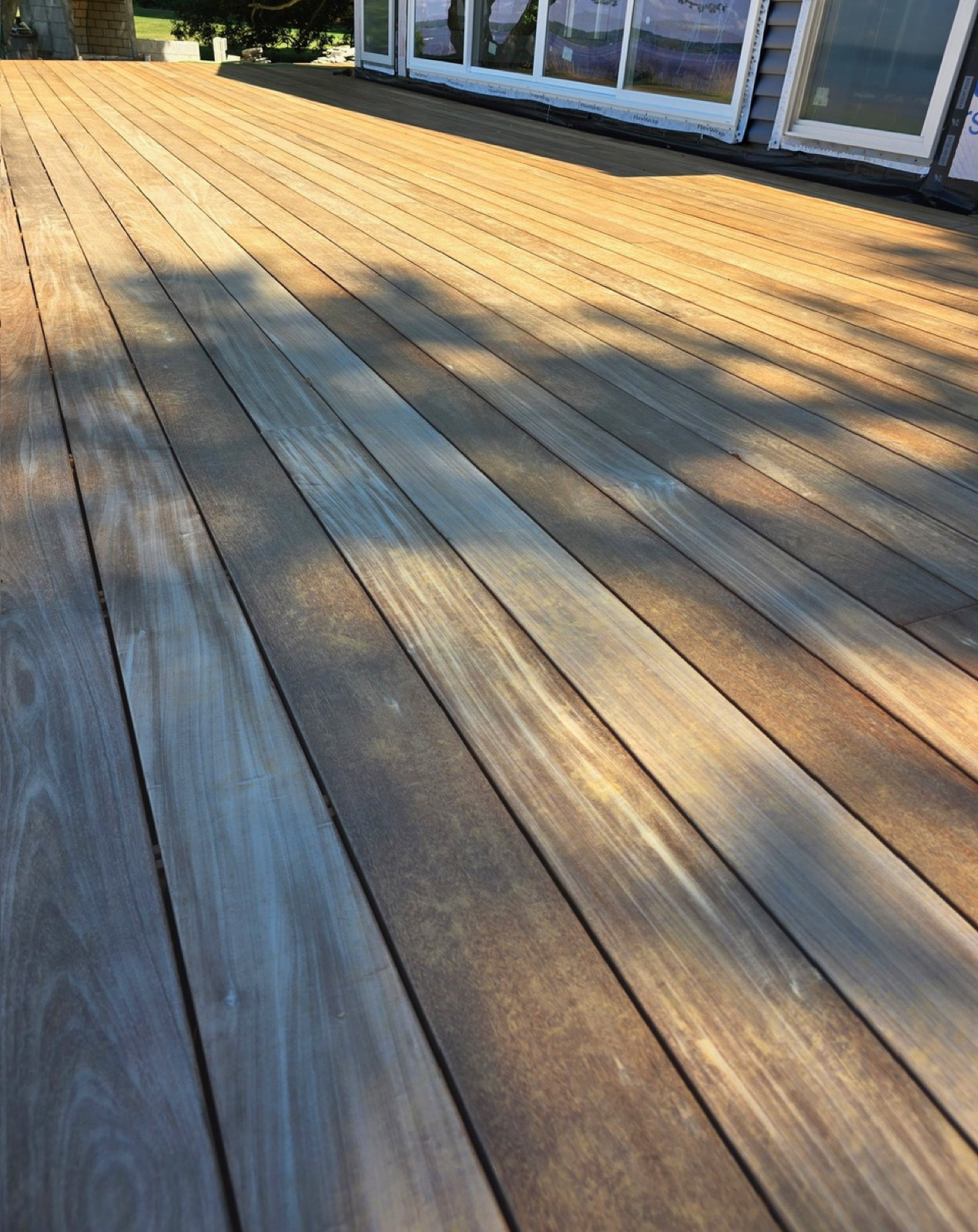
Sort maintenance by cause and the same five failure modes explain almost every hour anyone spends on a bare tropical deck. The first is surface checking, the fine hairline splits that open along the grain when the face dries faster than the core, usually under direct sun. The second is end-grain splitting, where the exposed end of a board wicks and loses moisture roughly ten times faster than its face and pulls itself apart. Third is surface biological growth, the mold and mildew that colonize any damp, shaded horizontal surface. That growth feeds on pollen and organic film sitting on the wood, not on the dense heartwood itself, so it is cosmetic, but it still means a wash. Fourth is extractive bleed, the tannin-rich runoff that can stain concrete, stucco, or light siding below the deck during the first several rain cycles. Fifth is dimensional movement, the cupping, bowing, and gapping that follows a board's shrinkage as it equilibrates to service moisture. A species earns a low-maintenance reputation by resisting several of these at once. Density alone predicts none of them cleanly, which is why the ranking is not simply the Janka chart in order.
Why Extractive Chemistry, Not Just Hardness, Governs Unfinished Behavior
The trait that keeps a bare board quiet is not hardness, it is a combination of low permeability and the fungicidal extractives locked inside the heartwood. Density gets the headlines because it is easy to measure, and it does matter: Ipe runs about 1,050 kg/m3 and roughly 3,680 lbf on the Janka scale, Cumaru about 1,070 kg/m3 and 3,540 lbf. Dense wood is less permeable, so water moves in and out slowly, and slow moisture exchange means less of the differential drying that drives checking. But permeability is only half the story. The other half is chemistry. Ipe carries lapachol and related quinones plus a measurable silica load, and those extractives are why the U.S. Forest Products Laboratory rates it among the most naturally durable timbers on earth, EN 350 Durability Class 1 against decay. Those same compounds suppress the surface fungi that would otherwise colonize a damp board, and they resist the insects that create their own maintenance headaches. The USDA Forest Products Laboratory has documented for decades that natural durability tracks heartwood extractive content, not density in isolation. A moderately dense wood rich in the right extractives can outlast a denser wood that lacks them. That is why the maintenance ranking and the hardness ranking do not line up perfectly, and why the comparison below is built on failure resistance rather than a single number.
| Species | Surface checking | End splitting | Surface mold | Extractive bleed | Dimensional movement |
|---|---|---|---|---|---|
| Ipe (Tabebuia spp.) | Very high | High | Very high | Moderate (early tannin runoff) | Very high |
| Cumaru | High | High | High | Moderate | Moderate |
| Red Balau | High | Moderate | High | Moderate | Moderate to high |
| Jatoba | Moderate | Moderate | High | Low (bleeds more) | Moderate |
| Garapa | Moderate | Moderate | Moderate | Low to moderate | Moderate |
| Massaranduba (comparison only) | Moderate | Low (checks readily) | High | Moderate | Moderate |
Ipe: The Lowest-Labor Bare Deck
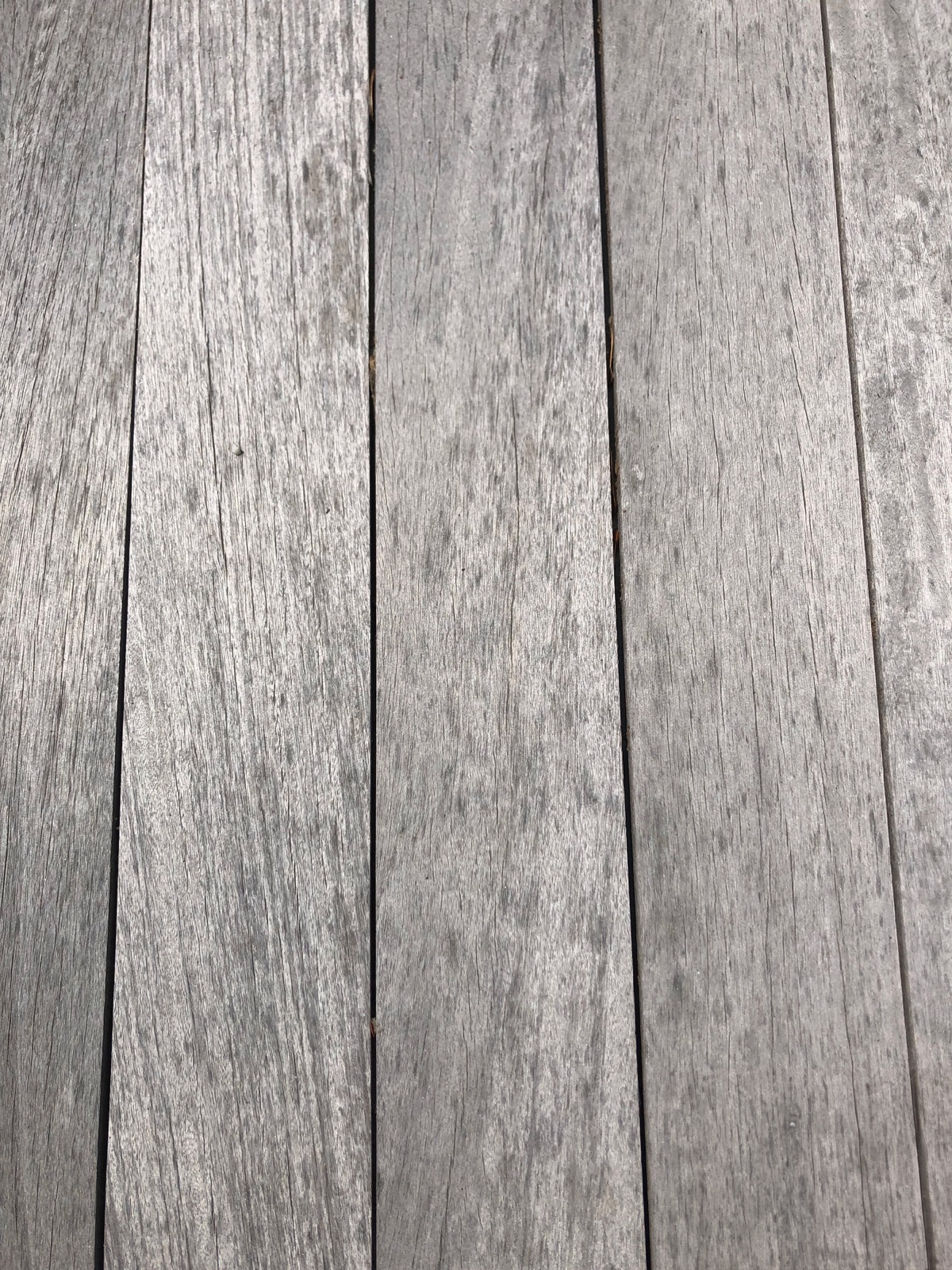
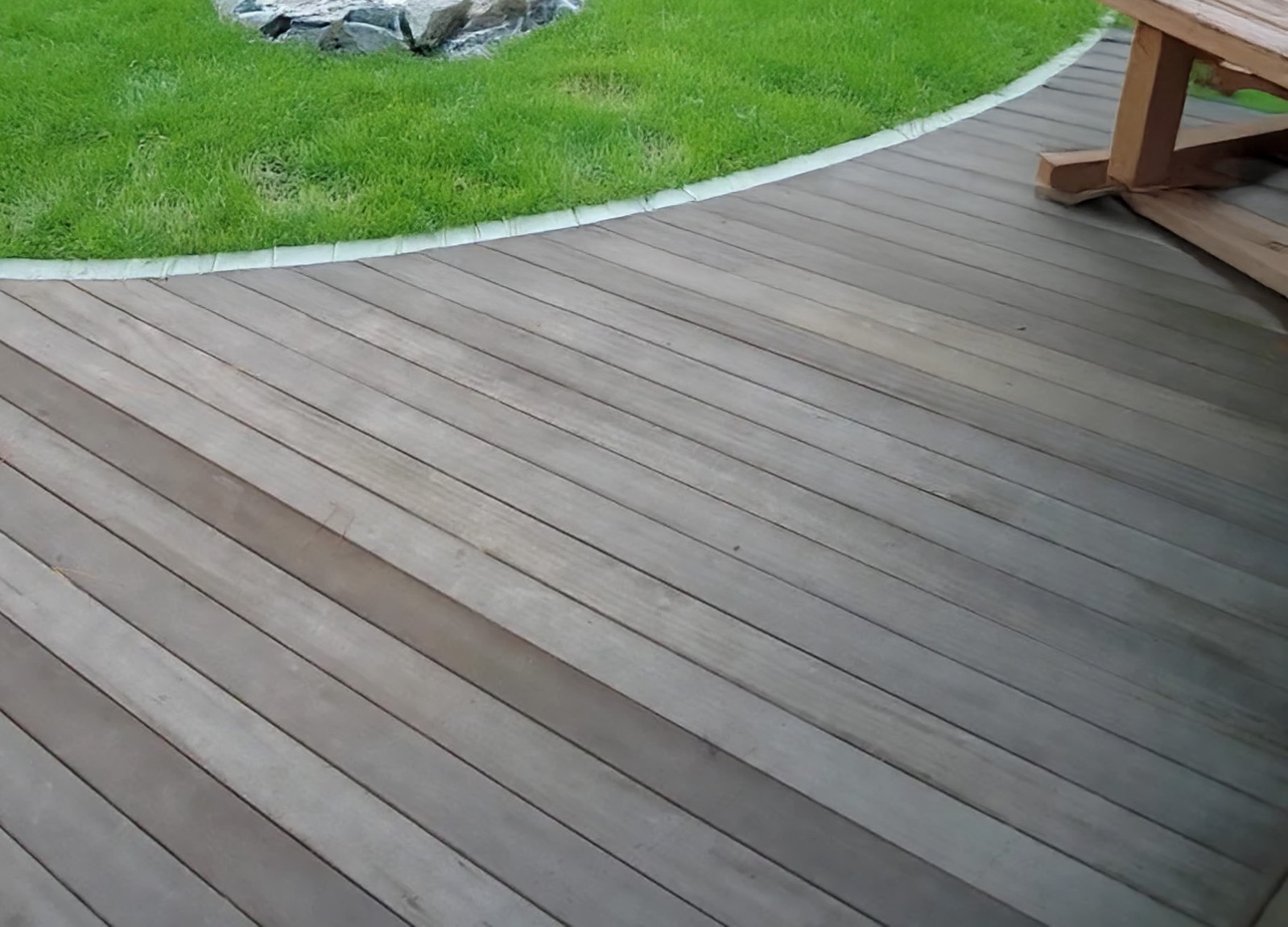
Ipe is the benchmark because it is the rare species that resists all five failure modes without a coating. Its density and tight, interlocked grain slow moisture movement enough that surface checking stays minimal even under hard sun, and its extractive chemistry shuts down the surface fungi that plague damp installations. It moves very little once it reaches service moisture, so gaps and fastener lines stay honest year over year. Unfinished, an Ipe deck weathers from its warm brown to a soft silver-gray over roughly six to twelve months of exposure, a purely cosmetic change that does not affect the wood underneath. The one item on its short list is early extractive bleed. For the first several rains, tannin-rich runoff can stain light concrete or stucco below the deck, which is a detailing question rather than an ongoing chore. J. Gibson McIlvain stocks Ipe decking in a vast inventory across every standard and custom dimension, kiln-dried toward the 12 to 16 percent service range so boards arrive close to where they will live. Its ASTM E84 Class A flame-spread rating, meaning a flame-spread index of 25 or less, is a bonus that matters for commercial and wildland-interface work.
Cumaru, Red Balau, Jatoba, and Garapa: Where Each Adds a Chore
Every species below Ipe is low-maintenance in absolute terms, but each one gives back a specific chore that the ranking should name honestly. Cumaru is the closest substitute, roughly as hard and as durable, with a warmer honey-brown tone and an interlocked grain that can raise slightly on drying. It moves a touch more than Ipe, so it wants tight gapping discipline and a stable service moisture, but its checking and mold resistance are excellent. Red Balau, at about 1,700 to 2,000 lbf, runs a beautiful deep red and holds up well unfinished, though its end grain is a little more prone to splitting, which puts extra weight on end sealing. Jatoba is dense and handsome at about 2,690 lbf, but it carries more color-shifting extractives, so early bleed is heavier and it wants sealed ends and clean drainage below. Garapa is the outlier by design: lighter in color and weight at about 1,700 lbf, cooler underfoot in full sun, and easier to handle, but that lower density means slightly more attention to checking and a faster gray-out. None of these need a finish. Each simply shifts one item up your list, and knowing which item lets you match the species to the failure mode your site actually produces.
Climate Reshuffles the Ranking
The species order is not fixed, because the dominant failure mode changes with your climate, and the best board is the one that resists your worst exposure. In the arid Southwest, the enemy is checking and end splitting driven by low humidity and brutal UV, so density and slow permeability win outright and Ipe pulls further ahead. In the humid Southeast, the enemy is surface mold on shaded boards, so extractive-rich species and generous airflow underneath matter more than raw hardness. Along the coast, salt and corrosion move to the front, which is a fastener and detailing problem as much as a species one. In northern freeze-thaw country, the real risk is water sitting in an open end check and expanding as it freezes, so end sealing and drainage carry more of the load than the species name. A quote sent by
"People fixate on the Janka number and forget that the deck's worst enemy is decided by its zip code. I have shipped the same Ipe order to a client in Phoenix worried about checking and a client in Charleston worried about mold, and my advice to each one was different. Match the board to the exposure, seal your ends, and give the underside air. Do that and the species will outlast the fasteners." Norm Moton, Director of Sales at J. Gibson McIlvainmakes the point better than any chart. J. Gibson McIlvain ships tropical decking nationwide, including regularly to California, and the spec conversation always starts with climate before it reaches species.
Detailing Decides Whether You Ever Pick Up a Tool
Installation controls more of your unfinished maintenance than the species choice does, and four details do most of the work. Seal the end grain. A wax-based end sealer on every fresh cut closes off the fastest moisture path in the board and prevents the end checks that no species is immune to. Give the deck drainage and airflow. Run boards on joists spaced 16 inches on center for dense tropical decking, hold consistent gaps so water clears the surface, and keep the underside ventilated so a shaded deck dries between rains instead of feeding mold. Get the fasteners right. Tongue-and-groove profiles are the only ones that accept hidden fasteners cleanly; a shiplap or square-edge board takes visible screws, and any grooved profile installs with the groove facing down so it sheds water rather than trapping it. Use the right metal. In coastal or high-salt service, 316 stainless fasteners resist the corrosion and iron-stain streaking that carbon-steel screws produce on tannin-rich wood. Get those four right and the deck asks almost nothing of you. Get them wrong and the best species on the chart will still hand you a chore list. The American Wood Council's codes and standards and the guidance published by Building Science Corporation both make the same case: exterior wood performance is a water-management problem first.
Leaving It Unfinished Is a Legitimate Spec, Not a Shortcut
Choosing to leave a durable tropical hardwood bare is a defensible engineering decision, not a corner cut, provided you accept the silver-gray patina. A finish on tropical decking is a cosmetic commitment that trades the gray-out for a recoating cycle, and on the dense species that cycle comes fast because the wood barely accepts the oil in the first place. Unfinished, you sidestep that entirely and inherit only the light cleaning routine. Solid, unmodified tropical decking carries no manufacturer warranty, which is normal for natural wood and reflects that field performance rides on installation. If a warranted product is a hard requirement, that points toward modified decking instead. Thermory and Abodo Vulcan both offer warranted modified boards, though modified woods top out around 16 feet because of kiln size, so specify accordingly on long runs. For a straight tropical hardwood deck left bare, the paperwork that matters is the durability data and the chain-of-custody documentation. When a species falls under a CITES-listed classification, documentation is required to move it legally, and a reputable supplier provides it as a matter of course. FSC certification, verifiable through FSC, and the species listings maintained by CITES are the references to check.
How J. Gibson McIlvain Would Specify This
Start with your climate's dominant failure mode, pick the species that resists it, then let the detailing carry the rest. For the widest range of exposures and the lowest total labor, specify Ipe: kiln-dried to a 12 to 16 percent service range, in the profile your fastener system requires, run on joists at 16 inches on center. Ask for it in the longest lengths your layout allows to cut down on butt joints, since every joint is an end-grain risk and a maintenance point. Order all end cuts sealed with a wax-based sealer, and seal any field cuts on site. If your deck sits in shaded, humid conditions, prioritize underside ventilation and generous gaps over any change in species. If you are coastal, specify 316 stainless fasteners from the start. If cool-underfoot comfort in full sun outranks the last increment of durability, Garapa is a rational trade. If you want a red tone, Red Balau delivers it with strong unfinished performance, given attention to end sealing. Confirm the durability data and chain-of-custody paperwork before the order ships. J. Gibson McIlvain is a commercial and contractor-volume supplier that mills and ships these species nationwide, and the team will match dimension, profile, and length to your drawings rather than to a retail rack. Call 800-638-9100 to spec the species, profile, and lengths, and to confirm inventory for your dimensions. The result is a deck that weathers to silver on its own and asks for little more than a wash.
Frequently Asked Questions
How often do I actually have to clean an unfinished Ipe deck?
Once or twice a year for most installations. A bare Ipe deck collects the same airborne pollen and organic film that lands on any horizontal surface, and that film is what surface mold feeds on. A wash with water and a mild deck cleaner, or a light pressure rinse held at a safe distance, clears it. Shaded, damp decks in humid climates may want two cleanings a year, while open decks in dry climates can often go with one. That cleaning is most of the routine, because the wood itself resists decay, checking, and movement without any coating.
Will an unfinished tropical deck grow mold in a shaded, damp yard?
It can grow surface mold, but the growth lives on the organic film sitting on the boards, not on the dense heartwood itself. The extractives in Ipe, Cumaru, and Red Balau suppress the fungi that would attack the wood, so what you see in a shaded, damp location is cosmetic surface mildew that washes off. The real fixes are detailing rather than species: keep gaps open so water clears, and ventilate the underside so the deck dries between rains. A shaded deck with poor airflow will need cleaning more often regardless of which tropical species you chose.
Does end-grain sealing matter if I leave the deck unfinished?
It matters more on an unfinished deck than almost anything else you do. End grain wicks and releases moisture roughly ten times faster than the board face, and that differential is what opens end checks and splits. A wax-based end sealer applied to every factory and field cut slows that exchange and prevents the splitting that no tropical species is fully immune to. In freeze-thaw climates it is close to mandatory, because water that sits in an open end check expands when it freezes and drives the split wider each winter.
Do I need to worry about tannin bleed staining the concrete or siding below the deck?
For the first several rain cycles, yes. Ipe, Jatoba, and the other extractive-rich species release tannin-heavy runoff when new, and that runoff can stain light concrete, stucco, or siding underneath. It is an early, temporary phase rather than an ongoing maintenance item, and it fades as the surface extractives wash out. Plan for it during construction: protect light surfaces below the deck, or schedule the finish grading and hardscape below after the deck has gone through its first rains. Jatoba bleeds the most of the common species, so it warrants extra care over light concrete.
Which unfinished species handles a freeze-thaw climate best?
Ipe, because its low permeability and dimensional stability keep water out of the wood and keep checks from opening in the first place. In freeze-thaw country the damage mechanism is water sitting in an open end check or surface check and expanding as it freezes, so the species that resists checking and moves the least wins. Pair that species choice with disciplined end sealing and open drainage gaps, and the freeze-thaw cycle has very little to work on. Species that check more readily, such as Massaranduba, are a poorer match for hard winters left unfinished.
Is Red Balau a legitimate low-maintenance choice or a compromise?
It is a legitimate choice, not a downgrade, especially if you want a deep red tone that grays to a warm silver. Red Balau resists surface mold and checking well and holds up unfinished, with the one caveat that its end grain is a little more prone to splitting than Ipe's, which puts more weight on thorough end sealing. For a buyer whose priority is color and who is willing to seal ends carefully, it delivers strong unfinished performance. For the single lowest-labor deck across the widest range of climates, Ipe still leads.


