Nobody Ships Finished Teak Off a Shelf
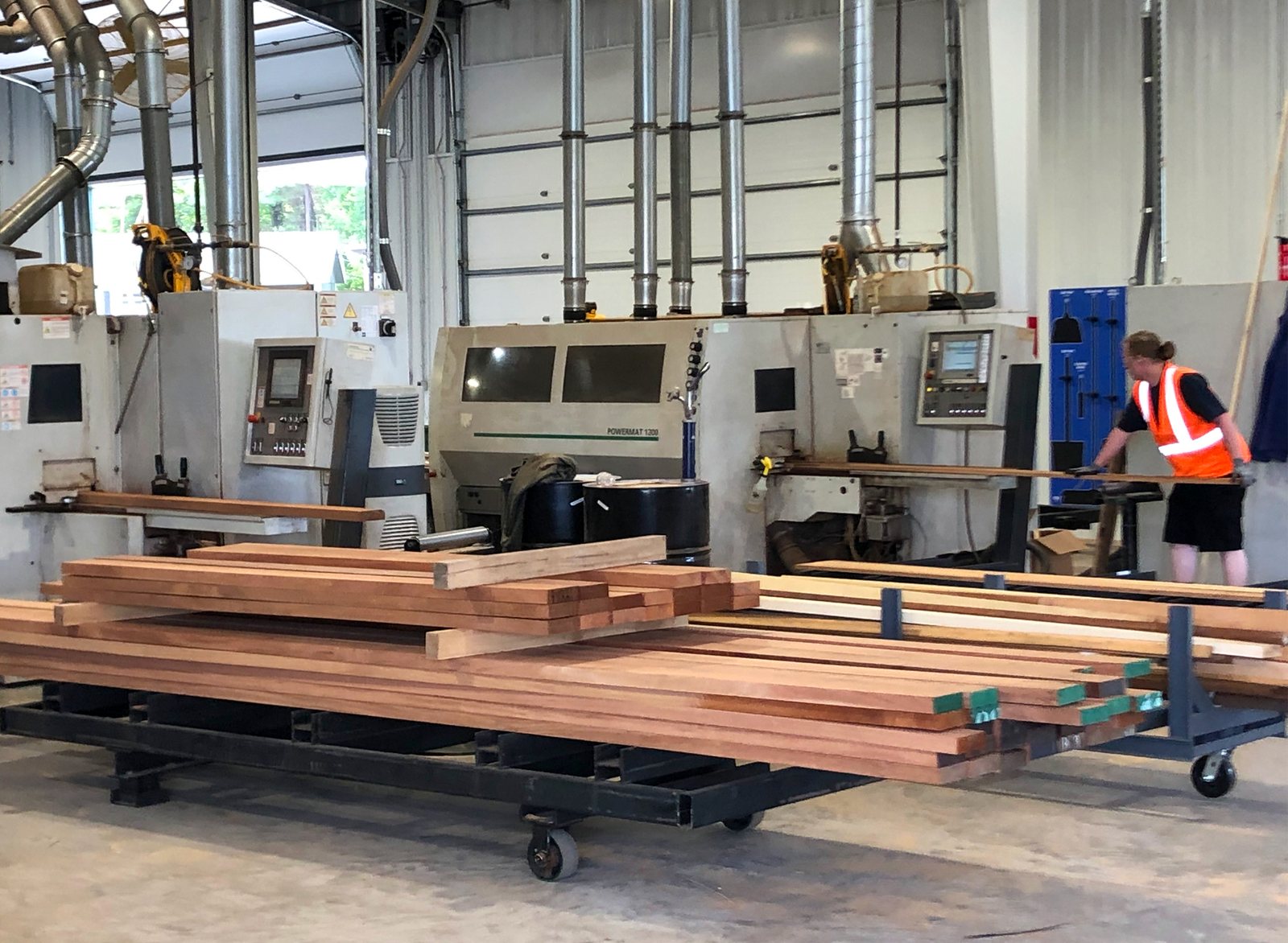
No lumber yard or mill stocks factory finished teak cladding or decking as a product, and a buyer hunting for one is hunting for something the trade does not sell. Teak moves unfinished. It is kiln dried, moulded to a profile, packaged and delivered bare, and the coating goes on afterward by whoever the project hired to finish it. That is not a hole in the supply chain. It is the only sane way to handle a species carrying this much natural oil and this many legitimate finish options.
Teak is also not a paint grade species. It gets stained, oiled, clear coated, or left alone to silver under UV. The owner makes that call, usually late, sometimes after a mockup panel has weathered outside for a month. A mill that coated the material before shipping would be making that decision on the owner's behalf and locking in a surface nobody has seen age yet.
So the useful question is not where to buy finished teak. It is what the mill controls before a finisher touches anything, because each of those controls either carries the finish or ruins it. Four things matter. In service moisture content, a uniform machined surface, thickness held tight enough that a coating film sits even across a face, and a profile that repeats from the first stick to the last.
What the Mill Controls and What the Finisher Controls
J. Gibson McIlvain supplies and mills teak, and it does not install, coordinate installation or field measure, which draws a clean line through the middle of this job. The mill owns drying, machining, dimensional consistency and profile. The finisher owns sanding, the first coat, every recoat, and sealing any end the installer cuts on site. Once both sides know where that handoff falls, nothing in the middle is ambiguous.
Factory finishing is a real and defined scope in architectural woodwork, and the AWI standards treat it as its own section with its own quality grades. Exterior teak cladding and decking sit outside that scope almost every time. The coating system gets selected for the exposure, for the maintenance interval the owner will actually honor, and for the color the architect approves off a sample, none of which are settled when the lumber is ordered.
Teak is imported and does not arrive against the NHLA grades that govern North American hardwood, so the order itself has to state face width, length and profile outright, and the mill works to that written description rather than to a grade minimum. Spell out the surface condition too. Machined and unfinished, no coating, no sealer.
"Buyers call us asking for finished teak, and what they actually need is teak that is dry, flat, and the same thickness end to end. I would rather hand a finisher a clean machined face and let him put the first coat on than ship a coating that has already been stacked, strapped and handled twice before it reaches the wall."
Norm Moton, Director of Sales, J. Gibson McIlvain
Moisture Content Is the First Finishing Decision
A coating applied over teak that is still equalizing will telegraph every bit of movement that follows, so moisture content at the mill is a finishing decision before it is a milling decision. Exterior teak wants to leave the kiln near 12 to 16 percent. Interior teak paneling and trim want 6 to 8 percent. Those are different targets for the same species, and the difference is the service environment, not the product.
J. Gibson McIlvain kiln dries and mills exterior teak into the 12 to 16 percent band and interior teak to 6 to 8 percent, which is the range an interior coating film can live with once the building is conditioned. Air dried stock settles near the local equilibrium instead, and it is not a substitute where an interior tolerance matters. Shrinkage and swelling behavior by species and by moisture change are tabulated in the USDA Forest Service Wood Handbook, and teak sits on the quiet end of that table.
Sawing pattern changes the math as well. Quartersawn and rift stock moves less across its width than plainsawn, which is why it gets specified where a panelized or filmed surface has to stay flat. On a wide teak face carrying a clear film, that stability is the difference between a tight joint line in February and a visible gap.
Thickness Tolerance and an Even Coating Film
Thickness variation inside a single bundle shows up as an uneven coating film, a shadow line at every joint, and a sanding step the installer never budgeted for. Hardwood thickness is quoted in quarters of an inch of rough thickness. 4/4 is nominal 1 inch rough, 8/4 is 2 inches, 16/4 is 4 inches, and every surfaced dimension comes off those rough numbers. Cladding usually starts at 4/4 or 5/4. Decking starts heavier.
Holding that dimension is machine work. Straight line and gang rip saws set width, band resaws break heavier stock down without wasting it, moulders cut the profile, and trimming saws square the ends. Run the whole order across the same setup and the faces land inside a tolerance a coating can bridge. Split it across two setups weeks apart and the finisher is the one who discovers it.
J. Gibson McIlvain holds over seven million board feet of exotic and domestic lumber at its Maryland yard, so a teak order for one elevation gets pulled from a single inventory rather than assembled out of three purchases that do not match each other in color or width. That matters more on teak than on most species. A clear oil hides nothing.
One failure gets blamed on the mill and belongs elsewhere. Cupping on installed cladding is driven by installation and back ventilation, not by species, and the drainage and drying cavity behind a rain screen assembly is what keeps a board flat. The reasoning behind that cavity is laid out plainly in Building Science Digest 013.
Mill Glaze on a Freshly Machined Teak Face
A knife leaves teak burnished, and a burnished face rejects the first coat, which is why a freshly machined teak surface gets sanded before anything goes on it. Heat and pressure at the cutterhead close the surface and pull extractives up into it. The board looks beautiful coming off the moulder. It is also, at that moment, close to sealed against the finish the owner is paying for.
The fix is a light abrasive pass, commonly 80 to 120 grit, enough to break the glaze and open the pore structure without rounding an arris or softening the moulded detail the profile was ground to produce. Orbital sanders handle flat faces. Profiled sections get hand work. On a cladding run the finisher does the faces before the boards go up and the exposed edges after.
That sanding belongs to the finisher, after delivery, for a practical reason. A face sanded at the mill then gets strapped, shipped, unloaded, stacked on site and cut, and by the time the first coat is scheduled it has picked up handling marks and surface contamination anyway. Teak that has sat exposed for a few weeks before coating needs the pass repeated regardless.
Teak's Oil Content Against Coating Adhesion
The natural oils that make teak last outdoors are the same oils that make coating adhesion the governing question rather than color. Open-grained and oily species absorb a great deal of finish, so the first coat on a sanded teak face largely disappears into the wood and the finisher should plan on a second before any film builds at all. Budgeting one coat on teak is how a job ends up blotchy.
Extractives also migrate. On a light colored or water clear film they can bleed through and discolor it, which is why finish manufacturers write separate instructions for oily tropical hardwoods and why a solvent wipe immediately before the first coat is standard practice on this species. The product choice, the wipe and the recoat window all sit with the finisher, working from the coating manufacturer's data sheet rather than from a mill's recommendation.
Hardness is worth checking against expectation. Teak runs around 1,070 lbf on the Janka scale per the Wood Database, which puts it below Sapele at roughly 1,410 lbf and White Oak at roughly 1,360 lbf. Teak earns its reputation on dimensional stability and decay resistance, not on surface hardness, so a film sitting on a teak deck is supported by a surface that still dents.
One Profile Across the Whole Order
A cladding profile that drifts partway through a run leaves a shadow line down the wall that no finish will hide. Rain screen cladding, shiplap, tongue and groove and a reveal detail all depend on the same geometry repeating for hundreds of linear feet. The reveal is either consistent or it reads as a mistake from the parking lot.
J. Gibson McIlvain keeps a profile library holding thousands of ground knives and grinds new knives every week, and where a teak profile is not already on file it gets ground to match the drawing. Custom knife grinders sit on the floor next to the moulders, which is why a drawn contemporary profile and a historical restoration match get handled the same way. One knife runs the order. Resharpening mid run shifts the profile slightly, so the sequence matters.
Standard softwood moulding patterns are catalogued by the Moulding and Millwork Producers Association under WM numbers, and almost no teak cladding job uses one. Teak profiles come off an architect's section drawing. Keep that drawing with the order and keep the knife on file, because phase two of a building shows up two years later and has to match phase one.
Who Performs Each Finishing Step
Every step between the moulder and the finished wall has one owner, and most of the arguments on a teak job start with two trades each assuming the other had a given step. Set it out in the submittal. The mill applies no coating to teak at any point, including no sealer on the ends, so the ends are live from the moment the bundle is opened.
| Step | Who performs it | When it happens |
|---|---|---|
| Kiln drying to the in service target | Mill | Before any machining |
| Moulding to the drawn profile | Mill | Before packaging |
| Thickness and surface consistency check | Mill | At the moulder, before the bundle is strapped |
| Sanding off mill glaze | Finisher | After delivery, before any coating |
| Solvent wipe of the machined face | Finisher | Immediately before the first coat |
| Sealing field cut ends | Installer | As each piece is cut on site |
| First coat | Finisher | After sanding, in the finisher's shop or on site |
| Recoat and ongoing maintenance | Owner's finisher | On an interval set by exposure |
Field cut ends deserve a line of their own in the specification. Every rip, every miter and every cut to length opens end grain the original machining never touched, and on a trafficked deck those are the first places water gets in. The installer treats them as they are cut, not at the end of the day.
Penetrating Oil Against a Film on a Trafficked Deck
A film forming finish on a teak deck wears through in the traffic lanes first, and a patched film looks worse than an oiled surface that was never filmed. Feet do not distribute wear evenly. They cut a path, the film fails along it, water gets under the film on either side, and the repair turns into a strip and refinish rather than a touch up.
A penetrating oil fails differently. It thins out gradually and gets refreshed by cleaning and recoating the worn area, with no hard edge between old and new. The interval depends on exposure rather than on the calendar, and a south facing deck in strong sun asks for attention far sooner than a shaded one. That is maintenance the owner signs up for when the species is selected.
Vertical cladding is a different case. Nobody walks on it, so a UV stabilized film has a real service life there, and plenty of teak cladding carries one. The third option is to apply nothing at all and let the surface silver, which is a specified look on many buildings and reduces maintenance to periodic cleaning. All three choices stay with the finisher and the owner, and none of them changes what the mill ships.
Teak Beside the Rest of the Exterior Palette
Teak is one of five species a millwork shop genuinely machines, and comparing it to a decking board misses what it is for. The millwork palette is Sapele, Iroko, Afrormosia, Teak and Utile, which is sold as Sipo. Those five mill cleanly, glue predictably and hold a profile, which is the whole requirement for a milled component.
The tropical decking species belong to a different conversation. Ipe, which is Tabebuia spp, along with Cumaru, Garapa, Jatoba and Red Balau, are extremely hard and carry high oil content, and that combination makes them difficult to glue. A decking supplier sells a great deal of them. A millwork shop reaches instead for Sapele, Iroko, Afrormosia, Teak or Utile whenever a part has to be machined, laminated or built up.
For painted exterior trim the answer is Sapele rather than Genuine Mahogany, which runs roughly 800 lbf against Sapele at roughly 1,410 lbf. Sapele holds paint better and comes in a wider range of sizes and longer lengths. It is not milled 1x8 for exterior use, which is too wide to stay stable in that application. None of this bears on teak, which is not a paint grade species at all.
Western Red Cedar remains a legitimate default for cladding, and on cedar the grade call carries more weight than the species call. CVG, clear vertical grain, behaves and finishes nothing like STK, select tight knot, and the two get specified for different jobs. The Western Red Cedar Lumber Association publishes the grade descriptions in full.
Modified wood is the other serious option, and J. Gibson McIlvain stocks both Thermory and Abodo Vulcan. Modified products top out around 16 ft, and most are sold on metric lengths just under 16 ft because of kiln size, so a longer run means a joint. Thermally modified Ash is not available wider than 8 inches, so a wide modified board means Accoya, roughly 1,600 lbf, whose acetylation gives dramatically reduced shrinkage and swelling, or Abodo Vulcan.
Warranties follow that same split. Modified products carry them. Solid unmodified wood does not and cannot, because it is an organic material responding to its environment, and no mill can warranty how a teak board answers a given wall in a given climate. What a mill stands behind is the drying, the machining and the profile.
How J. Gibson McIlvain Would Specify This
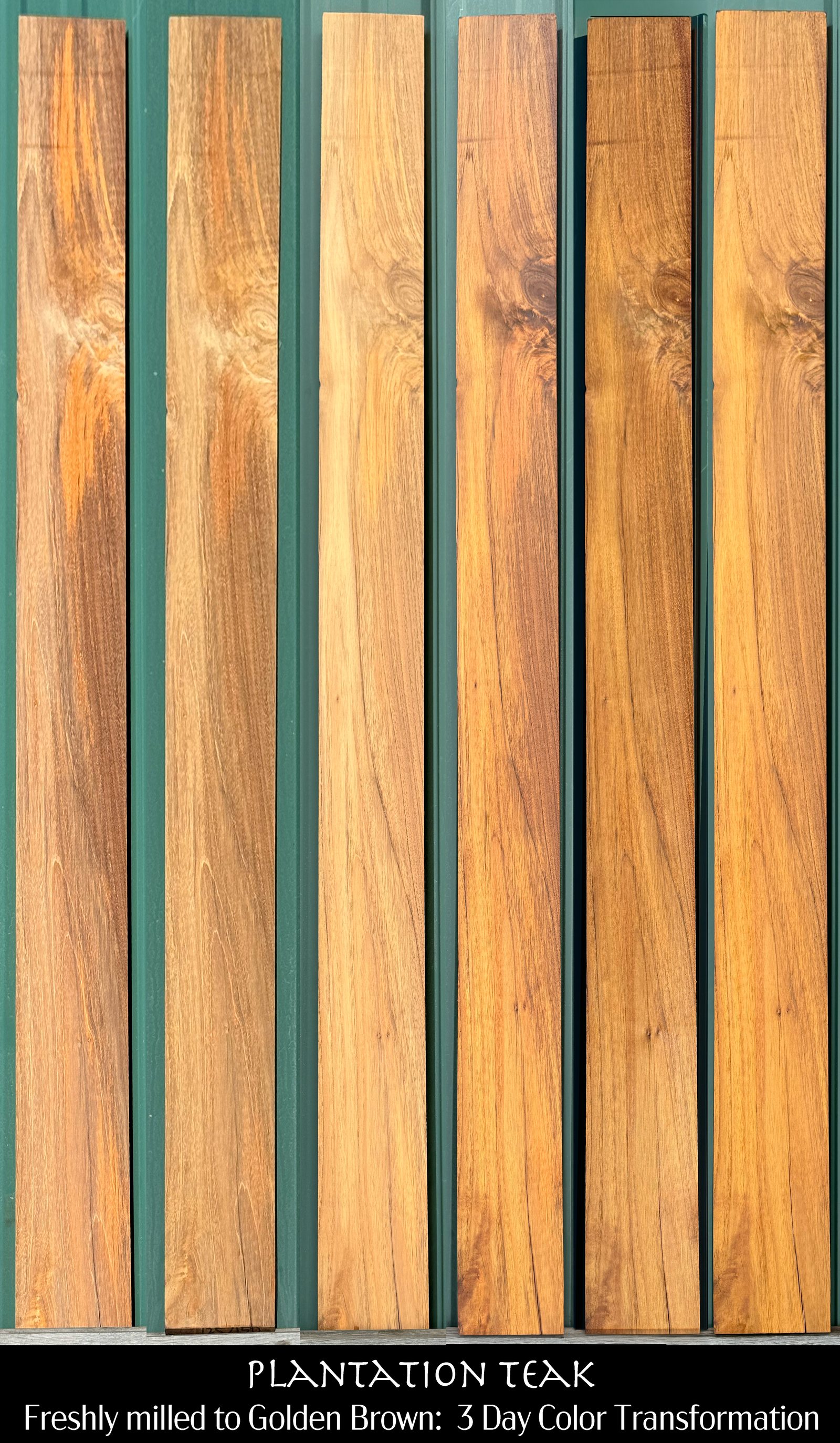
Write the order around the material condition and the handoff, not around a finish the mill will never apply. Name the species and the origin. The plantation teak J. Gibson McIlvain carries is Indian plantation teak, and that is what the company buys for this category.
Plantation origin changes two practical things inside this one operation. A rotation length log yields narrower and shorter boards, so the face widths and lengths drawn on a cladding elevation should follow what the material actually comes in rather than an ideal. Wider growth rings and lower extractive content also let the machined face take a finish a little more readily and a little more evenly, which the finisher will see on the first coat and should still sample for.
Then put the measurable items on the order. Rough thickness in quarters, finished face width, length, the profile drawing or the knife already on file, the in service moisture content target at 12 to 16 percent for exterior or 6 to 8 percent for interior, and the surface condition stated as machined and unfinished. J. Gibson McIlvain mills to that and ships it nationwide, regularly to California, bundled so the machined faces arrive clean enough to sand and coat without a recovery step.
What stays with the project is equally clear. The buyer's own finisher sands off mill glaze, wipes the face, applies the first coat and sets the recoat schedule, and the installer seals every field cut end as it is cut. Nobody on site should be waiting on the mill for any of it.
Bring the drawing and the exposure into the conversation early, because profile, width and length interact with what teak is on the ground. Details on the millwork services at J. Gibson McIlvain are on the company site, and a call to 800-638-9100 with an elevation drawing in hand will settle thickness, profile and lead time in one conversation.
Frequently Asked Questions
Where can I buy factory finished teak cladding or decking?
Nowhere, as a stock item. Teak is sold unfinished and coated afterward, and that is true across the trade rather than a limitation of one supplier. What you order is kiln dried teak milled to a stated thickness and profile with the surface condition written as machined and unfinished. The coating then goes on by the finisher the project hires, either in that finisher's shop before installation or on site after it. J. Gibson McIlvain mills teak cladding and decking to the drawn profile and ships it bare, with no coating and no sealer applied.
Why does a freshly machined teak face have to be sanded before the first coat?
Heat and pressure at the cutterhead burnish the surface and pull extractives into it, which is mill glaze. A glazed face resists the first coat and produces uneven absorption and poor adhesion. A light pass at roughly 80 to 120 grit breaks the glaze and opens the pore structure without rounding an arris or dulling the moulded detail. That pass belongs to the finisher after delivery, because a face sanded at the mill picks up handling and site contamination before the coating is ever scheduled.
What moisture content should teak be milled to?
Exterior teak cladding and decking leave the kiln near 12 to 16 percent, which is the band that matches outdoor service. Interior teak paneling and trim run 6 to 8 percent, since a conditioned building is a much drier environment. Coating teak that has not reached its in service range means the film has to absorb the movement that follows, and it will not. Air dried stock settles toward local equilibrium and is not a substitute where an interior tolerance matters.
Is a penetrating oil or a film finish better on a teak deck?
On a surface people walk on, a penetrating oil. Traffic concentrates wear into lanes, a film fails along those lanes first, water then works under the surrounding film, and the repair becomes a full strip and refinish rather than a touch up. An oil thins out gradually and gets refreshed by cleaning and recoating the worn area with no visible edge. Vertical cladding is different, since nobody walks on it, and a UV stabilized film has a real service life there.
Does J. Gibson McIlvain apply any coating to teak before shipping?
No. The company applies no coating to teak, including no end sealer, so the ends are live as soon as the bundle is opened. Teak is not a paint grade species at all. It is stained, oiled, clear coated or left to silver under UV, and the owner and architect usually settle that choice from a weathered sample well after the lumber is ordered. Sealing field cut ends, the first coat and every recoat stay with the finisher and the installer.
Which teak origin does J. Gibson McIlvain carry?
The plantation teak the company carries is Indian plantation teak, and that is what J. Gibson McIlvain buys for this product category. Plantation material comes off a rotation length log, so boards run narrower and shorter and the face widths drawn on an elevation should follow what the material actually comes in. Burmese teak is not on offer. It shows up as material already installed on an older vessel or an older building, or as salvaged stock, not as something to order for a new elevation.
Is there a warranty on teak cladding or decking?
No. Solid unmodified wood cannot be warrantied, since it is an organic material responding to the wall, the exposure and the climate it is installed in. Warranties exist on modified products, where the material has been chemically or thermally altered, and J. Gibson McIlvain carries both Thermory and Abodo Vulcan along with Accoya. What a mill stands behind on teak is the drying, the machining, the dimensional consistency and the profile, which are the things a mill controls.
Sources and Standards Referenced
- Wood Handbook, Wood as an Engineering Material (FPL-GTR-190), USDA Forest Service
- AWI Standards, Architectural Woodwork Institute
- Teak, The Wood Database
- BSD-013 Rain Control in Buildings, Building Science Corporation
- Moulding and Millwork Producers Association
- Western Red Cedar Lumber Association
- Accoya Modified Wood
- Thermory Thermally Modified Wood
- Abodo Wood