What a Teak Sample Set Has to Prove
A teak sample set exists so a designer's color decision survives contact with the lumber that actually ships, which means the set has to represent a range instead of presenting the best board in the yard. One handsome piece of teak is a sales object. A set is evidence. The difference shows up months later, when the pack lands on a receiving dock and somebody holds a board up against the thing that got approved.
Teak makes this harder than most species. Color lives in the extractives, and extractive content shifts from tree to tree, from the butt log to the upper log, and across the width of one board. Teak also arrives against export grades and the written description on the order rather than the North American hardwood rules a domestic buyer works from, which puts weight on the sample set that a grade stamp never carries for it.
So the set is doing three jobs at once. It shows what the material looks like, it fixes what the designer may hold the supplier to, and it quietly defines what counts as a rejection on arrival. Most of the trouble on a teak package traces back to a set that was built for the first job and never asked to do the other two.
How Many Pieces It Takes to Show the Range
Three pieces is the working minimum for a teak color decision and five is better, because an honest answer to a color question has a light end, a dark end and a middle. A single sample reads as a promise of an average. No teak pack delivers an average. It delivers a population, and the specifier who only ever saw the center of that population is the one who rejects the pale boards at delivery.
Build the set from the extremes inward. One piece off the palest straw material in the lot, one off the deepest olive brown end, one sitting where the bulk of the lot sits. That is a defensible three. It tells a designer what the tone window really is rather than where its midpoint happens to fall.
Go to five when the order runs in phases or when the parts are large. A long casing run tolerates a tone drift that a glued up panel field will not, and a five piece set lets a designer assign tolerance by part rather than by board. Door pairs get the tight end of the window. Blind returns and backer get whatever is left.
Every piece gets marked to the lot it came out of, with a piece number and a face call. An unmarked sample is a decoration. Six months later nobody can say whether the pale one came from the same bundle as the dark one, and the whole set collapses into an argument about memory.
Depth of inventory is what makes an honest range possible. J. Gibson McIlvain holds over seven million board feet of exotic and domestic lumber at its Maryland yard, so a five piece window can be pulled across more than one bundle instead of being squeezed out of whichever single pack happened to land that week. A supplier working out of one pack has to show a narrow range and then hope the next pack lands inside it.
The Set Comes Off the Material That Will Ship
A sample commits nothing unless it was cut from the lot being held for the job. Sample drawers everywhere are full of teak from packs that sold out two years ago. Handsome, and worthless as a reference. The sequence that works runs the other way, with the lot identified and reserved first and the sample cut from it second.
J. Gibson McIlvain pulls sample stock off the same bundles the order will ship from and records the lot against the job, so the pieces in a designer's hand and the material on the floor are the same population. That single step is most of what separates a sample set from a brochure. It also fixes the date, which matters later when a second phase needs matching.
Ask where a sample came from and the answer should be specific. A bundle identifier, a tally reference, a date. If the answer is the name of the species and nothing else, the set is not controlling anything, and a designer who specifies from it is specifying from a photograph. Species level sampling is fine for a feasibility conversation and useless for an approval.
What Six Weeks of Light Does to a Finished Sample
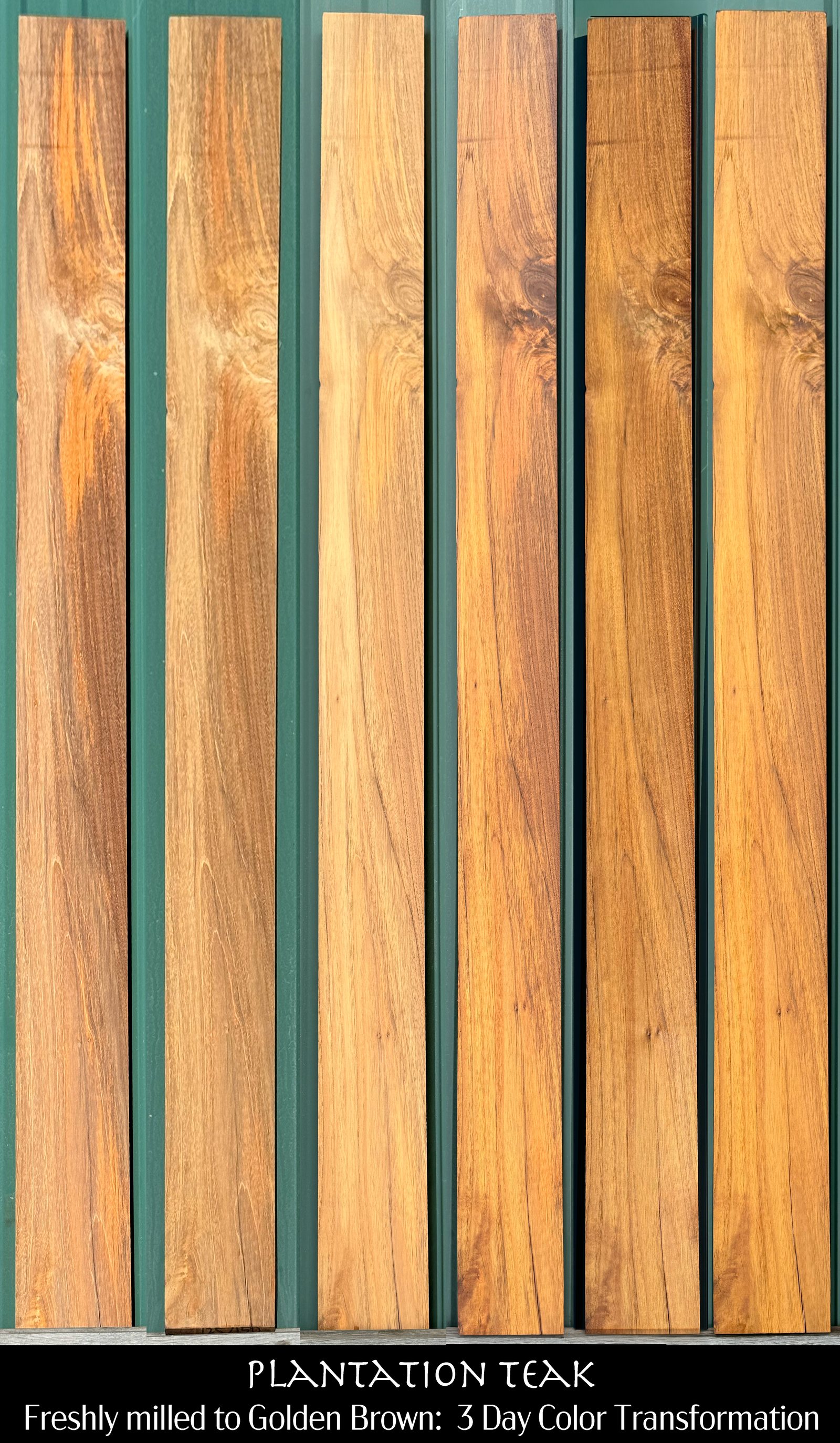
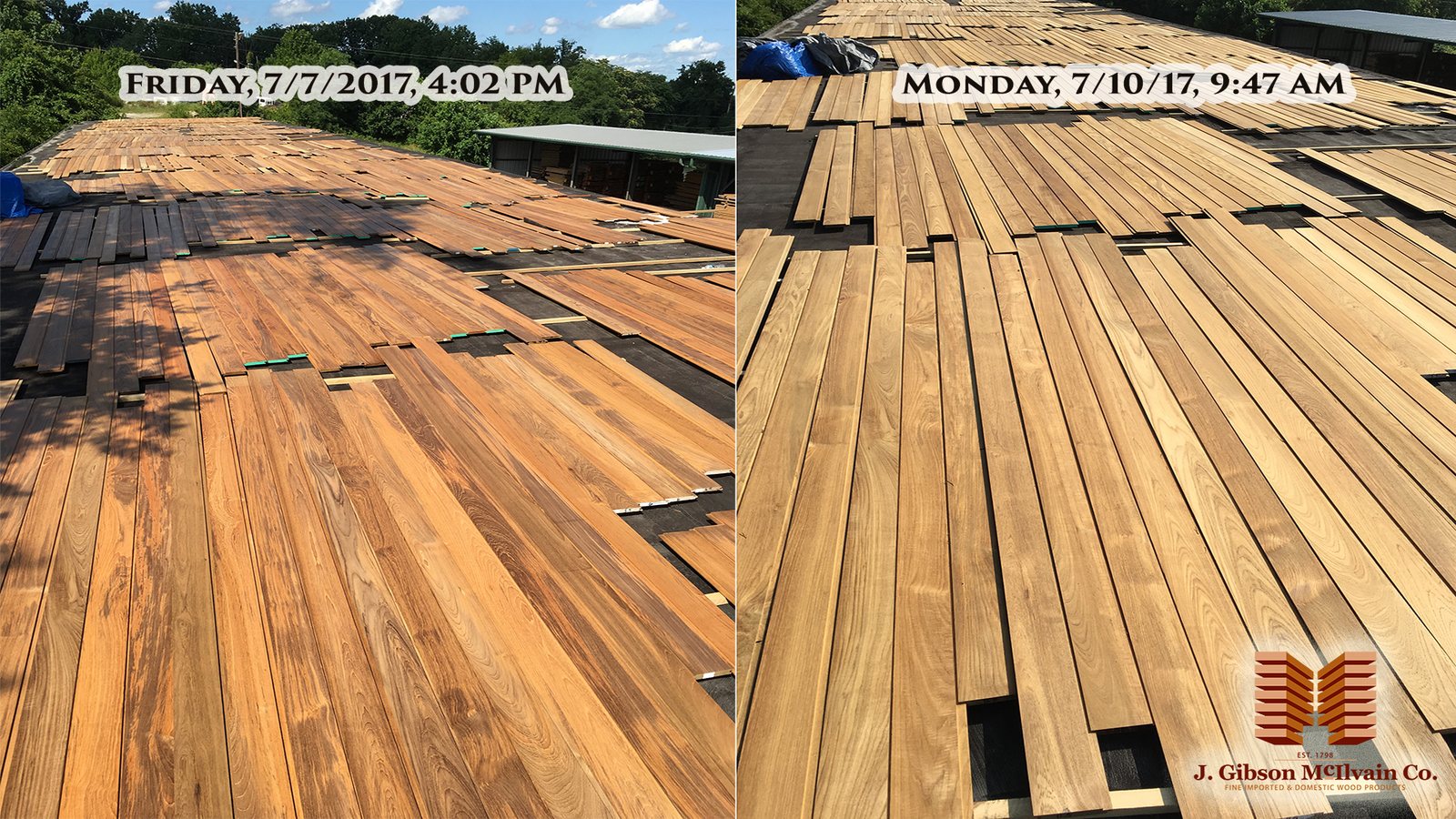
A finished teak sample at six weeks is a visibly different color from the day it was wiped, and the six week piece is the one telling the truth about the installed job. Fresh teak is the lightest and the most uneven it will ever be. Oxidation and daylight darken it, and the pieces that started furthest apart move toward each other while they do it.
That has a practical consequence most sample sets ignore. A designer approving a new set is approving a contrast level the finished job will never show, and often rejecting boards that would have blended into the field within two months. Over sorting burns through a reserved lot fast. Then the run spills onto a second pack with its own window and the matching problem starts over.
The answer is to make two sets on one day. Cut mirror pairs from the same boards, finish both with the same schedule, send one out and park the other somewhere with real daylight on it. Six weeks later the designer is looking at a fresh set and the shop is looking at where that set went. Color difference between the two is measurable rather than a matter of opinion, and the method behind that measurement is standardized in ASTM D2244.
Exterior work moves further. Teak left uncoated outdoors loses its brown and goes silver grey as the surface weathers, which is a finish decision rather than a failure, and the general mechanism is laid out in the Wood Handbook from the Forest Products Laboratory. A silvered sample and a fresh oiled sample of the same board look like two species. Both are the same specification at different points in its life, and an owner needs to see the one that matches the maintenance they intend to fund.
Keep the aged twin out of a south facing window unless the job sits in one. A sample cooked under glass darkens past anything the installation will do in a shaded interior, and then it is a different kind of wrong reference.
Why the Retained Reference Piece Decides the Second Phase
The piece that stays on the shelf is worth more than the piece that leaves the building. The sample a designer keeps gets handled, left in sun on a car seat, taped to a drawing and eventually lost. The retained twin is the only copy anybody can still trust when the second phase comes up for release.
Cut the retained piece as a mirror of what shipped, out of the same board, sequentially, and mark both halves with the same lot and piece number. Finish both at the same bench on the same day with the same product. Anything that happened to one happened to the other, which is the entire point. J. Gibson McIlvain holds finished material in storage for inventory control, and a reference piece belongs in that storage with its paperwork rather than in a drawer somewhere.
"The sample that leaves the building is only half the set. The half we keep on the shelf, cut off the same board and marked with the same lot, is what lets us fill a second phase a year later without guessing at what somebody approved."
Norm Moton, Director of Sales, J. Gibson McIlvain
Continuity is the reason this works at all. J. Gibson McIlvain has been in business since 1798 and is run by the seventh generation of the family, so a lot record and a reference piece from an early phase are still retrievable when a late phase needs matching. A file that outlives the people who opened it is worth more than any single sample in it.
The retained piece also settles disputes in the direction of fact. When a receiving crew calls a bundle off tone, the question is whether it falls inside the approved window, and the window is a physical object sitting in storage with a number on it. Nobody has to relitigate what the designer remembers seeing.
A Color Sample and a Machining Sample Are Different Objects
A sample sized to answer a color question and a sample sized to answer a machining question are built differently, and sending the wrong one is how a sample set stops being useful. The color question is about tone, grain character and how the finish reads across a face. The machining question is about whether a profile can be cut cleanly in this material at this thickness.
A color sample needs face area. Roughly 6 to 8 inches wide by 12 to 16 inches long gives a designer a full grain cycle, a believable read on figure, and enough surface for the finish to behave the way it will on a door stile. A 2 inch chip shows one grain event, and in teak a single grain event can be a gum streak or a band of sapwood that represents nothing.
Leave one edge and one back face unfinished on a color sample. The edge tells a designer the real thickness and lets them see grain orientation on the end. The raw back gives a point of comparison for how much the finish is doing. Both details cost nothing and prevent the conversation where a specifier discovers the finished color was mostly stain.
Sizing a Sample That Answers a Machining Question
A profile sample has to be a full section of the real part, in the real thickness, run on the production setup. Full width, full depth of cut, 12 to 18 inches long at the least, and longer for anything sprung or curved. A short piece of a profile hides the thing a machining sample is for, which is how the surface comes off the knife along a run.
Teak is abrasive. Silica in the wood wears a knife edge faster than a domestic hardwood does, and a dull edge in teak shows up as a burnished face that drinks finish unevenly rather than as obvious tearout. That is only visible across length. J. Gibson McIlvain runs profile samples on the same moulder with the same knife that will cut the order, so a sample shows what the production surface will look like instead of what a careful one off looks like.
Interlocked grain is the other reason length matters. Teak can reverse direction mid board, and a profile with an undercut or a tight quirk will tear on the reversal no matter how sharp the tooling is. See it on an 18 inch sample and the profile gets adjusted or the part gets reoriented. Discover it in production and the yield goes sideways.
True custom work is handled by ICD, the company's architectural millwork division, which builds custom trim profiles planned around a specific space rather than pulled from a catalog page. Profile nomenclature on the standard side follows the trade designations published by the Wood Moulding and Millwork Producers Association, which is worth citing on a drawing so the sample and the specification describe the same shape.
A joint sample is its own object again. Teak carries high oil content, which makes gluing difficult, so a laminated panel field or a mitered return should be proved on a sample that includes the actual joint, the actual adhesive and a few days of cure before anybody loads a production run on top of the assumption.
| Piece | Question it answers | What it has to carry | What it cannot answer |
|---|---|---|---|
| Tone range pieces, 3 to 5 | How wide is the color window in the reserved lot | Light end, dark end, bulk of the lot, each marked to its bundle | What any single board will look like |
| Six week aged twin | What the approved tone becomes after light and oxidation | Mirror pair of what shipped, same finish schedule, same day | Exterior silvering on an uncoated elevation |
| Retained reference piece | Was this delivery inside what was approved | Sequential mirror of the shipped piece, lot and piece number, held in storage | Anything, once it has been refinished or re-sanded |
| Profile sample | Does this shape machine cleanly in this material | Full section, real thickness, 12 to 18 inches or longer, production knife | Finished color across a whole elevation |
| Joint and adhesive sample | Will the glue line or miter hold in an oily species | The real joint, the real adhesive, cured before judgment | Service life of the assembly in place |
Oil, Varnish or Nothing Decides What the Sample Means
An unfinished teak sample answers almost nothing about color, since teak is a stained, oiled or varnished product or it is material left to silver. Raw planed teak reads pale and green against what any of those schedules produce. Approving tone off raw stock is approving a color nobody will ever see.
Match the sample schedule to the job schedule, product by product. An oiled sample and a varnished sample cut from one board land in different places, and a pigmented stain narrows the apparent window enough that a designer may accept a wider lot than they otherwise would. Where the sample is finished by a different hand than the job, say so on the submittal, because the sample then documents the material and not the coating.
Interim sampling has a legitimate shortcut. Wipe a window on a raw piece with mineral spirits or with the first coat of the intended oil and let a designer preview the finished tone while a finished set is being made. The AWI factory finishing standards set out how finish systems get classified and submitted, which is the right language to borrow when a sample is carrying a coating decision as well as a species decision.
Applying a finish schedule in the field, scheduling the finisher and maintaining the coating later are the finishing contractor's scope, not the lumber supplier's. The sample set defines what the material looks like under a stated schedule, and the exposure the assembly sees decides how long that appearance survives on an exterior elevation.
Moisture, Thickness and Grain the Sample Carries
A sample set is a dimensional statement as much as a visual one, so the pieces need to be milled to the moisture content and the thickness the job will actually get. Interior millwork lands near 6 to 8 percent in service moisture content. Exterior work runs near 12 to 16 percent. A sample pulled from stock that never saw the job's drying target looks right and measures wrong.
Thickness gets quoted in quarters of rough inches, with 4/4 at a nominal 1 inch rough and 8/4 at 2 inches, and surfaced dimensions come off those rough numbers. Say which one the sample represents. A designer holding a planed sample out of 4/4 and reading a drawing calling for a part out of 8/4 is comparing two different things without knowing it.
Grain orientation belongs on the label. Quartersawn and rift stock moves less across its width than plainsawn, which is why a panelized field or a wide stile gets specified that way, and a plainsawn sample standing in for quartersawn parts oversells both the figure and the stability. Species level reference data for teak, including its mechanical properties, sits in the Wood Database entry rather than in anybody's memory.
Plantation material has an honest limit here. J. Gibson McIlvain imports Indian plantation teak, and a plantation tree is younger, so rings run wider, extractive content is lower, and boards come narrower and shorter out of a rotation length log. A sample showing a wide quartersawn face is making a promise the pack may not be able to fill at that width, and the sizing conversation has to happen while the sample is being cut rather than after the lot is committed.
Where a reference piece has to match something already installed on an older building or an older vessel, the installed material may be old growth Burmese teak or salvaged stock, and no current sample is going to reproduce it exactly. The honest move is a sample that shows how close the available material gets, which is the same logic the Secretary of the Interior's Standards apply to historic replacement work.
What the Set Commits the Supplier To
An approved sample set becomes an acceptance standard, which is exactly why a supplier should be careful about what the set shows and explicit about what it does not. Once a designer signs a set, the lot is reserved against it, released against it and received against it. That is a real obligation, and it is worth having in writing.
Three things a set can promise. The material will come from the recorded lot. It will fall inside the tone window the pieces describe. It will be milled to the stated thickness and moisture content. The AWI submittals standard covers how samples, shop drawings and finish samples get transmitted and approved, and borrowing its structure keeps the obligation legible to everyone downstream.
Three things a set cannot promise. A single uniform tone, since teak is an organic material that responds to light and to its own extractive content. A board wider or longer than the lot yields. A color that holds still after installation, since the installed surface keeps moving for months. Saying these out loud at approval is cheaper than arguing them at delivery.
Storage and handling of the designer's copy belong to the designer. A sample taped to a sunny window for a season is no longer a reference, and a supplier who agreed to match a faded piece has agreed to something impossible. Field measurement, templating and the sequence of installation sit with the buyer's own installer, and the sample set has no bearing on any of them.
J. Gibson McIlvain ships sample sets and the production lot behind them nationwide, regularly into California, which means a designer on one coast and a mill on the other can work from the same physical reference. The set travels first, the approval comes back, the lot stays reserved, and nothing goes on a truck until those three line up.
How J. Gibson McIlvain Would Specify This
A teak sample set worth specifying from is five pieces, cut from a reserved lot, finished to the job schedule, duplicated as a retained twin, and dated. Here is the shape of it on a real order.
Identify and reserve the lot first. Record the bundle references and the date against the job. Pull the tone range next, five pieces running from the palest material in the lot to the deepest, with the bulk of the lot represented in the middle, each piece marked with a lot and piece number and a face call. J. Gibson McIlvain mills those pieces to the job's thickness and to 6 to 8 percent for interior work or 12 to 16 percent for exterior work, so the sample is dimensionally the same product as the order.
Cut mirror twins of all five at the same time. Finish both sets at one bench on one day with the stated schedule, ship one and shelf the other in daylight. Review the shipped set against the shelved set at six weeks before releasing a phased order, and for an uncoated exterior elevation include one piece that has been allowed to start silvering.
Handle the machining question separately. One full section of each profile, real thickness, 18 inches long where the part allows it, run on the moulder and the knife that will cut the order. Add a joint sample with the real adhesive wherever a panel is laminated or a miter is carrying a corner. Where the work is true custom casework or trim planned around a space, that sampling runs through ICD's working process rather than off a standard profile list.
Write the limits into the approval. The recorded lot, the tone window, the stated thickness and moisture content, and a plain statement that a single uniform tone is not what an organic material delivers. Then keep the file. J. Gibson McIlvain matches a second phase against the retained reference piece and its lot record, which is the part of this that pays for itself a year later.
To build a set on a specific job, talk to the millwork and lumber team about the lot that is actually in the yard, or review the species and product range first and then call 800-638-9100 to get a reserved lot and a dated sample set moving.
Frequently Asked Questions
How many teak samples does a designer actually need?
Three is the working minimum and five is better. Three pieces show the palest material in the reserved lot, the deepest, and where the bulk of it sits, which describes a tone window rather than a midpoint. Five is the right call when the order runs in phases or the parts are large, because it lets a designer assign a tight tolerance to door pairs and glued up panel fields and a looser one to long casing runs and blind parts.
Why does a six week old teak sample look different from a fresh one?
Fresh teak is the lightest and most uneven it will ever be. Oxidation and daylight darken the surface over the following weeks, and pieces that started furthest apart move toward each other. A designer approving a fresh set is approving a contrast level the finished job will never show, which leads to over sorting and to a reserved lot getting burned through. Finishing two sets on one day and shelving one in daylight gives you something honest to review at six weeks.
What size should a teak color sample be?
Roughly 6 to 8 inches wide by 12 to 16 inches long. That gives a full grain cycle, a believable read on figure, and enough surface for the finish to behave the way it will on a stile. Leave one edge and part of the back raw so the designer can see real thickness, grain orientation on the end, and how much of the finished color is coming from the coating.
How is a machining sample different from a color sample?
A machining sample has to be a full section of the real part in the real thickness, 12 to 18 inches long at minimum and longer for anything sprung or curved, and it has to be run on the moulder and knife that will cut the order. Teak is abrasive and can reverse grain direction mid board, and both problems only show up across length. A joint sample with the actual adhesive is a separate piece again, since teak's oil content makes gluing difficult.
Why keep a retained reference piece if the designer already has a sample?
The copy that leaves the building gets handled, sun faded, taped to a drawing and lost. The retained twin is cut from the same board, finished at the same bench on the same day, and marked with the same lot and piece number, so it is the only copy anybody can still trust when a second phase comes up for release. J. Gibson McIlvain holds finished material in storage for inventory control and keeps the reference piece there with its paperwork.
Can a sample set guarantee that every board will match it?
No. A set can commit a supplier to the recorded lot, to a tone window the pieces describe, and to a stated thickness and moisture content. It cannot promise one uniform tone, a board wider or longer than the lot yields, or a color that stops moving after installation. Teak responds to light and to its own extractive content, and the approval should say so in writing.
Does plantation teak change how the sample set is built?
It changes what the set can honestly show at size. A plantation tree is younger, so rings run wider, extractive content is lower, and boards come narrower and shorter out of a rotation length log. A sample showing a wide quartersawn face may be promising something the pack cannot fill at that width, so the width and length conversation belongs at the moment the sample is cut rather than after the lot is committed.
What should be written on each piece in the sample set?
Enough that the piece still means something a year later. A bundle or tally reference for the lot it came out of, a piece number, which face is the show face, the thickness it was milled from, the moisture target it was dried to, the finish schedule on it, the date it was finished, and whether a matching twin is retained. An unmarked sample is a decoration, and six months later nobody can say whether the pale piece and the dark piece even came out of the same lot.
Sources and Standards Referenced
- Wood Handbook, Wood as an Engineering Material, USDA Forest Products Laboratory
- ASTM D2244, Standard Practice for Calculation of Color Tolerances and Color Differences
- AWI Architectural Woodwork Standards, Submittals
- AWI Architectural Woodwork Standards, Factory Finishing
- Teak, The Wood Database
- Wood Moulding and Millwork Producers Association
- The Secretary of the Interior's Standards for the Treatment of Historic Properties, National Park Service
- BSD-013, Rain Control in Buildings, Building Science Corporation