Start From the Net Parts List
A teak order that fills a furniture cut list begins as a parts list sorted by net thickness, not as a single board footage figure. Most orders that go wrong arrive as one number against one thickness. The shop opens the bundle, finds 4/4 where the legs needed 8/4, and now has a lumber problem instead of a furniture problem. Sort the list by net thickness first. Inside each thickness group, sort by length, because the longest part in that group is what the yard actually has to pull off the pile.
Keep the list to four fields. Quantity, net thickness, net width, net length, part by part. A lounge chair with square legs, four seat rails, two arms, two arm supports and nine slats lands in three or four thickness groups, and those groups are the real shape of the order. Everything that follows is arithmetic worked on them.
Thickness is quoted in quarters of an inch of rough thickness. 4/4 is nominal 1 inch rough, 8/4 is 2 inches, 16/4 is 4 inches. Surfaced dimensions come off those rough numbers, which is where the first conversion error shows up. A 3/4 inch net slat 5 ft long does not come reliably out of 4/4 stock that has already given up thickness to surfacing and still has to be brought flat end to end.
Rough Thickness for Each Furniture Part
Every net thickness on the list gets bought at least one step up the quarter scale, and the step grows with length and with curvature. A 3/4 net slat out of 4/4 is sound work under about 3 ft. Past that, order 5/4 and accept the shavings. Seat rails and aprons at 1 inch net come out of 5/4. A flat arm at 1 1/4 comes out of 6/4. A square or tapered leg at 1 3/4 comes out of 8/4 with enough left to true the two reference faces.
Planing loss is not a fixed number. It scales with how far out of flat the board sits, and a rough board that cups 1/16 across its width over 7 ft gives up several times what the same cup costs over 18 inches. Short parts tolerate a thin allowance. Long parts punish one. The Forest Service Wood Handbook is still the clearest account of why a board distorts the way it does, and reading the distortion chapter once changes how a buyer sets allowances.
Curvature decides which dimension carries the extra. A part that curves in plan, such as a shaped arm or a bowed front rail, needs width equal to net width plus the sweep plus the saw cut. A part that curves in elevation, such as a crest rail pulled back from the uprights, needs thickness instead, and that is how a 1 1/4 finished rail ends up specified out of 10/4 or 12/4. Nest the pattern on paper before the thickness gets ordered, not after the lumber lands.
Heavy stock behaves differently from 4/4 and the order has to respect it. 8/4 and up dries slowly, the core lags the shell, and tension released during ripping shows up as crook in a blank that looked straight on the pile. Buy legs and turning squares with enough surplus that a crooked blank gets demoted to stretchers rather than stopping the run. Outdoor furniture lives at an exterior equilibrium near 12 to 16 percent rather than the 6 to 8 percent an interior part is milled to, and a blank bought dry for inside work will keep moving once the finished chair sits on a terrace.
Thickness and Width by Furniture Part
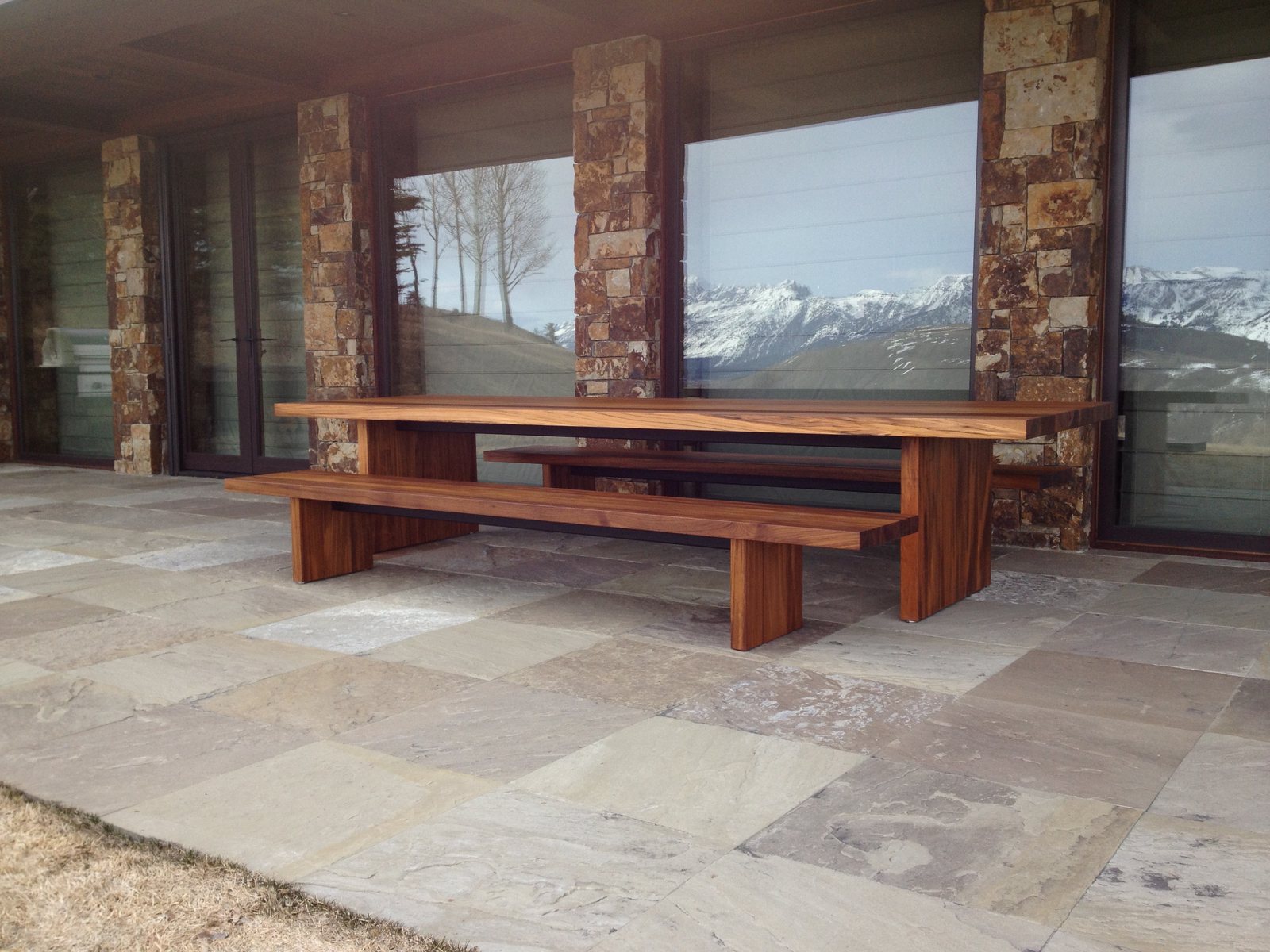
The conversion from parts to purchase order fits on one page, part by part, thickness by thickness. The table below is the working version of that page for exterior teak furniture. Read it as a starting specification and adjust the width column to the actual average width in the lot being offered, since that average is what governs how many parts come out of a board. J. Gibson McIlvain stocks teak by the quarter thickness rather than by the finished part, which is why the conversion is the buyer's first job and why it pays to do it on paper.
| Part | Rough thickness to order | Width to order | Where it comes from in the order |
|---|---|---|---|
| Square or tapered legs | 8/4 for net up to 1 3/4 | 4 inches and wider, ripped two legs per board face | The longest, straightest boards in the lift |
| Turned or heavily shaped legs | 10/4 or 12/4 | 4 inches and up, one blank per rip | A separate heavy stock line on the order |
| Seat rails and aprons | 5/4 or 6/4 | 5 inches and up, two rails per rip | Long boards, cut before any short part |
| Flat arms | 6/4 | Net width plus 1/4 for jointing | Clear mid length boards, show face chosen first |
| Shaped arms and bowed rails | 6/4 or 8/4 | Net width plus the full sweep | The widest boards, nested from a pattern |
| Crest rails curved in elevation | 10/4 or 12/4 | Net width plus 1/4 | Heavy stock line, bought with real surplus |
| Seat and back slats | 4/4, or 5/4 over 3 ft | 3 to 5 inches finished | Mid length boards and the long drops |
| Table and bench top staves | 4/4 or 5/4 | 3 to 5 inches, ripped and alternated | One lot held together for color |
| Stretchers and short rails | 5/4 or 6/4 | Narrow stock welcome here | Drops left by the rail cutting |
| Cleats, corner and glue blocks | 4/4 and ripping waste | Any width that cleans up | Shorts, never a separate purchase |
Narrow Widths and What They Yield
Width is where a plantation teak order and a furniture cut list part company. The log is younger, so the board comes off it narrower and shorter, with rings further apart and less extractive content than an old growth board carried. A cut list written against remembered widths meets that as a yield problem rather than as an argument a buyer can win. Design the parts around the widths the species actually delivers and the order fills. Design them around an 11 inch clear board and the order waits.
Run the rip arithmetic per part before committing. Net width, plus 1/8 for one jointed edge, plus the saw kerf, times the number of parts nested across the board. Two 2 1/4 inch rails come out of a 5 1/2 inch board only when both edges are straight enough to need one light pass. Give the same board a little crook and the second rail disappears, which is why width minimums belong on the order in writing rather than in the buyer's head.
Wide surfaces get glued up from staves rather than hunted as single boards. Keep stave widths inside the 3 to 5 inch band, alternate growth ring orientation across the panel, and a stave that wants to cup has too little width to lever the whole top. Quartersawn and rift stock moves less across its width than plainsawn, which is the reason a seat panel that has to stay flat under a cushion gets specified that way instead of being left to chance.
Taking the Short Parts Out of the Drop
Short parts are bought once, inside the long part order, and cut from what the long parts leave behind. Cutting runs long to short and never the other way. Legs and top staves come off the boards first, then rails, then stretchers and arm supports out of the drops, then blocks and cleats out of whatever is left. A set of six chairs throws off more clear 10 to 16 inch material than the set needs.
Take the short parts from the middle of a drop where the end checking has been trimmed back. A piece with crook along its length is worthless as a 40 inch rail and perfectly sound as a 9 inch arm support, since the curve gets cut out rather than planed out. Keep a written cut diagram per board for the long parts. Let the shorts be opportunistic.
None of this reasoning runs through a domestic grade rule, since teak is imported and arrives against export grades and the written description on the order rather than the National Hardwood Lumber Association rules that govern North American hardwood. What takes the place of a grade on a teak order is a plainly stated width minimum, a longest length, and a sentence about the end use.
Overage Over Net for Defect, Trim and Machining
Net board footage is not an order quantity, and the gap between the two is wider on furniture than on trim. Figure the net first. Board feet equal thickness in inches times width in inches times length in inches, divided by 144, worked on the rough thickness and the full width being bought. Then add the losses one at a time instead of guessing a single lump.
Trim takes 1 to 2 inches off each end of every blank. Jointing takes about 1/8 per edge. Surfacing takes whatever the cup and twist demand. Defect takes sapwood, the odd check and the occasional surprise inside a thick leg blank. Nesting takes the waste left between curved parts laid out on a pattern. Setup takes a test piece every time a profile, a tenon or a mortise gets dialed in on an unfamiliar lot.
For straight rectilinear parts out of random width and random length stock, 25 to 35 percent over net footage is the working range. Push that to 40 or 50 percent where parts are curved and nested, where the longest part is over 6 ft, or where every show face in a set has to match. Those are not padding. They are the yield the geometry allows, and a shop that orders net footage ends up buying twice and matching once.
Sapwood, Color and Matching a Set
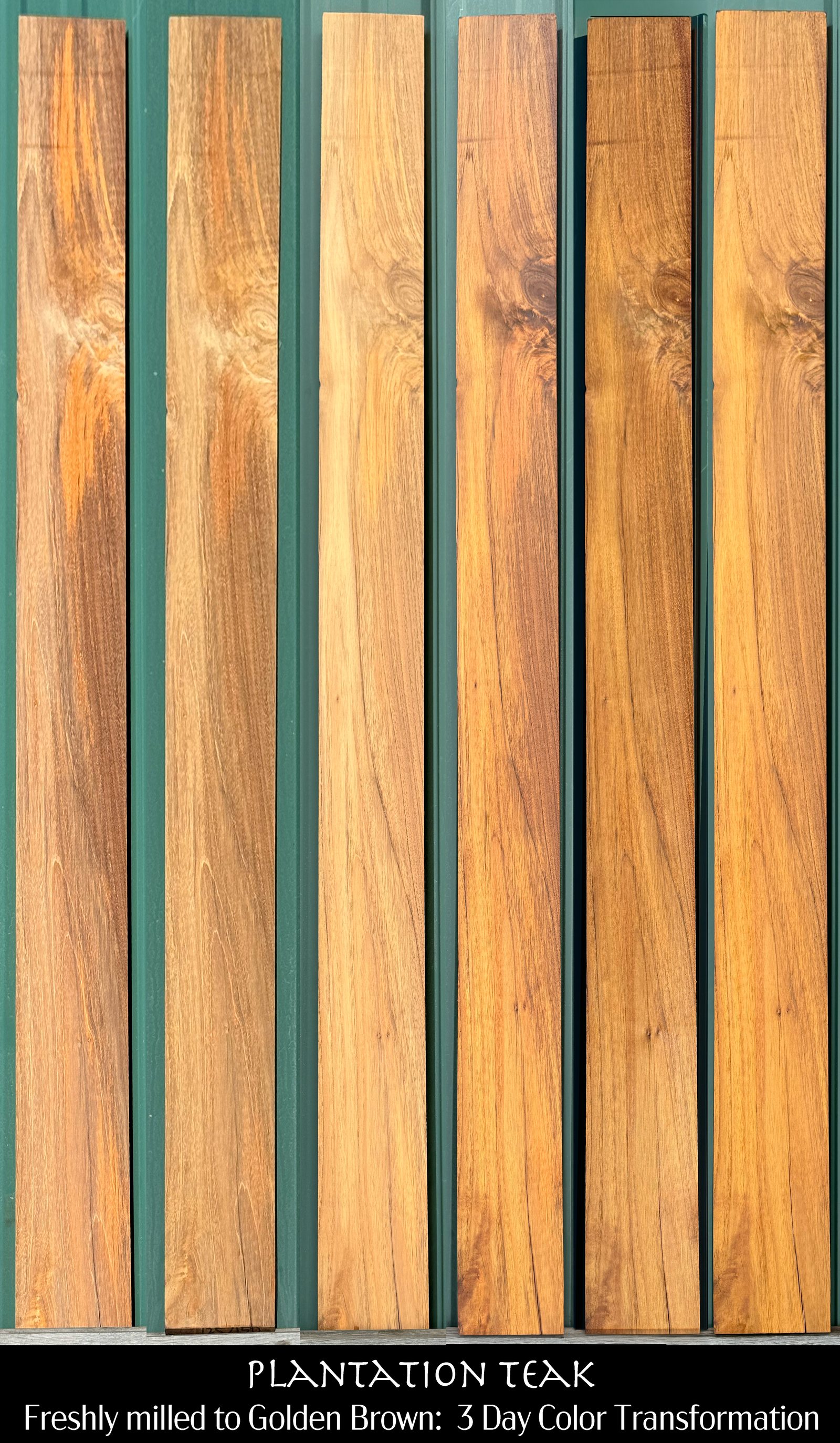
Teak runs from honey to mid brown inside a single lot, and a chair with an arm off one board and a leg off another announces it in the first season. Pale sapwood along a board edge is not a defect to be absorbed by the defect allowance. It is a width loss, and it belongs in the width column of the order rather than in a percentage at the bottom.
Pull every visible part for one set from the same lift. Cut show faces first while the choice of board still exists, mark them, and let the hidden parts fall where they fall. Teak weathers toward silver when it is left alone, and a set that started matched weathers evenly, while a set assembled from two deliveries keeps the difference visible under the gray. The Wood Database entry for teak is the place to check hardness and shrinkage figures against the species being compared.
Depth of inventory is what makes matching a set possible at all. J. Gibson McIlvain holds over seven million board feet of exotic and domestic lumber at its Maryland yard, which is how a 20 chair order gets pulled out of one lot in one pass instead of being chased across two shipments. Ask for the set to be drawn from one lift and say so on the order.
Glue Surfaces, Cutters and When to Mill
Teak changes the shop schedule more than it changes the order, and the order has to leave room for what the schedule costs. Joint the edges that will be glued close to the glue up rather than days ahead. A freshly cut teak surface glues far better than one that has sat, which means panel stock gets ripped, jointed and clamped as one operation.
Teak is hard on cutters and a dull knife tears the wide rings of plantation stock rather than slicing them. Plan on sharper intervals than a domestic hardwood run would need, and build a few extra blanks into the order so a torn face becomes a short part instead of a hole in the set. The Architectural Woodwork Institute standards are a useful reference for the surface quality a machined part is expected to reach.
This is also the place to be plain about warranties. Warranties exist on modified wood products and on nothing else. Solid unmodified lumber, teak included, is an organic material responding to its environment, and no supplier can warranty how a board behaves once it is cut, assembled and set outdoors. What a buyer can control is the order, the allowances and how the stock is stored before it is cut.
Buying for a Run Instead of One Piece
A production run is one lot bought up front and released in stages, not a fresh order every few weeks. Reordering mid run means a different lift, a different color range, and a different average width, and all three show up in the finished product. Buy the whole run against the whole cut list, then take delivery in the pieces the shop has rack space for.
J. Gibson McIlvain stores finished and reserved material for inventory control, so a shop with two racks and a tight floor can commit to a full run without taking it all through the door in one week. The stock that does arrive gets stickered, kept off the slab, and left to equalize in the space where it will be worked rather than cut the day it lands.
"The shops that get this right send us the cut list and the thicknesses before they send a footage number. Once we know the longest part and the narrowest width they can work with, we can tell them what the lot will actually yield instead of letting them find out at the saw."
Norm Moton, Director of Sales, J. Gibson McIlvain
Storage carries a second benefit on exterior work. Material held in a controlled space does not swing with the weather while the shop works through phase one, so the blanks cut in week six behave like the blanks cut in week one. J. Gibson McIlvain ships nationwide and sends teak to California regularly, so a staged release works the same way for a shop three time zones from the yard.
Writing the Order So the Yard Can Fill It
A teak order a yard can fill states footage by thickness, a width minimum, a longest length and the end use, in that order. Footage by thickness tells the yard which piles to work. The width minimum tells it which boards qualify. The longest length tells it whether the lot has the reach. The end use tells it that these parts are going outdoors, which changes what gets pulled. J. Gibson McIlvain fills an order written that way without a round of questions going back and forth first.
Say which thicknesses are firm and which are flexible. A shop that can take 6/4 instead of 5/4 for its rails gets filled faster and loses a little in shavings, and that trade is worth stating up front rather than leaving the yard to guess. Order rough and let your own machines make the parts. The ripping, jointing and dimensioning is shop work, and nothing about a furniture cut list wants to be converted into a parts list someone else cuts.
Imported stock also carries paperwork, and the paperwork should be asked for with the order rather than chased after delivery. J. Gibson McIlvain is an Forest Stewardship Council certified importer and miller, and documentation travels with the material it supplies. For a buyer writing sourcing language into a specification, the Forest Legality Initiative and the International Tropical Timber Organization both publish plain summaries of what tropical timber documentation covers.
How J. Gibson McIlvain Would Specify This
Specify the teak order as four thickness lines with a width minimum and a longest length on each, and the cut list comes out of it without a second purchase. Start with the parts list grouped by net thickness. Convert each group one step up the quarter scale, further for curved parts. Set the width minimum at what the parts genuinely need rather than at what would be convenient, and give the yard the longest part in each group.
Add 25 to 35 percent over net for straight parts and 40 to 50 percent where parts are curved, long or matched across a set. Order rough. Ask for the visible parts of a matched set to be drawn from one lift, and ask for the balance of the run to be held and released on the shop's schedule rather than delivered all at once.
J. Gibson McIlvain carries Indian plantation teak and reads a cut list in thicknesses, widths and footage rather than in one lump number. Built in benches, site fixed casework and other work planned around a specific space is a different job from loose furniture, and that work runs through ICD, the company's architectural millwork division. Everything about the lumber side starts with a cut list and a conversation about thicknesses.
Send the parts list rather than a footage number. Call 800-638-9100, give the longest part, the narrowest width the shop can work with and the thickness groups, and the order comes back as something a furniture run can actually be cut from. Stock behavior under exposure is worth reading up on separately, and Building Science Corporation covers moisture and exterior wood performance in detail.
Frequently Asked Questions
How much teak should I order over my net cut list footage?
For straight rectilinear parts out of random width and random length stock, plan on 25 to 35 percent over net board footage. Push to 40 or 50 percent where parts are curved and nested from a pattern, where the longest part runs over 6 ft, or where every show face across a set has to match for color. The overage is not padding. It covers 1 to 2 inches of trim per end, about 1/8 per jointed edge, surfacing loss that scales with how far the board sits out of flat, sapwood ripped off an edge, and a setup piece each time a cutter is dialed in on a new lot.
What rough thicknesses cover most exterior teak furniture parts?
Four lines usually cover a whole chair and table program. 4/4 for slats and panel stock under about 3 ft, 5/4 or 6/4 for seat rails, aprons, stretchers and flat arms, 8/4 for square or tapered legs at 1 3/4 net, and 10/4 or 12/4 for turned legs and for crest rails that curve in elevation. Parts that curve in plan take the extra in width rather than thickness, so nest the pattern on paper before deciding which thickness line to order them against.
Can I get an 8 inch wide teak board for a one piece seat?
Plan the seat as a glued panel instead. A plantation tree is younger, so boards come narrower and shorter out of a rotation length log, and a program built around wide single boards waits on material that may not come. Staves in the 3 to 5 inch band, ripped from one lot with growth ring orientation alternated, give a flatter seat than one wide board would anyway. Quartersawn and rift stock moves less across its width than plainsawn, which is why it gets specified where a panel has to stay flat.
Does teak come graded as FAS or No. 1 Common?
No. FAS, F1F, Selects and the Common grades are National Hardwood Lumber Association rules written for North American hardwood. Teak is imported and arrives against export grades and against the written description on the purchase order. That is why a teak order has to carry its own specification instead of leaning on a grade letter, meaning footage by thickness, a minimum width, the longest part length, and a line stating that the parts are going outdoors.
Should I order teak rough or surfaced if my shop does its own dimensioning?
Order rough. A furniture shop ripping, jointing and thicknessing to its own cut list needs the full rough thickness and the full width to work with, and every pass taken before delivery is thickness that cannot be used to true a reference face. Rough stock also lets the shop choose which face becomes the show face on an arm or a top stave, which is a decision nobody else can make from a parts list.
Is there a warranty on teak furniture stock?
Warranties exist on modified wood products and on nothing else. Solid unmodified lumber, teak included, is an organic material responding to its environment, and no supplier can warranty how a board behaves after it has been cut, assembled and set outdoors. What is controllable is the specification and the handling, meaning the right thickness for the part, honest allowances, stickered storage off the slab, and time to equalize in the shop before cutting.
How do I keep color consistent across a 20 chair order?
Buy the run as one lot and ask for the visible parts to be drawn from a single lift. Teak runs from honey to mid brown within a lot, and a set assembled from two deliveries keeps that difference visible even after the surfaces weather toward silver. J. Gibson McIlvain holds over seven million board feet of exotic and domestic lumber at its Maryland yard, so a full set can be pulled in one pass, and the balance can be held and released as the shop works through the run.