
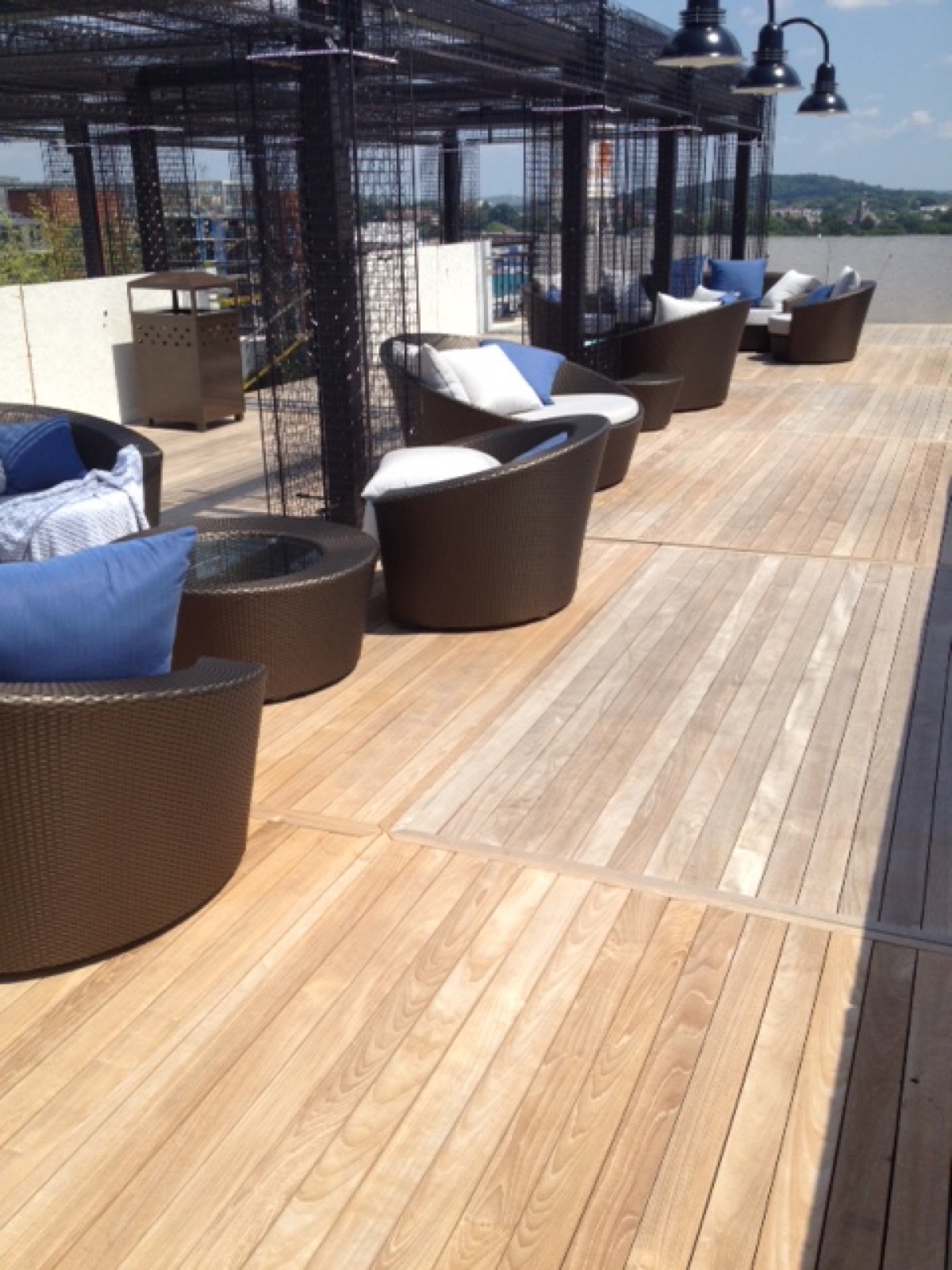
Ipe is the tropical hardwood that holds up longest on a commercial rooftop, and it earns that on stability, not just hardness.
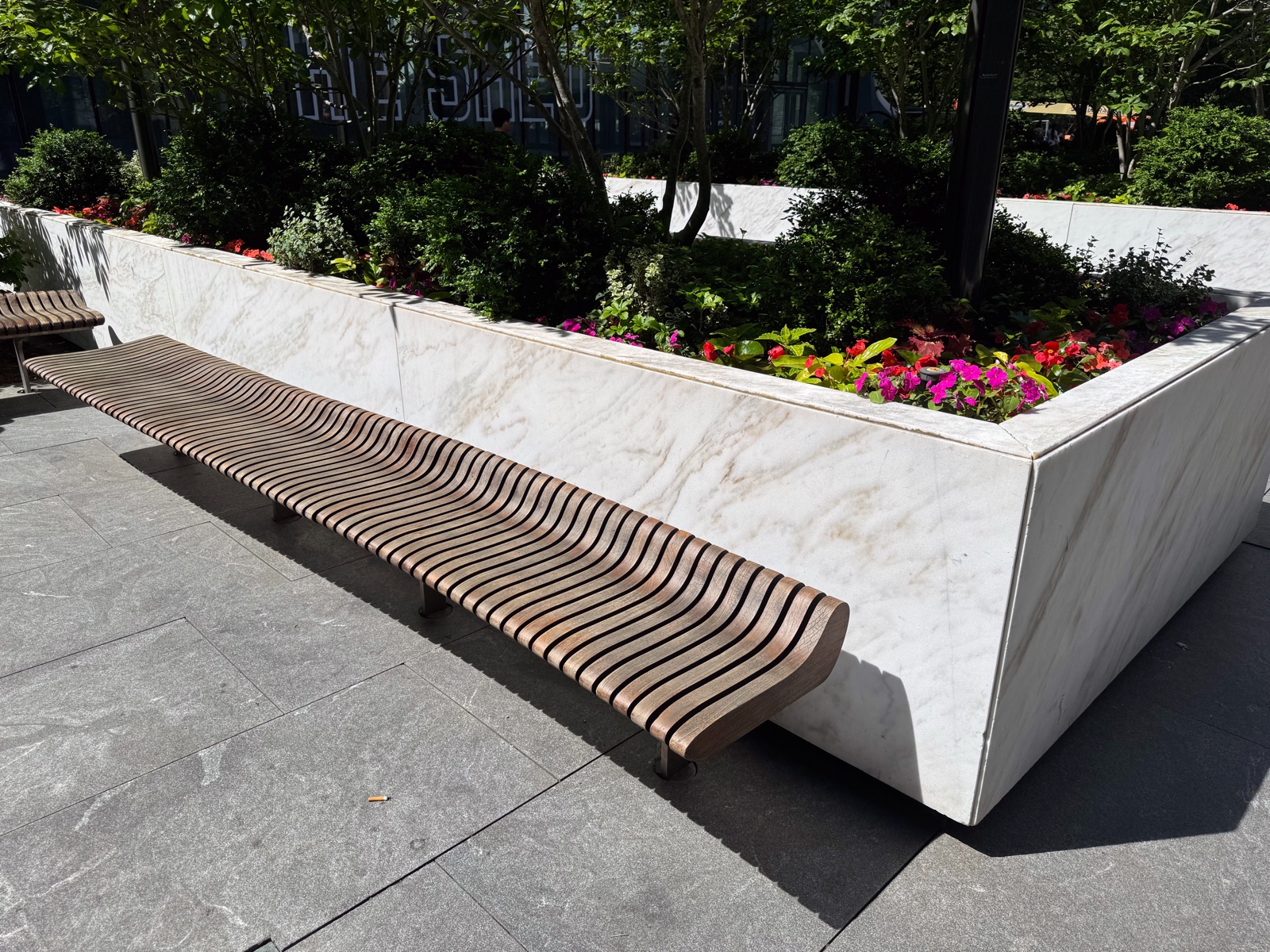
Most rooftop decking articles rank species by Janka number and stop there. Hardness matters for scratch and dent resistance. It tells you almost nothing about whether a board will still be flat, tight, and split-free in year twenty. A roof is a different test than a lawn. The deck sits in full sun, over a heat-holding membrane, with wind moving across every face of every board. What kills a rooftop deck is rarely soft wood. It is movement, checking, and fasteners that lost their grip because the wood shrank around them.
Ipe (Tabebuia spp.) wins the longevity question for three reasons that have little to do with its roughly 3,680 lbf Janka rating. It carries an EN 350 Class 1 durability rating, the top rank for resistance to decay and insects. It has a low tangential-to-radial shrinkage ratio, near 1.2, which is the single best predictor that a board will stay flat instead of cupping. And it reaches an ASTM E84 Class A flame-spread result with no treatment, which a commercial roof assembly frequently requires. Cumaru, Garapa, Jatoba, and Red Balau all have a place on a roof. They just ask you to give something up in exchange.
A rooftop is a harsher weathering chamber than any grade-level deck, and that changes which species survive.
Grade-level decks sit in shade for part of the day, near soil that buffers humidity, sheltered by the house from wind on one or two sides. A roof gives up all of that. Ultraviolet exposure runs higher because there is nothing overhead. Surface temperatures on a dark board over a warm membrane climb well past air temperature on a clear afternoon. Then the sun drops and the deck sheds that heat fast. The wood lives through a daily cycle of heating, drying, cooling, and rewetting that is more extreme than what a shaded backyard board ever sees.
That cycle is what you are actually specifying against. The USDA Forest Products Laboratory documents in its Wood Handbook that dimensional change tracks the swing in equilibrium moisture content, and a rooftop drives a wider swing than a protected site. Wind adds a second load. It pulls moisture out of exposed end grain and top faces faster than the core can equalize, and that gradient is exactly what opens surface checks. The denser and more decay-resistant the species, the better it rides out this treatment. A roof rewards the species that were already the most stable at grade level and punishes the ones that were marginal.
Dimensional movement, not hardness, is what backs screws out and opens gaps on a rooftop.
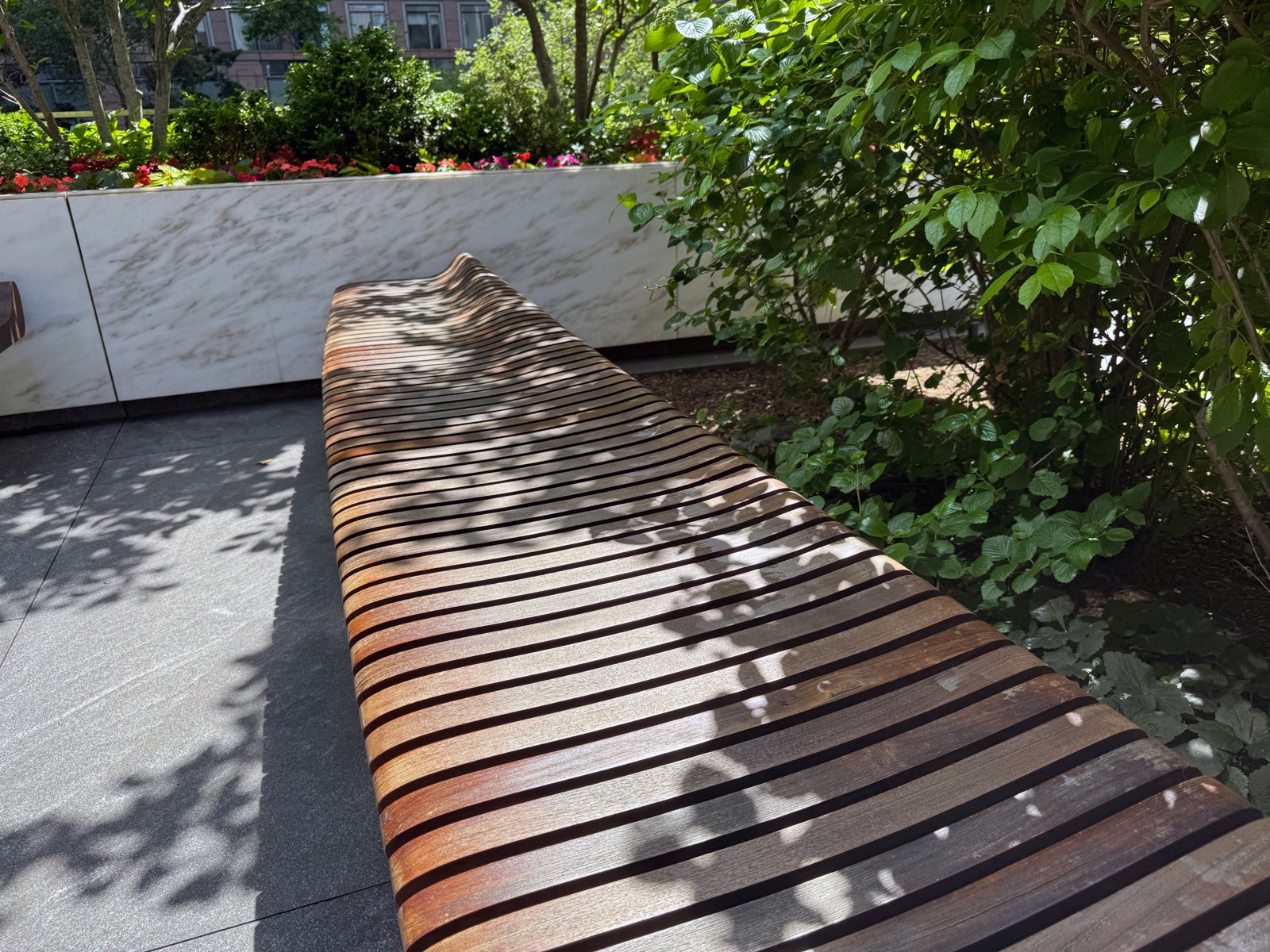
Every wood board shrinks and swells with moisture. What matters for a deck is how much it moves and, more importantly, how unevenly. Tangential movement (across the growth rings, roughly the width of a flat-sawn board) always exceeds radial movement (toward the center of the log). The ratio between them, the T/R ratio, tells you how much a board will tend to cup as it dries. A ratio near 1 stays flat. A ratio approaching 2 wants to curl.
Ipe sits near 1.2, which is why properly dried Ipe boards lie down and stay down. Cumaru runs higher, closer to 1.5, so it moves more and asks for tighter fastening and slightly narrower boards to behave. Jatoba climbs toward 1.9, which is fine indoors as flooring but is the trait that makes it the fussiest of this group outdoors on a wide board. The Wood Database publishes shrinkage figures for each of these species and is a reliable place to compare them side by side. The lesson for a roof: a species with a low T/R ratio buys you forgiveness on everything downstream, from board width to fastener spacing.
Movement also decides gap strategy. Tropical decking installed too wet will shrink after it acclimates, widening every gap and pulling on every fastener. Installed too dry in a humid coastal city, it swells and can buckle a tightly spaced field. Target an in-service moisture content of 12 to 16 percent and gap the boards for the conditions the roof will actually see, not for the day of installation.
Surface checking is the most common cosmetic failure on rooftop tropical decks, and density is the best defense.
Checking is the fine surface splitting that shows up along the grain after boards have baked and dried in place. It is a moisture-gradient problem. The face dries and shrinks while the core stays wetter, and the stress relieves as a crack. Rooftops accelerate this because the sun and wind pull the face moisture down fast while the underside, shaded and less ventilated, lags behind.
Dense, tight-grained species resist checking better because they move less overall and because the same growth structure that makes them hard also makes them slow to lose surface moisture unevenly. Ipe checks the least of the common tropical decking woods. Garapa, lighter at roughly 1,700 lbf Janka and less dense, is more prone to fine surface checking and end checking if the ends are left unsealed. Two installation habits cut checking on any species: seal every freshly cut end with a wax-based end sealer, and give the underside of the deck airflow so the board can equalize from both faces instead of drying only from the top. A UV-inhibiting penetrating oil slows the surface moisture swing and reduces checking as a side benefit, even if you do not care about color.
Ranked by how they behave over decades, the tropical decking species sort into clear tiers for rooftop service.
The table below compares the species on the axes that predict long-term rooftop performance rather than raw hardness alone. Massaranduba appears for reference because specifiers ask about it. It is hard and dense but moves considerably and is not part of the J. Gibson McIlvain decking program.
| Species | T/R ratio (cupping tendency) | Surface checking | EN 350 durability | Starting color / weathered gray | Maintenance to hold color |
|---|---|---|---|---|---|
| Ipe (Tabebuia spp.) | Low, near 1.2 (stays flat) | Lowest | Class 1 | Deep brown / silver-gray | Reoil about once a year |
| Cumaru | Moderate, near 1.5 | Low to moderate | Class 1 to 2 | Red-brown / gray | Reoil roughly once a year |
| Red Balau | Moderate | Moderate | Class 2 | Red to red-brown / gray | Reoil about once a year |
| Jatoba | Higher, near 1.9 (wants to cup) | Moderate | Class 2 to 3 | Red-brown / gray | More frequent oiling to hold color |
| Garapa | Moderate | Higher (seal ends) | Class 2 to 3 | Honey-gold / gray | More frequent oiling; lighter tone shows wear |
| Massaranduba (reference only) | High (more movement) | Moderate to high | Class 1 to 2 | Red-brown / gray | Reoil to hold color |
Janka and density still count for a rooftop deck that carries foot traffic and rolling furniture. Ipe at about 3,680 lbf and 1,050 kg per cubic meter and Cumaru at about 3,540 lbf and 1,070 kg per cubic meter lead on both. Red Balau at roughly 1,700 to 2,000 lbf and Garapa near 1,700 lbf are lighter underfoot and lighter on the roof structure, which is a real advantage when your structural engineer is counting every pound of dead load. The point of the table is that the flat, check-resistant, Class 1 material is Ipe, and everything else is a considered trade.
Every tropical hardwood on a roof will silver to gray unless you commit to a maintenance cycle, and the decision belongs in the spec.
Left alone, all of these species weather to a silver-gray patina. That is a surface effect. It does not weaken the wood, and on a Class 1 species like Ipe the deck is structurally sound gray or brown. The choice between letting it gray and keeping it brown is aesthetic and it is a maintenance commitment, so make the call before the deck goes down rather than two summers later when a client asks why the color changed.
Holding the original tone means a penetrating, UV-inhibiting deck oil, reapplied on a schedule the roof exposure dictates. A fully exposed rooftop burns through oil faster than a shaded deck, so plan on reoiling at least once a year for the dense browns and more often for lighter species like Garapa where fading is more visible. Do not film-form. Solid stains and varnishes peel on a hot, moving tropical board and turn maintenance into stripping. If the design intent is silver, skip the oil, clean the deck periodically, and let it go. Either path is legitimate. The mistake is not deciding.
Modified woods change the longevity math on a roof, and they come with something solid wood does not: a warranty.
Acetylated and thermally modified boards are worth weighing on a rooftop because their movement and decay behavior are engineered rather than inherited. Accoya, an acetylated softwood, has very low dimensional movement and carries a manufacturer durability warranty for above-ground use, which no solid unmodified tropical hardwood offers. Thermally modified options such as Thermory and Abodo Vulcan gain dimensional stability and decay resistance from the heat process and are lighter than Ipe, which helps on a dead-load-limited roof. Each carries its own manufacturer warranty terms.
Two limits keep modified wood from being an automatic answer. First, kiln size caps board length. Thermory, Abodo Vulcan, and Accoya top out around 16 feet, with the metric-milled products landing just under 16 feet, so a design that wants long continuous runs will hit that wall. Second, thermally modified wood trades some surface hardness and can be more prone to surface checking under the exact heat-and-UV load a roof delivers, so detailing and finish matter even more. Modified boards are a strong fit where low movement and a warranty carry the decision. They are a supplement to the tropical hardwood options, not a replacement for Ipe where hardness and length drive the job.
"On a roof, I care less about the Janka number and more about whether the board is going to lie flat in August after it has been baking all day. That is a moisture-content and a movement conversation. We kiln our Ipe to a rooftop-appropriate range, we seal the ends before it ships, and we walk the spec through board width and fastener choice with the crew, because a stable species installed wrong will still cup. Get those right and an Ipe rooftop deck outlasts almost everything else on the building." Norm Moton, Director of Sales, J. Gibson McIlvain
Fasteners, board width, and ventilation decide whether the deck stays flat, no matter how good the species is.
Movement is a fact of the material. Detailing is how you manage it. Narrower boards cup less than wide ones for the same species, so on a species with a higher T/R ratio, dropping to a narrower board is the cheapest stability you can buy. Fastening comes down to profile. Shiplap and square-edge boards take face screws, and on dense tropical wood you pre-drill and counterbore. Only tongue-and-groove and grooved-edge profiles work with hidden clip systems, and where a grooved profile drains, the grooves face down so water runs out instead of sitting in the channel. Use 316 stainless fasteners for any coastal or high-exposure roof. A rooftop is a corrosive environment even inland once you add wind-driven rain and pooled water.
Ventilation is the part rooftop decks get wrong most. A board that can only dry from its top face dries unevenly and cups toward the sun. Set the decking on sleepers or an adjustable pedestal system that lifts the boards off the membrane and lets air move under them. That airflow lets each board equalize from both faces, which is the same mechanism that reduces checking. The American Wood Council's codes and standards resources and building-envelope guidance from Building Science Corporation both reinforce the same principle: a wood assembly that can dry from both sides is the one that lasts. Space joists or sleepers at 16 inches on center for dense hardwood decking, and tighten that spacing if you run thinner boards or expect heavy point loads.
Plan the maintenance cycle for a 25-year roof at the specification stage, not after the first summer.
A rooftop tropical deck is a long-lived assembly, and its maintenance is predictable, so it belongs in the project documents. Budget an annual inspection: check fasteners for backout, look for early end checking, confirm the pedestal or sleeper field has not shifted, and clear debris from between boards where it traps moisture against the wood. If the design holds the original color, schedule the reoil interval by exposure, at least yearly for exposed Ipe and Cumaru and more often for lighter species. If the design accepts gray, the maintenance is mostly cleaning.
The membrane under the deck outlives its warranty faster than the wood does, so build in access. Removable deck sections or a pedestal system that lifts cleanly let a roofer reach the waterproofing without demolishing the deck. A tropical hardwood field that has to be pried apart to service the roof is a deck that gets replaced early for reasons that have nothing to do with the wood. Detailing for access is part of specifying for longevity.
A deck meant to last decades has to be legal and traceable for every one of them, so sourcing is a durability issue too.
Legality is not separate from longevity on a commercial job. Chain-of-custody documentation protects the owner across the full service life of the deck, and it is the specifier's job to require it. Ask for FSC chain-of-custody paperwork where the project targets it. The Forest Stewardship Council maintains the certification framework, and a certified supplier can produce the documentation that ties the material to a responsibly managed source.
Where a project uses a CITES-listed species, documentation is required and must move with the material, so confirm your supplier handles that paperwork correctly before the order ships. The CITES framework governs those species internationally. On flame-spread, verify the ASTM E84 Class A result if the assembly calls for it, since Class A means a flame-spread index of 25 or less, and the test method is published by ASTM International. Getting the paperwork right at purchase is what keeps a 25-year deck from becoming a compliance problem in year ten.
How J. Gibson McIlvain Would Specify This
For a commercial rooftop deck built to last, J. Gibson McIlvain specifies Ipe as the default and adjusts only when dead load, length, or a warranty requirement pushes the decision elsewhere. J. Gibson McIlvain mills Ipe decking to a rooftop-appropriate moisture range, seals the board ends before shipping, and carries the species in a vast inventory across standard and custom dimensions, so the profile and length the roof plan calls for is available rather than substituted. The company ships this material nationwide, including regularly to California, from its operation as a contractor and commercial-volume supplier.
The written spec should name the species and the profile together. Choose square-edge or shiplap with pre-drilled, counterbored 316 stainless face screws for maximum hold on a high-movement roof, or a grooved profile with a hidden clip system where the design wants a clean face, grooves down for drainage. Call out an in-service moisture content of 12 to 16 percent, a joist or sleeper spacing of 16 inches on center for dense hardwood, and a pedestal or sleeper assembly that ventilates the underside and preserves membrane access. Decide the color path in the spec: annual UV-inhibiting oil to hold the brown, or a cleaning-only cycle to accept the silver. Where dead load is the binding constraint, step to a lighter Class 1 or Class 2 species like Cumaru or Red Balau, or weigh a warrantied modified product such as Accoya, Thermory, or Abodo Vulcan while respecting the roughly 16-foot length ceiling on modified boards. To match a species and profile to a specific roof assembly and its structural limits, call a J. Gibson McIlvain decking specialist at 800-638-9100 or start at the Ipe decking page.
Frequently Asked Questions
Which tropical hardwood moves the least on a rooftop deck?
Ipe moves the least of the common tropical decking species and, just as important, moves evenly. Its tangential-to-radial shrinkage ratio sits near 1.2, which is the trait that keeps boards flat instead of cupping as they dry in the sun. Cumaru moves more, near a 1.5 ratio, and Jatoba is higher still near 1.9, which is why Jatoba is the fussiest of the group on a wide exposed board. Installing any of them at an in-service moisture content of 12 to 16 percent, with airflow under the deck, keeps movement predictable.
Why do rooftop Ipe boards check on the surface, and can I prevent it?
Surface checking comes from a moisture gradient. The top face dries and shrinks under sun and wind while the core stays wetter, and the stress relieves as fine splits along the grain. A roof accelerates this because the exposed face dries fast while the shaded underside lags. You cannot eliminate checking, but you can cut it sharply: seal every freshly cut end with a wax-based end sealer, ventilate the underside so the board equalizes from both faces, and apply a penetrating UV-inhibiting oil to slow the surface moisture swing. Dense species like Ipe check the least to begin with.
Should I let a rooftop tropical deck weather to gray or keep it brown?
Both are legitimate, and the choice is a maintenance commitment, not a structural one. Every tropical species silvers to gray under rooftop UV, and the wood stays sound either way. Holding the original brown means a penetrating UV-inhibiting oil reapplied at least once a year on an exposed roof, more often for lighter species like Garapa. Accepting gray means periodic cleaning and no oil. Decide before installation and write it into the spec, because switching strategies two summers in is harder than committing up front. Never use a film-forming solid stain or varnish, which peels on a hot, moving board.
How wide can rooftop deck boards be before cupping becomes a problem?
Wider boards cup more than narrow ones for the same species and moisture swing, so width is a stability lever you control. On a low-movement species like Ipe, standard decking widths behave well when the wood is dried and ventilated correctly. On higher-movement species like Jatoba, dropping to a narrower board is the cheapest way to keep the field flat. Pair any width choice with underside ventilation on sleepers or pedestals, because a board that can only dry from the top will cup toward the sun regardless of how narrow it is.
Do modified woods come with a warranty for rooftop use?
Yes, and that is one reason to consider them. Accoya, Thermory, and Abodo Vulcan carry manufacturer warranties that solid unmodified tropical hardwood does not, along with lower dimensional movement, which helps on a roof. The trade-offs are length and hardness. Kiln size caps these products at roughly 16 feet, with metric-milled boards landing just under 16 feet, so long continuous runs are limited. They are also softer than Ipe and can be more prone to surface checking under intense rooftop heat and UV, so finish and detailing matter. Treat them as a strong supplement where low movement and a warranty drive the decision.
What in-service moisture content should rooftop tropical decking be installed at?
Target 12 to 16 percent in-service moisture content and gap the boards for the conditions the roof will actually reach, not for the weather on installation day. Material installed too wet shrinks after it acclimates, widening every gap and pulling on fasteners. Material installed too dry in a humid coastal climate swells and can buckle a tightly spaced field. A supplier that kilns tropical decking to a rooftop-appropriate range and seals the ends before shipping removes most of the guesswork from this.


