A Saltwater Dock Deck Fails in Six Specific Ways, and Species Choice Only Answers Four of Them
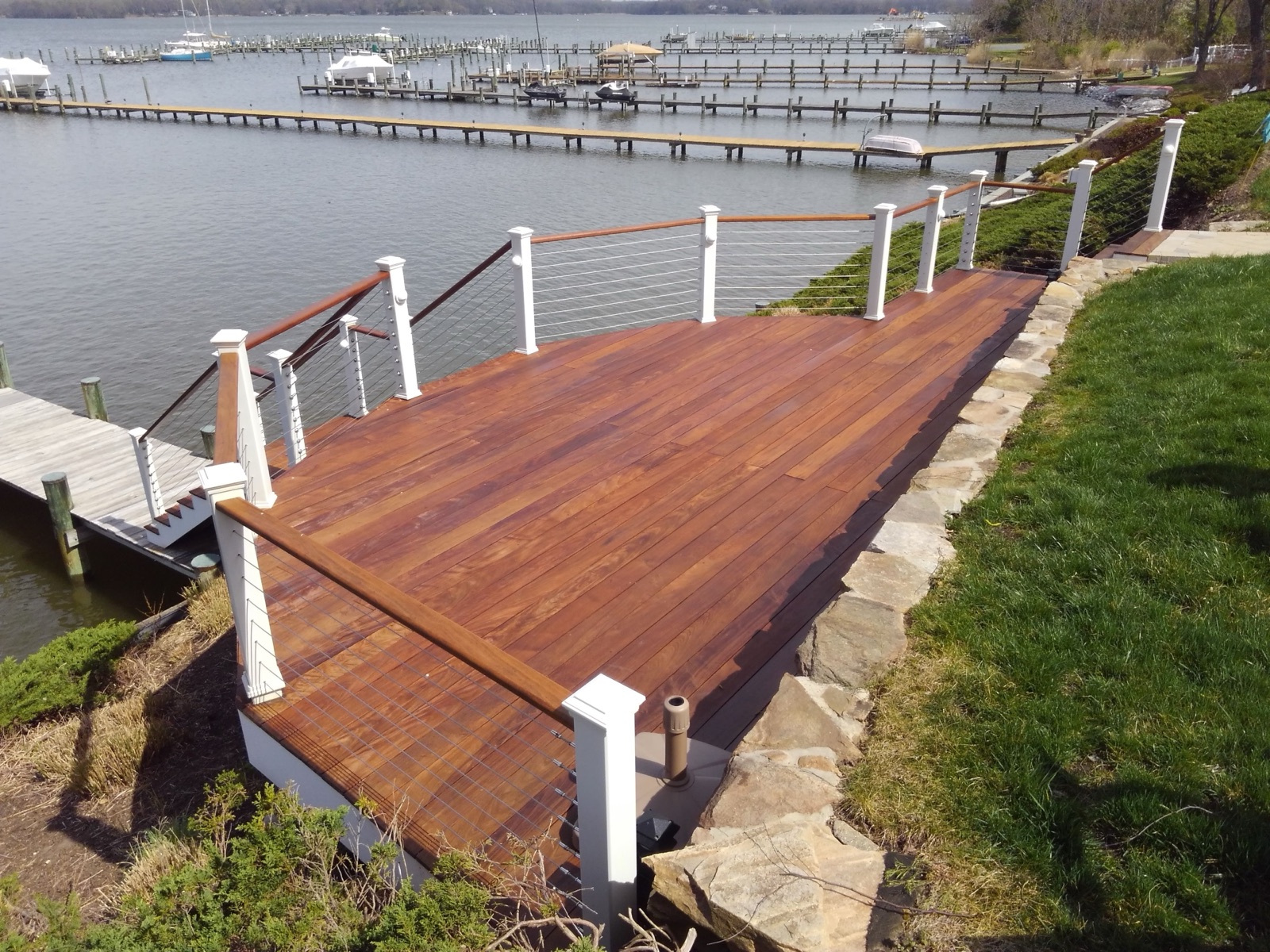
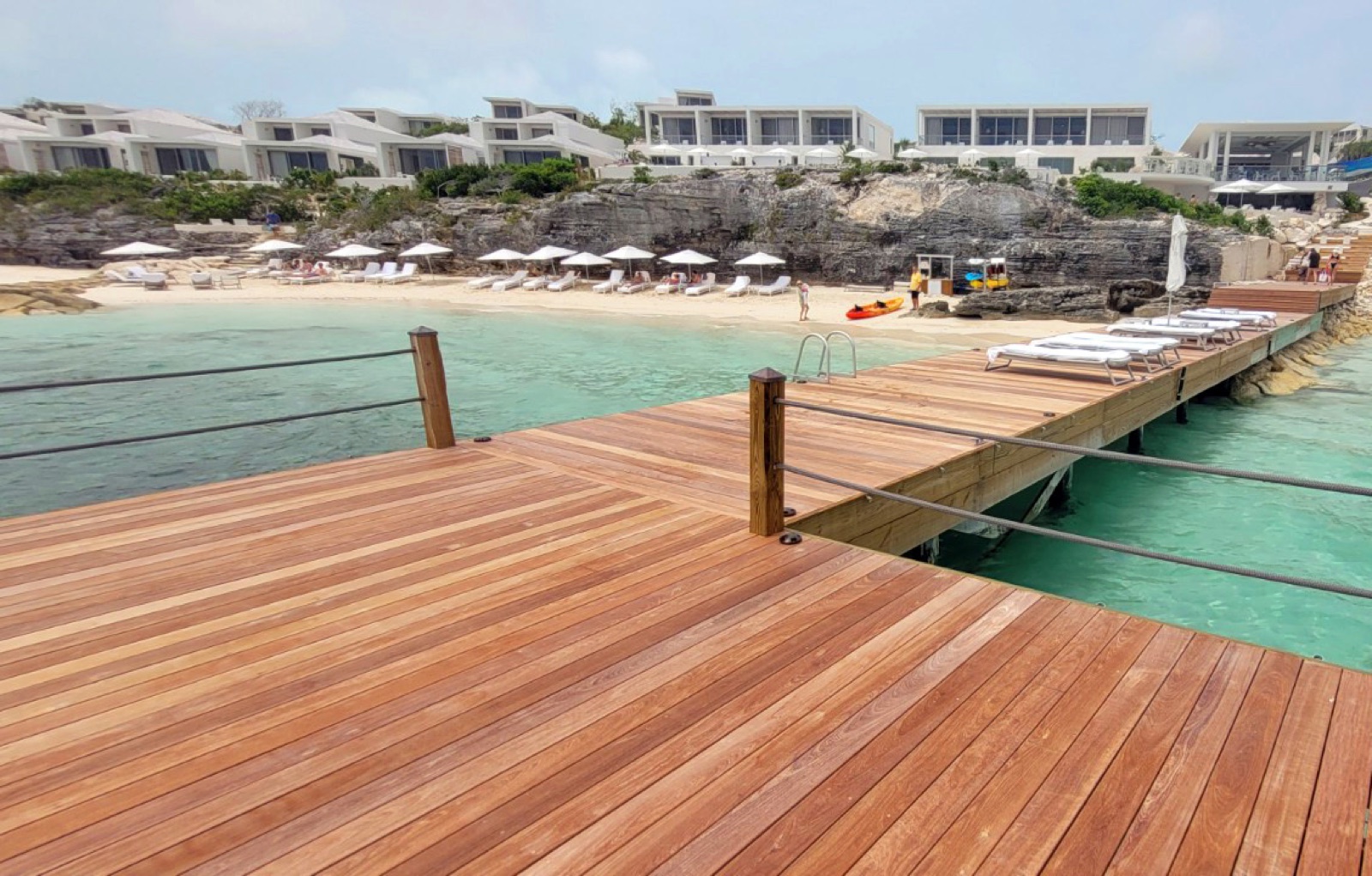
The right tropical hardwood for a dock or pier is the one that resists the particular failure modes of a marine deck, and on that test Ipe wins the deck field outright with Cumaru close behind. Most species comparisons stop at a hardness number and a durability class. A dock is harsher than that. Salt water attacks a waterfront structure through six separate mechanisms, and each one loads a different property of the wood.
Fungal decay at trapped-moisture contact points. Marine borer attack below and around the tide line. Wet and dry cycling in the splash zone, which drives dimensional movement far harder than an inland deck ever sees. Salt crystallization inside surface cells. Ultraviolet degradation on an unshaded structure with water reflecting light back up at the boards. And crevice corrosion at every fastener, which stains and eventually splits the board around the hole.
Species selection answers decay resistance, borer resistance in the above-water zone, movement, and to a degree UV surface breakdown. It does not answer fastener corrosion, and it does not answer framing deflection. Those belong to hardware and structure. Any recommendation that names a species and stops has answered part of the question.
Salt Water Does Two Different Things Depending on Elevation
Above the splash line, salt is mostly a drying and abrasion problem; at and below the tide line, it introduces marine borers that no decking species is rated to survive. The distinction matters more than any Janka figure.
Deck boards on a fixed pier sit in the atmospheric zone. They get salt spray, sun, and rain. Salt spray dries into crystals inside the outer cell structure, and those crystals are hygroscopic, so the board surface holds a slightly elevated moisture content longer after each wetting. That extends the wet portion of every wet and dry cycle. It also mildly accelerates surface erosion under UV, which is why a saltwater deck silvers faster than the same species inland.
Down at the water, the biology changes. Shipworms and gribbles work on submerged and tidal timber, and their range extends anywhere salinity supports them. The USDA Forest Products Laboratory Wood Handbook treats marine borer resistance as a separate category from terrestrial decay resistance for exactly this reason. A species can hold EN 350 Class 1 durability against fungi and still be attacked by borers in warm salt water. Ipe and Cumaru both have field reputations for holding up in tidal contact better than most timbers, but neither is a substitute for a properly specified marine piling. Deck species are deck species.
The practical line: specify tropical hardwood for everything the public walks on and touches, and let the marine engineer specify what goes in the water.
Tidal Structures Move More Than Inland Decks, and That Changes the Gapping Math
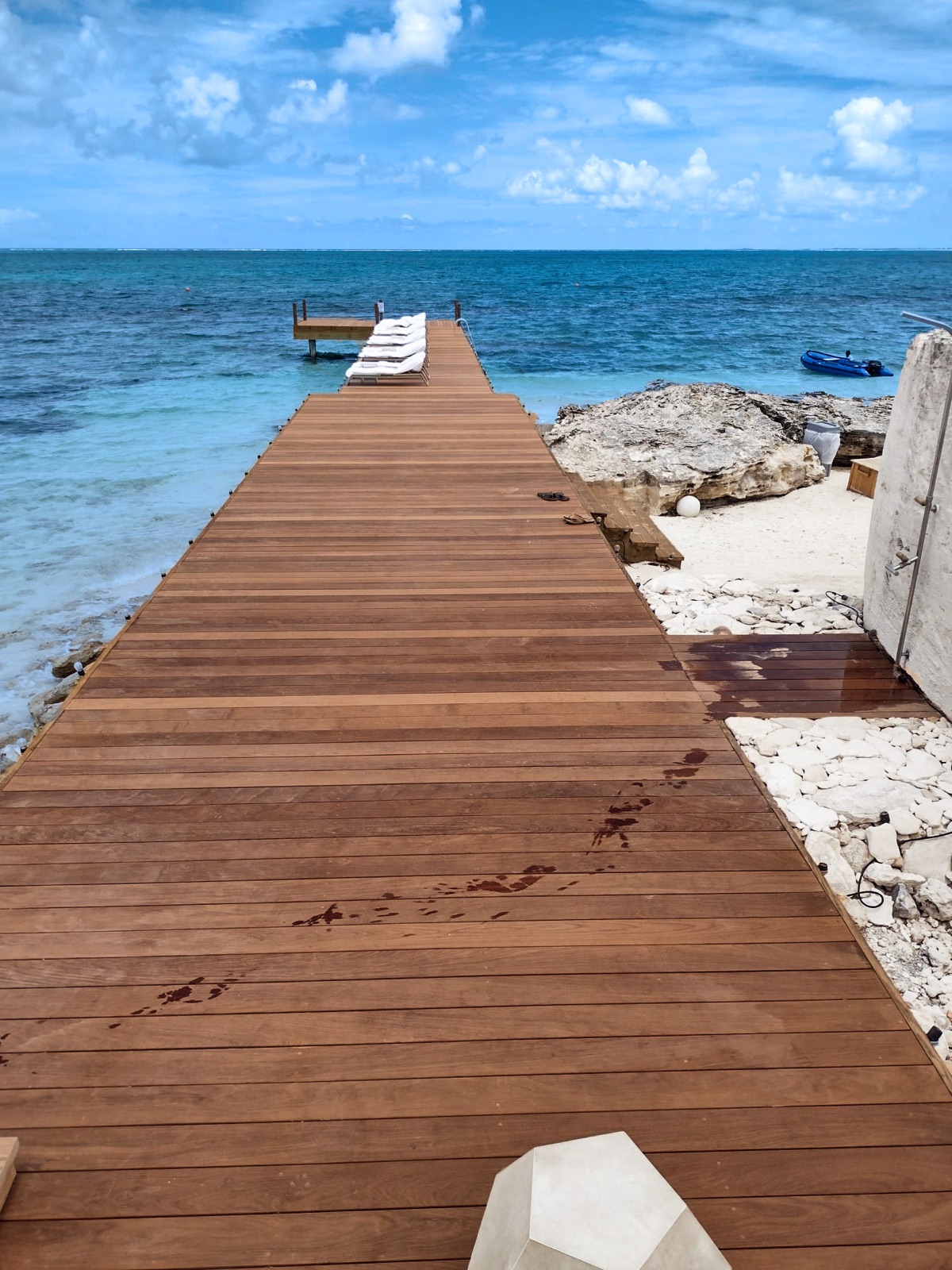
A dock deck sits over a permanent source of humidity, so its underside stays wetter than its face, and the resulting moisture gradient drives cupping and gap change harder than on any land deck. Underneath a pier the relative humidity near the water surface runs high year round. The face of the board bakes. That differential is the engine behind most dock deck complaints.
Ipe moves comparatively little for a wood of its density, and it is dimensionally quiet along the length. Across the width it still moves. Set boards at 12 to 16 percent moisture content at installation, which is where kiln dried tropical decking should land for exterior service, and gap accordingly. On a saltwater structure a working gap of about 3/16 inch on 6 inch nominal boards holds up through a season cycle. Tighter gaps look good on delivery day and close up on the first wet stretch.
Two details keep the gradient manageable. Seal every field cut and every end grain surface as it is made, not at the end of the day. And coat both faces before the board is fastened down. A board finished only on top is a board with two different absorption rates, which is the recipe for cup.
On an accessible route, the gap also has a legal ceiling. The ADA Accessibility Standards limit openings in a walking surface so that a 1/2 inch sphere cannot pass through, and elongated openings must run perpendicular to the dominant direction of travel. Commercial boardwalks and public piers get held to that. Residential docks do not, but the same gap range works either way.
Ranking the Shortlist by What Each Species Actually Survives
Five tropical species belong in a serious dock conversation, and they separate less on hardness than on whether they can be sourced in the thickness the structure requires. Hardness matters for wear at gangway transitions and slip landings. It does not predict decay resistance, and it does not predict whether a species will be available in 2x.
| Species | Janka (lbf) | Density (kg/m3) | EN 350 durability | Sourceable in 2x decking | Where it belongs on a marine structure |
|---|---|---|---|---|---|
| Ipe (Tabebuia spp.) | ~3,680 | ~1,050 | Class 1 | Yes | Commercial piers, boardwalks, high traffic residential docks, ASTM E84 Class A where required |
| Cumaru | ~3,540 | ~1,070 | Class 1 to 2 | Yes | Large residential docks and commercial work where a warmer tone is wanted |
| Jatoba | ~2,690 | ~910 | Class 2 to 3 | Yes | Sheltered decks, ramps and stair treads; the third species available in commercial thickness |
| Red Balau | ~1,700 to 2,000 | ~800 | Class 2 | No | Residential docks and 5/4 work approved by the engineer of record |
| Garapa | ~1,700 | ~830 | Class 2 to 3 | No | Residential floating docks and pale toned pool surrounds; lighter dead load |
| Teak | ~1,070 | ~660 | Class 1 | Limited | Boat decks, seating, caps and trim; too soft for heavy public deck traffic |
| Massaranduba (comparison only) | ~3,190 | ~1,150 | Class 1 to 2 | Varies | Cited here for density comparison; sharper checking and greater movement than Ipe |
| Thermally modified (Thermory, Abodo Vulcan) | Varies by base species | Reduced by process | Class 1 to 2 after modification | No | Ramps, screens, benches and rail infill; lengths cap around 16 ft due to kiln size |
Species figures line up with published values at the Wood Database and with the durability classifications used across European exterior and marine timber specification.
Commercial Piers Get Specified in 2x, and That Quietly Eliminates Half the Shortlist
Boardwalk, pier and plaza decks open to the public are specified at 2x thickness to control deflection, and only Ipe, Cumaru and Jatoba can be sourced consistently in that thickness. This is the most useful filter on a commercial marine job, and it decides the species list before durability ever comes up.
The reason is not purely structural math. Run the numbers on a 5/4 Ipe board over joists at 16 inches on center and the strength check passes comfortably. Deflection under a crowd load is a different feel underfoot, and a public pier with bounce generates complaints and inspection attention regardless of what the calculation says. No design professional wants to be the first one on a municipal job to go thinner. Specifying 2x removes the argument before it starts.
Once 2x is on the drawing, Red Balau and Garapa drop off. Both are legitimate decking species, and both perform well in residential service, but neither is reliably available in true 2x decking thickness. Putting them on a public pier spec creates a substitution problem at buyout. Keep them where they belong: private docks, engineer approved 5/4 assemblies, and lighter floating structures.
Load path deserves the same attention. Dense tropical decking is heavy, so the framing has to be designed for it rather than inherited from a softwood detail. Design values and connection guidance live in the standards published by the American Wood Council, and structures over water usually pick up additional load cases from the local marine provisions adopted through the International Code Council.
Floating Docks Are a Weight Problem Before They Are a Durability Problem
Dead load is the constraint on a float, and the densest species is not automatically the right one. A fixed pier carries its deck to pilings. A float carries its deck on buoyancy, and every added pound of decking eats freeboard.
Ipe at roughly 1,050 kg/m3 is close to three times the weight of the cedar or treated pine many float systems were originally drawn around. Swap decking without recalculating flotation and the structure sits low, ships water at the edges in wake, and loses the freeboard that keeps the frame out of the wet zone. That is a design change, not a finish change.
Three ways this gets solved. Add float volume, which is easy at the design stage and painful later. Move to a lighter dense species such as Garapa or Red Balau on a residential float, both of which sit meaningfully below Ipe in density while still delivering real durability. Or reduce thickness to 5/4 with the engineer of record signing off on the span. Floating structures are one of the few places where the honest answer is not Ipe.
Fixed piers face the opposite pressure. There the extra mass is an asset, since dense hardwood decking resists uplift in wind and wave better than a light board, and it stays put under foot traffic without the drumming a thin board produces over open water.
Surface Checking Is Normal on Dense Tropical Decking and Cannot Be Engineered Away
Checking is tension release, not failure, and any supplier who promises a check free tropical deck is setting up a callback. The mechanism is simple. Sun heats the top of the board, the surface dries faster than the core, the surface wants to shrink while the interior holds it, and the wood relieves the stress with fine separations along the grain.
Small surface checks do not reduce the structural capacity of a deck board, and their presence is frequently evidence that the material was properly seasoned rather than case hardened. A dock intensifies the effect. Reflected light off water increases the surface heat load, and the humid underside widens the moisture gradient across the board thickness.
What genuinely reduces checking is stabilization from the inside. J. Gibson McIlvain factory coats tropical decking with Cutek, a penetrating oil wood stabilizer that slows the rate at which the surface gives up moisture, and the reduction in checking on factory coated material is significant. Site practice does the rest. Take delivery of material at a moisture content close to service conditions, keep bundles covered and off the ground with stickers for air movement, seal all cuts, and get the deck fastened down rather than letting loose boards sit in the sun on a barge for a week.
None of that eliminates checking, and it should not be sold as though it does. It keeps checks small, tight and cosmetically unremarkable, which is the achievable outcome.
Every Fastener Hole Gets Drilled On Site, Against the Frame As Built
Nobody should be buying dock decking pre-drilled, and no mill should be drilling fastener holes before a board ships. Layout gets adjusted in the field. Joists land where the pile driver put them. Boards get cut to fit around cleats, ladders, hatches and utility penetrations. A factory hole pattern is invalidated by the first field cut, and a hole that misses the joist by a quarter inch is a permanent defect in an expensive board.
Correct technique on a dock deck:
- Pilot every hole. Ipe and Cumaru will not accept a screw without a pilot, and driving without one splits the board or shears the fastener.
- Two fasteners per board per joist, placed consistently so the deck reads as a straight line of hardware down the pier.
- About 3/4 inch edge distance from the board edge, which keeps the fastener out of the zone that splits.
- Full pilots near board ends, where splitting risk is highest.
- Butt joints land on doubled bearing, never on a single joist shared by two board ends.
- A self centering combination bit that pilots and countersinks in one motion is the tool that makes a large deck consistent.
Fastener metallurgy is not negotiable in salt. Use 316 stainless in coastal and brackish exposure. The 300 series alloys resist chloride attack far better than coated carbon steel, and the difference shows up as the absence of the black staining that bleeds down a dock deck within a season or two when the wrong hardware goes in. Tropical hardwood extractives are aggressive toward mild steel, and salt spray finishes the job.
Hidden fastener systems have a place. Only an edge grooved board accepts hidden clips, and square edge stock must be face screwed. On a public pier, face screwing is usually the better call anyway, since a clipped deck is harder to open for inspection and repair, and marine structures get opened.
Rails, Skirts and Benches Are a Different Specification Than the Deck Field
The deck field takes the traffic, but rails, cladding and seating take the direct weather, and the right material for each is not the same. Splitting the specification by component gets a better structure than forcing one species across everything.
Handrails and cap rails get hands, sunscreen and constant wet contact. Ipe and Cumaru both work, and a cap rail is one of the few places where a slightly softer, lower movement species is a legitimate alternative for comfort. Rail infill and privacy screening are where thermally modified wood earns its keep, since Thermory and Abodo Vulcan deliver stability and a rot resistant profile in components that carry no significant structural load. Both cap out around 16 feet, with metric lengths landing just under that, because the modification kiln sets the limit. Accoya belongs to the same conversation for painted marine components. Modified products are also the only category on a dock that carries a manufacturer warranty. Solid unmodified tropical hardwood is sold on species performance and grade, not on a warranty document, and anyone offering one on solid stock is selling something other than lumber.
Skirting and any wall cladding on a dock house or storage box follow siding rules, not decking rules. Shiplap takes visible fasteners. Only tongue and groove works with a hidden fastener. Either profile goes on furring strips over the framing so there is a drainage and ventilation gap behind the boards, and grooves face down so water runs out rather than sitting in the joint. Cedar remains a reasonable default for these components, and it should not be dismissed. Clear vertical grain cedar gives the flattest, most stable board for exposed cladding and trim, while select tight knot delivers the character grade at a lower material tier and performs well when detailed properly.
Painted exterior trim on a dock structure is a Sapele job. It holds paint better than Genuine Mahogany and comes in longer lengths, which matters on fascia and rail runs where a splice is the first thing to fail.
Documentation Travels With the Wood on a Permitted Waterfront Job
Waterfront construction sits inside an environmental permitting process, and the wood package is part of the paperwork more often than buyers expect. Municipal piers, park boardwalks and marina rebuilds routinely require chain of custody documentation, and the reviewing agency may be a coastal commission rather than a building department.
FSC certification is the credential most often written into public specifications, and it also maps onto material credit categories in USGBC rating systems. J. Gibson McIlvain is FSC certified and can supply certified material where the specification calls for it. When using a CITES-listed species, documentation is required and must accompany the shipment, and the current appendices are published by the CITES Secretariat. Confirm listing status at the time of purchase rather than relying on a species list carried over from an old project.
Fire performance shows up on covered structures and on piers attached to buildings. Ipe carries an ASTM E84 Class A rating, meaning a flame spread index of 25 or less, under the test method published by ASTM and adopted through the building code. Design assistance on assembly level fire and structural questions is available through WoodWorks. For the moisture and detailing side of an over water structure, the research library at Building Science Corporation covers the drainage and ventilation principles that apply to a pier as well as they do to a wall.
"The dock jobs that come back to us with problems almost never have a species problem. They have a hardware problem, or a frame that was drawn for treated pine and then loaded with 2x Ipe, or boards that sat unsealed on a barge for two weeks in July. I would rather spend an hour on the phone about joist spacing and 316 stainless than sell a package that ends up getting blamed on the wood." Norm Moton, Director of Sales, J. Gibson McIlvain
How J. Gibson McIlvain Would Specify This
For a fixed saltwater pier or dock open to the public, specify 2x6 Ipe decking, factory coated with Cutek, over framing designed for the actual dead load, fastened with 316 stainless screws in field drilled pilots. That is the specification with the fewest ways to go wrong.
Component by component:
- Deck field, commercial or public: Ipe 2x6, S4S with eased edges, kiln dried to 12 to 16 percent, factory coated with Cutek on both faces and all four edges. Cumaru 2x6 as the alternate where a warmer tone is preferred.
- Deck field, residential fixed dock: Ipe or Cumaru 5/4x6 over joists at 16 inches on center. Red Balau where a less costly dense hardwood is acceptable.
- Floating dock: Recalculate flotation before selecting. Garapa or Red Balau 5/4 where dead load governs, Ipe only where the float system was designed for hardwood.
- Framing: Joists at 16 inches on center for any dense hardwood deck. Doubled bearing at every butt joint. Confirm the substructure was designed for tropical hardwood dead load and not inherited from a softwood detail.
- Fasteners: 316 stainless throughout, including hangers, bolts and washers. Pilot every hole on site, two per board per joist, roughly 3/4 inch edge distance, full pilots near ends.
- Gapping: About 3/16 inch on 6 inch nominal boards. Verify against the 1/2 inch sphere limit if the structure is an accessible route.
- Rails, screens, seating: Ipe or Cumaru for structural rail members. Thermory or Abodo Vulcan for infill and screening, with lengths held to about 16 feet.
- Painted trim and fascia: Sapele, for paint adhesion and long length availability.
- Cladding on dock structures: Tongue and groove over furring for hidden fasteners, shiplap over furring for face fastened, grooves down. Clear vertical grain cedar where flatness matters, select tight knot where the character grade suits the design.
Ordering math is straightforward. A 5/4x6 board covers roughly 2.1 linear feet per square foot of deck, so a 1,200 square foot pier needs about 2,520 linear feet before waste, and a marine job should carry a larger waste allowance than a rectangular backyard deck because of the cuts around piles, cleats and hardware.
J. Gibson McIlvain stocks Ipe decking in a vast inventory across every standard and custom dimension, including true 2x thickness for commercial pier and boardwalk work, along with Cumaru, Garapa, Jatoba and Red Balau. Material ships nationwide from the company's own yard and mill, including regular deliveries to waterfront projects in California and along both coasts, on company trucks or by common carrier depending on the site. Deck packages can be milled to a custom profile, cut to length, and factory coated before they leave. Review the Ipe decking options or start at mcilvain.com, then call 800-638-9100 to get a project quote and work through the framing, fastener and coating details with someone who has supplied marine decks before the drawings were finished.
Frequently Asked Questions
Do tropical hardwoods resist marine borers the way they resist rot?
Not equivalently. Natural durability ratings such as EN 350 Class 1 describe resistance to fungal decay in above-ground and ground-contact service, not resistance to shipworms and gribbles in salt water. Ipe and Cumaru hold up in tidal splash contact better than most timbers, and both are appropriate for the deck field, ramps and rails on a marine structure. Anything continuously submerged, including pilings and cross bracing below the tide line, belongs to the marine engineer and is normally specified as treated marine timber, concrete or jacketed steel rather than tropical decking stock.
Will Ipe decking sink my floating dock?
It will lower it. Ipe runs about 1,050 kg/m3, roughly three times the weight per volume of the softwood many float systems were originally drawn around, so re-decking a float with dense hardwood changes the dead load and eats freeboard. Recalculate flotation before you order. If the float system cannot take the added weight, the options are more float volume, a lighter dense species such as Garapa or Red Balau, or a reduction to 5/4 thickness with the engineer of record confirming the span.
My new tropical hardwood dock developed surface checks in the first summer. Is it defective?
No. Checking is the wood releasing tension as the sunlit face heats and dries faster than the core, and it happens in every dense tropical decking species. Small surface checks do not reduce the board's strength, and their presence often indicates the material was properly seasoned rather than case hardened. A dock makes the effect stronger because reflected light adds heat on top while the water keeps the underside humid. Factory coating with Cutek, a penetrating oil stabilizer, significantly reduces checking, and sealing all cuts plus getting boards fastened promptly keeps checks small. No process eliminates them.
Can I order dock decking pre-drilled or pre-countersunk to save labor?
No, and no reputable mill should offer it. Joist layout on a dock is set by where the piles ended up, boards get cut around cleats, ladders and utility penetrations, and one field cut invalidates a factory hole pattern. Drilling is installation work done against the frame as built. On site, pilot every hole, place two fasteners per board per joist at roughly 3/4 inch edge distance, use full pilots near board ends, land butt joints on doubled bearing, and use a self centering combination bit so the countersinks stay consistent across the deck.
Can Garapa or Red Balau be used on a commercial pier or public boardwalk?
They should not be specified there. Public boardwalk, pier and plaza decks are specified at 2x thickness to control deflection under crowd loading, and only Ipe, Cumaru and Jatoba can be sourced consistently in true 2x decking thickness. Garapa and Red Balau are good decking species with real durability, but putting them on a public spec creates a substitution problem at buyout. They belong on residential docks, floating structures where dead load matters, and 5/4 assemblies approved by the engineer of record.
What moisture content should dock decking be at when it arrives?
Aim for delivery close to the 12 to 16 percent range that dense tropical decking holds in exterior service. Material that arrives much wetter will shrink and open gaps after installation, and material that arrives very dry over a tidal structure will take on moisture from the humid underside and close gaps. Check with a pin meter on a few boards from different bundles, sticker and cover the pile so air moves through it, and let the material acclimate on site briefly rather than installing straight off the truck.
Does a dock deck gap have to meet ADA requirements?
On a public or accessible route, yes. The ADA Accessibility Standards require that openings in a walking surface not permit passage of a 1/2 inch sphere, and elongated openings must be oriented perpendicular to the dominant direction of travel so a cane tip or caster does not drop in. A 3/16 inch working gap on 6 inch nominal boards satisfies that comfortably while still allowing drainage and seasonal movement. Private residential docks are not held to the standard, but the same gap range performs well.
Are 304 stainless fasteners good enough on a brackish or freshwater dock?
Use 316 anywhere salt or brackish water is in play. Chloride ions attack the passive layer on 304 stainless and start pitting, and once corrosion moves into the crevice under a screw head it accelerates on its own. Type 316 carries molybdenum and holds up. On genuinely fresh inland water the exposure is milder, but tropical hardwood extractives are still aggressive toward mild and coated carbon steel, so stainless remains the right call. Specify 316 for hangers, bolts, washers and hidden fastener clips too, not just the deck screws.
Sources and Standards Referenced
- Wood Handbook: Wood as an Engineering Material (FPL-GTR-190), USDA Forest Products Laboratory
- Codes and Standards, American Wood Council
- ADA Accessibility Standards, U.S. Access Board
- Ipe (Tabebuia spp.) Species Data, The Wood Database
- CITES Appendices and Documentation Requirements, CITES Secretariat
- Forest Stewardship Council: Chain of Custody Certification
- International Code Council
- ASTM International Standards
- WoodWorks: Wood Products Council Technical Support
- Building Science Corporation Research Library