
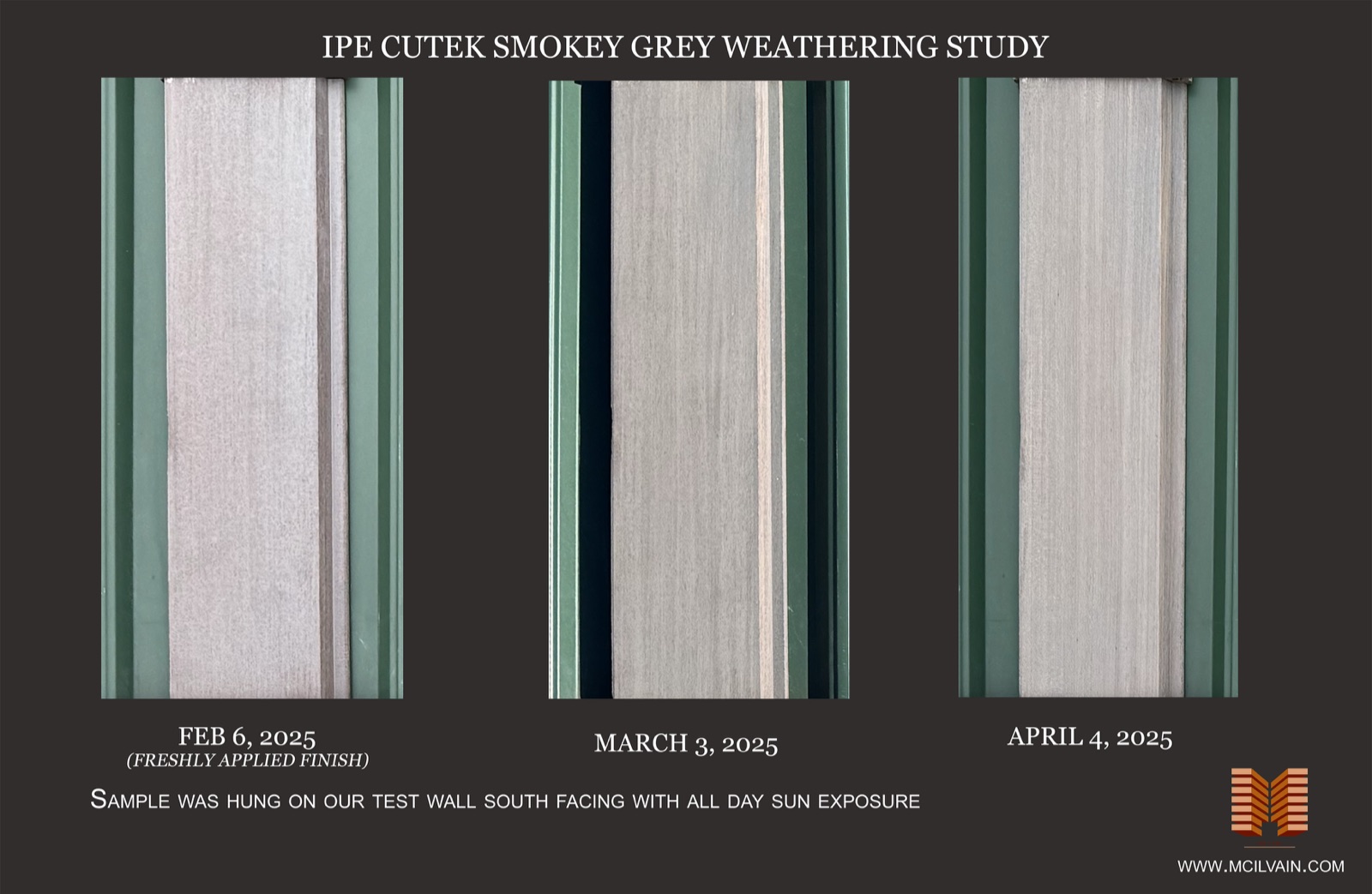
Ipe weathers to silver gray more gracefully than any other tropical hardwood, and Cumaru is the closest working alternative.
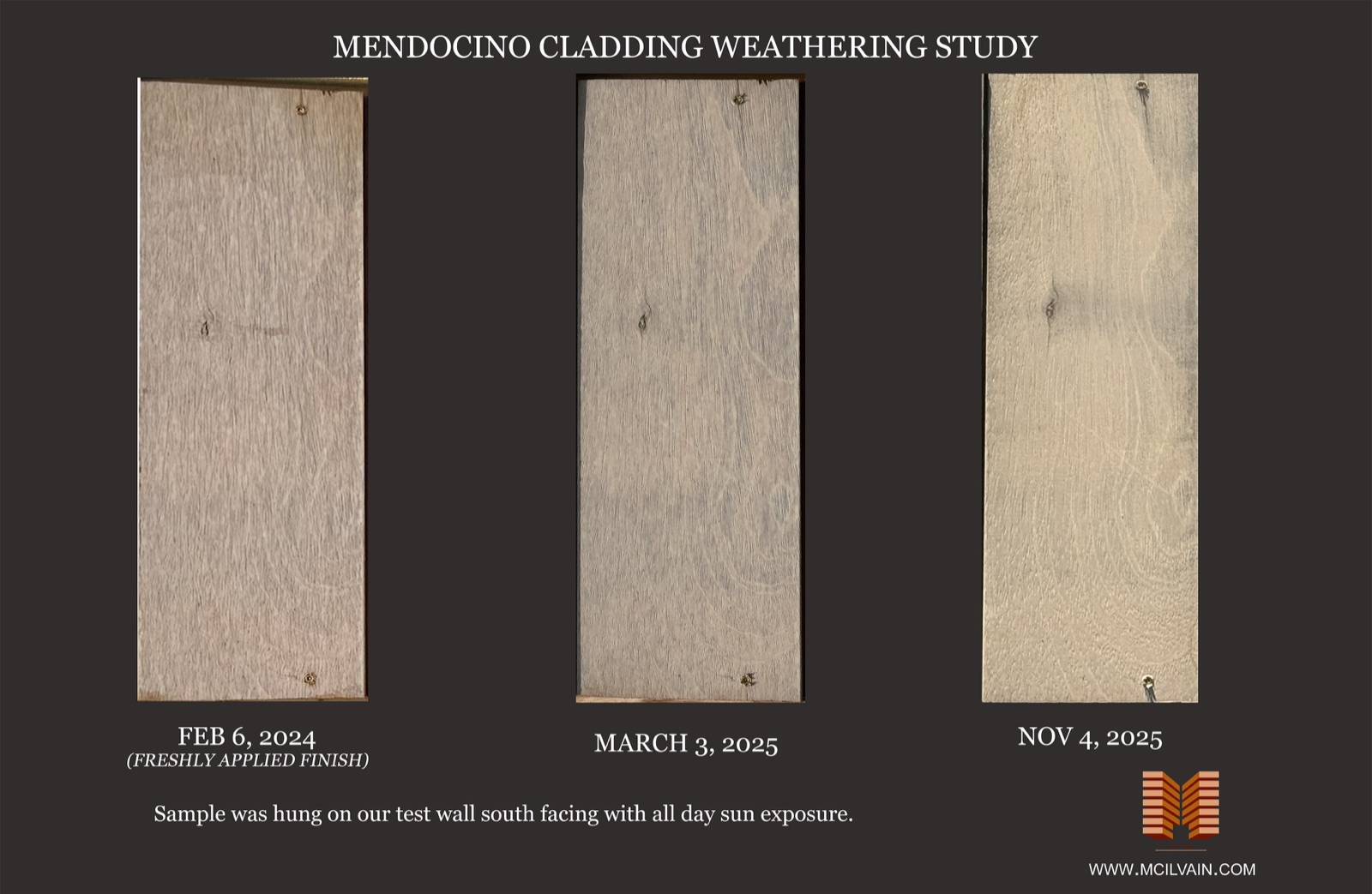
Graceful is a loaded word, so define it before choosing a board. A deck that grays gracefully holds its shape as it ages. The surface stays flat. The face checks shallow instead of deep. The color shifts from brown to silver in a single even wash rather than a patchwork of light and dark. A deck that grays poorly does the opposite. It cups at the edges, splits along the grain, mildews in the shade and bleaches to bone in the sun, and the two-tone result looks like neglect even when the owner has done nothing wrong.
Species sets the ceiling on how good the aging can look. Ipe sits at the top for the same reasons it lasts. High density, tight interlocked grain and heavy extractive content mean the boards move little, resist fungal staining and shed rain without soaking. Cumaru, Jatoba and Red Balau follow in a working tier. Garapa and Teak reach a paler silver that reads as intentional in some designs and washed out in others. None of that matters, though, if the grain runs the wrong way or the boards are milled too wide. Grace is decided as much on the mill floor and at the joist as it is in the genus name.
Silver gray is lignin breaking down at the surface while the cellulose underneath stays intact.
Wood turns gray through photodegradation. Ultraviolet light breaks down lignin, the brown polymer that binds wood fibers and carries most of a species color. Rain washes the degraded lignin away and leaves a thin layer of bleached, weathered cellulose behind. That silvered layer is only a few cells deep. The wood below keeps its color and strength. The USDA Forest Products Laboratory has documented this weathering sequence in detail, and its work on wood durability and surface degradation is the reference most specifiers lean on.
Graceful gray depends on that bleached layer forming evenly and the surface staying sound while it does. Two things fight the process. The first is uneven moisture cycling, which drives checking and cupping that break the flat plane the eye reads as clean. The second is mildew, dark fungal staining that colonizes damp shaded wood and mottles the silver with gray-black blotches. Dense tropical species resist both. Low permeability keeps water from driving deep into the board, and heavy natural extractives slow fungal growth long enough for the surface to bleach before mold takes hold. The result is the flat, even patina people picture when they say silver gray.
Ipe grays gracefully because its density and extractives suppress the two things that make weathering look bad.
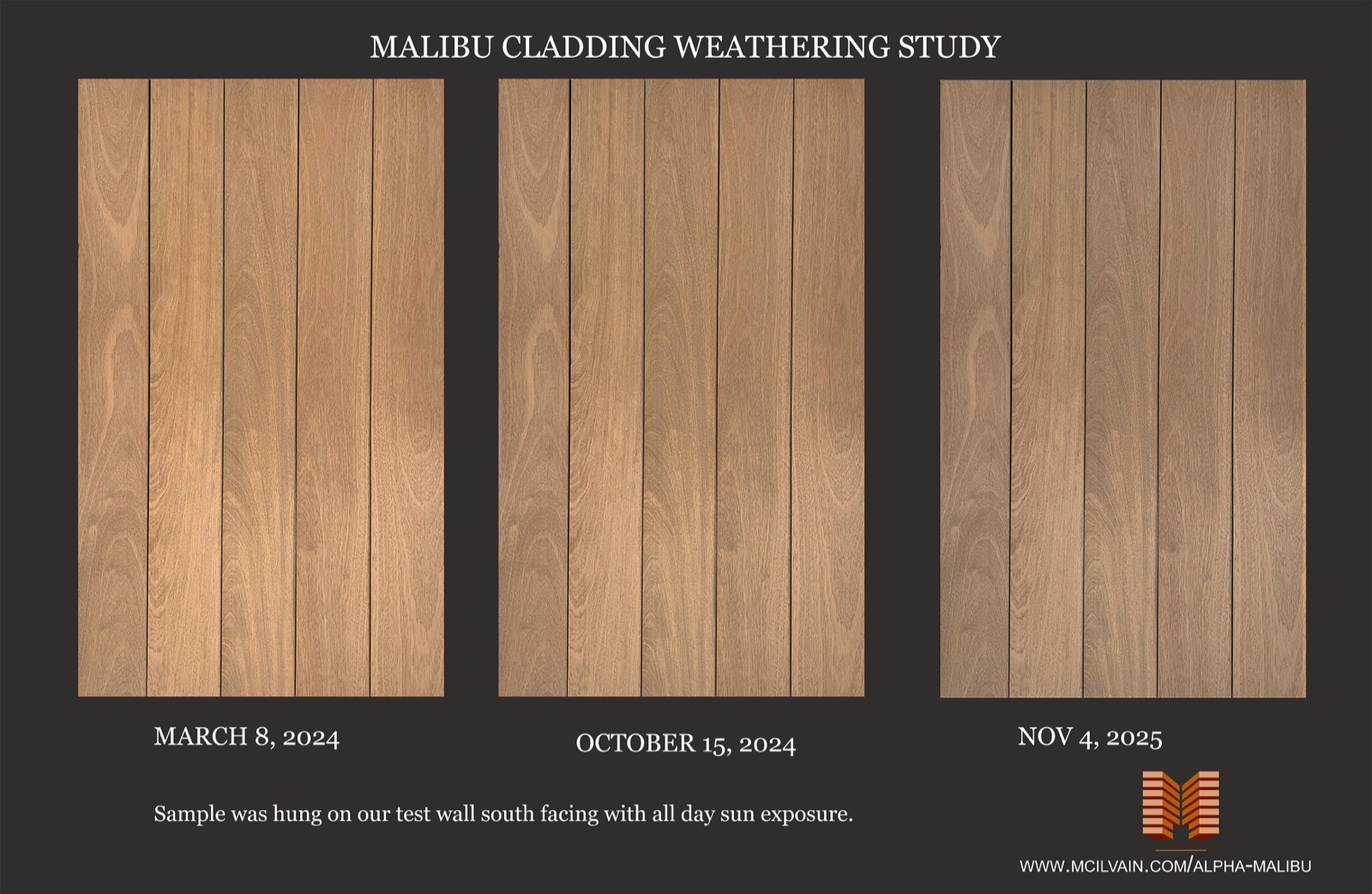
Ipe (Tabebuia spp.) runs about 3,680 lbf on the Janka scale and roughly 1,050 kg per cubic meter in density. It carries an EN 350 Class 1 durability rating, the highest natural class, and an ASTM E84 Class A flame-spread rating, meaning a flame-spread index of 25 or less. Those numbers are why it lasts decades outdoors. They are also why it grays well. A board that dense absorbs little water, so it barely moves through wet and dry cycles, and a surface that stays dimensionally quiet stays flat. Deep checking is rare. The technical entry at the Wood Database Ipe page lays out the mechanical properties for anyone specifying to a number.
The extractives do the second half of the job. They give fresh Ipe its olive-brown to near-black color, and as UV breaks them down at the surface the board lightens through amber to a clean silver. Because the extractives also resist decay fungi, the shaded parts of an Ipe deck bleach instead of blackening with mildew the way a softer, less durable species would. J. Gibson McIlvain mills and stocks Ipe decking across every standard and custom profile, and holds a deep inventory in all dimensions, so a specifier is not forced to narrow a design to whatever a yard happens to have on the rack.
Cumaru, Jatoba and Red Balau gray well too, each with a different starting color and a different pace.
Cumaru is the closest thing to Ipe for graceful aging. At roughly 3,540 lbf Janka and about 1,070 kg per cubic meter, it is nearly as dense and nearly as stable. It starts warmer, a reddish tan to medium brown, and moves through a slightly ruddier intermediate stage before landing on silver. Cumaru has more oil in the grain than Ipe, which can raise the fibers slightly in the first season, so it rewards a clean initial surface and adequate gapping. The Wood Database Cumaru page covers its interlocked grain, which is what makes it stable and also what makes it worth working with sharp tooling.
Jatoba runs about 2,690 lbf and starts a vivid orange-red to reddish brown. It is a beautiful board fresh and a dramatic one to watch age, because the drop from saturated red to gray is the longest visual journey of the group. Jatoba is a touch more photosensitive, so the early color loss comes fast before the silver settles in. Red Balau falls between roughly 1,700 and 2,000 lbf, lighter and more affordable than Ipe while still weathering to a respectable even gray. It is the value option when a project needs a lot of square footage and the budget will not carry Ipe across all of it. J. Gibson McIlvain carries Cumaru, Jatoba and Red Balau decking alongside its Ipe, so a design that wants a specific starting color has real choices without leaving one supplier.
Garapa and Teak reach a paler silver that looks deliberate in the right design and washed out in the wrong one.
Garapa starts a soft honey-yellow and weathers to a light, almost pale-gray silver. At about 1,700 lbf it is far less dense than Ipe, so it moves more, checks a bit more readily and wants tighter attention to fastening and gapping. Where it wins is tone. On a light modern deck or a pool surround where a dark board would read heavy, Garapa greets the eye softer and grays to a color that flatters pale stone and stucco. It photobleaches faster than the dense species, which means the silver arrives sooner and the early color is fleeting.
Teak sits around 1,070 lbf, lower still, and is prized for a golden-brown that mellows to a warm silver-gray. Genuine teak is expensive and supply is constrained, so on decking it shows up mostly in marine and yacht-adjacent work rather than large residential fields. Both species answer a real design question. Not every client wants the dark drama of Ipe fading to charcoal-tinged gray. Some want the deck to disappear into a light palette, and for that the paler silvers earn their place.
Compared on the traits that actually govern graceful aging, the dense species pull ahead on stability and checking.
Color is the obvious axis, and the wrong one to specify by alone. What decides whether the gray looks graceful is how much the board moves in service, how prone the face is to checking, and how evenly the surface bleaches. The table below ranks the field on those traits rather than on durability numbers you can find anywhere.
| Species | Janka (lbf) | In-service movement | Checking tendency | Time to full silver | Board width that ages best |
|---|---|---|---|---|---|
| Ipe (Tabebuia spp.) | ~3,680 | Very low | Very low | 12 to 18 months | Up to 6 in |
| Cumaru | ~3,540 | Low | Low | 10 to 16 months | Up to 6 in |
| Massaranduba (comparison only) | ~3,190 | Moderate | Moderate to high | 12 to 18 months | 4 in preferred |
| Jatoba | ~2,690 | Moderate | Moderate | 8 to 14 months | Up to 5 in |
| Red Balau | ~1,700 to 2,000 | Low to moderate | Low to moderate | 10 to 16 months | Up to 6 in |
| Garapa | ~1,700 | Moderate | Moderate | 6 to 12 months | 4 in preferred |
| Teak | ~1,070 | Low | Low | 8 to 14 months | Up to 5 in |
Massaranduba appears here only as a reference point. It is dense and strong, but it moves and checks more than Ipe or Cumaru and it bleeds heavily in its first season, which is why it is a comparison species rather than a first recommendation. Read the table by row, not by the Janka column alone. A board can be very hard and still age poorly if it moves and checks, and a slightly softer board that stays flat will look better in year three.
Grain orientation and board width control graceful aging as much as the species does.
Two boards of the same species can age very differently depending on how they were sawn. Flatsawn boards, cut tangent to the growth rings, shrink and swell more across their width and tend to cup as they cycle. Quartersawn and riftsawn boards, cut closer to radial, move less and stay flatter. On a deck you want to weather cleanly, riftsawn and quartersawn stock ages more gracefully, and it is worth asking for on a visible field even though most decking is sold flatsawn.
Width matters just as much. A wide board has more distance across which to cup, and every species has a width beyond which cupping becomes visible. Dense, stable Ipe and Cumaru hold a 6 inch face well. Garapa and the softer species look better held to 4 inches, where the shorter span across the grain keeps the surface flat. Thickness feeds into it too. Standard 5/4 decking, at roughly one inch net, balances stiffness against movement, and one 5/4x6 board covers about 2.1 linear feet per square foot of deck for estimating purposes. Specify the width to the species, not the other way around, and the deck will gray flat instead of washboarded.
Sun exposure decides whether a deck grays uniformly or splits into two tones.
Silvering is driven by ultraviolet light, so the parts of a deck that see the most sun gray first and fastest. A field that runs from full southern exposure into the shadow of the house or a pergola will bleach unevenly, silver at the open end and still brown under cover, and that gradient can last a year or more. It is the single most common reason an owner thinks their deck aged badly when the wood is fine.
Plan for it at design. Where a deck spans a hard shade line, expect the transition and let the client see it coming rather than field a complaint in month four. Boards under permanent cover may never fully silver and will hold more of their original color, which some designers use deliberately by running a covered border in a species chosen for that retained tone. Ventilation feeds into the same issue, because a shaded zone that also stays damp is where mildew mottles the gray. Building science on drying and airflow, including the material at Building Science Corporation, is the right reference for keeping the underside of a deck dry enough that the top weathers cleanly.
Fastening, gapping and ventilation decide whether the flat surface survives long enough to gray gracefully.
A deck cannot silver gracefully if the boards are moving against their fasteners or trapping water underneath. Set joists at 16 inches on center for dense tropical hardwood, tighter than the 24 inches some softwood systems allow, because the stiff boards want firm support to stay flat. Pre-drill and fasten Ipe and Cumaru, since their density will split an unpiloted screw hole. For coastal and poolside work, use 316 stainless fasteners, which hold up to salt and chloride where lesser grades stain and fail.
Hidden fasteners work with edge-grooved decking, where a clip rides in a side groove milled into the board, the same principle that lets tongue and groove hide its fasteners while a face-screwed or shiplap board shows them. Any relief kerf milled into the back of a board goes face down so water sheds off it instead of pooling in it. Gap the boards for drainage and airflow, and keep the underside ventilated so the boards dry from both faces. A deck that dries evenly top and bottom moves less, checks less and grays flatter. The American Wood Council publishes the deck construction guidance that governs the structural side of this, and it is worth following even where local code is silent.
The clients who are happiest with how their deck aged are the ones who understood at the start that gray was coming and set the deck up to earn it. We spend real time on the front end matching a species and a board width to how much sun the deck gets and how it drains, because that is what decides whether the silver looks like a finish or looks like a problem. When someone calls a year in worried about the color, almost always the wood is doing exactly what it should, and the fix is patience, not product. Camden Zacker, J. Gibson McIlvain
Graceful aging starts with sound, legally sourced material milled and dried to a stable moisture content.
A board that shows up wet, case-hardened or poorly milled will move and check no matter how good the species is. Decking should reach the job at an in-service moisture content of roughly 12 to 16 percent for most of the country, so it settles into its environment without a violent first-season adjustment. Consistent milling matters too, because a board with a torn or fuzzy surface bleaches unevenly and holds mildew in the rough spots. Ordering from a supplier that mills its own stock, rather than reselling whatever a broker ships, is how a specifier keeps that quality controlled.
Documentation is part of the specification now. Certification through the Forest Stewardship Council supports responsible sourcing and satisfies green-building requirements, and when using a CITES-listed species, the required CITES documentation must travel with the material for it to move legally. A commercial supplier that handles this paperwork routinely spares the buyer a shipment held at the border. J. Gibson McIlvain, an FSC-certified importer and miller established in 1798, supplies contractors and architects nationwide from its own inventory, and ships tropical decking regularly to jobs on the West Coast including California. To match a species and grade to a specific deck, call 800-638-9100 or start at the Ipe decking page.
How J. Gibson McIlvain Would Specify This
For a deck meant to weather gracefully to silver gray, J. Gibson McIlvain would specify Ipe as the default and match the board and layout to the site. Start with Ipe in a riftsawn or quartersawn field where the visible aging matters most, held to a 6 inch maximum face width, 5/4 thickness, delivered at 12 to 16 percent moisture content. Where budget has to stretch across a large field, drop to Red Balau or Cumaru rather than widening the boards or loosening the joist spacing. Where the design wants a lighter silver, move to Garapa held to 4 inch boards, and accept that it will silver sooner and want closer attention to fastening.
Set the structure to hold the boards flat. Joists at 16 inches on center, pre-drilled fastening, 316 stainless at the coast, edge-grooved hidden clips where a clean face is wanted, and full ventilation under the deck. Map the sun before finalizing the layout, and where a hard shade line crosses the field, tell the client to expect a temporary two-tone that will even out. If a project needs a modified alternative for a covered or dimensionally critical zone, Thermory and Abodo Vulcan thermally modified options carry manufacturer warranties that solid unmodified wood does not, with the constraint that modified boards top out around 16 feet because of kiln length. For the solid tropical field, choose the species for its starting color and its stability, size the board to the species, detail it to stay flat, and let the deck do what every uncoated deck eventually does, only better and more evenly than the softer alternatives. For a species-and-grade recommendation tuned to a specific site, call J. Gibson McIlvain at 800-638-9100.
Frequently Asked Questions
Does board width really change how gracefully a deck grays?
Yes. A wider board has more distance across which to cup as it cycles through wet and dry weather, and cupping breaks the flat plane the eye reads as a clean silver surface. Dense, stable species like Ipe and Cumaru hold a 6 inch face well. Softer species like Garapa look better held to 4 inches, where the shorter span keeps the board flat while it bleaches. Size the width to the species rather than defaulting to the widest board available.
Will a south-facing deck gray faster than a shaded one, and will that leave me with a two-tone deck?
It can, and it is the most common reason owners think their deck aged badly when the wood is fine. Silvering is driven by ultraviolet light, so sunnier zones bleach first while shaded and covered areas hold their original brown longer. Where a deck spans a hard shade line, expect a temporary gradient that can last a year or more before it evens out. Plan for it at design and set client expectations up front.
Should I let tropical decking air-dry before installing so it weathers more evenly?
What matters more than air-drying on site is receiving the material at a stable in-service moisture content, roughly 12 to 16 percent for most of the country, so it settles into its environment without a violent first-season adjustment. A board delivered too wet will move and check as it dries in place, which is exactly what makes aging look rough. Order from a supplier that mills and dries its own stock, and let boards acclimate briefly at the site before fastening rather than trying to season them yourself.
Does quartersawn or riftsawn stock age more gracefully than flatsawn?
Yes. Flatsawn boards, cut tangent to the growth rings, move more across their width and tend to cup as they cycle. Quartersawn and riftsawn boards move closer to radially and stay flatter, so they hold the flat plane that silvers cleanly. Most decking is sold flatsawn, so riftsawn or quartersawn stock is worth requesting for a visible field where the aged appearance matters.
Can I speed up silvering or match new replacement boards to an already-gray deck?
You cannot meaningfully rush natural silvering, since it depends on real ultraviolet exposure and rain over months. Gray weathering stains exist and can pre-tone new boards to blend with an aged deck, which is useful when replacing a damaged board in an established field. For a full deck, the more graceful result comes from letting the whole field weather together rather than forcing the color chemically.
Do the lighter species like Garapa silver too pale to look intentional?
It depends entirely on the design. Garapa weathers to a soft, pale silver that flatters light stone, stucco and modern palettes, and on those projects it reads as deliberate. Against a dark or traditional scheme it can look washed out. Choose it when the design wants the deck to sit light and recede, and choose a denser, darker-starting species like Ipe or Cumaru when you want the silver to carry visual weight.


