The Job Type Filters Your Species List Before Color Ever Comes Up
Whether a tropical deck can hold stain for the long haul gets settled by where the deck sits, since public and commercial work restricts the species list to boards available in 2x thickness before anyone talks about finish. Boardwalks, piers and plaza decks are specified at 2x thickness to control deflection under crowd loading, and no professional goes first with a thinner board on a public job even where the strength math on 5/4 stock works out. Only Ipe, Cumaru and Jatoba can be sourced consistently in 2x decking thickness. That one sourcing fact removes Garapa and Red Balau from commercial specs before the color conversation starts, no matter how well either species takes pigment.
Residential work runs the other direction. A backyard deck or an engineer-approved 5/4 assembly opens the full species list, and that is exactly where the two most stain-friendly tropical boards belong. Public walking surfaces also answer to the federal accessibility guidance on floor and ground surfaces, which demands a firm, stable, slip-resistant plane. A peeling film finish on a municipal boardwalk is a maintenance liability and a slip complaint waiting to happen, so the commercial answer is nearly always a penetrating oil or bare weathering, never a film. Sort the project into its lane first. The stain question gets much easier once the structural spec has already cut the list down.
Each Species Brings Its Own Extractive Chemistry, and Very Little of It Is True Tannin
The discoloration that installers call tannin bleed is really a family of different extractives, and every tropical decking species carries a different one behind its surface. Ipe, botanically Tabebuia spp., holds a yellow-green crystalline compound called lapachol in its pores. Fresh cuts and new decks shed it as a mustard-colored powder or a gold-brown wash in the first rains, and it flips to a deep red when it meets alkaline cleaners. Cumaru carries coumarin, the compound that gives fresh boards their vanilla-cinnamon smell, along with a dense oil load that resists coating penetration. Jatoba runs moderate on extractives and its heartwood is unusually colorfast once the initial flush is done. Garapa sits at the light end of the extractive scale, which is the quiet reason it accepts pigmented finishes so willingly. Red Balau, one of the Shorea species, sheds a modest reddish wash in its first season and then settles down.
Classic tannin, the polyphenol family that plagues oak and gives cedar its reputation, is a smaller player in these woods than the trade vocabulary suggests. The Wood Database entry for Ipe and the companion Cumaru profile both describe density and oil content as the defining workability traits, and those two properties, not tannin load, decide most finish failures on tropical decks. What migrates through a coating on Ipe is oil and lapachol. What discolors a Cumaru deck early is water-soluble extractive flushing out of end grain. Naming the actual chemistry matters, since the fix for each mechanism is different.
Density Decides Penetration, Extractives Decide Bleed
Stain performance on tropical decking tracks two numbers, the density that governs how far a finish can penetrate and the extractive load that determines what migrates back out. A board at 1,050 kg/m3 leaves a coating almost nowhere to go, so product sits shallow and wears fast. A board around 830 kg/m3 drinks enough finish to build real pigment retention. The table below compares the species a specifier will actually weigh, on the axes that decide whether the finish stays put.
| Species | Density (kg/m3) | Janka (lbf) | Extractive behavior under a finish | First field coat window | Where it belongs |
|---|---|---|---|---|---|
| Ipe (Tabebuia spp.) | ~1,050 | ~3,680 | Lapachol wash and surface oil migrate early, then stabilize | 60 to 90 days, then clean and brighten | Commercial 2x, premium residential |
| Cumaru | ~1,070 | ~3,540 | Coumarin and oil resist penetration, moderate early wash | 60 to 90 days, then clean and brighten | Commercial 2x, residential 5/4 |
| Jatoba | ~910 | ~2,690 | Moderate flush, then notably colorfast heartwood | 45 to 60 days | Commercial 2x, residential 5/4 |
| Garapa | ~830 | ~1,700 | Light extractive load, accepts pigment readily | About 30 days | Residential and engineer-approved 5/4 |
| Red Balau | ~850 | ~1,700 to 2,000 | Modest reddish wash in season one, holds stain after | 30 to 60 days | Residential and engineer-approved 5/4 |
| Massaranduba (comparison only) | ~1,150 | ~3,190 | Heavy extractive wash, high movement stresses films | Extended weathering required | Not stocked by J. Gibson McIlvain |
| Thermory ash / Abodo Vulcan (modified) | ~500 to 650 | Varies by product | Extractives driven out in modification, near zero bleed | Coat on installation | Residential, lengths just under 16 ft |
Read the table as a pair of filters. Commercial work keeps the top three rows. A residential deck that must carry a uniform stained color for years points hard at Garapa and Red Balau. Massaranduba appears for comparison because buyers ask about it, and its combination of extreme density and high movement in service makes it one of the tougher boards on the market to keep finished.
A Penetrating Oil Cannot Bleed Because There Is No Film to Bleed Through
Bleed-through requires a film, so choosing a penetrating oil for dense tropical decking removes the failure mode from the system entirely. A film-forming stain or deck paint cures as a membrane on top of the wood. Extractives dissolved by rain or driven by sun then have exactly one place to show up, as color moving through or under that membrane, followed by the peeling that starts wherever adhesion was weakest. On a board as dense and oily as Ipe or Cumaru, adhesion is weak nearly everywhere. The USDA Forest Products Laboratory's Wood Handbook covers this mechanism in its finishing chapter, and its conclusion has not changed in decades. Penetrating finishes fail gracefully by erosion. Film finishes on high-density exterior wood fail by peeling, and every peel edge is a moisture entry point.
A penetrating oil places its pigment and its water repellency inside the top fraction of a millimeter of wood. Extractives can still wash off the surface in the first season, but they wash off the wood, not through a coating, and a rain or a light cleaning carries them away without leaving a scar in the finish. Maintenance is a wash and a recoat, no stripping, no sanding a failed membrane off 3,680 lbf material. That is the whole argument in two sentences. Films look furniture-grade for one season on tropical hardwood. Oils look honest for a decade of recoats.
Factory Cutek Coating Puts the First Coat On Before the Boards Ever See the Sun
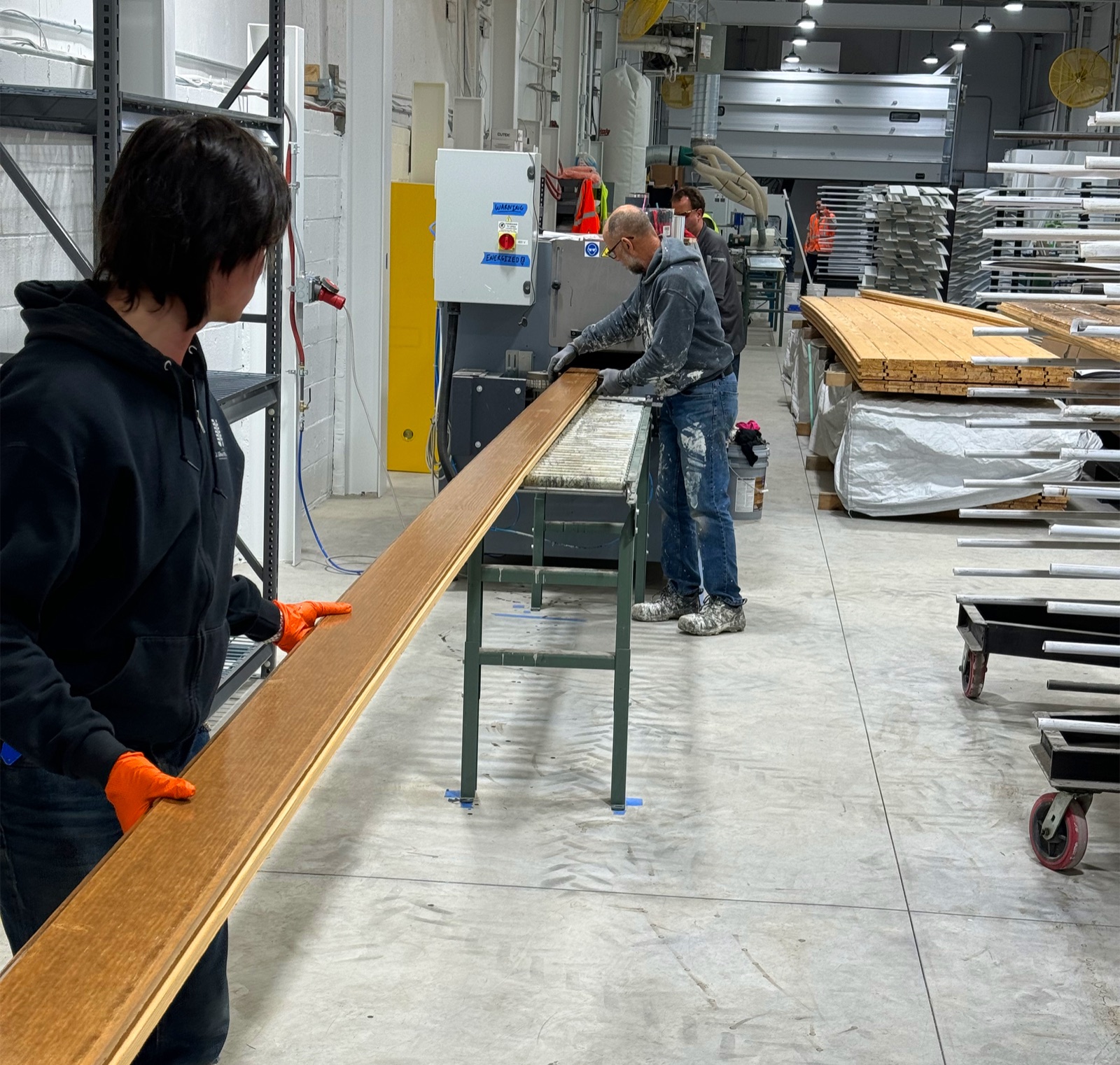
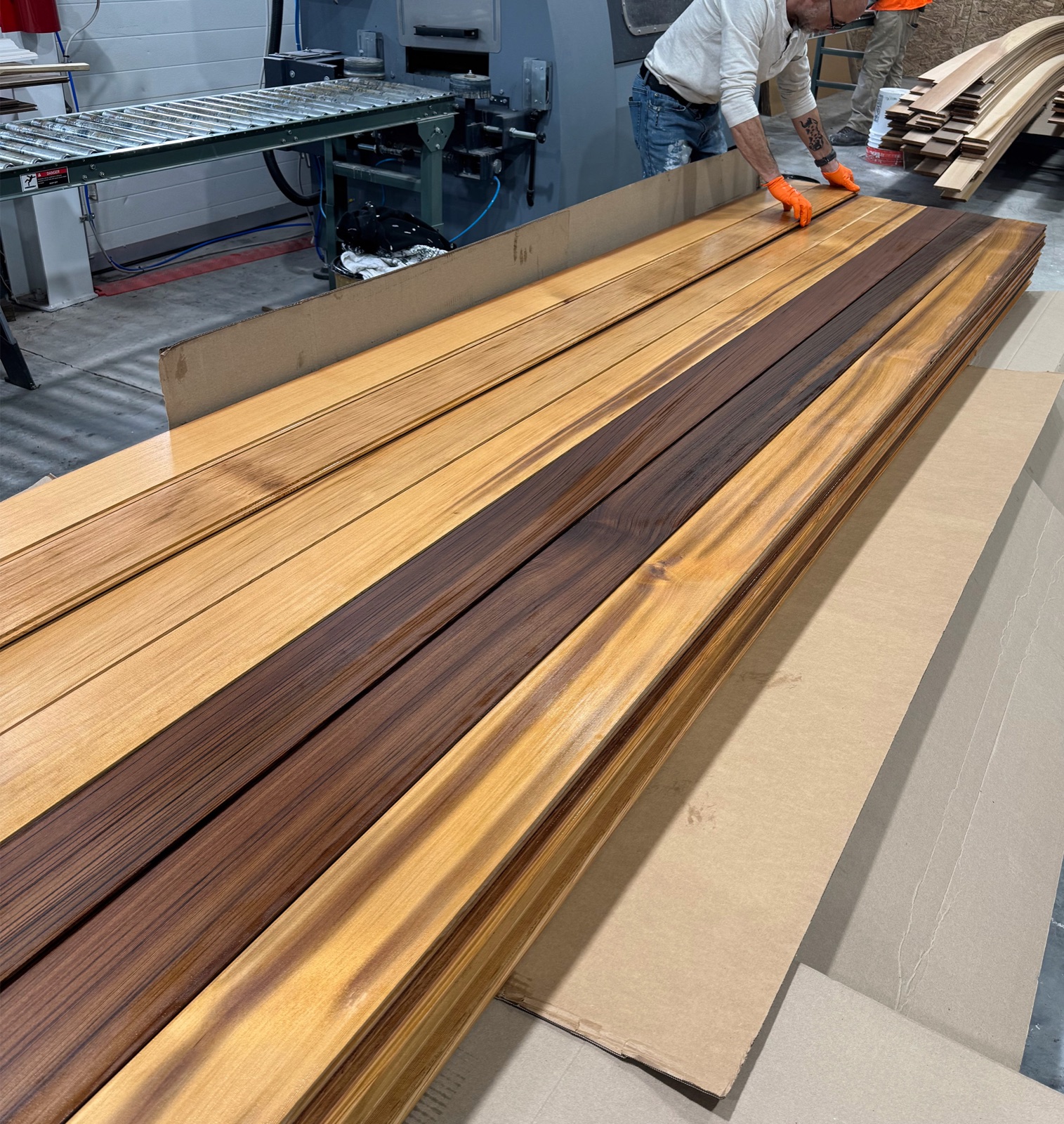
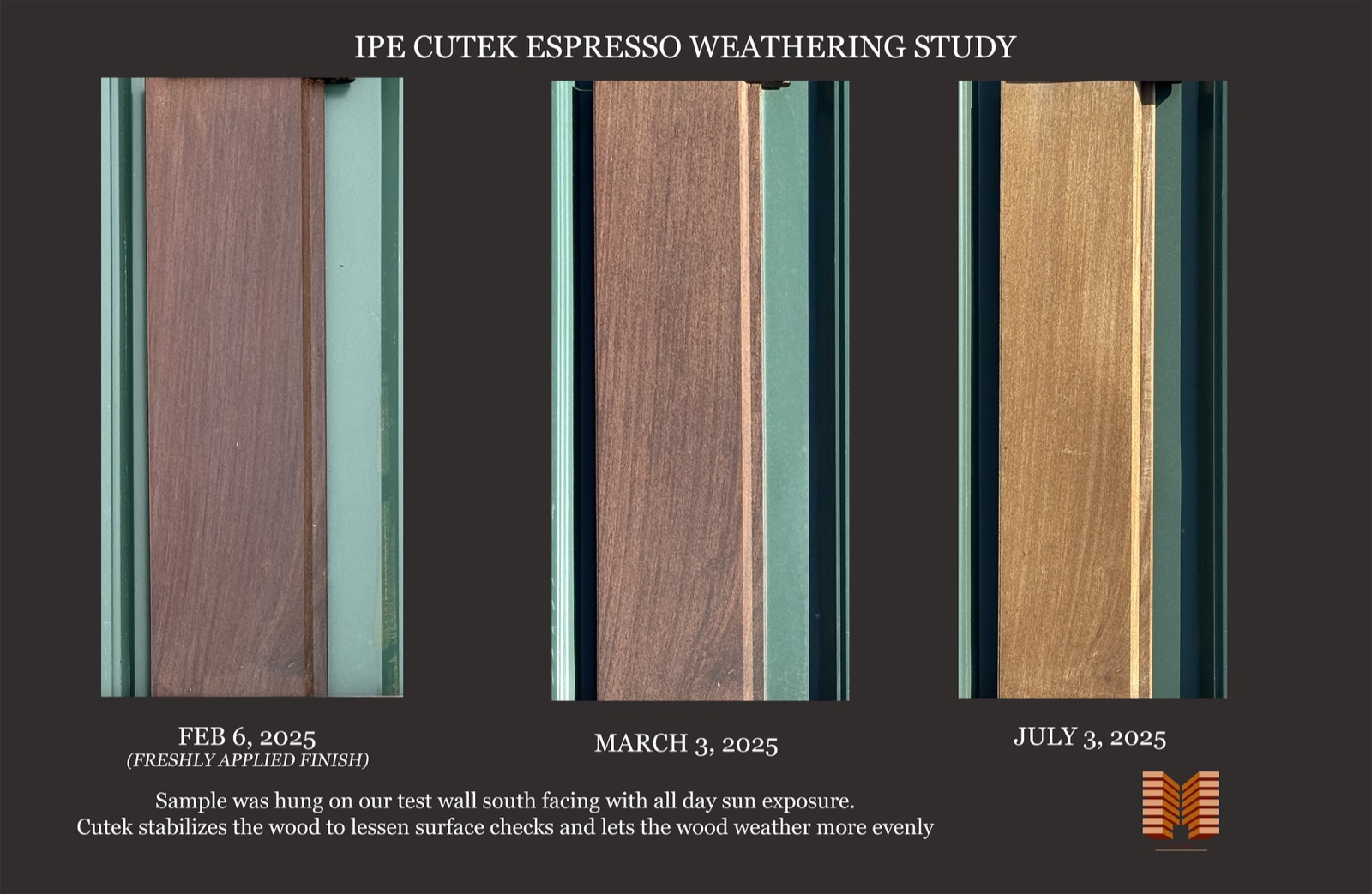
The most effective coat of finish a tropical deck will ever receive goes on at the mill, not on the job site. J. Gibson McIlvain factory coats its tropical decking with Cutek, a penetrating oil wood stabilizer that soaks into the board before it ships. The oil slows the moisture exchange between a hot, dry surface and a cooler core, which significantly reduces surface checking during that first brutal season of acclimation. Checking itself cannot be promised away. It is the wood's natural tension release as the face heats and dries faster than the interior, it does not weaken the board, and small surface checks are normal, even a sign of properly seasoned stock. What the factory oil does is keep that tension release small and shallow instead of wide and gray.
For the finish schedule, the factory coat changes the opening move. The deck arrives already protected, so there is no panic to get product down in week one. The boards weather evenly under the Cutek instead of raw, the early extractive flush happens on an oiled surface that releases it cleanly, and the installer gets to wait for the correct window instead of racing the weather. Site practice still matters. Sound moisture content at delivery, sealed end cuts and honest ventilation under the deck keep checks small. Nothing eliminates them, and any supplier promising otherwise is selling a claim the wood will not honor.
The First Field Coat Has a Window, and Rushing It Causes Most Bleed Calls
Dense tropical decking needs a weathering period before its first field coat, and staining inside that window is the single most common cause of the failures that get blamed on tannin. Fresh-milled dense hardwood carries a burnished surface, sometimes called mill glaze, plus its full charge of mobile extractives and surface oil. A stain applied to that surface sits on top, mixes with migrating extractives, and dries blotchy or tacky. Give Ipe and Cumaru 60 to 90 days of exposure. Garapa is ready in about a month. Then prep, in order. Wash with a sodium percarbonate cleaner to lift dirt and oxidized extractive, follow with an oxalic acid brightener to neutralize the alkalinity and pull the gray-brown residue out of the surface, rinse hard, and let the deck dry to a coatable surface. Skip the brightener on Ipe and the alkaline cleaner residue will turn lapachol red in the pores.
Half the bleed complaints I take turn out to be a deck that got stained ten days after it went down. I ask when the boards were installed and the phone goes quiet for a second. Give the wood its weathering window, clean it, brighten it, and the exact same product that failed in May holds fine in September.
Norm Moton, Director of Sales, J. Gibson McIlvain
Moisture matters as much as the calendar. Exterior decking runs 12 to 16 percent moisture content in service, and the first coat should go on a surface that has dried at least two full days past the last rain. Coat in shade or evening. Hot boards flash the carrier off before the oil penetrates, and that thin surprise layer is what peels.
Black Staining Is Iron Chemistry, Not a Failed Stain
The black spots and streaks that appear around fasteners on a stained tropical deck are iron tannate reactions, a hardware problem the finish cannot solve. Trace iron from a non-stainless screw, from steel wool, or from the shavings a cheap bit leaves behind reacts with the wood's polyphenols and water to form the same blue-black compound that once made ink. The cure is specification, not chemistry after the fact. Use stainless fasteners on every tropical deck and 316 stainless anywhere near salt air, since coastal chlorides will pit lesser grades until they weep rust down the grain.
Profile and fastening rules follow the material. Standard deck boards on joists or furring strips take face fastening. Shiplap profiles take visible fasteners, full stop. Only tongue and groove works with hidden fastening, and any grooved or profiled board goes grooves down so water drains instead of ponding in the profile. All drilling is site work against the frame as built. Field layout and cut-offs make any pre-set hole pattern worthless, so the crew pilots every hole with a self-centering combination bit, sets two fasteners per board at every joist, holds about 3/4 inch of edge distance, drills full pilots near board ends, and lands butt joints on doubled bearing. Sweep steel filings off the deck the same day they are made. On a stained deck every one of them is a future black freckle.
Ventilation Under the Deck Protects the Finish as Much as the Finish Chemistry Does
A stained tropical deck keeps its finish only when the board is equally dry on both faces, which makes the joist system and the airflow beneath it part of the finish spec. A board that is damp on the bottom and baking on top cups, and a cupping board sheds finish along its raised edges no matter what was applied. Frame dense hardwood decking on joists at 16 inches on center, hold honest clearance above grade, and leave the skirting open enough for cross-flow. Low decks over damp ground are the hardest case, and they are exactly where perimeter venting earns its framing time. The American Wood Council's codes and standards library, including its residential deck construction guidance, is the reference to hand a framing crew before the first joist goes up.
Gapping belongs in the same conversation. Dense tropical boards move less than domestic softwoods but they still move, and a deck gapped too tight traps water in every joint, feeds the bottom-face moisture problem, and concentrates extractive wash at the board edges where it shows worst against a pigmented finish. Side gaps sized to the board width and the local climate, drainage that actually daylights, and end grain sealed with wax at every field cut do more for finish life than a second top coat ever will.
Plan the Recoat Cycle by Species and Exposure, Not by the Label on the Can
Every horizontal exterior surface is on a recoat cycle, and the honest difference between species is how long that cycle runs, not whether it exists. A penetrating oil on Ipe or Cumaru holds its color for roughly one to two years on full-sun exposures before it wants refreshing, a wash and a single reapplied coat. Garapa and Red Balau, with their lighter density and lower extractive load, carry a pigmented semi-transparent finish noticeably longer between cycles, which is why they anchor the residential stained-deck spec. Owners who want zero recoat obligation have a legitimate third path. Let the deck silver. Weathered Ipe grays to an even pewter, loses nothing structurally, and most municipal boardwalk owners choose exactly that. Ipe also brings a Class A flame spread rating, an index of 25 or less under ASTM E84, which matters on rooftop amenity decks and egress paths where a coating choice must not compromise the rating.
The modified woods answer the same question from the factory side. Thermory and Abodo Vulcan, both carried by J. Gibson McIlvain, along with Accoya, have had their extractives driven out or locked down during thermal or acetylation treatment, so they hold coatings with almost nothing left in the wood to migrate. They are the one category on this page where manufacturer warranties exist, and their kilns cap lengths at just under 16 feet, a real constraint on long-run commercial layouts. Solid unmodified tropical decking carries no warranty and needs none. Its track record on hundred-year-old boardwalks is the datasheet.
How J. Gibson McIlvain Would Specify This
The specification that holds stain writes the species, the thickness, the fastener metal, the ventilation detail and the finish schedule as one system, and here is how that reads in practice. For a commercial boardwalk, pier or plaza, specify 2x6 Ipe or Cumaru on joists at 16 inches on center, 316 stainless fasteners, factory Cutek coating, and either a penetrating oil maintenance cycle or intentional silvering written into the owner's manual. For a residential deck that must hold a stained color, specify 5/4x6 Garapa or Red Balau, grooves down if a profiled board is used, tongue and groove only where hidden fasteners are demanded, and a first field coat of pigmented penetrating oil after the weathering window and a percarbonate wash plus oxalic brightening. Estimating runs about 2.1 linear feet of 5/4x6 per square foot of deck. Where the project wants a coated product with a paper warranty, pair Thermory with Abodo Vulcan and keep every run under 16 feet.
J. Gibson McIlvain stocks Ipe decking in a vast inventory across every standard and custom dimension, and mills Cumaru, Garapa, Jatoba and Red Balau decking to order from the same Maryland yard. All tropical decking ships factory coated with Cutek. The company is FSC certified, documents chain of custody on request, and when a project involves any CITES-listed species, the required export and import documentation is handled in-house as part of the import process. This is contractor-volume supply, not a retail rack. Truckload and job-lot orders ship nationwide, with regular freight into California, and a sales team that reads plans before quoting. Send the deck drawings or call 800-638-9100 to spec the package, or start with the Ipe decking page at mcilvain.com and work outward from there.
Frequently Asked Questions
How long should tropical decking weather before the first field coat of stain?
Give Ipe and Cumaru 60 to 90 days of exposure, Jatoba 45 to 60 days, and Garapa or Red Balau roughly 30 days. The wait lets mill glaze wear off and the heaviest extractive flush happen before any product goes down. Follow the weathering with a sodium percarbonate wash, an oxalic acid brightener, a hard rinse and at least two dry days before coating. Boards factory coated with Cutek are protected through this whole waiting period, so there is no rush to coat early.
What is the yellow residue washing out of new Ipe boards, and will it come through the finish?
That is lapachol, a crystalline extractive natural to Tabebuia species. It sheds as a mustard-colored powder from fresh cuts and a gold-brown wash in early rains, and it turns deep red on contact with alkaline cleaners. Under a penetrating oil it simply washes off the surface without damaging the finish. Under a film-forming coating it can migrate as visible color, which is one more reason films are the wrong category for Ipe. An oxalic acid brightener removes the residue before coating.
Can another finish go over the factory Cutek coating?
Yes. Cutek is a penetrating oil, not a film, so it does not need stripping. Let the deck complete its weathering window, clean and brighten the surface, and apply a compatible penetrating oil, pigmented or clear, once the boards are dry. The factory coat exists to stabilize the wood through shipping and acclimation, and it leaves the surface ready to accept the field finish rather than blocking it.
Do commercial boardwalks get stained at all, or should the spec let them silver?
Most municipal and commercial owners let 2x Ipe or Cumaru silver to an even gray on purpose, since a public deck cannot tolerate a peeling coating on a walking surface and a recoat cycle across thousands of square feet is a real maintenance budget line. Silvering costs nothing structurally. Owners who want the brown color kept commit to a penetrating oil cycle, roughly every one to two years on full sun exposure, written into the maintenance manual from day one.
Which deck cleaner is safe on tropical hardwood before recoating?
Use a sodium percarbonate cleaner for the wash and follow it with an oxalic acid brightener, then rinse thoroughly. Avoid chlorine bleach, which attacks lignin and leaves a fuzzy, degraded surface, and never leave an alkaline cleaner unneutralized on Ipe, where residue reacts with lapachol and turns the pores red. A pressure washer is acceptable at low pressure with a wide fan tip, but a stiff brush and rinse do the job with less risk of furring the grain.
Why does a solid-color stain fail faster than a penetrating oil on dense tropical decking?
A solid-color stain is a film, and films depend on adhesion. Wood at 1,000+ kg/m3 with a natural oil load gives a film very little to grip, so foot traffic, UV and moisture cycling break the bond and the coating peels in sheets, pulling extractive color through as it goes. A penetrating oil has no film to lose. It wears by gradual erosion and renews with a wash and one recoat, which is why it is the standard recommendation for Ipe, Cumaru and Jatoba.
Sources and Standards Referenced
- Wood Handbook: Wood as an Engineering Material (FPL-GTR-190), USDA Forest Products Laboratory
- Ipe | The Wood Database
- Cumaru | The Wood Database
- ASTM E84 Standard Test Method for Surface Burning Characteristics of Building Materials
- American Wood Council Codes and Standards
- U.S. Access Board Guide to Floor and Ground Surfaces
- Forest Stewardship Council
- CITES, Convention on International Trade in Endangered Species