What Thermal Modification Does to the Board
Thermal modification degrades hemicellulose under heat and low oxygen, and that one chemical change is what makes both Ash and Spruce behave the way they do on a wall. The sugars that decay fungi feed on are broken down. The sites in the cell wall that pull water vapor in and push it back out are reduced in number. What leaves the kiln is darker through the full thickness rather than on the surface, lighter than it went in, and far less inclined to swell through a wet week and shrink through the dry one that follows.
The trade is real and it is not hidden. Toughness drops. Bending strength drops. A thermally modified board is more brittle than the same species untreated, and it does not carry published structural design values the way framing species do. The Forest Products Laboratory Wood Handbook remains the reference for how heat and moisture history rewrite mechanical properties, and it explains why a board can gain decay resistance and lose impact resistance in the same process.
Thermory and Abodo Vulcan both reach the market through thermal modification, and both are carried. Accoya belongs in a separate column. Accoya is acetylated, not heat treated, which means the reactive sites in the cell wall are chemically converted rather than thermally degraded. It keeps its strength, gains dramatically reduced shrinkage and swelling, and runs around 1,600 lbf on the Janka scale. Treating the two processes as interchangeable is the single most common error on a cladding submittal.
Ash and Spruce Are Not the Same Raw Material
The kiln schedule is similar for both, but Ash starts out far heavier and several times harder than Spruce, and no modification cycle closes that gap. Everything a buyer cares about downstream, meaning dent resistance, fastener holding, weight on the scaffold and how the board reacts to a dropped tool, tracks the species that went into the kiln.
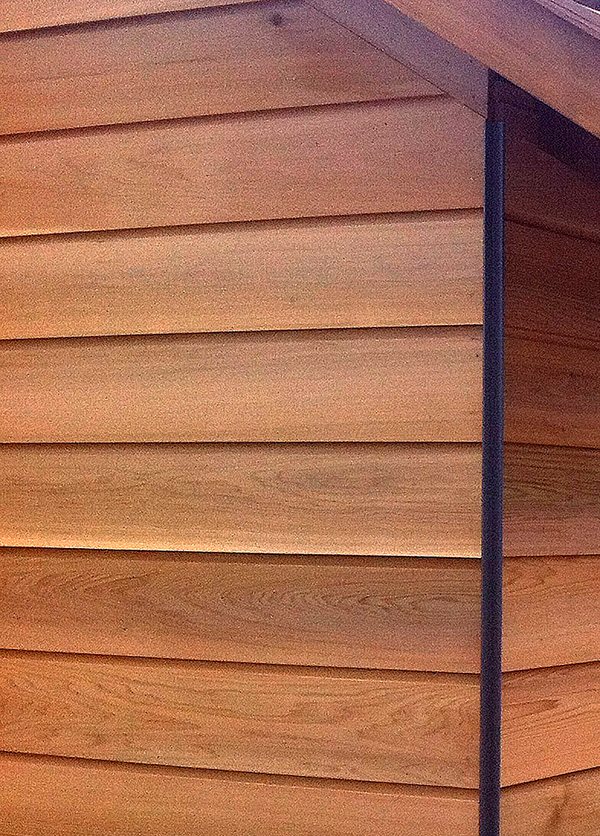
White Ash is ring porous, with a coarse open pore structure and strong growth ring figure. Untreated it sits near 1,320 lbf on the Janka scale and around 42 lbs per cubic foot at 12 percent moisture content, per the Wood Database entry for White Ash. Modification darkens it to a deep coffee brown and takes some mass out of it, but it still reads and behaves as a dense hardwood.
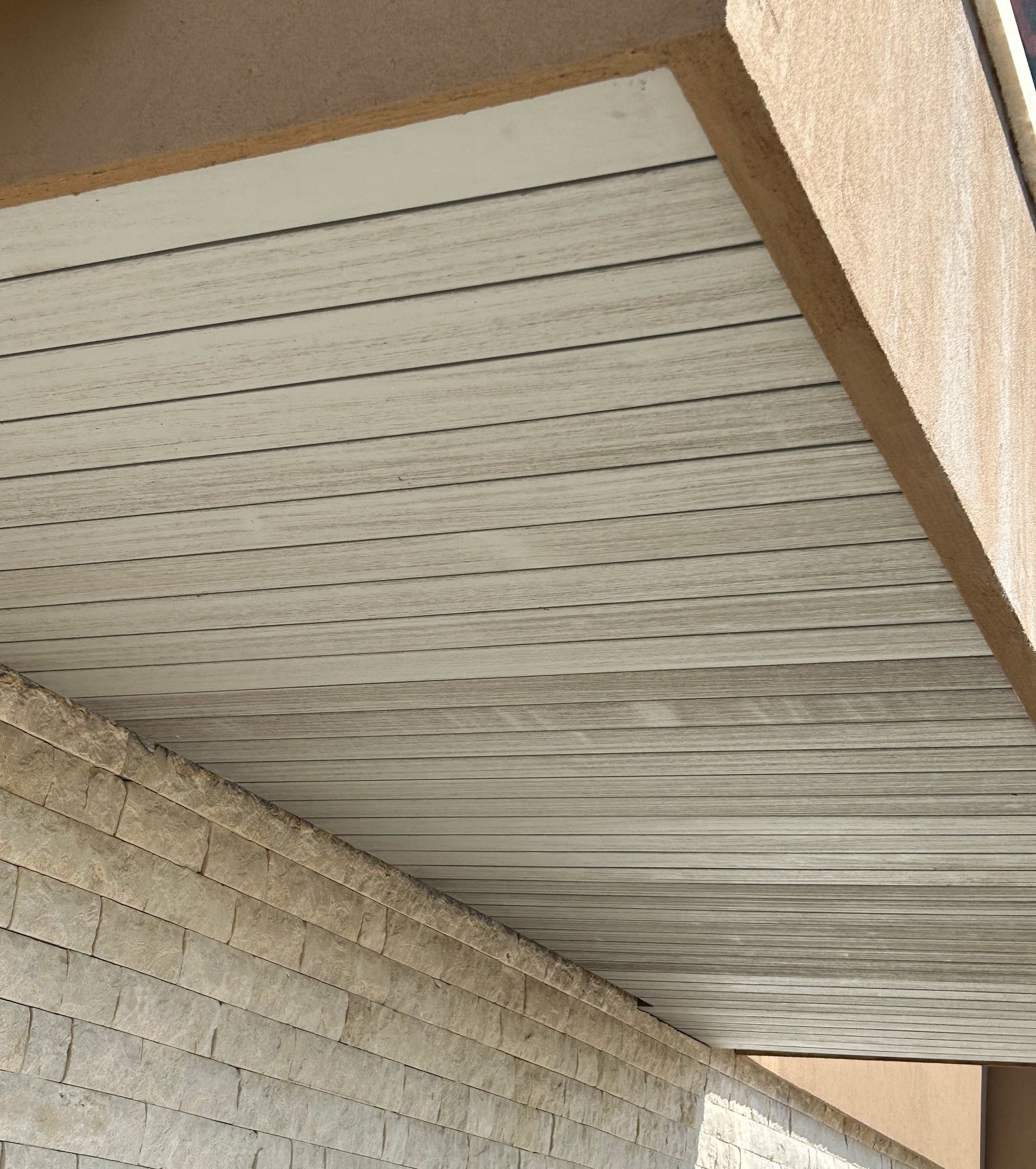
Spruce is the opposite profile. Norway Spruce runs near 380 lbf Janka and roughly 25 lbs per cubic foot, per the Wood Database entry for Norway Spruce. The grain is tight and even, the figure is quiet, and after modification the color lands warm and mid brown with very little contrast between earlywood and latewood. A crew running long courses up a lift feels the weight difference before lunch.
Modification pulls the two species closer together on movement. It leaves them where they started on density and hardness. That is the whole basis of the choice.
Width Is the First Decision, Not the Last
Thermally modified Ash is not available wider than 8 inches, so any detail that needs a wide board in a modified product means Accoya or Abodo Vulcan. This is a hard supply fact, not a preference, and it kills more Ash specifications than any performance argument does.
A drawing that shows a wide plank rainscreen field, a wide fascia in one piece, or a nominal 1x10 soffit board cannot be filled in thermally modified Ash. The options at that point are to redesign the field to narrower courses, to move the wide members to Accoya, or to move the whole elevation to Abodo Vulcan. Catching that on the submittal is cheap. Catching it after the elevation is approved is not.
Narrow to medium widths are where modified Ash earns its keep, and the species suits them. Coarse figure reads well at a narrow exposure, the density holds a crisp arris on a shiplap or rainscreen profile, and the board resists the handling abuse that narrow stock takes on a job site.
J. Gibson McIlvain stocks Accoya, Thermory and Abodo Vulcan at its Maryland yard and mills all three into linear trimwork, finished cladding and primed trim, which means the width question gets answered against real inventory rather than against a catalog.
Length Tops Out Near 16 ft
Every modified product tops out around 16 ft, and most is sold on metric lengths that land just under 16 ft, because the modification kiln sets the ceiling. Ash, Spruce, Abodo Vulcan and Accoya all live under the same limit. Nobody in the category ships a 20 ft modified board.
That ceiling has to be designed into the elevation rather than discovered during installation. A 40 ft wall in a modified cladding will carry joints. The useful questions are where those joints fall, whether they are staggered on a pattern or aligned on a module, and whether a scarf or a shadow reveal is detailed at the break. The shop supplies the material and the profile. The installer decides the joint layout in the field, and a drawing that has already picked a module makes that a much shorter conversation.
Trim runs feel the limit harder than cladding does, because a long fascia or a continuous water table reads badly when the breaks land at random. Where a genuinely long single piece is the requirement, the honest answer is an unmodified species. J. Gibson McIlvain holds over seven million board feet of exotic and domestic lumber at the Maryland yard, which is where the long lengths and wide widths that modified stock cannot supply actually come from.
Weight Changes What the Wall Has to Carry
Thermally modified Ash weighs on the order of half again more than thermally modified Spruce at the same dimension, and that shows up in furring, fasteners and labor hours. On a small accent field it is noise. On four full elevations it is a detailing and scheduling input.
Heavier cladding wants closer fastener spacing and a furring layout that actually puts a fastener into structure rather than into sheathing alone. Overhead work is where the difference bites hardest. Soffits, porch ceilings and high fascia runs in Ash cost more time per square foot to hang than the same detail in Spruce, and that is before anyone factors in the lift.
Fastener behavior splits the same way. Dense Ash holds a screw well but is less tolerant near an edge, so pre-drilling at ends and at narrow reveals is not optional on modified stock that has already given up toughness. Spruce drives easily and forgives a slightly off shot, and it holds less. Stainless fasteners belong on both, because a modified board that outlasts a carbon steel screw has solved nothing.
One failure mode gets blamed on species and almost never belongs to it. Cupping is driven by installation and back ventilation, not by species. A drained and back ventilated assembly built on the principles in Building Science Digest 013 on rain control keeps flat boards flat in either species. A board screwed tight to a solid substrate with no air behind it will cup in Ash, in Spruce, in Cedar and in anything else.
Wear, Traffic and Dents
Wear is where the two species part company for good, and it is the cleanest decision rule in the whole comparison. If people, pets, ladders, luggage or furniture will touch the surface, the answer is Ash. If nothing but weather will touch it, Spruce does the job at a fraction of the weight.
Ash belongs on screens and privacy walls at hand height, on bench tops and seat slats, on railing components, on garden structures that get climbed and leaned on, and on the lower courses of a wall where a hose reel and a wheelbarrow live. Its hardness survives contact. Its figure also stands up to the visual scrutiny that comes with being close enough to touch. ICD, the company's architectural millwork division, builds benches, railings, pergolas and gates from modified stock, and those are exactly the components where the density earns its place. The ICD exterior millwork category covers that work.
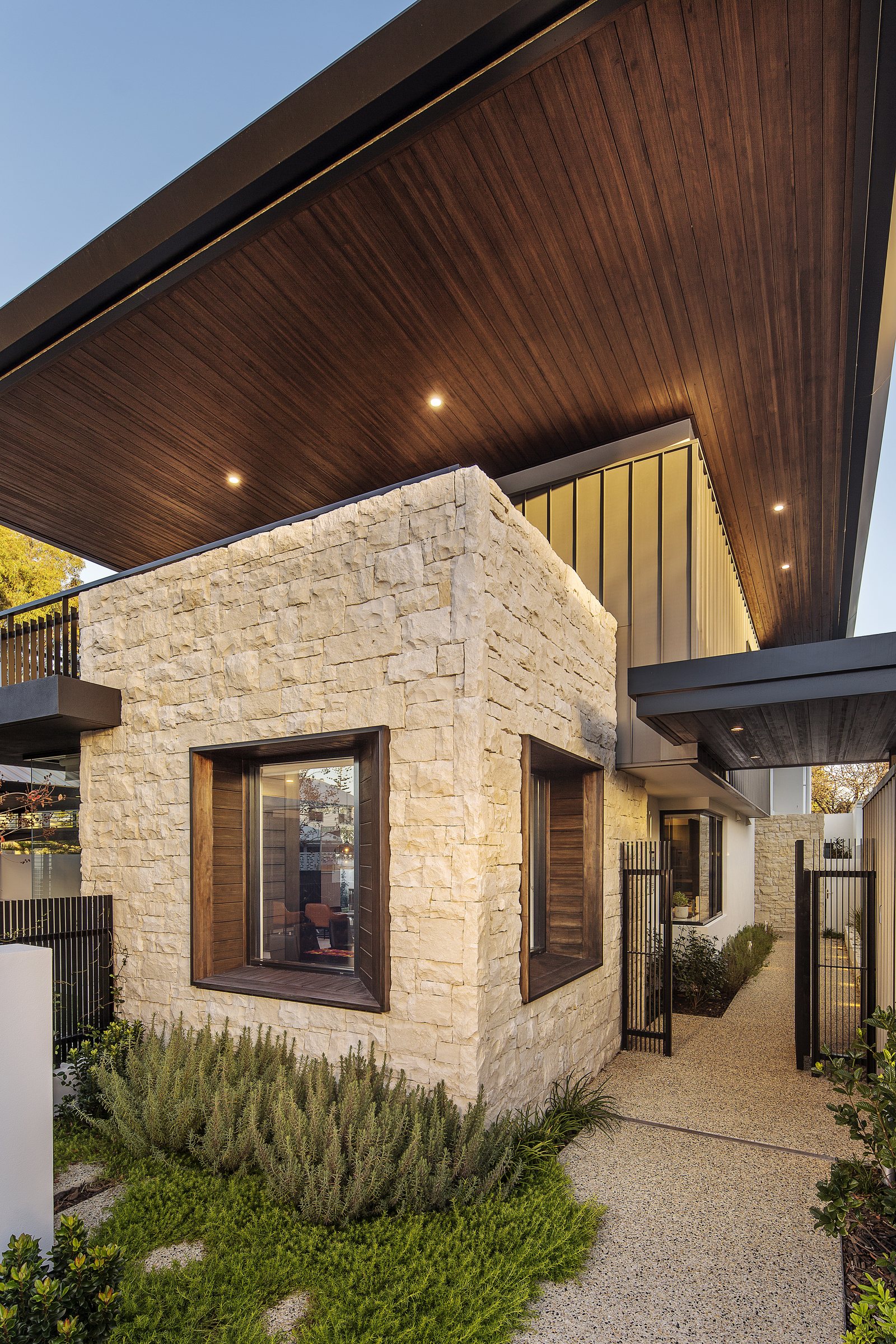
Spruce belongs in the field above the splash zone, on soffits and porch ceilings, and across large areas where cutting weight cuts both the substructure and the labor. It dents. A hail event or a thrown football leaves a mark that Ash would have shrugged off. That is an acceptable outcome 12 ft up and an unacceptable one beside a back door.
Brittleness applies to both and deserves its own note. Thermal modification costs toughness, so the stock is more prone to edge blowout at a nail gun, splitting at a tight end nail, and snapping rather than flexing when a long piece is handled carelessly. Crews used to Cedar need a short calibration period.
"The question I get is which one is better, and that is the wrong question. Ash and Spruce are answers to two different problems. Tell me what touches the wall and how wide the board has to be, and the choice makes itself in about a minute."
Norm Moton, Director of Sales, J. Gibson McIlvain
Side by Side on Width, Weight and Wear
Laid out against each other, the two thermally modified species divide cleanly by application, with Accoya and Abodo Vulcan covering the wide stock that modified Ash cannot. The table below is the short form of every conversation above.
| Consideration | Thermally Modified Ash | Thermally Modified Spruce | Accoya or Abodo Vulcan |
|---|---|---|---|
| Maximum width | Not available wider than 8 inches | Narrow to medium cladding widths | The route to any wide board in a modified product |
| Maximum length | Around 16 ft, most on metric lengths just under | Around 16 ft, most on metric lengths just under | Around 16 ft, same kiln ceiling |
| Relative weight | Heavy, near 42 lbs per cubic foot untreated | Light, near 25 lbs per cubic foot untreated | Accoya moderate, Abodo Vulcan light |
| Surface hardness | Near 1,320 lbf Janka untreated, best dent resistance | Near 380 lbf Janka untreated, dents readily | Accoya around 1,600 lbf |
| Appearance | Coarse ring porous figure, deep brown | Quiet even grain, warm mid brown | Accoya pale and near uniform, takes pigment evenly |
| Best fit | Contact surfaces, screens, benches, railings, low courses | Field cladding above splash, soffits, porch ceilings | Wide plank fields, wide fascia, painted exterior details |
| Below grade | Not the material for ground contact | Not the material for ground contact | Acetylated wood behaves differently below grade and has to be evaluated on its own documentation |
What Neither Species Will Do
No thermally modified board should be specified for ground contact, and the reason is not a technicality. Acetylated wood and thermally modified wood behave differently below grade, and that distinction has to be stated accurately rather than blurred into one claim about modified wood. Anything buried, embedded in concrete or sitting in soil has to be evaluated against the specific product's own published documentation. Accoya publishes its own use class guidance, and Thermory publishes separate guidance for thermally modified stock. The two do not read the same.
Structure is the second hard limit. Thermally modified stock does not carry published structural design values, so it cannot be dropped into a member that a drawing has sized for load. Anything resisting load belongs in a species and grade with values in the American Wood Council codes and standards library, and the frame behind a modified rafter tail or a modified pergola member is a structural question rather than a cladding question. Design references collected by WoodWorks are the right starting point for the framing that carries the finish.
The third limit is the one buyers most want in writing. Warranties exist on modified products and on nothing else. It is not possible to warranty solid unmodified wood, an organic material that responds to its environment on its own schedule. That asymmetry is the strongest practical argument for a modified product on a project where a warranty document has to be produced.
Finish, Color and Primed Delivery
Both species weather to silver grey without a pigmented coating, and both hold a finish better than the unmodified versions of themselves. Reduced moisture cycling means less stress at the coating film, which is why a modified substrate stretches a maintenance interval rather than removing it.
Ash and Spruce take finish differently, and pore structure is the reason. Open-grained and oily species absorb a great deal of finish, so a primer coat evens out the eventual painted surface, and sanding or buffing after priming knocks back grain raising while keeping moulded detail crisp. Ash, with its coarse ring porous structure, is the one that drinks primer. The tight even grain in Spruce needs less material to reach a uniform film.
J. Gibson McIlvain primes in three levels, in both oil based and water based systems, and exterior primed trim leaves the shop with a fungicide additive in the coating. Priming in the shop rather than on a tarp in a driveway is what puts an even film on every face of a profile before anything sees weather.
For a clear or pigmented oil rather than paint, expect the modified surface to pull the first coat in quickly and even out on the second. Recoat intervals on a south elevation are shorter than on a north one, in either species, modified or not.
Cedar and the Species Still Worth Considering
Cedar is the default cladding species for most contractors and it rarely fails, so a modified product has to earn the switch rather than assume it. Where Cedar comes up, the grade call matters more than the species call. CVG, clear vertical grain, is a different material from STK, select tight knot, and a project that bought STK while expecting CVG performance has a grading problem rather than a species problem.
For painted exterior trim, Sapele is the better call than Genuine Mahogany. It holds paint better, and it comes in a wider range of sizes and longer lengths, which matters exactly where the 16 ft modified ceiling becomes a constraint. Sapele runs near 1,410 lbf Janka against roughly 800 lbf for Genuine Mahogany. Sapele is not milled 1x8 for exterior use, because that width is too wide to stay stable in service.
The millwork palette a shop actually machines and glues is Sapele, Iroko, Afrormosia, Teak and Utile. The tropical decking species, Ipe (Tabebuia spp), Cumaru, Garapa, Jatoba and Red Balau, are extremely hard and carry high oil content, which makes them difficult to glue, so a millwork house reaches for Sapele, Iroko, Afrormosia, Teak or Utile when a component has to be machined, laminated or assembled. Decking is where the decking species belong.
Where a species on that palette is CITES listed, documentation and chain of custody travel with the material from the yard to the job, and a specification with sourcing requirements should say so in writing. The CITES appendices and the FSC standards are the two documents to have open when writing that paragraph. Grading language for the domestic hardwoods in the mix comes from National Hardwood Lumber Association rules, and for work inside a historic district the Secretary of the Interior's Standards decide whether a modified substitute is allowed at all.
How J. Gibson McIlvain Would Specify This
The specification starts with two measurements and one question, meaning the widest board on the drawing, the longest single run, and what physically touches the surface. Answer those three and the species is settled before anyone argues about appearance.
J. Gibson McIlvain stocks Accoya, Thermory and Abodo Vulcan at the Maryland yard and mills all three to an exterior service moisture content near 12 to 16 percent, into linear trimwork, finished cladding and primed trim. A drawing calling for a board wider than 8 inches in a modified product gets moved off thermally modified Ash and onto Accoya or Abodo Vulcan at the submittal stage rather than at delivery. A run longer than the roughly 16 ft kiln ceiling gets a joint module drawn on it, or gets moved to an unmodified species that can be supplied in one piece.
Profiles come off a library holding thousands of ground knives, and new knives are ground every week, so a profile that is not already on the shelf gets ground to match, including difficult historical restoration shapes and contemporary ones. A millwork shop sits on site at the lumber yard for the linear runs, and ICD, the architectural millwork division, builds the true custom components off site. Rafter tails, gates, box beams, custom doors, radius trimwork, pergolas, shutters, benches and railings come out of that shop, and the ICD working process is where a custom component starts.
What the company does not do is install, coordinate installation or field measure. It supplies and it mills. Fastener schedules, furring layout, flashing and the back ventilated cavity belong to the installer, and the shop's job is to deliver material milled, primed and packaged so the installer's work is the only variable left. Finished millwork can be stored for inventory control and released against a phased schedule, and orders ship nationwide, regularly to California.
To specify thermally modified Ash, thermally modified Spruce, Accoya or Abodo Vulcan on a project, or to check whether a detail on an elevation sits inside the width and length limits, see the J. Gibson McIlvain millwork services page or call 800-638-9100 and work it through with someone who has the inventory in front of them.
Frequently Asked Questions
For exterior cladding, does thermally modified Ash or thermally modified Spruce perform better?
Neither one wins across the board, and the honest answer depends on two things. Ash performs better wherever the surface gets touched or struck, because it starts near 1,320 lbf on the Janka scale against roughly 380 lbf for Spruce, so it resists denting far better on screens, benches, railings and low wall courses. Spruce performs better on large field areas, soffits and porch ceilings, because it weighs roughly 25 lbs per cubic foot against about 42 for Ash untreated, which cuts both the substructure demand and the labor. Decay resistance and dimensional stability come from the modification process rather than from the species, so on that axis the two are close. Width often settles it before performance does, since thermally modified Ash is not available wider than 8 inches.
Can I get thermally modified Ash in a 1x10 or 1x12 board?
No. Thermally modified Ash is not available wider than 8 inches. If the design needs a wide board in a modified product, the choices are Accoya or Abodo Vulcan. The practical move is to catch that at the submittal stage, either by redesigning the field to narrower courses or by moving the wide members to one of those two products. J. Gibson McIlvain stocks Accoya, Thermory and Abodo Vulcan at its Maryland yard and mills all three into cladding and trim.
How long can modified cladding and trim be supplied?
All modified products top out around 16 ft, and most are sold on metric lengths that land just under 16 ft, because the modification kiln sets the size limit. That applies to thermally modified Ash, thermally modified Spruce, Abodo Vulcan and Accoya alike. Any wall or trim run longer than that will carry joints, so the joint module belongs on the drawing rather than being improvised in the field. Where a genuinely long single piece is required, an unmodified species is the answer.
Is thermally modified wood suitable for posts or anything in ground contact?
No. Do not specify thermally modified wood for ground contact. Acetylated wood and thermally modified wood behave differently below grade, and the two cannot be treated as one category. Anything buried, embedded in concrete or sitting in soil has to be evaluated against that specific product's own published documentation, and that is a conversation to have before the material is ordered rather than after.
Does modified wood come with a warranty, and does solid wood?
Warranties exist on modified products and on nothing else. It is not possible to warranty solid unmodified wood, an organic material that responds to its environment on its own schedule. On projects where a warranty document has to be produced for an owner, that difference is usually the strongest argument for a modified product over an unmodified species.
Should I switch from Cedar to a modified product?
Only if the project needs something Cedar does not give it. Cedar is the default cladding species for most contractors and it rarely fails. Where Cedar is on the table, the grade call matters more than the species call, because CVG, clear vertical grain, and STK, select tight knot, are different materials with different expectations. A modified product earns the switch when a warranty is required, when a dark through-color is wanted without a stain schedule, or when movement has to be held tighter than a solid species will hold it.
Why does modified stock dent and split more than expected?
Thermal modification degrades hemicellulose, which buys decay resistance and stability and costs toughness and bending strength. The stock is more brittle than the same species untreated, so edge blowout at a nail gun, splitting at a tight end nail and snapping during rough handling are all more likely. Pre-drilling near ends and at narrow reveals solves most of it. Thermally modified stock also does not carry published structural design values, so it should not be substituted into a member a drawing has sized for load.
Can modified cladding and trim arrive primed?
Yes. J. Gibson McIlvain primes in three levels, in both oil based and water based systems, and exterior primed trim carries a fungicide additive. Open-grained and oily species absorb a great deal of finish, so a primer coat evens out the eventual painted surface, and sanding or buffing after priming knocks back grain raising while keeping moulded detail crisp. Ash, with its coarse ring porous structure, takes noticeably more primer than Spruce does.
Sources and Standards Referenced
- Wood Handbook: Wood as an Engineering Material, USDA Forest Products Laboratory
- White Ash, The Wood Database
- Norway Spruce, The Wood Database
- BSD-013: Rain Control in Buildings, Building Science Corporation
- Codes and Standards, American Wood Council
- Accoya Acetylated Wood
- Thermory Thermally Modified Wood
- The Secretary of the Interior's Standards for the Treatment of Historic Properties, National Park Service
- National Hardwood Lumber Association Grading Rules
- CITES Appendices I, II and III
- FSC Standards and Chain of Custody Certification
- J. Gibson McIlvain Millwork Services