
Square Footage Is Not a Teak Order
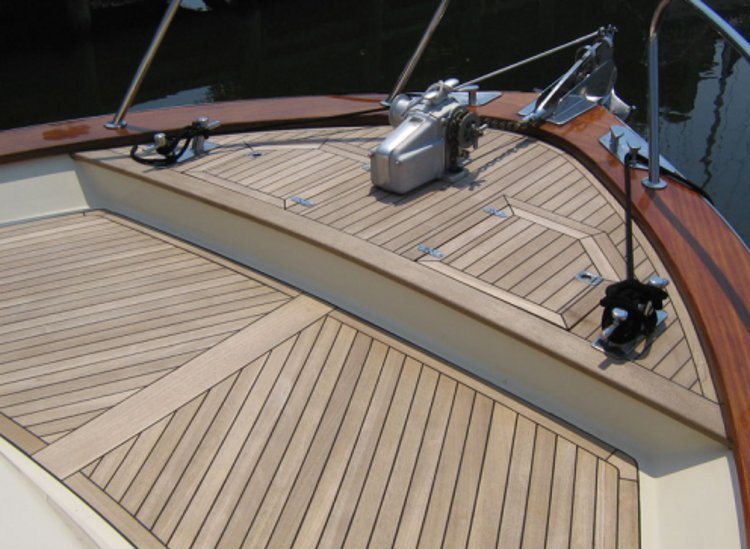
A teak deck order written to the net square footage of the deck will not finish the deck. The drawing gives a clean number. Lay that number down as planking and it comes up short, sometimes badly, and the difference is not waste in the ordinary sense of a sloppy cut or a careless crew. It goes to places that can be drawn and counted before anyone writes the order.
Seven things eat the difference. Tapered strakes that start wide and finish narrow. Plank ends nibbed into the margin board. A king plank wider than anything else on the boat. A covering board that follows a curve in plan rather than a straight line. Pieces culled at layup because the grain turned. Breakage. And the stock held back for the repair nobody has planned yet.
Most orders cover all of that with one blanket percentage laid over the whole job. One guess, stretched across seven unrelated problems. It lands wrong in both directions at once, short through the forward third of the deck where the taper is severe, long through the straight run aft where almost nothing is lost. Work each element out on its own terms and the order arrives close enough that the yard is not waiting on a second shipment.
J. Gibson McIlvain holds over seven million board feet of exotic and domestic lumber at its Maryland yard, which is what allows a deck order to come out of one lot in one width class instead of being assembled from three arrivals with three different colors.
Net Area Versus Ordered Volume
Net area and ordered volume are different units, and the conversion between them is where the arithmetic usually breaks. A deck takeoff produces square feet of finished surface. Lumber is sold by the board foot, which is volume, so the thickness decision multiplies every allowance sitting above it in the takeoff.
Rough thickness is quoted in quarters of an inch. 4/4 is nominal 1 inch rough, 8/4 is 2 inches, and surfaced dimensions come off those rough numbers rather than off the finished deck thickness. A deck planked at one finished thickness is almost never ordered at that thickness, so an area allowance worked out honestly and then multiplied by the wrong rough thickness is still the wrong order.
Moisture content belongs in the same conversation, because a plank that arrives wet will shrink in the seam and a plank that arrives too dry will swell against the caulk. Exterior work lands near 12 to 16 percent, and a deck is exterior work no matter how much of the boat is enclosed. Interior cabin joinery is a different target, near 6 to 8 percent. The relationship between wood, water and the air around it is set out in the USDA Forest Service Wood Handbook, and the material behavior behind it is covered in Building Science Corporation's digest on moisture and materials.
One more unit problem catches buyers who come to teak from domestic hardwood. Teak is imported and travels against export grades and the written description on the order, not against the National Hardwood Lumber Association grades that govern domestic species, so width and length for deck parts get specified in the description rather than inferred from a grade name.
Tapered Strakes and the Blank They Come From

A tapered strake is cut from a blank as wide as its widest point, so the taper is paid for in full width across the whole length of the piece. This is the largest single line in the difference between net and ordered. It is also the easiest one to work out exactly.
Take a strake that finishes 2 1/4 inches at its widest and runs down to 1 inch where it dies into the margin board forward. Its average width is 1 5/8 inches, which is what the net area calculation sees. The blank it comes out of is 2 1/4 inches wide plus saw kerf, which is what the order has to buy. Nearly 28 percent of that blank leaves the saw as a long thin triangle.
Now do that for every strake on the plan rather than for an average one. The strakes in the straight run amidships lose almost nothing. The strakes sweeping forward to the stem lose a third or more each. A deck sprung from a centerline king plank tapers differently from one laid parallel to the covering board, and the two layouts do not carry the same allowance.
Two tapers can sometimes be nested head to tail out of one wider board, which is exactly why the taper allowance belongs to the layout and not to a percentage. Whether the nest works depends on the widths actually available, on keeping straight vertical grain running the full length of each piece, and on color matching between neighbors. That is a decision made against the boards in hand.
Nibbed Ends Into the Margin Board
A nibbed plank end needs a square end of real width, which means the taper stops short of the point the geometry would otherwise reach. Run a strake out to a feather edge and the tip breaks off, the caulk seam has nothing to hold on either side, and the first few seasons of wear open it up.
So the plank is nibbed. The end stops at a set width, a fraction of the full plank width, and a matching notch is cut into the margin board to receive it. The notch removes material from the margin board as well, and the margin board is wide stock that nobody wants to be short of.
Count the nibs rather than estimating them. A deck with 14 strakes a side, nibbed forward and aft, is 56 nibbed ends and 56 notches. Each one is a separate layout, a separate set of saw cuts and a separate chance to lose the piece, and the cumulative material is not a rounding error.
The King Plank Takes the Widest Board
The king plank is the hardest piece in a teak deck order to buy, and it is the piece a square footage takeoff hides completely. It is wider than any field plank, it runs long, it has to be clear and straight grained for its entire length, and it carries a nib notch for every strake that lands on it.
Those notches are not decorative. Each one has to be cut into solid material with enough left on either side to survive caulking and years of foot traffic, which sets a minimum width that has nothing to do with the width a designer drew for appearance. Scarfing a king plank in segments is normal practice on a longer deck, and each scarf wants extra length beyond the net run.
J. Gibson McIlvain sorts the long, wide, clear boards a king plank needs out of the lot before the field planking is pulled, because a board that would have made the king plank disappears into strake stock the moment somebody rips it. The order should name the king plank as its own item with its own length and width, never as part of a total.
A Covering Board Follows a Curve
A curved part cut from straight stock throws away everything outside the curve, and the covering board is the longest curved part on the deck. In plan it follows the sheer line and the inboard face of the toe rail. On paper it is a ribbon. In lumber it is a shape that has to be cut out of a rectangle.
A covering board segment that finishes 5 inches wide through a real curve can need a blank close to twice that width, and the material taken off the inside and the outside of the sweep is gone. Segmenting the run and scarfing the joints reduces that loss, which is why the segmenting plan has to exist before the lumber is ordered rather than after.
Grain direction decides where the segments break. A covering board with the grain running out across the curve has a short grain weak point waiting to split, so segments get laid out to keep the grain following the sweep. That constraint, not the arithmetic of area, is what sets the width of the blanks the order has to specify.
Culls at Layup and What the Log Yields
Pieces culled at layup are not defects the supplier missed, they are the cost of a deck that wants straight vertical grain running the full length of every plank. A deck plank is held to a standard almost nothing else in woodworking is held to. Grain that wanders across the face wears unevenly under a sanding block and under traffic, and a seam cut into turning grain does not hold caulk the way a seam in straight grain does.
So planks come out of the stack at layup. Some for grain that turns near one end. Some for a color that reads wrong next to a neighbor on a deck that will be seen as one surface. Some for sapwood on an edge that was acceptable in the board and is not acceptable in a 2 inch wide strip. Mechanical properties and working characteristics for the species are documented in the Wood Database entry for teak.
Yield is also a function of the log the boards came out of. A plantation tree is younger than an old growth tree, so its rings run wider, its extractive content is lower, and boards come out of a rotation length log narrower and shorter. On a deck order that shows up as fewer full length strakes per board and more pieces set aside at layup, which is a layout problem to solve on paper rather than a reason to change species.
J. Gibson McIlvain buys Indian plantation teak for this work as an FSC certified importer and miller, and the documentation travels with the material to the yard. Burmese teak enters this subject only as material already installed on an older vessel or salvaged off one, not as something a yard can order today. Supply and plantation teak research is published by the International Tropical Timber Organization, and the chain of custody framework behind certified material is set out by the Forest Stewardship Council.
Breakage, Short Ends and Handling
Breakage on a teak deck job concentrates in two places, the long thin ripped strip and the nibbed point, and both can be allowed for by the piece. A deck strake is a long narrow strip of wood being bent to a curve by hand. Some of them break. That is not a supplier problem and it is not a crew problem, it is what happens when a 2 inch wide piece 16 ft long gets sprung into position.
Short ends accumulate in a way nobody tracks. A strake cut to length leaves an offcut too short for another strake and too long to throw out, and it sits on the rack until a nib repair or a small patch needs it. Those offcuts are real material that the net area calculation already spent.
J. Gibson McIlvain rips deck stock to width on straight line and gang rip saws and resaws thickness on band resaws, which keeps that volume and the dust off the yard's own machines. The layup, the springing, the fitting and the caulking stay with the yard doing the work, and the order gets written so that what arrives is ready for that crew rather than ready for another trip through a saw.
The Repair Stock Nobody Budgets
A teak deck will be damaged, and the only material that will ever match it is material from the same lot bought at the same time. A dropped winch handle, a dragged chain, a leak traced to one seam. The repair is small. Matching it is not, because teak weathers, and new material set next to a deck that has been silvering for two seasons reads as a patch from across the slip.
So a holdback is part of the order rather than an afterthought. Enough for a plank or two, a nib repair, a short covering board segment. It goes into the same written description as the rest of the deck so it machines the same way when it is finally needed. Write down the seam sealant the same way, against a specification such as ASTM C920 for elastomeric joint sealants rather than by brand name alone, because the repair happens years later and products get reformulated while a standard does not.
J. Gibson McIlvain stores finished material for inventory control, which means a holdback can sit at the yard in a controlled stack instead of in a damp locker at the marina slowly going out of plane. The lot gets recorded against the order, and the release happens when the boat needs it.
"Count the pieces, not the area. When somebody sends me a deck area and asks what to order, I ask for the planking plan, because the number of nibs and the taper on the forward strakes tell me more about that order than the square footage ever will."
Norm Moton, Director of Sales, J. Gibson McIlvain
Building the Order Element by Element
Every element of the deck earns its own allowance, worked out from its own geometry, and the order is the sum of those allowances rather than a percentage over a total. That takes an afternoon with the planking plan. It saves the week a second shipment takes when the forward strakes run out.
The table below sets the deck elements against what the net area calculation sees, what actually has to be bought, and where the difference goes. Nothing in it is a blanket figure, because none of these allowances is a blanket figure.
| Deck element | What net area sees | What gets ordered | Where the difference goes |
|---|---|---|---|
| Straight field strakes | Finished width times length | Finished width plus saw kerf, full length | Kerf and end trim only, the smallest allowance on the deck |
| Tapered forward strakes | The average of the wide and narrow ends | A blank as wide as the widest point, full length | A long triangle off each piece, calculated strake by strake off the plan |
| Nibbed plank ends | A point reaching the margin board | A square end at the nib width, stopped short of the point | Material at every nib, plus a notch cut out of the margin board |
| King plank | One plank inside the total | A named item, wider and longer than anything else, clear full length | Nib notches down both edges, scarf length, and the width a notch demands |
| Covering board and margin | A ribbon of constant width | Wide blanks, or segments laid out so the grain follows the sweep | Everything outside the curve, plus scarf length at each joint |
| Layup culls | Nothing | Extra pieces in the same width class from the same lot | Grain that turns, color that reads wrong, sapwood exposed by ripping |
| Breakage | Nothing | Spare strips at the long lengths | Long thin strips sprung to a curve, and nib points that snap |
| Repair holdback | Nothing | A plank or two and a short covering board segment | Future damage, matched to the original lot rather than to a later arrival |
How J. Gibson McIlvain Would Specify This
A teak deck order is specified as a list of named parts with their own quantities, never as a deck area with a percentage on top. The planking plan comes first. Out of it come the strake count, the taper at each station, the nib width, the king plank dimensions and the covering board segment plan.
Thickness and moisture go into the written description, with the rough thickness in quarters and an exterior in service target near 12 to 16 percent. Width class goes into the description, because a deck laid from one width class looks like a deck and one laid from whatever arrived looks like a repair. Lot matching goes in too, including the holdback, so the repair material comes off the same boards as the deck it will patch.
J. Gibson McIlvain mills the deck stock to the ordered rough thickness, rips it to width in the rough mill, records the lot against the order, and ships nationwide, regularly to California, so a hull on the opposite coast is working from the same material the drawing was written around. The construction standards the finished deck answers to are published by the American Boat and Yacht Council, and the layup and the fitting belong to the yard holding the contract.
Bring the planking plan and the species question to the teak page at J. Gibson McIlvain or call 800-638-9100. Working the taper on the forward strakes out before the order is placed takes an afternoon. Finding out about it when the deck is half laid takes a week.
Frequently Asked Questions
Can I just add 20 percent to the deck area and order that?
A blanket percentage is one guess spread over problems that have nothing to do with each other. The straight run amidships loses little more than saw kerf, while a strake tapering from 2 1/4 inches down to 1 inch loses close to 28 percent of its blank. Add a flat number and the aft end of the deck is overbought while the forward strakes, the king plank and the covering board are short. Work the taper off the planking plan strake by strake, count the nibs, size the king plank and the covering board blanks as named items, then add the layup culls, the breakage strips and the repair holdback as their own lines.
Why does the king plank need a wider board than the drawing shows?
The drawn width is an appearance decision. The ordered width also has to carry a nib notch for every strake landing on it, with enough solid material left on either side of each notch to survive caulking and foot traffic. The piece has to stay clear and straight grained its whole length too, which on a longer deck usually means scarfed segments with extra length at each joint. Specify the king plank as its own line item with its own width and length rather than folding it into a total, or it quietly gets ripped into strake stock.
Does Indian plantation teak change the quantity I should order?
It changes the yield math, not the species decision. A plantation tree is younger, so rings run wider, extractive content is lower, and boards come out of a rotation length log narrower and shorter. On a deck order that reads as fewer full length strakes per board and a few more pieces set aside at layup for grain that turns. The answer is a layout worked out on paper against the widths and lengths actually available, with the long parts, the king plank and the covering board segments, picked first.
How much teak should I hold back for future repairs?
Enough for a plank or two, a nib repair and a short covering board segment, taken off the same lot as the deck and described the same way so it machines the same way later. Teak silvers as it weathers, so a patch cut from a later arrival reads as a patch for a long time. J. Gibson McIlvain stores finished material for inventory control, so the holdback can sit in a controlled stack with the lot recorded against the order instead of going out of plane in a damp locker at the marina.
Is teak graded FAS or No. 1 Common like oak or walnut?
No. FAS, F1F, Selects and No. 1 Common are National Hardwood Lumber Association grades written for North American hardwood, and none of them apply to imported teak. Teak travels against export grades and against the written description on the order, which is why a deck order spells out thickness, width class, length and the character expected on the face rather than relying on a grade name to carry it.
Can a tapered strake be cut from a board the width of its narrow end?
No. The blank has to be at least as wide as the widest point of the finished piece, plus saw kerf, for its entire length. That is the whole reason the taper allowance exists. Two tapers can sometimes be nested head to tail out of one wider board, but that depends on the widths in hand, on straight vertical grain running the full length of each piece, and on color matching between neighbors, so it is decided against the boards rather than assumed in the takeoff.
Can I order Burmese teak for a new deck?
It is not on offer. Burmese teak turns up in this work as material already installed on an older vessel or an older building, or as salvaged stock. For a new deck the material is Indian plantation teak, which J. Gibson McIlvain buys as an FSC certified importer and miller with the documentation traveling with the order.
What does the lumber order cover and what stays with my yard?
The order covers the material and the rough mill work, meaning deck stock milled to the ordered rough thickness and ripped to width on straight line and gang rip saws, with thickness resawn on band resaws. The layup, the springing of each strake, the nibbing as fitted, the caulking and the final sanding stay with the yard holding the contract. Writing the order off the planking plan is what lets that crew start laying rather than sawing.
Sources and Standards Referenced
- Teak | The Wood Database
- Wood Handbook: Wood as an Engineering Material, USDA Forest Service
- National Hardwood Lumber Association
- Standards, American Boat and Yacht Council
- Chain of Custody Certification, Forest Stewardship Council
- BSD-138: Moisture and Materials, Building Science Corporation
- International Tropical Timber Organization
- Teak, J. Gibson McIlvain