What Matching Across a Run Means
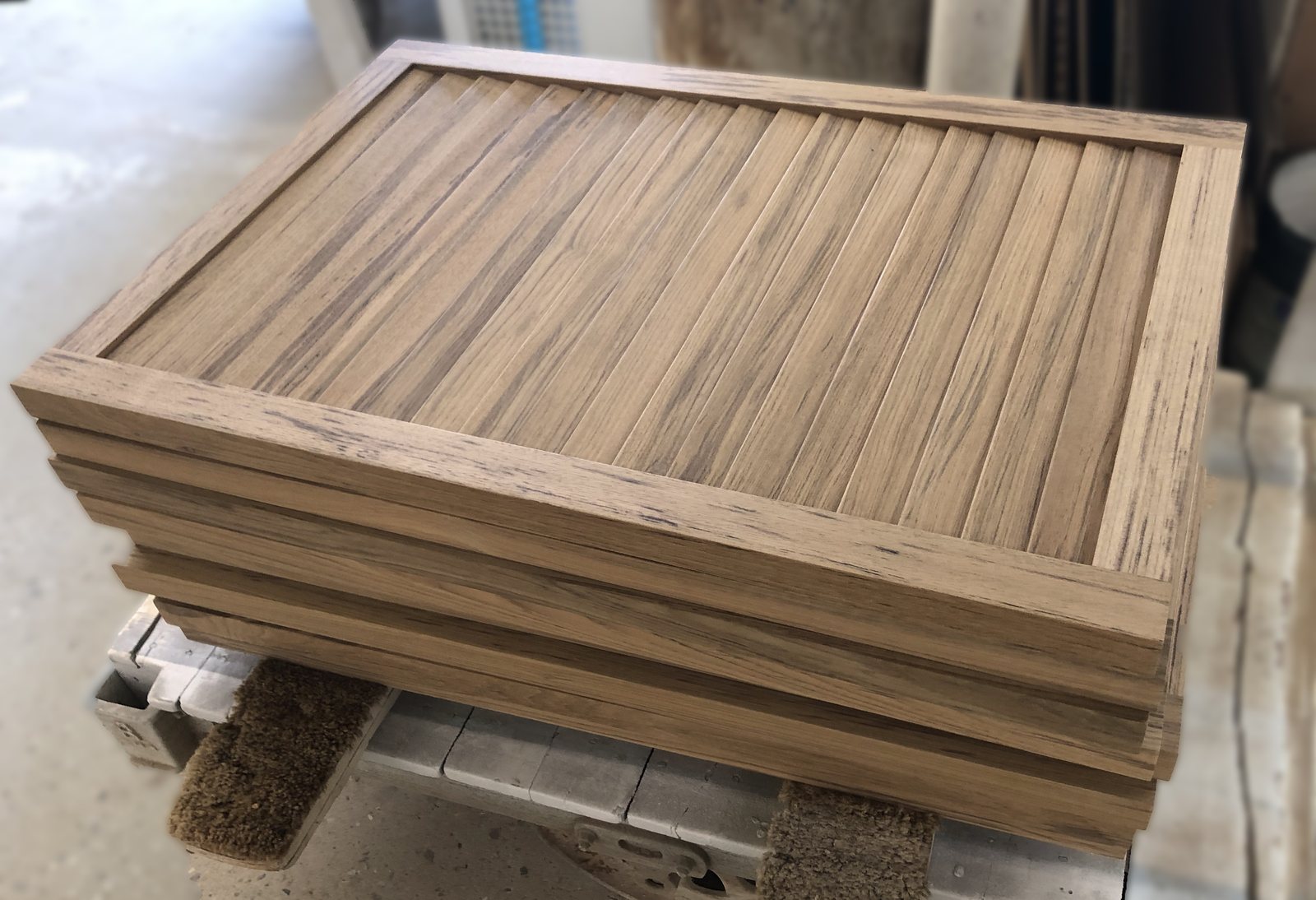
Matching a Teak run means holding color, figure and grain direction consistent across every panel a viewer takes in at once, and that control is set at the lumber order rather than at the press. One panel is easy. Twenty panels wrapping a boardroom, a stair core and two flanking doors turn into a sorting problem. The eye forgives plenty in isolation and almost nothing in sequence.
Teak moves through a wide color band. Fresh stock runs from pale honey to a mid golden brown, some logs carry darker streaking, and the whole surface continues to shift as it oxidizes under a finish. Two parcels bought a year apart can sit inside the same grade description and still read as two different woods once they are hung on the same wall six feet apart.
So the useful question is narrower than where to buy Teak. It is where enough Teak of one character sits in one place, at the thickness and the length the drawing calls for, with the balance held back for the phase that has not been released yet. That is a supply question. The shop answers the rest.
Solid Teak Panels Are Glue-Ups First
A solid Teak panel is a glue-up, so every decision about it is a decision about how the joints will read and how the field will move. Wide clear Teak in long lengths is the scarcest thing in any pile, which is why panels get edge glued from narrower staves instead of cut from one board. The glue line is not the problem. The pattern the glue lines make is.
Stave width drives that pattern. A five-piece panel built from 4 inch rips reads as stripes, especially in plainsawn stock where each stave carries its own cathedral. The same panel built from three wider rips reads as a surface. Neither is wrong, but the choice has to be made once and then repeated on every panel in the run, because a room with two stripe counts in it looks like a mistake.
Resawing changes what a solid panel can do. J. Gibson McIlvain resaws 8/4 and thicker Teak on band resaws, and two faces opened out of one board carry nearly the same grain, which is the closest thing solid stock offers to a book match. That is how a pair of flanking doors or a symmetrical pilaster set gets built without veneer.
Teak's oil content is the other constraint on a glue-up. A joint made on a freshly surfaced edge holds far better than one made on an edge that sat on a cart for a week, so panel stock wants to be jointed and clamped in the same shift. Grain direction gets set before the clamps go on, not corrected after. Running every stave the same direction makes a panel that planes and sands cleanly in one pass.
Where a Veneered Face Changes the Problem
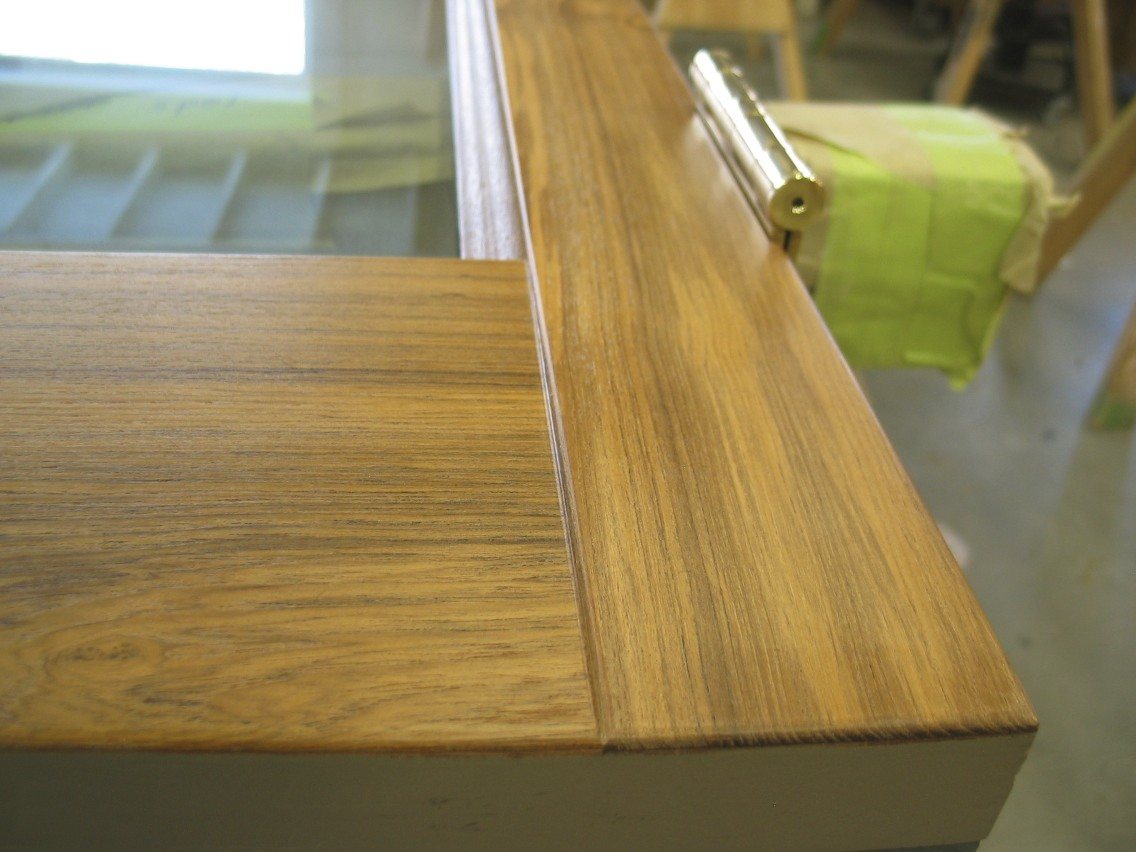
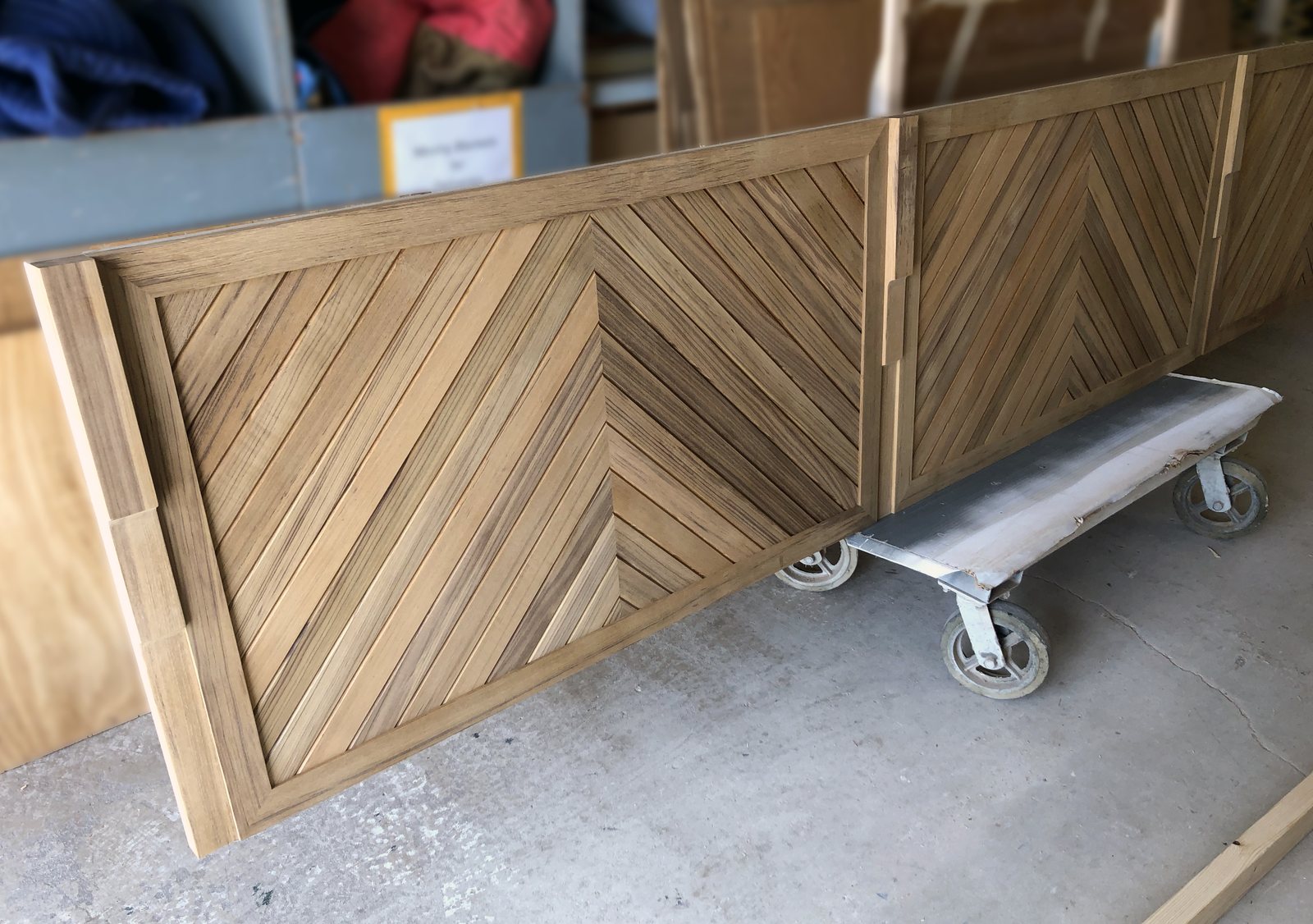
A veneered Teak panel solves width and movement and replaces them with a seam problem, because a veneered face is a repeating pattern of leaves and the pattern is what the room actually reads. A 48 inch wide solid Teak panel does not exist in any quantity. A 48 inch veneered face is routine. What a specifier gives up is control of the joint rhythm, which is now fixed by leaf width.
The match types are standardized, and the Architectural Woodwork Institute is the reference a millwork submittal will cite. Book matching flips alternate leaves so the figure mirrors at each joint, which is dramatic and also produces the barber pole effect in some Teak, where alternate leaves take light differently and the panel looks striped under a wall wash. Slip matching repeats each leaf in the same orientation, so the figure marches across the panel without mirroring and the light stays even.
What the veneered assembly still needs in solid Teak is the part a lumber order controls. Stiles, rails, applied mouldings, reveals, edge bands and the solid returns at a jamb all have to agree with the veneered face in both color and cut. Those come out of lumber, and they are where a mismatched run gets exposed first, because an edge band sits an inch from the face it is supposed to disappear into.
| Layup approach | How the face reads | Where it goes wrong | What the lumber order has to carry |
|---|---|---|---|
| Edge glued solid panel | Visible glue lines at a repeating stave rhythm, full depth of real wood at every edge and profile | Stave counts that change panel to panel, mixed sawing orientation inside one field | Long clear stock in one lot, consistent rip width, quartersawn or rift where flatness is specified |
| Resawn solid pair | Near mirror figure across two components, no veneer anywhere in the assembly | Resaw yield loss, limited to the width of the parent board | 8/4 or thicker boards wide enough to open, sequenced and kept together as pairs |
| Book matched veneer | Figure mirrors at every joint, strong symmetry, pronounced centerline | Barber pole striping under directional light, joints that telegraph in low sheen | Solid Teak for stiles, rails, edges and returns pulled from the same color range as the flitch |
| Slip matched veneer | Figure repeats in one direction, even light across the full width | Grain that drifts progressively across a long elevation | Solid components that can be sorted to follow that drift rather than fight it |
| Running match across a run | Leaves run continuously from panel to panel with no panel-by-panel symmetry | Half leaves landing at a reveal, patterns that break at a phase boundary | Whole run released from one order, with the balance stored until the later phase ships |
Color Drift Is a Lot Problem
Color variation inside Teak is a lot problem and not a grade problem, which is why a grade letter on a purchase order does nothing to guarantee a matched wall. Hardwood grading rules describe the yield of clear cuttings a board will give. They are silent on hue, on streak, and on how two boards will look next to each other after six months of daylight.
The controls that actually work are unglamorous. Buy the whole run at once, from one lot, including the parts nobody has drawn yet. Sort for color at the yard before the material is cut to length, when a board that does not belong can still go back in the pile instead of into a panel. Keep a finished control sample out of the first phase and ship it with the last one.
Depth of inventory is what makes a single-lot pull possible. J. Gibson McIlvain holds over seven million board feet of exotic and domestic lumber at its Maryland yard, so a long Teak run can be pulled, sorted and set aside as one body of material instead of assembled from three part shipments that each came from somewhere else. The Wood Database entry for Teak is a reasonable starting point on the species itself, including the figures this article does not quote.
"When a client calls about a Teak library, the first thing I ask is what the full scope is, including the phases that are not funded yet. I would rather sort and hold the whole run now than explain in two years why the last eight panels do not match the first forty."
Norm Moton, Director of Sales, J. Gibson McIlvain
Grade, Yield and Long Clear Widths
Grade tells a buyer about yield, not about beauty, and a Teak panel run lives or dies on the yield of long clear widths. North American hardwood grading runs on the National Hardwood Lumber Association rules, which score a board by how much clear face cutting it will give up rather than by how it looks on the stack.
FAS is the top grade. It requires a minimum board of 6 inches wide by 8 ft long yielding 83 and 1/3 percent clear face cuttings. FAS One Face, written F1F, meets FAS on the better face. Selects meet FAS on the better face at a smaller minimum size. No. 1 Common requires 66 and 2/3 percent from a minimum board of 3 inches by 4 ft, and No. 2A Common requires 50 percent.
A No. 1 Common board is not a defective board. It yields smaller clear cuttings, which makes it the economical grade for short parts and the wrong grade for a 10 ft panel stave that has to be clear end to end. Buying No. 1 Common for long panel work and then paying a shop to cut around it is how a panel budget quietly doubles in waste.
Imported Teak arrives described by the exporting mill's own grading rather than by an NHLA letter, so the yield logic matters more than the label. Ask what width and what length the stock actually runs, and what percentage of a lift will give a clear 10 ft rip. Thickness is quoted in quarters of rough inches, where 4/4 is a nominal 1 inch rough, 8/4 is 2 inches and 16/4 is 4 inches, and every surfaced dimension comes off that rough number. A glued panel that needs a cleanup pass after the clamps come off wants rough thickness above nominal 1 inch, not exactly at it.
Sawing Orientation and Staying Flat
Quartersawn and rift Teak moves less across its width than plainsawn, which is why a panel that has to stay flat under a thin finish gets specified that way. The mechanism is in the Forest Products Laboratory literature on dimensional change, and it does not care which species is involved. Tangential movement is roughly double radial movement in most hardwoods.
Quartersawn Teak also matches more easily. Straight grain across a set of staves reads as one calm surface, and a replacement panel cut two years later stands a real chance of blending. Plainsawn Teak carries cathedral figure that is handsome on a single door and very hard to repeat across eleven panels, because no two cathedrals land at the same height.
Cupping is driven by installation and back ventilation, not by species. A solid Teak panel finished on one face only will cup toward the dry side no matter how well it was sawn, so both faces get the same film, and the frame has to let the panel move inside it. Frame and panel construction exists for that reason and a glued-in panel defeats it. Building Science Corporation is the better reference on the interior humidity swings the panel is actually responding to.
Moisture, Oil and Finish Uptake
Interior Teak panels belong at a 6 to 8 percent in-service moisture content, and anything that arrives wetter than that will open its joints inside the first heating season. J. Gibson McIlvain mills interior components to that range. Exterior work sits near 12 to 16 percent, which is a different target and not interchangeable with the interior one.
Air dried Teak settles near the local equilibrium wherever it was stacked, and it is not a substitute for kiln dried stock where an interior tolerance matters. A panel glued up at 11 percent and installed in a conditioned building will shrink across its width, and the glue lines are where that shrinkage shows up. Checking moisture on arrival takes a minute and saves a mobilization.
Finish behavior is the other place Teak surprises people. Open-grained and oily species absorb a great deal of finish, and Teak is both, so the first coats disappear into the surface and a finisher who schedules for three coats ends up applying five. Pressing veneer, final sanding and the clear finish schedule belong to the millwork shop and the finisher, and the material decision that makes their job predictable is a single lot at a single moisture content.
Sequencing a Run Across Phases
A matched Teak run almost never ships in one delivery, and the gap between deliveries is what breaks most panel jobs. Phase one installs. Phase three releases eleven months later. By then the lot that supplied phase one is gone and the replacement reads half a shade cooler, which is exactly enough to see in a corridor.
J. Gibson McIlvain stores finished material for inventory control, so the balance of a sorted Teak run can stay where it was milled until the later phase is actually released. That is a scheduling tool, not a warehouse favor. It lets a specifier commit the whole quantity at one buy, which is the only reliable way to hold color across a multi-year fit-out.
J. Gibson McIlvain ships nationwide and delivers regularly to California, so a run held for a later phase is not held hostage to geography. Where the scope is true custom case work rather than linear panel stock, ICD, the company's architectural millwork division, builds the cabinets and case work around that material, planned for the specific space instead of assembled from standard modules that leave filler strips and mismatched face frames.
Sourcing Documentation on a Teak Order
Teak is the species where a buyer should settle sourcing documentation before the order goes in, not after the material is on a truck. J. Gibson McIlvain imports and mills as an FSC certified operation, which means the chain of custody paperwork travels with the material rather than being reconstructed later from invoices.
That matters on two kinds of jobs. A specification with a responsible sourcing requirement, including the material credits under LEED, will ask for documentation at closeout. An institutional or federal client will ask earlier, and a run already installed is a bad time to discover that the paper does not exist.
One thing a buyer should not ask for is a warranty on the wood itself. Warranties exist on modified products and on nothing else. It is not possible to warranty solid unmodified wood, an organic material that keeps responding to its environment for as long as it is in the building, and any supplier who offers one is describing something other than lumber.
When Another Species Does the Job Better
Teak is not automatically the right species for a panel run, and the substitutes worth considering are the rest of the millwork palette rather than whatever is cheapest on the floor. That palette is Sapele, Iroko, Afrormosia, Teak and Utile, which is sold as Sipo. All five mill cleanly, glue predictably and come in the widths and lengths panel work needs.
Sapele at roughly 1,410 lbf on the Janka scale is the workhorse of that group and comes in a wider range of sizes and longer lengths than Genuine Mahogany at roughly 800 lbf. Iroko and Afrormosia both read closer to Teak in color than Sapele does, which makes them worth a sample when a client wants the Teak look at a wider available width. Utile machines beautifully and takes a stain more evenly than Sapele.
The tropical decking species are a separate conversation. Ipe, which is Tabebuia spp, along with Cumaru, Garapa, Jatoba and Red Balau, are extremely hard and carry high oil content, which makes them difficult to glue, so a millwork house reaches for Sapele, Iroko, Afrormosia, Teak or Utile for anything glued, pressed or machined. Domestic options hold up well where the design does not need a tropical color, with quartersawn White Oak at roughly 1,360 lbf, White Ash at roughly 1,320 lbf, Black Walnut at roughly 1,010 lbf and Yellow Poplar at roughly 540 lbf for paint-grade cores. The Wood Moulding and Millwork Producers Association publishes the profile and grading conventions those orders are written against.
How J. Gibson McIlvain Would Specify This
A Teak panel run specified correctly reads as six lines on a purchase order, and every one of them is about material rather than about appearance. The appearance follows from the material. It does not survive being specified on its own.
- Full run quantity committed at one buy, including unreleased phases, pulled from one lot and sorted for color before anything is cut to length.
- Grade stated by the yield the parts need, FAS or F1F for long clear panel staves and stiles, with No. 1 Common reserved for short blocking and interior framing.
- Rough thickness in quarters, with enough above the finished dimension to allow a cleanup pass after glue-up.
- Quartersawn or rift specified wherever a panel field has to stay flat, plainsawn accepted only where the figure is the point.
- Moisture content at 6 to 8 percent for interior work, verified on arrival.
- Balance of the run held back against the later phase, with a finished control sample kept out of phase one.
Pressing veneered faces, final sanding, the clear finish schedule and hanging the finished work are the buyer's millwork shop and installer, and a clean handoff depends on them receiving one lot at one moisture content with the solid components already sorted to the face material. J. Gibson McIlvain mills the solid Teak components for that side of it, and ICD takes on the true custom case work where the millwork service has to be planned around a specific room.
For a Teak panel run with phases, long clear stave requirements or a sourcing specification attached, call J. Gibson McIlvain at 800-638-9100 and have the elevations and the full scope in front of you, including the phases that have not been funded. The conversation is faster and the run matches.
Frequently Asked Questions
How wide can a solid Teak panel be glued up before it becomes a problem?
Width is not the limit, movement is. A solid Teak panel can be glued up to whatever width the staves allow, but the wider the field, the more total movement it carries across the grain, and that movement has to be accommodated by the frame rather than resisted by glue or fasteners. Quartersawn and rift stock moves less across its width than plainsawn, which is why wide solid fields get specified that way. Past roughly the width of a cabinet door, most shops move to a frame and panel assembly or to a veneered face, because a captured panel can shrink and swell without opening a joint or splitting at a fastener.
Does book matching or slip matching hold up better on Teak?
Slip matching is the safer call on Teak. Book matching flips alternate leaves, which means alternate leaves present their grain to the light from opposite directions, and in an oily, ribboned wood like Teak that produces the barber pole effect, where the panel looks striped under a wall wash even though every leaf came from the same flitch. Slip matching repeats each leaf in the same orientation so the light stays even across the width. Book matching is still the right choice where strong symmetry around a centerline is the design intent, and in that case the mockup should be viewed under the actual lighting rather than under shop fluorescents.
What grade should I order for long clear Teak panel staves?
Order for the yield the part needs. FAS or FAS One Face, written F1F, is the grade to specify for long clear staves, stiles and rails, because FAS requires a minimum board of 6 inches by 8 ft yielding 83 and 1/3 percent clear face cuttings. No. 1 Common requires only 66 and 2/3 percent from a minimum board of 3 inches by 4 ft, which makes it economical for short parts and wrong for a 10 ft clear rip. Imported Teak is usually described by the exporting mill's own grading rather than an NHLA letter, so ask directly about the widths, the lengths and the clear yield per lift.
Can a Teak run still be matched if the second phase is a year away?
Yes, but only if the whole quantity is bought up front. The reliable method is to commit the full run at one order, including the phases that have not been drawn or funded, sort it for color at the yard, and hold the balance until the later phase releases. J. Gibson McIlvain stores finished material for inventory control, which is what makes that approach practical rather than theoretical. Buying phase two a year later from whatever Teak is then available is how a corridor ends up with a visible seam between two campaigns of work.
What should a Teak panel run be milled to for moisture content?
A 6 to 8 percent in-service moisture content for interior work. Exterior work is a different target near 12 to 16 percent and the two are not interchangeable. Air dried Teak settles near the equilibrium of wherever it was stacked, which is not a substitute for kiln dried stock when an interior tolerance matters. Check the material with a meter on arrival, before anything is ripped. A panel glued up at 11 percent and installed in a conditioned building will shrink across its width, and the glue lines are exactly where that shrinkage shows.
Who handles pressing, finishing and hanging the panels?
Those are the buyer's millwork shop, finisher and installer. J. Gibson McIlvain mills and supplies the solid Teak that goes into the assembly, including resawn pairs kept together for near mirror figure, and ICD, the company's architectural millwork division, takes on true custom case work planned around a specific room. Pressing a veneered face, final sanding, the clear finish schedule and installation on site sit with the fabricator and installer, and what makes their work predictable is receiving one lot at one moisture content with the solid components already sorted to the face material.
Is there a warranty on solid Teak panels?
No. Warranties exist on modified products and on nothing else. Solid unmodified wood is an organic material that keeps responding to the humidity around it for as long as it is in the building, so no honest supplier can warranty how a solid Teak panel will behave. What a buyer can get instead is documentation and control, meaning a stated grade, a verified moisture content, a known sawing orientation and material pulled from one lot. Those are the things that actually determine whether the run holds together.