
Why Teak Behaves Unlike the Rest of the Palette
Teak is the one species in the interior joinery palette where the wood's own chemistry, not its hardness or its figure, drives most of the shop decisions. Tectona grandis carries natural oils and resinous extractives all through the heartwood, and it carries silica. Those two facts change tooling, glue-up, finish adhesion and how a panel looks a year after install. A joiner who treats teak as Sapele in a different color will get away with it on a run of trim and will not get away with it on a glued panel face.
The rest of the palette is more forgiving. Sapele, Iroko, Afrormosia and Utile, which is sold as Sipo, machine and bond predictably with ordinary shop practice. Teak asks for sequence instead. Surface it and glue it the same day, keep carbide in the spindle, and prove the finish on offcuts from the same lot before the first panel goes in a clamp.
Published hardness and shrinkage figures for teak are easy to find at the Wood Database, and they are not the interesting part of the story. Teak's reputation rests on dimensional stability and on decay resistance, and both come from the same extractives that complicate every adhesive and every film finish applied to it. You do not get one without the other.
What You Are Actually Buying When You Buy Teak
Teak arriving in North America comes from several growing regions, and the growing region shows up in the board rather than in the species name. Slow-grown material runs toward narrow rings, uniform color and dense, oily heartwood. Plantation-grown stock runs toward wider rings, a higher share of juvenile wood near the pith, more sapwood at the edge and a wider color spread from honey to olive brown. Both are teak. They do not photograph alike and they do not finish alike.
That variation is the real buying problem for panel work. A single door or a single cabinet face can absorb it. A run of 40 raised panels in one room cannot, because the eye finds the outliers the moment the finish goes on. Panel work has to be bought as a matched lot, not as a board footage number with a species attached.
J. Gibson McIlvain holds over 7 million board feet of exotic and domestic lumber at its Maryland yard, which turns a matched teak lot into a question of pulling from depth rather than a question of waiting on the next container. Depth is also what lets the second phase of a job draw stock that reads like the first phase did, months later, on the same drawing.
J. Gibson McIlvain imports and mills as an FSC certified operation, so chain of custody documentation travels with the material instead of being reconstructed later from a purchase order. On a tropical species that matters to the specifier, to the general contractor, and to anyone answering a sourcing requirement written into the project manual.
Grading Teak Against a Measurable Spec

North American hardwood grading measures yield, not beauty, and a buyer who understands that writes a far better teak order. The National Hardwood Lumber Association rules grade a board by the yield of clear face cuttings it will produce. FAS is the top grade and requires a minimum board 6 inches wide by 8 ft long yielding 83 and 1/3 percent clear face cuttings. FAS One Face, written F1F, meets FAS on the better face. Selects meet FAS on the better face at a smaller minimum size.
Below that, No. 1 Common requires 66 and 2/3 percent clear face cuttings from a board at least 3 inches by 4 ft, and No. 2A Common requires 50 percent. None of those lower grades describes a defective board. They describe a board that yields smaller clear cuttings, which makes No. 1 Common the economical grade for short parts such as stiles, drawer fronts and small panel frames, and the wrong grade entirely for a long clear run of casing.
Imported teak often arrives on export grading conventions rather than on an NHLA ticket, so the useful move is to specify what you can measure on the receiving dock. Thickness, minimum length, minimum width, grain orientation, sapwood tolerance and color range are all checkable against a sample. "Furniture grade" is not checkable against anything.
Thickness is quoted in quarters of an inch of rough thickness. 4/4 is a nominal 1 inch rough board, 8/4 is 2 inches, and 16/4 is 4 inches. Surfaced dimensions come off those rough numbers, so a 4/4 teak board will not yield a finished 1 inch part, and a panel frame that has to finish at 1 and 1/8 inches needs to start life as 6/4.
Moisture Content and Why Teak Still Needs the Kiln
Teak's low movement is real and it is not a license to skip kiln drying. Interior millwork is milled to an in-service moisture content near 6 to 8 percent. Exterior work runs near 12 to 16 percent. Air dried stock settles near the local equilibrium, wherever that happens to sit, and it is not a substitute for kiln dried material where an interior tolerance matters.
Teak that arrives air dried at 12 to 14 percent keeps shrinking inside a conditioned building until it finds equilibrium with the room. On a 20 inch wide glued panel, even teak's modest coefficient will open a joint or pull a frame out of square. The failure is slow, it surfaces after the punch list is closed, and it gets blamed on the joinery rather than on the lumber.
J. Gibson McIlvain mills teak to the interior target near 6 to 8 percent and reports it with the order, which gives the shop a known starting point instead of a guess. Building Science Corporation publishes the relationship between indoor relative humidity and wood equilibrium moisture content, and the number to design against is the one in the finished building, not a regional average. A gallery held at 50 percent relative humidity and a lake house shut down all winter are not the same job.
Sawing Pattern for Panels and Stiles
Quartersawn and rift teak move less across the width than plainsawn, which is why they belong in any panel field that has to stay flat. Straight grain also reads calmer under a clear finish, and teak's ray fleck is subtle enough that quartersawn stock looks quiet rather than busy. On a wide raised panel the difference between quartersawn and plainsawn is the difference between a flat field and a shallow cup you can see in raking light.
Plainsawn teak is not banished. It is the right call where the figure is wanted and where the part is narrow enough that cross-grain movement has nowhere to go. Trouble starts when both patterns land in the same visual field, because a run of quartersawn stiles framing plainsawn panels reads as two different woods once the finish is on.
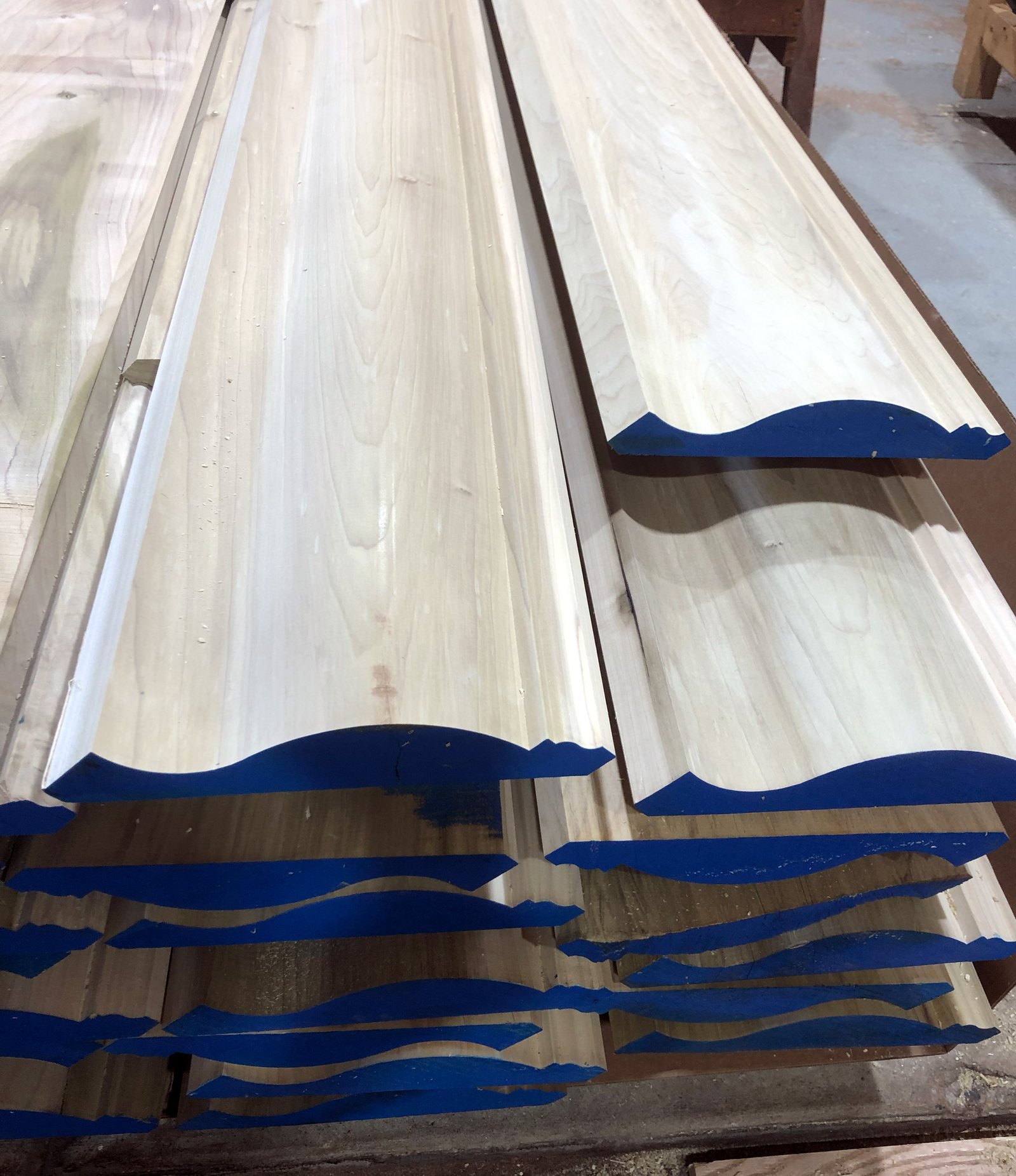
Resawing matters here too. An 8/4 board resawn into two book-matched faces holds color and grain across a pair of doors far better than two separate 4/4 boards ever will. J. Gibson McIlvain runs band resaws, straight line and gang rip saws, moulders, custom knife grinders and trimming saws on the floor, so teak can be rough milled, resawn and ripped before it ships rather than tying up the joinery shop's machines for a week.
Machining Teak Without Burning Through Knives
Silica, not hardness, is what dulls tooling in teak. Teak sits well below Hard Maple at roughly 1,450 lbf and Sapele at roughly 1,410 lbf on the hardness scale, and it still eats cutting edges faster than either one. Mineral content does that. High speed steel knives go dull in a fraction of the run length the hardness number would suggest, so carbide is the default and carbide ground with a shear geometry is better.
Dull knives cause a second problem that only appears at finishing. A burnished surface in an oily species is effectively sealed by its own extractives, and coating sits on it unevenly. Sharp tooling, moderate feed and a light final pass keep the surface open. Sanding is not a rescue, because a worn belt burnishes a teak face exactly the way a dull knife does.
Teak dust deserves its own line in the job hazard analysis. It is a known respiratory and skin irritant, and shops that run a lot of it treat dust collection and respirators as standard rather than optional. The Forest Products Laboratory publishes the wood properties research behind most of this, and the Wood Handbook is the reference a specifier should keep within reach.
Gluing an Oily Species
Teak glues reliably only when the surface is fresh, clean and clamped within hours of machining. Oils migrate back to a newly cut face over time. A board jointed on Monday and glued on Thursday is being glued on a different surface than the one the jointer left behind, and that is where most teak joint failures start.
The working sequence is short. Machine the glue face. Wipe it with acetone or denatured alcohol and let the solvent flash off. Spread, clamp at even pressure, and do not starve the joint trying to keep squeeze-out tidy. Resorcinol and epoxy tolerate oily substrates better than a standard PVA does, and on a structural lamination that tolerance is the entire argument.
Test the assembly, not the glue. A sample lamination made from the same lot and broken after full cure tells you more than any product data sheet, because the variable is the board, not the adhesive. The Architectural Woodwork Institute standards cover the joint performance an architect's specification will reference, and they are the right place to settle what a passing joint looks like before anyone argues about it on site.
Finishing, Color Change and the Priming Question
Teak's extractives interfere with both adhesion and cure, so the finish schedule gets decided before the first board is machined. Oil-based varnish over unsealed teak can stay soft in patches where extractives concentrate. Water-based coatings can fisheye. A barrier coat of dewaxed shellac or a compatible sealer handles most of it, and the sample that proves it has to come off the same lot as the job.
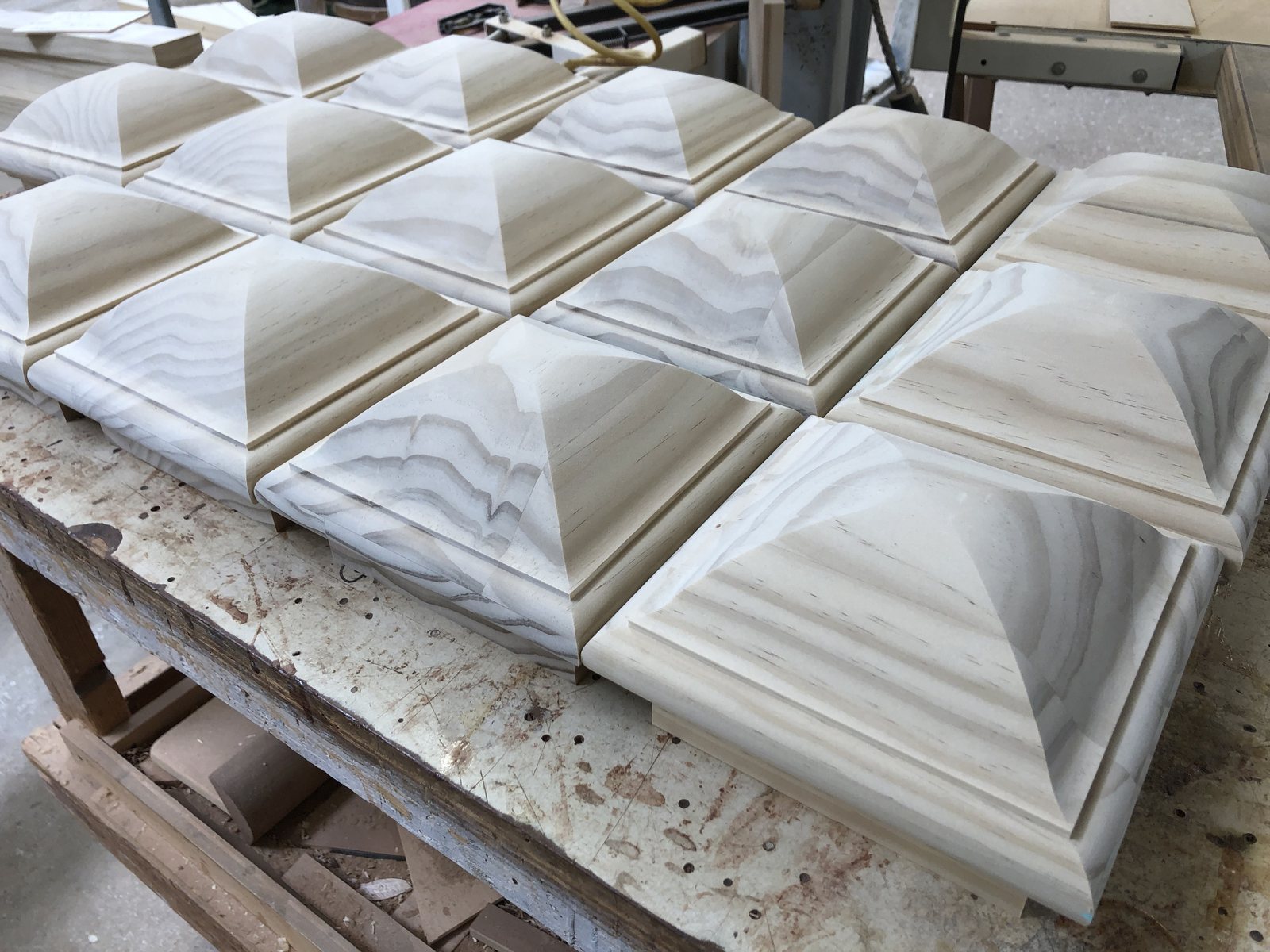
Open-grained and oily species absorb a great deal of finish, so a sealer or primer coat is what evens out the eventual surface rather than an extra step to cut from the schedule. Sanding or buffing after that coat knocks back grain raising while keeping moulded detail crisp. On a profiled panel edge that distinction is visible from across the room.
Color is the other conversation, and it is the one that generates calls. Fresh teak is golden and it does not stay golden. Exposed to light it darkens and ambers, and the rate depends on the coating and on the room. Nobody can warranty that. Nobody can warranty solid unmodified wood at all, because it is an organic material responding to its environment, and warranties exist on modified products and on nothing else.
Teak Against the Rest of the Joinery Palette
Teak earns a specification on stability and decay resistance, and it gives ground on every operation involving adhesive or film finish. The honest comparison is against the four species a millwork shop actually reaches for alongside it, which are Sapele, Utile sold as Sipo, Afrormosia and Iroko.
| Species | Movement across the width | Gluing behavior | Finishing behavior | Where it earns the spec |
|---|---|---|---|---|
| Teak | Lowest of the five, the main reason it gets specified for wide panels | Demanding, needs fresh surfaces, a solvent wipe and a tolerant adhesive | Demanding, needs a barrier coat and lot specific samples | Wide panel fields, wet rooms, marine interiors, anywhere movement is the governing risk |
| Sapele | Low, and lower again in quartersawn or rift | Predictable with standard shop adhesives | Takes stain and clear finish evenly, and holds paint better than Genuine Mahogany at roughly 800 lbf | Long lengths, wide widths, painted exterior trim, the general purpose choice at roughly 1,410 lbf |
| Utile, sold as Sipo | Low, close to Sapele | Predictable | Even, with slightly more uniform color than Sapele | Door stiles and rails, interior panel frames where color consistency governs |
| Afrormosia | Low, with good stability in service | Predictable, with interlocked grain to watch at the planer | Even, and it darkens with age toward a teak-like tone | Where teak's look is wanted without teak's gluing and finishing penalties |
| Iroko | Low, comparable to teak in service | Workable, with occasional mineral deposits that are hard on cutters | Even once the deposits have been dealt with | Exterior joinery, sills, thresholds, hard-use interior surfaces |
Afrormosia is the species most reached for when teak's appearance is the actual requirement. It darkens toward a similar tone, machines with less abuse to tooling and bonds without the solvent routine. Working figures for it sit on the Wood Database alongside the rest of the palette. Where a client has specified teak by name and will accept nothing else, that is a different conversation and a fair one to have.
Iroko and teak overlap more than most specifiers expect. Iroko holds up outdoors, machines reasonably and costs the job less in tooling, though it carries occasional calcium deposits that will chip a knife without warning. For a threshold or an interior sill that takes standing water, either species does the work.
"The teak question is almost never really about the species. It is about whether the lot sitting in front of you matches the lot you are going to need in four months, and whether the paperwork behind it holds up. That is an inventory problem before it is a woodworking problem."
Norm Moton, Director of Sales, J. Gibson McIlvain
Where Teak Is the Wrong Call
Teak under paint is wasted, and teak on a deck is a different purchase entirely. Both mistakes come from treating the species name as the specification instead of asking what the part has to do once it is installed.
If the part is going to be painted, the species call collapses to stability and machinability. Yellow Poplar at roughly 540 lbf takes paint well and costs the job nothing in appearance. Where cedar is the default, and it legitimately is on a great deal of work, the grade call matters more than the species call, which means CVG, clear vertical grain, against STK, select tight knot. Those are different products with different movement and different paint behavior.
If the real application is exterior decking, teak is not the comparison to be making. Ipe, which is Tabebuia spp, along with Cumaru, Garapa, Jatoba and Red Balau, are the decking species, extremely hard and high in oil content, which makes them difficult to glue. That is exactly why a millwork shop reaches for Sapele, Iroko, Afrormosia, Teak or Utile on milled, glued and machined components and leaves the decking species to the deck.
Domestic species deserve a fair hearing on interior joinery too. White Oak at roughly 1,360 lbf, Red Oak at roughly 1,290 lbf, White Ash at roughly 1,320 lbf, Black Walnut at roughly 1,010 lbf and Cherry at roughly 950 lbf all behave well in panel work and none of them fight the glue line. Teak is the answer to a movement and moisture problem, not a default upgrade.
How J. Gibson McIlvain Would Specify This
A teak order for interior joinery should be written as eight measurable lines, because anything vaguer gets settled by whoever loads the truck.
- Species and growing region expectation, with sapwood tolerance stated plainly.
- Grade named against the NHLA definitions, together with the part length it has to yield.
- Rough thickness in quarters, 4/4 through 16/4, and the finished thickness it has to produce.
- Minimum and maximum lengths, and whether the run needs continuous lengths or will be jointed.
- Grain orientation, quartersawn, rift or plainsawn, called out separately for stiles, rails and panel fields.
- Moisture content target near 6 to 8 percent for interior work, reported at shipment.
- Color range, with a physical sample retained on both sides of the order.
- Lot matching and release schedule, phase by phase.
J. Gibson McIlvain mills to those lines and stores finished material for inventory control, so phase two of a job draws from the same lot phase one did instead of from whatever landed in between. That one provision prevents more teak panel complaints than any finishing decision ever will.
Where the work runs past lumber and milled components into true custom casework, ICD, the company's architectural millwork division, builds cabinetry and case work planned around a specific room rather than assembled from standard modules, which is what produces filler strips and mismatched face frames. Teak case work gains the most from that approach, since the oily faces and the color matching have to be resolved as one package rather than part by part. The cabinets and case work side of the division carries that scope.
Veneered panel lay-up, carved ornament and the installed assembly itself stay with the buyer's own fabricator and installer, and the lumber and milled components arrive ready for that work. J. Gibson McIlvain ships nationwide and sends teak orders to California on a regular basis, which counts on a species where a West Coast buyer is otherwise working from a short local list. The millwork services page covers what comes off the mill. For a teak lot, a grade call or a matched run against a specific drawing, call 800-638-9100 and talk to someone who can put eyes on the stock before it ships.
Frequently Asked Questions
Where do I buy teak for interior joinery and panel work?
Buy it from an importer and miller that holds depth in the species rather than from whoever has a few lifts on hand, because panel work has to come out of a matched lot. J. Gibson McIlvain carries teak at its Maryland yard alongside the rest of the millwork palette, mills it to the interior moisture target near 6 to 8 percent, and will hold a matched lot across phases of the same job. Call 800-638-9100 with the grade, the thickness in quarters, the lengths and the grain orientation you need, and ask for a physical color sample to be retained on both sides of the order.
Does teak have to be kiln dried for interior work?
Yes. Teak moves less than almost anything else in the palette, but a board that arrives air dried at 12 to 14 percent keeps shrinking in a conditioned building until it reaches equilibrium with the room. Interior millwork is milled to an in-service moisture content near 6 to 8 percent. Exterior work runs near 12 to 16 percent. Air dried stock settles near the local equilibrium and is not a substitute where an interior tolerance matters, and on a wide glued panel the difference shows up as an open joint after the punch list is closed.
Why do glue joints fail in teak?
Because the surface changes after machining. Oils and resinous extractives migrate back to a freshly cut face, so a board jointed three days before glue-up is being bonded on a different surface than the one the jointer left. Machine the glue face, wipe it with acetone or denatured alcohol, let the solvent flash off, and clamp at even pressure the same day. Resorcinol and epoxy tolerate oily substrates better than a standard PVA. Test a sample lamination from the same lot and break it after full cure rather than trusting a product data sheet.
Is plantation teak as good as slow-grown teak?
It is teak, and it is not the same board. Slow-grown material tends toward narrow rings, dense oily heartwood and uniform color. Plantation stock tends toward wider rings, more juvenile wood near the pith, more sapwood at the edge and a wider color spread. For a single door or a stair part, either works. For 40 raised panels in one room, the color spread is the whole problem, which is why the order should state sapwood tolerance and color range and why the lot should be matched before anything ships.
What finish schedule works over teak?
Decide it before the first board is machined. Oil-based varnish over unsealed teak can stay soft in patches where extractives concentrate, and water-based coatings can fisheye. A barrier coat of dewaxed shellac or a compatible sealer handles most of it. Open-grained and oily species absorb a great deal of finish, so the sealer or primer coat is what evens out the eventual surface, and sanding or buffing after it knocks back grain raising while keeping moulded detail crisp. Prove the schedule on offcuts from the same lot, not on a generic sample board.
What should I specify if I want the teak look without the teak problems?
Afrormosia. It darkens with age toward a similar tone, machines with far less abuse to tooling, and bonds without the solvent routine. Utile, which is sold as Sipo, and Sapele give you predictable gluing and finishing with low movement, and Sapele comes in a wider range of sizes and longer lengths. Iroko overlaps teak closely in service and holds up outdoors, with the caveat that occasional calcium deposits will chip a knife. All four are part of the same millwork palette and all four are easier to run.
Which NHLA grade should I order for teak panel work?
Match the grade to the part length. The National Hardwood Lumber Association rules grade a board by the yield of clear face cuttings, so FAS, which requires a minimum board 6 inches wide by 8 ft long yielding 83 and 1/3 percent clear cuttings, is what a long clear run needs. FAS One Face meets FAS on the better face, and Selects do the same at a smaller minimum size. No. 1 Common at 66 and 2/3 percent is not a defective grade, it simply yields smaller cuttings, which makes it the economical choice for stiles, drawer fronts and small panel frames.
Can teak be used under paint?
It can, and it is a waste of the material. Under paint the species call collapses to stability and machinability, and Yellow Poplar at roughly 540 lbf takes paint well with no appearance penalty. Where cedar is the default on painted work, the grade call matters more than the species call, which means CVG, clear vertical grain, against STK, select tight knot. Reserve teak for the places where movement, moisture and decay resistance are the governing risks and the grain is going to be seen.
Sources and Standards Referenced
- National Hardwood Lumber Association, Rules for the Measurement and Inspection of Hardwood and Cypress
- USDA Forest Service, Forest Products Laboratory
- The Wood Database, Teak (Tectona grandis)
- The Wood Database, Afrormosia
- Forest Stewardship Council, chain of custody certification
- Architectural Woodwork Institute, architectural woodwork standards
- Building Science Corporation, moisture and relative humidity in buildings