
What a Vessel Deck Order Has to State
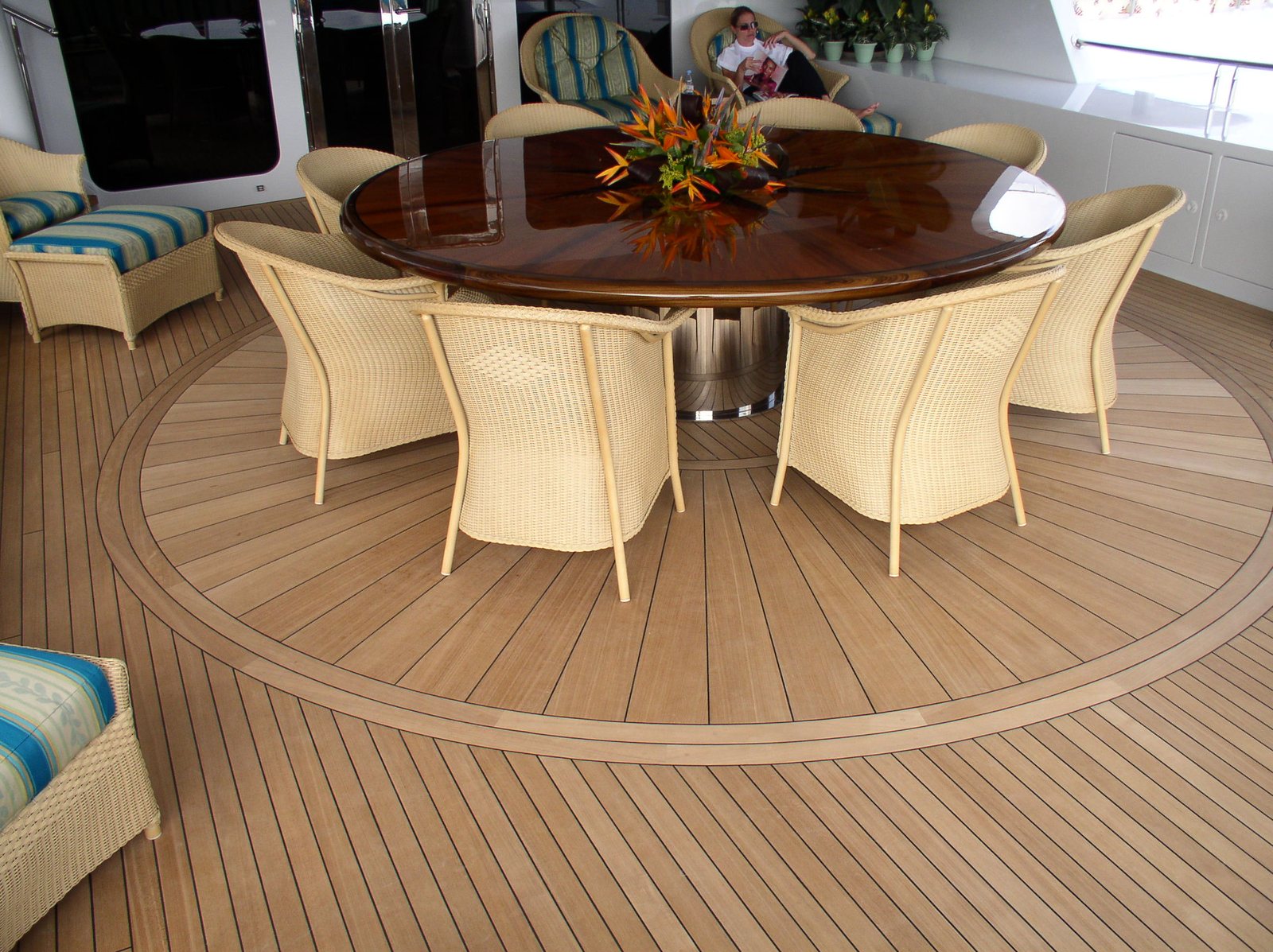
A teak decking order gets filled when it states width, length, thickness, grain orientation, moisture content and the tolerance allowed on each one, and it stalls when it states a species and a square footage. Square footage is a budget number. It tells a mill nothing about whether the boards in the stacks can become the thing on the drawing. Two orders covering the same deck area can ask for completely different material.
Compare asking for teak decking against asking for 4 inch wide vertical grain teak, 8 ft and longer, in 8/4 rough, dried for exterior service. The first question can be answered out of almost any lift. The second describes a narrow slice of what a log yields, and the honest answer depends on log diameter, on how the log was sawn and on how the stock was dried.
Marine buyers get caught in the same gap every time. The drawing carries a finished plank face width and a seam width. The purchase order carries a lumber dimension. Those are two different numbers, and the conversion between them belongs in writing on the order rather than in somebody's head at the saw.
Why Deck Teak Comes Off the Log Narrow
Vertical grain teak is narrow by geometry, not by anybody's grading preference. Quarter the log, saw radially, and the usable width of each board is bounded by the radius of that log. Wide vertical grain requires a large diameter log. Narrow stock and vertical grain are the same supply story told twice, which is why a drawing that calls for quartersawn deck planks and generous widths in the same breath is asking for two things that work against each other.
Plantation teak tightens the geometry further. Shorter rotations and smaller logs cap both width and length, so the widths that come through a plantation supply consistently are the narrow ones. On a refit that runs in phases across a season, consistent and repeatable matters more than wide.
Teak is Tectona grandis. Natural oils and silica content dull tooling and complicate adhesion, which is part of why the traditional laid deck relies on caulked seams rather than glue lines between planks. The oils that make the species worth specifying in the weather are the same oils that make a glued edge joint a harder bet. Density and hardness figures for the species are published in the wood database entry for teak.
None of that is a reason to fight the narrow width. It is a reason to design the order around it. A deck drawn in 3, 4 and 5 inch stock is a deck that can be bought in May and again in September and still match.
Width and the Movement Math Behind Narrow Planks

Wood moves far more tangentially than radially, and movement across a board scales with its width, so a 4 inch plank has roughly half as much to give back as an 8 inch plank of the same species and orientation. That one ratio explains most of what a laid deck does over a season. The published shrinkage coefficients behind it sit in the Wood Handbook from the USDA Forest Products Laboratory, and they are the reason grain orientation gets its own line on a decking order.
On a deck the consequence shows up at the seam. More seams, each moving less, is a more stable surface than fewer seams each moving more. Caulk has a working range, and a seam that stays inside that range for years is a seam cut between boards narrow enough that neither side asks too much of it.
Cupping is driven by installation and back ventilation, not by species. A narrow board also has less width across which to cup in the first place, which is the quiet second benefit of a 3 or 4 inch plank on an exposed horizontal surface that takes sun on one face and nothing on the other. Radial faces wear more evenly underfoot as well. Quartersawn teak presents the same ring structure across the whole plank face, so the surface sands back flat instead of washboarding where soft early wood meets hard late wood.
Specified Width Versus Random Width
Hardwood is sold random width unless the order says otherwise, and a vessel deck cannot be built out of random width. A random width tally means boards ship as the grade produced them and the buyer sorts. For a deck that needs one repeating plank dimension, that sorting job lands on the boat shop floor, where it costs shop time and produces a pile nobody planned for.
Specified width is a different order. It names 3 inch, 4 inch or 5 inch, says whether that number is the rough width or the finished width, and states how much variation is acceptable. J. Gibson McIlvain rips teak to one consistent width on straight line and gang rip saws, which is what turns a graded board into stock a deck layout can repeat.
Write the number as a finished face width wherever the deck detail allows it. Rough width gives the mill room to work but hands the final dimension back to the shop. Finished width puts the dimension where the drawing needs it and makes the tolerance line mean something.
| Order line | What to write | What that line controls |
|---|---|---|
| Width | One number, 3, 4 or 5 inch, marked rough or finished | Whether the deck layout repeats, and how much the seam has to absorb |
| Length | A minimum length band, plus the share of the order allowed to fall short of it | Butt placement, nibbing at the margin plank, total material required |
| Thickness | Rough thickness in quarters, with the intended finished thickness noted | Sanding life on a laid deck, or panel consistency on an overlay |
| Grain orientation | Vertical grain or rift, written as a requirement rather than a preference | Movement across the plank face and how the surface wears |
| Moisture content | 12 to 16 percent for exterior service, 6 to 8 percent for interior joinery | Seam width at installation and how much the deck moves after it is laid |
| Tolerance | An allowed variation on width and on thickness, in writing | Whether delivered material is accepted or argued about |
Length, Rotations and Deck Layout
Length is where a decking order quietly doubles, since a plank that has to run a given distance without a butt cannot be made from a shorter board. The grading rules make this plain. No. 1 Common requires 66 and 2/3 percent clear face cuttings and allows a minimum board of 3 inches by 4 ft, which makes it the economical grade for short parts and the wrong grade for long clear runs.
Deck layouts spend length unevenly. Straight runs between the margin plank and the king plank take the longest boards. Nibbed ends, margin planks and the short pieces around hatches, winches and deck hardware take stock that would be waste in a straight run. A good order splits itself along that line instead of buying one length band for the whole job.
Plantation rotations cap the top end. Smaller logs mean the long clear lengths thin out fast, so a drawing that needs a continuous plank the full length of a hull side may be describing material that does not exist in a given supply. Staggered butts solve it, and staggered butts are a layout decision made on paper rather than a procurement problem a mill can fix.
"The orders that go smoothly tell me the minimum length and how much of the order is allowed to come in under it. I can work with that all day. The ones that stall just say long lengths, and then we are all guessing at what the deck actually needs."
Norm Moton, Director of Sales, J. Gibson McIlvain
State the minimum length, the preferred length band and the share of the order that may fall below the minimum. Three numbers. They turn a conversation that takes two weeks into a confirmation that takes an afternoon.
Thickness in Quarters, Not Finished Inches
Hardwood thickness is quoted in quarters of an inch of rough thickness, and every finished deck dimension has to be worked backward from that number. 4/4 is nominal 1 inch rough. 8/4 is 2 inches. 16/4 is 4 inches. Surfaced dimensions come off those rough numbers, which means a finished plank thickness is always a subtraction problem and never the number on the order line.
A traditional laid deck carries thickness for a reason. The surface gets cleaned, sanded and eventually sanded again, and the fastening detail has to stay buried under all of it. Thickness bought at the start is sanding life bought at the start, and a deck specified thin to save material is a deck with fewer refinishing cycles in it.
Overlay decks work from the other direction. A thin teak overlay bonded to a substrate wants consistent thickness far more than it wants mass. J. Gibson McIlvain resaws thicker stock on band resaws when an order calls for overlay thickness rather than full laid deck thickness, and resawn stock holds a tighter thickness range than planed stock pulled off a rough lift.
Moisture Content for a Deck That Lives Outside
Teak headed for an exposed deck belongs near 12 to 16 percent moisture content, not the 6 to 8 percent band that interior millwork is dried to. Those two numbers describe the service environment, not the quality of the drying. Interior stock at 6 to 8 percent taken straight onto a wet deck will pick up moisture and swell, which closes seams and loads the caulk from both sides.
J. Gibson McIlvain mills exterior teak to a 12 to 16 percent in-service moisture content and interior stock to 6 to 8 percent, and the width of the board does not change either target. A 3 inch plank and a 10 inch board dry to the same number. The narrow plank simply has less width across which to express whatever movement is left in it.
Air dried stock settles near the local equilibrium moisture content and is not a substitute for kiln dried material where a tolerance matters. The physics of equilibrium moisture content and seasonal cycling is covered well by Building Science Corporation, and test methods for measuring moisture in wood are published by ASTM International. Ask for the moisture reading at shipment. A number on the packing list is a number the boat shop can plan a seam width around, and it also tells the yard whether material that sat on a dock in July needs time to settle before anything gets laid.
Grade Language Between Buyer and Mill
North American grading rules describe clear cutting yield, imported teak arrives on a mill's own export description, and neither one tells you the plank width you are getting. The National Hardwood Lumber Association rules grade a board by the yield of clear face cuttings rather than by appearance alone. FAS is the top grade and requires a minimum board of 6 inches wide by 8 ft long yielding 83 and 1/3 percent clear face cuttings. FAS One Face, or F1F, meets FAS on the better face. Selects meet FAS on the better face at a smaller minimum size. The Common grades sit below them, No. 1 Common at 66 and 2/3 percent and No. 2A Common at 50 percent.
Grade describes yield, not character. A No. 1 Common board is not a defective board. It yields smaller clear cuttings, which is exactly what a run of short margin pieces and hardware surrounds needs, and exactly what a long clear deck plank does not.
Imported teak complicates the letter. Those rules were written for North American hardwoods, and teak reaching a buyer in the United States usually carries an export description from the mill that cut it rather than an NHLA letter. That is workable as long as the order carries dimension, grain orientation and tolerance, because those three lines survive the translation when a grade letter does not.
Documentation matters as much as the grade on imported stock. J. Gibson McIlvain operates as an FSC certified importer and miller, so the sourcing paperwork travels with the material rather than being reconstructed later when a specification or an owner's representative asks for it. Specifications that carry sourcing requirements into a woodwork package are addressed in the standards work of the Architectural Woodwork Institute.
Tolerance, Tally and Allowance in Writing
Tolerance is a number the buyer writes or a number the mill assumes, and the second version is where deck orders go wrong. Ripped stock holds a tight width. How tight is a question with a real answer, and the answer belongs on the order. A deck layout working to a fixed seam width can absorb very little width variation plank to plank, and the shop needs to know what it is getting before it sets up to caulk.
Thickness tolerance works the same way on an overlay. A bonded overlay that varies in thickness telegraphs that variation into the finished surface, and sanding it out eats the very thickness the overlay was specified to keep. Tally is the third number people skip. Hardwood is tallied in board feet on the rough dimension, so a tally and a finished square footage are not the same measurement, and converting one into the other needs the width, the thickness and the length band.
Put an allowance on the order as well. State the share of the delivery permitted to fall under the minimum length, under the nominal width or outside the grain call, and state what happens to it. An allowance written down is a shipment that gets accepted. An allowance left unwritten is a phone call.
What Arrives Milled and What the Boat Shop Cuts
A decking order arrives as consistent, dried, correctly oriented stock, and the deck itself gets laid, seamed, fastened and bunged by the yard doing the work. That division is worth drawing on the drawing. The bevel on the plank edge, the seam width, the nibbing at the margin plank and the fastening pattern are details the boat shop cuts to its own layout, and they change from hull to hull.
What the mill controls is everything upstream of that. One width, held. One thickness, held. Grain orientation called and sorted. Moisture at a stated number. Lengths grouped so the long runs and the short pieces come out of the right material instead of being cut from whatever arrived.
Matching across phases belongs on that list too. J. Gibson McIlvain matches a run across phases so a second release reads like the first, which is the difference between a deck finished in two seasons and a deck that looks finished in two seasons.
Brightwork and trim around the deck are a separate order from the deck surface. Cap rail, toe rail, coaming and companionway trim run in profile rather than in plain stock, and where a section has to match something already on the boat the knife gets ground to match it. J. Gibson McIlvain primes the faces that will be unreachable once an assembly closes, on the parts of a package that get painted rather than oiled. Open-grained and oily species absorb a great deal of finish, so a primer coat evens out the eventual painted surface, and sanding or buffing after priming knocks back grain raising while keeping moulded detail crisp.
Interior joinery is a third order again, dried to 6 to 8 percent rather than 12 to 16 percent. ICD, the company's architectural millwork division, builds cabinets and case work planned around a specific space rather than assembled from standard modules, and a vessel's joiner shop works from the same kind of blank stock on the same logic.
How J. Gibson McIlvain Would Specify This
The order that gets filled on the first pass names six things, and five of them are numbers. Species and botanical name, Teak, Tectona grandis. Width, one number, 3, 4 or 5 inch, marked rough or finished. Thickness in quarters, with the finished thickness noted beside it. Grain orientation, vertical grain or rift, written as a requirement. Moisture content, 12 to 16 percent for the deck and 6 to 8 percent for interior joinery. Minimum length, with the share of the order allowed to fall below it.
Add the tolerance line under the width and the thickness. Add the tally basis so the board foot number and the deck area number reconcile. Note whether the deck is a laid deck or an overlay, since the thickness decision follows from that and nothing else.
Then say what phase the material is for. A hull in a two season refit is a different order from a new deck going down next month, and the matching question only has a good answer when the mill knows a second release is coming.
J. Gibson McIlvain mills and ships decking stock nationwide, including regularly to California, and works from a buyer's dimensions rather than from a stock list. Send the deck plan, the plank schedule and the moisture target, or call 800-638-9100 and talk it through with someone who will ask about width and length before anything else. The lumber and milling side of J. Gibson McIlvain handles the material, and the millwork service handles the profiled brightwork that goes around it. For a comparison of teak against the other millwork species on a given exposure, the species entry for Sapele is a reasonable place to start before the order gets written.
Frequently Asked Questions
Where can I buy teak decking for a vessel in specified widths?
From a supplier that rips to a stated width rather than shipping a random width tally and letting the boat shop sort it. J. Gibson McIlvain rips teak to one consistent width on straight line and gang rip saws, mills exterior stock to a 12 to 16 percent in-service moisture content and resaws thicker material on band resaws where an overlay thickness is called for. Send the plank schedule with the width marked rough or finished, the minimum length, the thickness in quarters and the grain orientation, or call 800-638-9100 and give those numbers over the phone. The bevel, the seam width, the nibbing and the fastening pattern stay with the yard laying the deck.
Why is vertical grain teak so hard to get in wide boards?
Quartersawing produces narrow boards by geometry. Quarter the log, saw radially, and each board's usable width is bounded by the radius of that log, so a wide vertical grain plank needs a large diameter log. Plantation teak runs on shorter rotations and smaller logs, which caps width and length further. That is why the widths coming through consistently are 3, 4 and 5 inch, and why a drawing asking for quartersawn planks in generous widths is asking for two things that work against each other.
Is narrow teak decking just the cheap option?
No. It is the engineering answer. Wood moves far more tangentially than radially, and movement across a board scales with its width, so a 4 inch plank has roughly half as much to give back as an 8 inch plank of the same species and orientation. On a laid deck the result shows up at the seam, where more seams each moving less is a more stable surface than fewer seams each moving more. A narrow board also has less width across which to cup, and cupping is driven by installation and back ventilation rather than by species.
What moisture content should teak decking arrive at?
Near 12 to 16 percent for anything living in the weather, and near 6 to 8 percent for heated interior joinery. Interior stock taken straight onto a wet deck picks up moisture and swells, which closes seams and loads the caulk from both sides. Air dried material settles near the local equilibrium moisture content and is not a substitute where a tolerance matters. Ask for the moisture reading at shipment and put the target on the order so the delivery can be measured against it.
Can a teak deck come with a warranty?
No. It is not possible to warranty solid unmodified wood, an organic material responding to its environment. Warranties exist on modified products and on nothing else. Accoya, at roughly 1,600 lbf, is acetylated and gives dramatically reduced shrinkage and swelling, and Thermory and Abodo Vulcan are both carried as thermally modified options. All of them top out around 16 ft, with most sold on metric lengths just under 16 ft because of kiln size, and thermally modified Ash is not available wider than 8 inches, so a wide board in a modified product means Accoya or Abodo Vulcan.
What should I specify for a dock, float or shoreside deck instead of marine teak?
That is the one place the tropical decking species belong in the conversation. Ipe, which is Tabebuia spp, along with Cumaru, Garapa, Jatoba and Red Balau, are decking stock, extremely hard and high in oil content, which makes them difficult to glue. For anything milled, glued or machined the millwork palette does the work instead, Sapele at roughly 1,410 lbf, Iroko, Afrormosia, Teak and Utile, which is sold as Sipo. Cedar is a legitimate call on a shoreside structure, and there the grade matters more than the species, CVG for clear vertical grain against STK for select tight knot.
How should length be written on a decking order?
As three numbers rather than the word long. State the minimum length, the preferred length band, and the share of the order allowed to fall below the minimum. Deck layouts spend length unevenly, since straight runs between the margin plank and the king plank take the longest boards while nibbed ends and the pieces around hatches and deck hardware take stock that would be waste in a straight run. Splitting the order along that line buys the right material for each part instead of one length band for the whole job.
Sources and Standards Referenced
- Wood Handbook: Wood as an Engineering Material, USDA Forest Products Laboratory
- National Hardwood Lumber Association, hardwood grading rules
- Teak (Tectona grandis), The Wood Database
- Sapele (Entandrophragma cylindricum), The Wood Database
- Forest Stewardship Council, chain of custody certification
- Building Science Corporation, moisture and equilibrium moisture content
- ASTM International, standard test methods for moisture in wood
- Architectural Woodwork Institute, woodwork standards