Why Teak Is the Marine and Luxury Standard
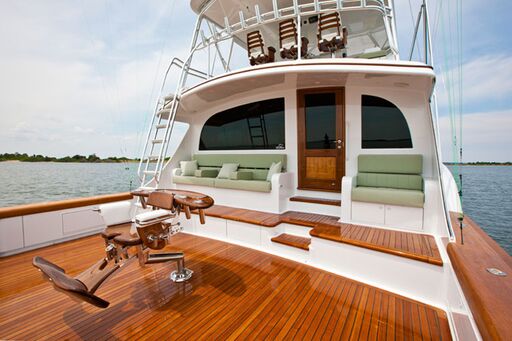
Teak's natural silica and oil content make it uniquely stable and rot-resistant in constant wet exposure, which is why it has been the decking of choice for boat builders for centuries. Those oils resist water absorption and fungal decay, and the wood's fine, straight grain gives a surface that stays grippy underfoot when wet, a safety property that matters on a boat deck. Teak is Class 1 durable under EN 350 and moves very little across seasons.
On luxury residential decks, teak is specified for the same reasons plus its appearance: it weathers to a refined silver-gray or holds a warm honey-brown under oil. For teak's grading in depth, see our teak lumber grades guide, and for restoration of existing teak our Salk Institute teak restoration case study. All of that assumes the boards live up to the species, which is where grade comes in.
FEQ Teak Grade Explained
The single most important teak specification is grade: FEQ (First European Quality) means straight-grained, defect-free, uniform-color heartwood, and it is what separates true marine teak from variable lower grades. Plantation teak and lower grades can carry sapwood, knots, color variation, and less oil, which show up as instability and inconsistent weathering. Because "teak" alone says nothing about grade, the grade and the supplier are what determine quality. Specify the grade, not the species, and most teak surprises disappear. J. Gibson McIlvain, an FSC-certified company, supplies FEQ teak with documented sourcing, the same standard behind the material in the Salk Institute restoration project referenced above. With the grade settled, the next decisions are milling profile and fastening.
| Attribute | Marine / luxury standard |
|---|---|
| Grade | FEQ, First European Quality heartwood |
| Grain | Straight, vertical grain preferred |
| Color | Uniform, no sapwood |
| Profile | Milled to marine deck dimensions, often narrow |
| Sourcing | Documented legal origin, FSC where available |
Teak Decking Milling, Fasteners, and Finish
Marine teak decking is typically milled to narrow widths for stability and laid with caulked seams, while luxury residential teak follows standard decking practice with stainless fasteners. Teak's oils mean adhesives and some finishes need surface preparation, and like other durable hardwoods it can be left to weather gray or maintained with a penetrating oil. J. Gibson McIlvain mills teak to the required marine or residential profile in-house. Milling sets the deck up; weathering decides how it looks in year ten.
Teak Weathering, Non-Slip Surface, and Seam Systems
Teak weathers to a refined silver-gray if left unfinished or holds a honey-brown under oil, and critically, its non-slip character when wet persists as it weathers, which is why it stays the marine safety standard. The natural oils and fine grain that make teak grippy underfoot do not wash out with weathering, so a grayed teak deck remains safe wet. On boats, teak decking is traditionally laid with caulked seams that flex with the deck and shed water, a system distinct from residential decking.
For a marine deck, the seam and caulk system is engineered alongside the wood, and narrow, straight-grained boards keep the seams tight. On luxury residential teak, owners choose between the silver-gray patina and a maintained honey tone with periodic oil. Our Salk Institute teak restoration case study shows how teak recovers even after decades of weathering, and our marine-grade lumber guide covers the wet-exposure detailing. J. Gibson McIlvain mills FEQ teak to marine or residential profiles in-house and ships nationwide. None of this holds, though, unless the wood underneath is genuine teak of the right grade.
Genuine Teak vs. Plantation Teak and Substitutes
Not all "teak" is equal: genuine old-growth Tectona grandis in FEQ grade is the marine standard, plantation teak is younger with more variation and less oil, and several unrelated woods are marketed as teak substitutes. Plantation teak grows faster and can carry more sapwood, wider grain, and lower oil content, which affects stability and the non-slip character that makes teak valuable on a boat. It has its uses, but it is not the same product as FEQ genuine teak. Plantation teak has real uses; a serious marine deck is not one.
Separately, woods like Ipe and afrormosia are sometimes offered as teak alternatives for decks that want teak's look or durability at a different cost, and each has its own properties rather than being teak. The key for a buyer is to specify exactly what is wanted, FEQ genuine teak for a true marine deck, and to buy from a supplier that documents what it sells. Our teak lumber grades guide details the distinctions. J. Gibson McIlvain supplies documented FEQ genuine teak and can advise on alternatives where they fit, shipping nationwide. Once the right teak is on order, ownership comes down to a simple care routine.
How to Maintain a Teak Deck
A teak deck asks little: periodic cleaning, and a choice between letting it silver or maintaining a honey tone with oil, with no film finish to strip because teak's oils reject films. Left natural, teak weathers to a refined gray that many owners prefer and that requires only occasional cleaning. Maintained warm, it takes a periodic penetrating oil after a gentle clean. Either path avoids the strip-and-recoat cycle a film finish would impose. Teak forgives neglect far better than it forgives a film finish.
On a boat, the caulked seams are inspected and maintained as part of the deck system. On a residential teak deck, the routine is simply clean and, if warmth is wanted, oil. Our teak restoration case study shows how far weathered teak can be brought back. J. Gibson McIlvain supplies FEQ teak and can advise on the care routine for the look an owner wants.
Teak Technical Specifications
Genuine teak measures a Janka hardness of about 1,000 to 1,155 lbf and an oven-dry density near 655 kg/m3, moderate figures whose value lies less in raw hardness than in exceptional stability and a Class 1 durability rating under EN 350. Teak's natural oils and silica content give it very low movement, tangential shrinkage around 4 to 5.8 percent green to oven-dry, among the lowest of any commercial hardwood, which is why it stays flat and tight on a moving boat deck. The USDA Forest Products Laboratory documents teak's dimensional stability and decay resistance as benchmarks among durable species.
FEQ teak is kiln-dried to roughly 12 to 15 percent moisture content and milled to narrow marine widths, often 1.5 to 4 inches, to keep caulked seams tight. Its silica content, while abrasive on tooling, contributes to the non-slip surface that persists as the wood weathers. These measured properties, not marketing, are what define marine-grade teak. Teak reaches ASTM E84 Class A flame spread, and documented Forest Stewardship Council sourcing confirms legal origin. J. Gibson McIlvain supplies FEQ teak graded and milled to these specifications, with documented sourcing, shipping nationwide.
Teak Decking Reference Figures
The measured properties that define marine-grade teak, documented in the USDA Wood Handbook and rated under EN 350.
| Property | Value |
|---|---|
| Density (oven-dry) | ~655 kg/m3 |
| Janka hardness | ~1,000 to 1,155 lbf |
| Durability (EN 350) | Class 1 |
| Tangential shrinkage | ~4 to 5.8% (green to oven-dry) |
| Moisture content (kiln-dried) | ~12 to 15% |
| Marine deck widths | ~1.5 to 4 in, caulked seams |
"With teak, the word on the invoice tells you almost nothing. The grade tells you everything. FEQ is straight-grained, all heartwood, consistent color, that is what holds up on a boat deck and that is what a luxury client is paying for. There is a lot of teak out there that is not that. We sell FEQ and we document where it came from, because at this level the provenance is part of the product."
Norm Moton, Director of Sales, J. Gibson McIlvain Company
How J. Gibson McIlvain Would Supply Teak Decking
For J. Gibson McIlvain, a teak decking order is defined by grade first. The team supplies FEQ genuine teak, straight-grained heartwood, milled to the marine or residential profile in-house, with documented legal sourcing and FSC chain-of-custody where available. Because teak is a premium, provenance-sensitive material, the paperwork is treated as part of the deliverable, not an add-on.
For marine work the team mills narrow decking for stability and coordinates the caulked-seam layout; for luxury residential decks it supplies standard decking dimensions. Either way the recommendation leads with FEQ grade, because that is the variable that actually governs how the teak performs and ages.
Performance and Procurement Checklist
| Item | Why it matters |
|---|---|
| Grade | FEQ heartwood is the marine and luxury standard. |
| Grain and color | Straight grain, no sapwood, uniform color. |
| Profile | Narrow marine decking or standard residential. |
| Fasteners and seams | Stainless; caulked seams for marine. |
| Documentation | Legal origin and FSC where available. |
Where Teak Orders Go Wrong
- Buying by species, not grade: "Teak" without FEQ can mean sapwood, knots, and variation.
- Plantation vs FEQ confusion: Lower grades weather and move differently; confirm grade.
- Ignoring provenance: At this price point, documented legal sourcing is expected.
- Wrong profile: Marine decks need narrow, stable widths and seam detailing.
Related J. Gibson McIlvain Guidance and Next Steps
Frequently Asked Questions
Where can I buy genuine teak decking?
Genuine teak decking is supplied by specialty lumber dealers who can guarantee grade and provenance. The grade to specify is FEQ (First European Quality): straight-grained, knot-free, uniform-color heartwood. J. Gibson McIlvain supplies FEQ genuine teak in marine and residential decking profiles, milled in-house, with documented legal sourcing and FSC chain-of-custody where available, shipped nationwide. Grade and source matter more than the species name alone.
What does FEQ teak mean?
FEQ stands for First European Quality, the top grade of genuine teak: straight-grained, free of knots and defects, all heartwood, with uniform color and high oil content. It is the standard for yacht decks and luxury decking because it is the most stable and consistent. Lower grades and plantation teak can include sapwood, knots, and color variation with less oil, which affects stability and weathering, so FEQ is what to specify.
Why is teak used for boat decks?
Teak's high natural oil and silica content give it exceptional dimensional stability and decay resistance in constant wet exposure, and its fine straight grain provides a surface that stays non-slip even when wet, a safety property on a moving deck. It moves very little across seasons and can be left to weather to a silver-gray or maintained with oil. These properties have made teak the marine decking standard for centuries.
Is teak decking worth the cost?
For marine and luxury applications, teak's stability, non-slip wet surface, and refined appearance justify its premium over other tropical hardwoods, and FEQ teak delivers a service life measured in decades with minimal movement. For general residential decking where those specific properties are not required, denser and less costly tropical hardwoods such as Ipe or Cumaru may deliver comparable durability, so teak is best reserved for where its marine and aesthetic qualities matter.
Does teak decking get slippery when it weathers?
No. Teak's non-slip character comes from its natural oils and fine, straight grain, which do not wash out as the wood weathers, so a grayed teak deck remains grippy underfoot when wet. This persistent wet traction is a key reason teak has been the marine decking safety standard for centuries. Whether left to silver-gray or maintained with oil, FEQ teak keeps its slip resistance. J. Gibson McIlvain supplies FEQ teak milled to marine and residential profiles.
How are teak boat decks sealed at the seams?
Traditional teak boat decks are laid with caulked seams that flex with the deck and shed water, a marine system distinct from residential decking, using narrow, straight-grained boards to keep the seams tight and stable. The caulk and seam system is engineered alongside the wood. This is why marine teak is milled narrow and straight-grained. J. Gibson McIlvain mills FEQ teak to marine deck profiles in-house and can coordinate the narrow widths a caulked-seam layout requires.
What is the difference between genuine teak and plantation teak?
Genuine old-growth teak in FEQ grade is straight-grained, defect-free heartwood with high oil content, the marine standard, while plantation teak grows faster and can carry more sapwood, wider grain, and lower oil content, which affects its stability and the non-slip character that makes teak valuable on boats. Plantation teak has uses but is not the same product as FEQ genuine teak. J. Gibson McIlvain supplies documented FEQ genuine teak so buyers know exactly what they are getting.
Are there substitutes for teak decking?
Some woods, such as Ipe and afrormosia, are offered as teak alternatives for decks wanting teak's durability or look at a different cost, but each has its own properties rather than being teak, and none replicates FEQ genuine teak's specific combination of oil content and non-slip marine performance. For a true marine deck, FEQ genuine teak is specified. J. Gibson McIlvain supplies documented FEQ teak and can advise on alternatives where they genuinely fit the application.
How do you maintain a teak deck?
A teak deck needs only periodic cleaning, plus a choice between letting it weather to a silver-gray or maintaining a honey tone with a periodic penetrating oil after a gentle clean. Teak's natural oils reject film finishes, so there is no strip-and-recoat cycle. On boats the caulked seams are also inspected and maintained. J. Gibson McIlvain supplies FEQ teak and can advise on the care routine for either the natural gray or the maintained warm look.
Sources and Standards Referenced
- USDA Forest Products Laboratory - Wood Handbook and Durability
- Forest Stewardship Council - Chain of Custody Certification
- EN 350 - Durability of Wood and Wood-Based Products
- CITES - Convention on International Trade in Endangered Species
- American Wood Council - Wood Construction Standards
- ASTM E84
- USDA Forest Products Laboratory - Wood Handbook (FPL-GTR-282)
- National Hardwood Lumber Association - Grading Rules
- North American Deck and Railing Association
- PEFC - Programme for the Endorsement of Forest Certification